International Journal of Emerging Technology and Advanced Engineering
Website: www.ijetae.com (ISSN 2250-2459, Volume 2, Issue 11, November 2012)505
Data Retrieval from Distributed Data by using Mobile Agents
Mr. Lipte Vishal D.
1,
Ms.Gunjal Baisa L.
2,
Mr.Gore Santosh I.
31Student, M.E. comp.,Sangamner, Maharashtra, India 2Assistant Professor, AVCOE, Sangamner, Maharashtra, India.
3
Sai Info. Solutions, Nasik, Pune. Maharashtra, India.
Abstract - In this paper we have described the process of data retrieval from distributed databases by using mobile agents along with a directory. For some systems data is distributed in different databases .To find data in such environment is costly task because there is need to transfer database from database server to the node where query is generated, this will consume response time, network traffic etc. For reducing these parameters mobile agents are used to fetch data from nodes where database resides. Along with mobile agents we are using directory containing information about data stored in database servers to focus retrieval process. By this search for data is done only in the databases which are containing answer to the query. This paper studies deployment of such multi agent system.
General Terms -Multi agent system, distributed data.
Keywords - Mobile agents, data retrieval
I. INTRODUCTION
In mobile computing environment, users can access information independent of their location [1,2,3,4]. But accessing this information should not restrict mobility of users. From data management point of view, mobile users can handle only fraction of data since mobile devices are having limited resources. The development of low cost and yet portable mobile devices have enabled mobile users to work from anywhere, at anytime. Along with growing technology millions of people are using these devices and through which these are accessing distributed data residing on distributed nodes. So there is need to develop a system which should provide required data to these mobile devices with a minimum use of resources. Nowadays mobile devices are developed to use Internet. These devices are GPRS enabled which provide a way to connect other devices to transfer data or to request data. These devices can be used to access distributed access through GPRS so as to preserve limited resources of these mobile devices. The devices are preserved by using mobile agents. By this technology all the computations are performed at the nodes themselves.
Mobile agent technology is used as a useful and efficient tool for searching and retrieving data in distributed environment where the data is stored at a various nodes of the system [5,6,7,8]. The advantage of mobile agent is that it searches for information instead of users. Mobile agents carry code of execution or query to be fired on database.
They run the query on the database and returns to the node which who had created that agent. This agent carries answer to the query .It is an efficient alternative to transfer data and also it reduces execution time. Thus by using mobile agents we can reduce bandwidth required for operation. In this paper we have implemented query retrieval approach by using directories and multi-agent system.
The Distributed Information Retrieval task deals with the collection of information from multiple and usually heterogeneous information sources that exist in a distributed environment. One way to address these issues is to use information agents. These Distributed Information Retrieval agents should be able to:
accept a request from a human or agent client,
translate this request into a language understood
by the information sources,
identify the information sources that contain
information relevant to the request,
pose the request to these sources,
collect the corresponding results,
process the returned results and
present the results to the client.
II. RELATED WORK
International Journal of Emerging Technology and Advanced Engineering
Website: www.ijetae.com (ISSN 2250-2459, Volume 2, Issue 11, November 2012)506
III. MOTIVATIONSolutions in which there is less transfer of data are generally more efficient. In distributed environment any computations can be moved to a single node and it can be optimized to get good efficiency. When problem to be solved itself is distributed then it is easier to develop solutions to these problems. To search for data in distributed databases is very good example of such type. Multi agent systems are the best way to design distributed computing systems.
IV. TOOL USED IN IMPLEMENTATION
JADE (Java Agent Development Framework) is a middleware for creating mobile agents [17]. It provides graphical tools that facilitates for debugging and development phases. JADE provides agent platform which is used for execution of agents [18,19 ]. Also JADE provides facility that this platform can be distributed across nodes and they can be controlled by remote Graphical User Interface (GUI).JADE provides some other interesting features like distributed agent platform, GUI, debugging tools, intra-platform agent facility and agent sniffer [17].
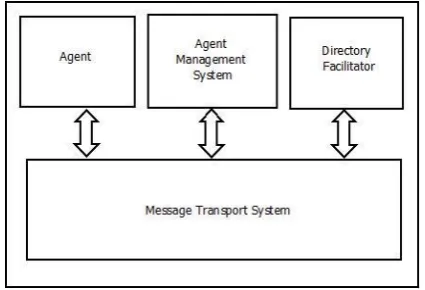
[image:2.595.57.270.609.754.2]JADE classes support the development of agents. It gives syntactical compliance and at some places semantic compliance with FIPA specifications. Fig. 1 shows reference architecture of a FIPA agent platform. Agent Management System (AMS) is the agent which controls access to agent platform and use of the platform. Only one AMS controls whole platform [18]. The AMS provides white page and life cycle service and maintains a directory which contains identifiers and corresponding states of agents. Every agent must have to register itself in order to get a valid Agent Identifier (AID).Without a valid AID agent is considered as malicious agent. The directory facilitator (DF) itself is an agent developed to provide yellow page service in the platform. The Message Transport system is a component controlling all the exchange of messages within the platform and with remote platform.
Fig 1:The Reference architecture of FIPA agent platform
JADE fully complies with FIPA reference architecture. When JADE platform is launched AMS and DF are immediately created. Messaging service is always activated in order to facilitate communication between platforms. Each JVM controls agents that provide a complete environment for agent execution and allows agents to execute simultaneously on the same host.
V. MULTI AGENT SYSTEM
As in distributed databases data is distributed across various nodes, it cannot be accessed directly by search engines, because search engines do not have access to all databases. By using distributed information retrieval distributed databases can be searched. This can be done by using mobile agents and multi agent system.
Agent technology represents one of the most consistent approaches to distributed systems development software agents are executable entities with variable degree of intelligence, autonomy and ability to communicate with each other. Mobility of these agents enables them to move from one node in the network to another. These agents need an environment in which they can execute their tasks. A multi agent system (MAS) represents a programming environment that controls agent’s lifecycle and provides it with all the necessary mechanisms for task execution.
5.1 Features of Homogeneous Non communicating Agents
The simplest multiagent scenarios involve
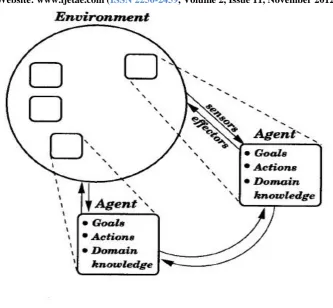
homogeneous non-communicating agents. In this scenario, all of the agents have the same internal structure including goals, domain knowledge, and possible actions. They also have the same procedure for selecting among actions. The only difference among agents is their sensory inputs and the actual actions they take; they are situated differently in the world.
Reactive vs. deliberative agents
Local or global perspective
Modeling of other agents states
How to affect others
Features of Heterogeneous Communicating Agents
Understanding each other
Planning communicative acts
Benevolence vs. competitiveness
Resource management (schedule coordination)
Commitment/decommitment
International Journal of Emerging Technology and Advanced Engineering
Website: www.ijetae.com (ISSN 2250-2459, Volume 2, Issue 11, November 2012) [image:3.595.130.464.125.433.2]507
Fig 3 The general multiagent scenario
5.2 Agent Communication
Traditional inter-process communication is followed in Multi-Agent applications. These mechanisms are too low level for supporting the communication requirements of interacting mobile agents. The reason is that the traditional inter-process communication mechanisms do not consider mobility of interacting entities. Since mobility is a distinguishing feature of mobile agents, the locations where agents are executing at the time of
communication, and the location where actual
communication takes place plays an important role. In the inter-agent communication, mobile agents communicate with one another at a specific location in the system. Either the sender agent, or the receiver agent, or both of the agents need to visit the location to communicate. The inter-agent communication technique as shown Fig 4 involves a coordinator agent (CA) running on coordinator, a search agent (SA) running on database server, for data to be communicated.
But in this work of inter-agent communication, agents communicate with one another independent of the location in the network. A coordinator agent is responsible for a large work, subcontracts various tasks of the work to one or more search agents by negotiation. To implement this efficiently, the coordinator agent and one or more searcher agent(s) communicate with one another.
Fig 4 scenario of agent communication
VI. PROPOSED SYSTEM
[image:3.595.324.549.468.626.2]International Journal of Emerging Technology and Advanced Engineering
Website: www.ijetae.com (ISSN 2250-2459, Volume 2, Issue 11, November 2012)508
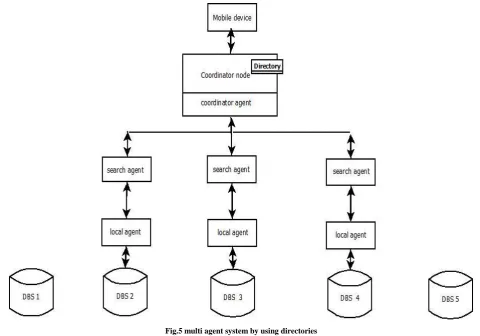
Coordinator agent will check a directory maintained at coordinator node which contains information of domain of data stored in distributed databases. Depending on this coordinator will decide which database servers contain answer to the query. In fig. 5 five nodes are shown. Out of these only two databases contain answer to the query. After finalizing this, coordinator creates as many no. of search agents as that of these databases, in the given figure this no. is three. It will assign query to these agents. After receiving query from coordinator agent search agents move to their respective database servers. One more type of agent is used in the system which is a stationary agent and called as local agent. [image:4.595.56.537.299.635.2]These are present at each node where data resides. Search agent can not directly retrieve data from database as it is not having knowledge about database management system used for database. Local agent is having knowledge about structure of database; it can retrieve data from database. These results are returned to search agent. The same process is repeated in all database servers. Now all search agents will return these retrieved results to coordinator agent. Coordinator agent will collect all these results and perform a simple join operation to get final answer of the query. This answer can be returned to mobile device where query was generated.
Fig.5 multi agent system by using directories
VII. CONCLUSION
This paper presents a study of Multi-agent system usage for the management of distributed databases by which bandwidth network traffic is reduced. Also this approach reduces transfer of data. Multi-agent technology is an alternative approach to the client-server traditional systems.
Mobile agent based approach offers some
advantages, such as scalability of the system, load balancing and low traffic in the network.
International Journal of Emerging Technology and Advanced Engineering
Website: www.ijetae.com (ISSN 2250-2459, Volume 2, Issue 11, November 2012)509
REFERENCES[1 ] S. Acharya, R. Alonso, M. Franklin, S. Zdonik, Broadcast disks: data management for asymmetric communication environments, in: Proceedings of the ACM SIGMOD Conference, CA, 1995. [2 ] R. Alonso, H.F. Korth, Database system issues in nomadic
computing, in: Proceedings of ACM SIGMOD Conference on Management of Data, 1993, pp. 388–392.
[3 ] R. Alonso, S. Ganguly, Query optimisation for energy efficiency in mobile environments, in: Proceedings of the 1993 International Workshop on Foundations of Models and Languages for Data and Objects, Aigen, Austria, 1993. [4 ] Y. Fu, S. Madria, Multi-layered databases for intelligent query
answering in mobile environments, in: International Workshop on Reliable and Secure Applications in Mobile Environments, New Orleans (also invited paper in NSF workshop), October, 2001.
[5 ] S. Fricke, K. Bsufka, J. Keiser, T. Schmidt, R. Sesseler,and S. Albayrak, “Agent-Based Telematic Services and Telecom Applications,” Comm. ACM, vol. 44, no. 4, pp. 43-48, Apr. 2001.
[6 ] M.L. Griss and G. Pour, “Accelerating Development with Agent Components,” Computer, vol. 34, no. 5, pp. 37-43, May 2001. [7 ] D Gavalas, G. Tsekouras, C. Anagnostopoulos, A mobile agent
platform for distributed network and systems management, Journal of Systems and Software 82 (2) (2009) 355–371. [8 ] TainchiLu,Chinghao Hsu,Mobile agents for informationretrieval
in hybrid simulation environment, Journal of Network and Computer Applications 30 (2007) 244–264
[9 ] Brewington B.,et al.,Mobile agents in distributed information retrieval. In:Klusch,M.(ed.) Intelligent Information Agents, pp. 355–395. Springer, Heidelberg (1999)
[10 ] Gray, R.S., Kotz, D., Cybenko, G., Rus, D.: „D‟Agents: Security in a multiple-language, mobile-agent system.In Vigna, G. (ed.) Mobile Agents and Security. LNCS,vol. 1419, pp. 154– 187. Springer, Heidelberg (1998)
[11 ] T.Kawamura,S.Joseph, A. Ohsuga, S. Honiden,Designing multi-agent systems based on pairwise multi-agent interactions, IEICE Transactions on Information Systems E 84-D (8) (2001) 968– 980.
[12 ] S. Papastavrou, G. Samaras, E. Pitoura, Mobile agents for World Wide Web distributed database access, IEEE Transaction on Knowledge Engineering 12 (5) (2000) 802–820.
[13 ] L. Ismail, D. Hagimont, A performance evaluation of the mobile agent paradigm, in: Fourteenth Conference on Object-Oriented Programming, Systems, Languages and Applications (OOPSLA), Denver, November 1999,pp. 306–313.
[14 ] Menczer, F.: Complementing Search Engines with Online Web Mining Agents. Decision Support Systems 35, 195–212 (2003). [15 ] W.Theilmann,K. Rothermel,Optimizing the dissemination of
mobile agents for distributed information filtering, IEEE Concurrency 8 (2) (2000) 53–61.
[16 ] Nguyen, N.T., Ganzha, M., Paprzycki, M.: A Consensus-based Multi-agent Approach for Information Retrieval in Internet. In: Alexandrov, V.N., van Albada,G.D., Sloot, P.M.A.,Dongarra, J.J. (eds.) ICCS 2006.LNCS, vol. 3993, pp. 208–215. Springer, Heidelberg (2006)
[17 ] FIPA,http://www.fipa.org [18 ] JADE, http://jade.tilab.com/.
[19 ] F. Bellifemine, G. Caire, A. Poggi, G. Rimassa, JADE: a software framework for developing multi-agent applications. Lessons learned, Information and Software Technology 50 (1–2) (2008) 10–21.
[20 ] N.R. Jennings and M.J. Wooldridge, Agent Technology Foundations, Applications, and Markets, Berlin, Germany: Springer-Verlag, 1998.
[21 ] M.P. Papazoglou, “Agent-Oriented Technology in Support of EBusiness,” Comm. ACM, vol. 44, no. 4, pp.71-78, Apr. 2001. [22 ] B. Hayes-Roth, L. Brownston, and R. van Gent,“Multiagent
Collaboration in Directed Improvisation,” Readings in Agents, San Francisco: Morgan Kaufmann, M. Huhns and M. Singh, eds., 1997.