Journal of Chemical and Pharmaceutical Research, 2016, 8(4):592-601
Research Article
ISSN : 0975-7384
CODEN(USA) : JCPRC5
Studies on structural, mechanical, NLO and electrical properties of
L-valine cadmium chloride crystals grown with different
concentrations of cadmium chloride
N. Sheen Kumar
1and S. L. Rayar
21Department of Physics, St. Xavier's Catholic College of Engineering, Chunkankadai, Nagercoil - 629 003,
Tamilnadu, India
2Department of Physics, St. Jude's College, Thoothoor - 629 176, Tamilnadu, India
_____________________________________________________________________________________________
ABSTRACT
Singe crystals L-valine cadmium chloride by varying the concentration of cadmium chloride were grown by solution method with slow evaporation technique. Single crystal X-ray diffraction technique reveals that the grown single crystals are crystallizing in the monoclinic structure. Kurtz powder technique was used to test the nonlinear optical (NLO) activity of the samples. A Vickers hardness tester was used to test the mechanical strength of the grown crystals. Dielectric parameters like dielectric constant, dielectric loss and AC conductivity were determined for the grown crystals of different concentration of cadmium chloride added L-valine cadmium chloride and the obtained results are discussed.
Key words: Amino acid complex; single crystal; solution growth; XRD; hardness; dielectric constant; SHG;
conductivity
_____________________________________________________________________________________________
INTRODUCTION
Amino acids are the interesting materials for NLO application as they contain proton donor carboxyl acid (COOH)
this work are LV(CC)0.25 (for 0.25 mole CdCl2), LV(CC)0.50 (for 0.50 mole CdCl2), LV(CC)0.75 (for 0.75 mole CdCl2) and LVCC (for 1 mole CdCl2) and the grown crystals were characterized by studies like structural,
mechanical, NLO and dielectric studies.
EXPERIMENTAL SECTION
Analytical reagent (AR) grade chemicals of L-valine and cadmium chloride (CdCl2) were obtained from Merck India Ltd. Double distilled water was used as the solvent for the growth of L–valine cadmium chloride (LVCC) single crystals. LVCC was synthesized by reaction between L-valine (C5H11NO2) and cadmium chloride and they were taken in the different molar ratios such as 1:0.25 for LV(CC)0.25, 1:0.50 for LV(CC)0.50, 1:0.75 for LV(CC)0.75 and 1:1for LVCC. The calculated amounts of reactants were dissolved in double distilled water and the solution was continuously stirred for an hour maintaining the temperature of 40 ºC. After the condition of saturation was achieved, 0.1 N of HCl was added to the solutions to adjust the pH ~4.5 to 5. The prepared saturated solutions were taken in different growth vessels and the slow evaporation technique was followed to obtain the sample crystals. The growth period was about 30 days and the harvested crystals were observed to be transparent, colourless and non-hygroscopic. It is noticed that the morphology of the LVCC crystals is different when they are grown with different concentrations of cadmium chloride.
RESULTS AND DISCUSSION
3.1 XRD studies
The grown single crystals of LVCC were subjected to single crystal X-ray diffractometer with MoKα radiation of
wavelength λ = 0.717 Å to find the crystal structure. The obtained XRD data for LVCC crystal are a = 10.285 (2) Å, b = 5.622 (3) Å, c = 12.546(2) Å, α = 90o , β = 95.76o , γ = 90o V = 721.78(3) (Å)3. The single crystal XRD data were taken for the samples and it is noticed that the values of lattice parameters for the grown samples are found to be almost the same and the structure is not altered when the concentration of cadmium chloride is changed in the LVCC crystals. The crystal structure for the samples is found to be monoclinic and the space group is observed to be P21. This implies that the crystal systems are non-centrosymmetric which is the primary requirement for a material to be having the second order NLO activity.
3.2 NLO studies
The nonlinear optical (NLO) property of the different concentration of CdCl2. mixed LVCC crystals were confirmed by Kurtz powder technique. The determination of SHG efficiency of the crystal using powder technique was done by Kurtz and Perry [11]. Microcrystalline material of KDP was used as a comparison with the samples for the SHG experiment. The grown crystals were ground to powder and packed between two transparent glass slides. The first harmonic output of 1064 nm from Nd:YAG laser was made to fall normally on the prepared crystal with pulse width of 8 ns, 10 Hz pulse rate and 6.5 mJ energy per pulse. The emission of green radiation from the crystals confirms the existence of second harmonic generation in the crystal. The output power from the different concentration of CdCl2 mixed LVCC crystals were compared to that of KDP crystal and the results are presented in Table 1.
Table 1: SHG efficiency values of different concentration of CdCl2 mixed LVCC single crystals
Sample name SHG efficiency ( compared with KDP)
LVCC0.25 1.32
LVCC0.50 1.61
LVCC0.75 2.06
LVVC 2.57
3.3 Microhardness studies
2 v
H
=
1.854 P / d ,
where d and P is an average length of diagonals in mm and applied load in kg respectively. The plot of variation of Vickers hardness number (Hv) with applied load of different concentration of CdCl2 mixed LVCC crystals are shown in Figure 1. From the plot, it is noted that the hardness number (Hv) of the crystal linearly increases with increasing of load. This indicates the reverse indentation size effect (RISE). Also the hardness value increases with increasing concentration of CdCl2 except LVCC crystal. Using the Meyer’s law P = A dn (where A is the constant and n is the Meyer’s index or work hardening coefficient) [12,13], the work hardening coefficients are found to be 1.627, 1.683, 1.734 and 1.892 respectively for LVCC0.25, LVCC0.50, LVCC0.75 and LVCC crystals respectively.
Figure 1:Dependence of hardness on load for various concentration of cadmium chloride mixed LVCC crystals
3.4 Dielectric Studies
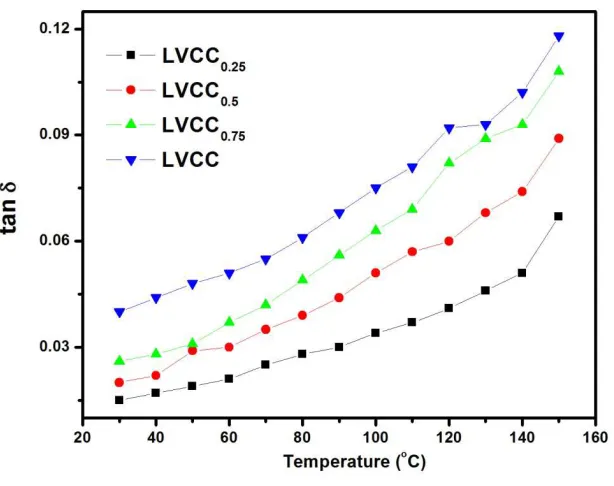
the materials having high dielectric constant. Therefore the grown crystals may be used for high speed electro-optic modulation. Variations of dielectric loss factor with temperature at different frequencies for the samples are shown in the figures 6-9 and from the results, it is observed the dielectric loss factor increases with increase of temperature and decreases with increase of frequency. This indicates the normal behavior of dielectric materials. When the concentration of cadmium chloride in LVCC crystals is varied, the loss factor is observed to be not varying systematically.
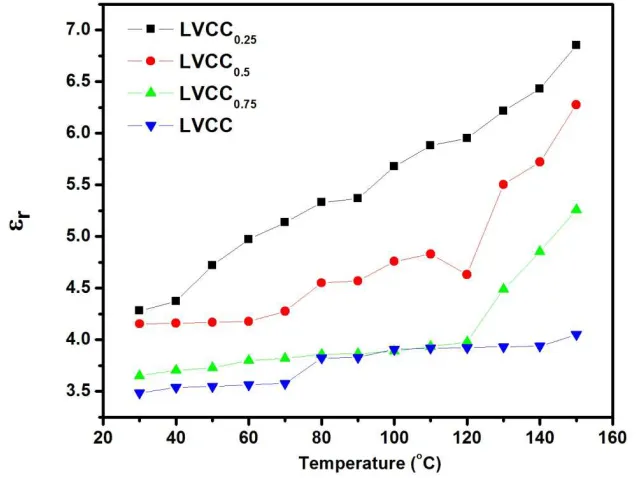
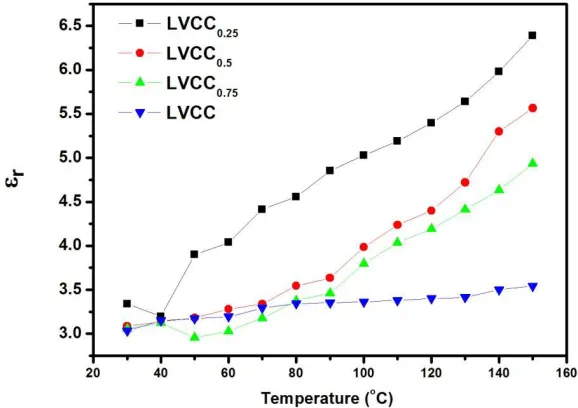
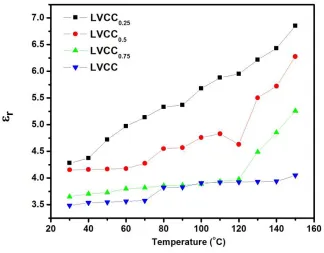
Figure 2: Variation of dielectric constant with temperature for different concentration CdCl2 mixed LVCC crystals at frequency of 1
kHz
[image:4.595.126.444.467.706.2]Figure 4: Variation of dielectric constant with temperature for different concentration CdCl2 mixed LVCC crystals at 100 kHz
Figure 5: Variation of dielectric constant with temperature for different concentration CdCl2 mixed LVCC crystals at frequency of 1
[image:5.595.140.429.405.609.2]Figure 6: Variation of dielectric loss with temperature at 1kHz for LVCC crystals
[image:6.595.123.447.415.668.2]Figure 8: Variation of dielectric loss with temperature at 100 kHz for LVCC crystals
Figure 9: Variation of dielectric loss with temperature at frequency of 1 MHz for LVCC crystals
[image:7.595.136.443.420.663.2]the permittivity of free space, εr is the dielectric constant and tan δ is the dielectric loss. The variations of AC
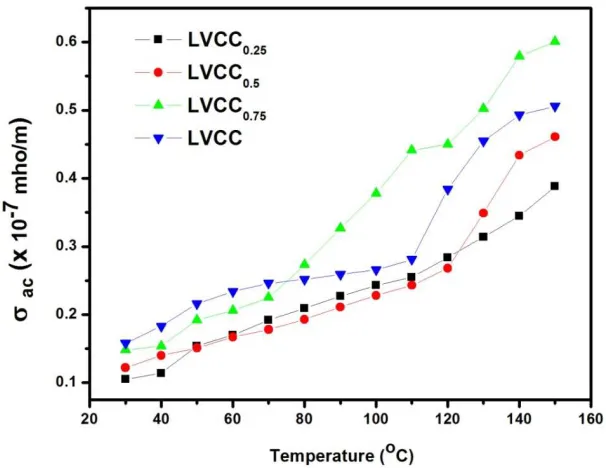
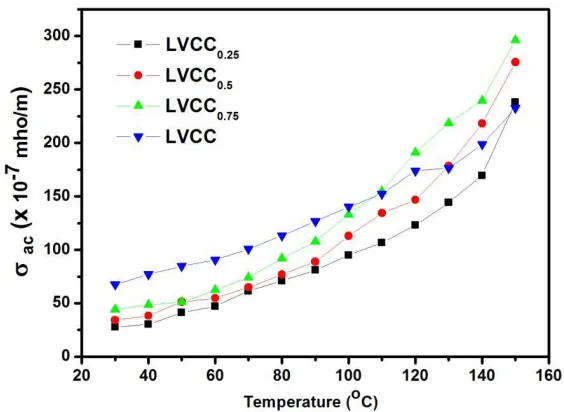
[image:8.595.135.438.190.424.2]conductivity with temperature for the different concentration of CdCl2 mixed LVCC crystals are presented in the figures 10-13. The values of σac increase with both frequency and temperature for the samples. When the temperature of the crystal is increased there is a possibility of weakening of the hydrogen bond. This results in an enhanced conduction in these materials. Since the AC conductivity is directly proportional to dielectric constant, frequency and loss factor, it is observed to be increasing with increase of frequency and temperature.
[image:8.595.127.448.470.695.2]Figure 10: Variation of AC conductivity with temperature at the frequency of 1 kHz for LVCC crystals
Figure 12: Variation of AC conductivity with temperature at the frequency of 100 kHz for LVCC crystals
Figure 13: Variation of AC conductivity with temperature at the frequency of 1 MHz for LVCC crystals
CONCLUSION
[image:9.595.147.429.424.630.2]KDP and the samples are identified to be good second harmonic generators. The dielectric constant and dielectric loss factor were measured using an LCR meter at different temperatures and frequencies and it is observed that these parameters are found to be increasing with increase of temperature and decreasing with increase of frequency. AC conductivity values were determined using the data of dielectric constant and loss factor and these values are observed to be increasing with increase of temperature and frequency. The mechanical parameters such as microhardness number and work hardening coefficient were determined and the grown crystals are found to be mechanically stable.
Acknowledgement
The authors would like to thank supported works from various research institutions to complete this work. Also the authors are grateful to the managements of St. Xavier's Catholic College of Engineering, Chunkankadai, Nagercoil and St.Jude’s College, Thoothoor for the encouragement given to carry out the research work.
REFERENCES
[1]J.J. Rodrigues Jr, N.M. Barbosa Neto, D.T. Balogh, S.C. Zilio ,L. Misoguti, C.R. Mendon, Optics
Communications 216 (2003) 233.
[2]A.S.J. Lucia Rose, P. Selvarajan, S. Perumal, Mater. Chem. Phys. 130 (2011) 950.
[3]L.Misoguti , A.T. Varela , F.D.Nunes,V.S. Bagnato ,F.F.A. Melo, J. Mendes Filho, S.C. Zilio Opt. Mater. 6 (1996) 147.
[4]A.Arivindan, P.Srinivasan, N.Vijayan, R.Goplakrishnan, P.Ramasamy, Spectrochimica Acta Part A , 71 (2008) 297.
[5]K. Vasantha, P.A. Angeli Mary, Spectrochim. Acta Part A, 66 (2007) 637.
[6]D. Rajan Babu, D. Jayaraman, R. Mohan Kumar, R. Jayavel, J. Crystal Growth 245(2002) 121. [7]C. Justin Raj, S. Jerome Das, J. Crystal Growth 304 (2007) 191.
[8]C. Ramachandra Raja,G. Gokila, A. Antony Joseph, Spectrochimica Acta Part A 72(2009) 753. [9]D. Prabha, S. Palaniswamy, Int. J. Chem. Environ. Pharma. Res. 1(2010)54.
[10]P. Maadeswarana, J. Chandrasekaran, Optik 122 (2011) 1128.
[11]S.K.Kurtz, T.T.Perry, J.Appl.Phys. 39 (1968) 3798.