Copyright © 2018 Nabeel Naeem Hasan Almaalei et al. This is an open access article distributed under the Creative Commons Attribution License, which permits unrestricted use, distribution, and reproduction in any medium, provided the original work is properly cited.
International Journal of Engineering & Technology
Website: www.sciencepubco.com/index.php/IJET doi: 10.14419/ijet.v7i4.22201
Research paper
An efficient algorithm to improve oil-gas pipelines path
Nabeel Naeem Hasan Almaalei 1 *, Siti Noor Asyikin Mohd Razali 1, Nayef Abdulwahab Mohammed Alduais 1
1 Department of Mathematics and Statistics, Faculty of Applied Sciences and Technology, Universiti Tun Hussein Onn Malaysia, Pagoh
Education Hub, 84600 Pagoh, Johor, Malaysia *Corresponding author E-mail:[email protected]
Abstract
Oil-gas pipeline is a complex and high-cost system in terms of materials, construction, maintenance, control, and monitoring in which it involves environmental, economic and social risk. In the case study of Iraq, this system of pipelines is above the ground and is liable to accidents that may cause environmental disaster, loss of life and money. Therefore, the aim of this study is to propose a new algorithm to obtain the shortest path connecting oil-gas wells and addressing obstacles that may appear on the path connecting any two wells. In order to show the efficiency of the proposed algorithm, comparison between ant colony optimization (ACO) algorithm and a real current meth-od of linking is used for this purpose. Result shows that the new proposed algorithm outperformed the other methmeth-ods with higher reduc-tion in operareduc-tional cost by 16.4% for a number of 50 wells. In addireduc-tion, the shortest path of connecting oil-gas wells are able to overcome all the addressed obstacles in the Rumaila north field, which is located in the city of Basra in southern Iraq.
Keywords: Shortest Path Algorithm; Ant Colony Optimization; and Oil-Gas Assembly Pipeline.
1.
Introduction
Oil is a crucial source of energy. It is used in many industries, transportations and electricity supplies. The oil is transferred from the oil fields to the main stations (oil refineries) that requires a network of pipes which includes a number of valves and pipes of different diameters and pumping stations. When oil passes through the pipelines, there occurs a loss of 3% of the total oil due to the evaporation process since the oil pipelines carry large quantities of oil. The oil pipelines are used to transport (import and export) petroleum products between different cities around the world with about 17.95 million barrels per day [1]. This has led to the devel-opment of large and extensive design as well as operations of pipelines which have become more complex in recent years [2]. The main issue discussed in this paper is using the proposed algo-rithm to find the shortest path that links the oil wells with the gathering facilities, hence, obtaining the least cost for the work of the oil-gas pipeline network.
In the past years, some optimization algorithms have been used such as the ant colony optimization algorithm (ACO) [3], the par-ticle swarm algorithm (PSO) [4], and the genetic algorithm (GA) [5] which was applied to improve the oil-gas pipeline network. In 1992, PhD study by [3] used ACO for the first time to solve the travelling salesman problem. The algorithm was then developed and applied to solve many other problems such as vehicle routing problem [6], quadratic assignment problem (QAP)[7], scheduling problem [8], data encoding in telecommunication systems [9], garbage collection problem [10], network model problem [11], protein folding problem [12], personal placement in airline com-panies [13], and job-shop scheduling problem [14]. Besides that, it has been successfully applied in finding the best solution for the complex problem in life such as the design of large communica-tion networks, the scheduling of traffic in major cities as well as creating the ideal locations and stores of energy plants [15]. Previous Related Works
design a pipeline path with algorithms to generate obstacles [22]. Chart technique was utilized to display a unique system to assess the supply dependability in natural gas pipeline systems where lists of the client part are partitioned into three viewpoints: likeli-hood, ampleness and time. The composed structure incorporates strategies to tend the issues from alternate point of view in regards of the ecological, utilitarian requirement, topology and dynamics. Apart from that, the graph theory technique was utilised to evalu-ate the supply of natural gas pipeline systems, and analyses the results in detail. From a practical point of view, the methodology may aid engineers and managers in estimating safety margins to serve costumers reliably [23]. The common problem that exists in the design of the pipeline networks are to handle obstacles such as bridge, river, lake, residential areas and private properties. Remov-ing or circumventRemov-ing obstacles is considered an additional cost on the basic project. Thus, this study presents an algorithm for find-ing an alternative to avoid these obstacles, and at the same time in finding the shortest path.
2.
A new proposed algorithm
This study proposes a new algorithm for oil-gas pipeline problem that is capable in avoiding all the obstacles addressed in the real situation. In this section, we present the following mathematical model:
(1)
Where represents the length of the pipe connecting two wells (km) and represents the cost of one pipe per km. We now have the following definitions.
Definition 1: There exists an obstacle between two wells, , if the link between them is null as defined in (2) below. In this case, the distance between is zero as stated in (3).
(2)
(3)
Definition 2:The distance between is zero for the same well given by
(4)
Definition 3: The connection between two wells, , is possible in one direction only given by:
(5)
The distance between defined in (5) is given by
(6)
We present the new proposed algorithm as below which is pro-grammed using MATLAB software.
Pseudocode for New Proposed Algorithm
1) Inputs : // Location Table for all wells 2) Output:
3) Begin:
4) Calculate 5) For Do // i=1, 2,n ; 6) For Do
7) If Obstacles(i,j) == 1 THEN 8)
9) ELSE 10) D(i,j)=
11) End IF 12) Next 13) Next
14) For Do
15) Determine Short path for Well ( ). 16) SET
17) S_ID = ,
18) SET Well( ).Links= S_ID
19) SET
20) SET 21) Z =
22) SET
23) 24) NEXT 25) END Algorithm
3.
Shortest path theory
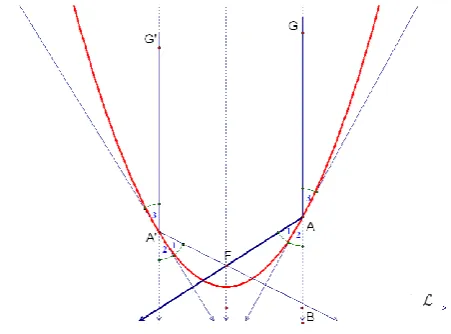
Given two points, A and B, on one side of a line, find C which is a point on the straight line that minimizes AC + BC. Here is the mathematical approach used by Heron. He noticed that if B is reflected across the line, to some point B’, then for any point C on the line, |CB|=|CB’|, and hence minimizing |AC|+|CB| is equiva-lent to minimizing |AC|+|CB’| . The shortest path from A to B’ is a straight line, so the point C that minimizes |AC|+|CB’| should be on the line AB’. Any other position of C will increase |AC|+|BC|.
In addition, because C is at an equal angle to B and B’. Also, since these are vertically opposite angles. Therefore, . This is the equal angle law of reflection. It was Euclid who, over three hundred years earlier, had noted the now well-known Reflection Law for light:
“Euclid's Law of Reflection states that if a beam of light is sent towards a mirror, then the angle of incidence equals the angle of reflection”.
This, as we have found, is true when the value of |AC|+|BC| is at its lowest, so light always takes the shortest path!
An interesting application of the Law of Reflection arises in the case of a light beam sent towards a parabolic mirror, where the light beam is parallel to the axis of the parabola. A parabolic mir-ror is one whose surface is generated by rotating a parabola about
its axis. Suppose the parabola has focus F and directrix , and that the light beam hits the parabola at A. Recall from Roberval's construction of tangent lines to parabolas that the tangent line
at A bisects the angle . Hence .
Since and are vertical angles, then . Hence,
. So by the Equal Angle Law of Reflection, the light beam will be reflected in the direction . This will be true for any point A on the parabola.
4.
Ant colony algorithm
The ACO algorithm is an exploratory method capable of solving complex problems by looking for optimal solutions in the graphs within a range of possibilities. This algorithm mimics the natural behavior of the ants in the search for food where ants come out to find food, and when it does, a chemical known as pheromone is released on the way back to the colony. The rest of the ants will pick up the scent and follows the same path. The more ants follow the path, the greater the concentration of the pheromone, which causes the long path to disappear as this material rapidly evapo-rates. In the end, there is only one path followed by the ants, which is the shortest path. On this basis, this algorithm is chosen for comparison purpose with the proposed algorithm.
The standard ACO rule mentioned in (7):
(7)
Where:
: The number of ant , at node i.
: The probability with which ant k chooses to move from node i to node j,
: The amount of pheromone along the transition from node to
: The parameter that controls the influence of ,
: The desirability of node transition (a priori knowledge, typi-cally 1/ dij, where is the distance),
: A parameter that controls the influence of ,
: represents the attractiveness and trail level for the other possible node transitions.
Pheromone update.
When all the ants have completed a solution, the trails are updated by:
(8)
With
(9)
Where
: The cost of the ant’s tour, : a constant.
Now, we present the steps in ACO which is written in MATLAB software.
Pseudo code for ACO Algorithm
1) Inputs : // Location Table for all wells 2) Output:
3) Begin:
4) Calculate 5) For
6) For
7) ant(k).Tour=randi([1 nVar]); 8) for l=2:nVar
9) i=ant(k).Tour(end);
10) P=tau(i,:).^alpha.*eta(i,:).^beta; 11) P(ant(k).Tour)=0;
12) P=P/sum(P);
13) j=RouletteWheelSelection(P); 14) ant(k).Tour=[ant(k).Tour j] 15) end
16) ant(k).Cost=CostFunction(ant(k).Tour); 17) if ant(k).Cost<BestSol.Cost
18) BestSol=ant(k); 19) end
20) end
21) Update Phromones 22) for k=1:n Ant 23) tour=ant(k).Tour; 24) tour=[tour tour(1)]; %#ok 25) for l=1:nVar
26) i=tour(l); 27) j=tour(l+1);
28) tau(i,j)=tau(i,j)+Q/ant(k).Cost; 29) end
30) end 31) NEXT 32) END Algorithm
5.
Results
[image:3.595.59.291.62.189.2]a) Ant colony algorithm
Table 1 below shows the number of oil-gas wells and the best cost for constructing a pipeline network connecting these wells, as well as the execution time by the ACO algorithm to reach the results as shown in Figures 1-5.
The table below shows the execution time for the algorithm using the MATLAB program, the best cost and different number of wells using ACO algorithm.
Table 1:
[image:3.595.61.287.354.521.2]wells second) 10 3.535363320166086e+04 19.48 20 4.588008572572926e+04 22.85 30 5.971085544455865e+04 26.29 40 6.669880728808713e+04 29.62 50 7.610282208287528e+04 32.97
Figure 1 shows the shortest path linking the locations of 10 oil wells, without obstacles. Assuming the total cost of constructing oil-gas assembly pipelines by length 1 km and diameter 5" is $100,000.
Fig. 1: Shortest Path for 10 Wells without Obstacles.
Figure 2 shows the shortest path linking the locations of 20 oil wells, without obstacles.
Fig. 2: Shortest Path for 20 Wells without Obstacle.
Figure 3 shows the shortest path linking the locations of 30 oil wells, without obstacles.
Fig. 3: Shortest Path for 30 Wells without Obstacles.
Figure 4 shows the shortest path linking the locations of 40 oil wells, without obstacles.
Fig. 4: Shortest Path for 40 Wells without Obstacles.
Figure 5 shows the shortest path linking the locations of 50 oil wells, with obstacles.
Fig. 5: Shortest Path for 50 Wells with Obstacles.
b) A new proposed algorithm
Table 2 below shows the various number of oil-gas wells and the best cost for constructing a pipeline network connecting these wells, as well as the execution time by the new proposed algo-rithm to reach the results as shown in Figures 6-10.
The table below shows the execution time for the algorithm using the MATLAB program, the best cost, and various number of wells using the new proposed algorithm.
Table 2:
No. of
wells Best cost ($)
Execution time (in second)
10 2.830483810509105e+04 0.643 20 2.231077578819970e+04 1.629 30 0.394613729618506e+05 2.125 40 0.423122375499187e+05 2.265 50 0.498650479761757e+05 2.781
Fig. 6: Shortest Path for 10 Wells without Obstacles.
Figure 7 shows the shortest path linking the locations of 20 oil wells, without obstacles.
Fig. 7: Shortest Path for 20 Wells without Obstacles.
Figure 8 shows the shortest path linking the locations of 30 oil wells, without obstacles.
Fig. 8: Shortest Path for 30 Wells without Obstacles.
Figure 9 shows the shortest path linking the locations of 40 oil wells, without obstacles.
Fig. 9: Shortest Path for 50 Wells without Obstacles.
Figure 10 shows the shortest path linking the locations of 50 oil wells, without obstacles.
Fig. 10: Shortest Path for 50 Wells without Obstacles. c) Comparison of results
In this section, we present the detailed simulation study that tests the performances of the proposed algorithm and ACO algorithm. The performance metric reduces the construction cost for oil-gas pipelines with MATLAB being used to write the code for the pro-posed algorithm. The evaluation is done based on numerous sce-narios.
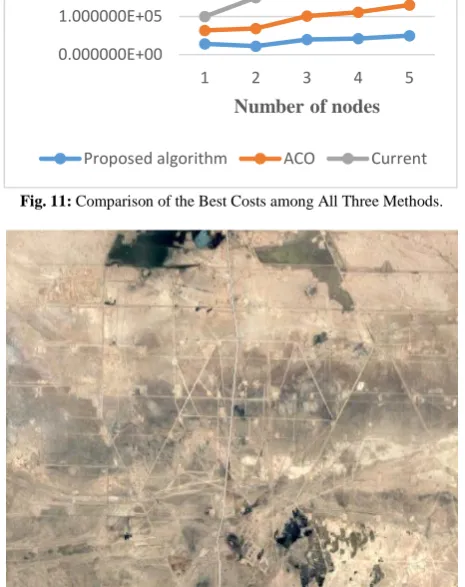
In Table 3 below, we show the number of wells and the best cost for three different methods which comprises of the new proposed algorithm, ACO algorithm, and a real current linking method. In addition, Figure 11 shows the superiority of the new proposed algorithm to the rest of the methods.
A comparison between the new proposed algorithm, ACO algo-rithm and the real current method of linking which shows that the higher the number of nodes, the greater the cost reduction which is clearly shown by the proposed algorithm.
Table 3:
No. of wel ls
Proposed Method
($) ACO Method ($) Current Method ($)
10 2.83048381050910 5e+04
3.53536332016608 6e+04
3.58346457762076 0e+04
20 2.23107757881997 0e+04
4.59678827052390 3e+04
8.11987395451890 0e+04
30 0.394613729618506e+04 0.612561509905572e+05 1.608440331710942e+05
40 0.42312237549918 7e+04
0.68819859812960 1e+05
2.22338636587100 8e+05
50 0.49865047976175 7e+04
0.80192081345371 2e+05
Figure 11 shows that the new proposed algorithm is able to search for optimal solution that minimizes the operational cost of oil-gas pipeline problem. Nonetheless, the reduction in operational cost will highly benefit the management in future.
Fig. 11: Comparison of the Best Costs among All Three Methods.
Fig. 12: Some Oil-Gas Wells Which were Involved in This Study Situated in the Northern Rumaila Oil Field, Iraq.
6.
Conclusion
The optimal design of the oil-gas pipeline is very difficult due to it being complex and diverse. The application of the traditional methods in improving the oil-gas pipeline system are challenging as well as time-consuming. Thus, the intelligent optimization has been widely used. In this study, the new proposed algorithm was applied which is based on finding the shortest path that links the gas wells to the assembly plant. The improvement of the oil-gas pipeline network has been undertaken, taking into considera-tion the obstacles, the cost of operaconsidera-tion as well as construcconsidera-tion.
Acknowledgement
Authors would like to thank Universiti Tun Hussein Onn Malaysia (UTHM) and Department of Security Staff UTHM for kindly providing us with the internal funding.
References
[1] Bast H, Funke S, Sanders P, and Schultes D (2007), Fast routing in road networks with transit nodes. Science , 316 (5824), 566. https://doi.org/10.1126/science.1137521.
[2] Chan T (2010), More algorithms for all-pairs shortest paths in weighted graphs. SIAM J. Comput. 39(5), 590-598. https://doi.org/10.1137/08071990X.
[3] Maniezzo V (1996), Ant System: Optimization by a Colony of Cooperating Agents. IEEE Trans. Syst. Man Cybern. B 26(1), 1–13. [4] Eberhart R and Kennedy J (1995), A new optimizer using particle swarm theory. MHS’95. Proc. Sixth Int. Symp. Micro Mach. Hum. Sci., 39–43. https://doi.org/10.1109/MHS.1995.494215.
[5] Goldberg DE and Holland JH (1988), Genetic Algorithms and Machine Learning. Mach. Learn. 3(2), 95–99. https://doi.org/10.1023/A:1022602019183.
[6] Pillac V, Gendreau M, Guéret C and Medaglia AL (2011), A Review of Dynamic Vehicle Routing Problems. Cirrelt-2011-62, 225(1), 0–28.
[7] Dorigo M, Maniezzo V and Colorni A (1991), Positive feedback as a search strategy. Tech. Rep. no. 91-016.
[8] Vitekar KN (2013), Review of Solving Software Project Scheduling Problem with Ant Colony Optimization, IJAREEIE 2(4), 1177–1182.
[9] Yu-Hsin Chen G (2013), A new data structure of solution representation in hybrid ant colony optimization for large dynamic facility layout problems. Int. J. Prod. Econ. 142(2), 362–371. https://doi.org/10.1016/j.ijpe.2012.12.012.
[10] Kuo RJ, Zulvia FE and Suryadi K (2012), Hybrid particle swarm optimization with genetic algorithm for solving capacitated vehicle routing problem with fuzzy demand – A case study on garbage collection system. Appl. Math. Comput. 219(5), 2574–2588. https://doi.org/10.1016/j.amc.2012.08.092.
[11] Tsuji Y, Kuroda M, Kitagawa Y and Imoto Y (2012), Ant Colony Optimization approach for solving rolling stock planning for passenger trains, IEEE/SICE Int. Symp. Syst. Integr., 716–721. [12] Aimoerfu, Shi M, Li C, Wang D and Hairihan (2017),
Implementation of the protein sequence model based on ant colony optimization algorithm. IEEE/ACIS 16th Int. Conf. Comput. Inf. Sci., 661–665. https://doi.org/10.1109/ICIS.2017.7960075. [13] Suresh LP, Dash SS and Panigrahi BK (2015), Artificial
Intelligence and Evolutionary Algorithms in Engineering Systems.
Adv. Intell. Syst. Comput. 325, 275–284.
[14] Anitha Rao and Sandeep Kumar Hegde (2015), Literature Survey On Travelling Salesman Problem Using Genetic Algorithms. Int. J. Adv. Res. Eduation Technol. 2(1), 4.
[15] Salama KM.and Freitas AA (2013), Learning Bayesian network classifiers using ant colony optimization. Swarm Intell. 7(2–3), 229–254. https://doi.org/10.1007/s11721-013-0087-6.
[16] Orlin JB, Madduri K, Subramani K, and Williamson M (2010), A faster algorithm for the single source shortest path problem with few distinct positive lengths. J. Discret. Algorithms 8(2), 189–198. https://doi.org/10.1016/j.jda.2009.03.001.
[17] Williams VV (2010), Nondecreasing paths in a weighted graph.
ACM Trans. Algorithms 6(4), 1–24. https://doi.org/10.1145/1824777.1824790.
[18] Carter RGG, Gablonsky JM, Patrick A, Kelley CT and Eslinger OJ (2001), Algorithms for Noisy Problems in Gas Transmission Pipeline Optimization. Optim. Eng. 2(2), 139–157. https://doi.org/10.1023/A:1013123110266.
[19] A. Cano-Acosta, J. Fontecha, N. Velasco, and F. Muñoz-Giraldo, “Shortest path algorithm for optimal sectioning of hydrocarbon transport pipeline,” IFAC-PapersOnLine, vol. 49, no. 12, pp. 532– 537, 2016.
[20] Cano-Acosta A, Fontecha J, Velasco N and Muñoz-Giraldo F (2016), Shortest path algorithm for optimal sectioning of hydrocarbon transport pipeline. IFAC-Papers OnLine 49(12), 532– 537. https://doi.org/10.1016/j.ifacol.2016.07.686.
[21] Xu MH (2007), An improved Dijkstra ’ s shortest path algorithm for sparse network q. Appl. Math. Comput. 185(1), 247–254. https://doi.org/10.1016/j.amc.2006.06.094.
[22] Chu F and Chen S (2012), Optimal Design of Pipeline Based on the Shortest Path, Phys. Procedia 33, 216–220. https://doi.org/10.1016/j.phpro.2012.05.054.
[23] Kang JY and Lee BS (2017), Optimisation of pipeline route in the presence of obstacles based on a least cost path algorithm and laplacian smoothing. Int. J. Nav. Archit. Ocean Eng. 9(5), 492– 498. .https://doi.org/10.1016/j.ijnaoe.2017.02.001. 0.000000E+00 1.000000E+05 2.000000E+05 3.000000E+05 4.000000E+05 5.000000E+05
1 2 3 4 5
B
est
Co
st
Number of nodes Comparison of the final costs of the
three methods
[24] Su H, Zhang J, Zio E, Yang N, Li X and Zhang Z (2018), An integrated systemic method for supply reliability assessment of natural gas pipeline networks. Appl. Energy 209 (May 2017), 489– 501. https://doi.org/10.1016/j.apenergy.2017.10.108.