Journal of Chemical and Pharmaceutical Research, 2018, 10(2):20-24
Research Article
CODEN(USA) : JCPRC5
ISSN : 0975-7384
20
Formulation and Evaluation of Sustained Release Granules of Nitazoxanide
Rashmi Dahima
*School of Pharmacy, Devi Ahilya Vishwavidyalaya, Indore, Madhya Pradesh, India _____________________________________________________________________________
ABSTRACT
The advantages of controlled release products are well known in the pharmaceutical field and include the ability to maintain a desired blood level of a medicament over a comparatively longer period of time. While many oral controlled and sustained release formulations are already known, certain drugs that are relatively insoluble in water and which further have relatively high dose requirements (based on weight) present formulation difficulties which render them unsuitable for inclusion in sustained release formulations. Nitazoxanide, a high dose, water insoluble antiprotozoal drug, is commercially available as immediate release dosage form. There is still a need in the art of formulation of sustained release dosage forms to formulate insoluble antiprotozoal that have enhanced bioavailability and provide suitable release profiles of the drug. The study was undertaken with the aim to formulate and evaluate Nitazoxanide sustained release granules using HPMC grades of polymer as retarding agent. These granules were coated with beeswax/cetyl alcohol. The in vitro dissolution studies were carried out with granules equal to 500 mg drug, using USP apparatus type I (Basket) at 100 rpm. Using 750 ml of 0.1N hydrochloric acid for the first 2 hours followed by 1000 ml of phosphate buffer pH 6.8 from 3 to 24 hours, medium maintained at 37°C ± 0.5°C. A sustained release profile was shown up to 24 hrs. The slope value of more than 0.7, however, appears to indicate a coupling of diffusion and erosion mechanisms – so called anomalous diffusion.
Keywords: Controlled release; Sustained release; Oral; Nitazoxanide; Antiprotozoal
_____________________________________________________________________________
INTRODUCTION
Two aspects most important to a drug delivery are spatial placement and temporal delivery of a drug. Spatial placement relates to targeting a drug to a specific organ or tissue, while temporal delivery refers to controlling the rate of drug delivery to the target tissue [1]. Conventional (immediate release) pharmaceutical dosage forms now in use are unable to control either the rate or site specific drug delivery. Immediate release from a conventional dosage form employs that absorption of drug across a biological membrane is the rate limiting step in the delivery of the drug to its target area. For non-immediate release dosage forms the release of the drug from the dosage form is the rate limiting step. The effort to develop a non-immediate release delivery system must be directed primarily at altering the release rate [2].An appropriately designed controlled release drug delivery system can be a major advance toward solving the problems of spatial placement and temporal delivery [1]. Sustained release dosage forms are designed to achieve a prolonged therapeutic effect by continuously releasing medication over an extended period of time after administration of a single dose [3]. Key advantages to the use of this technology are prolonged activity, fewer doses, control on fluctuations, fewer side effects and reduced toxicity [4]. The principle method of granulation may be classified into three main categories viz., wet process (wet massing, fluid bed granulation, spray drying, pan granulation and extrusion and pelleting), dry process (roller compaction and slugging) and other processes (humidification, prilling and melt pelletization) [5].
Nitazoxanide (C12H9N3O5S; mol. wt.=307.283 g/mol) is an antiparasitic drug used in the treatment of amoebiasis,
21
Nitazoxanide is a prodrug forming short lived redox active intermediate. Upon oral administration it is rapidly converted by esterases to an active metabolite, tizoxanide; parent compound is not detected in the plasma. The peak serum concentration is reached within 1-4 hours. In plasma, more than 99% of tizoxanide is bound to proteins. Tizoxanide has an elimination half-life of 1-1.6 hours. Only small amounts of tizoxanide are recovered in urine, bile and faeces [6-13].
EXPERIMENTAL METHOD
Preparation of Granules
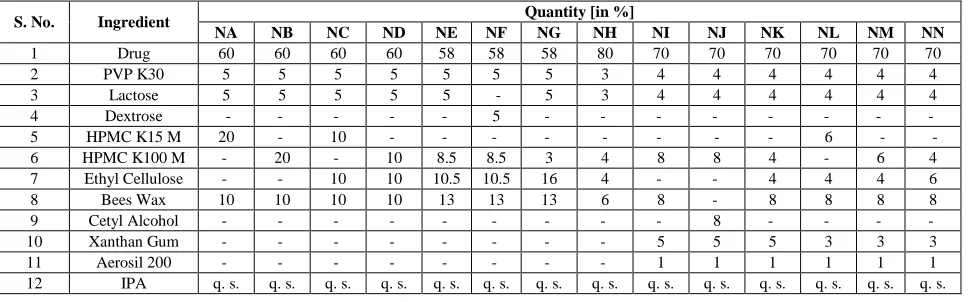
Granules of Nitazoxanide with the selected excipients were prepared by wet granulation method. All the ingredients were separately passed through sieve of 60 mesh size. According to the formula, the selected excipients and drugs for particular batch formulation were weighed accurately and were poured in a polythene bag in geometric dilution manner. All the ingredients were then blended uniformly for 10 minutes and then sufficient volume of isopropyl alcohol was added drop by drop with continuous mixing. The wet mass was passed manually through sieve of 44 mesh size to form the granules. These wet granules were dried at room temperature for 24 hours and after drying coating was done with bees wax/acetyl alcohol (Table 1).
[image:2.612.66.552.324.475.2]For coating, granules were placed in molten wax/acetyl alcohol and were uniformly mixed for 5 minutes under elevated temperature. The temperature was then reduced and slow mixing was continued until room temperature was reached. These coated granules were passed through sieve of 22 mesh size to yield uniform granules. The preparations were stored in air tight containers at room temperature for further study.
Table 1: Concentration of ingredients in different batches for approximation of sustained release formulation
S. No. Ingredient Quantity [in %]
NA NB NC ND NE NF NG NH NI NJ NK NL NM NN
1 Drug 60 60 60 60 58 58 58 80 70 70 70 70 70 70
2 PVP K30 5 5 5 5 5 5 5 3 4 4 4 4 4 4
3 Lactose 5 5 5 5 5 - 5 3 4 4 4 4 4 4
4 Dextrose - - - - - 5 - - - -
5 HPMC K15 M 20 - 10 - - - - - - - - 6 - -
6 HPMC K100 M - 20 - 10 8.5 8.5 3 4 8 8 4 - 6 4
7 Ethyl Cellulose - - 10 10 10.5 10.5 16 4 - - 4 4 4 6
8 Bees Wax 10 10 10 10 13 13 13 6 8 - 8 8 8 8
9 Cetyl Alcohol - - - 8 - - - -
10 Xanthan Gum - - - 5 5 5 3 3 3
11 Aerosil 200 - - - 1 1 1 1 1 1
12 IPA q. s. q. s. q. s. q. s. q. s. q. s. q. s. q. s. q. s. q. s. q. s. q. s. q. s. q. s.
Evaluation of Granules
Prepared sustained release granules were evaluated for Angle of Repose, Bulk Density, Compressibility Index, Drug Content and Dissolution Studies.
For Drug Content, an accurately weighed amount of powdered drug granules (100 mg) was extracted with methanol and the solution was filtered through 0.45 µ filter. The absorbance was measured at 414 nm after suitable dilution with phosphate buffer pH 6.8. Further calculations were done with reference to the calibration curves.
In vitro Release Studies
The in vitro dissolution studies were carried out with granules equal to 500 mg drug, using USP apparatus type I (Basket) at 100 rpm. Using 750 ml of 0.1 N hydrochloric acid for the first 2 hours followed by 1000 ml of phosphate buffer pH 6.8 from 3 to 24 hours, medium maintained at 37°C ± 0.5°C. A 1 ml sample was withdrawn at appropriate time interval and it was replaced with fresh dissolution medium.
22
RESULT AND DISCUSSION
Micromeritic Properties
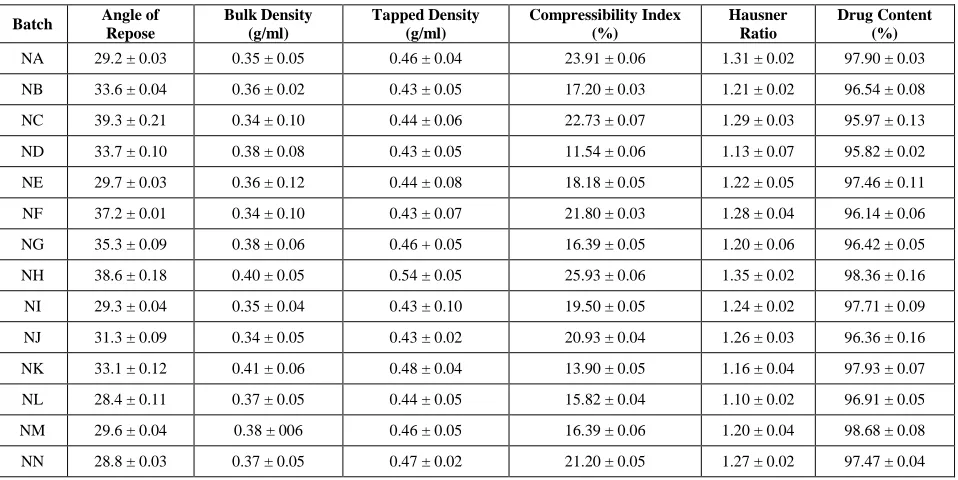
Table 2 displays the micromeritic properties of the granules. Batches NA, NE, NI, NL, NM and NN show angle of repose <30°. Batches NA, NC, NF, NH, NJ and NN show compressibility index >20% showing poor flow properties. The BD ranges from (0.34 ± 0.10) to (0.41 ± 0.06) while the TD ranges from (0.43 ± 0.10) to (0.54 ± 0.05), for free flow property, the bulk density and tapped density should be close in value. The Hausner ratio for
[image:3.612.68.547.195.435.2]batches NA, NC, NF, NH and NN were >1.26 showing poor flow. The drug content ranges from (95.82 ± 0.02) to (98.68 ± 0.08), this shows a high degree of drug content uniformity among different batches.
Table 2: Evaluation of granules
Batch Angle of Repose
Bulk Density (g/ml)
Tapped Density (g/ml)
Compressibility Index (%)
Hausner Ratio
Drug Content (%)
NA 29.2 ± 0.03 0.35 ± 0.05 0.46 ± 0.04 23.91 ± 0.06 1.31 ± 0.02 97.90 ± 0.03
NB 33.6 ± 0.04 0.36 ± 0.02 0.43 ± 0.05 17.20 ± 0.03 1.21 ± 0.02 96.54 ± 0.08
NC 39.3 ± 0.21 0.34 ± 0.10 0.44 ± 0.06 22.73 ± 0.07 1.29 ± 0.03 95.97 ± 0.13
ND 33.7 ± 0.10 0.38 ± 0.08 0.43 ± 0.05 11.54 ± 0.06 1.13 ± 0.07 95.82 ± 0.02
NE 29.7 ± 0.03 0.36 ± 0.12 0.44 ± 0.08 18.18 ± 0.05 1.22 ± 0.05 97.46 ± 0.11
NF 37.2 ± 0.01 0.34 ± 0.10 0.43 ± 0.07 21.80 ± 0.03 1.28 ± 0.04 96.14 ± 0.06
NG 35.3 ± 0.09 0.38 ± 0.06 0.46 + 0.05 16.39 ± 0.05 1.20 ± 0.06 96.42 ± 0.05
NH 38.6 ± 0.18 0.40 ± 0.05 0.54 ± 0.05 25.93 ± 0.06 1.35 ± 0.02 98.36 ± 0.16
NI 29.3 ± 0.04 0.35 ± 0.04 0.43 ± 0.10 19.50 ± 0.05 1.24 ± 0.02 97.71 ± 0.09
NJ 31.3 ± 0.09 0.34 ± 0.05 0.43 ± 0.02 20.93 ± 0.04 1.26 ± 0.03 96.36 ± 0.16
NK 33.1 ± 0.12 0.41 ± 0.06 0.48 ± 0.04 13.90 ± 0.05 1.16 ± 0.04 97.93 ± 0.07
NL 28.4 ± 0.11 0.37 ± 0.05 0.44 ± 0.05 15.82 ± 0.04 1.10 ± 0.02 96.91 ± 0.05
NM 29.6 ± 0.04 0.38 ± 006 0.46 ± 0.05 16.39 ± 0.06 1.20 ± 0.04 98.68 ± 0.08
NN 28.8 ± 0.03 0.37 ± 0.05 0.47 ± 0.02 21.20 ± 0.05 1.27 ± 0.02 97.47 ± 0.04
All values are expressed as mean ± SD, n=3
In-vitro Drug Release Study
23
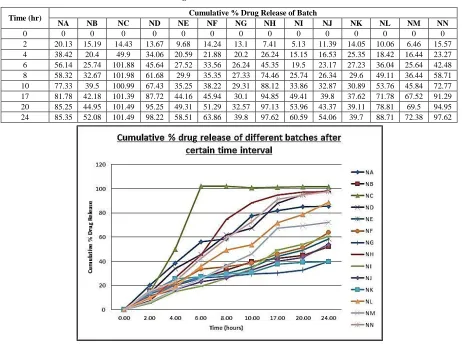
Table 3: Cumulative % drug release of different batches after certain time interval
Time (hr) Cumulative % Drug Release of Batch
NA NB NC ND NE NF NG NH NI NJ NK NL NM NN
0 0 0 0 0 0 0 0 0 0 0 0 0 0 0
2 20.13 15.19 14.43 13.67 9.68 14.24 13.1 7.41 5.13 11.39 14.05 10.06 6.46 15.57
4 38.42 20.4 49.9 34.06 20.59 21.88 20.2 26.24 15.15 16.53 25.35 18.42 16.44 23.27
6 56.14 25.74 101.88 45.64 27.52 33.56 26.24 45.35 19.5 23.17 27.23 36.04 25.64 42.48
8 58.32 32.67 101.98 61.68 29.9 35.35 27.33 74.46 25.74 26.34 29.6 49.11 36.44 58.71
10 77.33 39.5 100.99 67.43 35.25 38.22 29.31 88.12 33.86 32.87 30.89 53.76 45.84 72.77
17 81.78 42.18 101.39 87.72 44.16 45.94 30.1 94.85 49.41 39.8 37.62 71.78 67.52 91.29
20 85.25 44.95 101.49 95.25 49.31 51.29 32.57 97.13 53.96 43.37 39.11 78.81 69.5 94.95
24 85.35 52.08 101.49 98.22 58.51 63.86 39.8 97.62 60.59 54.06 39.7 88.71 72.38 97.62
Figure 1: Cumulative % drug release of different batches after certain time interval
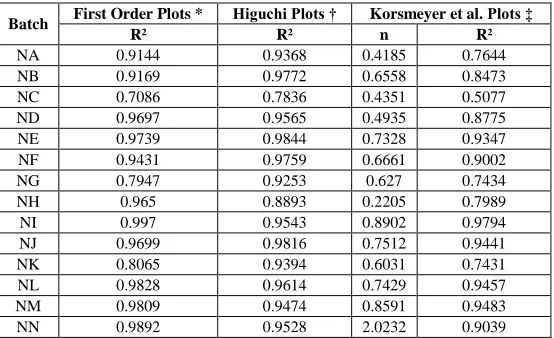
To know the mechanism of drug release from these formulations, the data were treated according to first order (log cumulative percentage of drug remaining vs. time), Higuchi’s (cumulative percentage of drug released vs. square root of time) and Korsmeyer et al. (log cumulative percentage of drug released vs. log time) equations along with zero order (cumulative amount of drug released vs. time) pattern. As clearly indicated all formulations did not follow a zero order release pattern. The release rate kinetics data for all other equations can be seen in Table 4. When the data was plotted according to the first order equation, the formulations showed a fair linearity, with regression values between 0.7086 and 0.9970 with mean 0.9223. Release of the drug from a matrix containing hydrophilic polymers generally involves factors of diffusion. Diffusion is related to transport of drug from the dosage matrix into the in-vitro study fluid depending on the concentration. As gradient varies, the drug is released and the distance for diffusion increases. This could explain why the drug diffuses at a comparatively slower rate as the distance for diffusion increases, which is referred to as square root kinetics or Higuchi’s kinetics.
In our experiments, the in-vitro release profiles of drug from all the formulations could be best explained by the Higuchi’s equation, as the plot showed high linearity (R2 : 0.7836 to 0.9844 with mean 0.9404). To confirm the
24
Table 4: Kinetic values obtained from different plots of formulation
Batch First Order Plots * Higuchi Plots † Korsmeyer et al. Plots ‡
R² R² n R²
NA 0.9144 0.9368 0.4185 0.7644
NB 0.9169 0.9772 0.6558 0.8473
NC 0.7086 0.7836 0.4351 0.5077
ND 0.9697 0.9565 0.4935 0.8775
NE 0.9739 0.9844 0.7328 0.9347
NF 0.9431 0.9759 0.6661 0.9002
NG 0.7947 0.9253 0.627 0.7434
NH 0.965 0.8893 0.2205 0.7989
NI 0.997 0.9543 0.8902 0.9794
NJ 0.9699 0.9816 0.7512 0.9441
NK 0.8065 0.9394 0.6031 0.7431
NL 0.9828 0.9614 0.7429 0.9457
NM 0.9809 0.9474 0.8591 0.9483
NN 0.9892 0.9528 2.0232 0.9039
R² = Regression Coefficient; * First Order Equation {log C = log C₀ - Kt /2.303}; †Higuchi's Equation {Q = Kt 1/2}; ‡ Korsmeyer et al. Equation
{Mt/Mα = Ktn}
CONCLUSION
The study was undertaken with the aim to formulate and evaluate Nitazoxanide sustained release granules using HPMC grade of polymer as retarding agent. From the above results and discussion, it is concluded that sustained release granules of Nitazoxanide can be prepared using HPMC, xanthan gum, ethyl cellulose with lactose as diluents and PVP as binder and bees wax as coating agent by wet granulation method. This can be optimized formulation of sustained release granules for 24 hours release as it fulfills all the requirement of sustained release preparation and study encourages further clinical trials and long term stability study on this formulation.
REFERENCES
[1] AR Gennaro.Remington’s Pharmaceutical Sciences, 18th edition, 1990, 1677-1678.
[2] NK Jain; RK Khar.Controlled and Novel Drug Delivery, 1st edition, CBS Publishers, Delhi, India, 2002, 6-53, 55-56.
[3] BE Ballard. An Overview of Prolonged Action Drug Dosage Form in Sustained Release and Controlled
Release Drug Delivery Systems, Edited by J.R. Robinson. New York, Marcel Dekker, 1978. [4] E Ojoe; EM Miyauchi; TC Viviani; VO Consiglieri; Braz J Pharm Sci.2005, 41(3), 377-384. [5] PC Record. Int J Pharm Technol Prod Manuf.1988, 1, 32-39.
[6] SC Sweetman.In: Martindale, The Complete Drug Reference. 33rd edition, Pharmaceutical Press, London,
2002, 598-599.
[7] MJ O’Neil. In: The Merck Index, An Encyclopedia of Chemicals, Drugs and Biologicals. 13th edition, Merck & Co. Inc., Whitehouse Station, NJ, 2001, 1177.
[8] http://www.fda.gov/cder/foi/nda/2004/21-497_Alinia_Prntlbl.pdf
[9] National PBM Drug Monograph – Nitazoxanide (Alinia®)
[10] http://redpoll.pharmacy.ualberta.ca/drugbank/cgibin/getCard.cgi?CARD=APRD00558.txt
[11] A Stockis; X Deroubaix; R Lins; B Jeanbaptiste; P Calderon; JF Rossignol.Int J Clin Pharmacol Ther. 1996, (34), 349-351.