Why students avoid sandwich placements
Morgan, H
Title Why students avoid sandwich placements
Authors Morgan, H
Type Conference or Workshop Item
URL This version is available at: http://usir.salford.ac.uk/2002/ Published Date 2005
USIR is a digital collection of the research output of the University of Salford. Where copyright permits, full text material held in the repository is made freely available online and can be read, downloaded and copied for noncommercial private study or research purposes. Please check the manuscript for any further copyright restrictions.
Why Students Avoid Sandwich Placements
Huw Morgan, [email protected]
Abstract
This paper outlines research undertaken to identify factors that dissuade accounting degree students at the University of Salford from taking a year’s work placement. Interviews with key staff and purposively-selected students were transcribed and analysed using grounded theory. A questionnaire, based on emerging factors, was completed by students; with factor analysis triangulating and enhancing the interviews’ findings. Key factors identified are: awareness of the placement scheme, links with local small and medium-sized enterprises (SMEs), and better descriptions of job opportunities illustrating the placement’s quality. In conclusion, further research is recommended using a shorter questionnaire focussing on these and other emerging factors, such as the students’ socio-economic status and pre-entry levels (UCAS points), which require validation. Cross-discipline research opportunities exist.
Introduction
Much literature has been published supporting the role of work placement in improving generic skills that are vital for a student’s employability. The University of Salford prides itself in the employability of its students: its prospectus states that over two-thirds of all full-time undergraduate programmes offer the chance to work in the UK or abroad. However, the number of placements on the BSc in Finance and Accounting (FAOF) programme has been averaging at approximately 11 per cent of the year’s cohort. This research project will identify factors that dissuade students in the accounting degree programme from taking a work placement.
Researcher bias was minimised as the author had no prior involvement in the placement scheme. Teaching and support staff were readily accessible, and students over all three years were questioned to obtain perspectives from students who may be considering a placement, those active in seeking placement, those returning from a year’s placement, and - most importantly - those who have rejected the idea of a placement.
Anticipated Outcomes
This project’s results should improve the quality of teaching and learning by reviewing the support mechanisms available within the work placement scheme, leading to a clearer understanding of what support students need in order to improve their generic employment skills. Methods can be developed to increase student participation in the work placement scheme, or to identify other means of preparing students for employment, short of placing students at work for a full year.
There is the potential to expand this project, once initial factors have been identified. Further research could be undertaken into work placement schemes provided by other programmes within the University, or within accountancy courses at other universities.
Literature Review
The profile of work experience in universities was raised by the National Committee of Inquiry into Higher Education, who recommended identifying “opportunities to increase the extent to which programmes help students to become familiar with work, and help them to reflect on such experience” (Dearing, 1997). The recommendations
were based in part on an extensive report published by Harvey et al. (1997), which concluded:
If there was to be a single recommendation to come from the research, it would be to encourage all undergraduate programmes to offer students an option of a year-long work placement and employers to be less reluctant to provide placement opportunities.
The Advantages of Work Placement
Harvey et al. (1997) interviewed 258 managers, graduates and non-graduate employees. Work placement was “one of the most regularly mentioned suggestions for helping students towards success at work, improving links and bridging the ‘skills gap’.” Work placements allow employers and universities to “establish more meaningful relationships”, and can result in making the “curriculum more relevant to the demands of the workplace”. Longer placements are preferable to short ones, although there may be an “onus on the organisation” to make the placement “worthwhile”. Advantages to the employer include reducing recruitment costs and screening potential recruits. For the graduate, there “may be the prospect of carving out a job with their placement provider in the future”. Graduates will also benefit by having experience of work on their CV and “insight into the kinds of attitudes and abilities that employers want”. Finally, and increasingly important, they may get paid. Duckenfield and Stirner (1992) describe how students can relate classroom theory to the workplace, and “develop personally in terms of greater self-confidence and maturity”.
Bowes & Harvey’s (1999) analysis of 140,000 graduates’ post-graduation destinations also supports the use of a year-long work placement, as does the work of Silver (2003).
The Potential Problems of Work Placement
Harvey et al. (1997) note that a “protracted period out of an academic culture” may cause difficulties for students to continue studying on their return, and “there is a danger that students can be used as cheap labour and their skills under-utilised. This inhibits development and is not good practice”.
Harvey et al. (1998) recognise two different types of employer involved in a work placement: the “added-value organisation”, with high expectations and requirements, and “the stakeholder organisation”, which works alongside the university, considering long-term developments as well as short. This reinforces suggestions that some employers are simply utilising work placements as cheap labour. Harvey et al. (1998) also raise the socio-economic background of students taking work placement as an issue.
Increasing Work Placement Opportunities
2
faculty placement unit; which provides an agency service between employer and student, as outlined by Ellis & Moon (1998).
Crebert et al (2004) surveyed 164 work placement graduates. 74% of respondents considered work placement a significant contribution to career advancement. However, the results highlighted the need for a structured supervision, with liaison between academic and work supervisors to ensure “meaningful work”, and the negotiation of learning objectives with the placement supervisor. Employers, although happy to give formative feedback, were not keen on providing summative assessment which may affect the student’s academic record. A structured process of teaching students how to work collaboratively at university was the major requirement for improving student employability.
The Students’ Perspective
Much academic literature has been written on the subject of work placements; however, little exists on the barriers faced by students in taking a work placement, which is the subject of this research.
Methodology
This research follows a methodology similar to that used by Skrtic (1985): using semi-structured interviews combined with questionnaires and observation, to allow triangulation.
Stage One: Interviews
An understanding of the placement system was obtained by interviewing staff most closely involved in the scheme: the programme manager, placement tutor, and careers officer. Initial questions were based on the literature review.
A placement workshop session was recorded and transcribed, in which previous work placement students described their experiences and answered questions from current students. Previous work placement students could converse about the benefits and possible pitfalls of a year out on placement, and prospective placement students could raise any concerns they may have. There was no agenda, so any issues could be raised. Although there was a risk of non-participation by respondents, observation was preferred to direct interview by the students’ tutor, which could have raised issues of bias.
Students for interview were selected serially, based on Patton’s (1980) purposive sampling strategies, commencing with a student who withdrew from the workshops. Because the full sample was not based solely on a priori decisions, new factors from subsequent interviews influenced the sample selection. Non-directive interviewing techniques ascertained reasons for withdrawal, and questions were then raised on the key factors which emerged from the staff interviews. Students were interviewed until factors appeared to be exhausted. Where new factors emerged, key staff were re-interviewed to obtain their opinions. This ensured completeness of factors and triangulated results from two separate experiences (staff and student).
Finally, the minutes from the Annual Conferences of Placenet, an organisation connecting placement officers from HE institutions, were analysed to include areas of concern to placement officers nationally.
3
sentence-by-sentence, to allow tracing back to transcriptions. These codes were then categorised, with a rule devised to describe the nature of each category.
Stage Two: Questionnaire
Students in each year were requested to complete a questionnaire to investigate attitudes to certain issues over the placement scheme that emerged from Stage One. A design with separate sections for students in different years with differing perspectives was rejected in favour of standardised questions on student attitudes and opinions. The questionnaire included sections on personal information (age, gender, UK or international student, pre-entry qualifications, career intentions), and also on the extent of part time work. This allowed identification of possible student subgroups. The remaining questions used a 5-point Likert scale to question students’ opinions and attitudes on the:
extent to which they feel prepared for employment
importance of work experience in applying for jobs
extent of support from the university in seeking placement opportunities
elements contributing to a successful placement
elements considered on whether to apply for a placement.
About five questions were raised on each issue, firstly to confirm the validity of data by analysing consistency of replies, and secondly to allow the use of factor analysis. Interview findings were thus triangulated to a wider base of students. A large number of multicollinear explanatory variables were rationalised into a smaller number of composite variables representing the underlying concept. Exploratory factor analysis was used, to “summarize and concisely describe the data by grouping correlated variables together”, and then “attempt to interpret the meaning of the factors once they have been identified”. (Hutcheson and Sofroniou, 1999, p218).
The factors were extracted using ‘principle component analysis’, which selects those components providing the largest explanation of the variance in the sample. Although factor analysis requires data to be measured on a continuous scale, meaningful results can be obtained from ordered categorical data derived from a Likert scale (Hutcheson and Sofroniou, 1999).
Kaiser (1970) developed the Kaiser-Meyer-Olkin (KMO) statistic to illustrate the extent of correlation in data, and hence the appropriateness of factor analysis. Individual KMO scores were reviewed to assess the effect of each variable on the factor analysis. Variables with low individual KMO scores were eliminated piecemeal from the analysis, depending upon whether:
a significant correlation with another variable meant the removal of one would have no great effect on the interpretation of the emerging factors, and leave a single variable with a much higher individual KMO score to explain the variance in that factor, or
the variable represented a factor in its own right, having little effect in the description of factors emerging in the analysis. Such variables should be but reconsidered when a final model is being constructed, alongside the factors produced from the analysis.
The resulting factor model was then compared with factors emerging from Stage One and the literature review, to produce a full set of factors that may dissuade students from taking a work placement.
Validity of Research, Monitoring and Evaluation
A number of techniques should ensure trustworthy results:
Triangulation: Pitting various data sources / methods to cross-check data and interpretations
Member checks: continuously testing data / interpretations with people from whom the data derived
Purposive sampling: maximising the range of data by interviewing people with particular characteristics / factors emerging from previous interviews
Dependability: an audit trail from assertions and interpretations back to actual raw data.
Findings - Qualitative Analysis
The following sections cover the main issues identified from the qualitative analysis of interview and observation transcriptions. References are provided in brackets; more details are provided in Appendix 1.
Career Intentions
Students may be unsure of their preferred career, and therefore unwilling to do a placement (6:33). Others prefer qualifying first: “I thought (a placement) was going to be useful, but… as we’ve been going along I’d rather get technical knowledge before jumping into a job for a year” (6:19).
The university could better cross-promote its courses: it offers a post-graduate professional course of which some students were unaware (6:12).
Student’s Attitude to Learning at Work
Students valued the experience of a work placement, including those who subsequently rejected it:
It probably is the best way to learn. If someone was to ask me a question from last year, I could tell you the overall concept or argument, but I couldn’t tell you in detail, whereas if you were in the job you’re probably more practiced at. (6:31)
Some students have “a part-time job that’s relevant”, and are thus reluctant to do a placement (1:12). One student worried about a lack of technical experience: “it would be slightly embarrassing if you were given a piece of work and no matter how many times you went through it you couldn’t get it to balance” (6:2). However, employers appear more concerned that the student can communicate effectively: “having knowledge is one thing, being able to communicate effectively is quite another” (Employer, Placenet conference 2003) (7:47).
Work Placement Promotion
Although prominence is given to the placement counting as a year’s professional experience, whether this exemption is valued by prospective placement students depends on their willingness to progress with professional exams (3:12). What appears to be more important is the placement salary: “… the people who I talk to who are
going into it - all they talk about is the money” (6:25). The placement tutor agreed: “The salaries they get are the equivalent to first year graduates. More or less, so they do very well - especially if they’re living at home.” (4:58).
A placement’s location is also important. Students are less willing to travel, and generally take less risks: “It’s this comfort thing: letting go of what you’re familiar with to go into the unknown. It’s getting the message across that it’s ultimately their benefit” (Careers, 2:32).
Applying and Support
Students must obtain their own placement. They are not matched to employers (which could “lead to claims of discrimination” (8:9)), but are notified of vacancies (3:40). Detailed placement job descriptions would ensure relevancy to accountancy students (6:27).
Most students used Prospects (“like an encyclopaedia - I went through all of those and then on the internet, searching” (5:26)). This could discourage students: “They’re asking for the equivalent of three B’s at A-level: 280 to 300 UCAS points, plus an expectation of a 2.1 - and that’s a barrier for a lot of students” (Careers, 2:18). Students with lower UCAS points can be rejected automatically using online applications (5:12); vocational-based students and HND students starting the degree in year 2 experienced similar problems.
One student suggested that those doing better academically will be guaranteed a placement: “I get the impression then that even if I went in and slapped the person doing the interview on the face, and I had 100% in all my modules, I’d still get that job” (6:46). Nationally, “companies are often wasting talent because of their insistence on points, or their on line applications which are computer checked… many companies need a way of filtering, but …. perhaps they are filtering too much” (Placenet conference, 2004 (8:14)). Conversely, the placement officer suggested that when the University builds contacts with local employers, the application requirements are less onerous: “with local businesses, the job descriptions I’ve seen, quite a lot of them don’t have minimum requirements” (4:17).
Successful students experienced delays before obtaining their placements: “None of our year had a placement before the end of May” (3:28). “It is a long time. It’s why a lot of people give up really early on - they don’t realise how long it’s going to take… by Easter, you’re just… (exhales)” (5:29).
The placement scheme is not promoted in the first year (4:55). “When we got back it was just like: right who wants to go on placement? It was, like, everything was coming at you. So a lot of people started dropping out straight away” (5:17). Some students wanted to start researching in the summer to allow "3 or 4 months’ head start" (5:36). To assist students without work experience, the course expanded activities developing generic skills in year 2 (1:9).
The optional workshop module is possibly undervalued by students. Many students participate in the first workshop session and then drop out, although attendance at workshops has improved (4:6). Some workshop sessions were too basic (6:23). One student suggested using “actual application forms from actual companies” in the workshop, and cross-discipline sessions on interview techniques: “It would be better if you did it with someone you don’t know” (5:37).
At the Placement
Employers are using placements as a selection process (2:41), and students are offered part-and full-time jobs after their placement year. The placement officer believed employers “liked to have that link with Salford. To have a student that they could then employ” (4:59).
Experience and opportunities can vary between placements. One student on a new placement said: “(another student) got involved in all sorts - and when she left they were like, right we actually need somebody to do this post, whereas if I left it wouldn’t make any difference. It would just get passed on to someone else” (5:7). Closer monitoring of new placements could resolve this issue (5:4). The University visits placement students once each semester; additional monitoring could be done via email and peer group meetings (1:22).
Before the placement, students expect that “all I’m going to do is make tea” (3:4). “I would have thought it would be more invoice/clerical work …. not really high-end stuff” (6:3). However, returning placement students stated they received a variety of work experience (3:33), as well as adapting to change within the workplace (3:42). The degree certificate of a placement student states 'with industrial placement'. Full accreditation raises difficulties over validation and employer assessment (4:28).
Resources and Alternatives to Placements
The successful placements appear to be with employers who have a long-term relationship with the course (4:23). The benefits are “enormous. Not just in terms of outcomes for students, but in the links with employers. Through those placements I’ve now got employers regularly coming in to host workshop sessions, employers willingly coming in to discuss education” (Programme Manager, 1:16).
More resources are needed to “go out and liaise more with employers, build up a database” (Programme Manager, 1:26). This view is repeated by the Careers Office (2:34).
Alternatives to a year-long placement are summer internships, using the same work experience log (4:44), or shadowing in a local business. Both could increase local business contacts (6:38).
Nationally, students are choosing a year’s employment outside the placement scheme, partly explaining the decline in placements (8:5).
Students’ Value of Time
Students living locally may rely on their part time work to fund their studies, which can deter students from applying for placements (2:16).
Students may want to graduate quickly: delays are regarded as negative. One prize-winning student originally had this opinion, before being offered a placement:
Although I looked on it as though I may be a year behind everyone else before I went, you’re not really: because at the end of the day they’ve still got to go out and get their three years’ experience (3:39).
However, the above student sought professional exemptions. Other students had a different outlook: “…in terms of packaging it up as if you’d be super-employable, I should be working by the time the people finish their degree” (6:49).
The workload of the second year may put off students from continuing with the placement workshops:
When you’re in the first year, it’s a long way off (laughs). You’re not really bothered about two year’s time. You’re just thinking about passing” (5:23).
Some students lack the long-term view: “It’s sometimes difficult to sell that idea to students who perhaps live more for the moment. OK, they know it’ll benefit them in 18 month’s time, but maybe they’ll worry about that nearer the time” (Careers, 2:20).
Findings – Questionnaire
There were 117 respondents (65% of the population). The overall gender mix of the sample was representative of the population, and consistent within each year: 51% male and 49% female. It included 11 UK and 9 overseas mature students, with 61.9% entering the course following A-levels, and 15.3% from the International Foundation course. 61.5% of students were resident in the Greater Manchester area; a quarter were international students.
One third of respondents had no part-time work, and a quarter worked more than sixteen hours a week during term time: a substantial time for a full-time course. Of the students with part-time work, only 12.5% claim it to be accounting-related. 55% work in customer service. The proportions of those without part-time work were similar between UK and international students. Unusually, 45% of students without part-time work agree or strongly agree that they will be very well prepared for full-time work after the course, compared to 38.6% of those with a part-time job. Students may not be recognising the generic skills that such jobs provide. 37.9% wanted a full-time accounting job in which further professional exams could be taken, and almost 20% were undecided.
Factor Analysis
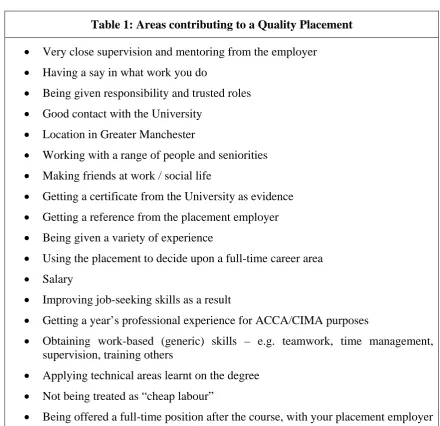
Responses to questions on what students considered were important in a successful placement yielded a KMO overall score of 0.977 and only one component was extracted, explaining 99.761% of the variance. More information on the KMO score is given in Appendix 2. All of the individual KMO scores were in the high 0.9’s. The attempt to rationalise the variables in this area was ineffective: all the questions raised in this area are relevant to the factor relating to the quality of the work placement, which later emerged as the first component in the full factor analysis. These are listed in Table 1.
The remaining variables were then added to the analysis. A colour-coded excel spreadsheet was used to monitor changes in KMO scores each time a variable with a significant correlation at the 0.01 level was removed from the analysis.
The final factor analysis yielded an overall KMO statistic of 0.899, and included only four variables with individual KMO scores of less than 0.7. Overall the analysis of 50 variables was rationalised into 29, and then further collapsed into six factors. These factors have been interpreted in Table 2.
Table 1: Areas contributing to a Quality Placement
Very close supervision and mentoring from the employer
Having a say in what work you do
Being given responsibility and trusted roles
Good contact with the University
Location in Greater Manchester
Working with a range of people and seniorities
Making friends at work / social life
Getting a certificate from the University as evidence
Getting a reference from the placement employer
Being given a variety of experience
Using the placement to decide upon a full-time career area
Salary
Improving job-seeking skills as a result
Getting a year’s professional experience for ACCA/CIMA purposes
Obtaining work-based (generic) skills – e.g. teamwork, time management, supervision, training others
Applying technical areas learnt on the degree
Not being treated as “cheap labour”
Being offered a full-time position after the course, with your placement employer
Table 2: Factors and Interpretation
The quality of the work placement. (See table 1)
The costs (financial and personal) relating to a placement: low salary, lack of time, costs of relocation, lost friends, losing technical academic skills
Support from the university: Despite useful workshops in year 2, promotion of placements in year 1 appears weak. There is no formal assessment of the placement. Students feel there may be employers willing to take them as a placement student, but more support may be needed.
The ‘right employer’: Not enough employers to meet student level – small, local. Too much competition for jobs advertised, and too much time to apply for them; also, not enough information on the jobs on offer.
Uncertainty over career aspirations: students may be undecided on accountancy as their career choice, and feel they may not have the technical knowledge to do a year’s placement. However, they recognise a placement would help in deciding on their career; or at least offer opportunities of part time work in their final year.
High employer entry requirements. Students are put off applying because the workshops and employer visits suggest that employers are looking for high UCAS points as an entry requirement. There are suggestions within this factor that some students may not be so concerned with being a ‘year behind’ their peers academically – the application entry barriers are the problem.
Conclusions
This short research project revealed a number of factors influencing a student’s decision on whether to undertake a work placement on the Accounting and Finance degree at the University of Salford. Students recognise the value of work experience in seeking final employment, but have reservations over factors that are detailed in Table 2. In particular, students appear reluctant to apply because of high entry requirements imposed by the larger employers. In contrast, where the University has built up contacts with local employers, such employers have less stringent entry requirements. However, the further development of employer links will require additional resources.
There are opportunities for further research using a combination of a more concise questionnaire for statistical modelling, and additional interviews with purposively sampled students. In addition to the factors identified by this project, the literature suggests that students’ socio-economic background is important; this should also be incorporated into further research.
The research could be expanded to include students from other disciplines within the University of Salford, who are offered an optional placement year. Alternatively, more subject-specific results may be obtained by involving students from accounting degrees in other universities.
References
Bourner, T. & Ellerker, M. (1998) Sandwich Placements: improving the learning experience – parts 1 and 2. Education & Training Vol. 40, no. 6/7
Bowes, L. & Harvey, L. (1999): The impact of sandwich education on the activities of graduates six month post-graduation. Centre for Research into Quality, UCE, Birmingham
Crebert, G., Bates, M., Bell, B., Patrick, C., & Cragnolini, V. (May 2004): Developing generic Skills at University, during work placements and in employment: graduates’ perceptions. Higher Education Research & Development Vol. 23, No.2. [Full report available online at http://www.gu.edu.au/centre/gihe/griffith_graduate/project.htm, November 2004]
Collin, K. & Tynjala, P. (2003): Integrating theory and practice? Employees’ and students’ experiences of learning at work. Journal of Workplace Learning, Vol. 15 no. 7/8
Dearing, R. (1997) Higher Education in the learning Society, HMSO, London. Available at: www.leeds.ac.uk/educol/ncihe/
Duckenfield, M., and Stirner, P., 1992, Higher Education Developments: Learning Through Work. Sheffield, Employment Department.
Ellis, N. & Moon, S. (1998): Business and HE links: the search for ,meaningful relationships in the placement marketplace – part 1. Education & Training Vol. 40, no. 5
Glazer, N. & Strauss, A.L. (1968)“The discovery of grounded theory, Aldine, Chicago. Harvey, L., Moon, S., & Geall, V., (1997): Graduate’s Work: Organisational Change and Students’ attributes, Chapter 8: Work Placements. UCE, Birmingham. Retrieved from http://www.uce.ac.uk/crq/publications/gw October 2004.
Harvey, L., Geall, V., & Moon, S. (1998) Work Experience: Expanding opportunities for undergraduates, UCE, Birmingham. [Online], retrieved from
http://www.uce.ac.uk/crq/publications/we/zwecon.html January 2005
Huntington, S., Stephen, J. & Oldfield., B. (1999) Formal assessment of student placement within a retail sandwich degree. Education & Training Vol. 31, no. 3
Hutcheson, G. D. and Sofroniou, N. (1999). The Multiple Social Scientist: Introductory Statistics using Generalise Linear models. Sage Publications.
Morgan, A. & Turner, D. (2000): Adding value to the work placement: working towards a professional qualification in an undergraduate degree programme. Education & Training Vol. 42, no. 8
Neill, N. & Mulholland, G. (2003): Student Placement – structure, skills and e-support.
Education & Training Vol. 45, no. 2
Patton, M.Q. (1980) Qualitative evaluation methods. Sage. Beverly Hills, CA.
Silver, J. (2003), An evaluation of the Employability Skills Acquired by Industrial Placement Students. [Online] University of Salford. Retrieved from:
http://www.edu.salford.ac.uk/her/proceedings/ December 2005
Skrtic, Thomas M. (1985), Doing Naturalistic Research into Educational Organizations.
Organizational Theory and Inquiry. Ed. Y. S. Lincoln. Sage,185-220. Beverly Hills, CA.
14
Appendix 1: References to Qualitative Analysis quotations
[image:15.595.218.405.545.687.2]The following table lists the sources of data upon which the Qualitative Analysis section of this report is based. References in the section are based on the Atlas.ti reference system, which defines the data source and paragraph. For example, (6:16) refers to transcription 6, section 16.
Table 3: Summary of Qualitative Data Sources Transcription
ref:
Data source:
1 Interview with Programme manager, FAOF.
2 Interview with Careers Adviser involved with FAOF placement scheme 3 Transcription of workshop discussion in which five returned placement
students talk to prospective students on their experiences 4 Interview with FAOF Placement Officer
5 Interview with a returning placement student
6 Interview with a student who rejected the placement scheme 7 Analysis of Placenet Conference (2003) Minutes 8 Analysis of Placenet Conference (2004) Minutes
Appendix 2: Sampling Adequacy
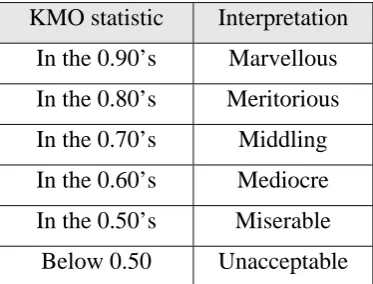
A measure of sampling adequacy provides an indication of how well the factor analysis represents the data. Kaiser (1970) developed the Kaiser-Meyer-Olkin statistic, referred to as the KMO statistic in this report. This provides an indication of the extent of correlation in the data, and hence the appropriateness of factor analysis. KMO statistics are produced for the overall factor analysis as well as for individual variables. Kaiser (1974) also provided guidance as to how the KMO statistics can be interpreted:
KMO statistic Interpretation In the 0.90’s Marvellous In the 0.80’s Meritorious In the 0.70’s Middling In the 0.60’s Mediocre In the 0.50’s Miserable
Below 0.50 Unacceptable