CONPLAN: CONSTRUCTION PLANNING AND
BUILDABILITY EVALUATION IN AN INTEGRATED
AND INTELLIGENT CONSTRUCTION
ENVIRONMENT
Zainuddin Hassan
T.I.M.E Research Institute
Department of Surveying
University of Salford, Salford, UK
LIST OF CONTENTS
Page Title
List of contents
List of illustrations
List of tables
Acknowledgements
List of abbreviations
Abstract
CHAPTER 1- INTRODUCTION
1.1. Introduction
1.2. The Research Background 1.3. Aims of the Research
1.4. The Objectives of the Research
1.5. Methodology of Research 1.6. Scope of the Research 1.7. Guide to the Thesis
2. CHAPTER 2- THE RESEARCH CONTEXT: THE
CONSTRUCTION INDUSTRY AND ITS
APPROACHES TO BUILDABILITY
2.1. Introduction
2.2. Definition of Buildability
2.3. The Origin and Development of Buildability in Design
and Construction 23
2.4. Scope of Buildability 26
2.5. The Effect of Buildability on the Project 28
2.6. Buildability in Project Life Cycle 30
2.7. The Key Areas of Buildability 34
2.8. Applying Buildability to Projects 39
2.9. Evaluating Buildability 41
2.10 The Approach of Buildability Assessments 43
2.11 Summary 49
3. CHAPTER 3- THE RESEARCH CONTEXT: THE
CONSTRUCTION INDUSTRY AND ITS APPROACH
TO CONSTRUCTION PLANNING PROCESS
503.1. Introduction 50
3.2. Definition 51
3.3. The Aspects of Construction Planning Process 52 3.4. The Stages of the Construction Planning Process 54
3.5. Developing the Construction Plan 57
3.5.1. Gathering Project Information 58
3.5.2. Defining the Construction Activities 61 3.5.3. Selecting Construction Methods 64 3.5.4. Sequencing the Construction Activities 66
3.5.5. Resource Allocating 72
3.5.6. Optimising Construction Plans 74
3.6. The Important of Construction Planning in a Project
Life Cycle 76
3.6.1. Supporting Construction Management
Functions 76
3.6.2. Supporting Buildability Evaluation 83
AND BUILDABILITY ASSESSMENT:
CURRENT SYSTEMS
874.1 Introduction 87
4.2 Computer Application System for
Construction Planning 89
4.2.1. BUILDERS 93
4.2.2. PLATFORM 95
4.2.3. CONSTRUCTION-PLANEX 96
4.2.4. GHOST 99
4.2.5. OARPLAN 101
4.3 Computer Application System for Buildability
Assessments 103
4.3.1. PREDICTE 104
4.3.2. 'Intelligent' Construction Time and
Cost Analysis(IKBS) 107
4.3.3. COKE 110
4.3.4. The Dimensional Bay Design System. 114
4.3.5. CADDS 116
4.3.6. MOCA 120
4.4. Review of the Buildability Assessment
Application Systems 122
4.5. Summary 125
5
CHAPTER
5-APPROACHES TO INTEGRATION
1265.1. Introduction 126
5.2. Overview of the Integration Process in the Construction
Industry 127
5.2.1. Definition of Integration 129
5.2.2. Aims of the Integration 131
5.2.3. Approaches to Data Exchange 132
5.3. Integration Through Product Models 137
5.4. Integrated Models 140
5.5. Key Features for the Integrated for Product Data Model 144 5.6. Reviews of Current Product and Process Model for
Construction Planning and Buildability Evaluation 147 5.7. The Advantages of System Integration to Construction
Planning and Buildability Evaluation 149
5.8. Summary 151
6
CHAPTER
6-THE PROPOSED BUILDABILITY
ASSESSMENT
1526.1. Introduction 152
6.2. Key Requirements for a Quantitative Evaluation
Approach for Buildability 153
6.3. Information Required for the Construction Planning 155
6.3.1. Design Information 156
6.3.2. Information Required from Other Disciplines 159 6.4. Construction Planning Information for Evaluating
Design Buildability 161
6.5. The Elements of the Proposed Buildability Evaluation
Approach 168
6.5.1. Repetitiveness 169
6.5.2. Functional Requirement 173
6.5.3. Location 174
6.5.4. Trade Utilisation 176
6.5.5. Plant Utilisation 178
6.5.6. Facility Utilisation 180
6.5.7. Assembly Buildability 182
6.5.8. Elements Buildability Dependency 185
6.6. The Framework for the Evaluation 188
MODELS FOR CONSTRUCTION PLANNING AND
BUILDABILITY EVALUATION
1927.1. Introduction 192
7.2. The Object Oriented Techniques 193
7.3. The Advantages of Object Oriented Techniques 195
7.4. Object Oriented Methodologies 197
7.4.1. Object and Object Type 198
7.4.2. Attributes, Methods, Messages
and Polymorphism 199
7.4.3. Encapsulation 200
7.4.4. Hierarchy and Inheritance 201
7.4.5. Instances 201
7.5. The Object Structural Analysis(OSA) and Object
Behaviour Analysis(OBA) 202
7.5.1. The Notations 203
7.6. The Proposed Information Models 207
7.6.1. The Object Flow Diagram for Construction
Planning Process 209
7.6.2. The Object Relationship Diagrams for
Construction Planning 215
7.6.3. The Object Flow Diagram for Buildability
Evaluation 220
7.6.4. The Object Relationship Diagram for
Buildability Evaluation 222
7.7. Summary 228
8.
CHAPTER 8- SPACE
2298.1. Introduction 229
8.2. The Integrated Construction Environment(ICE) 230
8.2.1. The Project Model 231
8.3. The Multiple View Provider 234
8.4. Implementation 238
8.4.1. CAPE 238
8.4.2. SPECIFICATION 239
8.4.3. CONVERT 239
8.4.4. INTESITE 240
8.4.5. EVALUATOR 240
8.4.6. CONPLAN 241
8.5. Summary 242
9
CHAPTER 9- CONPLAN: THE SYSTEM
ARCHITECTURE, IMPLEMENTATION AND
APPLICATION
2439.1. Introduction 243
9.2. The System Architecture 244
9.2.1. The System Input 245
9.2.2. The Knowledge Based of CONPLAN 246
9.2.3. Output of the System 252
9.3. The System Environment 253
9.4. The System Implementation 255
9.4.1. Knowledge Structure 256
9.4.2. Knowledge Representation 260
9.4.3. Knowledge Processing 277
9.5. CONPLAN System Interaction 294
9.6. CONPLAN System Application 297
9.6.1. Generating Construction Plan 298
9.6.2. Construction Simulation 305
9.6.3. Buildability Evaluation 309
THE PROTOTYPE
31910.1. Introduction 319
10.2. The Experimental Approach 319
10.3. General Arrangement and Procedures of
the Experiment 321
10.3.1. Experimenting With the Construction
Planning Process 321
10.3.2. Experimenting With the Buildability
Evaluation Process 325
10.4. Overall Conclusion of the Experiment 327
10.5. Summary 329
11.
CHAPTER 11- SUMMARY AND CONCLUSIONS
33011.1. Introduction 330
11.2. Summary of the Research Work 331
11.3. Main Conclusions 335
11.4. Recommendation for Future Work 340
11.5. Recommendation for the Industry 342
REFERENCES 344
APPENDICES 370
APPENDIX A: Basic Operation Time for Calculating 370 Duration
APPENDIX B: Construction Plan: Detail, Executive & Master 378
APPENDIX C: Buildability Result for Slab, Beam, Column,
LIST OF ILLUSTRATIONS
Figure 1.1 Figure 2.1 Figure 2.2 Figure 2.3 Figure 3.1 Figure 3.2 Figure 3.3 Figure 3.4 Figure 5.1 Figure 5.2 Figure 5.3 Figure 5.4 Figure 5.5Figure 7.1 Figure 7.2 Figure 7.3 Figure 7.4 Figure 7.5 Figure 7.6 Figure 7.7 Figure 7.8 Figure 7.9 Figure 7.10 Research Methodology
Project Life Cycle and Designers Level of Influence
The Project Buildability Improvement Life Cycle
The Project Life Cycle and Buildability Evaluation The General Sources and the Generated
Information of Construction Planning Process The Levels of Construction Plan Representation The Use of Construction Plan
The Relationship of Design and Construction Information in Construction Planning
Inter-Application Data Exchange Sharing data Via Neutral Model Sharing Data Via Common Resources Data Sharing Via Central Core
Data Sharing Via a Mutually Exclusive Partly Common Model
Object and Object Type
Column object and Its Attributes Object Flow Diagram
An Example of a Fern Diagram An Example of a Box Diagram Composed-of and Generalisation (or sub typing) and Notations Example of a SubType Relationship Cardinality Constraint Symbols
An Example of a One to Many Relationship Relationship Between the Different Levels of
Figure 7.12 Figure 7.13 Figure 7.14 Figure 7.15 Figure 8.1 Figure 8.2 Figure 9.1 Figure 9.2 Figure 9.3 Figure 9.4 Figure 9.5 Figure 9.6 Figure 9.7 Figure 9.8 Figure 9.9 Figure 9.10 Figure 9.11 Figure 9.12 Figure 9.13
The Initial Stage of Information Exchange For Construction Planning
The Decomposition of 'Produces Construction Plan' Process
Object Relationship Diagram (ORD) for Construction Planning
OFD for the 'Provide Buildability Evaluation' Process
Object Relationship Diagram for Buildability Evaluation
Proposed Framework for the Integrated Construction Environment(ICE)
The Concept of Providing Multiple Views CONPLAN Systems Architecture
The Main Processes of CONPLAN Conceptual Process Structure Involved in CONPLAN
Middle-Down-And-Up Approach of CONPLAN The Various Knowledge Structure Involved in CONPLAN
The Object Classes Hierarchy Used by CONPLAN The Building Element Hierarchy
The Building Element Attributes as Produced by
CAPE
The Construction Activities Object Hierarchy The Common Attributes Inherited by
Construction Activity Objects
CONPLAN Created Attributes In the Building Element Object
The Resources Attributes Used in CONPLAN CONPLAN Systems Interaction Processes
Figure 9.14 The Opening Screen for CONPLAN in Space
System Integration 298
Figure 9.15 The Interface for Loading Resources into
CONPLAN 300
Figure 9.16 The Users/Evaluators Selection for Resources
Allocation 301
Figure9.17 The Interface for Selecting the Required Resources 302 Figure 9.18 The Interface for Changing Project Resources 302 Figure 9.19 The Construction Planning Report Interface 303 Figure 9.20 An Example of Construction Plan on the Bar
Chart Format 304
Figure 9.21 Example of the Construction Plan Resources
Profile 305
Figure 9.22 CONPLAN Main Menu with Construction
Simulation and Buildability Evaluation Buttons 306 Figure 9.23 The Construction Simulation Users/Evaluator
Interface 307
Figure 9.24 A Cost Report for Simulated Month 308
Figure 9.25 The Buildability Evaluation Interface 310 Figure 9.26 The Post Input Form for Determine the
Weighting Value for the Formwork 312
Figure 9.27 The Users/Evaluators Input Form for Deciding the Likely Method of Construction for the Main
Elements. 314
Page Table 1: Table showing the buildability factors and calculation for
ACKNOWLED GEM ENTS
I would like to take this opportunity to extend my special thank to my supervisor Prof. Mustafa Aishawi for giving invaluable and continous support, guidance and assistance during my study and the preparation of this thesis. Special thanks are also extended to all AIC 's group, Dr. Ghassan Aouad. Dr. Ihsan Faraj. Dr. Jason Underwood and other members, for their interesting and lifely debates and suggestions of improvements during this study.
I am also grafeful in general to all staff in the Surveying Department, especially Dr. John Hinks, Ms. Sheila Walker and Mrs. Lynn Williamson for their assistance. I would also like to thank to all my friends in the department, especially Che Wan Fadhil and Jamil Sulaiman for helping with the prototype.
My gratitude is also due to SIRIM and the Malaysian's government for providing the sponshorship.
Abbreviations Meaning AEC AT AIC ASCII BPM BCCM CAD dc CII CIRIA COMBINE CPM DBMS DDE DXF ER IBPM ICON IGES IRMA ISO ICE JSD LISP NEDO NIAM OFD ORD PGES
Architecture, Engineering and Construction Artificial Intelligence
Automation and Integration in Construction
American Standard Code for Information Interchange Building Product Model
Building Construction Core Model Computer Aided Design
Computer Integrated Construction Construction Industry Institute
Construction Industry Research and Information Association Computer Models for the Building Industry in Europe
Critical Path Method
Data Base Management System Dynamic Data Exchange
Data eXchange Format (CAD system) Entity Relationship
Integrated Building Process Model
Integration of Information for CONstruction Initial Graphical Exchange Specification Information Reference Model for AEC International Standard Organisation Integrated Construction Environment Jackson System Development
High level programming language for Al National Economic Development Office Nijssen's Information Analysis Method Object Flow Diagram
Object Relationship Diagram
PERT PROLOG SADT SASD SSADM STEP KBS RDBMS RIBA VE VR
Project Evaluation and Review Technique Programming in Logic
Strutured Analysis and Design Technique Structured Analysis and System Design
Structured System Analysis and Design Methodology STandard for Exchange of Product Data
Knowledge Base Systems
Relational Data Base Management Systems Royal Institute of British Architects
The lack of a buildability evaluation at the design stage coupled with the separation of the design and construction processes have been acknowledged to cause buildability problems on site. Normally, designers view of their task, is to
develop a masterpiece which satisfies the functional requirements of a project while constructors consider their task as construction works, which need to be completed at the lowest price. No significant efforts have been made to bring the design and construction processes together to facilitate the integration of information for the improvement of the overall project performance.
This study proposes an integrated framework for construction planning which is capable of exchanging information with other construction disciplines and generating planning information in an integrated construction environment. Planning data and processes were first modelled using object oriented analysis methodology, i.e. Martin (1993), where the emphasis was placed on both the data and its behaviour. This development was carried out within a general integrated framework which facilitates the integration between the various construction application across the project life cycle. The developed models highlight the importance and the role of the planning process which is vital in providing
relevant information to other disciplines.
construction plan. The qualitative principles of buildability improvements were
adopted to formalise this approach. A combination of weightings and scores were assigned to building elements to reflect their buildability factors.
The developed data and process models, were implemented in an object oriented environment as part of a single integrated construction environment SPACE (Simultaneous Prototyping for An Integrated Construction Environment) where CONPLAN (Intelligent CONstruction PLANning for design rationalisation) is one of the SPACE modules. CONPLAN automatically generates the
Chapter 1
Introduction
1.0 Introduction
The construction industry is profoundly recognised as being a fragmented
industry (Howard etal., 1989). The industry is different to any other industry by its size, uniqueness of the product, required various professionals, easily influenced by environment etc. No two projects are identical and site characteristics vary extensively (Seeley, 1984). The construction process has
also increasingly been getting more complex by the availability and usability of various kinds of building materials, the new needs of construction technology, the wide range of building systems, the availability of new construction plant and machinery, the variety of professionals involved, as well as the sophisticated needs from the client, for the facility (Carrara et al.,
1991; Eastman, 1991). Due to the special characteristics of the construction industry compared to other industries, the encountered management problems in the design development and the construction process are complex and enormous.
Chapter 1
internal problems range from developing optimum design solutions, choosing the right construction technology, selecting the construction process and procurement system, getting the right quality and cost, establishing the communication, organising, site management, etc. The external problems include the influence of the environmental variables such as political influences, legal restrictions and agreements, etc. (Bennett, 1985; Eastman, 1991; McDermott, 1994). Based on these facts, the development of a facility
demands a great deal of knowledge and collaborative effort from various project participants e.g. the government bodies, a wide range of designers, multiple level and types of contractors, various sources of suppliers, and different types of skilled workers through out the project life cycle. To
overcome the complexity of managing the construction processes, most clients of the construction industry have only to rely heavily on the skill of the designers, for assessing their needs, and the value of the solutions being
proposed.
for poor performance, being under productive, lack of competitiveness, and consuming longer product development time.
Compared to the manufacturing industry, the construction industry has also been criticised for not improving their approach in developing and delivering the facilities to the clients. Examples shown in the manufacturing industry that combine the product design, process design, and design for manufacturability into a single step (Yu et aL,1993, Savindo & Medeiros, 1990), which brought major advantages to a product development, such as reducing the product development time, increasing its quality and lowering the production cost, has overwhelmed the construction industry (Tatum,
1987).
Chapter 1
various researchers to remove the disadvantages of separating the design and
construction process (Illingworth, 1983; CIRIA, 1983; CII, 1986; Tatum, 1987).
Besides producing general guidelines for the construction industry for reducing the problems, among the major findings suggested was to incorporate the contractor's views on construction at the design stage (Illingworth; 1984, NEDO; 1975). Although the idea was principally agreed as an ideal way of solving the buildability problems, however, in reality, the approach has failed to achieve its objectives. Luiten and Tolman (1992) added that
"Designers are also often not really (financially) concerned with the construction process, because it is performed by other companies."
Since then, little progress of any kind has been made to improve the situation described earlier, not until 1979-80, when the Construction Industry Research
Information Association (CIRIA) made an effort to call contractors to find out what they regarded as the main problem of buildability (Griffith, 1985). The move made by CIRIA (1983) has established clear evidence that the contractor's practical skills could provide a benefit to the construction
industry, if onl y they could be incorporated in the design. Different procurement systems are introduced later in the attempt to reduce the
buildability problems, such as design-build, construction management, etc. However, the required construction process knowledge is still rarely available
to the designers when they are working on a project (Fisher, 1993; Alshawi & Underwood, 1996). Until now the question of how the buildability should be effectively implemented and analysed still remains to be further investigated
and manifested.
1.2 The research background
Chapter 1
processes are executed by a specific profession i.e. designers, contractor, facility managers, etc.
Between the briefing and the construction stage, designers have the full
responsibility to produce a design solution which meets the clients requirements, is economic to construct, and operable. At this stage, the design team has a large influence on the implications of buildability and cost on the project. As the stages sequentially move from design to construction, till the end of the construction work. the influence of the designers to control the cost of the project, will progressively become insignificant. Contrarily, if any changes are made by the designer on the design during the progress of the construction work, the result will be significant since the project cost will be indiscreetly increased, caused by the repercussions on other parts of the design (Crawshaw, 1976).
each other, within the ways the facility is to be used, and within the defined methods of construction costs, running cost and operating cost (Steve, 1983). These are essential to achieve an economical and operable design solution for
the project besides avoiding the client paying undesirable costs from a complex and inappropriate design solution during construction stage.
Based on the range of essential requirements of a project, few designers can be expert in all facets of the project life cycle; it is obvious that the design team would be comprised of a variety of expertise i.e. from costing, services, structural, geology, material, building regulations and construction. Even though various parties in the design team would give their utmost professional recommendation to get the best performance or functional solution into their design and besides the quantity surveyors (measurers) providing the elemental cost analysis, the design team is still lacking, and has very minimum construction process knowledge to extend their analysis to evaluate the impacts of their design on the construction works, especially when the project is a new design (William, 1983; Fisher 1993).
Chapter 1
advantages of utilising the construction process knowledge held by the contractor which would normally be exercised when they formulate the construction methods and plan (Luiten & Tolman, 1992; Fisher et aL, 1995).
Some of the implications that contribute to buildability, which are rooted in the design solution, which would normally be difficult for the designers to contemplate are, complexity of the sequencing activity between various trades, constraints in handling various building materials imposed by site restrictions, the impact of different construction methods to the construction process, availability of resources (labour, skill worker. plant) in the area, utilisation of plant, economic construction methods and the impact of uncertainty for making decision during construction planning, due to absence of relevant information (Leon, 1971; Bennett & Ormerod, 1984; Gray, 1983; Illingworth, 1984; Mansfield, 1983). Lack of this knowledge during design, will obviously subject the design to buildabilitv/constructability problems and the objective to provide efficient and economical assembly of the design components to form a facility could not be realised (Paulson. 1976; Gray,
1983; Fisher, 1991; CIRIA, 1983).
that if the construction information produced by the contractor from the development of the construction plan (i.e. construction activities,
construction methods, cost, time, etc.) are available to the designers at the stage of design. the designer would be able to use this knowledge to obtain optimum design solutions by considering design as well as construct (Illingworth, 1984.; Griffith, 1985; Gray, 1986, Luiten & Tolman, 1992: Fisher etal., 1995)
Since information technology has been increasingly used to improve the co-operative work and the information sharing between various designers. constructors and suppliers, this technology could also be used to capture the constructors knowledge on formulating the construction activities, methods and plans to evaluate the buildability of the project. The availability of powerful computer hardware and the software applications such as graphical applications, estimating packages, structural design packages, project planning packages, object oriented knowledge base systems or expert system shell, etc., provide a great opportunity to be used to identify and partially solve the inherent problem of buildability in the construction industry.
Chapter 1
information concurrently as the design progresses. Design for the construction outcome would be more feasible, construction process becomes more efficient, better solutions for the design could be presented, as well as providing the most economical and suitable methods of construction, thus providing the client better value for his money.
1.3 Aims of the research
Since the question of how the buildability should be effectively implemented and analysed still remains to be investigated and manifested, based on the buildability problems faced in the construction industry, and the current
opportunities in information technology to provide the solution, the research
aims
to:-1. Investigate the construction planning process in order to identify the processes involved in generating the construction information and developing a construction plan.
2. Investigate the buildability practice in construction, with particular emphasis being placed on the effects and contributions which could be evaluated from the construction planning process.
4. Formalising and developing an integrated and intelligent knowledge based system to support designers to evaluate their design solutions in an interactive manner with the construction process. The information derived from the construction plan will be used to highlight the consequences of the design solution based on the buildability aspects.
To achieve the aims of this research, two principle knowledge areas i.e. buildability in design practice and the construction planning process are essential to support the study. How these two knowledge areas are related to design and in what way they are important to help the designer deriving a
buildable solution will be discussed in detail in Chapter 2 and Chapter 3.
1.4 The objectives of the research
To meet the research aims which are based on the fact that current approaches of the project life cycle could not effectively support buildability evaluation through the incorporation of the construction planning knowledge, the objective of the study can be summarised as follows:
1. Analyse the construction planning process information requirements
Chapter 1
.
Identify the information supporting the development of theconstruction plan.
• Identify the factors and rules for generating the construction
activities.
• Identify the factors and rules for allocating the construction
resources.
• Identify the rules which govern the development of a construction plan.
2. Identify and formalise information required by designers to evaluate buildability based on the data produced from the construction planning
process.
• Identify the common principles for buildability evaluation.
• Identify information required by designers to assist buildability evaluation from construction planning information.
• Identify other construction information which are required for
buildability evaluation.
• Formalise information from design and construction planning to support the buildability evaluation.
3. Perform object oriented analysis to produce a conceptual model for an integrated computer environment. Such a model should be developed in conjunction with other disciplines in order to emphasise the integration of information between the different professions. This model should represent
:-• An information model representing the construction planning information.
• A process model representing the construction planning process.
• An information model representing the buildability evaluation.
• A process model representing the buildabilitv evaluation process.
4. Develop a prototype of an object oriented knowledge based system which will be integrated with several other construction applications such as design, estimating, site layout, etc.
5. Incorporate the prototype into the single integrated environment (SPACE).
Chapter 1
1.5 Methodology of the research
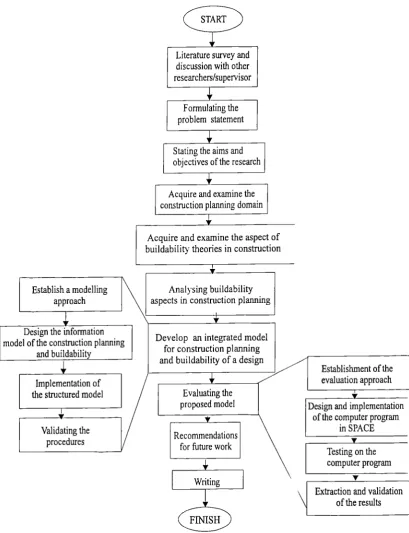
To respond to the aims and objectives of this research, Figure 1.1 outlined the methodology used for the research. Among the major works involved in the research methodology
include:-conducting literature reviews and interviews to acquire the construction planning domain and the buildability concepts applied in the construction industry to establish the problem area.
identifying and formalising the construction planning process and design models to develop a method for buildability evaluation using the construction data.
developing information models for both domains representing the integration approach and the proposed buildability evaluation model.
developing and implementing an integrated object oriented knowledge based system from the proposed information models.
model of the construction planning and buildability
Implementation of the structured model
drawing conclusions of the proposed application and recommendation for
future research.
START
Literature survey and discussion with other researchers/supervisor
Formulating the problem statement
Stating the aims and objectives of the research
Acquire and examine the construction planning domain
Acquire and examine the aspect of bui Idabi lity theories in construction
Establish a modelling Analysing buildability approach aspects in construction planning
Validating the procedures
Develop an integrated model for construction planning and buildability of a design
Evaluating the proposed model
Recommendations for future work
Writing
Establishment of the evaluation approach
Design and implementation of the computer program
in SPACE
Testing on the computer program
V
[image:32.595.74.484.164.698.2]Extraction and validation of the results FINISH
Chavter 1
1.6 Scope of the research
The research main aims are to provide a framework for construction planning application which is capable of exchanging information with other construction disciplines and formalise the construction process knowledge for buildability evaluation. The prototype application system would assist the users/evaluators in an interactive manner by highlighting the consequences of the design solution based on general buildability aspects. However, while
conducting and establishing the research work, various constraints have been
encountered in terms of:
1. The availability of buildability information covering reinforced concrete structure.
2. The difficulty in formalising the general principles of buildability using the information from the construction planning data since buildability is not
only influenced by technical matters but also by the multitude of
managers.
3. The size of construction knowledge required by the construction planning process in order to develop an optimum plan to provide the information
4. The technical factors in integrating and implementing the methodology for the prototype in an integrated computer application.
Based on the above constraints, the scope of the research work only covers certain subject areas,
namely:-1. The design subject to be investigated is an office building. The type of structure is only limited to reinforced concrete. Therefore, the construction plan and buildability analysis are limited to the construction process knowledge of a reinforced concrete structure.
2. The study is limited to the current documented construction activity types and their established construction methods. This limits the classification of the construction process and its required methods.
3. Since the research work will be part of an integrated system, the implementation of the conceptual models and the structured methodology developed from the research work will be limited by the software used i.e. Au t0 CAD/AECTM and KAPPAPCTM and the information provided by
the system from other domains.
4. Since the allocation of the type and number of resources, productivity and
Chapter 1
prototype system used a default resource allocation methods which have been developed by other researchers.
5. Only established buildability principles which can be extracted and measured from the construction plan, in the integrated system, will be considered.
1.7 Guide to the thesis
This section will highlight the structure of the thesis and the content of each chapter.
In order to highlight the issues and the current approaches of buildability in construction, Chapter 2 describes the basic concepts of buildability, its origin and development, its scope and problems, its effects, its influences on the project life cycle, its key areas and its evaluation approaches for a project.
be used as a tool to generate construction information for buildability evaluation.
Chapter 4 concentrates on the available development of application systems which supports both construction planning and buildability evaluation. It highlights the general approaches of the systems, the produced buildability results, and their system evaluation limitations.
Chapter 5 presents the integration involved in design and construction. It highlights the industry needs, the advantages of the approach and its related problems, especially the integration issues, between design and construction involved in a computer environment. The chapter also reviews the integration approaches to address the construction planning and buildability evaluation.
Chapter 6 presents the proposed quantitative approach of buildability assessment. It outlines the main information available from the construction planning process, the principles of buildability being used, and the measurement applied to evaluate the design based on the construction planning information.
Chapter 1
Object oriented techniques were used to model the static information and dynamic processes of both domains.
Chapter 8 describes the integration framework and approach used by SPACE (Simultaneous Prototyping Applications for Construction Environment) to accommodate the various application modules in the construction environment in which CONPLAN is part of the system. The chapter also briefly highlights SPACE's components and its system architecture.
Chapter 9 presents CONPLAN (intelligent CONstruction PLANning for design rationalisation) module which is developed as a prototype to generate construction plans and buildability evaluation. The system architecture, its components, and its development as an integrated application system are outlined in this chapter.
Having developed the CONPLAN as an integrated prototype system, Chapter 10 describes the experimental approach performed on CONPLAN to
evaluate the validity of its approach, applicability and its usefulness to the construction industry.
Chapter 2
The Research Context: The
Construction Industry And Its
Approach To Buildability
2.1 Introduction
Buildability has been a major criteria for successful design and construction of a project. In 1983, low buildability has been reported for causing high cost
of building in UK (Allsopp, 1983). When the problem was highlighted, a number of conferences have been reorganised to investigate the concepts, applications and implications of buildability in the construction industry. Although, the construction industry has long realised the benefits of buildability to the client as well as the rest of the parties in the project. the industry is still being subjected to high level of inefficiency caused by low buildability which undoubtedly clients are paying the price for.
Chapter 2
constructors take their tasks as construction works that required to be completed at the lowest price. Currently, since there has not been a clear understanding of how to formally incorporate the construction expertise as part of the design process (Jergeas, 1989), the problem would become more serious in the project if no effort have been made to take full account of both functions to obtain optimise solution for buildability of the project.
This chapter will describe briefly the definition, aspects, origin of the problem, scope, problem related to buildability in practice and appraisals adopted to improve buildability.
2.2 Definition of buildability
The Construction Industry Research Information Association (CIRIA) defined buildability as
".... the extent to which the design of a building facilities ease of construction subject to overall requirements for the completed
building."(CIRIA, 1983)
Construction Industry Institute (CII, 1986) defines buildability as
Chavter 2
Illingworth (1984) defined buildability as
".. design and detailing which recognise the problems of construction process in achieving the desired result safely and at least cost to client.".
Fergusan (1989) explained buildability
"as the ability to construct a building efficiently, economicall y and to agreed quality levels from its constituent materials, components and sub-assemblies."
Although buildability definition given by various researchers and organisations above appear somewhat different from one another, the concept and the purpose of the definitions are mainly the same.
2.3 The origin and development of buildability in design and
construction
Chapter 2
However, as projects become increasingly complex due to the emergence of new building materials, construction technology, users demand for high technology of service facilities, etc. various professions have emerged to provide the various demands in design and construction. Later, it has been suggested (Bowley, 1966) that the dichotomy in design and construction may be the cause of the difference between rapid rate of progress in science and technology and the slow pace with which advances are applied in the building process.
The establishment of various professions such as architecture, structural engineers, services engineers, landscape architects, builders, specialist contractors, etc. which reinforced the division in the industry were slowly encountered since the 18th1 century (Walker, 1989). The split of design and construction paved the wa y to the establishment of architecture as a
profession. Through the passing of a supplementary charter of the Royal Institute of British Architects in 1887, the separation of the design profession
from actual construction of buildings, was concluded, in which design activity was granted as a profession of architects.
task into several other specialist tasks, such as structural engineers, services engineers, civil engineers, quantity surveyors, etc.
Nevertheless, the separation of design and construction in the industry is considered as the practical approach to suite UK requirements and was not
challenged until 1962, when a report (Emmerson Report, 1962) was produced, suggesting that the separation was considered as major contributory factor to the inefficienc y of the U.K construction industry. This investigation inspired further awareness of buildability, which in 1964, further confirmation was noted (The Banwell Report, 1964) where it was suggested that
"design and construction must be considered together and that in the traditional contracting situation, the contractor is too far removed from the design stage at which his specialist knowledge and techniques could be put to invaluable use..., the builder is a member of the team and should be in it from the start."
Later in 1975, The Wood Report (NEDO, 1975) was produced recognising
the needs to improve the design and construction interrelationship i.e. buildability of a project. It was noted that
Chapter 2
contractors have much to offer at the design stage, especially by way of advice on constructional implications of design solutions and decisions ... yet, methods of procurement are still such that they are brought in too late for their advice and experience to be of practical use...the original problems still exist."
Again in l980's , various strong new opinions from within the construction industry emerged suggestin g that this traditional separation of design and construction phases of the building process was primarily responsible for the lack of buildability of present construction projects (Griffith, 1984). Despite CIRIA (1983) acknowledgement that ease of construction may be influenced by many organisational, technical. managerial and environmental considerations, the main contribution was thought to lie in those factors which fall within the influence or control of the design team.
2.4 Scope of buildability
Chapter 2
integrating the knowledge and experience of the designers/consultants, the builders, subcontractors and suppliers from inception to completion of a project.
Since CIRIA (1983) also acknowledged that the ease of construction may be
influenced by many organisational, technical, managerial and environmental considerations, therefore, each participant in the project life cycle, is responsible to initiate buildability improvements. As every participant at every stage would have different views on the implementation of buildability to a project, the influences of the buildability improvements would come from all stages of the project life cycle i.e. from briefing and feasibility stages, design, procurement, construction, maintenance and demolition (Ferguson,
1989).
Griffith (1984 &1985) suggested in his buildability investigation on a Health
Centre Project, that besides design matters, the managerial aspects are the greatest influence to increase productivity and achieving buildability. To highlight the significant influences of the management on buildability, he summarised that
Chapter 2
Although it is essential for buildability to be implemented at every stage of the project life cycle through the perspectives and knowledge of the participants (as they have different implications to the project), a special approach for evaluating the buildability at each of these stage is required (Kalay, 1991). Although the buildability aspects could be influenced by various managerial and project oriented aspects such as environmental, political, economical etc., currently, majority of work done on buildabiity
only focused on the effect of design on construction and vice versa.
2.5 The effect of buildability on the project
Buildability affects various participants of the project as well as the progress of the project in numerous ways (0' Connor, 1985). In its simplest message CIRIA (1983) has suggested that
"Good buildability leads to major cost benefits for clients, designers and builders."
influence the positive result, such as higher productivity, improve the utilisation of resources, etc. If the negative factors of the buildability aspects are left unchallenged i.e. building elements vary in shape and specification, it would reduce, or influence the buildability level of the project.
The utmost consequence from bad buildability of a project is the cost to the client either through lost of investment or increase of project cost (Allsopp, 1983). In many occasions, the project also could be delayed by variation orders which would normally be issued to rectify design problems. For the designers, they could possibly lose the opportunity to take a new project as they are occupied with extra redesign works caused by impractical designs found during construction in the current project.
Chapter 2
construction as well as when commissioning since their designs will have been evaluated base on the operational requirements on site. The designers reputation also increase with a good deliverable designed project (Adam, 1989; Griffith, 1984).
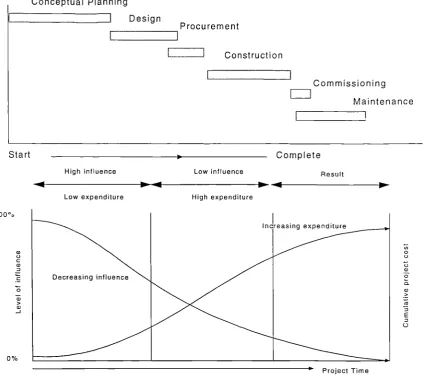
If buildability aspects are considered by the team at the early stage in design, the type of construction methods and its construction activities can be accurately be allocated in advance. Thus, the project can be efficiently constructed as accurate construction project planning and its predefined construction methods can be developed. The expected project duration also might be reduced, since less variation orders would be issued and interruptions caused by impractical design details are almost eliminated. The construction of the project would be able to run smoothly since less conflict between parties over design solution would be encountered, etc. Figures 2.1 below shows the stages for a project life cycle and indicate how progress made on each stage could lead to decreasing influence from designer and increasing in the project expenditure.
2.6 Buildability in project life cycle
1 000o a) 0 C a, S C 0 a, > a, -J 0%
by each of the participants vary accordingly. Although CIRIA (1983) has suggested that, to achieve good buildability, both designers and builders must be able to see the whole construction process through each others eyes, as the project develops through each stage of its life cycle; the opportunity and the effects of buildability improvements becoming less significant.
Traditional Project Life Cycle
Conceptual Planning I Design
_____________ Procurement
I Construction
Commissioning
Maintenance
Start Complete
High influence Low influence Result
Low expenditure High expenditure
0 0 U -w 0 0 a, > = E S 0 Project Time
[image:48.595.86.510.287.662.2]Level of influence on project cost
Chapter 2
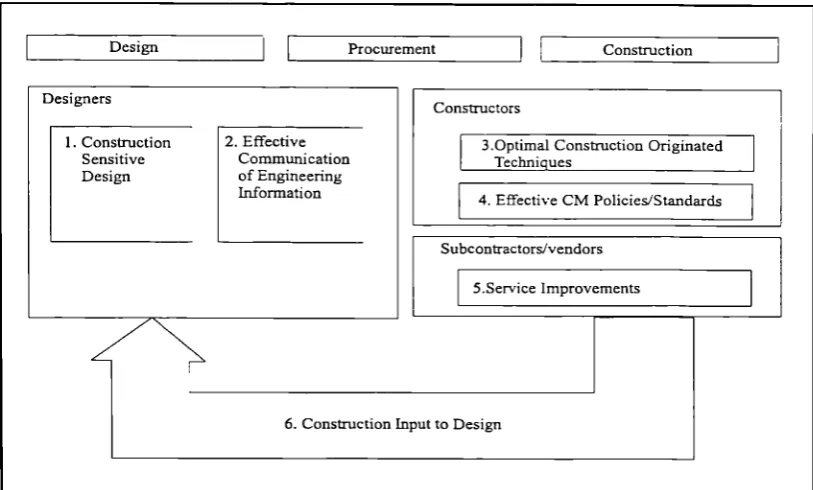
Among many of the participants involved in the project, the designers are expected to play the central role for buildability improvement, since they are responsible for most of the technical problems which arise in the project during design, in the erection of the project and commissioning of the project (Stone, 1983; Alkass, etai, 1991). For example, at the design stage, besides the designers are obligated to produce a design which conforms to the clients requirements they should also consider their detailed design implications to the construction process (Jergeas, 1989; Fisher, 1991).
Figure 2.1. illustrates the stages of project life cycle and the designers level of influence on the project cost over the project time. As the project progresses, the designers level of influence decreases while the project expenditure increases. The graph also illustrates that the best time to secure good buildability of a design is at the earlier stages of the projects development.
Hon, et al. (1989) stated that although for certain stages of the project life
of the project stages and the project participants requirements for improving buildability of a project.
Besides producing buildable detailed design, the communication of their design solution to the other parties involved in the project is also considered as one of the important factors for buildability, especially for the contractors and suppliers (0' Connor et aL, 1986). Efficient and effective format of
communication would have to be setup with which complete detailed drawings, specifications and instructions are clearly provided. The effective and efficient communication would be essential to avoid misinterpretation and misunderstanding of the design solutions by other parties.
Design Procurement Construction
Designers
1. Construction 2. Effective Sensitive Communication Design of Engineering
Information
Constructors
3.Optimal Construction Originated Techniques
4. Effective CM Policies/Standards
Subcontractors/vendors 5.Service Improvements
[image:50.595.71.478.407.652.2]6. Construction Input to Design
Figure 2.2 The project buildability improvement life cycle (0' Connor et al.,
Chavter 2
While at the construction stage, as part of buildability aspects required for project improvements, the contractors are entrusted to use optimal construction-originated construction techniques and effective construction resource management policies/standards (0' Connor et al., 1986). The contractors also have to contemplate how to use the most economical and efficient methods of construction for the project. It also suggested by 0' Connor etal.(1986 & 1987) that the vendor or subcontractor could also effect buildability at the construction stage by the standard of services they provided to the main contractor.
2.7 The key areas of buildability
From the range of buildability definitions given earlier, it is generally agreed that the aspects of buildability are contributed at all stages of the project life cycle, i.e. from briefing stage to maintenance and demolition. However, amongst all the stages of the project, the most prominent stages where buildability aspects have been properly defined and structured for implementation is design and construction (Fergusan, 1989; Illingworth.
1984; CIRIA, 1983; 0' Connor, 1985; 0' Connor etal.,1986).
Since, the implementation of buildability requires all parties involved in the design and construction to work together to secure good buildability, various guidelines have been produced to be observed and implemented for buildability of the project. CII Constructability Task Force (O'Connor et a]., 1986) described seven guidelines for accomplishing buildability in project development;
1. Construction-driven planning and programming.
Chapter 2
placed. After the drawings and specifications have been completed, further detailed and finalised schedules would be developed for the construction works in an interactive manner.
2. Design simplification.
Complex detailing which require difficult construction methods, could take longer construction time and costly resources and therefore should be avoided. Design should enable efficient construction. Although safety,
operability, maintainability and aesthetics are the usual project objectives which frequently transcend buildability, the design layout and design details may often be modified to enhance buildability without sacrificing the project objectives.
3. Standardisation and repetition of desin elements. This would reduce the learning curve and increase construction activity efficiency. Savings could be realised when the number of variations of components is kept to a minimum as it could simplify material procurement and materials management from fewer differing materials.
5. Modular/preassembly designs should be developed to facilitate prefabrication, transportation and installation. The benefit of modular/preassembly designs include improved task productivity, parallel sequencing of activity, increased safety, improved quality control and a reduced need for scaffolding.
6. Design should allow for accessibility of labour, materials and plant. Accessibility of the resources to site is a major requirements for effective and efficient construction. Projects would be delayed or incur high
construction cost if accessibility was not taken into consideration when designing the project.
7. Design should facilitate construction under adverse weather conditions.
Similar to the above objective but expressed in different words, CIRIA (1983) identify seven guidelines for both designer and contractor to follow in order to obtain good buildability. The guidelines proposed that:
Chapter 2
2. The layout and phased completion of sections of the building should
recognise the requirements of site access, materials handling and the construction sequence.
3. The method of construction should encourage the most effective sequence and should recognise the benefits of completing a "dry envelope" early on in the contract.
4. Designers should plan simplicity of assembly during the fitting out of the building and for a logical and ordered sequence of trades.
5. Maximum repetition and standardisation of components and building elements should be adopted.
6. Building designs should be prepared with achievable and appropriate tolerances.
7. Robust and suitable materials to allow for site conditions and the
capability of being protected should be specified.
difficult and uneconomic to build. For example, how many repetitions of specification for certain types of element is good enough for buildability to the project.
2.8 Applying buildability to projects
In general, the buildability of any construction project depends on five main participants, the client, the designers, the contractors, the manufacturers of building materials, and the institutional environment (local authority, banks. etc.). Each participant will have a time frame for taking part in the project development where their decisions could significantly affect the buildability improvement of the project. The clients contribute to buildability of the project by their skill in pointing out their needs at the briefing stage. prior to the preparation of the design and then assessing the value of the solutions put forward by the designers (Stone, 1983; 0' Connor, 1985).
Chapter 2
materials contribute to buildability of the project by providing quality building materials that fulfil the intended used on the site. The institutional environment play their roles in buildability of the project by providing efficient services required by the construction industry.
Although some suggestions for applying buildability improvements from CIRIA (1983) and O'Connor et al. (1986) have specified the area of responsibility of the participants involved in a project as described above, they do not address the specific procedures with which the participants could implement the buildability procedure in order to improve the buildability aspects of the project, except general guidelines to reduce the problem.
The absence of the specific procedure for improving the buildability is caused by poor interaction between all the project participants due to the procurement system employed, sequential process of project development, project participants are represented from different organisation, etc. In general the guidelines suggested for the designers to implement the buildability aspects in design, they have to analyse their design from the constructional point of view and to make appropriate adjustments to accommodate such views in their design solution.
designers have to take specific action to present the outcome of the analysis in an acceptable format for project communication and implementation.
2.9 Evaluating buildability
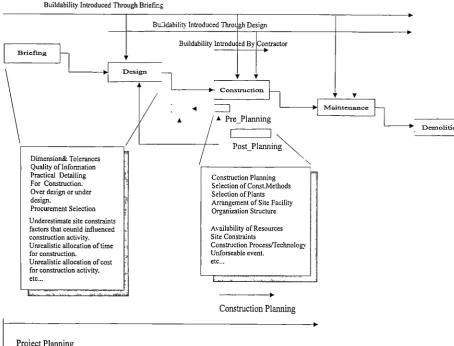
There are numerous aspects of design and construction which could be subjected to buildability evaluation such as dimension and tolerances, practical detailing, quality of information, selection of procurement system, site constraints, allocation of project construction cost and time, selection of construction methods, arrangement of site facilities, construction planning, etc. (Gray, 1983 & 1986; Illingworth, 1984: Ferguson, 1989; Jergeas. 1989; Underwood, 1995, Fisher, 1993). Figure 2.4 illustrate several stages of buildability evaluation which could be performed in the project development life cycle. Depending on the availability of information, some of these buildability aspects could only be performed at certain project development stages
Chapter 2
theoretical procedure to analyse and implement these aspects on a design (Jergeas, 1989, Fisher & Aalami, 1994).
Since the performed studies on buildability are varied and numerous, the result of the studies also varied accordingly i.e. from producing general guidelines of buildability to specific application systems addressing specific areas of buildability.
Buildability Introduced Through Briefing
Buldsbility Introduced Throtgh Design Buildability Introdued By
Briefing
Design
Construction
Dimension& Tolerances Quality of Information Practical Detailing For Construction. Over design or under design.
Procurement Selection Underestimate site constraints factors that counld influenced construction activity. Unrealistic allocation of time for construction.
Unrealistic allocation of cost for construction activity. etc...
I
Demolition A /A Pre Planning
__ P
_
Post Plannin''NN N Construction Planning
[image:59.595.73.528.305.651.2]Selection of Const.Methods Selection of Plants Arrangement of Site Facility Oreanization Structure Availability of Resources Site Constraints Construction Processffechnology Unforseable event. etc... Construction Planning Project Planning
Chapter 2
CIRIA(1983), CII(1986), Hon etal, (1989) and Ferguson (1989) for examples have produced general documentation giving various designs which show bad examples of buildability and the resolution adopted to amend the faults. Besides the guidelines, advance works have also been carried out to identify the low level aspects of buildability such as assembly and conversion of building materials (Ferguson, 1989), design against tolerances (Underwood,
1995), buildability against selection of standard formwork (Fisher, 1991 &
1993), buildability against time and cost (Gray, 1986; Stretton & Steven,1989), buildability against design detailing (Jergeas, 1989) and buildability design against construction methods (Fisher & Aalami, 1994).
2.10 The approach of buildability assessments
Majority of the research works on buildability have provided the industry with the general guidelines on what needs to be done to improve buildability, and when the implementation of the buildability is important in a project life cycle. Nevertheless, in spite of its importance, few researchers have recommended the practical solutions on how to evaluate the aspects of the buildability.
Chapter 2
suggested that the evaluation should consider the consequences from several different views, such as the time to construct, cost of construction and sequence of operations. Moore (1996) also suggested that the development of the buildability evaluation method is slow for two main reasons, first the difficulty to define buildability (within each stage of the project life cycle) in the context of its implication on construction and secondly how to evaluate a project which has little consideration to buildability.
However, the first generic qualitative measuring approach which could identify the effects of buildability aspects of a design was introduced by Ferguson (1989). The measurement was done by defining the 'hierarchy of difficulty' of assembly of the element or component of the building. The hierarchy is divided into five steps, i.e. assembly possible, assembly only possible with extreme difficulty, assembly possible without difficulty, assembly straightforward but perverse and assembly easy. The idea behind these hierarchy principles is for designers to measure the topological relationship of the design components or elements or sub-assemblies based on their interpretation as how difficult these elements are assembled or dissembled.
applying it to their design. However, since the method of measurement of this 'hierarchy of difficulty' is based on general rules on what the designers should observe to identify the buildability problem, further work to formulate this theory into a quantitative or an analytical technique in which design data can be collected and analysed is still to be developed.
The same basic buildability principles was also used by Fisher (1993), however, the research work has managed to provide specific feedback in which the designers could directly evaluate their proposed layout and dimensioning of reinforced concrete structures (building) with the available proprietary formwork system. The evaluation (Fisher, 1993) will argue about the geometrical and topological properties of the design before providing buildability answers to designers whether a selected construction method (in this case formwork system) can be used efficiently for the project. The facts about the applicability of the formwork selected for the structure is compared with the geometrical data (thickness, height, shape etc.) of all the structures elements i.e. beam, column, wall and slab. If the selected formwork is proved not suitable either caused by dimension or layout, the designers can change the proprietary formwork to a different system or change the entire arrangement of the structures layout and dimensions.
Chapter 2
significant influence on buildability, Jergeas (1989) has developed an evaluation approach, that could provide designers with an assessment system of detail design through a series of questions. By utilising previous project detail designs of a retaining wall system, and based on information provided by the designers, the evaluation approach would search a suitable wall system that meets design criteria defined by the user as well as recommending its components and the wall type construction that would have less of a buildability problem. Before recommending the wall system, the evaluation approach would reason about the weight of the retaining wall, lateral loads resistance, deterioration factor, services installation within the wall. weather conditions, degree of inspection required and type and complexity of formwork to be used. A report which shows the cost activity breakdown of the wall system is also displayed for comparison.
to justify the buildability of the selected cladding system and the structure grid and layout dimension system. Accordingly based on the allowable tolerances of the cladding or lining that have been selected, all the grid and layout dimensions either horizontally or vertically would be adjusted. A prototype system which provides the analysis and the solution was build as part of the research work.
Besides the above approaches which are used to analyse buildability of a project, the general quantitative accepted measurement for comparing design solutions developed by other researchers is through using costs and duration derive from the design. This measurement is done by calculating the cost and duration required to build a specific type of project, based on the general construction activity such as groundwork, superstructure, roof, services, etc. The result from the construction activity in the system will indicate whether the design is costly, economic or efficient to be build.
Comparatively, based on the general activity breakdown of the project, i.e. superstructure or substructure or roof or services, if the design show high construction costs and longer duration, the designers can decide either to redesign or maintain the same design solution. This type of analysis for buildability was produced by Stretton and Steven (1989) and Gray (1986).
Chapter 2
design with the available proprietary formwork system, previous detail designs or cladding type on the market, the systems do not provide construction evidence which are based on cost, time and resources or the construction processes that could be concluded if the recommendations were overruled or taken on board. With reference to the result of the analysis, the designers are only given an opportunity to alter their selected proprietary system or change the structure, size and dimensional layout.
On the other hand, the evaluation provided in Gray (1986) and Stretton and Steven (1989) gave general indication of buildability impacts on cost, resources and time, they do not highlight specifically the elements or factors for which the buildability factors have been considered such as whether it was caused by irregular elementary dimensions, incompatible design layout with available formwork systems, difficulty of assembly due to non-standardised elements, dimensional intolerance, specifications or by the factor of difficulty in the construction processes.
element requires close evaluation for buildability, is impossible to be indicated from the system.
Having outlined the theoretical aspects of buildability alone could not fully assist the designers to produce a good buildable construction project. Therefore, some researchers also have formalised the basic theoretical aspects of identifying and solving the buildability factors into a computer system to provide an automatic buildability assessment system. Chapter 4 will address these applications and explain a new proposal to measure buildability of various elements of the design. The proposed evaluation would consider the consequences of buildability from the general principles of buildability improvements which would be able to provide the result of the analysis by indicating the time to construct, cost of construction, sequence of operations, trade and plant usability, etc.
2.11 Summary
Chapter 3
The Construction Industry And
Its Approach To Construction
Planning Process
3.1 Introduction
Although the available information technology could provide enormous advantages for the construction planning process, and increase the added value of the process, the development of an automated construction planning process still face many obstacles (Hendrickson & Maher, 1989; Aouad, 1991; Kahkonen, 1993; Yamazaki, 1993). Among the major problems that slowed down the automation of construction planning process are structuring the construction planning process knowledge, capturing the scope of design and construction information required for a particular project, providing an optimum solution and presenting various scopes and levels of the construction plan (Benjamin et al., 1990; Navinchandra et aL, 1988; Kartam
& Levitt, 1990).
This chapter will describe the various fundamental aspects of the construction planning process and its contributions to the construction of a project and to the parties involved. The aim is to highlight the complexity of various processes involved before formalising it to support buildability evaluation.
3.2 Definition
Chapter 3
since it would become the basic reference for executing, monitoring and controlling the construction work on site.
Currie and Drabble (1992) describes, the word 'plan' which simply means as creating a set of actions to meet some predefined objectives while a planning system' (whether it is used in construction, manufacturing or other industrial sectors) is the process responsible for producing a plan defining a possible solution to a specified problem. Ackoff (1970) defined planning as a decision making process performed in advance of action, which endeavours to design a desired future and effective ways of bringing it about. Laufer (1990) describes planning as a decision making process that employs formal procedures and techniques, documented presentation (in the form of plans) and implementation, which evolves through a hierarchical process from general outlines into objectives, to elaboration of means and constraints that lead to a detailed course of action.
3. 3 The aspects of the construction planning process
primarily to reduce the uncertainty that exists before or while a project is executed, avoiding project crisis and improve efficiency of the operation by clarifying the objectives (Ahuja etai, 1994).
As a normal practice in the construction industry, the construction planning process is carried out by the contractor to produce the construction plan before the actual construction work takes place on site. Based on estimated qualitative analysis and judgement, the construction plan represents of what. how, when and why factors of the contractor's intention to realise the project. Therefore, the production of the project construction plan demands variety and extensive knowledge about planning and scheduling principles. the project objectives, the availability of construction techniques and methods, types and use of various construction resources, construction safety. construction regulations, and the interpretation of designs and specifications of a project. Each of these significantly affect the accuracy of the construction plan.