Available online www.jocpr.com
Journal of Chemical and Pharmaceutical Research, 2014, 6(6):2038-2043
Research Article
ISSN : 0975-7384
CODEN(USA) : JCPRC5
Oil film pressure distribution of combined piston skirt considering
the function of instantaneous clap force
Zhang Chun Yan
1, Ma Qi Hua
2and Jin Zhou
31
School of Mechanical Engineering, Shanghai University of Engineering Science, Shanghai, PR China
2School of Automotive Engineering, Shanghai University of Engineering Science, Shanghai, PR China
3Technical Research Center Shanghai Volkswagen Automotive Co. Ltd, Shanghai, PR China
_____________________________________________________________________________________________ABSTRACT
When the piston moves in the cylinder, on the one hand influenced by the explosion pressure of the gas, on the other hand due to the large mass of the piston, the piston is subjected to a large inertial force, then the force caused by the two side force on the piston. The change of lateral force will cause a slight lateral movement of the piston and the rocking motion (secondary movement) in the cylinder. The change of instantaneous clap force has a great impact on the form of oil film, which will affect the distribution of the oil film distribution. The instantaneous clap force of the piston skirt which is measured on a test machine will be considered to modular calculation of the dynamic equations. the distribution of oil film pressure will be analyzed and compared under the circumstances of considering the instantaneous clap force and not considering the instantaneous clap force, which will lay a solid foundation for the design of profile of the piston skirt as well as improve the lubrication conditions and reduce the impact on the cylinder.
Key words: Instantaneous Clap Force, Oil Film Pressure, Secondary Movement, Combined Piston Skirt _____________________________________________________________________________________________
INTRODUCTION
With the rapid development of ICE industry, high-power diesel engine piston is one of the most demanding parts of diesel engine, which would pass driving force in the high-speed reciprocating motion and withstand high mechanical and thermal loads [1]. The piston is one of the bottlenecks of the constraints to further diesel development. The piston design quality and machining accuracy level would directly affect the economic reliability and service life of the diesel engine. In the modern piston design process, considering the contact and friction performance of the design would become increasingly important throughout the entire design process.
Based on the hydrodynamic lubrication theory and system dynamics, the research of teratology characteristic on the combined piston of the type of 16V280 [2] high-power diesel engine was established. According to the secondary movement of the combined piston and to calculate the piston transverse and swing movement. The oil film pressure would be calculated by the means of the coupled hydrodynamic lubrication theory and the convex body elastic contact model.
EXPERIMENTAL MODELS AND NUMERICAL CALCULATION
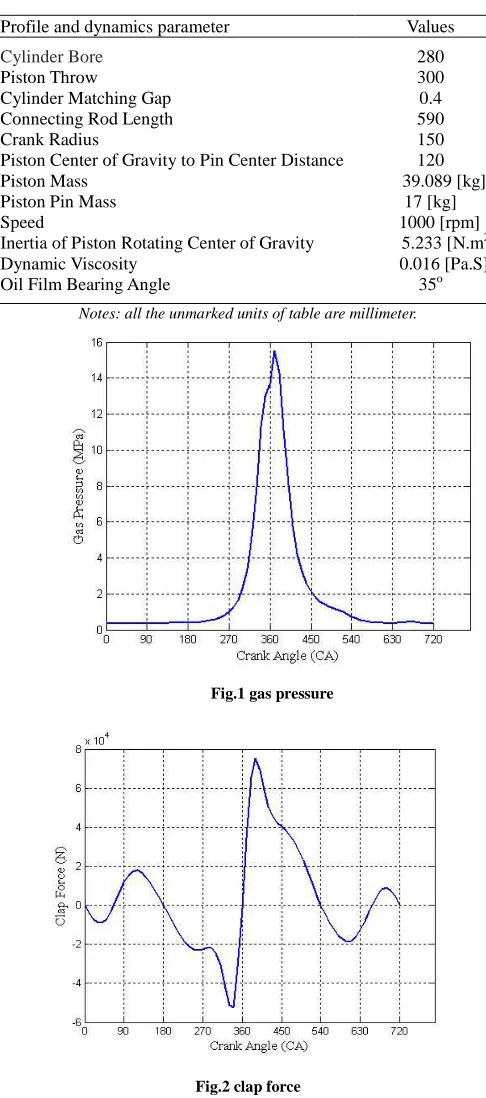
[image:2.595.182.425.175.724.2]The instantaneous clap force of the piston skirt which is measured on a test machine will be considered to modular calculation of the dynamic equations, given the basic parameters of the piston skirt and the equation iteration of the initial displacement, velocity and acceleration. In Table 1, the profile and dynamics parameter of piston of 16V280 diesel engine are shown on. In the case of speed 1000rpm, the gas pressure would be given at the top of piston head, which would be defined as Fig.1. Based on the Reynolds and dynamics Equation, under the circumstance of the conformity with iteration residuals, the results concerning the oil film pressure distribution could be obtained.
Table 1 Profile and dynamics parameter of piston of 16V280 diesel engine
Notes: all the unmarked units of table are millimeter.
Fig.1 gas pressure
Fig.2 clap force
The average two dimensional Reynolds equationof piston skirt and cylinder[3]is defined as Eq.1. Profile and dynamics parameter Values
Cylinder Bore Piston Throw
Cylinder Matching Gap Connecting Rod Length Crank Radius
Piston Center of Gravity to Pin Center Distance Piston Mass
Piston Pin Mass Speed
Inertia of Piston Rotating Center of Gravity Dynamic Viscosity
Oil Film Bearing Angle
280 300 0.4 590 150 120 39.089 [kg]
17 [kg] 1000 [rpm] 5.233 [N.m2]
Zhang Chun Yan et al
______________________________________________________________________________
3 3
(
h)
(
h)
6
(
s) 12
x y
P
P
h
h
U
x
φ
x
y
φ
y
µ
y
σ
y
µ
t
∂
∂
∂
∂
+
∂
=
+
+
∂
∂
∂
∂
∂
∂
∂
Oil film bearing area is calculated in the region
is zero in other region. The oil film bearing area is defined as Fig.3.
The grid area is oil film bearing area,the other determined,using different axial vertical grid spacing film bearing area of the piston skirt
along the direction of the skirt. Similarly in the circumferential direction is divided into the direction of the skirt and n equal parts.
Each grid cell of the skirt portion in the longitudinal direction and the circumferential spacing of the grid as Eq.2. 1
2
m
L
y
n
θ
θ
∆ =
∆ =
(2)SIMULATION RESULT AND ANALYSIS
According to the above numerical method [5], which i
oil film pressure distribution of the four strokes of the piston skirt modular, which would be defined as Fig.4, Fig.5, Fig.6, Fig.7 in the case of not considering the instantaneous clap force.
The image part with relationship ID rId19 was not found in the file.
J. Chem. Pharm. Res., 2014, 6(6):
______________________________________________________________________________
(
h
P
h)
(
h
P
h)
6
U
(
h
T s) 12
h
Tx
x
y
y
y
y
t
φ
φ
∂
+
φ
∂
=
µ
∂
+
σ
∂
+
µ
∂
∂
∂
∂
∂
∂
∂
∂
(1)
in the region of
(
−
θ θ
1, )
1 and(
π θ π θ
−
1,
+
1)
, Assuming region. The oil film bearing area is defined as Fig.3.Fig.3 oil film bearing area
film bearing area,the other blank space is non-bearing area. After
different axial vertical grid spacing and the same number as the standard to mesh grid film bearing area of the piston skirt is circumferentially divided into m equal parts, which
Similarly in the circumferential direction is divided into m equal parts and n equal parts.
he skirt portion in the longitudinal direction and the circumferential spacing of the grid
D ANALYSIS
numerical method [5], which involves the corresponding calculation Matlab code, maximal oil film pressure distribution of the four strokes of the piston skirt modular, which would be defined as Fig.4, Fig.5, Fig.6, Fig.7 in the case of not considering the instantaneous clap force.
Fig4. oil film pressure crank angle 110(deg.)
The image part with relationship ID rId19 was not found in the file.
J. Chem. Pharm. Res., 2014, 6(6):2038-2043
______________________________________________________________________________
Assuming the oil film pressure
bearing area. After the calculating region is same number as the standard to mesh grid [4].The oil , which is divided into n parts m equal parts divided along
he skirt portion in the longitudinal direction and the circumferential spacing of the gridis defined
As can be seen from the figure, the pressure distribution symmetrical, a peak value is in the center of the contact area. Fig degree, the maximum oil film pressure
peak top on the piston, the piston combined joint action by the force of inertia, friction
The calculating result considering the i
Fig.10 shows at the time when the crank angle is 380 degree, when the oil film pressure distribution of the skirt portion, the maximum oil film pressure reaches 4.2 MPa in the expansion stroke. The volume of the combustion gas
Fig5. oil film pressure crank angle 330(deg.)
Fig6.oil film pressure crank angle 380 (deg.)
Fig7. oil film pressure crank angle 610(deg.)
As can be seen from the figure, the pressure distribution along the circumferential direction of the film is a peak value is in the center of the contact area. Fig.6 shows at the time when
the maximum oil film pressure reaches 2.11MPa in the expansion stroke. The gas pr the piston, the piston combined joint action by the force of inertia, friction.
result considering the instantaneous clap force is defined as Fig.8, Fig.9, Fig.10, Fig.11.
he crank angle is 380 degree, when the oil film pressure distribution of the skirt portion, the maximum oil film pressure reaches 4.2 MPa in the expansion stroke. The volume of the combustion gas along the circumferential direction of the film is at the time when the crank angle is 380 he gas pressure is also a great
is defined as Fig.8, Fig.9, Fig.10, Fig.11.
Zhang Chun Yan et al
______________________________________________________________________________
upper dead point, the wedge due to the presence of two small extruded film while its carrying capacity is increased only.
J. Chem. Pharm. Res., 2014, 6(6):
______________________________________________________________________________
upper dead point, the wedge due to the presence of two-way, the film thickness due to the lateral force becomes small extruded film while its carrying capacity is increased only.
Fig.8 oil film pressure crank angle 110(deg.)
Fig.9 oil film pressure crank angle 330(deg.)
Fig.10 oil film pressure crank angle 380 (deg.)
J. Chem. Pharm. Res., 2014, 6(6):2038-2043
______________________________________________________________________________
According to the calculation results and analysis, comparison of the
in the case of not considering the instantaneous clap force and considering the instantaneous clap force. The three-dimensional pressure distribution can reflect the actual value of the oil film pressure
distribution. The results show the maximal value of the oil film pressure reaches 2.11MPa without considering the instantaneous clap force. On the contrary, the oil film pressure of the piston skirt reaches 4.2MPa in the case of considering instantaneous clap force. By Comparison, it sharply increases 2.09MPa in the oil film pressure, which is mainly attributed to the instantaneous clap force in the momentary action and the decreasing thickness of the oil film, which increases in the bearing capacity of the oil film [6]. With the requirements of the withstanding the higher mechanical and thermal load, the oil film pressure of the piston skirt would be considered, which is of benefit to form bidirectional oil wedge.
[1] X.H. Meng Y.B. Xie: Lubrication Engineering [2] KevinSawly, et al: Railway Age
[3] Patir N, Cheng H S. ASME Journal of Lubrication Technology [4] R.H. Sun T. Xu: Journal of Jilin University
[5] Y.Lou J.J. Yan: Vehicle Engine [6] Z.Wang, et al: Transaction of CSICE
Fig.11 oil film pressure crank angle 610(deg.)
CONCLUSION
According to the calculation results and analysis, comparison of the oil film pressure distribution of the piston skirt in the case of not considering the instantaneous clap force and considering the instantaneous clap force. The
dimensional pressure distribution can reflect the actual value of the oil film pressure
distribution. The results show the maximal value of the oil film pressure reaches 2.11MPa without considering the instantaneous clap force. On the contrary, the oil film pressure of the piston skirt reaches 4.2MPa in the case of idering instantaneous clap force. By Comparison, it sharply increases 2.09MPa in the oil film pressure, which is mainly attributed to the instantaneous clap force in the momentary action and the decreasing thickness of the oil film,
bearing capacity of the oil film [6]. With the requirements of the withstanding the higher mechanical and thermal load, the oil film pressure of the piston skirt would be considered, which is of benefit to
REFERENCES
Lubrication Engineering, Vol. 33(2008) No.11, p.23.(In Chinese) : Railway Age, 1999, No.2.
ASME Journal of Lubrication Technology, 1978, 100(1):12-17. Jilin University, Vol. 39(2009) No.5, p.1236.(In Chinese) Vehicle Engine, Vol. 164 (2006) No.4, p.11.(In Chinese)
Transaction of CSICE, Vol. 17(1999) No.4, p.17.(In Chinese)
oil film pressure distribution of the piston skirt in the case of not considering the instantaneous clap force and considering the instantaneous clap force. The dimensional pressure distribution can reflect the actual value of the oil film pressure and status of pressure distribution. The results show the maximal value of the oil film pressure reaches 2.11MPa without considering the instantaneous clap force. On the contrary, the oil film pressure of the piston skirt reaches 4.2MPa in the case of idering instantaneous clap force. By Comparison, it sharply increases 2.09MPa in the oil film pressure, which is mainly attributed to the instantaneous clap force in the momentary action and the decreasing thickness of the oil film,
bearing capacity of the oil film [6]. With the requirements of the withstanding the higher mechanical and thermal load, the oil film pressure of the piston skirt would be considered, which is of benefit to
) No.11, p.23.(In Chinese)