SHUKUR BIN SALEH
OPERATION WITH RENEWABLE ENERGY
SHUKUR BIN SALEH
A project report submitted in partial
fulfillment of the requirement for the award of the Degree of Master of Electrical Engineering
Faculty of Electrical and Electronic Engineering Universiti Tun Hussein Onn Malaysia
ACKNOWLEDGEMENT
In the name of Allah, The Most Gracious and The Most Merciful
First of all, I wish to praise God, the Almighty God and the benevolent for given me the strength and time to complete this task. I would like to express my sincere appreciation to my supervisor; Dr. Mohd Noor Bin Abdullah for his thoughtful insights, helpful suggestions and continuous support in the form of knowledge, enthusiasm and guidance throughout this master project.
Special thanks to my family, especially my wife (Norhasikin Binti Ismail) and my parents for their constant encouragement and always praying for my success and also very supportive throughout my studies. A million thanks to my MSc/PhD colleagues; Mr. Azmi Sidek and Mr. Ariffuddin Joret, thank you so much for your ideas, motivations, involvement and support during our MSc journey. A special thanks to all lecturers in the Department of Electrical Power Engineering, Faculty of Electrical and Electronic Engineering, Universiti Tun Hussein Onn Malaysia.
ABSTRACT
Lately, an electrical network in microgrid system becomes very important to rural or remote areas without connection from primary power grid system. Higher cost of fuels, logistic, spare parts and maintenance affect the cost for operation microgrid generation to supply electrical power for remote areas and rural community. This project proposes an Improved Firefly Algorithm (IFA), which is a improvement of classical Firefly Algorithm (FA) technique using characteristic approach of Lévy flights to solve the optimal microgrid operation. The IFA has been used for optimizing the cost of power generation in microgrid system where daily power balance constraints and generation limits are considered. The microgrid system for this case study considered both of renewable energy plant and conventional generator units. There are two test systems that have been considered as case study. The first test system is a simple microgrid system which consists of three generators. The second test system consists of seven generating units including two wind turbines, three fuel-cell plants and two diesel generators. The IFA method has been implemented using MATLAB software. The results obtained by IFA was compared to FA and other algorithms based on optimal cost, convergence characteristics and robustness to validate the effectiveness of the IFA. It shows that the IFA obtained better results in terms of operating costs compared to FA, Differential Evolution (DE), Particle Swarm Optimization (PSO) and Cuckoo Search Algorithm (CSA).
ABSTRAK
TABLE OF CONTENTS
TITLE i
DECLARATION ii
ACKNOWLWDGEMENT iii
ABSTRACT iv
ABSTRAK v
TABLE OF CONTENTS vi
LIST OF FIGURES x
LIST OF TABLES xi
LIST OF SYMBOLS AND ABBREVIATIONS xiii
LIST OF APPENDICES xiv
CHAPTER 1 INTRODUCTION
1.1 Project Background 1
1.2 Problem Statement 2
1.3 Project Objectives 3
1.4 Project Scopes 3
1.5 Project Methodology 3
1.6 Significance of the Project 5
1.7 Report Organization 6
CHAPTER 2 LITERATURE REVIEW
2.1 Introduction 7
2.5 2.6
Operation
Renewable Energy Resources Firefly Algorithm
14 15 2.7
2.8
Review Application of Firefly Algorithm Summary
18 19
CHAPTER 3 METHODOLOGY
3.1 Introduction 20
3.2 Project Methodology 20
3.3 Cost Modelling for Distributed Generation 3.3.1 Wind Turbine Generator
3.3.2 Fuel-cell Plant 3.3.3 Diesel Generator
23 23 24 24
3.4 Problem Formulation 24
3.4.1 Objective Function 25
3.4.2 Constraints 25
3.5 Classical Structure Firefly Algorithm 26 3.5.1 Implementation Steps of Firefly
Algorithm
28
3.6 Proposed an Improved Firefly Algorithm (IFA)
30
3.7
3.8
Proposed IFA for Solving Generation Scheduling in Microgrid
3.7.1 Implementation Steps of IFA Summary
30
CHAPTER 4 RESULT AND ANALYSIS 4.1 4.2 4.3 4.4 Introduction Test System I
4.2.1 Effect of Population Size
4.2.2 Effect of Parameter Setting Attractiveness (β) and Randomization (α) for IFA
4.2.3 Optimal Power Output 4.2.4 Robustness of IFA
4.2.5 Comparison Between IFA and Other Optimization Algorithms
Test System II
4.3.1 Wind Turbine Output Power 4.3.2 Effect of Population Size
4.3.3 Effect of Parameter Setting Attractiveness (β) and Randomization (α) for IFA
4.3.4 Optimal Power Output 4.3.5 Robustness of IFA
4.3.6 Comparison Between IFA and Other Optimization Algorithms Summary 37 37 38 39 41 41 42 44 45 47 49 50 54 55 56
CHAPTER 5 CONCLUSION AND RECOMMENDATIONS
5.1 5.2
Conclusion
Recommendation and Future Work
APPENDIX A 64
LIST OF FIGURES
1.1 A flowchart of the general methodology of the project
4 2.1 Taxonomy of firefly algorithm application 16 3.1 A flowchart of project research methodology 22 3.2 Pseudo code for Firefly Algorithm (Yang, 2010) 26 3.3 Pseudo code for an Improved Firefly Algorithm
(IFA)
31
3.4 Flowchart of an Improved Firefly Algorithm using Levy flights
35
4.1 4.2 4.3 4.4
4.5 4.6
4.7 4.8
Test system I
Robustness of best objectives IFA
Comparison method on total generator cost ($) Convergence of optimal cost between IFA and FA
Test system II
Convergence characteristic of IFA for difference population sizes
Convergence characteristic of IFA and FA Robustness of best objectives IFA
38 42 43 43
44 48
LIST OF TABLES
2.1 Comparison of traditional power grids and microgrids.
10
4.1 Parameter setting of IFA 37
4.2 Cost coefficient and generator limits for test system I
38 4.3 Effect of population size between IFA and FA
for test system I
39
4.4 Average cost of microgrid for different values of attractiveness (β) results
40 4.5 Average cost of microgrid for different values of
randomization (α) results
40
4.6 Optimal schedule of microgrid using IFA and FA
41
4.7 Comparison of the optimal solution 42 4.8 Generation cost coefficients and generation
limits of distributed generations
44 4.9 Load profile and wind speed within 24 hours 45 4.10 Wind turbine speed characteristic and output
power calculation
46
4.11 Comparison result of different population size between IFA and FA
48 4.12 Average cost of microgrid for different values of
attractiveness (β) results
49
4.13 Average cost of microgrid for different values of randomization (α) results
50
4.15 Optimal schedule of microgrid using FA 52 4.16 Comparison of the optimal results between IFA
and FA for test system II
53
4.17 Comparison of the optimal results between IFA and others algorithm with total generation of DG’s within 24 hours
LIST OF SYMBOLS AND ABBREVIATIONS
CSA - Cuckoo Search Algorithm DE - Differential Evolution DG - Distributed generation ED - Economic Dispatch Eff. - Efficiency
FA - Firefly Algorithm
IFA - Improved Firefly Algorithm ith - No. of iterations
kW - KiloWatt
PSO - Particle Swarm Optimization
Pmin - Minimum power output of generator
Pmax - Maximum power output of generator
, , - The cost coefficient of the generator unit ( ) - The total fuel cost
h - Hour
n - No. of population Fireflies Algorithm - Power demand
- The real power output of generator v - Wind Speed
α
β
- Randomization parameter of FA - Attractiveness parameter of FA γ - The absorption coefficient $ - Dollar
LIST OF APPENDICES
APPENDIX TITLE PAGE
A Optimal power output of different population
sizes (n) for Test system-I 65
B Optimal power output of different population
CHAPTER 1
INTRODUCTION
1.1 Project Background
Recently, microgrids play a significant role to sustain generating and distribution of power energy system in modern electric networks. Microgrids are small scale network that supply power from renewable or conventional generating plant to small community such as rural area or islands with limited or no connection to main grid power [1]. A microgrid can operate as an independent system [2] and can be connected or disconnected from primary grid which is operated autonomously when the main grid is down. Besides strengthening power efficiency, stability and reliability for operation, the most challenging issue of microgrid is the economical operation. Since then, investigations on methods optimizing microgrid operation become a significant study among many researchers.
Thereby many researches have been used and proposed several optimization methods to reduce the operation cost of power generation in microgrid. Basu et al. [3] applied differential evolution (DE) method to reduce the emission and fuel cost in microgrids and M. Modiri et al. [4] have used an iteration based optimization method to minimize total cost generation and find out the schedules of generating units in power system. In some cases, as the microgrids consist of various types of generation units, optimal cost has become the most important target for overall operation [5].
generator in order to obtain the lower cost operation for microgrids. The FA algorithm was pioneer developed by Yang in 2008 [6], which is inspired by the behaviour of the fireflies. Firefly algorithm has been applied to solve optimization problems since early 2009. Many problems from various areas especially in engineering fields were successfully solved using FA. In recent years, some improvement; modification or even hybridization of FA started to be explored by many researchers with the aim to overcome computational constrain to become more flexible and efficient for future application [7].
In this research project, IFA will be used to solve the generation scheduling in microgrid system consisting of combination of conventional and renewable energy generating such as diesel fuel, wind turbine and fuel cell plant. However, this chapter will discuss the overview of the study beginning with research background followed by problem statement. Research objectives, research contributions, research scopes, research methodology and research significance are presented in the following section.
1.2 Problem Statement
The main problem of the research is determining optimal cost microgrid operation through generation cost minimization while satisfying the constraint and load demand. The challenge is greater when the generation of microgrid consists of various sources with different costs for each source whether its renewable or conventional resources. Although the operating cost is most significant but the performance of microgrid also needs to be optimum. Therefore an improved firefly algorithm will be applied to minimize the generation cost.
(a) To propose an Improved Firefly Algorithm (IFA) for solving optimal generation power scheduling in microgrid system.
(b) To investigate the performance of an Improved Firefly Algorithm (IFA) for minimizing operation cost in microgrid within 24 hours.
(c) To compare the results of an Improved Firefly Algorithm (IFA) with FA and other well-known algorithms in microgrid operation.
1.4 Project Scopes
In this study, there are three (3) scopes. The research has been conducted with the following limits:
(a) This study has focused on reducing cost operation in microgrid using an Improved Firefly Algorithm (IFA) technique.
(b) The software tools applied for IFAtechnique is MATLAB version R2013b. (c) Dispatch duration for minimizing cost operation is within 24 hours.
(d) The microgrid system consists of renewable energy such as two unit of wind turbine plants, three units of fuel-cell plants and conventional such as two units of diesel fuel generators for this case study.
(e) Investigate the performance of IFA in terms of generated power output, cost minimization, simulation time, convergence characteristics and robustness. (f) Comparison between the IFA and other algorithms.
1.5 Project Methodology
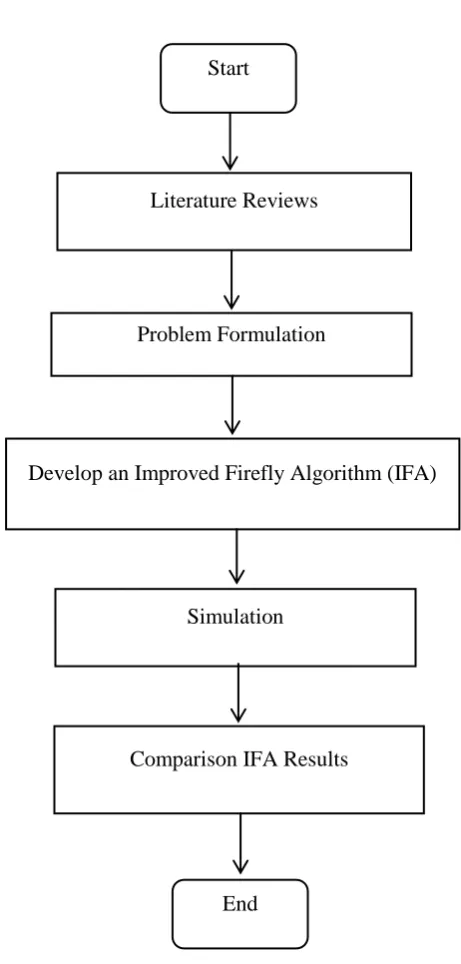
Figure 1.1: A flowchart of the general methodology of the project
In order to achieve the objectives of this study, the following methodology is used as guideline during the study.
(a) In literature reviews: Explanation of related case studies from previous research or technical paper, research gap and objective determination.
Literature Reviews
Problem Formulation
Develop an Improved Firefly Algorithm (IFA)
Comparison IFA Results Simulation
Start
(c) Develop Firefly Algorithm in MATLAB: For initial stage to create programming FA in MATLAB command. Then impose a few modifications or improved original FA coding during research study. In this developing programming codes for solving optimization problem - using IFA. After that identify and compile the objective/fitness function, parameter and boundary setting from formulation problem into IFA programming. At the end of this section, after IFA has finished simulating, results of optimal power generators and minimum cost operation of microgrid as our main goal of research study will be obtained.
(d) Perform data test using IFA: The test depends on the valid resource data from previous recommended research paper with consent of author and supervisor. The test system and parameter applied depend on requirement. Detail explanation regarding test system will be covered in methodology section (Chapter 3).
(e) Conduct Comparison between IFA with other algorithms: Compare results (optimum power and cost operation) between IFA to other algorithms (DE/PSO/CSA) to investigate optimization level to obtain best minimal operation cost in microgrid.
(f) Analyse the performance of IFA: Carry out sensitivity analysis to investigate IFA such as convergence performance.
1.6 Significance of the Project
(a) Enhance insight regarding the knowledge of determining the significant small modification or hybridization of FA techniques in the fireflies for example insect behaviour imposed with Gaussian, Lévy flights or Chaos distribution method for problem optimization solution.
(b) Since IFA technique has improved compared to FA, the algorithm improvement will provide more precise efficient and flexible method, beneficial in many fields. This contributes to solving optimal generation power scheduling with minimum operation cost in microgrid for real-world problems.
1.7 Report Organization
This report orderly consists of 5 chapters. The content of each chapter is explained briefly as follows:
Chapter 2: includes discussion and summarization of previous researches and theories of the relevant research works conducted by other researchers in similar field through literature review.
Chapter 3: presents the methodology being used to construct this project. The details of method process are discussed in this chapter.
Chapter 4: shows the results obtained of IFA and the results are being analysed completely. Then, discussion on results obtained are compared to FA and other algorithms in the case study.
LITERATURE REVIEW
2.1 Introduction
In this chapter, a literature review of microgrid operation and optimizing techniques that
have been used to solve the microgrid optimization problem will be discussed. Recently,
the operation cost of microgrid region on the generation and distribution of power supply
to the local community has become a critical issue for many years. Therefore economic
dispatch (ED) problem is the root of optimization problem. Thereby, the economic
dispatch is described in this chapter to understand the problem. A review of economic
dispatch in microgrid from a previous study is also discussed in this chapter with various
applications for solving problems. The review on economic dispatch will be described in
sub-chapter 2.2. The theory of microgrid system is explained in sub-chapter 2.3.
Sub-chapter 2.4 and 2.5 described the review by various researchers related to renewable
energy resources and optimization methods applied in microgrid. The general theory of
Firefly Algorithm is explained in sub-chapter 2.6, with its application in several fields.
The review of improvement or upgrading FA in previous research for solving
optimization problems in several fields become new challenges for researcher to find the
best current solution and this will be described in sub-chapter 2.7. Lastly, the discussion
on summary of overall literature review of sub- topic related with research study in order
to achieve the objective of this project will be explained in sub-chapter 2.8.
2.2 Economic Dispatch
dispatch of power system can be categorized into static and dynamic dispatches [8]. The dynamic economic dispatch is more suited with an actual operation system, which is for coordinates between the different distribution generations (DGs) over several periods other than considering the lowest cost in scheduling cycle. Meanwhile the static economic dispatch is based on the operating conditions of system over independent period to determine their priority and operation mode of power generating equipment. Therefore many researches on dynamic economic dispatch for optimal generation scheduling in microgrid is very vital. The research in [9] introduced model CHP microgrid by proposing a Monte Carlo simulation based on Leapfrog Firefly Algorithm (LFA) to solve optimization problem for dynamic economic dispatch. The CHP model consists of wind turbines (WT), photovoltaic cells (PV), micro turbines (MT), storage batteries (SB), gas-fired boilers, heat load and electric load. Final finding of the research concludes that dispatch period is rather long since the characteristic of microgrid shows that the outputs of microsources change very fast making the model built is not taken into account.
Han et al. [10], presented a study on the factors that affect the feasibility and optimality solution for dynamic economic dispatch (DED). It proposes two methods for solving the optimization problems; which is to provide feasible and optimal solution for power generation. The 5-unit and 10-unit system are selected for test with various solution methods such as heuristic, unconstrained, optimal and look ahead. Thus, the results above on attempted methods succeeded in providing two solution techniques to obtain the best solving for optimization for DED problems. These two new techniques provide; firstly, to find a feasible solution for all load profiles and secondly, an efficient technique for finding the optimal solution for cost operation minimization.
PV, DE and FC. Considering dynamic grid cost, the dynamic economic dispatch of microgrid also establishes the coordination between different distributed generations over many periods. Moreover, in order to maintain the reliability of the microgrid system, various scheduling strategies are employed.
A Weighted SumTime-Varying Differential Evolution (TVDE) is used to solve the dynamic economic emission dispatch with loss and heat optimization for microgrid [13]. The research study highlighted the power generation cost minimization and emission reduction of a microgrid. The microgrid consists of DE generator, WT, MT, SB, PV and FC. The technique proposed is to address economic emission dispatch with loss and heat optimization problem by creating sets of Pareto-optimal results. The results obtained show that TVDE gives better results for simultaneous optimization of four objectives like cost, emission, heat and loss in a microgrid.
2.3 Microgrid
In general, a microgrid refers to a small-scale version of the electricity or low voltage distribution of centralized system that consists of distributed energy resources (DERs). Other than that, microgrid sometimes can operate in either islanded; when a main utility grid faces serious problems, the power is constantly supplied to customers in the islanding operation [14] or grid-connected mode. There are two features of a microgrid; the integration of renewable sources and the use of combined heat and power (CHP) generators. These combinations increase the overall efficiency and contribute a great advantage to electricity system in microgrids. Hayden et al. [15] elaborated the microgrids consisting of several types depending on environment scale requirement such as community utility microgrid, commercial and industrial microgrids, campus or institutional microgrids, military base microgrids and finally remote “off-grid” microgrids.
through long distance main-grid transmission or distribution network [16]. The primary objective of microgrids is to ensure affordable energy reliability, security network and power stable delivery to utility consumers.
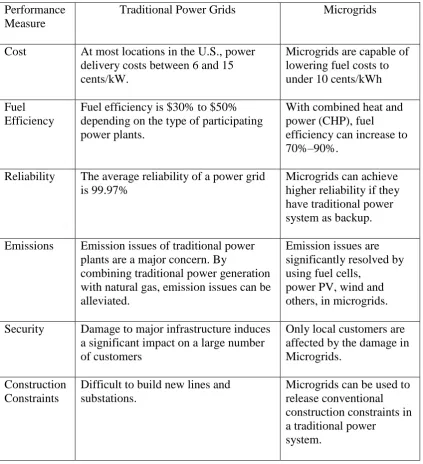
Table 2.1: Comparison of traditional power grids and microgrids.
Performance Measure
Traditional Power Grids Microgrids
Cost At most locations in the U.S., power delivery costs between 6 and 15 cents/kW.
Microgrids are capable of lowering fuel costs to under 10 cents/kWh Fuel
Efficiency
Fuel efficiency is $30% to $50% depending on the type of participating power plants.
With combined heat and power (CHP), fuel efficiency can increase to 70%–90%.
Reliability The average reliability of a power grid is 99.97%
Microgrids can achieve higher reliability if they have traditional power system as backup. Emissions Emission issues of traditional power
plants are a major concern. By
combining traditional power generation with natural gas, emission issues can be alleviated.
Emission issues are significantly resolved by using fuel cells,
power PV, wind and others, in microgrids. Security Damage to major infrastructure induces
a significant impact on a large number of customers
Only local customers are affected by the damage in Microgrids.
Construction Constraints
Difficult to build new lines and substations.
Microgrids can be used to release conventional construction constraints in a traditional power
system.
than power-grid. To further enhance the reliability and resilience of power generation in microgrids, proposed multiple microgrids can be connected to form an interconnected network as one of the best solutions if a large load demand can be separated and supplied by multiple microgrids.
Furthermore, when microgrids operate in grid-connected mode, it can also generate income for essential consumers and business by reselling the microgrid power to the grid or utility[17]. The ancillary services sold could include demand response, real-time price response, day-ahead price response, voltage support, capacity support and spinning reserve[15].
However, there are disadvantages of microgrids which is difficulty of setting parameter (voltage, frequency, power quality) because the parameter must be controlled to acceptable standards whilst the power balance is maintained in microgrid operation [15]. Besides that, microgrid requires more space and maintenance due to the battery banks [18]. Moreover, the difficulty of resynchronization with the utility grid, protection problems, and issue regarding obstacles to standby charges/net metering and inconsistency application are due to interconnection standards IEEE P1547 [19].
2.4 Review of Optimization Methods of Generation Scheduling for Microgrids Operation.
There are two types of optimization method, which are traditional and meta-heuristic methods. Meta-meta-heuristic method is a nature-inspired algorithm. This is because it is inspired by the behaviour of the nature to develop an algorithm that will be used to solve optimization problems. Examples of meta-heuristic methods are Genetic Algorithms (GA), Ant Colony Optimization (ACO), Particle Swarm Optimization (PSO), Differential Evolution (DE), Artificial Bee Colony (ABC), Glowworm Swarm Optimization (GSO), Cuckoo Search Algorithm (CSA), Bat Algorithm (BA) and Firefly Algorithm (FA) that have shown great potentials in solving hard engineering optimization problems. In order to solve the diverse problems, the original algorithms need to be improved by modifying or hybridizing.
There are many research papers using meta-heuristic methods to investigate the economic generation scheduling for microgrid. Braun et al. [20] has proposed GA to investigate on short term optimization of microgrid operation to reduce the costs of operation and pollutant treatment. Asaduz-Zaman and Chowdhury [21] have employed GA in their paper to reduce the operating cost of the proposed interconnected microgrid with energy storage system and to find out the optimum value of the output power produced by distributed generator. On the other hand, Moshi et al. [22] optimized generation scheduling of four diesel generators in a planned microgrid applying General Algebraic Modelling System (GAMS) and GA.
The search technique of PSO only employs a single simple velocity updating process involving both intensification and diversification strategies. Since PSO is a population based search technique, each particle progresses its position by appropriately updating its corresponding velocity based on its individual experience. Karthikeyan, Manikandan and Somasundaram [23] used PSO to minimize both cost and emission from the micro sources. The benefits of PSO are it is simple, not overlapping and mutation. The PSO technique has also been applied in shipboard microgrid power system (SMPS) together with GA in order to reconfigure the SMPS [24].
researchers in many engineering application. However, there are several research papers using ABC algorithm to minimize operation cost and reducing pollutant emissions of microgrids. Govardhan et al. [26] used ABC technique to reduce the emission, operation and maintenance cost of microgrids for scheduling generation (WT, PV, DE, FC and MT) in 24 hours. Besides that, the ABC technique has also been applied to obtain profit maximization of grid connected microgrid within 24 hours comprising of WT, hydro plant and battery storage system (BSS). The profit maximization focuses into deliberation of costs for capital, operation and maintenance (OM), replacement cst and salvage value of BSS and WP to provide the best maximum profits to community microgrids [27]. On the other hand, Ciabattoni et al. [28], presented to overcome optimal sizing problem on microgrid (MG) components. By simulation, a model has been built using real demand data for a grid-connected MG. It includes households, PV, WT and ES systems for maximization of energy saving benefits for the community served by the MG while satisfying network present value (NPV) of the whole investment in a cost benefit analysis (CBA) in order to make the most of the profit of the microgrid.
In another work, Li et al. [29] proposed the Binary Gravitational Search Algorithm (BGSA) to dynamically optimize the operation scheduling of microgrid, which includes power dispatch and dynamic optimal unit commitment. BGSA is the modified version of Gravitational Search Algorithm (GSA). The Newton’s law of universal gravitation and the law of motion inspire GSA. The optimization particles attract each other by gravitational force and continue to move according to the law of motion. The optimization particles keep moving forward as particles with heavier mass, eventually arriving at or near the best position to achieve optimization. However, in BGSA the position of each particle is taken as 0 or 1 during the iteration process.
approach to solve the minimization cost problems in microgrids with high accuracy and low time consumption.
2.5 Renewable Energy Resources
The problem with fossil fuels is the impact of pollution and global warming gas released to the earth besides increasing fuel price. Renewable energy source (RES) can be used repeatedly because it is replaced naturally such as solar energy, wind energy and geothermal energy. These energy sources were converted into other forms of useful energy like electrical energy. Today, the electrical energy is the major demanded energy, and many researches are going to extract more electrical energy from these renewable sources [17].
The new technology for renewable resources is helping to make them cheaper. De Investigacion et al. [30] had presented smart grid topology consisting of RES’s sources such PV, WT and FC to become primary energy sources. The RES becomes the most significant generation for smart grid models to provide the optimal solution and indirectly reduce operation cost in microgid. Mariam et al. [31], had highlighted that more penetration of RESs is expected in microgrid systems as they are almost pollution-free and thus environment-friendly in the future. Solar PV generation involves the generation of electricity from solar energy and PV which is also known as Distributed Energy Resources (DERs) worldwide [31]. The major advantages of PV are as summarized as follows:
(i) the sustainable nature of solar energy and no air or water pollution, (ii) positive environmental impact,
(iii) longer life time and silent operation.
Wind is another type of solar energy, generated by uneven solar heating on and sea surfaces. Wind power output depends on the wind energy density of the geographic location where the wind turbine is installed. The major advantages of WT are as summarized as follows:
(i) no emission of air or water pollution. (ii) no water requirement for cooling
cell needs continuous supply of fuels to produce electricity, while a battery has chemicals stored inside that react and create electricity. The major advantages of FC are as summarized as follows [32]:
(i) fuel cells have no moving parts, so they are very quiet. (ii) require less maintenance than combustion engines
(iii) fuel cells produce very few harmful emissions compared to conventional generation.
As an optimal solution in microgrid operation with RESs such as WT and FC is combined with conventional generator, DE becomes our priority to minimize operational cost and sustain optimum output power of every generator in microgrids.
2.6 Firefly Algorithm
The first Firefly Algorithm (FA) was developed by Xin-She Yang at Cambridge University in 2008 [33]. It is inspired by the flashing patterns and behaviour of fireflies in nature. The fireflies are the most charismatic species among the insects and in essence, FA uses the following three main idealized rules:
(i) Firefly is unisex so that one firefly is attracted to other fireflies despite their sex.
(ii) The brightness of a firefly is determined by the landscape of the objective function.
(iii) The attractiveness is proportional to the brightness and they decrease as their distance increases. Thus for any two flashing fireflies, the less bright one will move towards the brighter one. If there is no brighter one, it will randomly move.
(i) FA automatically divides its population into subgroups, because of the fact that local attraction is stronger than long distance attraction. (ii) FA does not use the best historical individual and explicit global. This
reduces the potential impacts of premature convergence.
(iii) FA has an ability towards its mobility and the possibility to control the parameter such as 𝛾.
[image:30.595.109.553.294.563.2]
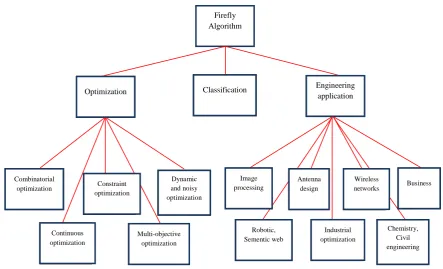
The taxonomy of the developed firefly algorithm applications is illustrated in Figure 2.1 [6]. As can be seen, FA has been applied in various fields as in the following categories:
Figure 2.1: Taxonomy of firefly algorithm application
Since the FA was introduced by Xin-She Yang in year 2008, many researchers have been using the FA as problem solving methods in various applications. Many researchers applied FA for their studies for example in optimization related to electrical system. Sulaiman et al. [34], used FA in solving the Economic Dispatch (ED) problem by minimizing the fuel cost and considering the generator limits and transmission losses. Abedinia et al. [35] proposed on Multi-objective Firefly Algorithm (MOFA) to be performed for Environmental/ Economic Power Dispatch
Firefly Algorithm
Optimization Classification Engineering
application Combinatorial optimization Continuous optimizatio n Constraint optimizatio n Multi-objective optimization Dynamic and noisy optimization Industrial optimizatio n Business Wireless network s Image processing Antenna design Robotic, Sementic web Chemistry, Civil engineering
Optimization Classification Engineering application
In order to solve congestion problem of the independent system operator, Verma & Mukherjee [36] had applied FA on the modified IEEE 30-bus and IEEE 57-bus systems. The results show that FA has relieved congestion and the rescheduling cost is lower than the comparison methods such as PSO and simulated annealing. It also reduces the total amount of rescheduling and losses. For the purpose of optimizing the control variable, Balachennaiah et al. [37] employed FA for simultaneous optimization of voltage stability limit of the transmission system and real power loss by testing it on New England 39-bus system. The results indicate that FA is better compared to Interior Point Successive Linear Programming (IPSLP) method and Real Coded Genetic Algorithm (RCGA) considering both single and multi-objective cases.
2.7 Review Application of Firefly Algorithm
Previous researches have demonstrated that the FA is quite powerful and efficient. However several researchers have done some modification or hybrid from the original FA, to increase the performance in solving nonlinear or global optimization problems based on their case study to obtain the best solution. Sundari et al. [38] performed improved firefly algorithm (IFA) on programmed pulse modulation width and showed that IFA surpassed other algorithms. Wang et al. [39], presented some improvements of FA by imposing additional information exchange between the top fireflies, or the optimal solutions during the process of light intensity update. It can speed up the global convergence rate without losing, the strong robustness and provide better global numerical optimization result than the original FA.
Besides that, Hackl et al. [40] has proposed extended FA to solve the Rastrigin test function and an electromagnetic field problems to optimize design of a magneto-rheologic clutch. Furthermore, M. Tuba & N. Bacanin [41] firstly did a few adjustments on FA to solve constraint problem and then enhanced those exploitation processes. After that, FA and uFA are compared together and the results obtained show that uFA is significantly better to solve constraint and unconstraint portfolio problems.
In order to overcome too many attractions that affect oscillation problems in FA during optimization solution search process, Wang et al. [42] proposed a new FA variant called FA with neighbourhood attraction (NaFA). In this technique, each firefly is attracted to other brighter fireflies selected from a predefined neighbourhood rather than those from the entire population. The results showed that the proposed technique can efficiently reduce computational time and improve the accuracy of solution.
CHAPTER 3
METHODOLOGY
3.1 Introduction
This chapter discusses the methodology used in this case study which is trying to apply IFA methods to obtain optimal microgrid operation. Sub-chapter 3.2 will describe the project methodology workflow to achieve the objectives of the case study explained step by step. Then, a brief development on pre-design IFA pseudo code with mathematical modelling for each generator is presented in sub-chapter 3.3. In sub-chapter 3.4, the formulation of the problem for minimizing the operation generation cost in microgrid is described which includes objective functions and constraints. Then, sub-chapter 3.5 will explain the classical structure of FA and process approach of FA structure. The next sub-chapter is the explanation of proposed improvement technique of FA using Lévy flights characteristic including review of Lévy flights technique, summary of IFA in pseudo code structure and implementation of IFA before applied to test the system in sub-chapters 3.6 and 3.7. Lastly, discussion on summary of overall methodology work flow for solving minimization cost operation problem in microgrid is defined in sub-chapter 3.8.
3.2 Project Methodology
formulated consists of diesel generators, wind turbine and fuel cell plants.
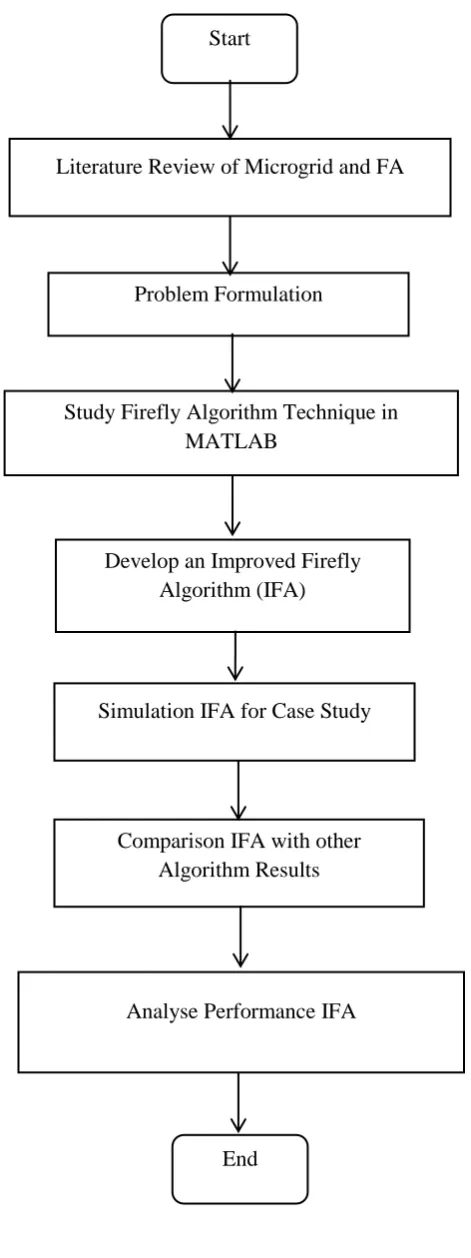
Figure 3.1: A flowchart of project methodology
Literature Review of Microgrid and FA
Problem Formulation
Study Firefly Algorithm Technique in MATLAB
Comparison IFA with other Algorithm Results
Analyse PerformanceIFA Develop an Improved Firefly
Algorithm (IFA)
Simulation IFA for Case Study
There are several technologies used in microgrids to generate electricity. In this section, the wind turbine generator, fuel-cell plant and diesel generator models are described as below [1] :
3.3.1 Wind Turbine Generator
The cost function of wind turbine generator can be modelled by a linear function as shown in Equation (3.1). The output power of the wind generator depends on the speed, power and strength of the wind.
)
(
)
(
,,
t
b
P
t
F
wti
i wtiwhere the Pwt,i(t) and Fwt,i(t) are the power and generation cost of ith wind power
plant in the scheduled period t respectively. The cost coefficient is bi.
0 0 ) ( , , , r i wt in cut r in cut r i wt i wt P v v v v P t P out cut out cut r r in cut in cut v v v v v v v v v v
where Prwt,i is the rated power of wind turbine number i, v is the wind speed in (m/s),
and vcut-in, vcut-r, vcut-outrepresent cut-in, nominal and cut-out wind speeds respectively.
The vcut-in, vcut-r, vcut-out wind speeds of wind turbines are equal to 5,10 and 15 (m/s)
respectively. .
(3.1)
3.3.2 Fuel-cell Plant
The cost for generating the fuel-cell system is represented by Equation (3.3) by considering the efficiency of energy conversion.
i fc i fc i i fc t P b t F , , , ) ( ) (
where Ffc,i(t) and Pfc,i(t) are the generation cost and output power of ith fuel-cell plant
at time t, respectively. The coefficient bi is also the cost of natural gas in ($/kg) and
the parameter
fc,i is the efficiency of the ith fuel-cell plant.3.3.3 Diesel Generator
This generator is considered the traditional power plant and the cost function is usually modelled by a quadratic function. Equation (3.4) shows:
)
(
)
(
)
(
, 2 ,,
t
a
b
P
t
c
P
t
F
dieseli
i
i dieseli
i dieseliwhere Fdiesel,i(t) and Pdiesel,i(t) are the generation cost and output power of ith diesel
unit in the scheduled period t, respectively. The cost coefficients of ith diesel are
a
i,i
b
andc
i.3.4 Problem Formulation
The problem of this case is to reduce the cost in power generation of microgrid in 24 hours. It is considered as a single objective optimization problem subject to operation constraints of generators and the system. The main components of this problem are as follows.
(3.3)
REFERENCES
[1] M. Modiri-Delsha, N. A. Rahim, S. S. Taheri, and S. J. Seyed-Shenava, “Optimal Generation Scheduling in Microgrids by Cuckoo Search Algorithm,” in 2014 3rd IET Int. Conf. Clean Energy Technol. 2014, no. 2, p. 10 (5 .)-10 (5 .), 2014.
[2] N. Cai, N. T. T. Nga, and J. Mitra, “Economic dispatch in microgrids using multi-agent system,” 2012 North Am. Power Symp. NAPS 2012, 2012.
[3] A. K. Basu, A. Bhattacharya, and S. Chowdhury, “Planned Scheduling for Economic Power Sharing in a CHP-Based Micro-Grid,” Power Systems, IEEE Transactions on, vol. 27, no. 1, pp. 30–38, 2012.
[4] S. H. Aghay, E. Taslimi, J. Selvaraj, and N. A. Rahim, “An Iterated-Based Optimization Method for Economic Dispatch in Power System,” in 2013 IEEE Conference on Clean Energy and Technology (CEAT), 2013, pp. 88–92, 2013. [5] L. Toma, I. Tristiu, and C. Bulac, “Optimal generation scheduling strategy in a
microgrid,” 2012 3rd IEEE PES Innovative Smart Grid Technologies, 2012, no. 4, pp. 491–496, 2012.
[6] I. Fister, X. S. Yang, and J. Brest, “A comprehensive review of firefly algorithms,” Swarm Evol. Comput., vol. 13, pp. 34–46, 2013.
[7] N. Ali, M. A. Othman, M. N. Husain, and M. H. Misran, “A review of firefly algorithm,” ARPN Journal of Engineering and Applied Sciences, vol. 9, no. 10, pp. 1732–1736, 2014.
[8] H. Wu, X. Liu, and M. Ding, “Electrical Power and Energy Systems Dynamic economic dispatch of a microgrid : Mathematical models and solution algorithm,” Int. J. Electr. Power Energy Syst., vol. 63, pp. 336–346, 2014. [9] X. Lin, P. Li, J. Ma, Y. Tian, and D. Su, “Dynamic optimal dispatch of
combined heating and power microgrid based on leapfrog firefly algorithm,” ICNSC 2015 - 2015 IEEE 12th Int. Conf. Networking, Sens. Control, no. 50977029, pp. 416–420, 2015.
22–28, 2001.
[11] M. Modiri-delshad, S. Koohi-kamali, E. Taslimi, and S. H. Aghay, “Economic Dispatch in a Microgrid through an Iterated- Based Algorithm,” in 2013 IEEE Conference on Clean Energy and Technology, 2013, pp. 82–87, 2013.
[12] R. Jha et al., “Dynamic Economic Dispatch of Micro-grid using Harmony Search Algorithm,” Elect. Power and Energy Syst., pp. 1–6, 2015.
[13] M. Grid, A. Pathak, and M. Pandit, “Dynamic Economic Emission Dispatch with Loss & Heat Optimization for a Micro-Grid,” in 2014 PIICON, 2014, pp. 326–336, 2014.
[14] W. Shi, X. Xie, C. Chu, and R. Gadh, “Distributed Optimal Energy Management in Microgrid,” IEEE Trans. Smart Grid, vol. 6, no. 3, pp. 1–10, 2015.
[15] E. Hayden and C. Ceh, “INTRODUCTION TO MICROGRIDS,” pp. 1–13, 2012.
[16] N. Bartek and G. Montes, “Microgrids, macro benefits:” pp. 1-8, 2014. [17] F. García, “Optimal Economic Dispatch for Renewable Energy Microgrids
with Hybrid Storage using Model Predictive Control,” IEEE Conf., pp. 7932– 7937, 2013.
[18] F. Zhang and C. Meng, “Advantages and Challenges of DC Microgrid for Commercial Building,” Elect. Power & Energy Syst., pp. 355–358, 2015. [19] H. Bs and R. Setiabudy, “Review of Microgrid Technology,” QiR (Quality In
Research, International Conf.,2013: IEEE Publication; pp. 127-132, 2013. [20] M. Braun, “Optimization of microgrids short term operation based on an
enhanced genetic algorithm.” in 2013 IEEE PowerTech Eindhoven,2013: IEEE Publication; pp. 20- 25, 2015.
[21] A. H. Chowdhury, “Optimum Economic Dispatch of Interconnected Microgrid with Energy Storage System,” in 2015 International Conference on Electrical Engineering and Information Communication Technology
(ICEEICT), 2015, pp. 21–23, 2015.
[22] G. G. Moshi, M. Pedico, C. Bovo, and A. Berizzi, “Optimal Generation Scheduling of Small Diesel Generators in a Microgrid,” in 2014 IEEE International Energy Conference (ENERGYCON), 2014, pp. 867–873, 2014. [23] A. Karthikeyan, K Manikadan, and P. Somasundaram “Economic Dispatch of
[24] F. Shariatzadeh, N. Kumar, and A. K. Srivastava, “Optimal Control Algorithms for Reconfiguration of Shipboard Microgrid Distribution System Using Intelligent Techniques,” IEEE Transactions on Industry Applications, vol. 53, no. 1, pp. 474–482, 2017.
[25] S. Vasanthakumar, N. Kumarappan, R. Arulraj, and T. Vigneysh, “Cuckoo Search Algorithm based Environmental Economic Dispatch of Microgrid System with Distributed Generation,” in 2015 International Conference on Smart Technologies and Management for Computing, Communication,
Controls, Energy and Materials (ICSTM), 2015, pp. 575–580, 2015.
[26] M. D. Govardhan, “Artificial Bee Colony based Optimal Management of Microgrid,” in 2012 11th International Conference on Environment and Electrical Engineering, 2012, pp. 12–17, 2012.
[27] N. K. Paliwal, N. K. Singh, and A. K. Singh, “Optimal Power Flow in Grid connected Microgrid using Artificial Bee Colony Algorithm,” in 2016 IEEE Region 10 Conference (TENCON), 2016, pp. 671–675, 2016.
[28] L. Ciabattoni, F. Ferracuti, G. Ippoliti, S. Longhi, and U. Politecnica, “Artificial bee colonies based optimal sizing of microgrid components : a profit maximization approach,” in 2016 IEEE Congress on Evolutionary Computation (CEC), 2016, pp. 2036–2042, 2016.
[29] P. Li, S. Member, Z. Zhou, X. Lin, and X. Yang, “Dynamic Optimal Operation Scheduling of Microgrid using Binary Gravitational Search Algorithm,” in 2014 International Conference on Power System Technology, 2014, pp. 20–22, 2014.
[30] G. De Investigacion, D. Sistemas, and P. I. Indutect, “Study of a Renewable Energy Sources-Based Smart Grid. Requirements, Targets and Solutions,” in 2016 3rd Conference on Power Engineering and Renewable Energy
(ICPERE), 2016, pp. 45–50, 2016.
[31] L. Mariam, M. Basu, and M. F. Conlon, “A Review of Existing Microgrid Architectures,” Hindawi Publication; vol. 13, pp. 1-8, 2013.
Engineering Conference (APPEEC), 2016, pp. 1599–1603, 2016.
[33] Q. Zhai, “Application Potential of Solar PV , Wind and Fuel Cells Technologies for Global Sustainability Improvement,” ProQuest Dissertations Publishing, pp. 53-96, 2012.
[34] M. H. Sulaiman, M. W. Mustafa, Z. N. Zakaria, O. Aliman, and S. R. Abdul Rahim, “Firefly algorithm technique for solving economic dispatch problem,” 2012 IEEE Int. Power Eng. Optim. Conf. PEOCO 2012 - Conf. Proc., no. June, pp. 90–95, 2012.
[35] O. Abedinia, N. Amjady, and M. S. Naderi, “Multi-objective Environmental/Economic Dispatch using firefly technique,” 2012 11th Int. Conf. Environ. Electr. Eng. EEEIC 2012 - Conf. Proc., pp. 461–466, 2012. [36] A. Rastgou and J. Moshtagh, “Application of firefly algorithm for multi-stage
transmission expansion planning with adequacy-security considerations in deregulated environments,” Appl. Soft Comput. J., vol. 41, pp. 373–389, 2016. [37] P. Balachennaiah, M. Suryakalavathi, and P. Nagendra, “Engineering Science
and Technology, an International Journal Optimizing real power loss and voltage stability limit of a large transmission network using firefly algorithm,” Eng. Sci. Technol. an Int. J., vol. 19, no. 2, pp. 800–810, 2016.
[38] M. G. Sundari, M. Rajaram, and S. Balaraman, “Application of improved firefly algorithm for programmed PWM in multilevel inverter with adjustable DC sources,” Appl. Soft Comput. J., vol. 41, pp. 169–179, 2016.
[39] G.-G. Wang, L. Guo, H. Duan, and H. Wang, “A New Improved Firefly Algorithm for Global Numerical Optimization,” J. Comput. Theor. Nanosci., vol. 11, no. 2, pp. 477–485, 2014.
[40] A. Hackl, C. Magele, and W. Renhart, “Extended Firefly Algorithm for Multimodal Optimization,” in 2016 19th International Symposium on Electrical Apparatus and Technologies (SIELA), 2016, vol. 1, pp. 21-43, 2016. [41] M. Tuba and N. Bacanin, “Upgraded Firefly Algorithm for Portfolio Optimization Problem,” 2014 UKSim-AMSS 16th Int. Conf. Comput. Model. Simul., vol. 1, no. 3, pp. 113–118, 2014.
[42] H. Wang, W. Wang, X. Zhou, H. Sun, J. Zhao, and X. Yu, “Firefly algorithm with neighborhood attraction,” Journal of Information Sciences, vol. 383, pp. 374–387, 2017.
of Nonlinear Equations,” 2014 Seventh Int. Symp. Comput. Intell. Des., pp. 228–231, 2014.
[45] X. Yang, “Firefly Algorithm, L´evy Flights and Global Optimization,” Springer, pp. 200-218, 2010.
[46] M. Basu and A. Chowdhury, “Cuckoo search algorithm for economic dispatch,” Energy, vol. 60, pp. 99–108, 2013.