Georgia State University Georgia State University
ScholarWorks @ Georgia State University
ScholarWorks @ Georgia State University
Public Health Theses School of Public Health
5-11-2012
The Association between Mobility and HIV Risk: an Analysis of
The Association between Mobility and HIV Risk: an Analysis of
Ten High Prevalence ZIP Codes of Atlanta, Georgia
Ten High Prevalence ZIP Codes of Atlanta, Georgia
William C. Rencher Georgia State University
Follow this and additional works at: https://scholarworks.gsu.edu/iph_theses
Recommended Citation Recommended Citation
Rencher, William C., "The Association between Mobility and HIV Risk: an Analysis of Ten High Prevalence ZIP Codes of Atlanta, Georgia." Thesis, Georgia State University, 2012.
https://scholarworks.gsu.edu/iph_theses/206
THE ASSOCIATION BETWEEN MOBILITY AND HIV RISK: AN ANALYSIS OF TEN
HIGH PREVALENCE ZIP CODES OF ATLANTA, GEORGIA
by
WILLIAM CAREY RENCHER
B.A., FURMAN UNIVERSITY
J.D., UNIVERSITY OF FLORIDA
A Thesis Submitted to the Graduate Faculty
of Georgia State University in Partial Fulfillment
of the
Requirements for the Degree
MASTER OF PUBLIC HEALTH
ATLANTA, GEORGIA
THE ASSOCIATION BETWEEN MOBILITY AND HIV RISK: AN ANALYSIS OF TEN HIGH PREVALENCE ZIP CODES OF ATLANTA, GEORGIA
by
WILLIAM CAREY RENCHER
Approved:
Richard Rothenberg, M.D.
__________________________________________ Committee Chair
Laura Salzar, Ph.D.
__________________________________________ Committee Member
Dajun Dai, Ph.D.
__________________________________________ Committee Member
April 6, 2012
ABSTRACT
WILLIAM C. RENCHER
THE ASSOCIATION BETWEEN MOBILITY AND HIV RISK: AN ANALYSIS OF TEN HIGH PREVALENCE ZIP CODES OF ATLANTA, GEORGIA
(Under the direction of Richard Rothenberg, M.D.)
Studies from developing countries disagree on whether mobility is a risk factor or a protective factor for HIV risk. The difference is often determined by gender. Few studies exist, however, examining the relationship among high risk populations in developed nations. This study seeks to examine that relationship in 10 high risk ZIP codes of Atlanta, Georgia using data gathered from the Geography Project by Rothenberg and colleagues. Logistic regression was used to examine the relationship between HIV risk and five independent variables of mobility. Results were stratified by gender. After controlling for demographic and behavioral variables, use of public transportation by men was significantly protective of HIV risk. Significant associations were also observed with ever injection drug use and recent condom use, indicating that high risk behaviors may be the real driver of the epidemic in these neighborhoods.
AUTHOR’S STATEMENT
In presenting this thesis as a partial fulfillment of the requirements for an advanced degree from Georgia State University, I agree that the Library of the University shall make it available for
NOTICE TO BORROWERS
All theses deposited in the Georgia State University Library must be used in accordance with the stipulations prescribed by the author in the preceding statement.
The author of this thesis is:
Student’s Name: ___Wiliam C. Rencher_____________________________
Street Address: ____43 Finch Trail, NE______________________________
City, State, and Zip Code: ____Atlanta, Georgia 30308_________________
The Chair of the committee for this thesis is:
Professor’s Name: _____Richard Rothenberg, M.D._____________________
Department: _______Prevention Sciences_____________________________
College: ________Institute of Public Health___________________________
Georgia State University P.O. Box 3995
Atlanta, Georgia 30302-3995
Users of this thesis who not regularly enrolled as students at Georgia State University are required to attest acceptance of the preceding stipulation by signing below. Libraries borrowing this thesis for the use of their patrons are required to see that each user records here the information requested.
NAME OF USER ADDRESS DATE TYPE OF USE
CURICULUM VITAE
WILLIAM C RENCHER 43 FINCH TRAIL, NE
ATLANTA, GEORGIA 30308
EDUCATION
Master of Public Health, Georgia State University May 2012
Concentration: Prevention Sciences (Epidemiology) Honors and Activities:Georgia Health Foundation Scholar
Juris Doctor with Honors, University of Florida College of Law
May 1995
Honors and Activities: Book Awards in Property and Remedies; Summer Program in Law at Oxford
Bachelor of Arts magna cum laude, Furman University May 1992
Major: History
Honors and Activities: Phi Beta Kappa; Debate Team; Foreign Study in Madrid, Spain
WORK EXPERIENCE
Graduate Research Assistant for Dr. Frances McCarty Georgia State University, School of Public Health
Aug 2010—May 2012
Program Intern Aug 2011—Jan 2012
National Foundation for the Centers for Disease Control and Prevention
Commercial Title Attorney and Examiner
Trinity Title Insurance Agency; Decatur, Georgia
June 1998—Oct 2009
Underwriting Attorney and Title Examiner First Title Corporation; Atlanta, Georgia
Jan 1996—May 1998
Part time Law Clerk
Steven H. Koval, Esq., Atlanta, Georgia
Summer Law Clerk
Law Offices of Eilon Krugman-Kadi, Gainesville, Florida
Summer Intern
Legal Aid Society, Orlando, Florida
MEMBER
State Bar of Georgia Phi Beta Kappa
Aug—Dec 1995
May—Aug 1994
May—June 1993
iii
TABLE OF CONTENTS
Page
ACKNOWLEDGEMENTS……….iv
LIST OF TABLES………...……….v
CHAPTER 1. INTRODUCTION………..1
2. REVIEW OF THE LITERATURE………5
3. METHODS AND PROCEDURES………..15
Background………..………..15
Data Collection………..………15
Variables Used………..………….16
Statistical Analyses………..………..18
Informed Consent………..……….20
4. RESULTS……….……21
Basic Characteristics………..…21
Univariate Analysis………....22
Univariate Analyses for Possible Confounders……….………22
Multivariate Analyses……...……….24
5. DISCUSSION AND CONCLUSIONS………26
Interpretation of Findings………..26
Strengths and Limitations………..30
Implications………....31
Conclusions………....32
REFERENCES……….33
APPENDIX………..……40
iv
ACKNOWLEDGEMENTS
Thesis Committee
Dr. Richard Rothenberg, Institute of Public Health
Dr. Laura Salazar, Institute of Public Health
Dr. Dajun Dai, Department of Geosciences
The staff of the Center for Community Development
Tina Marie Taylor
v
LIST OF TABLES
TABLE 1: Demographic, Dependent, and Independent Variables………43
TABLE 2: Univariate Analysis of Independent Variables with HIV Status………...…44
TABLE 3: Univariate Analysis of Possible Confounders with HIV Status………..45
TABLE 4: Univariate Analysis of Possible Confounders with Independent Variables…………46
Chapter I Introduction
Epidemiological studies have shown that sexually transmitted diseases (STDs), such as
HIV, tend to concentrate in core geographic areas of inner cities which act as reservoirs of
disease for their larger communities (Potterat, et al., 1985; R Rothenberg, Muth, Malone,
Potterat, & Woodhouse, 2005; R. B. Rothenberg, 1983). These inner city neighborhoods are
characterized by poverty; a high prevalence of HIV-risk behaviors, such as unprotected sex and
injection drug use (IDU); and high partner assortativity (associating with persons of similar
circumstances) (R. B. Rothenberg, 1983). The concentration of these characteristics in
geographic cores helps maintain the endemicity of HIV and increases the risk of infection for
those who live in or associate with these core communities, even if they are not involved in
high-risk behaviors (Potterat, et al., 1985; R. B. Rothenberg, 1983). These findings have been
observed in several cities, including Atlanta, Georgia (Hixson, Omer, del Rio, & Frew, 2011).
Another characteristic of these inner city areas is limited mobility. Many people do not
own their own car and must rely on public transportation or friends for travel and moving around
(Gindi, et al., 2011; Potterat, et al., 1985; R Rothenberg, 2007; Zenilman, Bonner, Sharp, Rabb,
& Alexander, 1988). Some studies in developing countries have shown increased mobility to be
an independent risk factor for HIV (Boerma, Urassa, Senkoro, Klokke, & Ng'weshemi, 1999;
Lagarde, et al., 2003). However, other studies have shown increased mobility to be protective,
especially for women in groups with high HIV prevalence (Haibo, et al., 2010; Strathdee, et al.,
2008; Watts, et al., 2010). Due to a lack of an operational definition of mobility (Deane,
Parkhurst, & Johnston, 2010) and a scarcity of studies in developed countries, it is not clear if
2
developed country, such as the United States.
Therefore, the present study addressed the question: “How does mobility affect HIV risk
in inner city areas with high HIV prevalence located in the United States?” Based on the
available literature and the data available, I proposed the following affirmative hypothesis:
“increased mobility has a protective effect on HIV risk among persons living in inner city
communities of Atlanta, Georgia with high HIV prevalence, but the effect varies by gender.”
The corresponding null hypothesis was: “mobility has no effect on HIV risk among persons
living in inner city communities with high HIV prevalence, regardless of gender.” For the
purposes of this paper, the research question was examined in terms of the affirmative
hypothesis.
The question posed was important, because knowing the effects of mobility in these
communities would further contribute to the growing evidence base on the influence of social
networks in HIV transmission. Much research has been done already on the characteristics of
these networks in inner city communities with high HIV prevalence. Multiple contacts and high
partner assortativity have been shown to increase HIV risk in these core geographic areas (R
Rothenberg, et al., 2005). Because mobility is one way that persons form contacts with others,
those who are highly mobile would presumably have more contacts and a larger social network
than those who are less mobile. Nevertheless, those who are highly mobile could also leave
those high risk neighborhoods more often and be less exposed to high-risk behaviors and HIV.
Thus, it was heretofore unclear how mobility would affect HIV risk in these communities.
Knowing how mobility influences HIV risk in these communities could help formulate
more effective HIV prevention programs. For example, if increased mobility were shown to be a
3
efforts on women in these communities who are geographically isolated. Likewise, if increased
mobility were shown to be a risk factor for men, campaigns could be developed that address men
who travel frequently. The transmission of HIV is influenced by a variety of factors and more
knowledge of those factors could lead to more effective interventions targeted to those at greatest
risk. Therefore, the present study was undertaken to examine how mobility might affect HIV
risk in these core geographic areas of the inner city.
Before analyzing the research question, the current literature on geographic
concentrations of STDs and HIV, the influence of social networks on HIV transmission in these
core areas, and the effects of mobility on HIV risk in high prevalence populations was
thoroughly examined. Data from the Geography Project by Rothenberg and colleagues was used
to perform statistical analyses of the effects of mobility on HIV risk in 10 ZIP codes of Atlanta,
Georgia with high HIV prevalence. Variables from that data set were re-coded to form five
independent variables of mobility: furthest distance away from one’s center of activity (COA)
within in the Atlanta area in the past six months, travel out of the Atlanta area in the past six
months, driving one’s own car, use of any car, and use of public transportation. The dependent
variable was HIV status, determined by the results of an HIV antibody test.
The five independent variables of mobility were compared in univariate analyses to the
dependent variable of HIV status. Further univariate analyses were used to determine significant
associations between each independent variable of mobility and various demographic and
behavioral factors. Those factors were also compared to HIV status. Any factor shown to be
significantly associated with a mobility variable or HIV status was included in the final
multivariate analysis. A logistic regression model was used to analyze the relationship between
4
stratified by gender. Subsequent to the analyses, the results were interpreted in light of the
current literature and the need for HIV prevention programs, leading to recommendations for
5
Chapter II
Review of the Literature
Nearly 30 years ago, Rothenberg (1983) found that gonorrhea cases in upstate New York
were concentrated in a small number of census tracts representing only nine percent of the
population. He also observed a gradient of clustering with the highest concentrations located in
these core tracts and a gradual dispersion of cases moving out from the core into adjacent and
peripheral areas. Furthermore, Rothenberg (1983) found that these core census tracts
corresponded to inner city poverty areas of high population density where persons frequently had
sexual contact only with others from the same area; thus, the gonorrhea epidemic was maintained
in and largely confined to these small geographic clusters.
Potterat and colleagues (1985) confirmed these findings in a similar study of gonorrhea in
Colorado Springs, Colorado. There they found that 51 percent of cases came from only four
census tracts representing 5.9 percent of the city’s population with a similar proportion of
contacts from the same area. They also observed that 30 percent of cases came from adjacent
census tracts and the remainder came from the rest of the city (the periphery). This core area of
the inner city served as a reservoir of gonorrhea for the rest of the city: Sex usually happened
between core cases and contacts and between peripheral cases and contacts, but adjacent cases
were more likely to have sex with core contacts than with adjacent cases. Interestingly, the
population of this core area was rather stable with half of cases not having moved in the previous
six months and 38 percent not having moved in the previous year.
Geographic concentrations have also been observed with other sexually transmitted
diseases (STD), such as syphilis and Chlamydia (Alvarez-Dardet, Marquez, & Perea, 1985), as
6
In addition, Bernstein and colleagues (2004) found that high risk behaviors tended to further
concentrate in small areas within the geographic core of an STD epidemic.
Furthermore, Kerani and colleagues (2005) demonstrated a gradient of concentrations
based on the type of STD. For example, they found that STDs transmitted less efficiently and
for a shorter duration, such as syphilis, would only persist in populations with high levels of
sexual mixing and therefore be more concentrated in small core areas. In contrast, STDs
transmitted efficiently and for longer periods, such as herpes, would be more broadly distributed
in a population. This observation was confirmed in a study by Zenilman and colleagues (2002)
who found that 53 per cent of gonorrhea cases at Fort Bragg were concentrated in three
morbidity areas whereas the distribution of Chlamydia, which has a longer duration due to its
more frequent asymptomatic nature, was much more widespread.
Geographic concentrations of infection have also been observed with HIV. Rothenberg
and colleagues (2005) found that HIV cases were concentrated in the downtown area of
Colorado Springs and that the majority of social connections between cases and contacts were in
this same area. They found that geographic concentrations promoted higher mixing of persons at
risk than would be observed in the general population, even for those not connected socially.
This tendency to associate with others with similar characteristics, such as HIV risk, is known as
assortative mixing and is another feature of core areas that helps maintain the epidemic. Such a
concentration of HIV infection has been observed in Atlanta, Georgia: Hixson and colleagues
(2011) found that 60 per cent of HIV cases in metro Atlanta were contained in a large cluster
centered on the downtown area with an HIV prevalence of 1.34 percent as compared to 0.32
percent in the general population.
7
Characteristics of inner city neighborhoods contribute to their being reservoirs for disease. Inner
city neighborhoods are characterized by poverty and its various sequelae (Hixson, et al., 2011; R.
B. Rothenberg, 1983); high population density (Hixson, et al., 2011; R. B. Rothenberg, 1983;
Zenilman, et al., 2002); a greater frequency of high risks behaviors, such as injection drug use
(IDU) and prostitution; and men who have sex with men (MSM) (R. B. Rothenberg, et al., 2000;
Zenilman, et al., 2002). Although many inner city neighborhoods are predominantly African
American, the literature shows that racial identity is not as important a factor in STD prevalence
as is poverty (Hixson, et al., 2011; Jennings, Curriero, Celentano, & Ellen, 2005) and
socio-economic status (SES) (Zenilman, et al., 2002).
The characteristics of the social networks within these geographic areas also influence the
transmission of HIV and other STDs. Most importantly, these networks are highly assortative:
People generally associate with others in their same network. When these associations involve
sexual relations, the chance of pairing with an infected partner is high and thus, the disease
remains epidemic in the community (Bernstein, et al., 2004; Doherty, Padian, Marlow, & Aral,
2005; Gindi, et al., 2011; Kerani, et al., 2005; Potterat, et al., 1985; R Rothenberg, et al., 2005;
R. B. Rothenberg, 1983; Zenilman, Ellish, Fresia, & Glass, 1999). Conversely, disassortative
mixing (associating with people of different characteristics) creates a bridge for transmission to
areas outside of the core network (Doherty, et al., 2011). Core social networks also have a high
incidence of STDs that are widespread among the various nodes in the network (Jennings, et al.,
2010; R. Rothenberg, Baldwin, Trotter, & Muth, 2001; R. B. Rothenberg, et al., 1998;
Woodhouse, et al., 1994). Furthermore, greater social cohesion—more connected components
than in the general population—leads to an increase in disease transmission over time (Potterat,
8
One possible reason for greater assortativity and social cohesion is that people in these
inner city core areas are generally less mobile than people in the general population. People
reside in these areas for long periods of time (Potterat, et al., 1985; R Rothenberg, 2007;
Zenilman, et al., 1988) and have less access to transportation (Gindi, et al., 2011). However, two
articles identified mobility as an independent risk factor for HIV in high prevalence areas of
Africa. Lagarde and colleagues (2003) found that short-term mobility (defined as having been
away from one’s village for at least one day and one night in the previous four weeks) was a risk
factor for HIV in men (OR=2.06) but not for women in a community in West Africa where the
prevalence rate was 10.5 percent. Similarly, Boerma and colleagues (1999) found greater
population mobility in a trading center in rural Tanzania where the HIV prevalence was twice
that of surrounding areas.
The studies by Lagarde and colleagues (2003) and Boerma and colleagues (1999) were
both conducted in Africa and may not be generalizable to high prevalence areas in the United
States or other developed countries. So whether mobility is a risk factor for HIV in the high
prevalence areas heretofore described is not clear. Like the two previously cited studies, most of
the literature on mobility and HIV risk focuses on migrants in developing countries who travel
from rural to urban areas either seasonally or frequently for work (Xiaoming, et al., 2004).
Unfortunately, there are virtually no studies of this topic in developed nations.
The numerous studies that do exist from developing countries, however, observe that
increased mobility is associated with high-risk behaviors, such as casual, extramarital, or
concurrent partnerships (Deren, Kang, Colon, & Robles, 2007; El-Bassel, et al., 2011; Feldacker,
Emch, & Ennett, 2010; Gupta, Vaidehi, & Majumder, 2010; Khan, et al., 2008; Vissers, et al.,
9
higher rates of commercial sex, both for female sex workers (FSW) (Bo, et al., 2007; Khan, et
al., 2008; Nguyen Anh, et al., 2007; Sopheab, Fylkesnes, Vun, & O'Farrell, 2006; Yang & Xia,
2006) and their male clients (Bo, et al., 2007; Feldacker, et al., 2010; Gupta, et al., 2010;
Sopheab, et al., 2006), and higher rates of IDU (Deren, et al., 2007; Rachlis, et al., 2007).
Studies have also found that HIV risk increases with one’s mobility (Lippman, et al., 2007;
Lydié, et al., 2004). Finally, even though some safer sex behaviors have been observed among
mobile persons, such as increased condom use (El-Bassel, et al., 2011; Goldenberg, Strathdee,
Perez-Rosales, & Sued, 2012; Haibo, et al., 2010), most people in these communities perceive
mobile persons to be more likely to engage in high-risk behaviors (Ezekiel, Talle, Mnyika, &
Klepp, 2010).
Despite the agreement that an association exists between mobility and high-risk behavior,
there is no consensus in the literature as to whether mobility is a risk factor for HIV. Many
studies identify it as a risk factor (Bloom, Urassa, Isingo, Ng'weshemi, & Boerma, 2002;
El-Bassel, et al., 2011; Kishamawe, et al., 2006; Nguyen Anh, et al., 2007; Sopheab, et al., 2006;
Vissers, et al., 2008; Zuma, et al., 2003), but several studies are inconclusive as to the effect of
mobility on HIV risk (Coffee, et al., 2005; Haibo, et al., 2010; Mundandi, Vissers, Voeten,
Habbema, & Gregson, 2006; Watts, et al., 2010; Yan, Xiaoming, Hongmei, Xiaoyi, & Ran,
2009). In addition, some studies found different results based on gender as to the influence of
mobility on both high-risk behaviors and HIV risk with no agreement as to whether mobility was
a greater risk for men (Lurie, et al., 2003) or for women (Bo, et al., 2007; Camlin, et al., 2010;
Khan, et al., 2008). Hirsch and colleagues (2007) found that men have different patterns of
movement that lead to greater opportunities for high-risk sexual behaviors. However, Feldacker
10
greater risk and that isolated women were protected from HIV. Moreover, they found that that
men’s heightened status in society may be a protective factor despite their greater mobility.
Therefore, whether and how gender plays a role in determining the sexual risks associated with
mobility is not clear.
There are several factors that may explain the disparate results observed in the literature
as to whether mobility is a risk factor for HIV. The most obvious explanation is that there is no
agreement on an operational definition for mobility; thus, mobility has been conceptualized in
different ways and subsequently measured differently. Results then depend on which definition
is used. The concept of mobility is broad and can include seasonal and circular migration, rural
to urban migration, commuting, internal displacement, and international refugee migration with
different results depending on what one is actually studying (Deane, et al., 2010). For example,
three studies from the same study cohort in Tanzania used three completely different definitions
but referred to their results simply in terms of “mobility”. Boerma and colleagues (1999) defined
mobility as having moved between the years 1994 and 1995 or having moved into one’s current
household in the previous five years (either condition qualified one as mobile). Using that
definition, they found that HIV positive persons were more mobile than HIV negative persons.
Kishamawe and colleagues (2006) used the terms long-term mobile and short-term mobile to
differentiate whether one had been living elsewhere (long-term) or briefly staying elsewhere
(short-term) the night before on at least one of the survey’s five rounds of demographic
interviews. Using those definitions, they found increased risk for short-term mobile men and
long-term mobile women. Finally, Vissers and colleagues (2008) defined couples as co-resident
or living apart and further defined individuals as non-mobile or mobile (based on whether or not
11
categories: co-resident mobile, co-resident mobile, living apart mobile, and living apart
non-mobile. Using this criteria, they found that mobile co-resident men were more likely to have
extramarital sex than non-mobile co-resident men and that women living apart who saw their
partner infrequently were at greater risk than non-mobile co-resident women. While each study
purported to be analyzing mobility, they were clearly talking about three different ideas and
arriving at different conclusions based on these arbitrary definitions. Therefore, results cannot
be compared across studies.
The various and nuanced characteristics of migration may also be a factor in whether
mobility increases or decreases HIV risk (Goldenberg, et al., 2012). Migration is a type of
mobility characterized by large scale movement of people from one location to another, often for
work or food. It is usually associated with negative characteristics, such as societal
marginalization that may reduce access to social and health services (Goldenberg, et al., 2012;
Xiaoming, et al., 2004; Yang & Xia, 2006), greater opportunities for high risk behaviors,
particularly in transit centers (Goldenberg, et al., 2012; Rachlis, et al., 2007), and a
disproportionate number of persons, particularly women, employed in the service and
entertainment industries (Yang & Xia, 2006). However, there are sometimes positive aspects to
migration, such as moving into an area with better access to social and health services, especially
HIV resources, and better attitudes toward women (Goldenberg, et al., 2012). Therefore,
whether mobility is a risk factor for HIV may also depend on the characteristics of the
community into which one is moving or travelling and community variations may be wide
spread even within a small geographic area.
Finally, even though most of the studies cited were performed in developing countries,
12
different places, but even within those large regions, there are numerous peoples, traditions, and
customs that could affect the outcome of these studies (Mundandi, et al., 2006). One study
performed in a country of West Africa may not be generalizable to an area in East Africa or even
to an adjacent country. Therefore, the results of these studies may be confounded by
unidentified variables unique to the study locations that have little to do with mobility.
Although there are no studies directly examining the association between mobility and
HIV risk in geographic areas with high HIV prevalence in the developed world, there are several
studies examining this relationship in other high risk populations, not necessarily defined by
geography. Even so, these studies may be provide some insight for the present analysis and thus
deserve further examination. Khan and colleagues (2008) compared HIV-related sexual
behavior among mobile and non-mobile populations by gender in two districts of Burkina Faso
with high HIV prevalence (1.4 and 2.3%). Defining mobility as travelers and recent migrants of
less than one year, they found that mobile women were more likely to report new sexual partners
(OR=2.07; 95% CI: 1.19, 3.50) and commercial sex (OR=2.3; 95% CI: 1.55, 3.42) in the
previous month as compared to their non-mobile counterparts. However, no significant
associations were observed among men.
In a study examining the relationship between mobility, sexual behavior, and HIV
infection, Lydié and colleagues (2004) studied an urban population (n=2,089) in Yaoundé,
Cameroon with a 2000 HIV prevalence of 5.5%. Mobility was determined by the number of
trips for more than one night outside of the city and the time spent away from their residence in
the previous 12 months. They found that HIV prevalence among men increased with time away
from home, after controlling for age, SES, and sexual behavior. More specifically, they found
13
had been away for more than 31 days (OR=0.23; 95% CI: 0.07, 0.82). However, the difference
for women was not significant.
In another study of a high risk population, Strathdee and colleagues (2008) compared
correlates of HIV infection among male and female IDUs in Tijuana, Mexico. In their study,
males (n=896) and females (n=157) had an HIV prevalence of 3.5% and 10.2%, respectively,
both rates being much higher than the general population. Adjusting for age, injection drug use,
active syphilis infection, deportations from the United States, and arrests, the authors found that
having lived in Tijuana for a longer period of time was associated with greater HIV infection in
women (Adj.OR=1.81 per 10 years; 95% CI: 1.12, 2.94), but that the opposite was true for males
(Adj.OR=0.65 per 10 years; 95% CI: 0.46, 0.93). Therefore, in this population with high HIV
prevalence, mobility was found to be a risk factor for HIV among men, but a protective factor
among women.
Furthermore, two recent studies on female sex workers (FSW) and their mobility implied
that increased mobility was a protective factor for this high risk population. Watts and
colleagues (2010) analyzed information from developing countries on the duration that women
sell and men buy sex and used modeling to simulate transmission between FSW and their male
partners. By comparing relative numbers of sexual partners, the authors found that non-mobile
sex workers were at greater risk of HIV infection. Similar results were observed in a cohort
study of Chinese FSW by Haibo and colleagues (2010) who found that the FSW at highest risk
were less mobile than those at lower risk.
Whether any of the previously described results would be observed among the high risk
population (as defined by geography) of an inner city in the United States is not clear but merits
14
and HIV risk for the populations of ten high-risk ZIP codes in the inner city of Atlanta, Georgia.
As this study did not involve a developing country or a migrant population and because the
available data on mobility were limited, mobility was based on how often people left their zone
of residence, how far they traveled when they did, and their access to transportation. As
previously reported, high risk areas in developed countries have been described as stable;
therefore, I hypothesized that greater mobility would be a protective factor for those residing in
these areas because of the ability to remove oneself from the concentration of risk behaviors, but
that the results would vary by gender. Univariate analysis was used to compare various mobility
variables to HIV risk and multivariate logistic regression was used to control for possible
confounders, such as age, race, SES, sexual behavior, and drug use. Results were stratified by
15
Chapter III
Methods and Procedures
Background
The data used in this analysis were gathered as part of the Geography Project conducted
by Rothenberg and colleagues from 2005 to 2011 in Atlanta, Georgia. That project sought to
examine the role of geography, networks, and risk in the transmission of HIV and other sexually
transmitted diseases (STDs) in inner city neighborhoods of Atlanta. Prior research had led to the
establishment of a theory that network structures and risk configuration were generated by local
choices. The research for the Geography Project sought to further illustrate that theory in an
inner city framework where local choices result in multiple paths of exposure from multiple
sources, a network that aids in transmission, and assortative mixing which encourages contact
primarily with those in the same network (whether or not persons are actually known to one
another).
The aims of the Geography Project were to determine the behavioral, social, and
geographic characteristics of those at risk due to drug use and sexual activity in high- and
low-burden HIV prevalence areas, as well as to evaluate the combined influence of those factors and
their dynamics on the prevalence and incidence of seven STDs, including HIV. Rothenberg and
colleagues expected to observe a strong association between social and geographic distance, a
high prevalence of compound risk, structural features of small networks that aid in transmission,
and data confirming the greater importance of these factors in high risk areas. The research was
funded by a grant from the National Institute on Drug Abuse to Dr. Rothenberg.
Data Collection
16
high prevalence rates for HIV (30318, 30314, 30310, 30315, and 30308), representing 30% of
reported AIDS cases in Fulton County, Georgia between 1998 and 2003; and five ZIP codes with
intermediate rates (30349, 30331, 30337, 30344, and 30311) adjacent to the five high prevalence
ZIP codes. An initial six month period of ethnographic investigation was used to determine three
seed persons from each ZIP code who represented the characteristics of persons at risk due to
their sexual activity or drug use and not known to each other. Each seed was interviewed and
asked to name 10-12 contacts and to nominate one of them to be another seed in the chain. The
process was repeated until three chains of three persons each and their contacts were formed in
each ZIP code. Some contacts, but none of the seeds, may have overlapped. The study was
designed with 80% power to detect an attributable risk as low as 15% when assuming an HIV
prevalence of 10%.
Seed persons in each chain and some, but not all, of their named contacts (respondents)
were interviewed using a standard questionnaire that included questions about
sociodemographic, behavioral, medical, sexual, and drug-using factors; as well as information
about their named contacts, such as geographic location, the nature of their relationship, and any
shared sexual or drug using experiences. In addition, respondents were offered testing and
appropriate counseling for seven STDs, including HIV; those testing positive were referred to the
local health department for treatment. Interviews were repeated at annual intervals over a three
year period from 2008 to 2011. Respondents were paid $20 for each interview. The data used in
the present analysis were obtained from the final interviews.
Variables Used
Among the sociodemographic questions asked, those relating to gender, race/ethnicity,
17
chose Male, Female, or other; those who responded “other” were treated as missing. For
race/ethnicity, respondents were asked “what race or ethnic group do you mainly think of
yourself as?” Possible answers were Black (African-American), Black (Caribbean), White,
Hispanic (Black), Hispanic (White), Native American Indian/Alaskan Native, Asian/Pacific
Islander, Mixed (Black/White), and other. Responses were re-coded into four categories: White,
Black (African American and Caribbean), Hispanic (Black and White), and other (all other
categories).
Regarding education, respondents were asked “what is the last grade you finished in
school?” Possible answers were none, elementary school (K-8), some high school (9-11), GED,
high school graduate, some college or technical training, college graduate, and graduate work.
Responses were re-coded into three categories: less than high school diploma, high school
diploma or equivalent, and some college or more. Respondents were also asked to identify their
sexual orientation from a list of possible answers: homosexual, heterosexual (straight), bisexual,
gay, lesbian, transgendered, transsexual, and other. Responses were re-coded into three
categories: heterosexual, gay/lesbian/bisexual (including homosexual), and other (including
transgendered and transsexual). Age at interview was categorized roughly into the four quartiles
observed: 18-24, 25-36, 37-47, and 48 or over.
The dependent variable in this analysis, HIV status, was initially determined by the
results of a saliva evaluation (Orasure®) administered during the interview. Positive results
were then confirmed using the STAHRS assay (Serologic Testing Algorithm for Determining
Recent HIV Seroconversion) and PCR testing. For the present analysis, those who were not
tested or who had an indeterminate result were coded as HIV negative.
18
were asked to give the furthest distance within the Atlanta area that they had travelled away from
their center of activity (COA) during the six months prior to interview. Responses were given in
miles and ranged from 1 to 16. Responses were re-coded into three categories: 4 miles or less,
5-8 miles, and 9 miles or more. Respondents were also asked if they had travelled outside the
Atlanta area to other parts of Georgia in the six months prior to their interview with response
options of yes or no.
Additional questions were asked about respondents’ use of various transportation modes:
whether they drove themselves, rode with others, paid other for rides, used public trains, used
public buses, or used taxis. Responses were yes, no, or N/A. All responses of N/A were treated
as missing. “Drove themselves” was examined by itself and also combined with “rode with
others” and “paid others for rides” to create a variable representing general use of any car.
“Used public trains”, “used public buses”, or “used taxis” were combined into one variable
representing general use of public transportation.
Several variables related to HIV risk behaviors were included in the present analysis as
possible confounders. Ever injection drug use was measured by the response to the question
“have you ever injected any drug?” Commercial sex was measured by the responses to the
questions “have you paid a woman to have sex with you in the past six months?” and “have you
paid a man to have sex with you in the past six months?” Finally, safer sexual practices were
measured by the response to the question “the last time you had sex, did you or the person you
were with use a condom?” Responses options for all of these items were yes or no. Answers of
“don’t know” or “refuse to answer” were treated as missing.
Statistical Analyses
19
Univariate analysis was used to compare each independent variable of mobility (travel from
COA in past six months, travel outside of Atlanta in past six months, drives oneself, use of any
car, and use of public transportation) with the outcome variable, HIV status. Associations were
measured using odds ratios and significance was determined by 95% confidence intervals. These
analyses were also stratified by gender.
Further univariate analyses were used to compare each demographic variable (gender,
race, education, sexual orientation, and age) and each potential confounder (ever injection drug
use, paying a woman for sex, paying a man for sex, and recent condom use) with both the
outcome variable and each independent variable. Those demographic and possible confounder
variables found to have a significant association, based on 95% confidence intervals for odds
ratios, with the outcome variable or any independent variable were included in the final
multivariate analysis.
Multivariate analyses were performed using logistic regression to control for the
variables shown to have significant associations in the univariate analysis. Because no strong
correlations were observed between any of the five independent variables of mobility (travel
from COA in past six months, travel outside of Atlanta in past six months, drives oneself, use of
any car, and use of public transportation), they were included in one logistic model along with
gender, age, education, sexual orientation, ever injection drug use, and recent condom use to
predict HIV status. A gender stratified analysis was also performed with gender removed as an
independent variable. Paying a woman for sex in the past six months was excluded from the
analysis for the total sample and the stratified analysis for females, because including it had the
effect of excluding most women from those analyses; it was, however, included in the stratified
20
confidence intervals.
Informed Consent
Informed consent was obtained in writing from all study respondents. The informed
consent form was approved by the Institutional Review Board of Georgia State University and
the research protocol was approved by the Institutional Review Boards of both Emory University
and Georgia State University. Possible vulnerable populations identified were pregnant women
and recent parolees. Pregnant women were informed of treatment risks for the conditions being
tested and extra precautions were taken to ensure that parolees knew they could leave the study
21
Chapter IV Results
Basic Characteristics
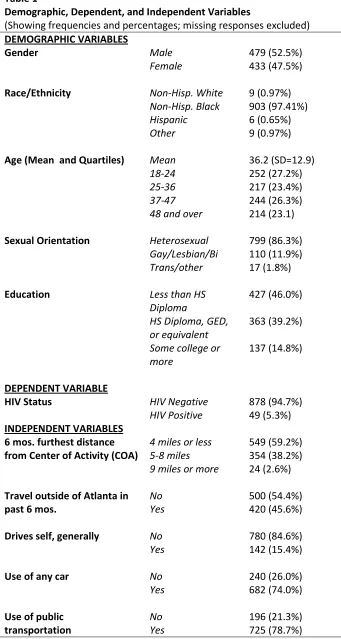
A total of 927 adults were included in the present analysis. As shown in Table 1,
excluding missing values, 479 (52.5%) were male and 433 (47.5%) were female. Regarding
race, there were nine non-Hispanic whites (0.97%), 903 non-Hispanic blacks (97.41%), six
Hispanics (0.65%), and nine of other racial backgrounds (0.97%). The mean age of participants
was 36.2 with a standard deviation of 12.9. The sample was almost evenly distributed in four
age group quartiles: 252 (27.2%) between ages 18 and 24, 217 (23.4%) between ages 25 and 36,
244 (26.3%) between ages 37 and 47, and 214 (23.1%) at age 48 or over. Heterosexuals
numbered 799 (86.3%); those identifying as gay, lesbian, or bisexual numbered 110 (11.9%);
and transgendered, transsexual, and others numbered 17 (1.8%). Finally, 427 (46.0%) had less
than a high school diploma, 363 (39.2%) had a high school diploma or its equivalent, and 137
(14.8%) reported some college or more. 49 respondents (5.3%) were HIV positive and 878
(94.7%) were HIV negative.
Regarding the five independent variables of mobility, 549 (59.2%) had traveled four
miles or less within the Atlanta area away from their center of activity (COA) in the six months
prior to interview. 354 (38.2%) had traveled a distance of five to eight miles, and 24 (2.6%) had
travelled a distance of nine miles or more. Slightly more than half of the sample (500; 54.4%)
had travelled outside of the Atlanta area to other parts of Georgia in the six months prior to
interview. Only 142 (15.4%) respondents reported that they generally drove themselves.
However, 682 (74.0%) reported having used a car, whether driving themselves or riding with
22
Univariate Analyses
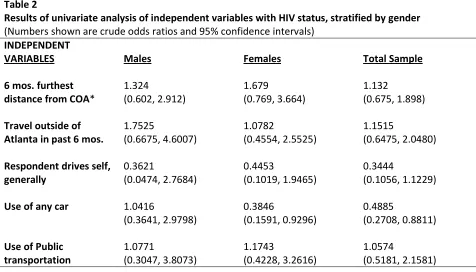
Univariate analyses of each independent variable with HIV status revealed few
significant associations (Table 2). No significant association between travel within the Atlanta
area outside of one’s COA in the past six months and HIV status was observed (OR=1.132; 95%
CI: 0.675, 1.898). Those who had travelled outside of the Atlanta area to other parts of Georgia
in the six months prior to interview were 1.1515 times as likely to be HIV positive as those who
had not travelled outside of the metro area but the association was not significant (95% CI:
0.6475, 2.0480). Those who drove themselves were almost two thirds less likely to be HIV
positive than those who did not drive themselves, but that association was also not significant
(OR=0.3444; 95% CI: 0.1056, 1.1229). However, those who used any car were significantly less
likely to be HIV positive than those who did not use a car (OR=0.4885; 95% CI: 0.2708,
0.8811). Finally, those who used public transportation were 1.0574 times as likely to be HIV
positive as those without such access, but this association was not significant (95% CI: 0.5181,
2.1581). Stratification by gender only revealed one significant association: Females who used
any car were significantly less likely to be HIV positive than those who did not use any car
(OR=0.3846; 95% CI: 0.1591, 0.9296).
Univariate Analyses for Possible Confounders
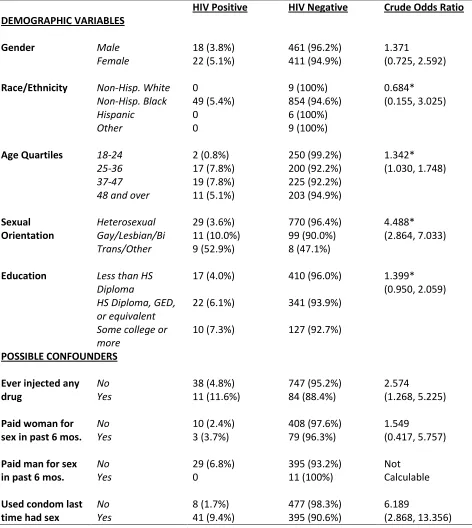
Stratification of the demographic variables by HIV status (Table 3) further revealed the
nature of HIV prevalence in the sample and some significant associations. In regards to gender,
3.8% of males and 5.1% of females were HIV positive, but this difference was not significant
(OR=1.371; 95% CI: 0.725, 2.592). Non-Hispanic blacks were the only racial/ethnic group to
have any HIV cases with 5.4% of them being positive, but that distribution was also not
23
highest percentages of HIV positive status with 7.8% each. In contrast, 0.8% of the 18-24 year
age group and 5.1% of the 48 or over age group were HIV positive. The association between age
group and HIV status was significant (OR=1.342; 95% CI: 1.030, 1.748). Sexual orientation was
also significantly associated with HIV status (OR=4.488; 95% CI: 2.864, 7.033): 3.6% of
heterosexuals; 10.0% of gay, lesbian, or bisexual participants; and 52.9% of transgendered,
transsexual, or other participants were HIV positive. However, education was not significantly
associated with HIV status (OR=1.399; 95% CI: 0.950, 2.059): 4.0% of those with less than a
high school diploma, 6.1% of those with a high school diploma or its equivalent, and 7.3% of
those with some college or more were HIV positive.
When stratifying the possible confounder variables by HIV status (Table 3), only ever
injection drug use and recent condom use were shown to be significant. 11.6% of those who had
ever injected any drug and 4.8% of those who had never injected any drug were HIV positive
(OR=2.574; 95% CI: 1.268, 5.225). Of those who used a condom the last time they had sex,
9.4% were HIV positive, while only 1.7% of those who did not use a condom were HIV positive
(OR=6.189; 95% CI: 2.868, 13.356).
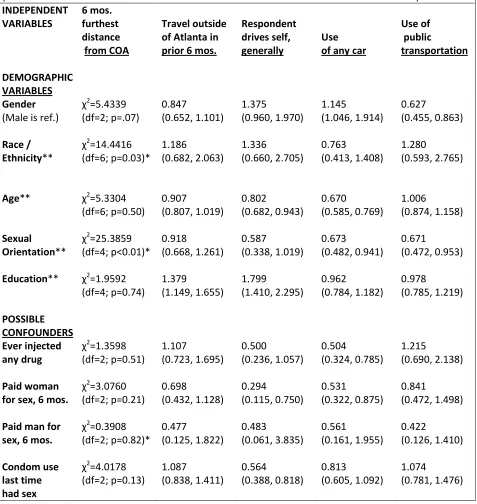
In comparing demographic and possible confounder variables with each independent
variable (Table 4), education was significantly associated with travel outside of Atlanta in the
past six months (OR=1.379; 95% CI: 1.149, 1.655). Significant associations were also observed
between those who drove themselves and age (OR=0.802; 95% CI: 0.682, 0.943), education
(OR=1.799; 95% CI: 1.410, 2.295), paying a woman for sex in past six months (OR=0.294; 95%
CI: 0.115, 0.750), and recent condom use (OR=0.564; 95% CI: 0.388, 0.818). Significant
associations were also observed between use of any car and gender (1.145; 95% CI: 1.046,
24
0.941), ever injection drug use (OR=0.504; 95% CI: 0.324, 0.785), and paying a woman for sex
in past six months (OR=0.531; 95% CI: 0.322, 0.875). Finally, gender (OR=0.627; 95% CI:
0.455, 0.863) and sexual orientation (OR=0.671; 95% CI: 0.472, 0.953) were both significantly
associated with use of public transportation.
Multivariate Analyses
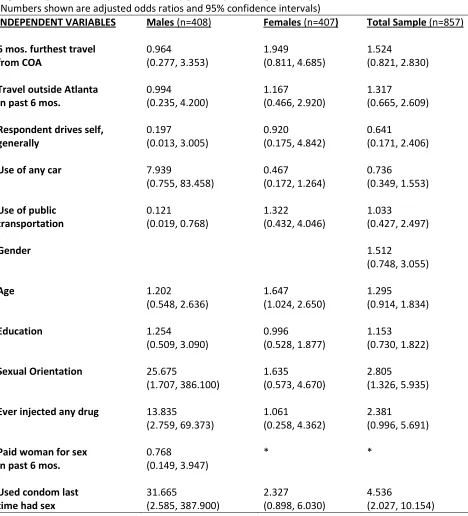
A logistic regression analysis (Table 5) composed of each independent variable of
mobility, as well as the demographic and confounder variables shown to be significant in
univariate analyses (gender, age, education, sexual orientation, ever injection drug use, and
condom use in past six months, but not paying a woman for sex in the past six months), did not
reveal any significant associations between the independent variables of mobility and HIV status.
HIV status was, however, significantly associated with sexual orientation and recent condom
use. When controlling for all other variables, those who were gay, lesbian, or bisexual were
2.805 times as likely as heterosexuals to be HIV positive, and those who were transgendered,
transsexual, or other were 2.805 times as likely to be HIV positive than those who were gay,
lesbian, or bisexual (95% CI: 1.326, 5.935). Finally, those who used a condom the last time they
had sex were 4.536 times as likely to be HIV positive as those who had not used a condom (95%
CI: 2.027, 10.154).
When the model was stratified by gender, no significant observations were observed
among females between the independent variables of mobility and HIV status. However, age
was significantly associated with HIV status for women. With each increase in age quartile,
women were 1.647 times as likely to be HIV positive (95% CI: 1.024, 2.650). In the stratified
model for males, which also included the variable “paid woman for sex in the past six months,”
25
not use public transportation, and this association was shown to be significant (adj. OR=0.121;
95% CI: 0.019, 0.768). No other independent variables of mobility were shown to be
significantly associated with HIV status among men. Nevertheless, large significant associations
were observed between HIV status among men and sexual orientation. When controlling for all
other variables, men who were gay, lesbian, or bisexual were 25.675 times as likely as
heterosexual men to be HIV positive, and men who were transgendered, transsexual, or other
were 25.675 times as likely as gay, lesbian, or bisexual men to be HIV positive (95% CI: 1.707,
386.100). Significant associations for men were also observed between HIV status and ever
injection drug use (adj. OR=13.835; 95% CI: 2.759, 69.373) and recent condom use (adj.
Chapter V
Discussion and Conclusions
This study analyzed the relationship between mobility and HIV risk in ten ZIP codes of
Atlanta, Georgia with high HIV prevalence. I hypothesized that increased mobility would be a
protective factor for persons residing in these geographic areas but that results would vary by
gender. The results of the logistic regression analysis comparing the five independent variables
of mobility with HIV risk, controlling for demographic and behavioral variables, show that, with
one exception, no significant relationship existed between those variables and HIV risk.
Therefore, the hypothesis of this study is rejected, except to the extent that use of public
transportation appears to be a protective factor for men, but not women, in this population.
Interpretation of Findings
Univariate analysis revealed that those who used any car were less likely to be HIV
positive than those who did not. However, multivariate analysis did not support this finding. In
fact, no significant associations were found in the total sample population between any of the
independent variables of mobility and HIV risk. Prior studies analyzing this relationship were
primarily conducted among migrant populations in developing countries. Most of those studies
found mobility to be an independent risk factor for HIV, but some also showed it to be
protective. However, it would appear from the present study that those results are not applicable
to inner city populations in the southeastern region of the United States. There are several
possible reasons for this disparity in findings.
The most obvious explanation is that the mobility analyzed in the present study is
different than the types of mobility examined in prior research. This study is unique in looking
27
this study, mobility was measured by variables that essentially related to being able to move
around on a regular basis—recent movement outside of one’s center of activity (COA) and
access to transportation. Therefore, this study was really about the effects of short term, or even
daily, mobility on HIV risk. The studies conducted in developing countries, however, focused
primarily on long-term migration or other forms of mobility which are necessary for survival.
The motivation for the mobility observed in the present sample is unknown, but presumably
many people are moving around by choice, or at least not for the same types of basic survival
needs that motivate migrants in developing countries.
The results also indicate that mobility in these inner city neighborhoods cannot be
separated from the demographic and behavioral characteristics which define the population.
Rather, it is part of a cluster of several factors that occur together. The basic characteristics
observed in this study are consistent with previous findings that core areas of STD transmission
are characterized by poverty and its various sequelae (Hixson, et al., 2011; R. B. Rothenberg,
1983). Almost half of study participants had less than a high school diploma and only 15%
drove their own car, implying that this population is composed mainly of person of low
socio-economic status. In addition, the risk behaviors observed in this sample are consistent with prior
studies showing a concentration of high risk sexual behaviors in these core areas (Bernstein, et
al., 2004). Twelve percent of the sample had ever injected any drug and more than half did not
use a condom the last time they had sex. The results of the present study imply that all of these
factors, including mobility, contributed to the observed high HIV prevalence of 5.29% in the
sample population and that most of these factors cannot be analyzed separately.
I also hypothesized that study results would vary by gender and the results indicate that
28
car were significantly less likely to be HIV positive than women who did not use any car. No
other variables in the univariate analyses were found to have a significant association for either
women or men. Multivariate analysis did not confirm this finding but instead showed that men
who used public transportation were significantly less likely to be HIV positive than men who
did not use public transportation. No other significant associations were found in the stratified
logistic regression model.
These findings have several possible interpretations. I based much of my hypothesis that
mobility results would vary by gender on several studies which observed a protective factor for
mobile women in various high-prevalence groups in developing countries (Haibo, et al., 2010;
Khan, et al., 2008; Lydié, et al., 2004; Strathdee, et al., 2008; Watts, et al., 2010). Those studies
were of populations with different demographic compositions and motivations for mobility than
those in the present sample. In addition, the condition of women in those studies was quite
different from the women in the present study. For example, two studies were of female sex
workers (Haibo, et al., 2010; Watts, et al., 2010) and two studies were of more long-term migrant
populations (Khan, et al., 2008; Lydié, et al., 2004). The gender differences observed in those
studies, therefore, do not appear to be applicable to an inner city population in the United States
with a high HIV prevalence.
The observation that men who used public transportation were significantly less likely to
be HIV positive than men who did not use public transportation is interesting. Several studies
found mobility to be a risk factor among men because there are more opportunities for risk
behaviors when men are away from their homes (Bo, et al., 2007; Rachlis, et al., 2007). As only
15% of the sample drove their own car, it is likely that, for most, public transportation was their
29
as far as those who drive a car, because public transportation options and distances are limited.
Therefore, they may be protected by being closer to home. More research is needed as to the
effects of public transportation use on HIV risk to see if this relationship is observed elsewhere.
Although few significant associations were found between HIV risk and the independent
variables of mobility, significant associations were observed with sexual orientation, ever
injection drug use, and recent condom use. Sexual orientation was shown to be a significant risk
factor in the entire study population; however, when the logistic model was stratified by gender,
it was only significant for men. This is consistent with findings that men who have sex with men
are still at increased risk for HIV and are concentrated in inner city neighborhoods (R. B.
Rothenberg, et al., 2000; Zenilman, et al., 2002). Additionally, that half of those who identified
as transgendered, transsexual, or other were HIV positive is alarming and indicates that more
research is needed as to why that population might have such a high rate of HIV and whether
certain high-risk behaviors are more prevalent in this group.
Ever injection drug use was also shown to be a significant risk factor for HIV: Those
who had ever injected any drug were almost three times as likely to be HIV positive as those
who had never injected. This finding is consistent with studies showing injection drug users to
be at high risk for HIV and to be concentrated in geographic core areas (R. B. Rothenberg, et al.,
2000; Zenilman, et al., 2002). Surprisingly, recent condom use was shown to be a significant
risk factor for HIV in the study population. Those who reported using a condom the last time
they had sex were more than four times as likely to be HIV positive as those who had not used a
condom. It is possible that condom use served as a marker for those who engage in frequent
sexual activity with multiple partners and are, therefore, at greater risk. However, it may also be
30
partners. The significance of these two behavioral variables suggest that high-risk behaviors are
the main drivers of the HIV epidemic in these core areas, despite whatever other common factors
may exist.
Strengths and Limitations
The present study has several strengths which add reliability to its findings. The sample
size was large at 927 adults and was generally representative of the population in the ten ZIP
codes from which participants were recruited. The ethnographic portion of the study design
involved six months of preliminary research, consisting of focus groups and small surveys, in
order to establish a better relationship with the community involved. This approach improved
follow up and aided in the design of the final questionnaire. In addition, the three seeds in each
ZIP code, who would eventually form several chains of contacts, were carefully chosen to be
representative of and active in their communities. Great care was taken, however, to make sure
that the seeds were not known to each other, ensuring that more contacts could be named and
thereby increasing sample size.
This study also has its limitations. It was not possible to determine the motivations for
participants’ mobility. Much of mobility’s influence on HIV risk may depend on why one is
travelling or moving about. For example, commuting for work would presumably have a
different effect on HIV risk than travelling to meet a sexual contact or to use drugs. Therefore, it
is possible that significant associations might have been observed if the mobility variables could
have been further defined by purpose. Furthermore, the mobility variables that were examined
were not mutually exclusive; someone could, for example, be classified as both a user of public
transportation and a user of any car, preventing a comparison of risk between those two groups.
31
The results of this study may not be generalizable to other populations. It was not
possible to control for racial differences in this sample, because almost all participants identified
as black (of either African or Caribbean origin). It is unclear what results might have been
observed in a geographic area of high HIV prevalence with a more racially diverse population.
In addition, the cross-sectional nature of the sample prevents conclusions as to the effects of
mobility on HIV incidence. The mobility variables referred to current or recent behavior,
whereas HIV status was not related to a time interval. A positive test result could only measure
prevalence and did not indicate when a participant actually seroconverted. Thus, it is possible
that at the time one became HIV positive their mobility or access to transportation was different
than it was at the time of interview, but that relationship could not be examined.
Finally, the hypothesis formulated and the definitions of mobility used were limited by
the lack of studies on this topic in the developed world and by disagreement on an operational
definition for mobility. I formulated my hypothesis largely based on what had been observed in
developing countries and how that might be applied to the present study. Other hypotheses
would also be possible. Additionally, with no clear guidance on an operational definition of
mobility, the one used was largely based on the available data.
Implications
Despite the lack of significant associations, the results of this study confirm the findings
of Rothenberg (1983), and others, that cases of sexually transmitted diseases, such as HIV, are
concentrated in geographically defined areas of the inner city where poverty, risk behaviors, and
social network characteristics combine to create a reservoir for disease transmission. Even
though most of the independent variables of mobility were not found to have a significant
32
characteristic of these neighborhoods that may act in concert with other factors to influence HIV
risk. In addition, men’s use of public transportation was shown to be a significant protective
factor for HIV risk. Further studies are needed to confirm this association. Despite few
significant findings, the results of this study indicate that mobility options of a target population
should at least be considered along with other factors when examining HIV risk and formulating
prevention programs. Further analyses from the Geography Project will focus on the pattern of
geographic space in areas of higher and lower prevalence.
Conclusions
The association between mobility and HIV risk was examined using results from a large
study of ten ZIP codes of Atlanta, Georgia gathered by Rothenberg and colleagues between 2005
and 2011. Mobility was based on how often participants left their center of activity and their
access to transportation. It was classified by five independent variables: furthest distance away
from COA within the Atlanta area in the past six months, travel out of the Atlanta area in the past
six months, driving one’s own car, use of any car, and use of public transportation. Only use of
public transportation was shown to have a significant association with HIV risk and only as a
protective factor for men. Future studies on this issue in developed countries are needed to
establish an operational definition of mobility based on the types of and reasons for mobility
observed in geographic areas with high HIV prevalence. Once such a definition has been
established, additional studies should examine mobility’s effects on HIV risk and whether
33
References
Alvarez-Dardet, C., Marquez, S., & Perea, E. J. (1985). Urban clusters of sexually transmitted diseases in
the city of Seville, Spain. Sexually Transmitted Diseases, 12(3), 166-168.
Bernstein, K. T., Curriero, F. C., Jennings, J. M., Olthoff, G., Erbelding, E. J., & Zenilman, J. (2004).
Defining core gonorrhea transmission utilizing spatial data. American Journal of Epidemiology,
160(1), 51-58.
Bloom, S. S., Urassa, M., Isingo, R., Ng'weshemi, J., & Boerma, J. T. (2002). Community effects on the
risk of HIV infection in rural Tanzania. Sexually Transmitted Infections, 78(4), 261-266.
Bo, W., Xiaoming, L., Stanton, B., Xiaoyi, F., Guojun, L., Hui, L., et al. (2007). Gender differences in
HIV-related perceptions, sexual risk behaviors, and history of sexually transmitted diseases
among chinese migrants visiting public sexually transmitted disease clinics. AIDS Patient Care &
STDs, 21(1), 57-68. doi: 10.1089/apc.2006.0031
Boerma, J. T., Urassa, M., Senkoro, K., Klokke, A., & Ng'weshemi, J. Z. L. (1999). Spread of HIV
infection in a rural area of Tanzania. AIDS, 13(10), 1233-1240.
Butchko, H. H., Stargel, W. W., Comer, C. P., Mayhew, D. A., Benninger, C., Blackburn, G. L., et al.
(2002). Aspartame: review of safety. Regulatory Toxicology And Pharmacology: RTP, 35(2 Pt 2),
S1-S93.
Camlin, C. S., Hosegood, V., Newell, M.-L., McGrath, N., Bärnighausen, T., & Snow, R. C. (2010).
Gender, migration and HIV in rural KwaZulu-Natal, South Africa. PLoS ONE, 5(7), 1-10. doi:
10.1371/journal.pone.0011539
Coffee, M. P., Garnett, G. P., Mlilo, M., Voeten, H. A. C. M., Chandiwana, S., & Gregson, S. (2005).
Patterns of movement and risk of HIV infection in rural Zimbabwe. Journal of Infectious
34
Deane, K. D., Parkhurst, J. O., & Johnston, D. (2010). Linking migration, mobility and HIV K. D. Deane
et al. Tropical Medicine & International Health, 15(12), 1458-1463. doi:
10.1111/j.1365-3156.2010.02647.x
Deren, S., Kang, S.-Y., Colon, H. M., & Robles, R. R. (2007). The Puerto Rico–New York airbridge for
drug users: description and relationship to HIV risk behaviors. Journal of Urban Health, 84(2),
243-254.
Doherty, I. A., Adimora, A. A., Muth, S. Q., Serre, M. L., Leone, P. A., & Miller, W. C. (2011).
Comparison of sexual mixing patterns for syphilis in endemic and outbreak settings. Sexually
Transmitted Diseases, 38(5), 378-384.
Doherty, I. A., Padian, N. S., Marlow, C., & Aral, S. O. (2005). Determinants and consequences of sexual
networks as they affect the spread of sexually transmitted infections. Journal of Infectious
Diseases, 191, S42-S54.
El-Bassel, N., Gilbert, L., Terlikbayeva, A., West, B., Bearman, P., Wu, E., et al. (2011). Implications of
mobility patterns and HIV risks for HIV prevention among migrant market vendors in
Kazakhstan. American Journal of Public Health, 101(6), 1075-1081. doi:
10.2105/ajph.2010.300085
Ezekiel, M. J., Talle, A., Mnyika, K. S., & Klepp, K.-I. (2010). Social geography of risk: The role of time,
place and antiretroviral therapy in conceptions about the sexual risk of HIV in Kahe, Kilimanjaro,
Tanzania. Norwegian Journal of Geography, 64, 48-57.
Feldacker, C., Emch, M., & Ennett, S. (2010). The who and where of HIV in rural Malawi: Exploring the
effects of person and place on individual HIV status. Health & Place, 16, 996-1006.
Gindi, R. M., Sifakis, F., Sherman, S. G., Towe, V. L., Flynn, C., & Zenilman, J. M. (2011). The
geography of heterosexual partnerships in Baltimore city adults. Sexually Transmitted Diseases,