ISSN Online: 1947-394X ISSN Print: 1947-3931
Suitability of Large Sized Compacted Baked Clay
Blocks as a Walling Material
Nawab Ali Lakho, Muhammad Auchar Zardari*
Department of Civil Engineering, Quaid-e-Awam University of Engineering, Science and Technology, Nawabshah, Pakistan
Abstract
Some disadvantages associated with conventional brick masonry are: high cost of construction, lower compressive strength and less durability. In order to resolve these problems, a new technique of constructing walls using large size baked clay blocks is introduced. For this purpose, clay blocks of size 150 mm × 300 mm × 1980 mm were cast at a pressure of 6 MPa, and fired at a temperature of 700˚C. In this paper, compressive strength and tensile strength of baked clay were investigated in order to find its suitability as a walling material for low cost houses. Cubes of 150 mm sides were tested in compression and the beams were tested in flexure. The re-sults showed that compressive strength of baked clay cubes was found to be 10 MPa and tensile strength, in terms of modulus of rupture, was found to be 2.3 MPa. Since the baked clay blocks are larger in size than traditional bricks, it is inferred that the blocks could be used as a cheaper and stronger walling material.
Keywords
Baked Clay, Compressive Strength, Modulus of Rupture, Walling Material, Low Cost Houses
1. Introduction
Developing countries like Pakistan are experiencing more population growth and have limited resources to meet housing crisis for low income people. Main structural ele-ments of a building are: footing, column, wall, beam and slab. Of these eleele-ments, walls require more than 50% of total material of building construction. Traditionally, baked clay bricks are used as a material of construction of walls. But, brick masonry has some drawbacks such as: 1) it requires more quantity of cement mortar, plastering material and more labour cost, and 2) compressive strength of a masonry wall is generally less as compared to that of individual bricks.
How to cite this paper: Lakho, N.A. and Zardari, M.A. (2016) Suitability of Large Sized Compacted Baked Clay Blocks as a Walling Material. Engineering, 8, 669-675. http://dx.doi.org/10.4236/eng.2016.810060
Received: August 21, 2016 Accepted: October 7, 2016 Published: October 10, 2016
Copyright © 2016 by authors and Scientific Research Publishing Inc. This work is licensed under the Creative Commons Attribution International License (CC BY 4.0).
Compressive strength of baked clay is dependent upon compaction at the time of casting [1], and firing temperature [2]-[4]. But, the bricks are generally cast without compaction and are fired at 1000˚C in a kiln. Firing of bricks at this temperature re-quires more fuel, resulting in the increase of the cost. The cost of mortar and labour incurred in brick masonry may be reduced if large baked clay blocks of uniform size are used instead of bricks. Generally, cost of fuel used for firing commercial baked clay bricks is considered to be major part of the total cost of manufacturing. In addition, the cost of firing could be reduced by compacting the clay blocks and baking them at rela-tively less temperature. If the width of clay blocks is kept equal to that of a masonry wall, there may be no need of plastering and colouring. Moreover, these compacted baked clay blocks may be used as lintels over small openings of doors and windows. If the span of an opening is more, then these baked clay blocks can also be reinforced be-fore using as lintels. Therebe-fore, besides compressive strength, tensile strength in terms of modulus of rupture of baked clay blocks is required to be investigated.
Previous studies have been conducted to explore potential of baked clay beams as a substitute of Reinforced Cement Concrete, see e.g., references [5]-[12]. Compressive strength as high as 38 MPa, was achieved when these clay blocks compacted at 7.2 MPa were fired at the temperature of 1000˚C [1]. The average compressive strength of fired bricks manufactured in Sindh, Pakistan is about 12 MPa [13]. In general, the compres-sive strength of masonry is about one-fourth of an individual brick [14]. The object of this study is to investigate suitability of baked clay blocks fired at a temperature of 700˚C to be used as a walling material instead of traditional brick masonry. No such study is reported in the literature.
2. Materials and Methods
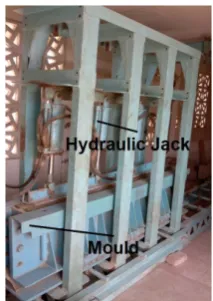
2.1. Casting of Baked Clay BlocksIndigenous clay and pit sand were mixed in a ratio of 70:30 by weight. Twenty-two percentage of potable water was added in the mixture which was mixed well in a pan mixer for fifteen minutes. This moist mixture was covered with plastic sheet. Clay blocks of size 150 mm × 300 mm × 1980 mm were cast in a steel mould. The blocks were cast in five equal layers. Each layer was tamped and spray of water was applied to achieve bond between consecutive layers. The blocks were compacted, at a pressure of 6 MPa, with the help of wooden plunger of the Mechanized System (Figure 1). The de-tails of the Mechanized System can be found in the reference [15] written by the au-thors.
tempera-ture was increased in increments, each of 50˚C. Each increment of the temperatempera-ture was maintained for half an hour. Finally, the temperature was increased to 700˚C and maintained for three hours. During whole process of firing, the lid of the kiln was slightly opened in order to allow the steam and moist flue gases to escape. Then, the firing was stopped and the blocks were allowed to cool slowly. Figure 2 shows a baked a clay block after firing.
2.2. Testing Programme
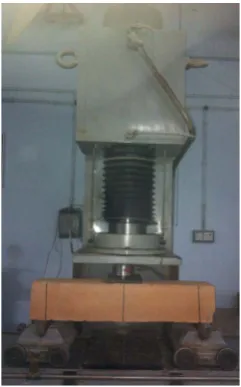
Cubes having standard size of 150 mm [16] were cut from these baked clay blocks and tested for compression in Universal Testing Machine as shown in Figure 3. The beam prisms having size of 150 mm × 150 mm × 760 mm were also sawed from the baked clay blocks. These beam prisms were tested in flexure in accordance with ASTM C42M
[17] and ASTM C293M [18]. The beams were supported on rollers at the ends and load was applied at mid span (Figure 4). The effective span of the beam during test was 600 mm. The modulus of rupture was calculated by using the following relation [18]:
2 1.5
R= PL bd
(1)
where R is the modulus of rupture in MPa, P is the maximum applied load in Newton, L is the span length in mm, b and d are the average width, and depth of the specimen in mm, respectively.
In order to compare modulus of rupture of baked clay with concrete, following for-mula was used [18]:
7.5
r c
f = f (2)
[image:3.595.319.426.445.596.2]where fc is the compressive strength of in psi.
Figure 1. Mechanized system for compaction of clay beams.
[image:3.595.252.496.626.691.2]Figure 3. Compressive strength test is being performed on a baked clay cube of 150 mm size, using universal testing machine.
Figure 4. A plain baked clay beam is being tested for modulus of rup-ture in universal beam testing machine.
3. Results and Discussions
3.1. Compressive Strength of Baked Clay Cubes
[image:4.595.312.433.325.519.2]mortar joints and improved compressive strength. This implies that the use of large sized compacted baked clay blocks as a walling material may result in strong and eco-nomical construction of houses.
3.2. Modulus of Rupture
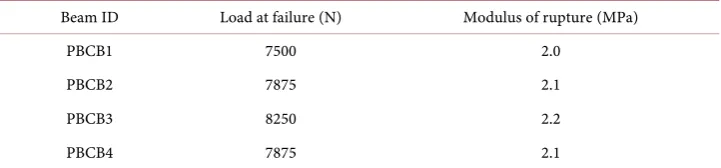
Beam prisms having size of 150 mm × 150 mm × 760 mm were sawed from these com-pacted baked clay blocks. These beams were tested with single point load applied at mid span. The beams were simply supported at their ends during the test. The results of the above plain baked clay beams tested in flexure are presented in Table 1. The average value of modulus of rupture of baked clay beams was found to be 2.3 MPa. The value of modulus of rupture, according to ACI code ACI 318-11 [19] for normal weight con-crete, is 3 MPa. Thus, the average value of modulus of rupture of baked clay beams fired at 700˚C is about 75% of the corresponding value of the normal weight concrete. The modulus of rupture depends upon compressive strength of a material. As stated above, the compressive strength of baked clay can be improved by the application of compaction at the time of casting [1]. Since the modulus of rupture of normal weight concrete is usually taken as 15% of its compressive strength. However, the tensile strength exhibited by concrete is not taken into consideration in design. Generally, steel bars are provided to make concrete stronger in tension. It can be concluded that like concrete, the tensile strength of the baked clay fired at 700˚C can be improved by using reinforcement.
4. Conclusions
In this paper, it was investigated whether large baked clay blocks could be used as wal-ling material instead of brick masonry. The following conclusions can be drawn:
1) The average cube crushing strength of the baked clay, compacted at 6 MPa and fired at 700˚C, was found to be 10 MPa.
2) The average value of the modulus of rupture of baked clay beams was found to be 2.3 MPa, which is about 75% of the corresponding value of the normal weight concrete.
3) This study suggests that the compacted baked clay blocks could serve as an eco-nomical and stronger walling material as compared to brick masonry.
Acknowledgements
[image:5.595.193.554.616.700.2]The authors would like to thank Quaid-e-Awam University of Engineering, Science and
Table 1. Load at failure and modulus of rupture of plain baked clay beams.
Beam ID Load at failure (N) Modulus of rupture (MPa)
PBCB1 7500 2.0
PBCB2 7875 2.1
PBCB3 8250 2.2
Technology Nawabshah, for providing access to the Structural Engineering Laboratory to conduct the tests mentioned in this study.
References
[1] Lakho, N.A., Zardari, M.A. and Memon, F.A. (2016) Effect of Intensity of Compaction on Crushing Strength of Indigenous Baked Clay. Journal of Engineering Research, 4, 18-28. http://dx.doi.org/10.7603/s40632-016-0011-5
[2] Karaman, S., Ersahin, S. and Gunal, H. (2006) Firing Temperature and Firing Time Influ-ence on Mechanical and Physical Properties of Clay Bricks. Journal of Scientific and Indus-trial Research, 65, 153-159.
[3] Karaman, S., Gunal, H. and Ersahin, S. (2006) Assessment of Clay Bricks Compressive Strength Using Quantitative Values of Colour Components. Construction and Building Materials, 20, 348-354. http://dx.doi.org/10.1016/j.conbuildmat.2004.11.003
[4] Johari, I., Said, S., Hisham, B., Bakar, A. and Ahmad, Z.A. (2010) Effect of the Change of Firing Temperature on Microstructure and Physical Properties of Clay Bricks from Beruas (Malaysia). Science of Sintering, 42, 245-254. http://dx.doi.org/10.2298/SOS1002245J [5] Ansari, A.A., Bhatti, N.K. and Bhutto, A. (2013) Suitability of Pre-Perforated Post-Rein-
forced Baked Clay Beam Panels for Low Cost Housing. American Journal of Civil Engi-neering, 1, 6-15. http://dx.doi.org/10.11648/j.ajce.20130101.12
[6] Ansari, A.A. and Lakho, N.A. (2013) Determination of Structural Properties of Baked Clay as Replacement of RCC. International Journal of Emerging Technology and Advanced En-gineering, 3, 17-25.
[7] Ansari, A.A. (2008) Experimental Study of the Behaviour of Pre-Perforated Post-Reinforced Baked Clay Panels of Beams. Ph.D. Thesis, Quaid-e-Awam University of Engineering Science and Technology, Nawabshah.
[8] Lakho, N.A. and Zardari, M.A. (2016) Comparison of Compressive and Tensile Strength of Baked Clay with Those of Normal Concrete. Engineering, 8, 301-307.
http://dx.doi.org/10.4236/eng.2016.86027
[9] Lakho, N.A. and Zardari, M.A. (2016) Flexural Behaviour of Reinforced Baked Clay Beams. Engineering, 8, 403-409. http://dx.doi.org/10.4236/eng.2016.87037
[10] Lakho, N.A. and Zardari, M.A. (2016) Experimental Study of Flexural Behaviour of Rein-forced Baked Clay Beams under Impact Loading. Engineering, 8, 347-352.
http://dx.doi.org/10.4236/eng.2016.86032
[11] Lakho, N.A., Zardari, M.A. and Memon, N.A. (2016) Effect of Firing on Cracking and Warping of Clay Beams. Mehran University Research Journal of Engineering and Technol-ogy, 35, 247-252.
[12] Lakho, N.A., Zardari, M.A. and Memon, N.A. (2015) Reduction of Cracking and Shrinkage in Compressed Clay Beams during Drying. Mehran University Research Journal of Engi-neering and Technology, 35, 395-400.
[13] Khoso, S., Wagan, F., Khan, J., Bhatti, N. and Ansari, A. (2014). Qualitative Analysis of Baked Clay Bricks Available in Larkana Region, Pakistan. Architecture Civil Engineering Environment, 7, 41-50.
[14] Kaushik, H.B., Rai, D.C. and Jain, S.K (2007) Stress-Strain Characteristics of Clay Brick Masonry under Uniaxial Compression. Journal of materials in Civil Engineering, 19, 728- 739. http://dx.doi.org/10.1061/(ASCE)0899-1561(2007)19:9(728)
Mechanized System for Casting and Compacting Laboratory Size Clay Beams. Scientiaira-nica, 22, 2046-2051.
[16] BS EN 12390-3 (2002) Testing Hardened Concrete—Part 3: Compressive Strength of Test Specimens.
[17] ASTM C42M-13 (2013) Standard Test Method for Obtaining and Testing Drilled Cores and Sawed Beams of Concrete. ASTM International, West Conshohocken, PA.
[18] ASTM C293M-10 (2010) Standard Test Method for Flexural Strength of Concrete (Using Simple Beam with Center-Point Loading. ASTM International, West Conshohocken, PA. [19] ACI 318-11 (2011) Building Code Requirements for Structural Concrete. American
Con-crete Institute, Farmington Hills, MI.
Submit or recommend next manuscript to SCIRP and we will provide best service for you:
Accepting pre-submission inquiries through Email, Facebook, LinkedIn, Twitter, etc. A wide selection of journals (inclusive of 9 subjects, more than 200 journals)
Providing 24-hour high-quality service User-friendly online submission system Fair and swift peer-review system
Efficient typesetting and proofreading procedure
Display of the result of downloads and visits, as well as the number of cited articles Maximum dissemination of your research work
Submit your manuscript at: http://papersubmission.scirp.org/