Munich Personal RePEc Archive
Optimization of Hydroelectric Power
Generation, Case Study of Roseires Dam
in Sudan
Mohamed, Issam A.W.
Al Neelain University
2011
Online at
https://mpra.ub.uni-muenchen.de/31558/
1
Optimization of Hydroelectric Power Generation,
Case Study of Roseires Dam in Sudan
Professor Issam A.W. Mohamed ABSTRACT
Water reservoirs are large pools of water created stream or river catchment's areas and torrential rains and for storing water for use in many ways, and perhaps electric power generation is one of the most important uses of these reservoirs and for agriculture. That is extremely beneficial considering a rare and limited economic resources. Applied stochastic processes model has been applied in the work of Roseires dam, in order to develop a system to generate the highest possible power in the resources available. The current paper aims to apply another model, which is a dynamic programming model to verify the possibility of developing the same system and thus generate the highest possible electricity from the reservoir.
Data collected from the Ministry of Irrigation and the National Electricity Cooperation and international information network during the years 206-2007.
1.
Introduction
Studies take importance of water resources; the studies improvise mathematical models for designing and managing complicated systems, which involve many variables. One of studies deal with Dynamic programming models, and the goal of this study is to introduce Dynamic model for generating hydroelectric power. In 1952 Bellman introduced the theory of dynamic programming following that Young (1967) used the dynamic programming to obtain the optimal operation policy for multiple dams assumes the capacity of storage is known and the study had been applied in California. Mobashori (1970) developed Hall’s models to obtain better storage policy, but the use of stochastic dynamic programming started in 1955 by little. In (1973) Yeh applied the (S.D.P) for maximizing the generated power and in (1980) Dogli used (D.P) depended on forecast values for inputs.
2.
The Dynamic Model
The objective function is to achieve maximum production when operating the system, objective function of dams depends on standard for measuring the efficiency of dam for maximization.
n
i n
P Max Z
1
where
n
P = Total of generated power subject to inputs, outflow, evaporation and other constraints
This objective function can be written as
n
i n
j i in in Y h Y Max Z
1 1 , ,
Where
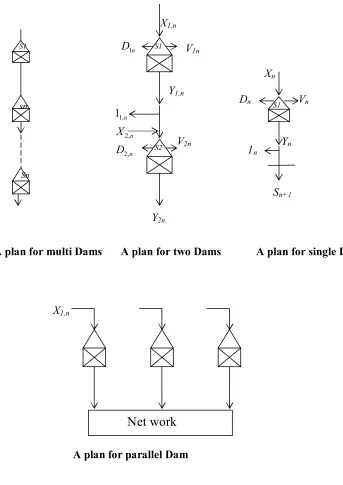
Sort of dam Constraint of mathematical model
Single Sn+1 = Sn + Xn – Yn – Dn - Vn
Two sequential dams S1,n+1 = S1,n + X1,n – Y1,n – 11,n - Yn,2 – V2,n
Multiple sequential dams Si,n+1 = Si,n + Xi,n + Yi–1,n – 1i,-1,n – Yi,n – Di,n – Vi,n Parallel dams Si,n+1 = Si,n + Xi,n – Yi,n – Di,n – Vi,n
Such that
Sn = Storage of water
Xn = Inputs of water
Yn = Output of water
Dn = Water had been taken from the Dam
Vn = Evaporation of water
3
Figure (1) Plans for different dams S2
S1 S1
S1
sn
Sn
n D1
n n n
D X
, 2 , 2 , 1
1
X1,n
V1n
Y1,n
V2n
Y2n
Xn
Dn
1n
Sn+1 Vn
Yn
A plan for two Dams
A plan for multi Dams A plan for single Dams
A plan for parallel Dam
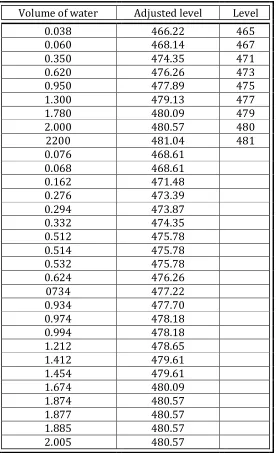
[image:4.612.108.451.72.557.2]Table (1) The Adjusted levels of waters at Roseires dam
Volume of water Adjusted level Level
0.038 466.22 465
0.060 468.14 467
0.350 474.35 471
0.620 476.26 473
0.950 477.89 475
1.300 479.13 477
1.780 480.09 479
2.000 480.57 480
2200 481.04 481
0.076 468.61
0.068 468.61
0.162 471.48
0.276 473.39
0.294 473.87
0.332 474.35
0.512 475.78
0.514 475.78
0.532 475.78
0.624 476.26
0734 477.22
0.934 477.70
0.974 478.18
0.994 478.18
1.212 478.65
1.412 479.61
1.454 479.61
1.674 480.09
1.874 480.57
1.877 480.57
1.885 480.57
2.005 480.57
The (N.E.C) program was achieved by calculating the difference between the upper and lower levels, and then applied the equation as in their table, HEAD Vs. S.W.C (Specific Water Consumption).
Here we determine the differences between levels, which are the effected charge. In addition, the efficiency of turbines* water density*.
[image:5.612.170.446.93.546.2]5
Table (2) Transformation of non linear for variables
Water
Volume Y Level X Log Y Log X
0.038 465 -3.270 6.142
0.060 467 -2.813 6.146
0.350 471 -1.050 6.155
0.620 473 -0.478 6.159
0.950 475 -0.051 6.163
1.30 477 0.262 6.167
1.78 479 0.577 6.171
2.00 480 0.693 6.173
2.200 481 0.788 6.176
When we apply the least squares estimation method for Log Y and Log X we get
= 6.17 and = 0.0077
Then 0077 . 0 0077 . 0 17 . 6 0077 . 0 17 . 6 0077 . 0 17 . 6
18
.
478
n n LnS LnS nS
S
e
e
e
e
EL
n n
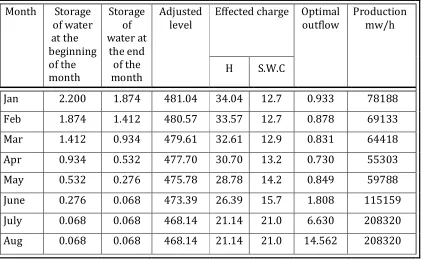
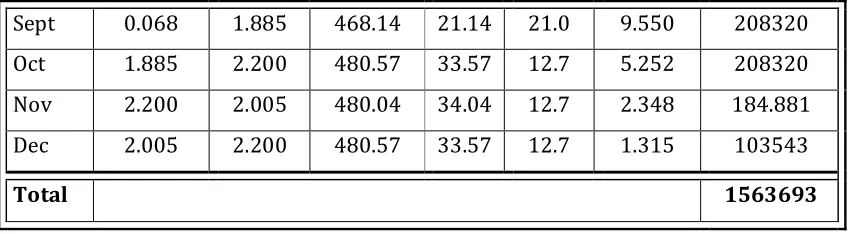
For the Rosiers dam, the generating electricity by the two methods is shown in the following tables
Table (3) Generating electricity by using stochastic process model Effected charge
Month Storage of water at the beginning of the month Storage of water at the end of the month Adjusted level
H S.W.C
Optimal
outflow Production mw/h
Jan 2.200 1.874 481.04 34.04 12.7 0.933 78188
Feb 1.874 1.412 480.57 33.57 12.7 0.878 69133
Mar 1.412 0.934 479.61 32.61 12.9 0.831 64418
Apr 0.934 0.532 477.70 30.70 13.2 0.730 55303
May 0.532 0.276 475.78 28.78 14.2 0.849 59788
June 0.276 0.068 473.39 26.39 15.7 1.808 115159
July 0.068 0.068 468.14 21.14 21.0 6.630 208320
[image:6.612.89.510.451.712.2]Sept 0.068 1.885 468.14 21.14 21.0 9.550 208320
Oct 1.885 2.200 480.57 33.57 12.7 5.252 208320
Nov 2.200 2.005 480.04 34.04 12.7 2.348 184.881
Dec 2.005 2.200 480.57 33.57 12.7 1.315 103543
Total 1563693
By using of dynamic programming model for the generation of electricity, we reach the results in the following table
Table (4) Generating electricity by using dynamic programming model Effected charge
Month Storage of water at the beginning of the month
Storage of water
at the end of the month
Adjusted level
H S.W.C
Optimal
outflow Production mw/h
Jan 2.200 1874 480.04 34.04 12.7 0.967 76141
Feb 1874 1.412 480.57 33.57 12.7 0.854 67244
Mar 1412 0.934 479.61 32.61 13.7 0.816 63750
Apr 0.934 0.532 477.70 30.70 14.2 0.716 52262
May 0.532 0.267 475.78 28.78 15.5 0.765 53873
June 0.276 0.068 473.39 26.39 21.0 1.755 113225
July 0.068 0.060 468.61 21.61 21.0 6.004 208320
Aug 0.060 0.060 468.14 21.14 21.0 14.424 208320
Sept 0.060 1.877 468.14 21.14 21.0 9.514 208320
Oct 1.877 2.200 480.57 33.57 12.7 6.232 208320
Nov 2.200 2.005 481.04 34.04 12.7 2.331 183543
Dec 2005 2.200 480.57 33.57 12.7 1.529 120393
Total 1563711
[image:7.612.86.510.68.185.2]7
3.
Conclusion
The maximum production of electricity is achieved when 45–78% of the stored water used by using the pervious two models. Economic advantage is achieved here, especially under precious and rare single limited water source as in the case of the Nile River. Consideration should given to such a model as part of an optimum control paradigm. The National Electricity Authority is called for to consider the two mathematical models, stochastic or dynamic and more studies may be carried-out when the relation between the volume and the level of water is nonlinear.
4.
References
1. Betsekas, D.P. (1978) Dynamic Programming Deterministic and Stochastic Models.
New Jersey.
2. Cooper, L. & Cooper, M.W. (1991) Introduction to Dynamic Programming. Pergaman Press.
3. Druce, D.J. (1990) Incorporating Daily Flood Control objectives into a Monthly Stochastic Dynamic programming for a Hydroelectric complex. Water Resources. 26 (1).
4. Goulter, I.C. & Tai F.K. (1985) Practical Implications in the Use of Stochastic Dynamic
Programming for Reservoir Operation. Water Resources. 21 (1), 65 -74.
5. Kelman, J. et al (1990) Sampling Stochastic Dynamic Programming Applied to Reservoir Operation. Water Resources. 62 (3), 447 – 454.
6. Kelmes. V. (1974) Probability Distribution of Outflow from a linear Reservoir. Journal of Hydrology 21, 303.
7. Maidmenl, D. and Chow, V. (1981) Stochastic State Variable Dynamic Programming