Munich Personal RePEc Archive
A shift in the prevailing institutional
models of the global order:is a new cycle
starting?
Kirdina, Svetlana
Renmin University of China
June 2012
Online at
https://mpra.ub.uni-muenchen.de/42999/
1 Svetlana Kirdina, Institute of Economics, Russian Academy of Sciences
A shift in the prevailing institutional models of the global order: is a new cycle starting?1
This paper2 discusses some theoretical-methodological bases for comparative
institutional analysis. First, it shows the specific approach of the Marxian school to analyzing social and economic institutions. Second, it discusses the most general features
of the system paradigm in economic theory (Kornai, 1998 [2002]). Third, it presents
institutional matrices theory, or IMT (Кирдина, 2001; Kirdina, 2001, 2010, etc.), which
develops a Marxian approach together with systemic ideas. This section describes two basic institutional models, so-called X- and Y-institutional matrices. Fourth, it demonstrates that the economic dominance of Y-matrix countries (like the USA and European countries) since the 1970s has gradually decreased and that since 2008 the global GDP share of X-matrix countries (like Russia and China, e.g.) has prevailed and continues to grow.
Keywords: institutions, economic systems, Marxian approach, institutional matrices
JEL codes: B24, B25, P20, P51
1. Marxian school and the analysis of institutions
We believe that the potential of the Marxian project is still undervalued by institutional theorists. In most debates between institutionalists about Marx’s legacy only
its historical significance (Hodgson, 2006; Осадчая, 2005) or the role of Marxism as a
criticism of capitalism (e.g. the works of URPE economists) is recognized. Here we are also interested in creatively developing Marxian thought to help in understanding societies and peoples today.
What are the specifics of the Marxian approach to analyzing institutions? First of all, Marx emphasized the important role of the material environment in building economic institutions. The structure of institutions (K. Marx considered not only the economic sphere
of institutional functioning, but also politics and ideology) is materially determined by the
development level of productive forces. Institutions are the result of social (collective) practices and depend on the manner in which humans produce the means to life.
Another peculiarity of the Marxian approach resulting from the first one is the acceptance of the fact that a particular character and development level of productive forces shapes the changes in economic systems. Marx created the basis for analyzing a
«multiplicity» of economies in their commensurate notions and he considered a capitalistic economy as just one possible type. Economies differ from each other first of all by
differences in their ownership system. For Marx, the ownership system is the most
important institution that defines the specificity of the whole economic, political and social structure.
Third, taking into consideration the historicity of institutions, Marx wrote about this
phenomenon for the first time in his review of Western European economic development in XV-XIX centuries, which is also a peculiarity of Marxian analysis. Scholars in the Marxian
1
The reported study was partially supported by the RFBR, research project № 11-06-12035-ofi-m-2011, and the Russian Foundation for Humanities, research project № 11-02-00088а.
2
2
school underline the historically changing character of institutions, their «non-uniformity»
which differs from representatives of the Neoclassical and Austrian schools of economics for whom exchange relations (that of the market economy) have a universal and
historically “eternal” character. Because of their criticism of modern society (e.g. O’Hara,
2000) institutionalists of the Marxian school are often called «radical institutionalists».
And lastly, Marx considered the emergence of the social system and institutions to
be the result of social (collective) activity over the course of a long-term iterative process. Marxian dialectics highlighted the interdependence between public conscience, social
practices and the conditions in which people live (Тесля А., Тесля Е., 2007). So both
conscious human actions and the material “surrounding” factors are together reflected in
the results of social activity.
In recent times, institutions in so-called “countries in transition” and with various
historical and cultural features have started to be re-examined by the Marxian school. The shifting in analytical focus away from “traditional capitalist” countries to these “other” countries is related to the fact that the developmental processes in these countries in transition can hardly be described using the terms of “American institutionalism”.
In economic research in Russia, the application of Marxian ideas goes in two principal directions. First, Marxian ideas are used to criticize modern capitalism and to show its unacceptability for Russia (Buzgalin, Kolganov, 2003). Secondly, new concepts are being constructed using Marxian methods of analysis and substantive provisions are being developed on the basis of achievements in modern economic thought combined with the system paradigm. Such an attempt named institutional matrices theory (IMT) will be presented below in section 3.
2
2.. TThheessyysstteemmppaarraaddiiggmmiinneeccoonnoommiiccrreesseeaarrcchh
Here we discuss a heuristic perspective of the system paradigm. The systemic approach deals not just with the individual (mereological) details of an economy but with the system as a whole, and not just with the economy but also with the political, ideological and social dimensions. It pays special heed to the interactions between these spheres. As
Janos Kornai has mentioned (Kornai, 1998 [2002]), the Marxian approach constitutes a
vivid example of a systems paradigm in the economic thought of XIX century.
The most general features of the system paradigm that appear in economic research are described in the well-known study by Kornai (1998 [2002]). They are summarized as follows:
1) The social system is considered as a whole. Interrelations between the whole
and its parts are the primary subject of analysis;
2) Research has an integral character and can’t be assigned to any one specific field of science (economics, sociology, political science). Special attention is paid to the interaction of different areas of society functioning;
3) Research focuses on the institutions that define the framework and flows of
specific processes. Institutions are understood in a broad sense as structures formed
historically and developed “evolutionary3”;
4) There is a close connection in understanding the current social organization
alongside of the historical process in which it appeared;
5) Primary attention is paid to major changes and deep transformations, rather
than to small and constant changes;
3 Janos Kornai outlined the similarity of the system paradigm and neo-institutional theory in that respect,
3 6) System “dysfunctions” are inherently built into any system, which may be compensated for but not eliminated since their self-reproducibility is deeply rooted in the system itself;
7) Comparison is a typical method within the system paradigm and is
conducted mostly on the qualitative rather than the quantitative level.
Kornai presented a list of authors, who, from his point of view, implemented the system paradigm in economic studies. The list includes Karl Marx, Joseph A. Schumpeter, Ludwig von Mises and Friedrich von Hayek, as well as Walter Eucken and Karl Polanyi. Among contemporary scholars following this trend Mr. Kornai also included himself.
Most of those who work in the framework of this paradigm are involved in studies that go beyond pure economic theory and which additionally analyze links between economic relations and general changes in social and political life (for example, “Capitalism, Socialism, and Democracy” by J. Schumpeter, “The Great Transformation” by K. Polanyi, etc.).
The significant formation of the system paradigm in the 20th century shows the need
for producing systemic theories that have the status of scientific ontology (i.e. paradigms,
with “solid cores” for research programs). In the middle of the last century Schumpeter
wrote that “Our time revolts against the inexorable necessity of specialization and
therefore cries out for synthesis, nowhere so loudly as in the social sciences” (1951, p. 56). Empirical generalizations in economics become more and more fragmentary. Likewise, the growing number of particular theories did not allow us to solve problems of analyzing and comparing “big economies” over prolonged historical periods. Up to now contemporary economists have not yet created theories of this kind, which can be widely accepted by the public and by scholars. This leaves the prospects of building on the system paradigm in economic research wide open.
The system paradigm includes evolutionary elements4, but is actually wider than
the evolutionary paradigm. While the evolutionary paradigm focuses mainly on the behavior of economic agents (e.g. individual selection, group selection or multilevel selection), the system paradigm focuses on features and dynamics of the economic system in the context of society as a whole. Recognizing the limits of the evolutionary paradigm and looking to go further with a systemic approach based on an institutional framework, the next step is to present IMT as a potential new way forward.
3. Institutional Matrices Theory (IMT), or X- and Y-theory
Based on the above-mentioned ideas from the Marxian approach and the system paradigm, we now elaborate on a model of human society as a social system structured
along three axes: economy, politics and ideology (see Fig. 1). These value spheres are
strongly interrelated morphologically as parts, sides or components of an indivisible whole.
4 Particularly it explains the fact that in some works Friedrich von Hayek and Ludwig von Mises (referred by J.
4
[image:5.595.233.405.63.208.2]
Fig. 1. The main projections of society.
Thus, the inherent structure of any social system includes the following spheres:
- economic sphere with interrelations that involve resources used for the production
and reproduction of work and business-related activities;
- political sphere with interrelations for regular and organized public and civil society
actions that aim to achieve defined local, regional or national objectives; and
- ideological sphere with interrelations that embody important social and cultural
ideas and values of a nation’s people.
Each sphere is regulated by a corresponding set of basic institutions. Institutions permanently reproduce the staples of social relations in different civilizations and historical periods. Basic institutions integrate a society into one whole that develops sometimes with conflicts and at other times with harmony, sometimes with competition and at other times with cooperation.
Institutions have a dual character: they are objectively determined and also at the same time ‘human–made,’ which involves subjective and teleological features. On the one hand, institutions manifest self-organizational principles in a society as a co-extensive political-economic-ideological system. On the other hand, institutions are the result of purposeful human reflection with regard to relevant laws and rules; they emerge, extend and are shaped as human-made entities.
As Thorstein Veblen wrote, “Social institutions are not only the result of selection and adaptation processes, shaping the prevailing and dominant types of relationships and spiritual position, at the same time they are special modes of the existence of a society, forming a special system of social relations and, hence, in turn, are an effective selective factor” (Веблен, 1984 [1899], p. 200).
Aggregations of interrelated basic economic, political and ideological institutions
are defined by IMT as institutional matrices. Historical observations and empirical research
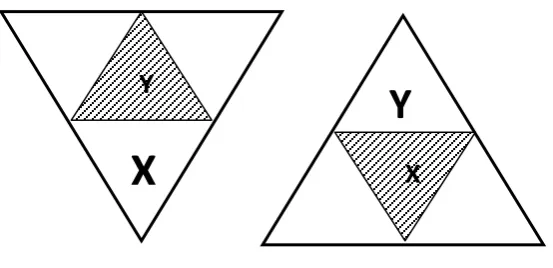
as well as mathematical modelling and a broad philosophical approach constitute the ground for our hypothesis about two particular interdependent types of institutional matrices existing around the world. Namely, we call the two types X-matrices and Y-matrices and compare the unique identities of each one in relation to the other. These matrices differ in function according to the set of basic institutions forming them (see Fig. 2).
The X-matrix is characterized by the following basic institutions:
in the economic sphere: institutions of a redistributive economy (a term introduced
by Karl Polanyi (1977). Redistribution-oriented economies are characterized by a situation where the center (at the top) regulates the movement of goods and services, as well as the rights to their production, reproduction and use;
5
in the ideological sphere: institutions of communitarian ideology, the essence of
which is expressed by the idea of collective, shared, public values and rights governing over individual, sovereign, private values and rights, i.e. the priority of We over I.
[image:6.595.95.461.155.311.2]
Fig. 2. Institutional X- and Y- matrices
The Y-matrix is characterized by the following basic institutions:
in the economic sphere: institutions of a market economy. Market-oriented
economies are characterized by a situation where horizontal exchange relations between economic agents exist;
in the political sphere: institutions of a federative (federative-subsidiary) political
order;
in the ideological sphere: institutions of an individualistic (or subsidiary) ideology,
which proclaims the dominance of individual values and rights over the values and rights of larger communities, where groups are subordinate to personalities, i.e. the priority of I over We.
In real-life societies and nations, X- and Y-matrices interact, with one of them permanently prevailing and governing. Nevertheless, the matrices are not and cannot be entirely exclusive of each other, given that both X- and Y-matrices co-exist concurrently in any given case. This is what distinguishes IMT as an approach based not on conflict, but rather on cooperation and collaboration.
6
Fig. 3. Combinations of governing and complementary institutional matrices
We contend that X-matrix institutions predominate in Russia, China, and India, along with most Asian and Latin American countries. In these cases Y-matrix institutions are also “a must,” but they have a complementary and additional character instead of a governing voice in society. And conversely, Y-matrix institutions prevail in most European countries and in North America, whereas X-matrix institutions also exist but at a smaller ratio.
All economic, political and ideological X- and Y-institutions coexist in different combinations and are embodied in many institutional forms. Thus, though we are outlining the general features of X- and Y-matrix institutions, in real-life situations the extreme cases are never fully demonstrated. The most efficient and effective functioning of X- and Y-matrices in each society requires an appropriate institutional balance with all morphologically interconnected institutions.
Why do X- or Y-institutions following historically determined institutional forms dominate in the structures of societies? The material and technological environment is seen as a key historical determinant of whether either an X-matrix or a Y-matrix prevails,
along with culture and social actions5. The national environment can stress an indivisible
communal system, wherein removal of some elements can lead to disintegration of the
whole system or it can amplify a non-communal system with possibilities of functional and
technological division (Bessonova et al., 1996, p.17-18). The institutional content of a nation
developing within a communally-oriented environment is achieved by the tasks of coordinating joint efforts towards efficient and effective usage. In this way, X-matrices are formed under communal conditions.
A non-communal environment, on the other hand, is divisible into separate, disconnected elements; it is more easily able to disperse and can exist as an aggregate of dissociated, independent technological objects. In this case, an individual or group of people (e.g. families) can participate using parts of the non-communal environment in their economy, can maintain their effectiveness, and use the obtained results themselves, without cooperating with other members of the society. When this is the case, the main function of the surrounding social institutional structures is to assure interaction between the atomized economic, political and social agents. Y-matrix institutions are shaped in such a non-communal environment.
To make a summary, in communal environments X-matrix institutions are dominant and Y-matrix institutions are complementary, while in non-communal environments the institutional balance is reversed.
The ratio of dominant and complementary institutions is defined by the changing conditions of political-economic-ideological development. At one extreme, there is an
5
The role of cultural factors for economic development is investigated in work of the so-called civilization approach (see e.g. Steven Rosefielde (2002, 2005 and 2008). In our research these factors are not investigated.
Y
X
X
7 outright dominance of one type of institutional matrices, yet without conscious implementation of complementary ‘other matrix’ institutions. This tends to result in a
general systematic collapse (e.g. USSR’s breakdown in the 1980s and ‘90s) or in a social
and economic crisis (e.g. the U.S.’s recent 2007-‘09 recession).
The opposite extreme implies an attempt to replace historically dominant institutions with complementary ones. This move leads to revolutions through reconstructing dominant institutions into new forms (e.g. the French Revolution as a reaction to economic and political centralization and, alternatively, the Russian October
Revolution as the outcome of an attempt at “building capitalism”) or unsustainable socio
-economic development (e.g. some Latin American countries). The main task of social and economic policy making in each country is thus to support the optimal combination (cf. proportional balance) of predominant and complementary institutions. For example, economic policy aims to find the best proportion between market and planned
redistributive institutions as well as means to their modernization (Kirdina, 2003). People
and authorities can actively help to achieve this balance faster and more efficiently with
concentrated “teleological” efforts, rather than just letting “unguided” evolutionary history
(cf. “the invisible hand”) take its course.
Like Marx’s economic doctrine IMT is built as a systemic politic al-economic-ideological theory of society, which means recognizing the role of technological change and
environment for national development, including the building of “human-made”
institutions. Sharing many of the presumptions of Marx’s institutional doctrine and accepting broadly his analytical schemes, IMT updates and elaborates them in an attempt to better understand our dynamic and complex contemporary globalized situation.
4. The comparative role of nations with X- or Y-matrix prevailing
[image:8.595.102.490.475.694.2]To compare the role of countries with X- or Y-matrices prevailing we will focus on measures of their GDP. Preliminary analysis shows that GDP proportions have been changed cyclically during a history of almost 200 years (see Fig. 4).
Figure 4. Proportion of GDP produced by countries with a prevailing X- and Y-matrix, 1820-2010
Search: Maddison Data Base, http://www.ggdc.net/MADDISON/oriindex.htm
The sample for this analysis included 34 nations (~75% of World GDP), data from which were available for the period of 1820-2010. Maddison Database was used to
0,20 0,30 0,40 0,50 0,60 0,70
1820 1830 1840 1850 1860 1870 1880 1890 1900 1910 1920 1930 1940 1950 1960 1970 1980 1990 2000 2010
GDP
p
ro
p
o
rtion
X-ВВП
8 calculate GDP levels for nations with a prevailing X-matrix (China, India, Japan, Brazil and former USSR countries) and Y-matrix (Western Europe -12, including Austria, Belgium, Denmark, Finland, France, Germany, Italy, Netherlands, Norway, Sweden, Switzerland and United Kingdom, and Western offshoots including Australia, New Zealand, Canada and United States).
We can see a long wave over a period of 140 years with a clearly distinguished GDP leader of Y-matrix countries. From 1820 (and before) to 1870, GDP was led by countries with a prevailing X-matrices, after which Y-matrices became dominant. The maximum spread between shares of Y-matrix and X-matrix countries in terms of GDP took place in
1950-65. But since the 1970s, the trend of Y-matrix countries’ dominance has gradually
decreased; and since 2008 the share of X-matrix countries has once again returned to prevail and this wave keeps growing.
Looking at this dynamic development, can we say that a new cycle in the global order has started?
5. Concluding Remarks
Institutionalists know that the path dependency approach has become more and
more popular in modern institutional research, especially when it involves comparative studies. In our point of view, this approach can be fruitful to understanding and elaborating a methodology as well. We started this paper with focus on the Marxian school to analyzing social institutions, then developed these ideas and the anthropological vision of Karl Polanyi within the system paradigm in economic theory and used all these approaches to construct a new institutional matrices theory (IMT). . IMT has been
presented therefore as a methodological outcome of social scientific path dependency. IMT
allows us to distinguish not only two types of historically co-existing nations, but also two types of institutional complexes (so called X- and Y-matrices) that interact complementarily within each country.
Long-term analyses of the comparative role of countries with X and Y-governing institutional matrices suggest that the configuration of the world's major global economic players is changing. Since 2008 the global GDP share of X-matrix countries (like Russia, China, Brazil, India, etc.) has prevailed over Y-matrix countries (like the USA and Europe) and the gap continues to grow. This developmental process is also accompanied by the important growth of X-institutions in Y-matrix countries: after the 2008-09 crisis the role of government regulation, centralized management and communitarian ideology of "common survival" has become increasingly popular.
The start of a new “institutional long wave” requires a new intellectual platform to
support a global dialogue of civilizations. This dialogue can be based on institutional
complementarity and proportionality instead of on general acceptance of “western”
superiority and capitalism as a universal ideal. We hope that institutional matrices theory (IMT) will be helpful for interpreting and developing this important task.
References
Bessonova O, Kirdina S, O'Sullivan R (1996). Market Experiment in the Housing Economy of Russia. NSU, Novosibirsk.
Buzgalin A., Kolganov A. (2003). Classical Marxism: What is out of Date, and What Has Stood the Test of Time (Theses for Discussion).
www.nodo50.org/.../buzgalin_kolganov_24... (15.06.2012)
9 Kirdina S. (2010). Prospects of Liberalization for S&T Policies in Russia: Institutional
Analysis// Sociology of Science and Technology, 1( 2).
Kirdina S. (2003). New Balance of Redistribution and Market Institutions in Modern Russian Economy. Proceedings of Hawaii International Conference on Social Sciences,
June 12 - 15. http://www.hicsocial.org/Social2003Proceedings/Svetlana Kirdina.pdf.
Accessed 25 January 2012.
Kirdina S. (2001). Fundamental Difference in the Transformation Process between Russia
and East European Countries // Berliner Osteuropa Info, № 16/2001.
Kornai J. (1998). The System Paradigm. William Davidson Institute Working Papers Series 278, William Davidson Institute at the University of Michigan. [ In Russian: Kornai J. Systemic Paradigm. // Voprosy economiki, 2002, № 4].
O’Hara P.A. (2000). Marx, Veblen and Contemporary Institutional Political Economy: Principles and Unstable Dynamics of Capitalism. Edward Elgar, Chetenham etc.
Polanyi K. (1977). The Livelihood of Man. Academic Press, Inc, New-York.
Rosefielde S. ( 2002, 2005, 2008). Comparative Economic Systems: Culture, Wealth, and Power in the 21st Century, Wiley-Blackwell.
Schumpeter J. A. (1951). Ten great economists. From Marx to Keynes. New York: Oxford University Press.
Веблен Т. (1984 [1899]) Теория праздного класса. М: Прогресс [Veblen T. The Theory of the Leisure Class. In Russian].
История экономической мысли. Учебное пособие. (2001) / Под ред В. Автономова, О. Ананьина и Н. Макашевой. М.: ИНФРА-М [History of Economic Schools / Edited by. V. Avtonomov, O. Anan’in, N. Makasheva: Study guide. In Russian.]
Кирдина С.Г. (2001). Институциональные матрицы и развитие России. 2-еизд. Новосибирск: СОРАН. [Kirdina S.G. Institutional Matrices and Russia Development. In Russian. Summary in English].
Осадчая Г. (2005). Стоит ли перечитывать Маркса. // Montenegrin Journal of Economics. Volume 1, № 1. [Osadchaya G. Do we need to reread Marx? In Russian.] Тесля А.А.Б Тесля Е.А. (2007) Интеллектуальное значение марксизма. М.: Хронос
[Teslja A.A., Teslja E.A. Intellectual Meaning of Marxism. // Moscow: Hronos] (In