ISSN Online: 2162-5344 ISSN Print: 2162-5336
Simulation and Millennials—The Perfect Storm
Gwen D. Erlam, Liz Smythe, Valerie Wright
Department of Health and Environmental Sciences, Auckland University of Technology, Auckland, New Zealand
Abstract
Simulation in its various forms has developed extensively over the past 15 - 20 years for use in undergraduate nursing programs. The widespread integration of technol-ogy-based educational tools into nursing curricula is raising concerns that technolo-gy rather than sound philosophically-based pedagotechnolo-gy is informing nursing educa-tion. Some believe that educational soundness has been overtaken by a focus on technological prowess. The manikins used in this immersive classroom often breathe, blink, and even speak in response to lecturer-controlled commands. This research explores how Millennials as a generational cohort (18 - 30 years of age) interface with the teaching/learning platform of simulation. This action research study is unfolded in three distinct action cycles involving 161 undergraduate nursing students. Millen-nial characteristics of confidence, high achievement, team orientation, technology focus, feedback-saturated, and trophy-seeking traits make them especially adept in immersive simulation environment. If supported by appropriate philosophical un-derpinnings, simulation as a teaching/learning platform has the potential to become the preferred classroom for Millennial nursing students.
Keywords
Simulation, Undergraduate Nursing, Millennials, Scaffold, Action Research
1. Introduction
A new generation is rising—the Millennials. These are individuals born between 1982 and 2002. They are unlike any other youth generation in living memory [1]. They are more numerous, more affluent, better educated, and more ethnically diverse than pre-vious generations [1]. For today’s students to acquire complex problem-solving, criti-cally reflexive analytical thinking, and succinct communication skills in appropriately technology-assisted contexts, educators will have to approach teaching differently [2].
Human patient simulation involves a computer-controlled manikin that mimics hu-man interaction with students in a controlled simulated clinical setting. The huhu-man
pa-How to cite this paper: Erlam, G.D., Smythe, L. and Wright, V. (2016) Simula-tion and Millennials—The Perfect Storm. Open Journal of Nursing, 6, 688-698.
http://dx.doi.org/10.4236/ojn.2016.69071 Received: August 8, 2016
Accepted: September 6, 2016 Published: September 9, 2016 Copyright © 2016 by authors and Scientific Research Publishing Inc. This work is licensed under the Creative Commons Attribution International License (CC BY 4.0).
tient simulator is a computerized full-body manikin that is able to provide real-time physiological and pharmacological parameters of persons of both genders, varying ages, and with different health conditions [3]. This study looks at the interface occurring when simulation and Millennials engage. Of interest are the Millennial responses to simulation when employed as an immersive classroom. Through these observations, various instructional strategies are outlined to maximize simulation for undergraduate Millennial nurses.
2. Background
It has been noted that organizations who take their companies from good to great must first pay attention to who is on their bus [4]. Who is working in their organization? Who is attending their university? It has also been correctly noted that the people on the bus are changing. This change is about the retirement of Baby Boomers (born ap-proximately 1940-1960) from the workplace, combined with the emergence of Millen-nials (born approximately 1982-2002) in unprecedented numbers in universities and places of employment. Millennials are the largest generation (76 million) to enter the workforce since the Baby Boomers [5]. While the Baby Boomers are the “me” genera-tion desiring money, title, and recognigenera-tion; Millennials are the “we” generagenera-tion enjoy-ing instead the interaction of discussenjoy-ing content, collaboratenjoy-ing, teamwork, and work-life balance [6].
While some have resisted the uniqueness of generational persona, it has long been known that history as a living force shapes generations. As Martin Heidegger observed, “The fateful act of living in and with one’s generation completes the drama of human existence” [7]. Three attributes contribute to the persona of a generation: 1) perceived membership; 2) common beliefs and behaviors; and 3) a common location in history [1]. Millennials as a generational cohort have seven distinguishing traits:
1) Special: Millennials feel they are collectively vital to whatever nation they belong, and to their parents.
2) Sheltered: Millennials have been on the receiving end of numerous safety rules and devices (e.g. car seats, bike helmets).
3) Confident: Millennials exhibit high levels of trust and optimism coupled with
endless hours in tutoring and lessons. This has produced high levels of confidence in this generation.
4) Team-oriented: Millennials have grown up in a culture of school uniforms and
classroom group learning. They possess strong team instincts and tight peer bonds. This characteristic also involves a high association with technology [8].
5) Achieving: With accountability and continuing higher school standards,
Millen-nials are on the way to becoming the best-educated adults in history.
6) Pressured: Pushed to study hard, avoid personal risks, and take advantage of col-lective opportunities, Millennials feel a “trophy kid” pressure to excel.
7) Conventional: Millennials take pride in improving their behavior and are more
support convention—the idea that social rules can help [1] [9]-[12].
It is evident that further research is needed to promote awareness and understanding of the expectations of today’s students and to reform nursing pedagogy to accommo-date the current generation of learners. In this article, the context of intergenerational diversity is explored, the importance of evidenced-based practice is reinforced, and current nursing pedagogy is examined, with the intention of stimulating a philosophical discourse among nurse educators regarding fundamental values and beliefs around pe-dagogical practice in simulation design.
3. Methods
Following ethics approval (AUTEC #12/208), this study employed action research in three investigative cycles to answer the question, “How do Millennials respond to si-mulation as a teaching/learning tool?” Action research was chosen as it is a proven me-thodology in the instigation of change [13] [14]. Change is required in order to better integrate the use of simulation in undergraduate healthcare environments.
This study occurred at a large nursing school in Auckland, New Zealand between December 2012 and April, 2014. The reconnaissance phase began (Cycle one) with fo-cus groups to critique current practice in simulation from which a one-hour simulation scenario was created embedding suggestions for improvement. Insights led to Cycle two where second year students participated in a newly designed scenario which em-ployed pre- and post-questionnaires to determine which elements emem-ployed in the si-mulation were most helpful. Student feedback led to Cycle three where final semester nursing students engaged in a simulation suite of three scenarios.
The simulation questionnaire (Cycle two) encompassed the following items:
• Likert scale inquiring as to effectiveness of previous simulation in the undergra-duate nursing program (i.e. before the day of the revised simulation);
• Most valued aspect of revised simulation (i.e. simulation on day of data collection); • Least valued aspect of revised simulation;
• What (if anything) hindered learning during the simulation/debriefing?
• Likert scale inquiring as to effectiveness of revision simulation on learning and professional performance (1 - 5).
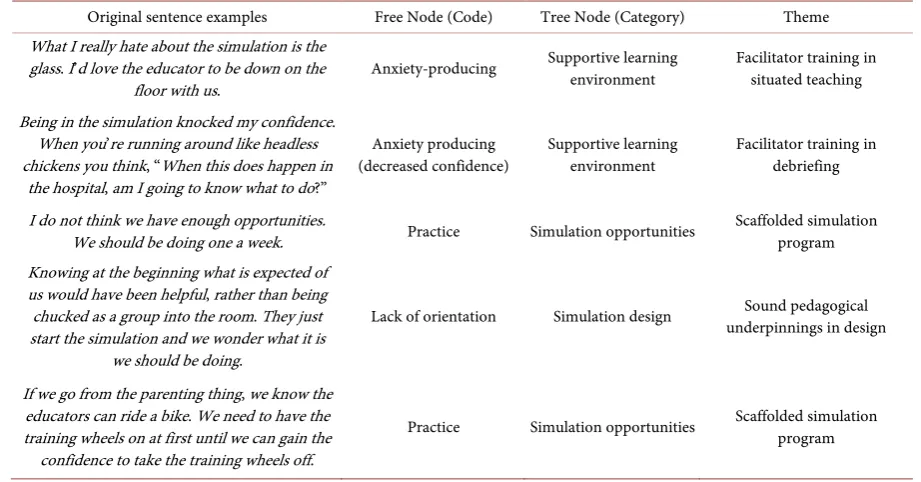
The responses to these questions were transcribed and coded using NVivo™ in the manner described in Table 1.
4. Participants
Table 1. Example of descriptive thematic analysis.
Original sentence examples Free Node (Code) Tree Node (Category) Theme What I really hate about the simulation is the
glass. I’d love the educator to be down on the
floor with us. Anxiety-producing
Supportive learning
environment Facilitator training in situated teaching Being in the simulation knocked my confidence.
When you’re running around like headless chickens you think, “When this does happen in
the hospital, am I going to know what to do?”
Anxiety producing
(decreased confidence) Supportive learning environment Facilitator training in debriefing
I do not think we have enough opportunities.
We should be doing one a week. Practice Simulation opportunities Scaffolded simulation program Knowing at the beginning what is expected of
us would have been helpful, rather than being chucked as a group into the room. They just start the simulation and we wonder what it is
we should be doing.
Lack of orientation Simulation design underpinnings in design Sound pedagogical
If we go from the parenting thing, we know the educators can ride a bike. We need to have the training wheels on at first until we can gain the confidence to take the training wheels off.
Practice Simulation opportunities Scaffolded simulation program
recruited participants through a student-operated Facebook™ page (n = 21). Sample size was determined by the number of students available to participate alongside full-time study. There was no power calculation or other justification for this.
Demographic information sought for these participants involved primarily their generation cohort (i.e. Millennial students were recruited). Students in Cycle One were 100% female; of which 80% were Caucasian, 13% Asian, and 7% Maori (native New Zealanders). In Cycle Two, demographics were narrowed to include any Millennials wanting to participate (i.e. 18 - 32 years of age). Cycle 3 included 21 Millennials. Of these, 86% were Caucasian, while 14% were Asian. One student of the 21 was male.
5. Results
Millennials as a generational cohort were recruited into this study with the intention of understanding how specific generational preferences influenced the effectiveness of si-mulation with undergraduate nurses. Specific detail as to what helped and hindered learning became the focus of investigation. In the second action cycle, students (n = 125) were asked to fill out a pre- and post-simulation questionnaire evaluating what contributed most powerfully to their learning during the simulation.
The data were coded employing descriptive thematic analysis. Raw data were coded in NVivo™ based on content representation from each line, breaking down data into smaller units or free nodes [15] [16]. These were then grouped based on shared con-cepts into what NVivo™ describes as tree nodes using the research question as a guide [15]. An example of this content analysis can be seen in Table 1.
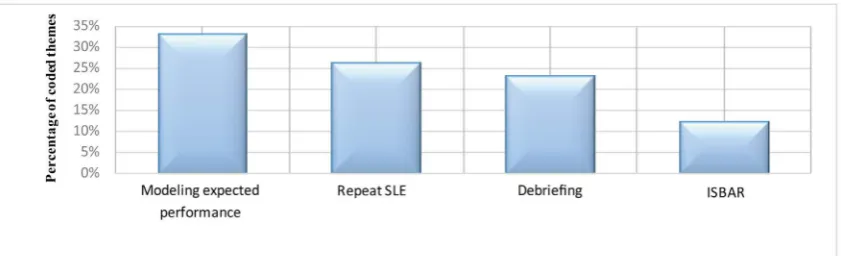
supportive debriefing; and 4) using the ISBAR tool to recruit support from other pro-fessionals. These responses can be seen in Figure 1.
When considering key Millennial traits in conjunction with the most valued aspects of the simulation (Figure 1), it is interesting to note that the most valued aspect was educator modeling of expected performance. The students found the modeling both in-structive and inspiring as evidenced by the questionnaire feedback below:
The role play that the educator did was really helpful to show us all of the roles
needed and assessments that needed to be done.
What I value from today’s simulation is how the educator demonstrated it to us
before the simulation started. That helps with our self-confidence.
[The educator] gave us a role play and how to react appropriately. If I did not have a chance to watch the role play by [the educator], I think I would still be confused. Students’ second most valued aspect was the opportunity to repeat their performance in the simulation after being given feedback. Repetition emerges as a philosophical un-derpinning from the behaviorist theorists, and results in skill improvement and mas-tery. Once this occurs, students can focus on critical thinking and problem solving. When asked about the opportunity to repeat the simulation, one student stated:
Yes, this helped immensely. It gave me an opportunity to “right what was wrong”. Doing this provided me the confidence to know that I was capable of
implement-ing the proper nursing interventions in a scenario as such. Being told what went
wrong, and then leaving it at that is not enough for me to know that I have learnt
it properly. I am a strong believer in hands on practical learning, so being given
the opportunity to actually practice and redo the simulation following feedback
meant that I was able to implement and consolidate what I had been told from my tutor.
[image:5.595.131.552.559.687.2]Debriefing was the third most valued aspect of the simulation. Within the context of simulation, debriefing weaves together the students’ prior understandings with new knowledge in a manner which helps them, in Dewey’s words, form new impulses which will clarify confusion [17]. Student comments from questionnaire feedback supported debriefing as an educational construct:
Getting feedback that was constructive really helped improve straight away. Individualized advice and support helped me. One-on-one feedback. Learnt struc-tured steps and roles to be completed in respiratory event.
I felt that letting us do it ourselves with our knowledge and then giving us guid-ance gave us confidence.
The fourth most valued educational construct was teaching the ISBAR tool (Identify, Situation, Background, Assessment, Request) to students as a format for eliciting help in a deteriorating patient situation. Student feedback from questionnaires were as fol-lows:
I feel more confident as I now know effective communication skills. I mostly ap-preciated learning that in a live situation we must be fully prepared before calling doctors as being hung up on in reality would be extremely humiliating.
Teach us about ISBAR was most valuable. This is life-saving information yet we
are not taught until year three?
Each [student should] have a turn at ISBAR!
The use of a structured method of communication employing a standardized tool can improve the quality of information exchange. The ISBAR tool contributes to im-proved communication as well as to increased practitioner confidence in getting other professionals to engage in a deteriorating situation [18]. The acronym is able to be re-called correctly in most cases, and the use of visual prompts is helpful in keeping the communication on track. The students felt that the tool kept them focused when stress and other compounding factors were producing anxiety and distraction. In essence, it enabled them to better manage the complexity of the situation, and in educational terms it reduced the load on working memory [19].
6. Discussion
This research has focused on considering the appropriateness of simulation as an edu-cational platform for Millennial students. The top four eduedu-cational strategies students reported as helpful to their learning were: 1) Educator modeling of expected simulation performance; 2) opportunity to repeat simulation after feedback; 3) supportive debrief-ing; and 4) using the ISBAR tool to recruit support from other professionals. These form an interesting tapestry when woven together with the seven distinctive Millennial traits: 1) special; 2) sheltered; 3) confident; 4) team oriented; 5) high-achieving; 6) pressured (trophy kids); and 7) conventional [1] [9]-[12].
6.1. Modeling: Demonstrate Best Practice in the Midst of the Storm
the learner building their own set of content to solve a particular problem [21] regard-less of previous knowledge. The content is not delivered, but constructed in a learner- centric, team-based, collaborative learning environment. Through modeling, new in-formation was provided which could be integrated into cognitive schema allowing stu-dents to construct their own revised performance [22].
Millennials are described as pressured, which means that they are pushed to study hard, but avoid personal risks while taking advantage of collective opportunities offered [1]. Modeling of expected performance reduces Millennial risk by allowing them to see an example of what they are to do. They prefer this as it reduces their risk of ‘losing face’ in front of their peers. It is therefore not surprising that Millennials would prefer to reduce risk by watching another perform first. Employing modeling as an instruc-tional strategy reduces student risk of poor performance thus increasing student en-gagement in simulation.
6.2. Repeat Performance: Give Opportunities for Improvement in
Managing the Storm
The second student-prioritized instructional strategy was allowing the students to re-peat their performance after feedback. Recall that Millennials are achieving; they want to be at the top of their game [1]. They see themselves as indispensable beings who de-sire to be highly sought after. They are generally high-achievers due to the large amount of support and privilege they have received from parents and teachers [1] [9]-[12].
Allowing students to repeat the simulation gives opportunity to put feedback into ac-tion. These achieving Millennials desired this as they did not want to simply be told what they had done wrong, but to have a chance to correct themselves. This repetition is a behaviorist theoretical underpinning which assists students to refine skills [23]. This path to learning is through the stimulus-response cycle. The stimulus (or cue) is often a physiological sign which students miss the appropriate response to on the first run. Learning appropriate responses to stimuli leads to satisfying results, and the repe-tition of these satisfying results produces learning [24]. Skill development of this type requires regular feedback in order for students to modify their performance and gain competence [25]. Repetition as an instructional strategy encourages skill mastery which then allows the student to focus on critical thinking and problem solving [25].
6.3. Debriefing: Clarifying Confusion in the Midst of the Storm
self-direction to apply forethought [28].
As Millennials tend to be team oriented, achieving, and confident (often through ex-tensive tutoring) [1] [9]-[12], debriefing affords a powerful collaborative instructional strategy. They are also the most catered for, tutored generation to emerge, and debrief-ing offers the availability of personal feedback which resonates with their desire to achieve and improve in confidence. Skilled debriefing is central to the development of critical thinking skills, achievement of expected learning outcomes, reflective learning, and the intent to apply the knowledge that has been acquired [28]. In effect, debriefing helps to clear the storm of confusion which often arises in managing deteriorating pa-tient situations.
6.4. ISBAR Tool: Effective Communication While Navigating the Storm
The fourth most valued instructional strategy identified by Millennials was being in-structed in how to effectively recruit assistance through the use of the ISBAR tool. In-structional strategies for simulation need to focus on safety breaches, communication, ability to make decisions and interpersonal interactions [29]. Millennials have grown up working in teams, along with being the most protected generation (sheltered). Their schooling gets the credit for instilling good teamwork skills, as most school assignments were done collaboratively [30]. Parents get credit for safety measures being put into place (sheltered).
Teamwork consists of a collection of behaviors and attitudes that promote efficient processing of information and ultimately lead to timely and proper actions carried out by various team members [31]. Excellent teamwork demands refined and effective communication skills in order to ensure that all members are both valued and effective in their roles. As Millennials tend to be team-oriented and sheltered, being on the re-ceiving end of numerous safety rules [30], effective communication strategies are par-ticularly relevant.
The ISBAR communication tool assists Millennials in prioritizing and categorizing significant information in order to clarify the crisis at hand and recruit assistance [18]. Using the tool helps decrease assumptions by making the reason for the communica-tion obvious at the outset and encouraging those involved to state the obvious. It also increases practitioner confidence in getting other professionals to engage in a deterio-rating situation [18]. Effective communication helps to maximize teamwork and stu-dent confidence at the same time. While Millennials are considered the “always con-nected generation” [9] [12], there is evidence to suggest that there is room for im-provement in verbal communication skills [8]. It is therefore essential to build commu-nication into instructional strategies of simulation design.
7. Limitations
support equipment acquisition and generate business plans, was lost at a most critical time. While her involvement continued as a third supervisor, she was no longer able to be the bridge to higher level decision making and resource allocation. Instigating this research at a time of leadership change has limited opportunity to involve “leaders” in the change process. Such change initially impacted this study, particularly in having the opportunity to stay closely aligned to key leaders within the school as the findings emerged.
8. Recommendations
Educators working in the design and implementation of simulation with undergraduate nurses should be mindful of aspects of this teaching platform which “resonate” with Millennial learners. Educators working in simulation would benefit from becoming fa-miliar with characteristics of preferred Millennial classrooms, as well as overall tenden-cies of Millennial learners. Appropriate pedagogical underpinnings should be used to underpin simulation design in order to maximize the impact of this powerful learning platform.
9. Conclusions
This study has highlighted the relevance of modeling to demonstrate best practice in the management of deteriorating patient situations, repetition to give opportunity for improvement, debriefing to help clarify confusion, and use of the ISBAR tool to im-prove patient safety through effective and efficient communication.
These four instructional scaffolds have particular relevance to Millennial students who are pressured and expected high levels of performance (achieving). Firstly, Millen-nials prefer to have expected performance modeled to ensure their own performance is perfected before being viewed by peers. Secondly, Millennial students desire a second opportunity to demonstrate improved skills and communication. This is again tied to their tendency to feel pressured and achieve to a high level.
Thirdly, Millennials want to be given feedback in the form of debriefing in order to perfect their performance, and improve teamwork. This instructional strategy resonates with Millennial tendencies to work in teams while receiving personal feedback to assist in perfecting their performance (achieving).
Fourthly, Millennials have been sheltered in their upbringing, causing a focus on safety to be predominant. Use of the ISBAR tool helps to ensure patient safety by de-creasing assumptions, improving overall communication structure, and improving student confidence thus resonating with Millennials’ need to achieve well while work-ing in teams.
models) will need to be revised in order to accommodate the expectations of this gen-erational cohort. Student-driven, active learning models which embrace Millennial strengths in visual processing and cooperation have the potential to breathe life into the tired bones of many classrooms.
References
[1] Howe, N. and Strauss, W. (2000) Millennials Rising: The Next Great Generation. Vintage, New York.
[2] Earle, V. and Myrick, F. (2009) Nursing Pedagogy and the Intergenerational Discourse. Journal of Nursing Education, 48, 624-630.
http://dx.doi.org/10.3928/01484834-20090716-08
[3] Kardong-Edgren, S., Adamson, K.A. and Fitzgerald, C. (2010) A Review of Currently Pub-lished Evaluation Instruments for Human Patient Simulation. Clinical Simulation in Nurs-ing, 6, e25-e35. http://dx.doi.org/10.1016/j.ecns.2009.08.004
[4] Collins, J. (2001) Good to Great: Why Some Companies Make the Leap and Others Don’t. Harper Business, New York.
[5] Hutchinson, D., Brown, J. and Longworth, K. (2012) Attracting and Maintaining the Y Generation in Nursing: A Literature Review. Journal of Nursing Management, 20, 444-450.
http://dx.doi.org/10.1111/j.1365-2834.2011.01203.x
[6] Koeller, M. (2012) From Baby Boomers to generation Y millennials: Ideas on How Profes-sors Might Structure Classes for This Media Conscious Generation. Journal of Higher Edu-cation Theory and Practice, 12, 77-82. http://www.na-businesspress.com/jhetpopen.html [7] Kriegel, A. (1978) Generational Difference: The History of an Idea. Daedalus, 107, 23-28. [8] Gibson, L.A. and Sodeman, W.A. (2014) Millennials and Technology: Addressing the
Communication Gap in Education and Practice [Article]. Organization Development Journal, 32, 63-75.
[9] McGlynn, A.P. (2010) Millennials—The “Always Connected” Generation. The Hispanic Outlook in Higher Education, 20, 14-16. http://www.hispanicoutlook.com
[10] Stephens, T.M. and Gunther, M.E. (2016) Twitter, Millennials, and Nursing Education Re-search. Nursing Education Perspectives, 37, 23-27.
[11] Trueman, M.S. and Miles, D.G. (2011) Twitter in the Classroom: Twenty-First Century Flash Cards. Nurse Educator, 36, 183-186.
http://dx.doi.org/10.1097/NNE.0b013e3182297a07
[12] Montenery, S.M., Walker, M., Sorensen, E., Thompson, R., Kirklin, D., White, R. and Ross, C. (2013) Millennial Generation Student Nurses' Perceptions of the Impact of Multiple Technologies on Learning. Nursing Education Perspectives, 34, 405-409.
http://dx.doi.org/10.5480/10-451
[13] McNiff, J. and Whitehead, J. (2011) All You Need to Know About Action Research. 2nd Edition, Sage, Thousand Oaks.
[14] Reason, P. and Bradbury, H. (2006) Handbook of Action Research. Sage, London. [15] Bazeley, P. (2007) Qualitative Data Analysis with NVivo. Sage, London.
[16] Polit, D.F. and Beck, C.T. (2014) Essentials of Nursing Research: Appraising Evidence for Nursing Practice. 8th Edition, Lippincott Williams & Wilkins, Philadelphia.
[18] Finnigan, M.A., Marshall, S.D. and Flanagan, B.T. (2010) ISBAR for Clear Communication: One Hospital’s Experience Spreading the Message. Australian Health Review, 34, 400-404.
http://dx.doi.org/10.1071/AH09823
[19] Artino, A.R. (2008) Cognitive Load Theory and the Role of Learner Experience: An Abbre-viated Review for Educational Practitioners. Association for the Advancement of Compu-ting in Education Journal, 16, 425-439. http://www.aace.org/
[20] Dewey, J. (1938) Experience and Education. Educational Forum, 50, 241-252. http://dx.doi.org/10.1080/00131728609335764
[21] Haw, M.A. (2006) Learning Theories Applied to Nursing Curriculum Development. In: Keating, S.B., Ed., Curriculum Development and Evaluation in Nursing, Lippincott Wil-liams & Wilkins, Philadelphia, 49-60.
[22] Josephsen, J. (2015) Cognitive Load Theory and Nursing Simulation: An Integrative Re-view. Clinical Simulation in Nursing, 11, 259-267.
http://dx.doi.org/10.1016/j.ecns.2015.02.004
[23] Chen, I. (2009) Behaviorism and Developments in Instructional Design and Technology. In: Rogers, P., Berg, G., Boettcher, J., Howard, C., Justice, L. and Schenk, K., Eds., Encyclo-pedia of Distance Learning, 2nd Edition, Information Science Reference, Hershey, 153-172. http://dx.doi.org/10.4018/978-1-60566-198-8.ch023
[24] Watson, J.B. (1914) Behavior: An Introduction to Comparative Psychology. Henry Holt & Company, New York. http://dx.doi.org/10.1037/10868-000
[25] Clapper, T.C. and Kardong-Edgren, S. (2012) Using Deliberate Practice and Simulation to Improve Nursing Skills. Clinical Simulation in Nursing, 8, e109-e113.
http://dx.doi.org/10.1016/j.ecns.2010.12.001
[26] McLoughlin, C.E. and Alam, S.L. (2014) A Case Study of Instructor Scaffolding Using Web 2.0 Tools to Teach Social Informatics. Journal of Information Systems Education, 25, 125- 136.
[27] Benner, P., Sutphen, M., Leonard, V. and Day, L. (2010) Educating Nurses: A Call for Rad-ical Transformation. Jossey-Bass, San Francisco.
[28] Burke, H. and Mancuso, L. (2012) Social Cognitive Theory, Metacognition, and Simulation Learning in Nursing Education. Journal of Nursing Education, 51, 543-548.
http://dx.doi.org/10.3928/01484834-20120820-02
[29] Guimond, M.E., Sole, M.L. and Salas, E. (2011) Getting Ready for Simulation-Based Train-ing: A Checklist for Nurse Educators. Nursing Education Perspectives, 32, 179-185.
http://www.nln.org/nlnjournalhttp://dx.doi.org/10.5480/1536-5026-32.3.179
[30] Cahill, T. and Sedrak, M. (2012) Leading a Multigenerational Workforce: Strategies for At-tracting and Retaining Millennials. Frontiers of Health Services Management, 29, 3-15.
http://ache.org/pubs/Frontiers/frontiers_index.cfm
[31] Cheng, A., Donoghue, A., Gilfoyle, E. and Eppich, W. (2012) Simulation-Based Crisis Re-source Management Training for Pediatric Critical Care Medicine: A Review for Instruc-tors. Pediatric Critical Care Medicine, 13, 197-203.
Submit or recommend next manuscript to SCIRP and we will provide best service for you:
Accepting pre-submission inquiries through Email, Facebook, LinkedIn, Twitter, etc. A wide selection of journals (inclusive of 9 subjects, more than 200 journals)
Providing 24-hour high-quality service User-friendly online submission system Fair and swift peer-review system
Efficient typesetting and proofreading procedure
Display of the result of downloads and visits, as well as the number of cited articles Maximum dissemination of your research work