Munich Personal RePEc Archive
Flexicurity in the European Union:
flexibility for outsiders, security for
insiders
Van Vliet, Olaf and Nijboer, Henk
Leiden University
February 2012
Online at
https://mpra.ub.uni-muenchen.de/37012/
Leiden Law School
Department of Economics Research Memorandum 2012.2
Flexicurity in the European Union: Flexibility for
Outsiders, Security for Insiders
Olaf van Vliet and Henk Nijboer
Correspondence to
Leiden Law School Department of Economics P.O. Box 9520
2300 RA Leiden The Netherlands
Phone ++31 71 527 7756 (7855) Email: [email protected] Website: www.economie.leidenuniv.nl
Editors
Flexicurity in the European Union:
Flexibility for Outsiders, Security for Insiders
∗∗∗∗
Olaf van Vliet and Henk Nijboer
Leiden Law School, Leiden University Department of Economics
Research program Reforming Social Security (www.hsz.leidenuniv.nl)
P.O. Box 9520, 2300 RA Leiden, The Netherlands Phone: ++ 31 71 527 7756
E-mail: [email protected]
E-mail: [email protected]
Abstract
Flexicurity is at the heart of European policy debates. Its aim is to overcome the tensions be-tween labour market flexibility on the one hand, and the provision of social security for work-ers on the other hand. To date, there is little insight into whether flexicurity policies have been adopted across the European Union. Therefore, the aim of this paper is to analyse to what extent labour market policies have been reformed along the lines of the flexicurity con-cept across 18 European countries over the period 1985-2008. Focusing on the main axes of the flexicurity concept, new datasets are used to examine changes in employment protection legislation, unemployment benefits and active labour market policies. Data on the strictness of employment regulation indicate that reforms have been influenced by labour market insid-ers, since the level of flexibility has been increased more for temporary employment, the la-bour market outsiders, than for regular employment, the insiders. Although gross unemploy-ment replaceunemploy-ment rates suggest that unemployunemploy-ment benefits have become more generous, net replacement rates indicate that the level of income security from benefits actually has been decreased. Moreover, data illustrate that larger shares of European labour forces have temporary contracts. As such, the gap between insiders and outsiders on the labour market has been increased. This development is contrary to the goals of the European Commission.
JEL-codes: H53, J08, J58
Keywords: Flexicurity, insider-outsider theory, labour market policy, welfare state, political economy
∗ Revised version of a paper presented at the 2nd
conference of the Active Social Policies European Network and the European Trade Union Institute, Brno, Czech Republic, 20-21 March, 2009. We thank all participants of
the workshop and Koen Caminada, Kees Goudswaard, Maarten Keune, Amparo Serrano Pascual, Stefan The-wissen, Ben van Velthoven and Timo Weishaupt for their useful comments and suggestions on earlier ver-sions of this paper. This study is part of the research program ‘Reforming Social Security’:
1. Introduction
The flexicurity strategy is at the heart of the European debate about reforming social security. At the European Union (EU) level, the concept is integrated in the European Employment Strategy, which is aimed at increasing employment and reducing unemployment in EU coun-tries. The European Employment Guidelines of 2001 already stated that flexibility and security should be raised simultaneously, and flexicurity was put explicitly on the agenda of the Euro-pean Council in Brussels in 2006. In line with the Lisbon agenda, flexicurity has been pro-posed as a promising reform concept for enhancing Europe’s economic growth and social co-hesion (e.g. EC, 2006; EC, 2007a; EC, 2007b; Boeri e.a., 2007). On the one hand, more flexible labour markets would reduce the costs of firms to adjust to the dynamics of the highly integrated global economy, improving Europe’s competitiveness. On the other hand, increased labour participation and higher income security would contribute to higher levels of social in-clusion. As such, flexicurity is also explicitly integrated in the Europe 2020 strategy and it is expected to contribute to the achievement of its objectives (EC, 2010). Moreover, the flexicu-rity strategy is aimed at diminishing the segmentation of labour markets, where relatively protected and unprotected employees coexist.
Following the significant attention for flexicurity in policy debates, the amount of academic work on this theme has also started to grow (Wilthagen and Tros, 2004; Boeri e.a., 2006; Schmid, 2006; Viebrock and Clasen, 2009). In the initial phase, the literature on flexicurity has been mainly conceptually and theoretically oriented. Remarkably, there is relatively little empirical research on flexicurity. Only recently, the first case studies on the adoption of flexicurity policies have been published (e.g. Bonoli and Emmenegger, 2010). Still, besides the typical examples of Denmark and the Netherlands, which have been extensively discussed in the policy documents and the conceptual literature, there is little insight into what extent flexicurity policies have been adopted in other European countries.
Therefore, the aim of this paper is to analyse to what extent labour market policies in EU countries have been reformed along the lines of the flexicurity concept. There is no universal definition of flexicurity (Viebrock and Clasen, 2009), but two central elements of the concept can be distilled. First, flexicurity refers to a configuration of labour market policies that aims to complement labour market flexibility with economic security. This static conceptualisation of flexicurity, as a state of the labour market, is discussed in section 2. Second, flexicurity refers to a strategy to reform labour market policies. Employees with permanent contracts are usually more protected and better organized than employees with temporary contracts. Therefore, the first group of employees, who are called insiders in the political economy litera-ture, is better able to influence labour market policy reforms than the latter group, the out-siders. Since flexicurity concerns a package of policy reforms rather than a single labour mar-ket policy, it is proposed to overcome opposition from insiders in policy reform processes. This dynamic element of flexicurity will be conceptualized in section 3. In the empirical part of the paper, section 4, labour market policies will be compared across countries and over time. The recent publication of new data on labour market policies by the OECD (2012) and by Van Vliet and Caminada (2012) enables us to examine whether countries have started to adopt flexicu-rity policies since the beginning of the 21st
2. Flexicurity as a static concept: state of the labour market
The main characteristic of flexicurity is that it is intended to overcome the tensions between labour market flexibility on the one hand, and the provision of social security for workers on the other hand (Viebrock and Clasen, 2009). Flexible labour markets can be seen as beneficial for job creation, especially during periods of recovery after recessions, but they generally im-ply lower levels of economic security. Welfare state programmes provide economic security, but they can have adverse effects, such as longer unemployment spells and therefore higher public expenditure and less mobility on the labour market. In the flexicurity concept, flexibility and security are viewed as complementary.
In the literature, the term ‘flexicurity’ has been used to refer to different configurations of labour market policies, in which several types and degrees of flexibility (external-numerical and internal-numerical flexibility, functional and wage flexibility) and security (job, employ-ment and income security) have been stressed (Wilthagen and Tros, 2004; Madsen, 2007; Viebrock and Clasen, 2009). This ambiguous nature of the concept has also been a source of criticism, as different interpretations and views on labour market policies are ranked under the concept of flexicurity (Burroni and Keune, 2011). In the often-mentioned textbook cases of flexicurity policies, namely those in Denmark and the Netherlands, there is variation too. The Danish model of flexicurity builds on the combination of flexible labour markets, generous unemployment benefits and a strong emphasis on activation. This combination is known as the ‘golden triangle’. The Dutch flexicurity model is more centred on combining non-standard work, such as temporary agency work and part-time work, with regular social security rights (Viebrock and Clasen, 2009). Because the Danish model is the most common example to il-lustrate the concept of flexicurity in the literature and in EU employment guidelines and policy documents (e.g. European Commission, 2006) we focus on the labour market policies of the Danish type of flexicurity.
The Danish model is a combination of three types of labour market policies. First, employment protection legislation (EPL) that is relatively loose provides flexibility for firms in terms of the hiring and firing of workers. This is compensated by a rather generous social safety net for the unemployed through unemployment benefits, which is the second element, income secu-rity. Indeed, the exchange between employment protection legislation and unemployment benefits can be regarded as the main axis of flexicurity. Economists usually concentrate on the trade-off between unemployment benefits and employment protection since unemploy-ment benefits and employunemploy-ment protection could be considered as substitutes (see e.g. Blanchard and Tirole, 2004; Blanchard and Tirole, 2008; Boeri et al., 2006).1 Third, flexicurity involves strong efforts on active labour market policies (ALMP). These policies are aimed at increasing labour market participation through programmes such as labour market training, services of employment agencies and subsidised employment. When low employment protec-tion leads to more dismissals, the mobility on the labour market will be greater when the skills of the unemployed are improved by labour market training. Thus, transitions from un-employment to un-employment can be made easier, leading to more un-employment security. As a result, job security is replaced by employment security, which is a central feature of the flexicurity concept.
Flexicurity policies are expected to improve the functioning of European labour markets, but the effects of less employment protection, more generous unemployment benefits and higher expenditure on ALMPs are not clear. Although high levels of employment protection lead to slower job creation owing to higher labour costs and therefore to longer unemployment spells, loosening employment protection may also have some drawbacks. An economic advantage of employment protection is for instance that investments in firm-specific human capital are higher. Another advantage is that firms internalise to some extent the external effects of
1
employment benefits. Hence, making firing more costly to employers reduces the layoff rate and unemployment incidence. Similarly, increases in the generosity of unemployment benefits may also have contradictory effects (Baily, 1978). On the one hand, more generous unem-ployment benefits reduce the incentive to search for new jobs and therefore lead to higher unemployment levels. On the other hand, longer job searches may lead to better matches on the labour market and therefore to more productive economies. With respect to ALMP, there is a lively debate going on about the effectiveness of those programmes (Kluve, 2010; Card et al, 2010). Positive effects on transitions from unemployment to work have been found for employment services and private sector incentive programmes. However, even if ALMPs are effective, it is questionable whether the benefits offset the costs, such as displacement ef-fects, lock-in effects and the tax burden.
3. Flexicurity as a dynamic concept: a reform strategy
Reforms of labour market institutions such as unemployment benefits and dismissal protec-tion can be understood with the insider–outsider approach (Lindbeck and Snower, 2001), that has gained importance in the political economy literature. In this view, a labour market con-sists of two segments. The core segment concon-sists of insiders who are defined as incumbent workers who enjoy more privileges than the outsiders at the margin, the rest of the labour force. Although insiders can differ from outsiders in many ways, insiders can generally be conceptualised as employees with permanent contracts who are labour union members, whereas outsiders are workers with fixed-term contracts who are not represented by labour unions.2 This disparity between insiders and outsiders exists because firms incur labour turn-over costs. These costs are the costs of hiring, firing and providing firm-specific training. It should be noted that the firing costs are largely determined by the rigidity of the EPL. Because of the labour turnover costs, employers give the insiders market power, that the insiders use to get wages above the market-clearing level (Lindbeck and Snower, 2001).
Insiders can be expected to object to reductions of employment protection on regular con-tracts, because that would lead to less job security for themselves. Moreover, less employ-ment protection could also imply that insiders have to accept lower wages owing to less bar-gaining power in wage negotiations (Lindbeck and Snower, 2001). Hence, it could be argued that trade unions will challenge reform proposals targeted at permanent contracts and that they will agree with policy-makers upon making temporary contracts more flexible instead. However, deregulation of the hiring of non-standard workers gives them a stronger position relative to standard workers in the competition for jobs. This tends to undermine insiders’ privileged position in terms of wages and working conditions in the long run (Eichhorst and Marx, 2011). Therefore, trade unions have a motivation to object to reforms of EPL concern-ing both permanent and temporary contracts, whilst they would still prefer marginal over general flexibilisation (Eichhorst and Marx, 2011).
Empirical evidence from Allan and Scruggs (2004) indicates that corporatism is positively as-sociated with the levels of unemployment benefits. Swank (2011) examines the impact of corporatism on the spending on unemployment benefits as well as on unemployment re-placement rates and he finds for both measures a positive impact of corporatism. Regarding ALMPs, Swank (2011) finds that political-economic institutions of (sector-) coordinated capi-talism are positively related to ALMP expenditure. In line with these results, Van Vliet and Koster (2011) find a positive effect of the presence of tripartite councils on spending on ALMPs. With respect to EPL, Emmenegger (2011) finds that a strong labour movement is a
2
determinant of high levels of EPL.3 It is not clear, however, whether this effect stems from labour unions or from left-wing political parties, since the employed index comprises both. Rueda (2007) examined the variation in job security regulation across countries and over time, but he did not report a clear effect of corporatism. One explanation for these mixed re-sults from an empirical viewpoint could be that these studies did not account for the differ-ences in EPL regarding workers with permanent or temporary contracts. It has been well documented that reforms aimed at flexibilisation have regularly resulted in two-tier reforms, in which the employment protection for temporary contracts has been reduced, while the em-ployment protection for permanent contracts has remained unchanged (Saint-Paul, 2004; Boeri and Garibaldi, 2007; Ochel, 2008). Since insiders are organised in trade unions that have direct access to political decision making, for instance in bi- or tripartite councils, they can challenge reform proposals. As a consequence, policy makers have opted for reforms of the least organised part of the labour markets.
In contrast, flexicurity conceptualised as a strategy to reform labour market policies is sup-posed to provide a package of policy reforms for the labour market as a whole instead of only targeted at the margin. Because the package consists of increasing flexibility and security simultaneously, lower levels of employment protection for insiders can be compensated with more generous unemployment benefits and higher expenditures on ALMP (EC, 2006; EC, 2007a; EC, 2007b; Boeri e.a., 2007; Wilthagen and Tros, 2004; Madsen, 2007). A reform proposal that concerns a package of policy reforms rather than an isolated policy reform can be expected to overcome opposition from employees in reform processes (Eichhorst and Konle-Seidl, 2005). Therefore, it can be expected that if governments have adopted the flex-icurity strategy, the strictness of the dismissal protection has been reduced, unemployment benefits have become more generous and expenditures on ALMP have been increased. Fur-thermore, if labour market insiders have been compensated with more generous unemploy-ment benefits, not only the employunemploy-ment protection on temporary employunemploy-ment but also on regular contracts should have become less strict.
3
4. A cross-country comparison
Flexibility of employment protection legislation
In this section we examine to what extent EU countries have changed their labour market policies in line with the flexicurity concept. Since flexicurity is a policy concept of the EU, this study is focused on EU member states. Subsequently, the selection of countries and years is guided by the availability of data. Hence, the study includes 18 member states of the EU for the period 1985-2008.
For the flexibility dimension of flexicurity, the study focuses on employment protection legisla-tion (EPL). To compare the strictness of EPL across countries and over time, the study relies on an EPL strictness indicator that is provided by the OECD (2009). The EPL indicator is avail-able for different types of employment. Here, we use the EPL indicator for employees with a regular contract to measure the employment protection of insiders, while the EPL indicator for employees with a temporary contract is used to measure the protection of outsiders.4
The EPL indicator for regular contracts is an index that is calculated as a weighted average of sub-indicators of employment regulation. The indicator covers three main areas. The first one is the difficulty of dismissal, referring to the legislative provisions setting conditions under which a dismissal is justified. The second area includes procedural inconveniences that an employer may face during a dismissal process. The third category includes notice and sever-ance pay provisions. The index is normalized to a scale from 0 to 6 where a higher score indi-cates stricter employment regulation. As such, the index is a comprehensive measure for in-ternational comparative studies. A limitation of this indicator is that some characteristics of EPL may be not fully reflected. For instance, since notice periods and severance pay are not legally regulated in some countries, they might be provided by collective agreements or con-tractual extensions. Because there is no detailed information about such concon-tractual provi-sions, the EPL index often relies on minimal requirements as provided by labour law. Another disadvantage is the lack of incorporation of judicial practices deviating from the minimal legal requirements (OECD, 2004). Despite these limitations, the index is a conventional summary measure to analyse a relatively large number of countries over a longer period.
Table 1 presents the index for the strictness of EPL with regard to regular employment for 18 EU countries for the period 1985-2008. In the 14 old member states of the EU, the average strictness of employment protection slightly declined between 1985 and 2008. Germany is the only country in which the strictness of EPL has been increased. In some countries, such as France and Italy, EPL has not changed at all. Only five countries, namely Austria, Finland, the Netherlands, Portugal and Spain, reduced the strictness of employment protection substan-tially. However, in all of them but Finland, the level of EPL still lies above average in 2008. In the countries that acceded the EU in 2004, the level of employment protection has not been changed. Interestingly, the level of employment protection in the new member states is com-parable to the level in the old member states.
4
Table 1. Strictness of employment protection legislation on regular employment 1985-2008
1985 1990 1995 2000 2005 2008 change 1985 - 2008 Austria 2.9 2.9 2.9 2.9 2.4 2.4 -0.6 Belgium 1.7 1.7 1.7 1.7 1.7 1.7 0.1 Czech Republic : : 3.3 3.3 3.3 3.1 : Denmark 1.7 1.7 1.6 1.6 1.6 1.6 -0.1 Finland 2.8 2.8 2.5 2.3 2.2 2.2 -0.6 France 2.5 2.3 2.3 2.3 2.5 2.5 0.0 Germany 2.6 2.6 2.7 2.7 3.0 3.0 0.4 Greece 2.4 2.3 2.3 2.3 2.3 2.3 0.0 Hungary : 1.9 1.9 1.9 1.9 1.9 : Ireland 1.6 1.6 1.6 1.6 1.6 1.6 0.0 Italy 1.8 1.8 1.8 1.8 1.8 1.8 0.0 Netherlands 3.1 3.1 3.1 3.1 3.1 2.7 -0.4 Poland : 2.1 2.1 2.1 2.1 2.1 : Portugal 5.0 4.8 4.3 4.3 4.2 4.2 -0.8 Slovak Republic : : 2.5 2.5 2.3 2.5 : Spain 3.9 3.9 2.8 2.6 2.5 2.5 -1.4 Sweden 2.9 2.9 2.9 2.9 2.9 2.9 0.0 UK 1.0 1.0 1.0 1.1 1.1 1.1 0.2
Mean EU-18 : : 2.4 2.4 2.4 2.3 : Mean EU-14 2.6 2.5 2.4 2.4 2.3 2.3 -0.2 Mean EU-4 : : 2.4 2.4 2.4 2.4 :
Note: The indicator for EPL on regular employment is based on eight sub-measures: the extensiveness of notification procedures for dismissals, the delay involved before notice can start, the length of the no-tice period of dismissals, the amount of severance payment, the definition of justified or unfair dis-missal, the length of trial periods, the compensation following unfair dismissals and the possibility of reinstatement following unfair dismissal.
EU-14: Austria, Belgium, Denmark, Finland, France, Germany, Greece, Ireland, Italy, the Netherlands, Portugal, Spain, Sweden and the UK.
EU-4: Czech Republic, Hungary, Poland, Slovak Republic.
Source: OECD Employment Database (OECD, 2009); and own calculations.
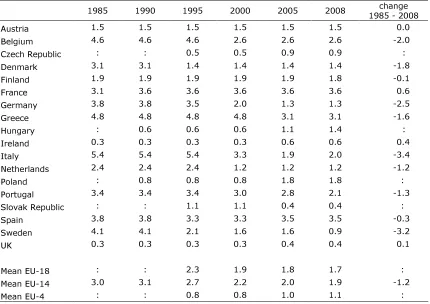
[image:11.595.71.507.96.397.2]increased the maximum number of successive fixed-term contracts and lengthened the maxi-mum total duration of contracts with temporary work agencies (OECD, 2004). Another inter-esting case is France. Although the French level of EPL on temporary employment was already above average in 1985, it has been increased even further in the following years. This implies that the French labour market policies have not become more flexible at all, since the EPL on regular employment remained constant. Remarkably, the level of EPL on temporary employ-ment has increased in three of the four new member states included. It only declined in the Slovak Republic. The average level is lower in the new member states than in the old member states, which implies that there seems to be some convergence between the old and new member states.
Table 2. Strictness of employment protection legislation on temporary employment 1985-2008
1985 1990 1995 2000 2005 2008 change 1985 - 2008 Austria 1.5 1.5 1.5 1.5 1.5 1.5 0.0 Belgium 4.6 4.6 4.6 2.6 2.6 2.6 -2.0 Czech Republic : : 0.5 0.5 0.9 0.9 : Denmark 3.1 3.1 1.4 1.4 1.4 1.4 -1.8 Finland 1.9 1.9 1.9 1.9 1.9 1.8 -0.1 France 3.1 3.6 3.6 3.6 3.6 3.6 0.6 Germany 3.8 3.8 3.5 2.0 1.3 1.3 -2.5 Greece 4.8 4.8 4.8 4.8 3.1 3.1 -1.6 Hungary : 0.6 0.6 0.6 1.1 1.4 : Ireland 0.3 0.3 0.3 0.3 0.6 0.6 0.4 Italy 5.4 5.4 5.4 3.3 1.9 2.0 -3.4 Netherlands 2.4 2.4 2.4 1.2 1.2 1.2 -1.2 Poland : 0.8 0.8 0.8 1.8 1.8 : Portugal 3.4 3.4 3.4 3.0 2.8 2.1 -1.3 Slovak Republic : : 1.1 1.1 0.4 0.4 : Spain 3.8 3.8 3.3 3.3 3.5 3.5 -0.3 Sweden 4.1 4.1 2.1 1.6 1.6 0.9 -3.2 UK 0.3 0.3 0.3 0.3 0.4 0.4 0.1
Mean EU-18 : : 2.3 1.9 1.8 1.7 : Mean EU-14 3.0 3.1 2.7 2.2 2.0 1.9 -1.2 Mean EU-4 : : 0.8 0.8 1.0 1.1 :
Note: The indicator for EPL on temporary employment is based on six sub-measures: valid cases for the use of fixed-term contracts, the maximum number of successive fixed-term contracts, the maximum cu-mulated duration of successive fixed-term contracts, the types of work for which temporary work agency employment is legal, restrictions on the number of renewals and the maximum cumulated du-ration of temporary work agency contracts.
EU-14: Austria, Belgium, Denmark, Finland, France, Germany, Greece, Ireland, Italy, the Netherlands, Portugal, Spain, Sweden and the UK.
EU-4: Czech Republic, Hungary, Poland, Slovak Republic.
Source: OECD Employment Database (OECD, 2009); and own calculations.
Income security from unemployment benefits
[image:12.595.75.505.270.574.2]relevant to indicate the generosity of unemployment benefits. However, because of the lim-ited data availability, the duration is not included in this study. Earlier research shows that most countries had not changed the duration of entitlement rights in the period 1995-2002 (Van Vliet, 2010). For gross unemployment replacement rates the study relies on OECD (2010b) data. This measure indicates the level of gross unemployment benefits as percentage of previous gross income from work. The replacement rate is calculated as an unweighted average of benefit payments in various situations of previous income, unemployment spells and household types.
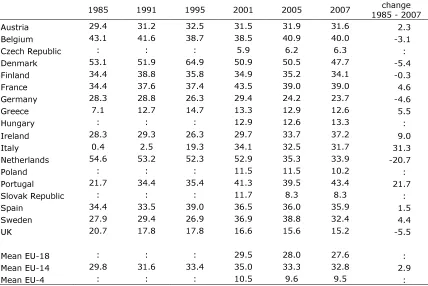
[image:13.595.75.503.377.663.2]Table 3 shows that gross unemployment benefits increased on average by 2.9 percentage points in the 14 old member states of the EU between 1985 and 2007. The increase was even larger in the first half of this period, but some countries reduced the benefit level after 2001. The generosity of replacement rates in the new member sates is lower than in the old mem-ber states. This partly causes the decline in the mean of the 18 EU countries from 2001 on-wards. The increase in the benefit level in the old member states indicates that income secu-rity has increased, which is in line with the concept of flexicusecu-rity. Especially the Southern wel-fare states Greece, Italy and Portugal, with rather low levels of replacement rates in 1985, caught up rapidly. As was the case with EPL for temporary employment, France shows a strong increase in the level of unemployment benefits. The sharpest decline in the level of unemployment benefits was in the Netherlands, owing to reforms of the unemployment bene-fit schemes.
Table 3. Gross replacement rates unemployment benefits 1985-2007
1985 1991 1995 2001 2005 2007 change 1985 - 2007 Austria 29.4 31.2 32.5 31.5 31.9 31.6 2.3 Belgium 43.1 41.6 38.7 38.5 40.9 40.0 -3.1 Czech Republic : : : 5.9 6.2 6.3 : Denmark 53.1 51.9 64.9 50.9 50.5 47.7 -5.4 Finland 34.4 38.8 35.8 34.9 35.2 34.1 -0.3 France 34.4 37.6 37.4 43.5 39.0 39.0 4.6 Germany 28.3 28.8 26.3 29.4 24.2 23.7 -4.6 Greece 7.1 12.7 14.7 13.3 12.9 12.6 5.5 Hungary : : : 12.9 12.6 13.3 : Ireland 28.3 29.3 26.3 29.7 33.7 37.2 9.0 Italy 0.4 2.5 19.3 34.1 32.5 31.7 31.3 Netherlands 54.6 53.2 52.3 52.9 35.3 33.9 -20.7 Poland : : : 11.5 11.5 10.2 : Portugal 21.7 34.4 35.4 41.3 39.5 43.4 21.7 Slovak Republic : : : 11.7 8.3 8.3 : Spain 34.4 33.5 39.0 36.5 36.0 35.9 1.5 Sweden 27.9 29.4 26.9 36.9 38.8 32.4 4.4 UK 20.7 17.8 17.8 16.6 15.6 15.2 -5.5
Mean EU-18 : : : 29.5 28.0 27.6 : Mean EU-14 29.8 31.6 33.4 35.0 33.3 32.8 2.9 Mean EU-4 : : : 10.5 9.6 9.5 :
Note: Replacement rates are calculated as unweighted averages of several situations in which benefits are
estimated for three durations of unemployment spells (1, 2 to 3, 4 to 5 years of unemployment), three family situations (single, with dependent spouse, with spouse in work), two earning levels (average earnings and two-thirds of average earnings of an average production worker).
EU-14: Austria, Belgium, Denmark, Finland, France, Germany, Greece, Ireland, Italy, the Netherlands, Portugal, Spain, Sweden and the UK.
EU-4: Czech Republic, Hungary, Poland, Slovak Republic.
Despite the fact that the gross unemployment replacement is a conventional measure in the comparative welfare state literature, it can only be seen as a limited indicator of the generos-ity of benefit systems for unemployed people (Whiteford, 1995). First, because of differences in taxation of unemployment benefits, gross replacement rates are difficult to compare across countries. Second, gross replacement rates only represent unemployment benefits instead of all the benefits unemployed people are entitled to, such as family benefits. Therefore, we also use an indicator that takes these shortcomings into account: the net unemployment replace-ment rate, taken from Van Vliet and Caminada (2012) who updated Scruggs’ (2005) Welfare State Entitlements Data Set. The net unemployment replacement rate is the ratio of the net income from unemployment benefits to the net income from work. The measure indicates the generosity of unemployment benefits in the initial phase of unemployment and it is based on the wage level of an average production worker.5 Here, we employ the unweighted average of the replacement rates of two household situations, namely single persons and one earner couples with two children.
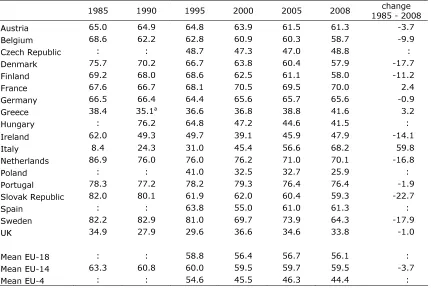
Net unemployment replacement rates are presented in Table 4. These data indicate that the net level of unemployment benefits has been decreased in most of the European countries. Interestingly, this trend is neither in line with the increase of the generosity of the gross un-employment benefits, nor with the concept of flexicurity. Only in Italy the net replacement rates increased substantially. In line with the stricter EPL and the higher gross benefits, also the net benefit level has been increased in France. In Ireland, the net replacement rate is lower in 2008 than in 1985, but from 2000 onwards, the benefit level has been increased. Furthermore, the levels of the net replacement rates are obviously higher than the levels of the gross replacement rates, which indicates that income taxes are lower and other social benefits are more generous for the unemployed. However, it should be noted that the differ-ence between gross and net can also be partly explained by the fact that the net replacement rates only refer to the first year of unemployment, whereas the gross replacement rates refer to a five year unemployment spell. In most countries, the level of unemployment benefits decreases when unemployment spells are longer.
5
Table 4. Net replacement rates unemployment benefits 1985 - 2008
Note: Replacement rates are calculated as unweighted averages of benefits for two family situations (single
person and one earner couple with two children), for an unemployment spell of 1 year and for the av-erage production worker wage.
a: The value for Greece in 1990 is calculated as the average of the values in 1989 and 1991.
EU-14: Austria, Belgium, Denmark, Finland, France, Germany, Greece, Ireland, Italy, the Netherlands, Portugal, Spain, Sweden and the UK.
EU-4: Czech Republic, Hungary, Poland, Slovak Republic.
Source: Unemployment replacement rates dataset (Van Vliet and Caminada, 2012); and own calculations.
Employment security from active labour market policies
To compare the developments in employment security policies across countries, the study relies on expenditures on ALMPs. The main programmes included are public employment ser-vice, labour market training, job rotation, employment incentives, supported employment, direct job creation and start-up incentives. We use a measure that expresses ALMP expendi-tures as a share of expendiexpendi-tures on all labour market policies (LMPs), defined as the sum of spending on activation policies and on unemployment benefits. This measure indicates gov-ernments’ emphasis on activation policies relative to all labour market policies. Furthermore, since both the nominator and the denominator of the indicator are related to the unemploy-ment rate, the effect of the unemployunemploy-ment rate on the expenditure measure as a whole is cancelled out. For this measure, data are taken from the OECD (2012).
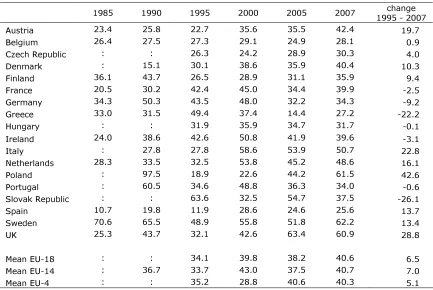
Table 5 presents the expenditures on ALMPs as a share of expenditures on all LMPs. Between 1990 (the first data year for which the observations of the old member states are complete) and 2007, the expenditures on ALMPs as a share of total LMP spending have been increased. This trend indicates that the financial efforts of the governments of the old member states on employment security have been increased, which is in line with the concept of flexicurity.6
6
In other studies (for instance Van Vliet and Koster, 2011) it has been shown that for many countries the trends in different ALMP expenditure measures, for instance ALMP expenditures per unemployed relative to GDP per capita, are rather comparable.
1985 1990 1995 2000 2005 2008 change 1985 - 2008 Austria 65.0 64.9 64.8 63.9 61.5 61.3 -3.7 Belgium 68.6 62.2 62.8 60.9 60.3 58.7 -9.9 Czech Republic : : 48.7 47.3 47.0 48.8 : Denmark 75.7 70.2 66.7 63.8 60.4 57.9 -17.7 Finland 69.2 68.0 68.6 62.5 61.1 58.0 -11.2 France 67.6 66.7 68.1 70.5 69.5 70.0 2.4 Germany 66.5 66.4 64.4 65.6 65.7 65.6 -0.9 Greece 38.4 35.1a
36.6 36.8 38.8 41.6 3.2 Hungary : 76.2 64.8 47.2 44.6 41.5 : Ireland 62.0 49.3 49.7 39.1 45.9 47.9 -14.1 Italy 8.4 24.3 31.0 45.4 56.6 68.2 59.8 Netherlands 86.9 76.0 76.0 76.2 71.0 70.1 -16.8 Poland : : 41.0 32.5 32.7 25.9 : Portugal 78.3 77.2 78.2 79.3 76.4 76.4 -1.9 Slovak Republic 82.0 80.1 61.9 62.0 60.4 59.3 -22.7 Spain : : 63.8 55.0 61.0 61.3 : Sweden 82.2 82.9 81.0 69.7 73.9 64.3 -17.9 UK 34.9 27.9 29.6 36.6 34.6 33.8 -1.0
These increases in ALMP expenditures can be observed across all welfare state types, such as for instance Austria, Denmark, Italy and the United Kingdom. However, in all of the consid-ered new member states except the Czech Republic, the efforts of governments on activation have been decreased between 1995 and 2007.
Table 5. ALMP expenditures as share of LMP expenditures 1985 - 2007
Note: Expenditures on labour market policies (LMP) consist of expenditures on passive labour market policies
(unemployment benefits) and active labour market policies (ALMP). ALMP expenditures include expen-ditures on public employment service and administration, labour market training, job rotation and job sharing, employment incentives, supported employment and rehabilitation, direct job creation and start-up incentives.
EU-14: Austria, Belgium, Denmark, Finland, France, Germany, Greece, Ireland, Italy, the Netherlands, Portugal, Spain, Sweden and the UK.
EU-4: Czech Republic, Hungary, Poland, Slovak Republic.
Source: OECD Social Expenditure Database (OECD, 2012); and own calculations.
Flexicurity reforms
The data provide insight into the changes in three dimensions of flexicurity policies in the EU. The developments in the EPL measures and the gross unemployment replacement rates seem to indicate that at least four countries changed their labour market policies into the direction of flexicurity, namely Austria, Finland, Italy, and Spain. In these countries, the expenditures on ALMP and the gross unemployment benefits have been increased and one of the two EPL measures shows a decline in strictness while the other EPL measure stays at least constant or has been decreased too. However, the net replacement rates have become lower in most of these countries, meaning that increases in unemployment benefits have not been applied to compensate the reductions in employment protection for the insiders. This is for instance the case for Austria. At first sight, the data suggest that Austria is a textbook example of the flexicurity strategy. EPL for regular employment has been loosened, compensated with higher
1985 1990 1995 2000 2005 2007 change 1995 - 2007 Austria 23.4 25.8 22.7 35.6 35.5 42.4 19.7 Belgium 26.4 27.5 27.3 29.1 24.9 28.1 0.9 Czech Republic : : 26.3 24.2 28.9 30.3 4.0 Denmark : 15.1 30.1 38.6 35.9 40.4 10.3 Finland 36.1 43.7 26.5 28.9 31.1 35.9 9.4 France 20.5 30.2 42.4 45.0 34.4 39.9 -2.5 Germany 34.3 50.3 43.5 48.0 32.2 34.3 -9.2 Greece 33.0 31.5 49.4 37.4 14.4 27.2 -22.2 Hungary : : 31.9 35.9 34.7 31.7 -0.1 Ireland 24.0 38.6 42.6 50.8 41.9 39.6 -3.1 Italy : 27.8 27.8 58.6 53.9 50.7 22.8 Netherlands 28.3 33.5 32.5 53.8 45.2 48.6 16.1 Poland : 97.5 18.9 22.6 44.2 61.5 42.6 Portugal : 60.5 34.6 48.8 36.3 34.0 -0.6 Slovak Republic : : 63.6 32.5 54.7 37.5 -26.1 Spain 10.7 19.8 11.9 28.6 24.6 25.6 13.7 Sweden 70.6 65.5 48.9 55.8 51.8 62.2 13.4 UK 25.3 43.7 32.1 42.6 63.4 60.9 28.8
gross unemployment benefits and ALMP expenditure. However, the net replacement rates indicate that the unemployment benefits have in fact become less generous. This raises the question why the reform of the Austrian EPL has actually been successful, since it is unlikely that employees accept lower unemployment benefits and more flexible EPL in exchange for higher ALMP expenditure. In 2002, a new severance pay law was adopted. The new law re-placed a conventional severance payments system with an individual and portable savings accounts system that is funded by employers via a monthly payment. In the case of dis-missal, an employee has the choice of either receiving severance payment drawn from his savings account or taking his accumulated balance to the next job. At retirement, the em-ployee can get a cash payment or convert his entitlements into an annuity (Hofer, 2007: 41). The reform is based on a compromise between the social partners. For employers the advan-tage of the new system is that there is no uncertainty regarding the costs of dismissal, which are lower than in the old system, because they are known at the time of hiring. For employ-ees, job mobility costs are lower because they do not lose their entitlement to severance payment when quitting a job, as was the case in the old system (Hofer, 2007: 46). Interest-ingly, by reforming EPL rather than plainly reducing dismissal protection, the social partners were able to come up with a proposal to enhance external flexibility that was acceptable for the insiders.
The Danish policies are interesting as well, since these are often mentioned as a typical ex-ample of flexicurity. Indeed, the strictness of EPL on regular employment has been below the mean level during the whole period and the unemployment benefits system is one of the most generous systems in the EU. However, this configuration of complementary labour market policies has emerged in the course of quite a long period, rather than being the result of an explicit reform strategy to increase flexibility and security simultaneously that was designed on the drawing board (Burroni and Keune, 2011). Moreover, as the data show, the direction of the policy changes is not in line with the principles of the flexicurity concept, as the unem-ployment benefits have become less generous and the flexibility of the labour market was only slightly extended, holding the protection of regular employment unchanged. However, the efforts on active labour market policies have actually been increased in Denmark, which is in line with the flexicurity concept.
Interestingly, the results indicate further that most countries have opted for a reduction of the EPL on temporary employment instead of changing the protection of regular employment. In seven countries – Belgium, Denmark, Germany, Greece, Italy, Netherlands and Sweden – employment protection has been reduced for temporary workers, while it remained constant for regular workers. In Germany, the employment protection for regular workers has even increased. This disparity between the reforms of regulation of regular and temporary em-ployment contracts indicates that governments have applied two tier reforms rather than the flexicurity strategy, which may be owing to the influence of insiders. In Italy for instance, labour law reforms included the deregulation of part-time employment and the introduction of project-based contracts, a new type of fixed-term contracts. These changes at the margins of the labour market are the result of the fact that the trade unions have successfully challenged attempts to introduce more flexibility for insiders, whereas outsiders were not represented in the negotiations between employers and trade unions (Bonoli and Emmenegger, 2010).
Dualisation of labour markets
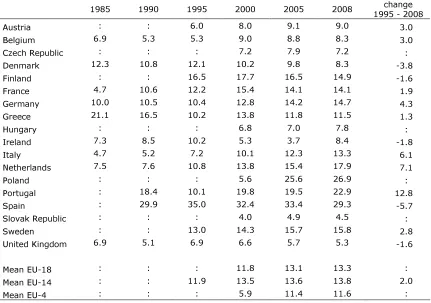
contract as a percentage of all employees, based on data from the Eurostat Labour Force Sur-vey (Eurostat 2010). There is considerable variation across the countries. In 2008, for in-stance, 29.3 percent of the Spanish employees worked on a temporary contract, while this was only 4.5 percent in the United Kingdom. In three of the four new member states, the share of temporary employees is lower than the average level of the old member states. The exception is Poland, that is with 26.9 percent the second highest of the whole country group. More important, the table shows that the share of temporary employees has increased in the EU countries. Among the old member states, the sharpest increase can be observed in the Netherlands, from 10.8 percent in 1995 to 17.9 percent in 2008. This is probably partly due to the fact that the EPL on temporary contracts has been reduced more than the EPL on open-ended contracts. On average, the share of temporary employees rose by almost two percent-age points in the old member states between 1995 (the first data year for which the observa-tions of the old member states are complete) and 2008. This implies that, combined with the above presented trend in the EPL on temporary employment, there are more employees with a temporary contract enjoying less protection.
Table 6. Employees with a temporary contract as percentage of total employees 1985-2008
1985 1990 1995 2000 2005 2008 change 1995 - 2008 Austria : : 6.0 8.0 9.1 9.0 3.0 Belgium 6.9 5.3 5.3 9.0 8.8 8.3 3.0 Czech Republic : : : 7.2 7.9 7.2 : Denmark 12.3 10.8 12.1 10.2 9.8 8.3 -3.8 Finland : : 16.5 17.7 16.5 14.9 -1.6 France 4.7 10.6 12.2 15.4 14.1 14.1 1.9 Germany 10.0 10.5 10.4 12.8 14.2 14.7 4.3 Greece 21.1 16.5 10.2 13.8 11.8 11.5 1.3 Hungary : : : 6.8 7.0 7.8 : Ireland 7.3 8.5 10.2 5.3 3.7 8.4 -1.8 Italy 4.7 5.2 7.2 10.1 12.3 13.3 6.1 Netherlands 7.5 7.6 10.8 13.8 15.4 17.9 7.1 Poland : : : 5.6 25.6 26.9 : Portugal : 18.4 10.1 19.8 19.5 22.9 12.8 Spain : 29.9 35.0 32.4 33.4 29.3 -5.7 Slovak Republic : : : 4.0 4.9 4.5 : Sweden : : 13.0 14.3 15.7 15.8 2.8 United Kingdom 6.9 5.1 6.9 6.6 5.7 5.3 -1.6
Mean EU-18 : : : 11.8 13.1 13.3 : Mean EU-14 : : 11.9 13.5 13.6 13.8 2.0 Mean EU-4 : : : 5.9 11.4 11.6 :
Note: EU-14: Austria, Belgium, Denmark, Finland, France, Germany, Greece, Ireland, Italy, the Netherlands, Portugal, Spain, Sweden and the UK.
EU-4: Czech Republic, Hungary, Poland, Slovak Republic.
5. Discussion and conclusions
The concept of flexicurity has gained importance in the European policy debates since the beginning of the twenty-first century. In contrast, the presented data show that the labour market policies across the EU have not been reformed along the lines of the flexicurity con-cept. The strictness of employment protection has been decreased on average between 1985 and 2008, but the disparity between insiders and outsiders has actually become larger. The data show that most countries have increased labour market flexibility by reducing employ-ment protection on temporary employemploy-ment more than employemploy-ment protection on regular open-ended contracts. In addition, since firms have hired relatively more temporary employ-ees, larger shares of European labour forces have a temporary contract. The inequality be-tween insiders and outsiders on the labour market has been illustrated by the consequences of the financial crisis around 2009. When firms started to reduce their production capacity in reaction to the recession, the temporary employees were the first to be dismissed. As a re-sult, the rising unemployment figures across the EU are overrepresented by former temporary employees (OECD, 2010a).
Furthermore, whereas most of the existing literature on labour market institutions is mainly focused on West European countries, this study also includes a number of Central and East European countries. Interestingly, the levels of protection on regular employment in the new EU member states are comparable to the protection levels in the old member states. This is remarkable, since labour market and social policies in the new member states usually differ strongly from the old member states (Draxler and Van Vliet, 2010). Naturally, these observa-tions should be interpreted with caution, since only four new member states are included. The differences in the reforms of employment protection on temporary and permanent con-tracts are probably owing to the role of insiders in policy making processes. Responding to pressure from internationalisation and labour market performance, governments have at-tempted to introduce elements of flexibility. Since trade unions have successfully challenged such attempts, governments have opted for reforms at the margins of the labour market. Yet, the flexicurity strategy is aimed at providing reform packages that could compensate the re-duced employment protection of insiders. A tentative explanation for the limited success of this strategy is that the second element of the flexicurity concept, an increase in income secu-rity, has not been implemented either. The developments in the gross unemployment re-placement rates suggest that unemployment benefits have become more generous, whilst the net replacement rates indicate that when taxes and other benefit schemes are taken into ac-count, the income security for the unemployed has actually been decreased. Consequently, insiders have not been compensated sufficiently for reductions in dismissal protection, even though the expenditures on ALMPs have been increased.
electorate changes, the attitude of the electorate towards more flexible employment regula-tion may become more positive which makes it more likely that politicians will adopt reforms (Saint-Paul, 2004). Political support for reforming EPL on permanent contracts could be ex-pected in countries with many temporary contracts, such as Spain and Poland.
References
Allan, J.P. and L. Scruggs (2004) Political Partisanship and Welfare State Reform in Advanced Industrial Societies. American Journal of Political Science 48(3): 496-512.
Baily, M.N. (1978) Some Aspects of Optimal Unemployment Insurance. Journal of Public Eco-nomics 10(3): 379-402.
Blanchard, O. and J. Tirole (2004) Redesigning the Employment Protection System. De Econ-omist 152(1): 1-20.
Blanchard, O. and J. Tirole (2008) The Joint Design of Unemployment Insurance and Employ-ment Protection: A First Pass. Journal of the European Economic Association 6(1): 45-77.
Boeri, T., J.I. Conde-Ruiz and V. Galasso (2006) The Political Economy of Flexicurity. FEDEA Working Paper No. 2006-15.
Boeri, T., P. Cahuc, S. Crnkovic, C. Kollonay-Lehoczky and T. Wilthagen (2007) Flexicurity Pathways, Turning Hurdles into Stepping Stones. Brussels: Report by the European Expert group on Flexicurity.
Boeri, T. and P. Garibaldi (2007) Two Tier Reforms of Employment Protection: A Honeymoon Effect? The Economic Journal 117(521): F357-F385.
Bonoli, G. and P. Emmenegger (2010) State-Society Relationships, Social Trust and the Development of Labour Market Policies in Italy and Sweden. West European Politics 33(4): 830-850.
Burroni, L. and M. Keune (2011) Flexicurity: A conceptual critique. European Journal of Industrial Relations 17(1): 75-91.
Caminada, K. K. Goudswaard and O. van Vliet (2010) Patterns of welfare state indicators in the EU: Is there convergence? Journal of Common Market Studies 48(3): 529-556.
Card, D., J. Kluve and A. Weber (2010) Active labour market policy evaluations: A meta-analysis. NBER Working Paper Series No. 16173.
Cornelisse, P. A. and K.P Goudswaard (2002) On the Convergence of Social Protection Sys-tems in the European Union. International Social Security Review 55(3): 3-17.
Draxler, J. and O. van Vliet (2010) European Social Model: No Convergence from the East. Journal of European Integration 32(1): 115-135.
Eichhorst, W. and R. Konle-Seidl (2005) The Interaction of Labor Market Regulation and Labor Market Policies in Welfare State Reform. IZA Discussion Paper No. 1718, Bonn.
Eichhorst, W. and P. Marx (2011) Reforming German labour market policies: A dual path to flexibility. Journal of European Social Policy 21(1): 73-87.
Emmenegger, P. (2011) Job security regulations in Western democracies: A fuzzy set analy-sis. European Journal of Political Research 50(3): 336-364.
European Commission (2006) Employment in Europe 2006. Brussels: European Commission.
European Commission (2007a) Towards Common Principles of Flexicurity: More and Better Jobs through Flexibility and Security. Brussels: European Commission.
European Commission (2007b) Employment in Europe 2007. Brussels: European Commission.
European Commission (2010) Europe 2020: A strategy for smart, sustainable and inclusive growth. Brussels: European Commission.
Hofer, H. (2007) The Severance Pay Reform in Austria. CESifo DICE Report 4: 3-11.
Houwing, H. (2010) A Dutch Approach to Flexicurity? Negotiated Change in the Organization of Temporary Work. Dissertation, University of Amsterdam.
Kluve, J. (2010) The effectiveness of European active labour market programs. Labour Eco-nomics 17(6): 904-918.
Lindbeck, A. and D.J. Snower (2001) Insiders versus Outsiders. Journal of Economic Perspec-tives 15(1): 165-188.
Madsen, P.K. (2007) Flexicurity - Towards a set of common principles? International Journal of Comparative Labour Law and Industrial Relations 23(4): 525-542.
Ochel, W. (2008) The Political Economy of Two-Tier Reforms of Employment Protection in Europe. CESIFO Working Paper No. 2461. Munich: CESIFO.
OECD (2004) Employment Outlook. Paris: OECD.
OECD (2009) Employment Database (www.oecd.org/dataoecd); download January 21st, 2009.
OECD (2010a) Employment Outlook: Moving beyond the jobs crisis. Paris: OECD.
OECD (2010b) Benefits and Wages. Paris: OECD.
OECD (2012) Social Expenditure Database 1980-2007
(www.oecd.org/document/9/0,3746,en_2649_34637_38141385_1_1_1_1,00.html);
down-load January 12th, 2012. Paris: OECD.
Pfann, G.A. (2006) Downsizing and Heterogeneous Firing Costs. Review of Economics and Statistics 88(1): 158-170.
Pfann, G.A. and F.C. Palm (1993) Asymmetric Adjustment Costs in Nonlineair Labour Demand Models for the Netherlands and U.K. Manufacturing Sectors. Review of Economic Studies 60(1): 397-412.
Rueda, D. (2007) Social Democracy Inside Out: Partisanship and Labor Market Policy in In-dustrialized Democracies. Oxford: Oxford University Press.
Saint-Paul, G. (2004) Why are European countries diverging in their unemployment experi-ence? Journal of Economic Perspectives 18(4): 49-68.
Schmid, G. (2006) Social Risk management through Transitional Labour Markets. Socio-Economic Review 4(1): 1-33.
Scruggs, L. (2005) Welfare State Entitlements Data Set: a Comparative Institutional Analysis of Eighteen Welfare States, Version 1.1.
Swank, D. (2011) Activating Workers? The Political Economy of Active Social Policy in Postin-dustrial Democracies. In: D. Brady (ed.) Comparing European Workers Part B: Policies and Institutions (Research in the Sociology of Work, Vol. 22), Emerald Group Publishing Limited: 9-51.
Van Vliet, O. (2010) Divergence within Convergence: Europeanization of Social and Labour Market Policies. Journal of European Integration 32(3): 269-290.
Van Vliet, O. and K. Caminada (2012) Unemployment replacement rates dataset among 34 welfare states 1971-2009: An update, extension and modification of Scruggs’ Welfare State Entitlements Data Set. NEUJOBS Special Report No. 2, Leiden University
(www.hsz.leidenuniv.nl) download January 12th, 2012.
Viebrock, E. and J. Clasen (2009) Flexicurity and welfare reform: a review. Socio-Economic Review 7(2): 305-331.
Whiteford, P. (1995) The Use of Replacement Rates in International Comparisons of Benefit Systems. International Social Security Review 48(2): 3-30.
Research Memorandum Department of Economics
Research Memoranda
- are available from Department of Economics homepage at : http://www.economie.leidenuniv.nl
- can be ordered at Leiden University, Department of Economics, P.O. Box 9520, 2300 RA Leiden, The Nether-lands Phone ++71 527 7756; E-mail: [email protected]
2012.02 Olaf van Vliet and Henk Nijboer
Flexicurity in the European Union: Flexibility for Insiders, Security for Outsiders 2012.01 Stefan Thewissen
Is it the distribution or redistribution that affects growth? 2011.03 Olaf van Vliet, Jim Been, Koen Caminada and Kees Goudswaard
Pension reform and income inequality among the elderly in 15 European countries 2011.02 Chen Wang and Koen Caminada
Disentangling income inequality and the redistributive effect of social transfers and taxes in 36 LIS countries
2011.01 Anton Rommelse
Een geschiedenis van het arbeidsongeschiktheidsbeleid in Nederland 2010.03 Joop de Kort
The Right to Development or the Development of Rights 2010.02 Carolien Klein Haarhuis and Ben van Velthoven
Legal Aid and Legal Expenses Insurance, Complements or Substitutes? The Case of The Neth-erlands?
2010.01 Koen Caminada, Kees Goudswaard and Ferry Koster
Social Income Transfers and Poverty Alleviation in OECD Countries. 2009.03 Megan Martin and Koen Caminada
Welfare Reform in the United States. A descriptive policy analysis. 2009.02 Koen Caminada and Kees Goudswaard
Social Expenditure and Poverty Reduction in the EU and other OECD Countries.
2009.01 Maroesjka Versantvoort
Complementariteit in arbeid- en zorgtijd. 2008.06 Koen Caminada and Kees Goudswaard
Effectiveness of poverty reduction in the EU.
2008.05 Koen, Caminada, Kees Goudswaard and Olaf van Vliet
Patterns of welfare state indicators in the EU. Is there convergence? 2008.04 Kees Goudswaard and Koen Caminada
The redistributive impact of public and private social expenditure. 2008.03 Karen M. Anderson and Michael Kaeding
Pension systems in the European Union: Variable patterns of influence in Italy, the Netherlands and Belgium.
2008.02 Maroesjka Versantvoort
Time use during the life course in USA, Norway and the Netherlands: a HAPC-analysis. 2008.01 Maroesjka Versantvoort
Studying time use variations in 18 countries applying a life course perspective. 2007.06 Olaf van Vliet and Michael Kaeding
Globalisation, European Integration and Social Protection – Patterns of Change or Continuity? 2007.05 Ben van Velthoven
2007.04 Ben van Velthoven
Rechtseconomie tussen instrumentaliteit en normativiteit. 2007.03 Guido Suurmond
Compliance to fire safety regulation. The effects of the enforcement strategy. 2007.02 Maroesjka Versantvoort
Een schets van de sociaal-economische effecten van verlof en de beleidsmatige dilemma’s die daaruit volgen.
2007.01 Henk Nijboer
A Social Europe: Political Utopia or Efficient Economics? An assessment from a public economic approach.
2006.04 Aldo Spanjer
European gas regulation: A change of focus. 2006.03 Joop de Kort and Rilka Dragneva
Russia’s Role in Fostering the CIS Trade Regime. 2006.02 Ben van Velthoven
Incassoproblemen in het licht van de rechtspraak. 2006.01 Jurjen Kamphorst en Ben van Velthoven
De tweede feitelijke instantie in de belastingrechtspraak. 2005.03 Koen Caminada and Kees Goudswaard
Budgetary costs of tax facilities for pension savings: an empirical analysis. 2005.02 Henk Vording en Allard Lubbers
How to limit the budgetary impact of the European Court's tax decisions? 2005.01 Guido Suurmond en Ben van Velthoven
Een beginselplicht tot handhaving: liever regels dan discretionaire vrijheid. 2004.04 Ben van Velthoven en Marijke ter Voert
Paths to Justice in the Netherlands. Looking for signs of social exclusion.
2004.03 Guido Suurmond
Brandveiligheid in de horeca. Een economische analyse van de handhaving in een represen-tatieve gemeente.
2004.02 Kees Goudswaard, Koen Caminada en Henk Vording Naar een transparanter loonstrookje?
2004.01 Koen Caminada and Kees Goudswaard
Are public and private social expenditures complementary? 2003.01 Joop de Kort
De mythe van de globalisering. Mondialisering, regionalisering of gewoon internationale economie?
2002.04 Koen Caminada en Kees Goudswaard
Inkomensgevolgen van veranderingen in de arbeidsongeschiktheidsregelingen en het nabe-staandenpensioen.
2002.03 Kees Goudswaard Houdbare solidariteit. 2002.02 Ben van Velthoven
Civiele en administratieve rechtspleging in Nederland 1951-2000; deel 1: tijdreeksanalyse. 2002.01 Ben van Velthoven
Civiele en administratieve rechtspleging in Nederland 1951-2000; deel 2: tijdreeksdata. 2001.03 Koen Caminada and Kees Goudswaard
International Trends in Income Inequality and Social Policy. 2001.02 Peter Cornelisse and Kees Goudswaard
On the Convergence of Social Protection Systems in the European Union. 2001.01 Ben van Velthoven
2000.01 Koen Caminada
Pensioenopbouw via de derde pijler. Ontwikkeling, omvang en verdeling van premies lijfren-ten volgens de Inkomensstatistiek.
1999.03 Koen Caminada and Kees Goudswaard
Social Policy and Income Distribution. An Empirical Analysis for the Netherlands.
1999.02 Koen Caminada
Aftrekpost eigen woning: wie profiteert in welke mate? Ontwikkeling, omvang en verdeling van de hypotheekrenteaftrek en de bijtelling fiscale huurwaarde.
1999.01 Ben van Velthoven and Peter van Wijck Legal cost insurance under risk-neutrality. 1998.02 Koen Caminada and Kees Goudswaard
Inkomensherverdeling door sociale zekerheid: de verdeling van uitkeringen en premieheffing in 1990 en 1995.
1998.01 Cees van Beers
Biased Estimates of Economic Integration Effects in the Trade Flow Equation. 1997.04 Koen Caminada and Kees Goudswaard
Distributional effects of a flat tax: an empirical analysis for the Netherlands. 1997.03 Ernst Verwaal
Compliance costs of intra-community business transactions. Magnitude, determinants and policy implications.
1997.02 Julia Lane, Jules Theeuwes and David Stevens
High and low earnings jobs: the fortunes of employers and workers. 1997.01 Marcel Kerkhofs and Maarten Lindeboom
Age related health dynamics and changes in labour and market status. 1996.07 Henk Vording
The case for equivalent taxation of social security benefits in Europe. 1996.06 Kees Goudswaard and Henk Vording
Is harmonisation of income transfer policies in the European Union feasible? 1996.05 Cees van Beers and Jeroen C.J.M. van den Bergh
The impact of environmental policy on trade flows: an empirical analysis. 1996.04 P.W. van Wijck en B.C.J. van Velthoven
Een economische analyse van het Amerikaanse en het continentale systeem van proceskos-tentoerekening.
1996.03 Arjan Heyma
Retirement and choice constraints: a dynamic programming approach. 1996.02 B.C.J. van Velthoven en P.W. van Wijck
De economie van civiele geschillen; rechtsbijstand versus no cure no pay. 1996.01 Jan Kees Winters
Unemployment in many-to-one matching models. 1995.05 Maarten Lindeboom and Marcel Kerkhofs
Time patterns of work and sickness absence. Unobserved effects in a multi-state duration model.
1995.04 Koen Caminada en Kees Goudswaard
De endogene ontwikkeling van de belastingdruk: een macro-analyse voor de periode 1960-1994.
1995.03 Henk Vording and Kees Goudswaard
Legal indexation of social security benefits: an international comparison of systems and their effects.
1995.02 Cees van Beers and Guido Biessen
Trade potential and structure of foreign trade: the case of Hungary and Poland. 1995.01 Isolde Woittiez and Jules Theeuwes
1994.10 K.P. Goudswaard
Naar een beheersing van de Antilliaanse overheidsschuld. 1994.09 Kees P. Goudswaard, Philip R. de Jong and Victor Halberstadt
The realpolitik of social assistance: The Dutch experience in international comparison. 1994.08 Ben van Velthoven
De economie van misdaad en straf, een overzicht en evaluatie van de literatuur. 1994.07 Jules Theeuwes en Ben van Velthoven
De ontwikkeling van de criminaliteit in Nederland, 1950-1990: een economische analyse. 1994.06 Gerard J. van den Berg and Maarten Lindeboom
Durations in panel data subject to attrition: a note on estimation in the case of a stock sample.
1994.05 Marcel Kerkhofs and Maarten Lindeboom
Subjective health measures and state dependent reporting errors. 1994.04 Gerard J. van den Berg and Maarten Lindeboom
Attrition in panel data and the estimation of dynamic labor market models. 1994.03 Wim Groot
Wage and productivity effects of enterprise-related training. 1994.02 Wim Groot
Type specific returns to enterprise-related training. 1994.01 Marcel Kerkhofs