Boron Removal by Electrocoagulation
Using Full Factorial Design
Khaoula Missaoui*, Wided Bouguerra, Chiraz Hannachi, Béchir Hamrouni UR11ES17 Traitement et Dessalement des Eaux, Faculté des Sciences de Tunis,
Université de Tunis El Manar, Tunis, Tunisie Email: *[email protected]
Received April 26, 2013; revised May 28, 2013; accepted June 22, 2013
Copyright © 2013 Khaoula Missaoui et al. This is an open access article distributed under the Creative Commons Attribution Li-cense, which permits unrestricted use, distribution, and reproduction in any medium, provided the original work is properly cited.
ABSTRACT
Saline waters treatment has become increasingly important for drinking water supply in a greater part of the world. However, some serious limitations had recently been discovered during water treatment, among them the boron prob- lem seems to have a critical meaning. According to the WHO regulations (2011), the boron concentration should be reduced to less than 2.4 mg/L for drinking water. The purpose of this study is to investigate the feasibility of electroco- agulation (EC) as a pretreatment process to remove boron from saline waters. To optimize the experimental conditions of boron removal, the effects of some parameters were studied such as inter-electrode distance (die), electrode connec-
tion mode, (S/V) ratio, pHi and initial conductivity of the solution (σi). Subsequently, an experimental design method-
ology was implemented to evaluate statistically the most significant operating parameters. The effects of current density, EC time and initial boron concentration and their mutual interaction were investigated using 23 full factorial design. At
optimal conditions, boron removal from synthetic aqueous solutions containing initial boron concentrations of 5 and 50 mg/L reached 81% and 79%, respectively. Applied to boron removal from seawater samples, EC reduces boron con- centration to less to 2.4 mg/L with excessive energy consumption under optimal parameters.
Keywords: Boron Removal; Electrocoagulation; Full Factorial Design
1. Introduction
Boron is an element that naturally occurs throughout the environment. It can be found mainly in the form of boric acid or borate salts. Boron is widely distributed in surface and ground waters mainly in the form of boric acid or borate salts depending on the pH of the water [1]. When the acid dissociation constant of boric acid (at 25˚C; pka =
9.24) is considered, it can be predicted that H3BO3 is the
predominant form at neutral and low pHs whereas B(OH)4
is expected to be present at high pHs [2].
Naturally occurring boron is present in groundwater primarily as a result of leaching from rocks and soils containing borates and borosilicates. Concentrations of boron vary widely and depend on the surrounding geology and wastewater discharges. The majority of Earth’s boron occurs in the oceans, with an average concentration of 4.5 mg/L [3].
Generally, boron has been found to have a dual effect on the living systems on Earth. In the case of plants, the effect of boron has the unambiguous meaning. It was
shown that there is a small range difference between bo- ron deficiency and boron toxicity levels. There are some plants that are more sensitive to boron than others [4]. A very low boron content is required in irrigation water for certain metabolic activities, but if its concentration is only slightly higher, plant growth will exhibit effects of boron poisoning, which are yellowish spots on the leaves and fruits, accelerated decay and ultimately plant expiration. Sensitive plants can tolerate irrigation waters with only 0.3 mg/L boron, while very tolerant plants may be able to survive for 4 mg/L of boron concentration [5]. High boron levels in drinking water can be toxic to humans as boron has been shown to cause male reproductive impediments in laboratory animals [6]. Boron has virulence for repro- duction and causes disease of the nervous system.
The World Health Organization for many years had recommended the drinking water limits for boron as low as 0.5 mg/L. Lately, the Expert Group on Guidelines for Desalination recommended that the guideline for boron should be reconsidered in the light of new thinking on the toxicity, as boron levels are quite high in seawater and
boron removal is difficult [7]. Therefore, the Drinking- Water Quality Committee, at its meeting of 9-13 No- vember 2009, recommended revising the Boron Guideline Value to 2.4 mg/L. The revised Guideline Value was in- corporated into the Guidelines for Drinking-Water Qual- ity, 4th Edition, that was published in 2011 [8].
As the requirement for fresh water increases worldwide, there is a need for implementation of more advanced technologies that are able to treat non-conventional water sources. Such chance we note for seawater that has be- come an important non-conventional source of water in many arid regions. However, seawater contains approxi- mately 5 - 6 mg/L of boron [4].
In order to prevent the environmental problems of high concentration of boron in waters, their boron contents should be removed by a suitable method. There is no easy method for removing boric acid and borates from aqueous solution. As has already been stated in the literature [2], conventional water treatment (coagulation, sedimentation, filtration) does not significantly remove boron, and spe- cial methods need to be used in order to remove high boron concentrations. Besides, ion exchange and reverse osmosis processes may enable substantial reduction but are likely to be prohibitively expensive [8]. Electro- chemical technology contributes in many ways to a clea- ner environment and covers a very broad range of tech- nology [9,10]. Electrocoagulation (EC) is an efficient me- thod used for treating various process effluents and in- vestigated as a new technology for boron [10,11].
In an electrocoagulation (EC) process, no addition of chemicals is necessarily needed. Small volume of sludge is produced, comparing with that in classical chemical process, which can be easily removed by decantation. EC involves the generation of coagulants in situ by dissolv- ing electrically either aluminum or iron ions from, re- spectively, aluminum or iron electrodes. The metal ion generation takes place at the anode; hydrogen gas is re- leased from the cathode. EC is a complex process occur- ring via serial steps such as electrolytic reactions at elec- trode surfaces, formation of coagulants in aqueous phase, adsorption of soluble or colloidal pollutants on coagu- lants which are removed by sedimentation or flotation [11]. The most widely used electrode materials in EC process are aluminum and iron. In the case of aluminum, main reactions are as:
• At the anode:
( ) 3 ( )
Als ↔Al+aq +3é (1)
• At the cathode:
2 ( ) (aq) 2(g)
2H Olq +2é↔2OH− +H (2)
Al3+ and OH− ions generated by electrode reactions (1) and (2) react to form various monomeric species such as
; ; ; and
polymeric species such as ; 17 ;
20 ; 13 ; 13 34 which
transform finally into
( )
Al OH 2+ Al OH
( )
2+ Al OH2( )
22+ Al OH( )
−4( )
3 6 15Al OH +
)
7 24+ Al
)
3( ) H( )
4 7Al OH +
)
5H +
( )
4 8Al OH + Al O OH4
(
(
Al O
(
O
s according to complex
precipitation kinetics [10].
( )
3( )l OH s 3
Al OH ( ) H aq + + + ( ) 3 3
Al (aq)+3H O2 ( )lq ↔A (3)
Freshly formed amorphous
( )
s “sweepflocks” have a large surface area which is beneficial for a rapid adsorption of soluble organic compounds and trap-ping of colloidal particles. Finally, these flocks are re-moved easily from aqueous medium by sedimentation or H2 flotation [11].
The aim of the present study was to optimize the ex- perimental conditions of boron removal by EC, such as inter-electrode distance (die), electrode connection mode,
(S/V) ratio, pHi and initial conductivity of the solution (σi).
Consequently, an experimental design methodology, 23
full factorial, was used to investigate the influence of the principal experimental parameters (current density, EC time and initial boron concentration). Lastly the effec- tiveness of EC treatment for boron removal from seawater samples was evaluated.
2. Material and Methods
2.1. Analytical Methods
Molecular Absorption Spectrometry in the UV-visible range using Azomethine-H as a colorimetric reagent ac- cording to the procedure of López et al. [12] was used for boron analysis. Azomethine-H is not considered a standardised reagent for boron analysis in waters. How- ever, it has been selected owing to its simplicity and competitiveness over other spectrophotometric reagents, according to Fuente and Munoz [13]. Boron concentra- tions were obtained by absorbance measurement at a wave length of 420 nm [14].
2.2. Electrocoagulation Test
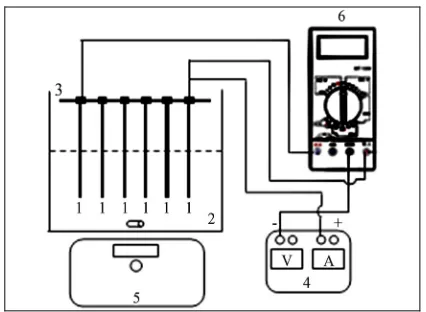
A laboratory-scale reactor used to conduct EC experi- ments was a beaker with a working volume of about 1 L. Electrode assembly is the heart of the present treatment facility. Two groups of alternating electrodes being cath- ode and anode, made from plates of aluminum with di- mensions of (18 - 8 - 0.02 cm) were arranged vertically. The immerged active surface of each electrode was Sa=
176 cm2. The electrodes assembly was connected to DC
Figure 1. Schematic diagram of electrocoagultion unit, ((1) aluminium electrodes; (2) treated solution; (3) electrodes support; (4) DC power supply; (5) magnetic stirrer; (6) multimmeter).
Before the EC test and in order to avoid any interfer- ence and ensure surface reproducibility, electrodes were prepared as follows:
• Mechanically polished underwater with abrasive pa- per,
• Cleaned in NaOH solution (2 mol/L) for 2 min,
• Rinsed with distilled water,
• Cleaned in HCl solution (2 mol/L) for 2 min,
• Rinsed with distilled water,
• Dried with absorptive paper.
The initial pH of the solutions was adjusted by adding either HCl (0.1 mol/L) or NaOH (0.1 mol/L). NaCl was used as supporting electrolyte to adjust the initial con- ductivity of the solution. For each experiment, the resid- ual boron concentrations in the samples filtered through 0.45 micron filter paper (Millipore) were determined. The percentage of boron removed (%B) is given as:
(
0%B=100 1× −Cf C
)
(4)Where C0 and Cf are the initial and residual boron
concentration in the solution.
3. Results and Discussion
Operating parameters such as inter-electrode distance (die), electrode connection mode, the (S/V) ratio: surface
area on solution volume, pH and conductivity of the so- lution (σi) were optimized for an initial boron concentra-
tion of 5 mg /L.
3.1. Optimal Inter-Electrode Distance Determination
Several tests were first performed to understand how EC efficiency varies with inter-electrode distance. Boron re- moval efficiency and energy consumption was examined for inter-electrode distance ranged from 1.0 to 7.0 cm.
The effect of inter-electrode distance on the boron re- moval efficiency is shown in Figure 2.
When the inter-electrode distance decreases, the boron removal efficiency increases slightly. The increasing of boron removal in the less distance is probably resulting from the increase of electrostatic interactions [15].
Furthermore, in an electrochemical process, the most important economical parameter is energy consumption
W (kWh/m3). This parameter is calculated from the fol-
lowing expression:
EC U I t W
V
⋅ ⋅
= (5)
where U is the applied tension (V), I is the current inten- sity (A), tEC is the time of EC (s) and V is the volume (m3)
of boron solution.
Applied tension could be explained with the following equation:
U I R= ⋅ (6) where R is the resistance (Ohm).
From Equations (5) and (6), the following equation could be obtained:
2
EC I R t W
V
⋅ ⋅
= (7)
Inter-electrode distance has an effect on the amount of electrical energy introduced into the system to generate an electric field and induce motion of ions [16].
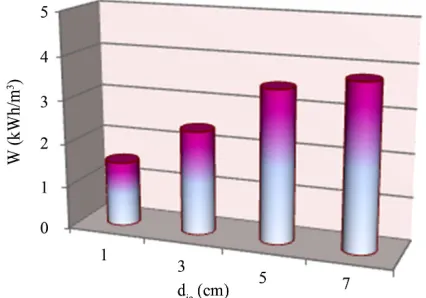
Figure 3 depicts the evolution of the energy consump- tion vs. inter-electrode distance. Globally, energy con- sumption increases with inter-electrode distance. This could be explained by the increase of the solution resis- tance, according to the following expression:
ie a
d R
S
ρ⋅
= (8)
where ρ is the resistivity (Ohm cm), die is the inter-elec-
trode distance (cm) and Sa is the total active surface
(cm2).
Obtained results showed that the highest boron re- moval with the lowest energy consumption was reached for die = 1 cm. Therefore, all EC experiments were con-
ducted at optimal die = 1 cm.
3.2. Optimal (S/V) Ratio and Electrode Connection Mode Determination
[image:3.595.66.279.82.238.2]Figure 2. Effect of inter-electrode distance on boron re-moval %B, (pHi = 8; J = 11.4 mA/cm²; tEC = 30 min and σi =
32.5 mS/cm).
Figure 3. Evaluation of the effect of inter-electrode distance on energy consumption, (pHi= 8; J = 11.4 mA/cm2; tEC= 30
min and σi = 32.5 mS/cm).
1; 2 and 3 pair(s) for (S/V) ratio respectively at (17.6; 35.2 and 52.8 m2/m3). Two different electrode connec-
tions (mono-polar (M.P) and bi-polar (B.P)) were exam- ined for choosing the better alternative. Schematic dia- gram of (M.P) and (B.P) electrochemical cell is shown in Figure 4.
It is basic to mention that in the B.P connection (Fig- ures 4(b)-(c)) multiple electrodes were used while only the extreme electrodes are connected to the power supply. Every electrode excluding the electrodes at the end acts as an anode on one side and cathode on the other side. Each adjacent electrode pair acts as single unit. In such condition, induced polarization took place when voltage was applied to the end electrodes so that the inner elec- trodes started acting as a secondary cells. Therefore, the total assembly was bipolarized with a primary and a secondary cells acting together. Effect of (S/V) ratio and electrode connection mode for the boron removal by EC is shown in Figure 5.
[image:4.595.310.536.87.177.2]The results confirmed that the (B.P) connection with
Figure 4. Schematic diagram of electrochemical cell. (a) M.P connection (1 pair); (b) B.P connection (2 pairs) and (c) B.P connection (3 pairs), (1) aluminium electrodes; (2) treated solution; (3) electrode support; and (4) DC power supply.
Figure 5. Effect of (S/V) ratio and electrode connection mode on boron removal %B,(pHi = 8; J = 11.4 mA/cm2; tEC
= 30 min and σi = 32.5 mS/cm).
multiple electrodes can serve better boron removal than the (M.P) connection with two electrodes. In (B.P) con- nection, several electrochemical cells acted together for which higher surface area compared to that of (M.P) connection favored the adequate anodic oxidation. As a result, with the same current density applied for both kind of connection, the intensity is higher in the bipolar connection. It is also seen from Figure 5 that when the number of pairs of electrodes increases (2 - 3 pairs), and so the (S/V) ratio increases (35.2 - 52.8 m2/m3), boron
removal increases. The reason of this observation is thought to be the workable rate of metal dissolution.
According to [17], the use of electrodes with large surface area is required and performance improvement has been achieved by using EC cells either with (M.P) electrodes or with (B.P) electrodes. However, to keep the EC system simple, the electrode plates are usually con- nected in (B.P) mode [18]. Experimental results showed that the high boron removal efficiency was obtained at (S/V) = 52.8 m2/m3 using 3 pairs of electrodes and (B.P)
connection. The effect of the number of pairs of elec- trodes on energy consumption was also evaluated at 1, 2 and 3 pair(s).
[image:4.595.318.526.250.369.2] [image:4.595.66.279.296.445.2]Figure 6. Evaluation of the effect of the number of pair of electrodes on energy consumption, (pHi = 8; J = 11.4
mA/cm2; tEC = 30 min and σi = 32.5 mS/cm).
When the number of electrodes pairs increases, the number of electrode pair acting as single EC unit in- creases. Thus, the total cell voltage (that is the sum of the individual unit voltages) and the electrical energy con- sumed are increased. Accordingly, all EC experiments were conducted at (S/V) = 52.8 m2/m3 using 3 pairs of
electrodes and (B.P) connection.
3.3. Optimal pHiDetermination
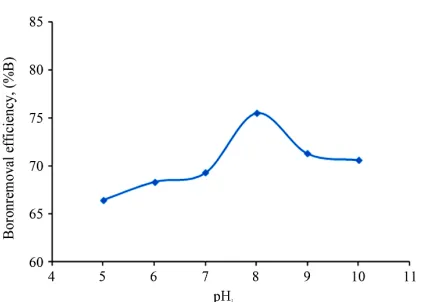
It has been established that the pH has a considerable influence on the performance of EC process. Indeed, the nature and the efficiency of the involved electrochemical and chemical reactions are intimately related to the pH level in the system. To investigate this effect, a series of experiments were carried out with an initial pH varying in the range pH 5 - 10.
Figure 7 depicts the evolution of boron removal as function of the initial pH.
From Figure 7, it was observed that boron removal ef- ficiency increased with initial pH up to 8.0, and then de- creased. If activity—pH diagram for Al(III) species in equilibrium with Al(OH)3(s) is investigated, it will be
seen that dominant Al(III) species is in the form of Al(OH)3(s) at pH 5.0 - 8.5 interval. Al OH
( )
−4( )aq formsat the higher pH and Al OH
( )
−4( )aq is a dissolving form and does not form flocks [19]. The highest boron re- moval efficiency was obtained at pH = 8 because boron was at 3 form and the formation Al(OH)3(s) wasa quite high at this pH. Therefore, all EC experiments were conducted at pHi = 8.
( )
B OH
3.4. Optimal Initial Conductivity Determination
The conductivity of the solution was adjusted to the de- sired levels upon addition of supporting electrolyte NaCl. The presence of the chloride ions in solution has been reported to decrease passivation of the aluminium surface and thereby increase the efficiency of electrocoagulation
Figure 7. Effect of pHi on boron removal %B, (J = 7
mA/cm2; tEC = 60 min and σi = 32.5 mS/cm). processes [20].
The effect of initial conductivity on the boron removal was examined. From Figure 8, experimental results showed that boron removal increased slowly with in- creasing initial conductivity up to 32.5 mS/cm and then decreased.
The effect of initial conductivity on the energy con- sumption was evaluated (Figure 9). The addition of NaCl would also lead to the decrease in power consump- tion because of the increase in conductivity [10].
Obtained results confirmed that high conductivity val- ues result in low energy consumption under the same current density. Increasing initial conductivity leads to energy consumption decrease due to relationship be- tween conductivity and resistance: the conductivity stat- ed as the inverse of the resistivity and according to Equa- tion (8) the resistance is proportional to the resistivity. To improve boron removal efficiency and minimize energy consumption, all EC experiments were conducted at an initial conductivity around 32.5 mS/cm.
4. Experimental Design Methodology
We have investigated the influence of three main pa- rameters: current density, EC time and initial boron con- centration using the experimental design methodology by means of factorial matrix (2k) [21]. In these types of de-
signs, variables (k) are set at two levels: low and high normalized as (−1) and (+1). With these designs, it was possible to calculate the average and the principle effects of each factors and their interaction.
The experimental response associated to a 2k factorial
design (for 3 variables) is represented by a linear poly- nomial model equation:
0 1 1 2 2 3 3 12 1
13 1 3+ 23 2 3
Y b b X b X b X b X X b X X b X X
= + + + + ⋅
+ ⋅ ⋅
2 (9)
where
[image:5.595.73.273.87.226.2]Figure 8. Effect of initial conductivity on boron removal %B, (pHi = 8, J = 7 mA/cm2; tEC = 60 min).
Figure 9. Evaluation of the effect of initial conductivity on energy consumption, (pHi = 8; J = 7 mA/cm
2
and tEC = 60
min).
Xi: coded variable (−1 or +1),
bi: estimation of the principal effect of the factor i for
the response Y,
bij: estimation of interaction effect between factor i and j for the response Y.
The response investigated is the percentage of boron removal. The coefficients of the equation model were calculated in the experimental field listed in Table 1.
[image:6.595.310.537.111.199.2]The experimental design and results are represented in Table 2.
According to the results obtained, the coefficients of the polynomial model were calculated using the Nemrod- W Software:
1 2
1 2 1 3 2 3
64.39 8.77 8.03 0.07
1.23 1.04 0.06
X X X3
X X X X
Y
X
+ + −
− −
=
− X (10)
The effects and interactions of the various investigated factors are represented in Figure 10.
It was concluded that current density (J) has the high- est effect. The effect of current density is positive, so it seems that removed boron level increases when current density increases. Similar effect was seen with the pa- rameter of EC time (tEC), it’s the second important factor
with a positive effect but slightly lower than current den-
Table 1. Experimental region investigated for boron re- moval by EC.
Experimental field Coded
variables (Xi)
Factors Minimum level
value
Maximum level value
X1 J (mA/cm2) 7 14
X2 tEC (min) 30 60
X3 [B]0 (mg/L) 5 50
Table 2. Factorial experimental design, experimental plan and results.
Experimental design Experimental plan Y
No.
Experiment X1 X2 X3 J t
EC [B]0 B (%)
1 −1 −1 −1 7 30 5 45.19
2 +1 −1 −1 14 30 5 67.56
3 −1 +1 −1 7 60 5 64.12
4 +1 +1 −1 14 60 5 80.98
5 −1 −1 +1 7 30 50 47.53
6 +1 −1 +1 14 30 50 65.15
7 −1 +1 +1 7 60 50 65.63
[image:6.595.308.536.233.517.2]8 +1 +1 +1 14 60 50 78.96
Figure 10. Graphical analysis of the effect of: J, tEC and the
[B]0 on boron removal by EC.
sity effect. The initial boron concentration [B]0 has a
negative effect but is not significant, in fact the coeffi- cient associated has an low negative value (−0.07). Also the interactions among the various investigated factors are not so significant and have negative small degree.
Pareto analysis [22] gives more significant information to interpret these results. In fact, this analysis calculates the percentage effect of each factor on the response, ac- cording to the following relation:
(
2
2 100 0
i i
i b P
b
= × ≠
i)
(11)where bi represent the estimation of the principal effect
of the factor i for the response.
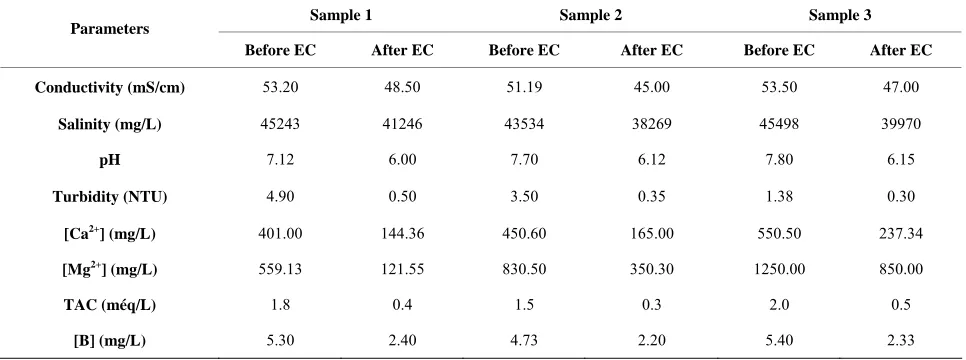
[image:6.595.307.536.235.514.2] [image:6.595.73.272.263.396.2]studied after EC treatment at optimum conditions. The results are summarized in Table 3.
From Table 3, it is necessary to mention that not only EC can remove boron from seawater but all initial pa- rameters decreased. The reason of the hardness decreas- ing is thought to be the calcium carbonate CaCO3
pre-cipitation and the magnesium hydrydroxide Mg(OH)2
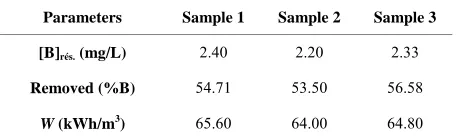
precipitation [25]. Boron removal and energy consump- tion at optimum conditions for seawater samples water containing boron are summarized in Table 4.
Under optimal parameters residual boron concentra- tion achieves about 2.3 mg/Lcorresponding to removal efficiency almost 55% and an energy consumption up to 65 kWh/m3. So it can be concluded that when EC process
is used for boron removal from seawaters, it is possible to reach the limit of recommended by WHO for boron concentration in drinking water (2.4 mg/L). From energy consumption viewpoint, EC is not suitable for seawater desalination. Indeed, based on the cost 1 kWh—0.06 $ [26], water purification cost from boron is 3.9 $/m3. For
comparison, the cost of desalination of seawater by re-verse osmosis with the residual boron concentration in the permeate 0.2 - 0.3 mg /L is only 0.53 $/m3. So EC
[image:7.595.67.283.86.220.2]may be suitable for boron removal from geothermal brackish and wastewaters [11,19,23,24].
Figure 11. Graphical Pareto analysis.
It shows that current density (J) and EC time (tEC) are
the most determining factors on the removal of boron by EC; their effect is 98.19% on the investigated response. Therefore, more than 99% of the response are bringing by these two factors and their interaction. However, ini- tial concentration of boron [B]0 and the other interactions
have a negligible effect, they represent a small degree lower than 1% of the response. As a consequence, the best removal of boron by EC conditions were obtained (J
= 14 mA/cm2) and (t
EC = 60 min), in the experimental
region investigated. These results were also reported by different authors [23,24] where they deduced that the re- moval efficiency of boron by EC increases with increas-
ing of current density and EC time.
6. Conclusions
The results of this study showed that EC process could be applied in the treatment of water containing boron. Based on the results of experiments, the following con- clusion may be obtained:
5. Application
In order to study the applicability of the process, experi- ments were conducted to determine the effectiveness of EC treatment for boron removal from seawater samples. Before starting EC tests, we proceeded to determine the main quality parameters of the three seawater samples. The variation of physico-chemical characteristics was
• Optimization of the experimental conditions of boron removal showed that optimal boron removal was achieved for: die = 1 cm, bipolar connection mode,
(S/V) = 52.8 m2/m3, pH
[image:7.595.57.540.556.736.2]i= 8, σi = 32.5 mS/cm.
Table 3. Physico-chemical characteristics of seawater samples before and after treatment by electrocoagulation (EC) treat- ment.
Sample 1 Sample 2 Sample 3
Parameters
Before EC After EC Before EC After EC Before EC After EC
Conductivity (mS/cm) 53.20 48.50 51.19 45.00 53.50 47.00
Salinity (mg/L) 45243 41246 43534 38269 45498 39970
pH 7.12 6.00 7.70 6.12 7.80 6.15
Turbidity (NTU) 4.90 0.50 3.50 0.35 1.38 0.30
[Ca2+] (mg/L) 401.00 144.36 450.60 165.00 550.50 237.34
[Mg2+] (mg/L) 559.13 121.55 830.50 350.30 1250.00 850.00
TAC (méq/L) 1.8 0.4 1.5 0.3 2.0 0.5
Table 4. Boron removal and energy consumption at opti-mum conditions for seawater samples water containing boron.
Parameters Sample 1 Sample 2 Sample 3
[B]rés. (mg/L) 2.40 2.20 2.33
Removed (%B) 54.71 53.50 56.58
W (kWh/m3) 65.60 64.00 64.80
• The statistical analysis of experimental design meth- odology showed that current density (J) and EC time (tEC) had a considerable effect on boron removal by
EC. Initial boron concentration was estimated as un- important factor. Experimental data showed that op- timum operating conditions were J = 14 mA/cm2 and
tEC = 60 min.
• At optimal conditions, boron removal from synthetic aqueous solutions containing initial boron concentra- tions of 5 and 50 mg/L reached 81% and 79%, re- spectively.
In order to study the applicability of the process, ex- periments were conducted to determine the effectiveness of EC treatment for boron removal from seawater sam- ples. Removal efficiency up to 55% was achieved under optimal parameters. But energy consumption was high. So it can be concluded that when EC process is used for boron removal from seawater, it is possible to reach the limit recommended by WHO for boron concentration in drinking water, 2.4 mg/L with huge consumption of elec- tricity.
REFERENCES
[1] I. Yilmaz Ipek, R. Holdich, N. Kabay, M. Bryjak and M. Yuksel, “Kinetic Behaviour of Boron Selective Resins for Boron Removal Using Seeded Microfiltration System,”
Reactive & Functional Polymers, Vol. 67, No. 12, 2007, pp. 1628-1634.
doi:10.1016/j.reactfunctpolym.2007.07.027
[2] W. Bouguerra, A. Mnif, B. Hamrouni and M. Dhahbi, “Boron Removal by Adsorption onto Activated Alumina and by Reverse Osmosis,” Desalination, Vol. 223, No. 1-3, 2008, pp. 31-37. doi:10.1016/j.desal.2007.01.193 [3] WHO, “Boron in Drinking-Water, Background Document
for Development of WHO Guidelines for Drinking-Water Quality,” 2009, pp. 1-15.
[4] N. Kabay, E. Güler and M. Bryjak, “Boron in Seawater and Methods for Its Separation—A Review,” Desalina- tion, Vol. 261, No. 3, 2010, pp. 212-217.
doi:10.1016/j.desal.2010.05.033
[5] R. Keren and F. T. Bingham, “Boron in Water, Soils, and Plants,” Advances in Soil Science, Vol. 1, 1985, pp. 229- 276. doi:10.1007/978-1-4612-5046-3_7
[6] W. Bouguerra, I. Marzouk and B. Hamrouni, “Equilib- rium and Kinetic Studies of Adsorption of Boron on Acti-
vated Alumina,” Water Environment Research, Vol. 81, No. 12, 2009, pp. 2455-2459.
[7] WHO, “Boron in Drinking-Water, Background Document for Preparation of WHO Guidelines for Drinking-Water Quality. Geneva, World Health ORGANIZATION,” 2003, pp. 1-10.
[8] WHO, “Guidelines for Drinking-Water Quality,” 4th Edition, 2011, pp. 323-324.
[9] G. C. Cushnie, “Electroplating Wastewater Pollution Te- chnology,” Noyes Publications, NJ, 1985.
[10] M. A. Zazouli and M. Taghavi, “Phenol Removal from Aqueous Solutions by Electrocoagulation Technology Using Iron Electrodes: Effect of Some Variables,” Jour- nal of water Resource and Protection, Vol. 4, 2012, pp. 980-983.
[11] A. E. Yilmaz, R. Boncukcuoglu, M. Muhtar Kocakerim and B. Keskinler, “The Investigation of Parameters Af- fecting boron Removal by Electrocoagulation Method,”
Journal of Hazardous Materials, Vol. B125, No. 1-3, 2005, pp. 160-165. doi:10.1007/978-1-4612-5046-3_7 [12] F. J. López, E. Jiménez and F. Hernández, “Analytical
Study on the Determination of Boron in Environmental Water Samples,” Fresenius’ Journal of Analytical Che- mistry, Vol. 346, No. 10-11, 1993, pp. 984-984.
doi:10.1007/BF00322763
[13] M. M. de la Fuente and E. Mùnoz, “Boron Removal from Industrial Wastewaters by Ion Exchange: An Analytical Control Parameter,” Desalination, Vol. 181, No. 1-3, 2005, pp. 207-216. doi:10.1007/BF00322763
[14] J. Rodier, “L’Analyse de l’eau,” 8th Edition, DUNOD, Paris, 1997, pp. 175-181.
[15] N. Daneshvar, “Pretreatment of Brackish Water Using DC-Electrocoagulation-Method and Optimization,” Ira- nian Journal of Chemistry & Chemical Engineering, Vol. 21, No. 1, 2002, pp. 13-20.
[16] S. Vasudevan, J. Lakshmi and G. Sozhan, “Electroche- mically Assisted Coagulation for the Removal of Boron from Water Using Zinc Anode,” Desalination, Vol. 310, 2012, pp. 122-129.
[17] H. Liu, X. Zhao and J. Qu, “Electrocoagulation in Water Treatment,” Electrochemistry for the Environment, Sprin- ger Science + Business Media, LLC., 2010.
[18] G. Chen, “Electrochemical Technologies in Wastewater Treatment,” Separation and Purification Technology, Vol. 38, No. 1, 2004, pp. 11-41.
doi:10.1016/j.seppur.2003.10.006
[19] A. E. Yilmaz, R. Boncukcuo˘glu, M. M. Kocakerim, M. T. Yilmaz and C. Paluluo˘glu, “Boron Removal from Geothermal Waters by Electrocoagulation,” Journal of Hazardous Materials, Vol. 153, No. 1-2, 2008, pp. 146- 151. doi:10.1016/j.jhazmat.2007.08.030
[20] K. Bensadok , S. Benammara, F. Lapicque and G. Nezzal, “Electrocoagulation of Cutting Oil Emulsions Using Alu- minium Plate Electrodes,” Journal of Hazardous Materi- als, Vol. 152, No. 1, 2008, pp. 423-430.
doi:10.1016/j.jhazmat.2007.06.121
[22] D. P. Haaland, “Experimental Design in Biotechnology,” Marcel Dekker Inc., New York, 1989.
[23] A, E. Yilmaz, R. Boncukcuoğlua and M. M. Kocakerim and E. Kocadağistan, “An Empirical Model for Kinetics of Boron Removal from Boron Containing Wastewaters by the Electrocoagulation Method in a Batch Reactor,”
Desalination, Vol. 230, No. 1-3, 2008, pp. 288-297. doi:10.1016/j.desal.2007.11.031
[24] G. Sayinera, F. Kandemirlib and A. Dimogloa, “Evalua-tion of Boron Removal by Electrocoagula“Evalua-tion Using Iron and Aluminum Electrodes,” Desalination, Vol. 230, No. 1-3, 2008, pp. 205-212.
doi:10.1016/j.desal.2007.11.031
[25] A. Saiba, S. Kourdali, B. Ghernaout and D. Ghernaout, “In Desalination, from 1987 to 2009, the Birth of a New Seawater Pretreatment Process: Electrocoagulation—An Overview,” Desalination and Water Treatment,Vol. 16, No. 1-3, 2010, pp. 201-217. doi:10.5004/dwt.2010.1094 [26] Val. S. Frenkel “Seawater Desalination: Trend and Tech-
![Figure 10. Graphical analysis of the effect of: J, tEC and the [B]0 on boron removal by EC](https://thumb-us.123doks.com/thumbv2/123dok_us/7863127.737335/6.595.308.536.233.517/figure-graphical-analysis-effect-tec-boron-removal-ec.webp)