Published Online September 2013 in SciRes (http://www.scirp.org/journal/ojml) http://dx.doi.org/10.4236/ojml.2013.33032
Semantic Features in Argument Selection
Izchak M. Schlesinger
Hebrew University, Jerusalem, IsraelEmail: [email protected]
Received February 27th, 2013; revised April 2nd, 2013; accepted April 9th, 2013
Copyright © 2013 Izchak M. Schlesinger. This is an open access article distributed under the Creative Commons Attribution License, which permits unrestricted use, distribution, and reproduction in any medium, provided the original work is properly cited.
One of the problems that has to be dealt with by theorists of early language acquisition theory is the mis- match between semantic constructs, like Agent, and syntactic ones, like subject. It is proposed that the linguistic system is based on semantic features that are more fine-grained than thematic roles, and that se- lection of subject and direct object can be accounted for by merely four semantic features. These features are conceived of as properties of participants in the lexical entries of verbs, and in this respect, too, they are unlike thematic roles, which are ascribed to NPs in sentences. Thematic roles play a part only in the realization of certain other arguments, notably, the oblique object. It is shown that this different treatment of direct and oblique objects permits a parsimonious explanation of certain linguistic regularities that have posed problems for other theories. Early language acquisition can be explained in terms of the acquisition of these semantic features, and this account thus supersedes the semantic assimilation hypothesis pro- posed previously to deal with the lack of congruence between thematic roles and syntactic categories. Keywords: Semantic Features; Thematic Roles; Linking Rules; Language Acquisition
Introduction
Several theories of argument selection have followed Fill- more’s (1968) seminal paper and dealt with the semantic-syn- tactic interface in terms of what have been variously called the- matic relations, thematic roles, or θ-roles. The construct of the- matic roles and that of a thematic role hierarchy have come un- der criticism from various quarters (e.g., Davis & Koenig, 2000; Dowty, 1989, 1991; Gropen et al., 1991a; Hoekstra, 1992; Le- vin & Rappaport Hovav, 2005; Newmeyer, 2002; Schlesinger, 1995: pp. 28-29; Zubizaretta, 1987, among others). As Andrews (2007: p. 140) observes, “… no presently known system of se- mantic roles can be applied in a comprehensive and convincing manner”1. Instead of thematic roles, Van Valin (2005) therefore posits more global “macro-roles”. Some other theorists propose less global notions, such as semantic features (see, e.g., McRae et al., 1997; Zubizaretta, 1987). In Jackendoff’s (1987: p. 409) system, thematic roles are derived notions “argument positions in conceptual structure” that are constituted of more basic se- mantic concepts which are akin to features. Others view fea- tures as elements into which thematic roles are decomposed (Rozwadowska, 1988), as “entailments” characterizing “proto- agent” and “proto-patient” roles (Dowty, 1991), or as occupy- ing a level preceding that of thematic roles (Schlesinger, 1995).
In the present paper it is argued that realization of the subject and the direct object can be accounted for without resorting to thematic hierarchies or to conceptual structures like those pro-posed by, e.g., Jackendoff (1990b) and Kiparsky (2001). In-stead, rules defined over certain semantic features are formu-
lated, which link NPs to the subject and the direct object. The- matic roles are conceived of as playing a part only in the reali- zation of certain other arguments. This theory affords a more parsimonious explanation of linguistic phenomena and solves certain problems encountered by a theory of early language ac- quisition2.
The first section of this paper introduces the semantic fea- tures figuring in the present system. Then a theory is developed in which features residing in the lexical entries of verbs deter- mine the selection of subject and direct object. Certain linguis- tic regularities are accounted for by assuming that the realiza- tion of oblique objects differs in that it involves thematic roles. The final section shows how the language learning child can ac- quire such a feature-based grammar.
Features of Subjects
The purpose of this section is to introduce the features that function in my system. Examples will be given of features that characterize subjects, but some of these features appear not only in subjects. The linking rules that select subjects and direct objects will be discussed in the section on “Selection of sub-jects and obsub-jects”.
Cause
The subjects of the following sentences pertain each to the cause of the activity referred to by the verbs:
1And Chomsky (1982: p. 89) once remarked in an interview: “I never know how people are able to pick out thematic relations with such security, I can’t”.
1) a. Sybil drank her coffee. b. Ron pushed Jack.
c. My uncle refused the offer. d. Sheila is swimming. e. The girl cried.
f. Bill was snoring on the couch.
Each sentence in 1) describes an activity caused by the entity referred to by the subject, and so the feature Cause is accorded to each of the subjects (or, more precisely, to the elements in the lexical entries of the respective verbs that are linked to the subjects. Cause characterizes internal causation, as in 1d), 1e), and 1f), as well as agents causing a change in another entity3.
Control
The animate subjects in 1) are not only the cause of the ac-tivity referred to, but also have Control over it (see Siewierska 1991: 47-49 on this feature). Our feature Control differs some-what from Dowty’s (1991) entailment “volitional”, as is shown by the following examples:
2) a. Celia refrained from interfering. b. Ronald is sleeping in his armchair.
c. Our community tolerates eccentric behavior. d. My aunt underwent surgery.
Celia is in control in so far as she can desist from refraining (that is, she can start to interfere), and one probably can, at least in some cases, voluntarily stop sleeping, and decide to behave intolerantly. And the lady referred to in 2d) by myaunt may refuse to be operated on or escape from the hospital.
Cause and Control are closely related features; they differ mainly in the phases of the activity which they focus on. Stated roughly, Cause initiates the activity and Control steers it or even terminates it. In fact, Cause and Control usually go to- gether. Most of the subjects in 2) have also the feature Cause. Refraining is “caused” by Celia, just as crying in 1e) is caused by the girl. An exception is 2d): the lady does not cause any- thing (surgery is performed by surgeons), but she may be said to be in control. There are also subjects that have only Cause
and no Control, as for instance the subject of snore; see 1f).
Change of State or Location
When a NP refers to an animate or inanimate entity under- going a change of state, we will say that it has the feature
Change.
3) a. The ice will melt. b. Their son has grown up. c. The hamster died in his cage. d. The rainbow slowly vanished. e. The waiter slipped on the wet floor.
The ice, their son, and the hamster are said to undergo a change of state, the rainbow and the waiter, a change of loca- tion4.
Some of the verbs in 1) also involve movement in addition to
Cause. Further on, I discuss the question of whether they have the feature Change.
Attributee of State
Some verbs, like those in 4), refer to states or to properties that are attributed to the subject5.
4) a. This box contains small coins. b. This car needs an overhaul. c. Smith is a pauper.
d. You really deserve a special treat!
e. The organization lacks funds for rebuilding. f. Ken likes ice cream.
g. She fears him.
h. He has a mole on his right shoulder.
I propose to introduce a feature that has not been discussed in the literature, to my knowledge: attributee of a state or property, or Attr-St, for short. There is no cause-and-effect relationship between the subjects and predicates of these sentences. One does not conceive of the box as being the cause of containing any-thing or of the car as causing its needing anyany-thing; instead, con-taining and needing are states or properties attributed to them6.
Examples 4f) and 4g) are of so-called mental verbs (or “psych-verbs”) in which the experiencers are sentence subjects. The subjects of these and other such verbs admire, respect, pity,
hate, loathe, and dread, among others have the feature Attr-St. Some mental verbs can appear in the imperative form, as in 5). Presumably this is because one may have some degree of con- trol over one’s emotions, which suggests that these verbs have also the feature Control7.
5) a. Don’t pity me! b. Don’t hate your enemy!
Conversely, the subjects in 2a), 2b), and 2c) should be as- signed the feature Attr-St in addition to Control, because the verbs attribute properties to their subjects.
The subjects of verbs denoting posture, like those in 6), may be viewed as having several features.
6) Herb is sitting/lying on the couch.
Usually, sitting and lying result from one’s deliberately as- suming a posture, and one can also desist from assuming it (or determine one’s manner of doing so). Subjects of the verbs sit
and lie thus have the features Cause and Control, in addition to
Attr-St, and so have some other stative verbs, like stand, and lean8. There are also some unclear cases. For instance, does the subject of find have the feature Cause (i.e., is finding an activity, like seeking) or Attr-St? One should not assume the existence of a sharp boundary line between these two features.
On the Nature of Features
Three classes of verbs have been described here: activity verbs, the subjects of which have Cause and/or Control, proc- ess verbs, and state verbs, the subjects of which have Change
and Attr-St, respectively. Not included in our list of features are
3These distinctions between kinds of causes, as well as those proposed in Schlesinger (1995), are not needed for the purpose of accounting for subject and object selection. The subjects in 1) seem to be close to what Van Valin and Wilkins (1996) call “effectors” and Levin and Rappaport Hovav (1995: p. 135) call “immediate causes”.
4The set of verbs having subjects with the feature Change overlaps more or less with that of unaccusative verbs.
5Phrasal predicates, like that in 4h) will not be further discussed in the pre-sent paper.
6The direct objects in these sentences (or in any sentence, for that matter) do not have this feature. Nothing is expressly attributed to smallcoinsin (4a); one can only infer that they are in the box.
7In a rating study (Schlesinger, 1992), it has been shown that adult speakers judge subjects of these verbs to have a greater degree of control than their direct objects.
some of those found in the literature, like animacy and sen- tience9. These and some other features can possibly account for some linguistic phenomena that are not explainable in terms of the above four features, but they are not needed for stating the linking rules that select subjects and direct objects. In the fol- lowing, this will be shown to be true for English. Not only lan- guages that do not have subjects (like Tagalog, which has a pre- dicate-topic structure; Schachter & Otanes, 1972), but also other languages with a subject-predicate structure may require additional features (see, e.g., Hopper & Thompson, 1980).
The theory proposed in the following sections is more parsi- monious than theories based on thematic hierarchies, and ac- cordingly the difficulty of learning the basic linking rules of the native language is diminished, as shown in the last section. It might be argued that the foregoing four features are thematic roles in disguise. Note the considerable overlap of features Cause
and Control with Agent, of Change with Theme or Patient, and of Attr-St with Experiencer. However, unlike thematic roles, features are relatively unequivocal and easily identified. To de- cide whether something undergoes a change is simpler than de- ciding whether it is a Theme. This is partly due to there being a larger number of thematic roles than of the features proposed here; the latter are more basic concepts, each of which may be common to a number of roles. Further, while definitions of the- matic roles are typically vague, and as a result cannot be ap- plied easily “outside classes of the verbs which have been used to motivate the θ-roles or are extended in unprincipled ways to new cases” (Rappaport & Levin, 1988: p. 8), this will be seen not to be true of features.
Another basic difference between thematic roles and our fea- tures is that while the former are usually conceived of as apper- taining to NPs, features are characteristics of participants in the lexical entries of verbs, as will be seen in the next section.
The Linking Problem
In the next section it will be shown how linking rules for subject and direct object can be formulated in terms of the four features discussed in the foregoing: Cause, Control, Change, and Attr-St. In the present section, I show that—unlike the rules in current theories, which are defined in terms of characteristics of the NPs—the rules that select the subject and direct object can be defined on features of lexical entries of verbs. But first, some of the concepts figuring in the present theory will be ex- plained.
Lexical Entries
Participants and Features Consider two simple sentences: 7) a. Doris broke the window pane.
b. Dan spilled the wine.
The subjects and direct objects of these sentences are deter- mined by the lexical entries of the verbs break and spill, re- spectively. Every lexical entry of a verb contains a “scene”. The scene for break, for instance, is a mental representation of breaking, and it includes mental representations for each of the
participants in the breaking activity, namely, the one who breaks and the object that is broken10.
It is important to bear in mind that in the present system the term “participant” does not refer to arguments, like subject and object (as Hopper and Thompson 1980, for instance, use this term). Neither does it refer to NPs or to their referents: instead, NPs are mapped into participants, as will be shown below.
There are many kinds of breaking: one can break chairs, pencils, windows, threads, etc. Therefore the mental representa- tion of the action of breaking must be schematic (just as dictio- nary definitions ought to be sufficiently abstract to accommo- date most instances of the defined term). The participants in- cluded in the mental representation will also be schematic: there are not only several ways of breaking but also kinds of breakers and of things that can be broken.
Each participant has certain syntactically relevant features. The following examples illustrate formulas for lexical entries (the left-to-right sequence of the participants being a matter of convenience and having no theoretical significance whatsoever):
break: “breaker” (Cause, Control), the thing broken (Change)
spill: “spiller” (Cause, Control), the material spilled (Change) No further decomposition of predicate verbs is needed for subject and object selection. The linking rules selecting subjects and direct objects are defined for features of the participants in the lexical entry and will be called feature linking rules. One such rule determines that the feature Cause is linked to the subject and another one that the feature Change may be linked to the direct object; see the next section for a discussion of fea- ture linking rules.
The participant in a lexical entry which, after the appropriate feature linking rules have applied, corresponds to the subject (in active sentences) e.g., the “breaker” and the “spiller” will be called here subject participant. Similarly, the participant that ends up as direct object (the thing broken, the material spilled) will be called the object participant. These terms are merely convenient labels; the participants themselves have neither sub- ject nor object character prior to the application of feature link- ing rules.
An assumption made by the present theory is that a lexical entry of a verb can include at most two participants: the subject participant and the object participant. Oblique objects are not realizations of participants but rather are arrived at by a differ- ent kind of linking rules; the rationale for this will be discussed in the section on Roles of NPs (below). Transitive sentences contain two participants, each of which may be realized by one NP, as in 7), or by more than one, as in 8):
8) Jim and John broke the vase, the saucers, and the salt shaker.
The lexical entries of intransitive verbs contain only one par- ticipant, which will be realized as subject, e.g.,
cry: the one who cries (Cause, Control)
melt: the material that melts (Change)
Verbs that have a subject participant with the feature Change, like cry and melt, are usually intransitive, but there are some exceptions, e.g.,
9) The pensioner sustained an injury.
sustain: affected entity (Change), source of affecting (ø) Here the object participant does not have any one of the fea- tures introduced so far—Cause, Control, Change, and Attr-St. The symbol ø—the “default feature”—stands for the absence of 9McRae et al. (1997) propose “features” which, unlike our features, are close
to what Dowty (1989: pp. 76-77) calls “individual thematic roles”, i.e. verb-specific (though each may characterize a large proportion of verbs in the language).
any one of these features11.
Lexical entries of verbs that have expletive subjects (like
rain) have no featured participants.
Assigning Features
A comment is in order regarding the feature Change. This feature is broadly conceived in the present system. Both af- fected and effected objects have Change:
10) a. David damaged this machine. b. David constructed this machine.
Change may stand for change of state, as in the object par- ticipant in 10a), or for change of location, i.e. motion, as in the object participant of spill. There are also mental changes (as in the direct objects of frighten, and surprise), changes of status (as in the direct objects of elect, nominate, appoint, promote,
convict, indict). Further, as illustrated in 10b), Change may apply to entities which come into being as a result of the activ- ity referred to by the verb, and these may also be abstract enti- ties (cf. passaresolution, deviseastrategy, deliveralecture). Changes can be scalar (as in mature or learn) or non-scalar (as in break or laugh). All these distinctions do not appear to be linguistically relevant as far as subject and object selection go, and will be ignored in this paper.
In the case of many verbs it is not immediately clear whether their lexical entries contain a given feature. For example, the subject participants of many verbs involve a limited degree of movement in addition to Cause and/or Control. To break some- thing, one moves one’s arms (or legs) and spilling is normally accompanied by some motion. The feature Change character- izes the subject participants of only those verbs that refer to activities in which movement or a change of state are essen- tially involved, such as swim, run, walk, enter, jump, and not of verbs like break, spill, or drink, where the movement or change of state are incidental. Movement is not part of the meaning of the actor of break, spill, and drink, whereas in the case of swim,
run, and walk, change of location is part of the meaning. The statement Heranwithoutmoving is an oxymoron (the first part of the sentence contradicts the second one), but Hedrankwine without making the slightest movement describes, at most, a physical impossibility. I propose this here as a rule of thumb, but naturally there will be many unclear cases.
Similarly, Change is assigned to an object participant only when there is an “essential” change in it. For instance, the ob- ject participant of break has, but that of hit does not have the feature Change. This is because 11a) is self-contradictory due to the meaning of break, which involves a change in the object broken, whereas 11b) asserts what is perhaps a physical impos- sibility, but the sentence is not self-contradictory.
11) a. *Doris broke the window pane, but it remained intact. b. Doris hit the TV screen, but it remained intact. There will of course be borderline cases, namely verbs where it is hard to decide whether the change (in either the subject or the object participant) is essential or not, but as should become clear further on, this will not affect the application of linking rules12.
Some verbs may refer to events that either do or do not in-
volve a certain feature. For instance, a person who is lying on some surface is obviously in a state, and so the subject partici- pant of lie has Attr-St; cf. example 6). But against the claim made there that lie also has the features Cause and Control, one might want to argue that an unconscious person, for instance, may be put on a stretcher or on a bed (and so does not cause anything) and left to lie there (without having any control over the situation). A related problem, which will be dealt with fur- ther on, may arise with verbs that may take either animate or inanimate subjects. However such objections overlook the fact that features are assigned to lexical entries and not to verbs in particular contexts13. The lexical entry of a verb is determined by its standard use, and the verb lie, as used standardly, has subjects referring to the person or animal that is the (internal) cause of assuming this posture and is in control of it.
There will be verbs which may raise doubts as to their stan- dard use. Fortunately, this will normally not be problematic for subject selection, as will be seen from the formulation of the subject linking rule further on.
Features Are Independent of Context
Features of participants reflect the meaning of the verb, and this means that they are independent of the sentence in which the verb appears. This is an important point that is easy to over- look, as the following examples show.
12) a. The police suspected the pickpocket. b. The police accused the pickpocket.
Suspect is a mental verb, and its subject participant has the feature Attr-St; cf. 4f) and 4g). Accuse has a subject participant with Cause and Control. In both 12a) and 12b), thepolice is therefore the subject. But what about thepickpocket? Plying his trade led to his being suspected or accused, and so one might maintain that the pickpocket caused the event referred to by the verb (and if so, the pickpocket competes with the police for subject position). A similar question might arise also with many other verbs, like blame, praise, arrest, punish, and reward.
But this argument is based on a faulty assumption. Lexical entries are not determined by the context in which the verb appears. It is not NPs or their referents that have the feature
Cause, but participants in the lexical entry. Sentences like 13) show that the meaning of suspect or accuse does not imply that the person suspected or accused is necessarily the cause of what the verb refers to.
13) a. The police suspected an innocent bystander. b. The police accused an innocent bystander.
Each of the lexical entries of suspect and accuse therefore includes one participant eligible for subject position and an-other participant with the “default feature”, and so have the lexical entries of blame, praise, arrest, punish, and reward.
suspect: “suspecter” (Attr-St), “suspectee” (ø)
accuse: “accuser” (Cause, Control), “accusee” (ø)
It is important therefore to keep in mind that features are context-free. In this respect, thematic roles are usually concei- ved of differently; they are “components of the mental repre- sentation of objects and concepts” (Wilkins, 1988: p. 191), and not components of the meaning of verbs, like features. As a result, truth-conditionally equivalent sentences have identical 11Cf. Fillmore’s (1968) “Objective”, which is a catch-all case. Some writers
use “Theme” in a similar manner.
12In a lexical entry formula, I will sometimes leave out Change, even where a good case can be made for including it. In most instances, adding Change to features of the subject participant will not make any difference to linking, as will become clear in the section on subject selection.
role assignments. On this view, assignment of a thematic role may depend on the sentential context. Thus, when the sentence states that an activity was performed accidentally, the actor may be assigned a thematic role that differs from that of a sentence which states that the activity was performed for some purpose. The assumption that thematic roles are sensitive to the part played by a NP in the situation described may give rise to problems. For instance, Grimshaw (1990: pp. 19-21) discusses two sentences describing the same situation:
14) a. The storm frightened us. b. We feared the storm.
Assuming Baker’s (1988: p. 37) theta criterion, Grimshaw argues as follows. Thestorm is Theme in both sentences, since the sentences are near-paraphrases of each other. Likewise, we
(us) is Experiencer in both. Since Experiencer precedes Theme in the thematic hierarchy, an explanation is required for the fact that in 14a) thestorm, the Theme of frighten, is subject. Grim- shaw thus focuses on the situations described by the NPs in these sentences, rather than on the verbs. Her reasoning is based on the assumption that if a NP has the thematic role R in a gi- ven sentence S, it must have the same role in every sentence that paraphrases S, or as Dowty (1991: 563) writes: “… any truth- conditionally equivalent sentence has the same role assignments”.
In a section the heading of which is called, appropriately, “The inadequacy of thematic reanalysis”, Grimshaw accounts for the fact that subject selection in 14a) does not conform to the hierarchy of thematic roles, by stating that thestorm has causal status, which is why it can be subject14. According to her analysis, then, thematic roles cannot do the job by themselves; the feature Cause comes in through the back door. Further on, it will be shown how 14) is dealt with in the framework of the present theory.
NP Matching
In the present system, then, features are attributes of partici- pants in lexical entries, not of NPs. NPs may match participants in the lexical entry of a verb. For the purpose of a schematic illustration that does not pretend to mirror actual performance of language users, let us assume that a speaker intends to state that Doris has broken a window pane. Expressing this idea involves choosing a verb that describes the activity, and break
fills this bill15. The lexical entry of this verb is break: “breaker” (Cause, Control), thing broken (Change).
This lexical entry prescribes that two NPs pertinent to the event be selected, one for each participant, the “breaker” and the “thing broken”. Doris can be matched with the “breaker” and the window pane, with the “thing broken”. The Feature linking rules to be formulated further on, link Doris to the sub- ject and the window pane to the direct object. The resulting sentence is
15) Doris broke the window pane.
Matching May Ignore Features
Usually a NP matches a participant not only in respect to its general sense, but also in respect to the participant’s features. In 15), Doris corresponds closely to the “breaker” participant of
break, because Doris is the cause of the breaking and presuma- bly has some control over it. The window pane undergoes a change as a result of the breaking activity and so thewindow pane matches with the “thing broken” participant, which has
Change. But such a close correspondence is not a necessary condition for NP matching. Take, for instance,
16) a. The captain passed the straits. b. The passengers passed the straits.
Presumably the subject participant in the lexical entry of pass
has the feature Control:
pass: “passer” (Cause, Control), location passed (ø)
But although only the captain, and not the passengers, has control over the event, the mental representations of the pas- sengers and the “passer” participant in the verb’s lexical entry of pass are sufficiently similar to permit matching in 16b) de- spite the absence of Control.
In general, although inanimates lack control over an activity, NPs referring to them can match with a participant having the feature Control. Breaking, for instance, is normally predicated of persons, and the lexical entry of break has therefore a subject participant with the feature Control. Although it cannot be said to have any control, thefalling branch can be the subject of
break in 17), because of its similarity to the subject participant in its lexical entry.
17) The falling branch broke the window pane.
Similarly, the verb extinguish has a participant with Control, but can have not only an animate subject, as in 18a), but also an inanimate one, as in 18b).
18) a. The boy extinguished the camp fire. b. The rain extinguished the camp fire.
Another feature that may be ignored in NP matching is
Change. Consider
19) a. He broke his promise. b. They dropped the plan.
In 19a), break is used in an extended sense to refer to the breaking of something immaterial: a promise is conceived of as something that is broken. Although the object participant of
break, the “thing broken” has the feature Change, hispromise
can match with it, although no change occurs in the promise. Likewise, the object participant of drop has the feature Change
(a dropped object changes its location), but although a plan cannot be said to change its location by being dropped, theplan
in 19b) matches with the object participant of drop. In general, metaphorical extensions of verb meaning, as in 18)-19), are due to such “partial” matchings that ignore a specific feature. This is in line with the principle that features are not properties of NPs but of participants in the lexical entry of a verb.
Similarity in Matching
Not just any conceivable similarity suffices for NP matching (after all, practically everything is similar to everything else in some respect or other). Take for example the verbs stir and eat:
stir: “stirrer” (Cause, Control), stirred material (Change)
eat: “eater” (Cause, Control), eaten material (Change) An instrument can be subject of stir, although only the per- son who wields it has control over the activity. Thus, in certain contexts, 20) may be acceptable.
14A different solution to this problem has been proposed by Belletti and Rizzi (1988).
20) The spoon stirred the soup.
Because a spoon can be viewed as “doing” the stirring, the spoon in 20) matches with the “stirrer”. But subjectivization of the instrument is not possible for some other verbs, like eat, because the similarity between the instrument and the subject participant is not large enough:
21) *The spoon ate the soup.
More is involved in eating than just bringing food to the mouth, which is all a spoon can do. Thespoon therefore does not match the subject participant of eat. The same factor also accounts for the oddness of the asterisked sentences in
22) a. He walked into the hall with a crutch. a’. *The crutch walked into the hall. b. They listened to the music with earphones. b’. *The earphones listened to the music. c. She jumped over the fence with a pole. c’. *The pole jumped over the fence.
Further, the similarity between a given NP and a participant must be not only large enough, but also greater than the simi- larity of any other NP in the sentence to that participant. This rules out
23) *The spoon stirred the soup by Fred.
The subject participant of stir has both Cause and Control. Fred is not only the cause of stirring, but is also in control, while the spoon can be viewed as causing the stirring but not as con- trolling it. Thus Fred fits the subject participant better than the spoon. Omitting byFred results in the grammatical sentence 20). As stated, Feature linking rules are defined in terms of fea- tures of participants in the lexical entry. However, such a rule does not operate directly on a participant with the required fea- tures, but on the NP that matches with this participant. For ex- ample, a Feature linking rule specifies that a NP that matches the participant with Cause is linked to sentence subject (i.e., is positioned before the verb, etc.). When Doris breaks the win- dow pane, Doris matches the participant “breaker”, and since the latter has the feature Cause, Doris has to be subject, as in 15).
The next section deals with linking in greater detail.
Selection of Subject and Direct Object
Subject Selection
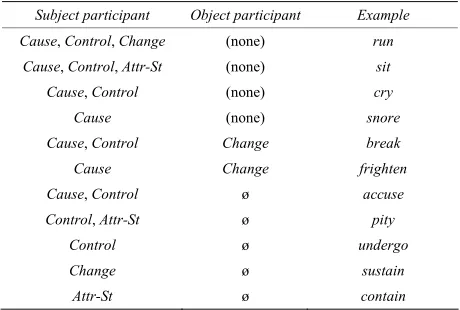
In English and in many other languages, the lexical entries of almost all verbs include a participant that is linked to the sen- tence subject. We now take a closer look at the feature compo- sition of the sentence subject and the direct object. Table 1 shows the combinations of subject and object features that we have encountered so far.
This table shows that a participant with the “default feature” ø never becomes subject. A necessary condition for a partici- pant of a given verb to be linked to the sentence subject in an active sentence is that it has at least one of the features Cause,
Control, Change or Attr-St. But is this also a sufficient condi- tion? I now show that it is not.
Feature Conflict?
There are verbs with lexical entries having one of the above four features in both their participants, and there might appear to be a “conflict” between the features: Which participant is linked to the subject? There are four classes of such verbs:
[image:6.595.308.538.109.264.2]a) Objectparticipantswith Change: The object participants of many verbs have Change, which is a feature that permits
Table 1.
Features of subjects and of direct objects.
Subjectparticipant Objectparticipant Example Cause, Control, Change (none) run
Cause, Control, Attr-St (none) sit
Cause, Control (none) cry
Cause (none) snore
Cause, Control Change break
Cause Change frighten
Cause, Control ø accuse
Control, Attr-St ø pity
Control ø undergo
Change ø sustain
Attr-St ø contain
linking to the subject. The object participants of spill, pull,
throw, and send involve changes of location; in those of break,
mix, eat, and repair a change of state occurs; and the activity denoted by a verb like build, paint, sculpt, or write results in something coming into being, i.e., changing from non-existence to existence. These verbs might seem to involve a conflict be- tween features that license linking to the subject: Change, on the one hand, and Cause and Control (the features characteriz- ing the “spiller”, “breaker”, “builder”, etc.), on the other.
b) Bothsubject and object participants withCause: In the lexical entries of a few verbs, both the subject and the object participants have the feature Cause. For instance,
24) The guide is leading the tourists.
Leading implies that both the leader and his followers move, that their movements are (internally) caused by them and are under their control; that is, the followers, like the leader, have the features Cause, Control, and Change. This appears to con- stitute a feature conflict, since only one of the participants can be linked to the subject16. Another verb that has an object par- ticipant with Cause and Control is incite.
c) Intransitiveverbsusedcausatively: For instance, 25) a. The lady is walking her dog.
b. The sergeant marched his men across the square. When one walks a dog, the latter is walking, too. Likewise, not only the sergeant, but also the men march. The movements of the dog and of the men are internally caused, and in each 25a) and 25b) there are therefore two participants with Cause, only one of which can be realized as subject. Davis (2001) criticizes Dowty’s (1991) theory for not accounting for sentence with such causative verbs.
d) Location subjects: Some verbs may have a location as subject, e.g.,
26) a. This room sleeps two students. a’. Two students can sleep in this room. b. This hall seats 150 listeners. b’. 150 listeners can sit in this hall.
26a) and 26b) describe properties of the room and the hall,
and so their subjects have the feature Attr-St. As a result of these properties, the students and the listeners, respectively, are able to sleep or sit, as stated in 26a) and 26b). Arguably, there- fore, the object participants of the transitive sleep and seat (re- alized here by twostudents and 150 listeners) have the features
Cause and Control17. Here, again, there seems to be a conflict between features, and a Feature linking rule has to determine which NP becomes the sentence subject.
Resulting Features
Note that in the above four cases of apparent feature conflict, the features of the direct objects result from the event described by the verb. The object participants of spill, pull, break, mix, and so on, have the feature Change, because of the change that occurs as a result of the activity referred to by the verb. Simi- larly, in 24), the event referred to by lead results in the tourists’ following the guide, and so the features Cause, Control, and
Change of the object participant (matched with by thetourists) are resulting features. The features Cause, Control, and Change
of the object participants of the causative walk and March in 25) are also resulting features. In 26), the students’ potential sleep- ing in the room and the listeners’ potential sitting in the hall result from the characteristics of the room and the hall. Partici- pants with such Resulting features are not eligible for becoming the subject of an active sentence.
The term “resulting feature” can be defined as follows: 27) A resulting feature is a feature of a participant in the le- xical entry of the predicate verb V, if and only if that feature is ac- corded to that participant as a result of the event referred to by V.
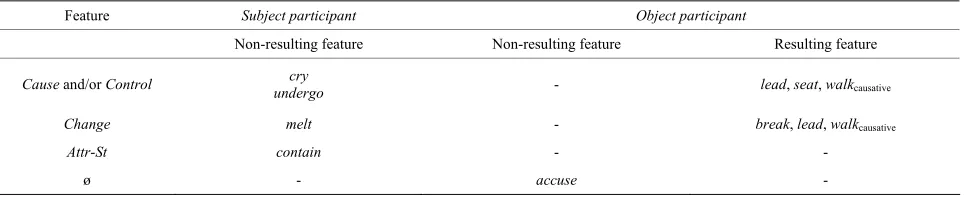
The occurrence of resulting and non-resulting features is summarized in Table 2. A feature can be a resulting feature in the lexical entry of one verb and a non-resulting one in that of another. Cause, Control, and Change can be either resulting features, as in some causative verbs (and then the participants to which they pertain become direct objects) or non-resulting ones (and then they become subjects). The features ø and
Attr-St are always non-resulting; the former is linked to the direct object and the latter to the subject.
A linking rule for the subject can now be formulated in terms of four features and the distinction between resulting and non- resulting features:
28) A participant with at least one non-resulting feature
Cause, Control, Change or Attr-St is linked to the subject of an active sentence.
This rule applies to subjects of both transitive and intransi- tive verbs. It bars participants with the feature ø and those with resulting features from being linked to the subject. Passive sen- tences will be discussed below.
“Symmetrical” Verbs
Some verbs might seem to present difficulties for this for- mulation of the subject linking rule. Let us look at the verbs
equal and resemble.
29) a. One yard equals .914 meters. b. John resembles his father.
The subject participant of equal has the feature Attr-St; in the first sentence, something is attributed to one yard. One might want to argue that the object participant, .914 meters, also has
Attr-St, and that there is thus a feature conflict. But note how awkward .914 metersequalsone yard sounds. To provide in- formation about meters it would be more natural to say One meterequals… The sentence does not say anything about .914 meters, although one can of course infer from it something about this measure of length. The object participant of equal
has therefore the “default feature” ø and not Attr-St. The same reasoning applies to resemble. 29b) attributes a state to John, not to hisfather (John’s father resemblesJohn would sound strange). On the psychological asymmetry of similarity state- ments see Tversky (1977: p. 38).
The moral is that one must distinguish between what is said in a sentence and what is implied by it. Feature assignment is independent of whatever can be inferred from the event or si- tuation described by the sentence.
There are also quasi-symmetrical activity verbs, as in 30) a. Erwin married my sister.
b. My sister married Erwin.
Both these sentences have the same truth value, but in many situations they are not interchangeable. When Erwin’s parents are furious that he married my sister, one does not say that they are furious that my sister married him. The two sentences 30b) and 30a) do not say the same; one can at most infer one from the other. Only the subject participant of marry, and not its object participant, has the feature Cause18.
[image:7.595.58.544.570.673.2]The same holds true of the lexical entries of meet (in one of
Table 2.
Examples of resulting and non-resulting Cause, Control, Change, and Attr-State*.
Feature Subjectparticipant Objectparticipant
Non-resulting feature Non-resulting feature Resulting feature
Cause and/or Control undergocry - lead, seat, walkcausative
Change melt - break, lead, walkcausative
Attr-St contain - -
ø - accuse -
17The causative form illustrated in 26) is found in only a handful of verbs. Neither theelevatorstandsfouradults nor thetentliessixboyscouts is grammatical. Children learning English as their native language sometimes over-generalize the causative construction to such verbs (Bowerman & Croft, 2008).
its uses) and fight. The subjects and objects in sentences with these verbs cannot always be interchanged with impunity: If a young boy met a pop star, it would be odd to say that the pop star met him, and if the government fights poverty, it is not the case that poverty fights the government.
Direct Object Selection
Semantics of the Object CategoryWe saw in Table 2 that a participant with the “default fea- ture” ø is always linked to the direct object. It would be desir- able to find a way to define this feature positively in terms of a property or properties common to all object participants having ø; but such a characterization in semantic terms seems to be unattainable. Already Jespersen (1933, Section 11.3) observed how difficult it is to define the relation of the object to the verb. That an entity is referred to by a direct object does not imply that it is in motion or undergoes a change of state. In measure thewidthofthetable, the width is neither effected nor affected, nor is it the Goal of the action in any sense. The object partici- pant of measure shares the “default” feature ø with the object participants of many other verbs, for instance, with those un- derlying lackmoney, answerthedoor, relatetheincident, avoid therush, imitateanovelist, and with the direct object partici- pants of deny, describe, forgive, revenge, regret, study, admit,
prove, see, like, and many more. There seems to be no common semantic denominator of all these object participants (see Levin 1993; Levin & Rappaport Hovav, 2005: pp. 27-28; Schlesinger, 1995: pp. 164-166). Hence the “default feature” can be defined only negatively, as the feature that is neither Cause, Control,
Attr-St, nor Change.
How, then, is the direct object selected? I propose that fea- tures of participants determine selection of the subject accord- ing to rule 28), and the remaining participant, if there is one, is linked to the direct object19. In other words, the direct object is a default category (cf. Levin & Rappaport Hovav, 1995: p. 154). This view of object selection is based on the already mentioned assumption that a lexical entry of a verb has at most two par- ticipants (but see note 26 for possible exceptions). This as- sumption is motivated also by other, independent, considera- tions, as will be shown in the section on Roles of NPs, below. But first let us clarify some questions concerning object selec- tion.
Converse Verbs
Above I discussed Grimshaw’s (1990) analysis of the pair of verbs frighten and fear. Let us see now how these verbs are analyzed in the present framework. Grimshaw’s example 14) is repeated here:
14) a. The storm frightened us. b. We feared the storm. The relevant lexical entries are:
frighten: the entity that frightens (Cause), the one who is frightened (Change)
fear: the one who fears (Attr-St), the feared entity (ø) In 14a), “the entity that frightens” has the feature Cause, and so is selected as subject, and the remaining participant, “the one who is frightened”, is linked to the direct object. In 14b), “the one who fears” is said to be in a state and so has Attr-St, which qualifies we for subject position, and so “the feared entity”, the storm, becomes direct object.
Two kinds of objections to this analysis might be made: a) A state is attributed to “the one who is frightened” (in the lexical entry of frighten). Hence this participant should have the feature Attr-St, just like the participant “the one who fears” in the lexical entry of fear. Accordingly, Attr-St would here be a resulting feature of “the one who is frightened”.
However, an activity or event cannot result in a state, but only in a change of state. “The one who is frightened”, is said to have changed from not fearing (i.e., may have evinced no fear before the frightening event) to fearing, and so has the re- sulting feature Change. Attr-St is never a resulting feature (see Table 2).
b) “The feared entity” in the lexical entry of fear, the storm in 14b), is what causes the fear and so should be assigned the feature Cause, rather than ø (just like “the entity that frightens” in the lexical entry for frighten). “The feared entity” would thus compete with “the one who fears” for subject position.
But the storm referred to in Wefeared thestorm is not the cause of the fear; rather, it is its content, just as it can be the content of mental states like expecting, imagining, enjoying, and hating, and not their cause:
31) a. We expected the storm. b. We imagined the storm. c. We enjoyed the storm. d. We hated the storm.
The storm cannot be the cause of expecting, since causes do not operate backward in time, and a storm does not cause any- one to imagine it. Verbs describing cognitive states other than ones referring to emotions also have object participants per- taining to content rather than to causes:
32) a. He remembers his uncle. b. He forgot his wallet.
The uncle may have long since died, and the wallet can hardly be held responsible for being forgotten.
The pair of verbs please and like will be analyzed like fri- ghten and fear, and so will persuade and believe (Peterpersu- adedBill and BillbelievedPeter)20. Some other converse verbs are dealt with in the section on Roles of NPs, below.
Object Elision
There are sentences in which the object participant of the lexical entry of a verb is not realized. Some transitive verbs, among them eat, drink, help, leave, permit elision of the direct object. Both Percy iseatinganapple and Percy iseating are grammatical.
“Symmetrical” verbs, like marry, fight, etc., also permit eli- sion of the direct object. If their subject is a conjoint, the verb may be understood in one of two ways: either as reciprocal, as in 33a), where eachother is elided, or not, as in 33b), where 19Oblique objects will be discussed in the section on Roles of NPs, below.
Cognate objects are not realizations of any participant in the lexical entry. The verbs laugh, live, and die do not have an object participant (they are normally used intransitively), but each of them may have a direct object that repeats the information in the verb: laughananguishedlaugh, liveagood life, dieaviolentdeath; consider also sculptan impressivesculpture. It appears that such cognate objects result from a realization rule that intro-duces a modifier of the verb, and they occur mainly when no adverb can do the job: Living a good life is not the same as living well, sculpt an impres-sive sculpture is not the same as sculpting impresimpres-sively, and ananguished laugh cannot be replaced by *laughanguishedly.
direct object NPs are elided. 33) a. John and Jill married.
b. John and his sister married.
In such “symmetrical” verbs, each NP in a conjoint must match in the same way with the subject participant of its predi- cate verb. The reason why Thedrunkandthelamppostembra- ced, is ungrammatical, is that the subject participant of embrace
has the features Cause and Control, thedrunk matches with this participant in respect to both these features, whereas thelamp- post would match it merely “partially”.
Object elision in several other verbs, e.g., dress, shave, bathe,
wash, hide, and feed, leads to the verb’s being construed as reflexive, as in 34b):
34) a. Paula dresses her doll. b. Paula dresses.
A Note on Dowty’s Theory
On the present theory, four features and the distinction be- tween resulting and non-resulting features are sufficient for sub- ject and direct object selection. The definitions of the four fea- tures differ in some respects from those of Dowty’s (1991) features of the Proto-Agent, and some of Dowty’s features (e.g., “sentience”) are not among the features included here.
Kako (2006) has found that the grammatical function of a NP in a sentence could serve as a clue as to Dowty’s features, thus providing evidence for the psychological validity of the latter. However, that speakers are aware of these syntactic-semantic correspondences does not mean that subject selection is based on them. The rule in 28) is simpler than Dowty’s rules, since it states that any one of the specified features is a sufficient con- dition for linking to the subject, whereas in Dowty’s system the number of features characterizing his Proto-Agent and Proto- Patient has to be taken into account (and this has also implica- tions for first-language acquisition; see the last section).
Roles of NPs
As stated, a lexical entry has either one or two participants, and these are realized as subject and (in entries with two par- ticipants) direct object. Other NPs in a sentence, notably oblique objects, do not match participants. In the following we will see what motivates this claim.
The Insufficiency of Features
Suppose for a moment that not only two, but all arguments of a verb are realizations of participants. Then there would be se- veral serious difficulties for subject and object selection, as will be shown now.
Causal Phrases
A prepositional object may refer to the cause of the event or situation described by the verb. Here are some examples:
35) a. The king died by the sword. b. The old man died through neglect. c. The explorer died from exhaustion. d. The child thrives with love.
Suppose that the sword in 35a) were to be matched with a participant of die; then it would have a non-resulting feature
Cause (the sentence mentions no other entity that causes the sword’s activity). Accordingly, thesword would have to be the subject, because the king matches with a participant with a
resulting feature (Change). The same goes, mutatis mutandis, for 35b), 35c), and 35d).
Sentences like these are also an obvious embarrassment for a thematic-roles theory. The NPs in the prepositional objects of 35) refer to causes, and these should be higher in the hierarchy than the thematic roles of what are here realized as subjects. Compare 35a), 35b), and 35c) to their near-paraphrases, The swordkilledtheking, Neglectkilledtheoldman, and Exhaus- tionkilledtheexplorer. Why, then, should thesword, neglect,
exhaustion, and love in 35) not be subjects?
Dowty’s (1991) theory apparently cannot provide an expla- nation either. True, the subjects of 35) are all animate and sen- tient, and might be good candidates for proto-agency. But the subjects in 36) are inanimate, hence not sentient; they do not cause a change, nor do they necessarily move, and so don’t even come near to being proto-agents. In fact, the oblique ob- jects in 36a)-36d) do have some of these entailments and thus should be proto-agents:
36) a. The plants withered for lack of water. b. The law passed thanks to the prime minister. c. Prices rose due to foreign investors.
d. The alarm went off because of our cat. e. The shack collapsed of old age.
Converse Verbs, Again
Converse verbs present what Dowty (1991: p. 379) calls a “puzzle” for a thematic role approach. The two sentences in 37) are near-paraphrases; Ben seems to have the same thematic role in both, and so has Amy. What accounts for the fact that the two sentences have different subjects? The same question arises in the framework of feature theory. When Amy sells a car, she causes the selling and has control over it, regardless of whether the transaction is described as in 37a) or as in 37b), and so Amy
should be subject in both. A similar argument can be made concerning the buyer, Ben.
37) a. Amy sold a car to Ben. b. Ben bought a car from Amy.
Alternating Verbs
Alternations present difficulties for thematic hierarchies. Some kinds of alternations appear to pose problems also for our fea- ture-based approach, for instance,
38) a. The fountain spouts water. b. Water spouts from the fountain. 39) a. He hit the wall with a hammer.
b. He hit the hammer against the wall.
If spout in 38b) had two featured participants, thefountain
would match with the subject participant just as it does in 38a). So why is thefountain in subject position in 38a) and not in 38b)? Similarly, in 39), ahammer may be thought to have the same features in both sentences, and so should have the same syntactic function in both.
Instruments
40) a. This key will open the door. b. The door will open with this key.
thekey has the Instrument role, and in both thedoor has the same role (Theme?).
Any theory based on a thematic hierarchy will presumably provide a separate solution for each of the difficulties posed by 35)-40). Grimshaw’s (1990) treatment of converse verbs like
fear and frighten can perhaps be adapted to cover cases like
sell and buy in 37), but will not be applicable to causal preposi- tional phrases like 35)-36). Likewise, treatments of the locative alternation (e.g., Beavers, 2006; Dowty, 1991: pp. 587-592; Hopper and Thompson 1980: 262) and Fillmore’s (2003: pp. 222-224) account of verbs like hit and break are not applicable to other cases discussed in the foregoing. In the next sub-sec- tion, I propose a single solution to all the difficulties described here. The linking system, it will be argued, relies neither on fea- tures alone nor on thematic roles alone; both features and the- matic roles are needed.
Roles without Hierarchies
The lexical entry of a verb, I have argued, contains at most two participants with features, and these are linked to the sub- ject and (when there are two) the direct object. A sentence may of course include NPs besides subject and object, notably obli- que objects, but these do not match any one of the participants in the verb’s lexical entry (even in those verbs that have an ob- ligatory oblique object). Instead, they express thematic roles, or roles, as they will be called here for short. In other words, only arguments that are realized as subjects and direct objects (and not adjuncts) appear in the lexical entry as participants with fea- tures. Thus, give has three arguments, but only two featured participants (the “giver” and the thing given); the Recipient is a role that is not based on a participant.
Subjects and direct objects are selected on the basis of Fea- ture linking rules and thus do not depend on precedence rela- tions between thematic roles. All other arguments have roles and are realized in accordance with Role Linking Rules, to be discussed further on. To illustrate:
41) a. After lunch, Anne threw the ball over the fence. b. After lunch, Anne threw the ball to Clara. The lexical entry of throw is
throw: “thrower” (Cause, Control), object thrown (Change) Feature linking rules assign the NP Anne, which matches the participant with Cause and Control, to subject position, and the ball, to direct object position. Of the remaining NPs, lunch has a temporal role, thefence in 41a) has a locative role, and Clara
in 41b), a Recipient role. Role linking rules determine that after
precedes lunch, over precedes thefence in 41a), and in 41b) to
precedes Clara.
Problems Solved
Positing roles alongside features provides a straightforward solution for the difficulties discussed in the foregoing:
a) Causalphrases: In 35)-36), the lexical entries of die, thrive,
wither, pass, rise, gooff, and collapse have each a single parti- cipant, which is linked to the subject. The NPs realized as pre- positional objects are adjuncts; they have causal roles and do not match with any featured participants. Hence they are not candidates for subject-hood.
b) Converseverbs: The lexical entries of sell and buy are:
sell: seller (Cause, Control), thing sold (Change)
buy: buyer (Cause, Control), thing bought (Change)
In addition to subject and direct object, the sentences in 37) contain NPs with roles: the Recipient or Goal (the buyer, Ben), and the Source (the seller, Amy). These are adjuncts realized as prepositional phrases. Similar analyses can be made of the uses of other pairs of converse verbs: teach and learn, lend and bor- row, and give and receive.
Gropen et al. (1991a) present an analysis of fill and pour in terms of event structures. On the present approach, these do not have to be resorted to. Consider:
42) a. John fills the glass with water. b. John pours water into the glass. The lexical entries of these verbs are:
fill: the one who fills (Cause, Control), the receptacle filled (Change)
pour: the one who pours (Cause, Control), the material pour- ed (Change)
The “receptacle” in fill undergoes a change of state (from empty to full), and the “material” in pour, a change of location. 42a) shows that a sentence with fill may have, in addition to the subject and direct object, a NP with a role (Theme? Material?), and 42b) shows that a sentence with pour may include a NP with the role Goal.
c) Alternatingverbs: Most alternations apply to only a small class of verbs and are based on different sub-entries in the lexi- cal entry of the verb. Spout, for instance, has a sub-entry con- taining two participants: “source of spouting’ (the internal Cause) and “the material spouted” (with Change). This sub-entry un- derlies The fountain spouts water 38a). Another sub-entry of
spout underlies Waterspouts from thefountain 38b) and has only one participant with the feature Change. The prepositional object fromthefountain is not based on a participant of spout, but has a role, and is realized as an oblique object. The verb hit
also has two sub-entries. In the sub-entry underlying 39a), the object participant is “the location hit” and in the one underlying 39b), “the instrument of hitting”. Both sentences have NPs with roles (ahammer andthewall, respectively), and roles do not compete for subject and direct object positions21.
d) Instruments: The verb open has two lexical sub-entries, a transitive one, as in 40a), and an intransitive one, as in 40b):
open1: the opener (Cause, Control), the thing opened (Change)
open2: the thing that becomes open (Change).
In 40a), thiskey matches “the opener” of open1 (by partial matching, because the key has no control). 40b), however, is based on open2, and only thedoor realizes a participant; this
key has a role (Instrument), and so its syntactic function is not determined by the linking rules for subject and direct object.
Passives with by-Phrases
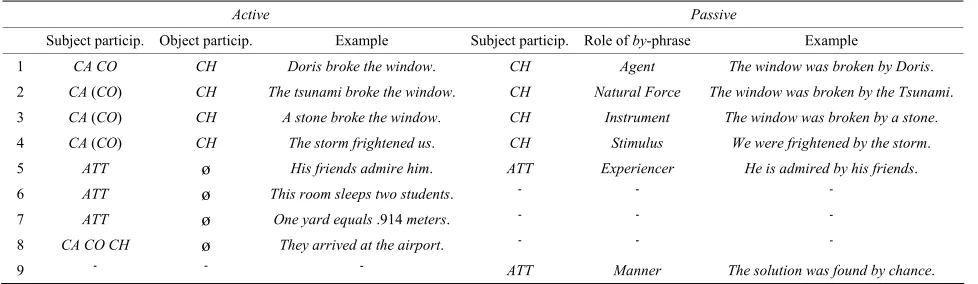
By-phrases are prepositional objects. They can be assigned various roles, as shown in Table 3.
By contrast, the subjects of the corresponding active sen- tences do not have roles, but features. Table 3 shows that when the direct object of an active sentence has the feature Change, the subject of the corresponding passive sentence also has
Table 3.
Passive sentences with by-phrases.
Active Passive
Subject particip. Object particip. Example Subject particip. Role of by-phrase Example
1 CACO CH Dorisbrokethewindow. CH Agent ThewindowwasbrokenbyDoris.
2 CA (CO) CH Thetsunamibrokethewindow. CH NaturalForce ThewindowwasbrokenbytheTsunami. 3 CA (CO) CH Astonebrokethewindow. CH Instrument Thewindowwasbrokenbyastone.
4 CA (CO) CH Thestormfrightenedus. CH Stimulus Wewerefrightenedbythestorm.
5 ATT ø Hisfriendsadmirehim. ATT Experiencer Heisadmiredbyhisfriends.
6 ATT ø Thisroomsleepstwostudents. - -
-7 ATT ø Oneyardequals .914 meters. - -
-8 CACOCH ø Theyarrivedattheairport. - -
-9 - - - ATT Manner Thesolutionwasfoundbychance.
Abbreviations: CA = Cause; CO = Control; CH = Change; ATT = Attr-St. (CO), in parenthesis, indicates that the subject participant has Control which is lacking in the
specific NP (and supplied by NP matching).
Change22. When the direct object of an active sentence has the feature ø, the subject participant of the corresponding passive sentence has the feature Attr-St. When a by-phrase has the Manner role, as in line 9 of the table, there is no corresponding active sentence.
As shown in lines 6 - 8, there are also active sentences with- out corresponding passives (either with or without by-phrases). The reason is that unlike all subjects of passive sentences, which have either Change or Attr-St, the suppositional subjects of such passive sentences would not match with any one of these features: Nothing of interest would be asserted of .914 meters by .914 metersareequaledbyoneyard, or of the airport by theairportwasarrivedatbythem, and so it would be infe- licitous to ascribe to these NPs the feature Attr-St. This is also the reason why the verbs possess, have, lack, suit, become, and
fit normally do not passivize. See Schlesinger (1995: pp. 131- 138) on this and similar constraints on passivization.
Distinguishing Direct from Oblique Objects
The theory proposed here is more parsimonious than one based on thematic hierarchies. This simplification comes at the price of a distinction between two sets of semantic notions, features and roles, and two corresponding classes of rules: Fea- ture linking rules and Role linking rules (to be dealt with fur- ther on. Let us see now whether there is any semantic criterion determining which arguments are represented by features in a lexical entry and which are not.
In many sentences, direct objects seem to be, as it were, more intimately related to the verb than oblique objects. One can throw a ball without throwing it to any specific place or person, and so theball in 41) is direct object, whereas overthefence
and toClara are not. That direct objects are more central to the verb’s meaning is the view of, inter alia, Jackendoff (1990a: 449), who states that the first object of a ditransitive verb (e.g.,
John in giveJohn abook) is not a direct object, since it “ex- presses a semantic role that is not an essential part of the verb’s meaning” in the way direct objects are.
But essentiality is anything but a reliable criterion. Thus, for
filling to take place, there has to be, in addition to the agent, a specific vessel that is filled and a material it is filled with. All three are essential for filling to occur, but only the vessel ap- pears as direct object; cf. 42). Buying requires, besides the buy- er and an item bought, a seller and money or a commodity given in exchange. In the absence of any one of these, buying cannot be said to have taken place, but the seller and the money given in exchange are expressed as oblique objects23.
Another distinguishing property that has been proposed is af- fectedness. A case in point is the locative alternation:
43) a. She sprayed the wall with paint. b. She sprayed paint onto the wall.
The first sentence, but not the second, suggests that the wall is wholly covered with paint. It has been argued that the direct object carries with it a sense of completeness (Anderson 1971; Fillmore 2003: 226), as evidenced also by the pair searchinthe room, searchtheroom, and denotes the “completely affected” (Hopper & Thompson, 1980: p. 262; see also Beavers, 2006), “wholly involved” (Levin & Rappaport Hovav, 2005: p. 209) entity. As Gropen et al. (1991a: p. 162) remark: “… the most natural interpretation of a state change is that it is the entire object that undergoes the change, rather than one part…”. Ac- cordingly, when the wall is completely painted, 43a) is more appropriate than 43b). This does not take us very far, however. It does not explain other alternations. For instance, why can the hammer and thewall each be either a direct or an oblique object in 39)?
A factor related to affectedness is success of the activity. Examples of the conative alternation, like pushthetable, push atthetable and shootthebird, shootatthebird, indicate that often the direct object, but not the oblique one, signals success of the activity. This factor can account only for alternations where one sentence has “verb + at” (like, e.g., push at) and the other only “verb” (push).
A semantic distinction between direct and oblique objects
22Or, in the case of an adjectival passive, Attr-St (e.g., Thevaseisbroken, in the sense of “broken vase”). One might conceive of active and the corre-sponding passive sentences as stemming from two sub-entries in the lexical entries of the verb V, V and be V en, and the adjectival passive as based on yet another sub-entry. Alternatively, the passive may be viewed as a result of a generalized lexical rule. This question will be left open here.