Effectiveness of Health Educational Program on
Secondary Schools Female Students' Knowledge about
Personal Hygiene in Bagdad City
Ayat Ibrahim Marhab*, Dr. Wissam Jabbar Kassim**
*
Community Health Nursing Specialist, MScN, Ministry of Health.
**
IMS. Dr, Community Health Nursing Department, University of Baghdad/College of Nursing.
Abstract- Study aims: To assess secondary schools female
students ' knowledge about personal hygiene before and after the implementation of the Health education program, and determine the effectiveness of Health education program on Secondary Schools Female Knowledge about personal hygiene, and to find out the relationship between their Knowledge and some variables such as, age and educational level of the parents and the economic status.
Methodology: A quasi-experimental study is conducted
throughout the period of (October 22/ 2015 to May 2nd 2016) . A Non probability (purposive) sample of (100) Female Students, which is selected from (24) Female secondary schools, is equally distributed among Karkh and Rusafa Directorates in Baghdad City. The study sample is divided into two groups; (50) Female Students for the study group, which is exposed to the health education program, and (50) Female Students for the control group, the groups are almost matched relative to their characteristics. Data collected through the utilization of the self-administration technique as a mean of data collection from (24) secondary schools in Baghdad City. Data are analyzed through the application of descriptive and inferential statistical data analysis approach, the reliability of the questionnaire which is determined through a pilot study and the validity are achieved through a panel of (15) experts.
Results: The study results showed demographic
characteristics analysis of the sample concerned, the large number of the sample that was age (12-14) years (36%), Results shows that weak relationships are proved throughout an overall improvements concerning health hygiene application distributed with no significant relationships at P>0.05.
Conclusion: The study concludes that the health education program in term of all domains of health hygiene are plying a meaningful role and inquiring the studied objects.
Recommendation: The study recommends that further
studies can be conducted to involve national level to evaluate secondary student’s female practice concerning personal hygiene. Need to be increase public awareness of the importance of personal hygiene particularly for adolescents through mass media.
Index Terms- Effectiveness, Health Educational Program,
Personal Hygiene
I. INTRODUCTION
ygiene is any application made and sanitary precaution taken to be protected from environments that can damage our health. Hygiene issues include personal hygiene, which is defined as self-care applications that individuals carry out in order to maintain their health. Personal hygiene is very important for protecting and maintaining health and addressing health problems and is also fundamental to the prevention of many diseases, particularly contagious diseases P
(1)
P
. Personal hygiene precautions include hand-face hygiene, regular bathing; using soap and running water in the cleaning process; washing hands before preparing food, before and after eating meals and after using the toilet, hair care washing and using one‘s own clothes, towels, shoes and slippers Besides constituting a basis for personal and social health, hygiene is an indispensable part of living in society, Human beings are continuously affected by external environmental pollutants. Everyday activities may involve contact with many sources of environmental contamination, these may be touched with the hand, present on shoes while walking, or contained in dust on the body and hair; moving the hand to the mouth also causes microorganisms to enter the body P
(2)
P
. Hygiene is an old concept related to medicine, as well as to personal and professional care practices related to most aspects of living. In medicine and in home (domestic) and everyday life settings, hygiene practices are employed as preventative measures to reduce the incidence and spreading of disease. Good hygiene is a key part of quality, the terms cleanliness or cleaning and hygiene are often used interchangeably, which can cause confusion. In general hygiene mostly means practices that prevent spread of disease-causing organisms. Since cleaning processes e.g., hand washing remove infectious microbes as well as dirt and soil, they are often the means to achieve hygiene. Other uses of the term appear in phrases including: body hygiene, personal hygiene, sleep hygiene, mental hygiene, dental hygiene, and occupational hygiene, used in connection with public health. Hygiene is also the name of a branch of science that deals with the promotion and preservation of health, also called hygienic. Hygiene practices vary widely, and what is considered acceptable in one culture might not be acceptable in another (3).
Study Objectives :
To determine the effectiveness of Health education program on Secondary Schools Female Knowledge about personal hygiene.
To find out the relationship between their Knowledge and some variables such as, age , educational level of parents, and their economic status.
II. METHODOLOGY
Design of the study: Quantitative research uses
quasi-experimental design to assess Female Students' Knowledge about Personal Hygiene in Baghdad City Secondary Schools. An educational program has been constructed and applied with an approach of pre-test and post-test for the study and control groups.
Setting of the study: The study is conducted on (24)
secondary schools, which are distributed throughout the educational directorates of Baghdad City, selecting of (100) Female Students of secondary schools. The Female Students' in secondary schools are selected from Al-Rusafa 1st , 2nd , 3rd and Al –karkh 1st , 2nd and 3rd Directorates.
Sample of the study: A Non probability (purposive) sample
of (100) Female Students, which is selected from (24) Female secondary schools, is equally distributed among Karkh and Rusafa Directorates in Baghdad City. The study sample in this study is divided into two groups; (50) Female Students for the study group, which is exposed to the health education program, and (50) Female Students for the control group.
Instrument of the study: Through review of the related
literature and studies, the questionnaire is constructed that is used as a mean of data collection. It consists of (2) major parts; the first part is concerned with students' socio-demographic characteristics of age, father and mother level of education, economic status , father and mother occupations. The second part is concerned with Female Students' Knowledge about Personal Hygiene that includes (94) items.
Validity and Reliability: The content validity of the
instrument was established through a panel of (10) experts, the reliability of the items were based on the internal consistency of the checklist was assessed by calculating Cronbach s' Alpha which as= 0.97.
Statistical analysis: The statistical data analysis approach by
using (SPSS-ver.20) is used in order to analyze and evaluate the data of the study. A descriptive statistical data analysis approach used to describe the study variables : Frequencies and Percentages. Inferential statistical data analysis approach: used by application of the Chi-square test, Contingency Coefficients, Binomial test, Wilcoxon Sign Rank test, Mc-Nemar test and ACNOVA.
III. RESULTS
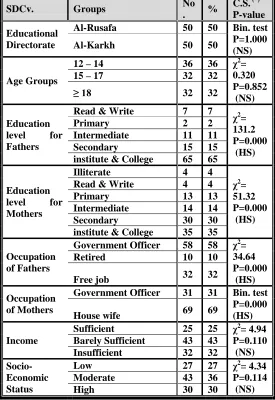
Table (1): Distribution of the studied sample according to (SDCv.) with comparisons significant
SDCv. Groups No
. %
C.S.P
(*)
P-value
Educational Directorate
Al-Rusafa 50 50 Bin. test
P=1.000 (NS)
Al-Karkh 50 50
Age Groups
12 – 14 36 36 χP
2
P
= 0.320 P=0.852 (NS)
15 – 17 32 32
≥ 18 32 32
Education
level for Fathers
Read & Write 7 7
χP
2
P
= 131.2 P=0.000 (HS)
Primary 2 2
Intermediate 11 11
Secondary 15 15
institute & College 65 65
Education
level for Mothers
Illiterate 4 4
χP
2
P
= 51.32 P=0.000 (HS)
Read & Write 4 4
Primary 13 13
Intermediate 14 14
Secondary 30 30
institute & College 35 35
Occupation of Fathers
Government Officer 58 58 χP
2
P
= 34.64 P=0.000 (HS)
Retired 10 10
Free job 32 32
Occupation of Mothers
Government Officer 31 31 Bin. test
P=0.000 (HS)
House wife 69 69
Income
Sufficient 25 25 χP
2
P
= 4.94 P=0.110 (NS)
Barely Sufficient 43 43
Insufficient 32 32
Socio-Economic Status
Low 27 27 χP
2
P
= 4.34 P=0.114 (NS)
Moderate 43 36
High 30 30
(*) HS: Highly Sig. at P<0.01; NS: Non Sig. at P>0.05; Testing based on One-Sample Chi-Square test, as well as Binomial test.
[image:2.612.307.582.115.515.2]Income, and socio-economic status illustrat that most of studied sample have a moderate level, and accounted 43(43%) with no significant difference at P>0.05 compared with different groups.
Table (2): Statistics concerning (Health Education program) effectiveness according to main domains responding at
studied periods
Position N o .
Before After
Z-val ue Si g.( *) C .S . G M S S D R S % G M S S D R S % General Inf. 1 0 0 1. 06 0. 33 52 .9 1. 64 0. 39 82 .1 -7.7 31 0. 00 0 H S Skin and Bathing 1 0 0 1. 23 0. 28 61 .3 1. 61 0. 35 80 .7 -7.3 30 0. 00 0 H S Hair 1 0 0 1. 14 0. 29 56 .8 1. 57 0. 42 78 .3 -6.9 63 0. 00 0 H S Eyes 1 0 0 1. 22 0. 26 60 .8 1. 61 0. 37 80 .4 -6.6 99 0. 00 0 H S Ears 1 0 0 1. 08 0. 33 54 .0 1. 58 0. 45 78 .9 -6.5 89 0. 00 0 H S Nose 1 0 0 0. 73 0. 33 36 .5 1. 36 0. 60 68 .0 -6.5 80 0. 00 0 H S Oral 1 0 0 0. 79 0. 28 39 .6 1. 41 0. 54 70 .5 -7.1 19 0. 00 0 H S
Hands 1
0 1. 27 0. 24 63 .6 1. 65 0. 34 82 .5 -7.1 0. 00 H S
0 18 0
Genital area and menstrua l 1 0 0 1. 03 0. 38 51 .6 1. 53 0. 47 76 .5 -7.0 17 0. 00 0 H S Foot 1 0 0 1. 09 0. 34 54 .5 1. 57 0. 42 78 .4 -7.3 34 0. 00 0 H S Clothes 1 0 0 1. 26 0. 30 62 .8 1. 74 0. 28 87 .0 -7.7 59 0. 00 0 H S (*)
HS: Highly Sig. at P<0.01 Statistical hypothesis based on Wilcoxon signed rank test.
(Health Hygiene)
Part 1: Main Domains (Health Hygiene) :
Regarding subjects of all studied parts, shows summary
statistics and initial assessments, such that, grand mean of score, standard deviation, and relative sufficiency are included for assesses responding levels of the studied sample either initially at the pre period of time or after applying educational program concerning health hygiene in compact form through studying questionnaire's main domains, which are included "General information, Skin and Bathing, Hair position, Eyes position, Ears position, Nose position, Oral Position, Hands position, Genital area and Menstrual,
Foot position, and Clothes", as well as comparisons
significant throughout "Wilcoxon sign rank" test are used, and illustrated that all of questionnaire's main domains are assigned a meaning improvements at p-values <0.01 resulted by effectiveness of the suggested educational program application.
Table (3): Summary Statistics concerning (Health Education program) effectiveness according to overall responding at studied periods
Overall Assessment
No.
Before After
Z-value Sig. (*) CS
GMS SD RS% GMS SD RS%
100 1.08 0.27 54.0 1.57 0.40 78.5 -8.419 0.000 HS
(*) HS: Highly Sig. at P<0.01 Statistical hypothesis based on Wilcoxon signed rank test.
= Overall Main Domains (Health Hygiene):
Regarding subjects, results shows summary statistics and
initial assessments, such that, global mean of score, standard deviation, and relative sufficiency are included for assess responding levels of the studied sample either initially at the pre period of time or after applying educational program in compact form throughout studying questionnaire's an overall main
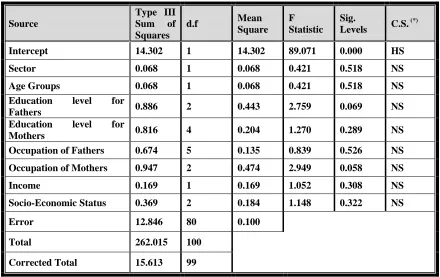
Table (4): Analysis of Covariance throughout Studied Periods about Health Hygiene Improvements according to SDCv.
Source
Type III Sum of Squares
d.f Mean
Square F Statistic
Sig.
Levels C.S.
(*)
Intercept 14.302 1 14.302 89.071 0.000 HS
Sector 0.068 1 0.068 0.421 0.518 NS
Age Groups 0.068 1 0.068 0.421 0.518 NS
Education level for
Fathers 0.886 2 0.443 2.759 0.069 NS
Education level for
Mothers 0.816 4 0.204 1.270 0.289 NS
Occupation of Fathers 0.674 5 0.135 0.839 0.526 NS
Occupation of Mothers 0.947 2 0.474 2.949 0.058 NS
Income 0.169 1 0.169 1.052 0.308 NS
Socio-Economic Status 0.369 2 0.184 1.148 0.322 NS
Error 12.846 80 0.100
Total 262.015 100
Corrected Total 15.613 99
(*)
HS: Highly Sig. at P<0.01; Non Sig. at P>0.05; Statistical hypothesis based on Analysis of Covariance (ACNOVA) test.
Relationship of Health Hygiene improvements and SDCv:
To predict/or to find out relationship between an overall
assessments of health hygiene improvements due to applying educational program and different socio-demographical characteristics variables concerning studied subjects, tables (4-4-1) included analysis of covariance of improvements that were occurred due to applying educational program about health hygiene application distributed by different (SDCv.) of the
studied subjects. Results shows that weak relationships are proved throughout an overall improvements concerning health hygiene application distributed by different (SDCv.) with no significant relationships at P>0.05. And accordance with that results, it could be conclude that the studied questionnaire of studying "Health Hygiene", throughout an overall assessments regarding (Improvements) due to applying program, could be amending for female's secondary students whatever differences with their SDCv.
Table (5): Redistribution (Under/Upper) cutoff point at the two periods (pre, and post) throughout overall assessments
Overall
Assessment Period No. and Percent
(After)
Total C.S.
(*)
P-value
Under Upper
(Before)
Under No. 8 32 40
McNemar test P=0.000 HS
% General Before 8% 32% 40%
Upper No. 0 60 60
% General Before 0.0% 60% 60%
Total No. 8 92 100
% General Before 8% 92% 100%
*)
HS: Highly Sig. at P<0.01 Statistical hypothesis based on McNemar test.
Results shows that 32(32%) of the studied subjects had positively improvements due to applying of studied educational program in light of health hygiene, with highly significant
[image:4.612.86.526.79.356.2] [image:4.612.87.528.81.357.2] [image:4.612.98.514.528.659.2]Table (6): Extracted Factor throughout an overall assessments at the post period of time
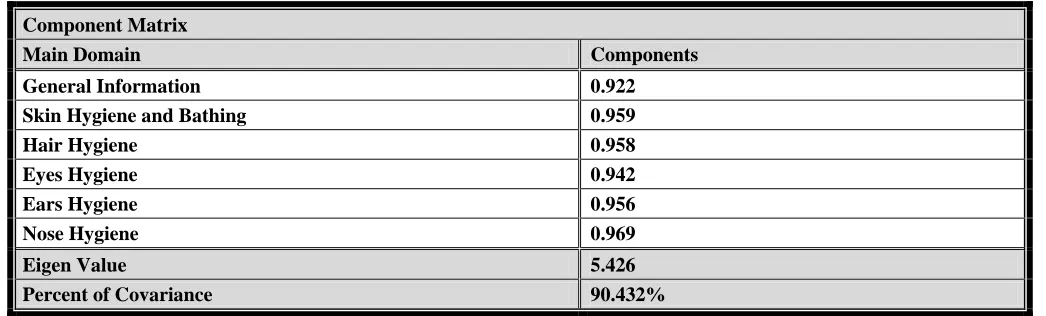
Component Matrix
Main Domain Components
General Information 0.922
Skin Hygiene and Bathing 0.959
Hair Hygiene 0.958
Eyes Hygiene 0.942
Ears Hygiene 0.956
Nose Hygiene 0.969
Eigen Value 5.426
Percent of Covariance 90.432%
For summarizing preceding results, it could be conclude that studied educational program are reported meaningful deviations along studied subjects within "General Information, Skin and Bathing, Hair, Eyes, Ears, and Nose" main domains, and that may be needs to be more clarify, either in formulation of written questionnaire's items, or through interviewing by the researcher, while leftover main domains had stationary effectiveness status, since most of studied subject's improvements seems to be stable.
IV. DISCUSSION
Part I: Discussion of the studied sample according to Socio-Demographical Characteristics variables
Respect to subject of educational directorate, the studied sample are distributed similarly between Rusafa and Al-Karkh sectors, and for each sector are accounted (50 ) Relative to subject of age groups, studied samples indicate that the majority of early adolescent of the study sample are within the age (12-14) years old, because these ages have little information about personal hygiene, especially early adolescence. This result concurrent with the result of Anitha and Runi (2013) that have studied personal hygiene practice of school of adolescent, a cross-sectional study design is conducted in Chennai on (1832) are selected from (30) schools, their finding indicates that the most of the study sample (58.5%) are aged between (12-14) years old P
(5)
P
.
The "Educational level for fathers, and mothers", results illustrated that most of studied sample are of College and institutes graduates levels, (65% and 35%) respectively. Furthermore, in a study who studied a comparative assessment of knowledge and practice regarding personal hygiene among urban and rural school students in Belagavi, India. Their findings indicate that the most of the parent’s education are College graduated levels P
(6)
P
.
Concerning occupation of the fathers and mothers, results illustrated that most of fathers are government officers, and they are accounted (58%), while most of mothers are house wife, and they are accounted (69%). The present study agreement with the result of study has been assessed the knowledge and practice regarding personal hygiene among school students from an urban areas. A cross-sectional study designs are conducted on school
students in India. Data are collected according to inclusion criteria using a pre-designed closed ended questionnaire. After statistically analysis, results indicate that the parents occupation (78%) are employed as concerning fathers occupation, and (73%) of mothers are (housewife) unemployed P
(5)
P
.
Socio-economic status illustrated that most of studied sample have a moderate level, and accounted (43%)
While in a study assessed of personal hygiene among school students: A community based cohort study. Their findings indicate that the most of the participants making moderate socio-economic status P
(7)
P
.
Part II: Discussion of Knowledge of Students about (Healthy Hygiene)
Regarding the summary statistics and initial assessments, such as, grand mean of score, standard deviation, and relative sufficiency are included to assesses responding levels of the studied sample either initially at the pre period of time or after applying educational program concerning health hygiene in compact form through studying questionnaire's main domains, which are included "General information, Skin and Bathing, Hair position, Eyes position, Ears position, Nose position, Oral Position, Hands position, Genital area and Menstrual, Foot position, and Clothes", as well as
comparisons significant throughout "Wilcoxon sign rank" test are used, and illustrated that all of questionnaire's main domains are assigned a meaning improvements at p-values <0.01 resulted by effectiveness of the suggested educational program application. These important findings show that knowledge can play a decisive role in improving adolescents personal hygiene practices, which in turn would help to protect against diseases and enhance confidence in self-appearance, especially ,to adolescents.
V. CONCLUSIONS
1. 1. It is found that the most of female students between the age (12-14) years old.
[image:5.612.46.569.80.238.2]3. It is found health educational program application in light of hair about health hygiene are effective in plying a meaningful role and inquiring the studied objects.
4. It conclude that health educational program application in light of eyes about health hygiene is plying a meaningful role and inquiring the studied objects.
5. Health educational program application in term of ears about health hygiene part is plying a meaningful role and inquiring the studied objects.
6. Health educational program application in light of nose about health hygiene part is plying a meaningful role and inquiring the studied objects.
7. Health educational program application in light of oral position about health hygiene part are plying a meaningful role and inquiring the studied objects.
8. health educational program application in light of hands position about health hygiene part are plying a meaningful role and inquiring the studied objects.
9. Health educational program application in light of genital area and menstrual about health hygiene part are plying a meaningful role and inquiring the studied objects.
10. Health educational program application in light of foot position about health hygiene part are plying a meaningful role and inquiring the studied objects.
11. Health educational program application in light of clothes about health hygiene part are plying a meaningful role and inquiring the studied objects.
VI. RECOMMENDATION
1. Further studies can be conducted to involve national level and evaluate secondary students’ female practice concerning personal hygiene.
2. Need to be increase of the public awareness about the importance of personal hygiene particularly for adolescents through mass media.
3. It is suggested that health education should be made a compulsory component of school education at all levels.
4. Increasing their perception and knowledge in accordance to personal hygiene and to make this applicable by teaching stuff
should be prepared by undergoing specialty courses held incorporate of Ministry of Education and Ministry of Health , the program of the students should be designed to gain knowledge, attitude and practice concerning personal hygiene.
It should be coordination between schools administrations and students families to achieve personal hygiene among students in a community and the schools.
REFERENCES
[1] Dangour AD, Watson L, Cumming O, Boisson S, Che Y, Velleman Y, et al. Interventions to improve water quality and supply, sanitation and hygiene practices, and their effects on the nutritional status. Cochrane Database Syst Rev, 2013:1;8
[2] Aslan, D., Mermerkaya M.U., Kaya F.E., Kaya H., Esen E., Koban Y. & Pekcan H. (2006). Ankara‘da Bir İlköğretim Okulunda El Yıkama Konusunda Yapılmış Olan Bir Müdahale Çalışması. Türkiye Klinikleri J Med Sci 26 (2): 157-162.
[3] International Scientific Forum on Home Hygiene. Household water storage, handling and point-of-use treatment (2005) .
[4] Aslan, D., Mermerkaya M.U., Kaya F.E., Kaya H., Esen E., Koban Y. & Pekcan H. (2006). Ankara‘da Bir İlköğretim Okulunda El Yıkama Konusunda Yapılmış Olan Bir Müdahale Çalışması. Türkiye Klinikleri J Med Sci 26 (2): 157-162.
[5] Aslan, D., Mermerkaya M.U., Kaya F.E., Kaya H., Esen E., Koban Y. & Pekcan H. (2006). Ankara‘da Bir İlköğretim Okulunda El Yıkama Konusunda Yapılmış Olan Bir Müdahale Çalışması. Türkiye Klinikleri J Med Sci 26 (2): 157-162.
[6] Tolson D, Swan I, Knussen C 2002 hearing disability :Asource of distress for older people and cares , British Journal of nursing 11 (15) : 1021- 1025. [7] United Nations Children’s Fund. (2005). Common water and sanitation
Related diseases. Retrieved December 08, 2010, from www.unicef.org.
AUTHORS
First Author – Ayat Ibrahim Marhab, Community Health
Nursing Specialist, MScN, Ministry of Health.
Second Author – Dr. Wissam Jabbar Kassim, IMS. Dr,