Retail Marketing
A. N. Tamragundi
Assistant Professor , Department of commerce, Karnatak university, Dharwad
Arjun D Koli
Research scholar, Department of commerce, Karnatak university, Dharwad
Indian retailing is being seen as a potential goldmine. India Ranks Fifth among the top 30 emerging
markets for retail in the current year. Government of India has also opened the door for the retailing
giants to enter into the markets. So the Indian retailing business play a significant role, as compared
to other countries and the retailing industry in India is divided into organized and unorganized
sector, but the Indian retail sector is highly fragmented with a major share of its business is being
run by unorganized retailers (more then 93 per cent) like the traditional family run stores and
corner stores. The organized retail sector (only 7 per cent) in India is still at a developmental stage,
characterized by a very small number of players trying to create a new paradigm. The major
challenges before organized sectors are to shift the customer purchasing practices from unorganized
to organized stores. But the organized retail stores are still failed to understand the buying behavior
of Indian customers. Availability of Technology and skilled labour is another major challenge of
organized sector.
But, apart from these challenges, India’s booming economy is a major source of opportunity. It is
the third largest in the world in terms of purchasing power. India is the second fastest growing
major economy in the world. The Indian consumer spend average grocery at 42% of monthly, so it is
Introduction
Retailing is one of the oldest businesses of mankind and almost close to settled agriculture, as its origins can be forced back to the time when exchange of goods started taking place. Any exchange( even better) as in prehistoric times represent retailing as there was a direct interaction with the consumer has the development of human civilization took place and business as an entity took birth the direct producer to the consumer interaction gave way to a business to consumer interaction . Any business to consumer interaction in the present context can be termed as retailing. Retailing therefore, encompasses all forms of direct marketing too, in its broader sense.
Meaning and Definition of Retail Marketing
Retail is the sale of goods and services from individuals and businesses to the end users. Retailers sell products directly to consumers. Customers do not usually consider the many stages that products go through before they are picked off the shelf, but there can be steps from simple resources to a complex end item. While small businesses may create and sell their own products, products that are sold at large chains often pass through the hands of several different companies before they reach the consumer. The last company they pass through is known as a retail marketer.
Retail marketing simply refers to the business of selling products to consumers. Only some
businesses work in retail marketing, while many others work further up the supply chain. Retail marketers only sell products to consumers. They rarely make the products they sell, and their primary tool of marketing is the storefront. Modern retail marketing involves both physical locations and Internet stores.
Indian Retailing Industry
The retail sector in India is growing at a phenomenal pace. India Ranks Fifth among the top 30 emerging markets for retail in the current year. The recent announcement by the India government with foreign direct investment in retail especially allowing 100% FDI in single brands and multi brand FDI has created positive sentiments in the retail sector.
There are many factors contributing to the boom in the sector. To name a few, increased consumerism with a capacity to spend on luxury items and increased spending power in the hands of Indians. More Indians are traveling abroad and are exposed to different culture and way of life and
thereby more brands. India’s internal consumption is also high and the consumption pattern owing to
diversity in culture, religion and the family values that encourage spending of specific occasion keeps the retail business well oiled.
The size of Indian retail sector is currently estimated at around $450 billion and organized retail accounts for around 7% of the total market share. Rating agency Fitch has assigned a stable outlook to the retail sector for the year 2012 as factor like expected sales, growth driven expansion and efficient working capital management are likely to benefit retail companies. It is estimated that the retail sector would continue to grow at 10-12% per annum. Which is extremely encourage when the countries economy is only projected to grow at 6 per cent
Structure of retailing industry in India
Retailing Industry in India
1. Organized retailing (7%) 2. Unorganized retailing (93%)
Major Segments
1. food
2. consumer durables
3. leisure and entertainment
4. health, beauty and pharma
5. books and music
6. fashion
1. Organized retail sector: Organized retailing refers to trading activities undertaken by licensed retailers, that is, those who are registered for sales tax, income tax, etc. These include the corporate-backed hypermarkets and retail chains, and also the privately owned large retail businesses.
Organized retail accounts for 7 per cent of India's roughly US$ 435 billion retail market and is expected to reach 20 per cent by 2020.Food accounts for 70 per cent of Indian retail, but it remains under-penetrated by organized retail.Organised retail has a 31 per cent share in clothing and apparel and continues to see growth in this sector. The home segment shows promise, growing 20 to 30 per
cent per year. India’s more urban consumer mindset means this sector is poised for growth. 2. Unorganized Retail Sector:
Indian retail is dominated by a large number of small retailers consisting of the local Kirana shops, owner-manned general stores, chemists, footwear shops, apparel shops, paan and beedi (local betel leaf and tobacco) shops, hand-cart hawkers, pavement vendors, etc. which together make up the
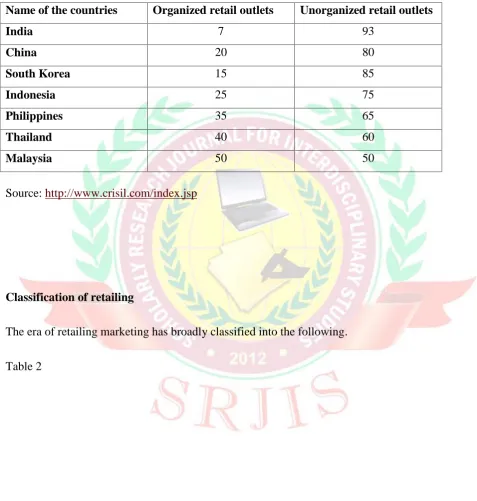
Retail trade in India and South East Asia (%)
Table 1
Name of the countries Organized retail outlets Unorganized retail outlets
India 7 93
China 20 80
South Korea 15 85
Indonesia 25 75
Philippines 35 65
Thailand 40 60
Malaysia 50 50
Source:http://www.crisil.com/index.jsp
Classification of retailing
Traditional Format Retailers Modern Format Retailers
1. Mom and Pop stores: mom-and-pop
shops are restaurants, bars, and billiard halls, the majority of their customers are local residents who patronize the establishment on a regular basis.
2. Kiosks: A Kiosk is a computer terminal
featuring specialized hardware and software designed within a public exhibit that provides access to information and applications for communication, commerce, entertainment, and education.
1. Supermarket
A retail store which generally sells food products and household items, properly placed and arranged in specific departments is called a supermarket.
2. Hypermarkets: A hypermarket is a
superstore combining a supermarket and a department store. The result is an expansive retail facility carrying a wide range of products under one roof, including full groceries lines and general merchandise. In theory, hypermarkets allow customers to satisfy all their routine shopping needs in one trip
3. Street Markets: A street market is an
outdoor market such as traditionally held in a market square or in a market town, and often held only on particular days of the week. Very similar markets, or bazaars, can also be found in large enclosed spaces, instead of on a street.
3. Departmental stores: A department
the same firm under different and unrelated brands.
would not sell anything else apart from the specific range.Speciality stores sell only selective items of one particular brand to the consumers and primarily focus on high customer satisfaction.
OPPORTUNITIES FOR THE ORGANIZED RETAIL SECTOR IN INDIA
1. India’sbooming economy is a major source of opportunity. It is the third largest in the world in terms of purchasing power. India is the second fastest growing major economy in the world.
2. India’s huge population has a per capita income of Rs 44,345. The proportionate increase in spending with earnings is another source of opportunity.
3. Increasing use of plastic money for categories relating to Apparel, Consumer Durable Goods, Food and Grocery etc.
4. Current market size of consumer durables is US $ 6.5 billion and is estimated to grow at a CAGR of 18%
5. India’s household spending on food is one of the highest in the world with 48% of income spent on food and grocery.
6. Increased urbanization has led to higher customer density areas thus enabling retailers to use lesser number of stores to target the same number of customers. Aggregation of demand that occurs due to urbanization helps a retailer in reaping the economies of scale.
7. With increased automobile penetration and an overall improvement in the transportation infrastructure, covering distances has become easier than before. Now a customer can travel miles to reach a particular shop, if he or she sees value in shopping from a particular location.
8. Increasing instances of Double Incomes in most families coupled with the rise in spending power. SWOT Analysis of Retail Industry of India
Table 3
Strengths:
1) Organized retailing at US$ 3.31 billion, growing at 8%.
2) 2nd largest contributor to GDP after
Weaknesses:
with shopping trends.
4) Consumer spending increasing at 11% annually.
5) Almost 25 million sq. ft. retail space available.
6) Paradigm shift in shopping experience for consumers pulling in more people.
3) Lack of industry status.
4) Retail revolution restricted to 250 million people due to monolithic urban-rural divide.
5) Lack of huge investments for expansion
Opportunities:
1) Increasing urban population-more participants in retail revolution.
2) Increase in consuming middle class population.
3) Social factors, like dual household income has enhanced spending power. 4) Spends moving towards lifestyle products and esteem enhancing products. 5) Average grocery spends at 42% of monthly spends-presents a huge opportunity.
Threats:
1) Rising lease/rental costs affecting project viability.
2) Poor monsoons and low GDP Growth could affect consumer spending drastically. 3) Archaic labor laws are a hindrance to providing 24/7 shopping experience.
4) Personalized service offered by Kirana stores.
5) Unavailability of qualified personnel to support exponential growth in retail.
6) Differentiate taxation laws hindering
Challenges faced by Organized Retail Sector in India
3. Shortage of skilled workforce in retail sector.
4. Retail shrinkage is also one of the major challenges. Retail shrinkage is the difference in the value of stock as per the books and the actual stock available in the shop. The causes of retail shrinkage are mainly employee theft, shoplifting, administrative errors and vendor fraud. Effective online monitoring system need to be implemented.
5. Understanding customers in terms of customer behavior and loyalty is a difficult job. Retailers need to implement effective customer relation management and loyalty program.
6. Distribution is an integral part of any retail organization. Delivering the right goods to the right place at the right time is main task of distribution. Retail majors are under serious pressure to improve their supply chain systems and distribution channels and reach the levels of quality and service desired by customers. The lack of proper infrastructure and distribution channels in the country results in inefficient processes.
7. Organized retail outlets use very large volumes of electricity for a variety of applications from lighting, air conditioning, escalators, cold storing, billing systems, lifts etc. As a result of insufficient and inefficient power supply, a huge amount of private investment goes into ensuring power backups. This makes it very difficult for organized retail to grow.
8. As more and more organized retail outlets are dotting the Indian topography, competition is no more restricted between organized and unorganized retailing. It is now quite evident between organized retailers as well. Efficient and effective Loyalty programs, home delivery of goods, customer retention strategies, offers, discounts etc are the order of the day.
Major Findings of the study
1. The role of unorganized retail stores (more then 93%) are more as compared to organized retail outlets(less then 7%) in India. The organized retail outlets are still in development stage.
2. The organized retail outlets are still failed to understand the consumer purchasing behavior. 3. Competition from unorganized sector is another challenge facing the organized retail
industry in India.
6. Emergence of concepts such as quick and easy money, EMIS, Credit card, has made purchasing possible for Indian consumers.
CONCLUSION