SYNTHESIS OF BIFEO
3NANOPARTICLE AND SINGLE PHASE BY
SOL-GEL PROCESS FOR MULTIFERROIC MATERIAL
Dwita Suastiyanti
1and Marlin Wijaya
21
Mechanical Department of Indonesia Institute Technology, Puspiptek-Serpong, Indonesia
2
Centre of Processing Industrial Technology, Agency for the Assesment and Application of Technology, Puspiptek-Serpong, Indonesia E-Mail: [email protected]
ABSTRACT
The magnetoelectric coupling (ME) in multiferroics i.e. BiFeO3 promises important technological applications in several multifunctional devices like data storage, spinotronics, sensor, actuator devices etc. BiFeO3 was synthesized using a sol - gel process. The aim of this research is to find optimum process condition of sol-gel method for BiFeO3 synthesis by varying of sintering temperature. It is expected to obtain BiFeO3 material in nanoparticle, single phase and shows electric voltage response if given an external magnetic field. It was used Bi5O(OH)9.(NO3)4, Fe(NO3)3.9H2O, HNO3, H2O as precursor and citric acid (C6H8O7) as fuel. It was used 450 oC; 500oC and 550 oC as sintering temperature for 10 hours respectively.Phases formation of material were carried out using X-Ray-Diffraction (XRD) for BiFeO3 powder. It was used Particle Size Analyzer (PSA) with Beckman Coulter DelsaTM Nano type to know particle size. “Home made ME instrument by Physics Department of University of Indonesia” was used to know electric voltage response when given an external magnetic field to BiFeO3 powder. XRD results confirm that single phase BiFeO3 is obtained at sintering temperature of 550 oC for 10 hours. The smallest particle size was 65 nm. When BiFeO3 powder was given an external magnetic field, it shows electric response. This response shows that the powder has multiferroic characteristic.
Keywords: magnetoelectric, multiferroic, sol-gel, nanoparticle, single phase.
INTRODUCTION
Multiferroics, also called ferroelectromagnets, represent a broad class of materials possessing two or more types of switchable states for memory and transducer applications [1]. In most cases, ferroelectric polarization P, magnetization M and magnetoelectric (ME) coupling between them are the frequently studied topics. It has been expected that fluctuations in P or M can be activated upon applying external magnetic field H or electric field E, respectively. This triggers quite a few proposed novel devices utilizing this additional degree of freedom besides P and M themselves [2, 3]. In one hand, quite a number of single-phase multiferroic compounds have been studied, focusing on the phase transitions associated with ferroelectric ordering and magnetic ordering as well as their coupling, noting that the ME coupling is usually weak [4, 5]. Although the detected polarization change upon a magnetic field H of ∼Tesla is only ∼nC/cm2, the well-reproduced polarization reversal induced by the time-varying H is impressive.
BiFeO3 is one of the very few magnetoelectrics with high phase transition temperatures (Curie temperature ∼1083 K, and Néel temperature ∼657 K). Since its discovery in 1960s, difficult synthesis of BiFeO3 and its current leakage have hampered its practical applications. There is a revival of BiFeO3 because of its possible novel applications [6]. Nowadays, several techniques have been successful in synthesis of pure BiFeO3 ceramics. In the solid state route [7], Bi2O3 and Fe2O3 are reacted at temperature of 800– 830 °C and impure Bi2Fe4O9 phases
are removed by washing in HNO3. The disadvantage of this process lies in the necessary of leaching the unwanted phases using an acid and the impurity appears again in the sintering process. A modified method is rapid liquid phase sintering [8, 9] described by following: Bi2O3 and Fe2O3 were thoroughly mixed in an agate mortar and the mixture was dried and pressed into the pellets and sintered in air at 860 °C with a high heating rate up to 100 °C/s. This method can result in a high resistivity and polarization value of BiFeO3, but also leads to high dielectric loss and more defects. Another technique for synthesis of BiFeO3 is precipitation/ coprecipitation method [10]. Recently Sushmita [11] successfully synthesized nanosized BiFeO3 via soft chemical route using tartaric acid as a complexing agent. In this work, we report the synthesis of a pure BiFeO3 by sol-gel method. The method is more simple, energy saving, cost effective and requiring lower process temperature than other methods. Another advantage of using sol-gel method include: reagents required are simple compound, produces nanoparticles, no special equipment is needed, the elements of dopants could be easily incorporated into the final product, there is little possibility of agglomeration of particles, and uniform grain shape [12, 13, 14].
LITERATURE REVIEW
for new memory devices. The rhombohedrally distorted simple perovskite structure of BiFeO3 is one of the representative multiferroic materials and has been much interested due to the antiferromagnetic behavior with a relatively high Neel temperature and the ferroelectric behavior with a high curie temperature.
Multiferroic materials, owing to the coexistence of ferroelectricity, ferromagnetism and even ferroelasticity in the same phase, have shown promising applications in nonvolatile information storages, spintronic devices and magnetoelectric sensors. Among the multiferroic materials studied so far, BiFeO3 (BFO) is known to have a rhombohedrally distorted perovskite structure with a R3c symmetry. It has two order parameters at room temperature: (i) a ferroelectric ordering with a high Curie temperature TC of 1103K, (ii) a antiferromagnetic ordering
of the G-type with a magnetic transition temperature TN of
643K. As the only one single phase multiferroic material which simultaneously possesses the ferroelectric and ferromagnetic properties at room temperature, BFO has been one of the most interesting materials studied. At
present, the ceramics and thin films of BFO have been
extensively investigated.
Although rhombohedral BiFeO3 (BFO R-phase) has been studied extensively since first discovery in 1960s, electrical properties of the pure BFO R-phase have been rarely reported due to its high conductivity, which may originated from uncertain oxygen stoichiometry, high defect density and poor sample quality. In order to understand the properties of multiferroic BFO, it is very important that the fabrication of pure BFO R-phase should be established. If temperature and oxygen parsial pressure were not controlled accurately during crystallization of the BFO R-phases, the kinetics of phase formation always lead to other impurity phases in Bi-Fe-O system such as Bi2Fe4O9, Bi2O2.75 and Bi46Fe2O72.
Wet chemical methods are a promising route to
prepare fine and homogeneous powder. Various wet
chemical methods such as hydrothermal, co-precipitation, combustion synthesis, molten-salt method, thermal decomposition, and sol–gel process have been developed and designed to prepare pure BiFeO3 nanopowder.
Recently, acid-assisted gel strategy has been proved to be an effective way to synthesize metastable BiFeO3 nanopowder. Pure BiFeO3 phase could be obtained by leaching out the minor Bi2O3 phase using diluted nitric acid. Pure BiFeO3 powder can be directly synthesized through the acetic acid-assisted or the tartaric acid-assisted sol-gel method. However, BiFeO3 powder synthesized by the organic acid-assisted sol-gel method maybe have relatively low purity resulting from the easy formation of bismutite phase during calcining. Therefore, mineral acid should be considered as an adjuvant to prepare BiFeO3 nanopowder. In the present paper, a nitric acid-assisted gel route has been introduced in the synthesis of BiFeO3 nanopowder.
METHODS
The synthesis of BiFeO3 powder uses basic compound pro analysis Merck product with a purity of 99.99% Bi5O(OH)9.(NO3)4, Fe(NO3)3.9H2O, HNO3, H2O and citric acid C6H8O7 as fuel. The basic compounds dissolved in aquabidestilata which was then heated on a hot plate at 80-90 oC to form a gel (approximately for 4 to 5 hours). The gel that is formed is then heated in a furnace at a temperature of 180 oC for 2 hours. The goal is to evaporate the water and the elements C, N and H. The powder obtained was then carried out by heating the sintering process in the furnace at temperature of 450,500 and 550o C for 10 hours respectively. The flowchart of the synthesis process is shown in Figure-1.
Figure-1. Flowchart of BiFeO3 synthesis by Sol-gel method.
Testing by XRD were performed using an XRD PW 1835 Phillips type with diffraction angle of 20o-100o
and using CuKα radiation.Characterization of Particle Size
multiferroic properties, it is used “Home made instrument” of Magnetoelectric constant.
RESULTS AND DISCUSSIONS
[image:3.595.311.543.114.302.2] [image:3.595.51.288.197.273.2]The synthesis stages of BiFeO3 powder is described by Figure-2.
Figure-2. Sol-gel process to synthesize BiFeO3.
Figure-2 shows that process starts with heating the solution of Bi5O(OH)9.(NO3)4, Fe(NO3)3.9H2O, HNO3, H2O, and C6H8O7 as a fuel until gel formed. After sintering it is produced nanoparticle BiFeO3 powder.To determine the temperatures of sintering, it has been already done TGA / DTA test and the result shows that phase transition occurs at 400 oC – 600 oC due to weight reduction and increasing of energy at those temperatures.
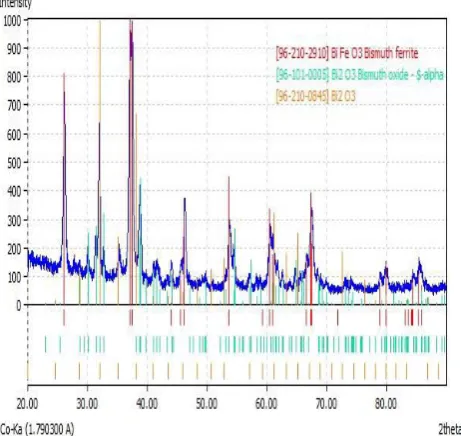
[image:3.595.310.544.357.579.2]To confirm the formation of BiFeO3 phase, it is performed XRD test for all samples and the results are shown in Figures 3, 4 and 5
Figure-3. XRD pattern of BiFeO3 powder at sintering of 450 oC for 10 hours.
Figure-4. XRD pattern of BiFeO3 powder at sintering of 500 oC for 10 hours.
Figure-5. XRD pattern of BiFeO3 powder at sintering of 550 oC for 10 hours.
Figure 3, 4 and 5 shows that there is an impurity phase Bi2O3 for powder at sintering temperature of 450 oC and 500 oC for 10 hours. There is no impurity phase at sintering temperature of 550 oC for 10 hours. It has 100% BiFeO3 phase. Bi2O3 phase is formed because there are a number of Bi3+ ions which is not soluble and reoxidized into Bi2O3 during temperature of 450 oC – 500 oC.
[image:3.595.54.285.453.671.2]Figure-6. Particle size distribution of sintering at 450 oC for 10 hours.
Figure-7. Particle size distribution of sintering at 500 oC for 10 hours.
Figure-8. Particle size distribution of sintering at 550 oC for 10 hours.
Figure 6, 7 and 8 show that BiFeO3 powder at sintering temperature of 550 oC has the smallest particle of 65 nm. The lower sintering temperature, the greater particle size. It could be seen that there is a relation between particle size and phase composition as shown in Table-1.
Table-1. Particle size and phase composition of BiFeO3 powder.
Sinter Process
BiFeO3
Phase (%)
Bi2O3
Phase (%)
Particle Size (nm) 450 oC
10 hours 56 44 82
500 oC
10 hours 92 8 72
550 oC
10 hours 100 0 65
Table-1 shows that BiFeO3 powder with the smallest particle has no impurity phase. However all samples with sintering temperature 450 oC, 500 oC and 550 oC are nanoparticle powder due to particle size < 100 nm.
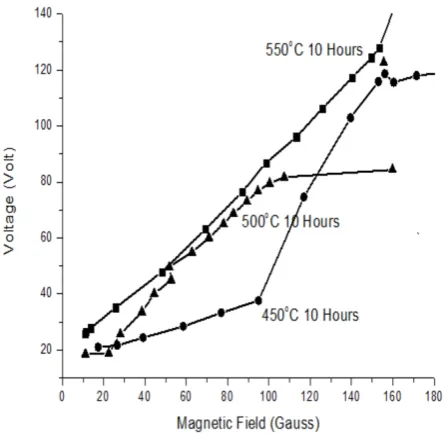
[image:4.595.56.280.330.505.2]Magneto Electric (ME) coupling is one of the characteristics of multiferroic material. To know whether there is ME coupling, it will shows electric voltage response when the powder is given an external magnetic field. The response is shown in Figure-9.
Figure-9. The electric voltage response of BiFeO3 at 450 o
C, 500 oC and 550 oC.
[image:4.595.310.534.479.698.2]powerful multiferroic properties when given external magnetic field. The weakest multiferroic properties owned by powder sintering temperature of 450 oC and 500 oC. Strong inter-phase contact in powder material certainly cause interactions around the surface of the crystal. The average size in the nanometer material causes the interact surface fraction will increase as well as with the decrease size of the grain size.
CONCLUSIONS
Sol-gel method at sintering temperature of 45oC - 550oC could produce nanoparticle and single phase BiFeO3, with the smallest particle owned by powder at sintering temperature of 550 oC for 10 hours. The powder has also single phase without impurity. The presence of residual phase Bi2O3 could decrease electric voltage response and increase particle size. All samples could apply as a multiferroic material due to given an external magnetic field around the sample provide a response in the form of electrical voltage effects.
ACKNOWLEDGEMENT
This research is supported financially by SINas research grant 2015 through letter of decree No. 147/M/Kp/IV/2015, Ministry for Research and Technology DIKTI, the Republic of Indonesia.
REFFERENCES
[1] J.M. Liu, V. Gao, G.L. Yuan, Y. Wang, M. Zeng, J.G. Wan, “Ferroelectric and Magnetoelectric Behaviors of Multiferroic BiFeO3 and Piezoelectric Magnetostrictive Composites”, Published online: 23 March 2007.
[2] T.H.O’ Dell, Electron Power 11, 266 (1965).
[3] L.P.M Bracke, R.G Van Vliet, Int. J. Electron 51, 255 (1981)
[4] Y.N. Venevtsev, V.V. Gagulin, Ferroelectrics 162, 23 (1994).
[5] M.I. Bichurin, Ferroelectrics 204, xvii (1997).
[6] J. Wang, J.B. Neaton, H. Zheng, Science 299, 1719 (2003).
[7] S.V. Kalinin, M.R. Suchomel, P.K. Davies, J.Am. Ceram. Soc. 85, 3011 (2002).
[8] Y.P. Wang, L.Zhou, M.F. Zhang, Appl. Phys. Let 84, 1731 (2004).
[9] A.K. Pradhan, K.Zhang, D.Hunter, J. Appl.Phys. 97,093903 (C2005).
[10]V.R. Palkar, D.C Kundaliya, S.K. Malik, Phys. Rev. B 69, 212102 (2004).
[11]S. Ghosh, S. Dasgupta, A. Sen, J. Am. Ceram. Soc. 88, 1349 (2005).
[12]D. Suastiyanti, B. Soegijono, M. Hikam, “Magnetic Behaviors of BaTiO3-BaFe12O19 Nanocomposite Prepared by Sol-gel Process Based on Differences in Volume Fraction”, Advanced Materials Research, vol. 789, pp. 118-123, 2013.
[13]J. Lin, Y. Zeng, C. Guo, W. Zhang, X. Yang, “One Step Synthesis of Barium Hexaferrite Nano Powders via Microwave Assisted Sol – gel Auto Combustion”, Elsevier Science Direct Ceramics International, vol. 30, pp. 993-997, 2010.