The Impact of the “Internet of Things” On Value
Creation for Stakeholders
Dr. A. Seetharaman *, Nitin Patwa **, A.S.Saravanan ***, Ashok Anand ****
*
Dean, Academic Affairs
**
Director of Simulations
***
Senior Lecturer, Taylors’ University, Malaysia
****
P G Scholar
Abstract- This study focuses on identifying the factors that influence the adoption of the internet of things that create value for stakeholders. The key factors identified as visibility, security, organization and data management. A survey of various industry participants in America, Asia Pacific/Australia, Europe and Middle East/Africa was performed to check the influence of the above factors in value creation and adoption of the internet of things. ADANCO 2.0 software (PLS-SEM) tool was used to analyse the surveyed data and to construct a structural equation model. The results of the study show that visibility, security, organization and data management create value for stakeholders in the form of business intelligence, integrity and trust, fair and equitable sharing of benefits among negotiating protocols and enhancement of productivity. Study influences the adoption of the internet of things from the point of value creation. This will enhance the competitive edge of businesses and will help in retaining existing customers and in the creation of new customers. As more enterprises adopt the internet of things, there is a scope for research on user experience of the internet of things.
Index Terms- Internet of things, Value creation, Visibility, Security, Organisation and Data Management
I. INTRODUCTION
he internet of things is one of the promising, technological evolutions of the internet. It connects devices and humans. The internet of things opens up new opportunities for enterprises to create value for stakeholders. Internet penetration and web devices are enabling the growth of the internet of things. Interconnected devices provide opportunities for businesses to deliver product-service content over the internet (Borgia, 2014). Estimates suggest that real business opportunity enabled by the internet of things will be worth $7.1 trillion by 2020 (IDC, 2014). Early forms of connected devices like RFID helped to improve operational efficiency (Delen, Hardgrave, & Sharda, 2007). The internet of things will involve many stakeholders like device manufacturers, telecommunication operators, system integrators and users along the supply chain.
The internet of things has enabled monitoring of remote assets without deploying manpower at the site. It has enabled
remote monitoring of patients in the healthcare sector (Hussain et al., 2015). Smart cities will be developed based on the internet of things (Lau S.P et al., 2015).The internet of things will help to monitor and improve the efficiency of manufacturing shop floors (Y. Zhang et al., 2014). The internet of things deployed in a retail supply chain enhances visibility for suppliers who can avoid an out of stock situation (Bardaki et al., 2012). Internet of things will enable product-service integration (Young et al., 2011). Many of the above applications depend on the intelligence and real-time visibility provided by the internet of things. But the growth of the internet of things will bring in security, privacy and trust concerns (Sicari et al., 2015).
A literature review on the internet of things shows that the primary focus of earlier studies was on the benefits of the internet of things, as established through vignettes or case studies. Literature research also reveals that visibility, security, organization and data management are the factors that allowed these benefits. This paper builds on the previous research to establish whether the above factors are driving values for stakeholders and influencing the adoption of the internet of things. While analysing the limitations and scope for further research in the previous renowned articles, it is found that value creation by internet of things is an worthwhile area to do an in depth research. This research could be helpful to businesses who want to create new value for their stakeholders or add revenues streams to the organization through the internet of things.
II. LITERATUREREVIEW
There is an existing body of literature that examines the benefits of internet of things. Inherent factors such as visibility, security, organization and data management which are important for the adoption and value creation of the internet of things are cited. Table 1 provides a comparative summary of the findings from extant studies and finding for each variable is discussed with identification of value creation as scope for future research (Identified in six renowned articles on the subject).
Comparative findings from previous studies for the variables used and scope for future research
Author(s) Visibility Security Organization Data
management Customer value creation through the internet of things (IOT)
Scope for future research Boosa, Guenterb, Grotea, & Kinderc, 2013. Organization has visibility of product paths and data associated with it at finer levels. -Owner has the visibility to verify if the product is genuine.
Accountabilities and
responsibilities of actors have to be defined and the organization should be aware of this.
Variety and volume of data will introduce system complexity. IOT provides value to organization in improving the supply chain. It helps to detect counterfeit goods.
Empirical data of accountabilities and
responsibilities is presented. More research data is needed to establish these factors on value creation of the internet of things.
Pang, Chen, Han & Zheng, 2015a. Visibility of patient’s data can be monitored for necessary action remotely. Secure handling of health care records is a value of the extended health care system.
Device, hardware, software
integrated to deliver the service. This is one of the framework for IOT business model. Efficient data fusion is highlight of extended health care system.
Delivery of in-home health care services using the internet of things. Security and privacy of information will create value to stakeholders in the internet of things. This research finding is limited by one case study. Broad research on this dependency has to be established. Reaidy, Gunasekaran, & Spalanzani, 2015. Visibility of data from the decentralized warehouse help to arrive at the action.
Self-organization and negotiating protocols between agents based on completion and cooperation was established. Data from RFID, ambient intelligence, multi- agent system and enterprise
resource
planning were integrated to arrive at the action. Improve order fulfilment process. Improve reaction capabilities of decentralized warehouses. This exploratory research did not comprehend all issues of the internet of things. This research focused on organization and decision support mechanisms enabled by the internet of things. Shrouf & Miragliotta, 2015. Using IOT, energy consumed by production floor is visible. Framework to support the integration of energy information data into company information technology platform. Collection of energy information and integrating with existing information technology platform. IOT delivers energy efficient production practice. Collection and managing energy data is limited to one case study. More data and research is required on value creation and adoption of the internet of things. Bardaki et al.,
2012. Visibility of operations and supply chain. -Consumers value privacy and are apprehensive Organizational structure must support for successful Collection, filtering and aggregation mechanism of
IOT helped in better supply chain
performance,
about data being shared by retailers.
-Willing to forgo privacy if they attain valuable
benefit.
implementation of RFID.
data enables data accuracy which drives the value of the data.
promotional performance, reduction in waste and better operational performance. Customer satisfaction, product availability.
privacy of information and data management.
Bottani,
Montanari, & Volpi, 2010.
Real-time data gives visibility of logistics process that helps to optimize supply chain
management.
Reduction of safety stock level.
Reduction of bullwhip effect.
Only empirical evidence of real-time data on logistics
performance is cited.
More data can establish this on value creation.
2.1. Value Creation by the Internet Of Things
2.1.1. Retaining existing stakeholders.
Enterprises are looking at innovative solutions to leapfrog competition and retain existing stakeholders. The internet of things will enable new product-service offerings (Cheng, Choi & Yeung, 2012) built on existing product-centric offerings. This provides value beyond a stakeholder’s expectation.
2.1.2. Improve supply chain performance, improve cash cycle, reduce inventory.
The real-time visibility (Yingfeng et al., 2015) enabled by the internet of things will help with monitoring remote assets, improve logistics performance and improve overall supply chain performance (Bardaki et al., 2012). Visibility and monitoring of performance (Jakob et al., 2015) is an important value creation of the internet of things.
2.1.3. Competitive edge.
Enterprises can add value to their existing businesses by building on the core expertise. Hospitals offering remote monitoring of patients’ health (Pang et al., 2015a) are an addition in value to their existing inpatient and outpatient services. The internet of things enables product and service values (David Opresnik & Marco Taisch 2015) that will provide a competitive edge (G. Ray et al., 2004) over competitors. Extracting intelligence (W. Chung 2014) from data and acting on it will create value to organizations.
2.1.4. Implementation of the internet of things within time and budget.
Cost-benefit analysis of the internet of things will be a key factor in a stakeholder’s mind when implementing the internet of things. Standard and scalable platform will create great value for stakeholders (Ray et al., 2014) of the internet of things. Backward integration with existing enterprise platforms will help in reducing the risk (Sanjay Mathrani & Anuradha Mathrani (2013) optimizing resources and the timely delivery of solutions to stakeholders.
2.1.5. Sustenance of the internet of things.
Sustainability is an important value of businesses. New business models and infrastructure like smart cities (Zanella et al., 2014) built using the internet of things have to be sustainable and this is an important value to the stakeholders. An organization framework (Reaidy et al., 2015.) with negotiating protocols between the partners and well defined accountabilities of human and device roles will enable a sustainable business model.
2.2. Visibility
Visibility of assets, operation, and the supply chain is one of the key characteristics of the internet of things. The internet of things adds value to enterprises by improving the supply chain (Depeng et al., 2014). It helps to detect counterfeit goods (Boosa et al., 2013). In the healthcare sector, patients’ health status is monitored remotely for necessary action (Sung et al., 2013). It will enable smart cities in future (Fabrice et al., 2015). Real-time information, accuracy of information and product service intelligence are sub variables of the internet of things. In this study, these three sub variables are considered elements of the internet of things that create value for stakeholders.
2.2.1. Real-time information.
In today’s global supply chain, lack of real-time insight of operations and assets (Amy et al., 2015) costs businesses. Visibility provided by interconnected devices helps to understand lead times and reduce slack time for both retailer and supplier. Visibility of retailer behaviour of product handling improves logistics performance (Tsai & Tang, 2012) at the micro level. Interconnected devices provide real-time visibility of the supply chain (Delen et al., 2007) which is an important value delivered to the stakeholders.
2.2.2. Accuracy.
inventory and wastage is essential information for competitive operation (Vlachos, 2014). Early forms of the internet of things like RFID has a positive impact on supply chain performance, but accuracy of information was a challenge. The technology advancement achieved through the internet of things will improve the accuracy (Hongju et al., 2013) of information. These benefits are a source of sustainable competitive advantage.
2.2.3. Product-service intelligence.
A customer’s expressed and latent needs (Slater & Narver, 2004) have to be satisfied. Knowledge about customer behavior (M. García-Murillo & H. Annabi 2002) is one of the values brought about by the internet of things. Intelligence on demography and usage patterns of consumers (Evgeny et al., 2015) at the micro level (Winter, 2014) can help businesses customize product-service model (Choi, H.S & Rhee, W.-S. 2014).
H1: The visibility of operations has a significant contribution to value created by business intelligence for stakeholders in the internet of things.
2.3. Security
With the internet of things, sensor devices will proliferate in everyday life. The security of systems (Kuan et al., 2014) and information is important for internet of things. Habits, personalities, and preferences will be tracked and analysed by organizations seeking to sell their products. There will be benefits enjoyed by consumers, but at the same time, governance issues like privacy, legitimacy, and transparency will arise (Weber, 2013). Privacy-preserving savvy access (Banerjee et al., 2014) to the internet of things can deliver value to stakeholders. The security of the internet of things rides on three sub variables—privacy, integrity, and complexity. These sub variables will be of prime importance for driving values for stakeholders and its adoption.
2.3.1.Privacy.
The sensors associated with the internet of things will collect intelligence of the environment and behaviors surrounding humans. The internet of things brings great value to the healthcare industry by monitoring the condition of patients remotely. The data collected on the health conditions of patients must be handled securely (Pang et al., 2015a). There are privacy (Depeng et al., 2014) concerns regarding the early forms of the internet of things like RFID (Bose et al., 2009). Similarly, data collected from the consumers at a retail outlet will include habits of the consumers and their personal choices. Consumers may approve of sharing personal information to obtain some benefits (Bardaki et al., 2012).
2.3.2.Integrity.
Internet of things implementation will involve many partner organizations. The information will flow through these numerous partners. So there are chances that sensitive information may be shared with or without the partner’s knowledge. The trust between the parties (Yan, et al., 2014) will be of paramount importance in driving the adoption of the internet of things. The new micro details of the information brought about by the
internet of things will need an integrity information framework. The micro details captured by the internet of things and transacted for various purposes may violate the privacy of the citizenship (Winter, 2014) and this remains an issue that needs to be addressed by standards and governance.
2.3.3.Complexity.
The variety of devices connected over the internet will be vulnerable to problems of malware, and viruses (A. Zhang et al., 2014). Proprietary security solutions do not provide a comprehensive solution to the internet of things as the devices and technology associated changes over time and is also wide spread. Standard (José L. Hernández-Ramos et al., 2015) security protocols make the deployment easier and are an important factor for the adoption of the internet of things (Keoh, Kumar & Tschofenig, 2014). Performance (Rashwan et al., 2014) of security solutions also need to be scalable (Ray et al., 2014) to match growth in business.
H2: Security solutions have significant relationship with value created by integrity and trust for stakeholders in the internet of things.
2.4. Organization
The internet of things will involve the role (Harry et al., 2014) of sensors, devices and humans. Organizations need well defined roles and responsibilities (Giuseppe et al., 2014) for sensors and humans. Business ecosystems (Rong et al., 2015) must evolve for the successful growth of the internet of things. Organizational complexities (Philippe et al., 2011) with multiple partners will pose challenges. There are four sub variables impacting the organization framework for the internet of thing which are clear accountabilities, negotiating protocol between the partners, value-centric organization, and flexible organization.
2.4.1.Accountabilities.
Organizations gearing to take advantage of the internet of things will need to relook at the organization’s structure. Organizations should map out the actors and decision makers (Bin et al., 2013) to handle this continuous stream of data. Implementation of early forms of networked devices like RFID needed an organizational structure with accountabilities between the roles of humans and devices clearly defined (Boosa et al., 2013). Accountabilities will support and enhance security of the internet of things (Weber, 2011).
2.4.2.Negotiating protocol.
Different stakeholders have to come together to implement the internet of things as information will flow through different partners. There must be a clear definition concerning who owns the data and who is transacting the data. Negotiating protocol based on competition and collaboration has to be established (Reaidy et al., 2015). Objectives of partners and the overall objective of the value chain will be met effectively only if hierarchal decision protocols are established (Luo, Fang & Huang, 2015).
Early forms of the internet of things like RFID and POS systems were mostly used in the traceability of items. With the advent of internet of things, value creation to stakeholders and businesses will be beyond traceability (Pang et al., 2015b). To achieve this, organizations must be structured around value. People-centric frameworks enable efficient delivery of healthcare for the elderly (Hussain et al., 2015). Value-centric organization will help stakeholders gain the full benefit of the internet of things.
2.4.4.Flexible organization.
The ambience or performance that is tracked using the internet of things will be real time. This real-time data needs quick decision making and action. Cognitive agility (X. Li et al., 2008) of an organization should be built in (Good, 2014) to deal with this real-time data. When new data points are collected and integrated into an existing enterprise platform (Mumtaz Abdul Hameed et al., 2015), organizations need to innovate, adapt to the new input (Shrouf & Miragliotta, 2015) and should device methods to react to the new inputs.
H3. Organization framework supporting sustainability has a significant contribution by fair and equitable sharing of benefits to value created for stakeholders in the internet of things.
2.5. Data Management
Data management of the internet of things is different from a traditional database. A traditional data type is that of storage and retrieval. Internet of things data is dynamic (Minbo et al., 2015) heterogeneous and streamed in volumes from a variety of devices (Abu-Elkheir et al., 2013). Information framework (Li et al., 2012) to share information and make intelligent decision (Z.X. Guo, et al., 2015) is important. Efficient management of data in smart communities (Monika Mital et al., 2015) will be important. Volume, variety and integration of data are important sub variables impacting data management of the internet of things.
2.5.1Volume and variety of data.
The internet of things will bring in a continuous stream of data (Christian et al., 2015) from various devices, located in remote locations. Data such as video streaming (Denis et al., 2014) volume will be huge to collect, store and analyze. Data processing has to modeled and automated to provide accurate information on time (Delen et al., 2007). Harnessing this huge volume of data (J. Fan et al., 2014) will be challenge, but will be important for decision making. The internet of things will collect data through various types of sensors and devices. Data collected from these devices are heterogeneous (Yi et al.,
2014).Technology to handle this heterogeneous data and the mining of it is evolving (Gebremeskel et al., 2015). Efficient handling of heterogeneous data for insightful action is of value to stakeholders (Ji et al., 2015).
2.5.2. Data integration.
The variety and volume of data from various devices should be integrated, and insightful information has to be derived for value creation (Amir Gandomi & Murtaza Haider 2015). Innovation in supply chain can be done by harnessing data (Kim Hua Tan et al., 2015). New data from the internet of things has to be integrated with existing enterprise application (Reaidy et al., 2015) to achieve the full benefit of an internet of things. Integration of data and algorithms to analyze (Benjamin et al., 2014) this data will enable the cognitive decision making ability of an organization (Kaur & Sood, 2015).
H4. Data management has a significant influence on the value created by enhancing productivity for stakeholders in the internet of things.
III. RESEARCHMETHODOLOGY
The research was developed based on primary data collection and secondary data collection. Secondary data collection was based on a literature review of 75 listed in ISI Thomson Reuters. The core independent variables that created value for stakeholders in the internet of things were identified through the literature review.
3.1. Data Collection
A survey questionnaire was used for the collection of primary data. The survey questionnaire was prepared and piloted with 20 industry experts. Industry experts included participants from various industry sectors who touch base with the internet of things or who are exploring the adoption of this technology in their organization. Personal interviews with some of these experts and their feedback were used to modify and arrive at the final questionnaire. A Likert scale was used to measure indicators. A five-point scale reference, with one indicating strongly disagree and five indicating strongly agree, was used.
The survey was sent to 970 industry participants in America, Asia Pacific/Australia, Europe, Middle East/Africa who were functional experts in various industry sectors. The usable responses of 203 were chosen for the study, out of 241 responses received. The demography of respondents of the survey is detailed below in Table 2:
Table 2: Demographic breakdown of respondents (n=203)
Item Measure Frequency Percentage
Consumer/home appliance 27 13%
Energy 10 5%
Food and Beverage 9 4%
Health care/pharmaceuticals 13 6%
Industrial/Automation 23 11%
IT/hardware/software 53 26%
Retail/Hospitality 11 5%
Security and public safety 4 2%
Telecommunications 20 10%
Transport/Automotive 22 11%
Function Business unit/Sales & Marketing 14 7%
Data management/analytics 59 29%
IT infrastructure/Platform/System/Software/hardware 107 53%
Supply chain/Operation 23 11%
Role Developing hardware/software for it 16 8%
Exploring or talking about it 99 49%
Implementer 3 1%
No role 3 1%
Touch base with IOT service flow 55 27%
User 27 13%
Role in the internet of things Doing business on internet of things 6 3%
Has a plan to implement 16 8%
Has implemented it (including early forms of
technology) 58 29%
Has not thought about it 4 2%
Some conversation about it 119 59%
Region Americas 5 3%
Asia Pacific/Australia 146 72%
Europe 17 8%
Middle East/Africa 35 17%
IV. DATAANALYSIS
ADANCO 2.0 was used to analyze the data collected from primary research. ADANCO 2.0 is a structural equation modeling tool. ADANCO was used to build the research framework and test the hypothesis (Ringle, Wende, & Will, 2005). ADANCO uses a composite based modeling approach to test the theories. ADANCO tests the model without imposing a normality condition of the data (Hulland, 1999). A two-step analysis was done. The first step was to assess the quality of measures of the structural model. Reliability and validity of the measures were also performed during this step (Sekaran & Bougie, 2010). The second step was to fit the model, perform path analysis and estimate the model parameters.
4.1. Reliability
The reliability of the model indicates the internal consistency of the constructs. This is assessed by a Cronbach alpha value. Cronbach alpha value greater than 0.6 is a good indicator of reliability (Hair et al., 2012). Jöreskog's rho known as composite reliability is also an indicator of reliability of construct (Wertz, Linn, & Jöreskog, 1974). Composite reliability values greater than 0.7 are an indicator of reliable and homogenous construct. For this model, the Cronbach value is
greater than 0.7, Jöreskog’s rho value is greater than 0.7, and Dijkstra-Henseler’s rho (ρA) value is greater than 0.7. This indicates that the construct is reliable.
4.2. Convergent Validity
Variable indicators are measured by convergent validity. It is a measure of conformity between scores. Convergent validity value is used to test the construct validity. For each construct, average variance extracted (AVE) should be above 0.5 (Barclay et al., 1995). As indicated in Table 3, the minimum AVE value is 0.6175, which is above 0.5 as required. The measurement model satisfies convergent validity requirements.
4.3. Discriminant Validity
[image:7.612.79.540.361.443.2]Discriminant validity values indicate the degree of discrimination between variables. ADANCO evaluates discriminant validity by comparing the measured value for each variable with other constructs. Square root of the AVE value should be greater than the AVE of other variables (Fornell & Larcker, 1981). Table 4 shows the results of the discriminant validity testing. Square root of AVE is greater than AVE of other variables, so the discriminant validity is proven.
Table 4: Discriminant validity
Construct Visibility Security Value creation Organization Data mgmt
Visibility 0.6938
Security 0.0000 0.6663
Value creation 0.4285 0.1326 0.7353
Organization 0.0259 0.0174 0.3336 0.6175
Data Mgmt. 0.5927 0.0016 0.4569 0.0827 0.6975
4.4. Structural equation modeling
ADANCO 2.0 is the structural equation modelling (SEM) software tool used to test the hypothesis. Theoretically linear and additive causal models are tested using second generation multivariate analysis tools like SEM. An unknown population can be modelled using bootstrapping methods (Hesterberg et al., 2003). Level of significance is tested using t-Statistic values. The
significance levels (p-values) and corresponding t-values (Cowles & Davis, 1982; Neyman & Pearson, 1933).
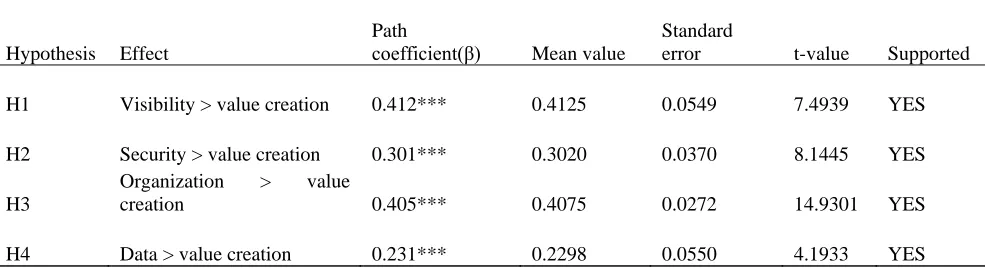
Four hypotheses were tested in our research. The outcome of the hypothesis testing was tested against the t- values. The results are tabulated in table 5
Table 5: Results of hypothesis testing
Hypothesis Effect
Path
coefficient(β) Mean value
Standard
error t-value Supported
H1 Visibility > value creation 0.412*** 0.4125 0.0549 7.4939 YES
H2 Security > value creation 0.301*** 0.3020 0.0370 8.1445 YES
H3
Organization > value
creation 0.405*** 0.4075 0.0272 14.9301 YES
H4 Data > value creation 0.231*** 0.2298 0.0550 4.1933 YES
[image:7.612.61.554.595.729.2]V. RESEARCHFINDINGS
The first hypothesis H1 tests the effect of visibility to value creation by the internet of things. The effect of visibility (7.4939) is highly significant as the t-value indicates the confidence interval more than 99%. Thus H1 (β = 0.412, P < 0.01) is supported. This indicates that visibility of assets and operations have significant contributions to value creation by business intelligence for stakeholders, whereas the earlier study (Zhou, Chong, & Ngai, 2015) found that the supply chain was benefitted by the visibility of operations provided by the internet of things. The second hypothesis H2 tests the effect of security to value creation by the internet of things. The effect of security (8.1445) is highly significant as the t-value indicates the confidence interval more than 99%. Thus H2 (β = 0.301, P < 0.01) is supported. This indicates that security solutions provided to protect systems and the privacy of information have significant relationship to value creation by integrity and trust for stakeholders in the internet of things, whereas an earlier study (Rodrigo Roman et al., 2013) found that standard security and privacy were important features and challenges of the internet of things.
The third hypothesis H3 tests the effect of organization to value creation by the internet of things. The effect of organization (14.93) is highly significant as the t-value indicates
the confidence interval more than 99%. Thus H3 (β = 0.405, P < 0.01) is supported. This indicates that an organization framework supporting sustainability has a significant contribution to the value creation by fair and equitable sharing of benefits for stakeholders in the internet of things, whereas an earlier study found (Shin, 2014) that a socio-technical organization framework helped in sustaining the internet of things.
The fourth hypothesis H4 tests the effect of data management on value creation by the internet of things. The effect of data management (4.1933) is very significant as the t-value indicates the confidence interval more than 99%. Thus H4 (β = 0.231, P < 0.01) is supported. This indicates that data management has a significant influence on value creation by enhancing productivity for stakeholders in the internet of things, whereas an earlier study (Abu-Elkheir, M et al., 2013) found solutions to data management and harnessing the benefits from the internet of things.
All the findings of this study are new contributions to the body of knowledge beyond the earlier findings discussed above regarding each hypothesis. The result of the bootstrapped structural model is shown in Figure 1. The path coefficients are displayed with all paths showing significant correlation between dependent and independent variables.
VI. IMPLICATIONSOFTHEINTERNETOFTHINGSTO STAKEHOLDERS
The key factors of the internet of things—visibility, security, organization and data management— deliver new values to stakeholders and strongly influence the adoption of the internet of things. Visibility of operations will create opportunities for product- service revenue streams for the enterprises. This will enhance the competitive edge of businesses and will help in retaining existing customers and in the creation of new customers. Standardized security platforms that are scalable will help speed up the adoption of the internet of things, as businesses do not need to worry about the complexity of implementing it, but rather can focus on their business objective. The internet of things will create real-time information which streams continuously. Organizations must be geared up to absorb
the information deluge and respond to it. Organizations must be flexible with effective negotiating protocols in place for good decision making. These characteristics of cognitive organization will create new values for stakeholders. The internet of things will create a huge volume and variety of data. Intelligent algorithms to harness this data automatically without human intervention will create value for the stakeholders and hence strongly influence the adoption of it.
VII. LIMITATIONSANDSCOPEFORFUTURE
RESEARCH
there is no data on user experience of the internet of things. This could be due to the nascent stage of the Internet of things. As more enterprises adopt the internet of things, there is a scope for research on user experience of the internet of things.
VIII. CONCLUSION
The internet of things will be a natural evolution of the internet. Visibility, security, organization and database management are key factors in creating values to stakeholders and influence adoption of the internet of things. Our research shows that all these factors have equally influenced the adoption of the internet of things. The above factors are the building blocks upon which enterprises will innovate and build differentiating values for their stakeholders. To date, many enterprises are evaluating and waiting to make the first move to harness and deliver unique value, using the internet of things. Eventually it will happen.
REFERENCES
[1] Abu-Elkheir, M., Hayajneh, M., & Ali, N. A. (2013). Data management for the Internet of Things: Design primitives and solution. Sensors, 13(11), 15582–15612.
[2] Amir Gandomi, Murtaza Haider (2015). Beyond the hype: Big data concepts, methods, and analytics. International Journal of Information Management, 35(2), 137–14.
[3] Amy J.C. Trappey, Charles V. Trappey, Lin Ma, Jimmy C.M. Chang (2015). Intelligent engineering asset management system for power transformer maintenance decision supports under various operating conditions. Computers & Industrial Engineering,84, 3-11.
[4] Banerjee, D., Dong, B., Taghizadeh, M., & Biswas, S. (2014). Privacy-preserving channel access for Internet of Things. Internet of Things Journal,
IEEE, 1(5), 430–445.
[5] Barclay, D. W., Thompson, R., & Higgins, C. (1995). The partial least squares (PLS) approach to causal modelling: personal computer adoption and use an illustration. Technology Studies, 2(2), 285–309.
[6] Bardaki, C., Kourouthanassis, P., & Pramatari, K. (2012). Deploying RFID-Enabled Services in the Retail Supply Chain: Lessons Learned toward the Internet of Things. Information Systems Management, 29, 233–245. [7] Benjamin T. Hazen, Christopher A. Boone, Jeremy D. Ezell, L. Allison
Jones-Farmer (2014). Data quality for data science, predictive analytics, and big data in supply chain management: An introduction to the problem and suggestions for research and applications. International Journal of Production Economics,154, 72-80.
[8] Bin Guo, Daqing Zhang, Zhu Wang, Zhiwen Yu, Xingshe Zhou, Opportunistic IoT (2013). Exploring the harmonious interaction between human and the internet of things. Journal of Network and Computer Applications, 36(6), 1531-1539.
[9] Boosa, D., Guenterb, H., Grotea, G., & Kinderc, K. (2013). Controllable accountabilities: The Internet of Things and its challenges for organisations.
Behaviour & Information Technology,32(5), 449–467.
[10] Borgia, E. (2014). The Internet of Things vision: Key features, applications and open issues. Computer Communications, 54(1), 1–31.
[11] Bose, I., Ngai, E. W. T., Thompson, S. H. T., & Spiekermann, S. (2009). Managing RFID projects in organizations. European Journal of Information Systems, 18, 534–540.
[12] Bottani, E., Montanari, R., & Volpi, A. (2010). The impact of RFID and EPC network on bullwhip effect in the Italian FMCG supply chain. International Journal of Production Economics, 124(2), 426–432. [13] Browne, M. W., & Cudeck, R. (1993). Alternative ways of assessing model
fit. Sage Focus Editions, 15, 136-162.
[14] Chang-Su, K., Son, B. G., & Bourlakis, M. (2012). Factors affecting successful adoption of ubiquitous computing technology in supply chain contexts. International Journal of Logistics Management, 23(2), 280–306.
[15] Cheng, T. C. E., Choi, T. M., & Yeung, A. C. L. (2012). An introductory essay: Creating a competitive edge in operations and service management through technology and innovation. Journal of Engineering and Technology Management, 29(1), 1–2.
[16] Choi, H.-S., & Rhee, W.-S. (2014).”IOT-Based User-Driven Service Modeling Environment for a Smart Space Management System.” Sensors (Basel, Switzerland),14(11), 22039–22064.
[17] Christian Esposito, Massimo Ficcob, Francesco Palmieri, Aniello Castiglionec (2015). A knowledge-based platform for Big Data analytics based on publish/subscribe services and stream processing. Knowledge-Based Systems.79, 3–17.
[18] Cowles, M., & Davis, C. (1982). On the origins of the .05 level of statistical significance. American Psychologist,37(5), 553–558.
[19] David Opresnik, Marco Taisch (2015). The value of Big Data in servitization. International Journal of Production Economics, 165, 174-184. [20] Delen, D., Hardgrave, B. C., & Sharda, R. (2007). RFID for better supply-chain management through enhanced information visibility. Production and Operations Management, 16(5), 613–624.
[21] Denise Lund, Carrie MacGillivray, Vernon Turner, Mario Morales (2014). Worldwide and Regional Internet of Things (IoT) 2014–2020 Forecast: A Virtuous Circle of Proven Value and Demand. IDC 2014.
[22] Denis Rosário, Zhongliang Zhao, Aldri Santos, Torsten Braun, Eduardo Cerqueira (2014). A beaconless opportunistic routing based on a cross-layer approach for efficient video dissemination in mobile multimedia IOT applications. Computer Communications, 45(1), 21-31.
[23] Depeng Li; Aung, Z.; Williams, J.; Sanchez, A. (2014). Privacy Preservation Protocol for Automatic Appliance Control Application in Smart Grid." Internet of Things Journal, IEEE,1(5), 414-429.
[24] Duncan McFarlane, Yossi Sheffi, (2003). The Impact of Automatic Identification on Supply Chain Operations. The International Journal of Logistics Management,14(1), 1.
[25] Edson Avelar, Lorena Marques, Diego dos Passos, Ricardo Macedo, Kelvin Dias, Michele Nogueira (2015). Interoperability issues on heterogeneous wireless communication for smart cities. Computer Communications, 58, 4-15.
[26] Evgeny Khorov, Andrey Lyakhov, Alexander Krotov, Andrey Guschin (2015). A survey on IEEE 802.11ah: An enabling networking technology for smart cities. Computer Communications,58, 53-69.
[27] Fabrice Theoleyre, Thomas Watteyne, Giuseppe Bianchi, Gurkan Tuna, V. Cagri Gungor, Ai-Chun Pang ( 2015). Networking and communications for smart cities special issue editorial. Computer Communications”. 58, 1-3. [28] Fornell, C., & Larcker, D. (1981). Evaluating structural equitation models
with unobservable variables and measurement errors. Journal of Marketing Research, 18(1), 39–50.
[29] Gebremeskel, G. B., Yi, C., Wang, C., & He, Z. (2015). Critical analysis of smart environment sensor data behaviour pattern based on sequential data mining techniques. Industrial Management & Data Systems, 115(6), 1151– 1178.
[30] Giuseppe Colistra, Virginia Pilloni, Luigi Atzori (2014). The problem of task allocation in the Internet of Things and the consensus-based approach.
Computer Networks,73, 98-111.
[31] Good, D. (2014). Predicting real-time adaptive performance in a dynamic decision-making context. Journal of Management & Organization,20, 715– 732.
[32] G. Ray, J.B. Barney, W.A. Muhanna, (2004). Capabilities, business processes, and competitive advantage: choosing the dependent variable in empirical tests of the resource-based view. Strategic Management Journal, 25 (1), 23–37.
[33] Hair, J. F., Sarstedt, M., Pieper, T. M., & Ringle, C. M. (2012). The use of partial least squares structural equation modelling in strategic management research: a review of past practices and recommendations for future applications. Long Range Planning, 45(5/6), 320–340.
[34] Harry Scarbrough, Nikiforos S. Panourgias, Joe Nandhakumar (2014). Developing a Relational View of the Organizing Role of Objects. A study of the innovation process in computer games Organization Studies.197-220. [35] Hesterberg, T., Moore, D.S., Monaghan, S., Clipson, A., & Epstein, R.
[36] Hulland, J. (1999). Use of partial least squares (PLS). Strategic management research: a review of four recent studies. Strategic Management Journal, 20(4), 195–204.
[37] Hongju Cheng, Ronglie Guo, and Yuzhong Chen (2013). “Node Selection Algorithms with Data Accuracy Guarantee in Service-Oriented Wireless Sensor Networks”. International Journal of Distributed Sensor Networks, Article ID 527965, 14 pages.
[38] Hussain, A., Wenbi, R., da Silva, A., Nadher, M., & Mudhish, M. (2015). Health and emergency-care platform for the elderly and disabled people in the Smart City. Journal of Systems and Software, 110, 253–263.
[39] Ji, M., He, Q., Han, J., & Spangler, S. (2015). Mining strong relevance between heterogeneous entities from unstructured biomedical data. Data Mining and Knowledge Discovery, 29(4), 976–998.
[40] Jakob Pilegaard Juul, Ole Green, Rune Hylsberg Jacobsen (2015). Deployment of Wireless Sensor Networks in Crop Storages.Wireless Personal Communications, 81(4), 1437-1454.
[41] J. Fan, F. Han, H. Liu, (2014). Challenges of big data analysis. National Science Review, 1 (2), 293–314.
[42] José L. Hernández-Ramos, M. Victoria Moreno, Jorge Bernal Bernabé, Dan García Carrillo, Antonio F. Skarmeta (2015). “Secure access framework for IOT-enabled services on smart buildings”. Journal of Computer and System Sciences, 81(8), 1452-1463.
[43] Kaur, N., & Sood, S. K. (2015). Cognitive decision making in smart industry. Computers in Industry, 74, 151–161.
[44] Keoh, S. L., Kumar, S. S., & Tschofenig, H. (2014). Securing the Internet of Things: A standardization perspective. Internet of Things Journal, IEEE,
1(3), 265–275.
[45] Kim Hua Tan, YuanZhu Zhan, Guojun Ji, Fei Ye, Chingter Chang (2015). Harvesting big data to enhance supply chain innovation capabilities: An analytic infrastructure based on deduction graph. International Journal of Production Economics, 165, 223.
[46] Kuan Zhang; Xiaohui Liang; Rongxing Lu; Xuemin Shen (2014). Sybil Attacks and Their Defenses in the Internet of Things". Internet of Things
Journal, IEEE,1(5), 372.
[47] Lau, S. P., Merrett, G. V., Weddell, A. S., & White, N. M. (2015). A traffic-aware street lighting scheme for Smart Cities using autonomous networked sensors. Computers & Electrical Engineering, 45, 192–207.
[48] Li, Y., Hou, M., Liu, H., & Liu, Y. (2012). Towards a theoretical framework of strategic decision, supporting capability and information sharing under the context of internet of things. Information Technology and Management, 13(4), 205-216.
[49] Luo, H., Fang, J., & Huang, G. Q. (2015). Real-time scheduling for hybrid flow shop in ubiquitous manufacturing environment. Computers & Industrial Engineering, 84, 12–23.
[50] M. García-Murillo and H. Annabi (2002). Customer Knowledge Management. The Journal of the Operational Research Society,53(8), 875-884.
[51] Minbo Li, Yanling Liu, and Yuanfeng Cai (2015). A Dynamic Processing System for Sensor Data in IOT. International Journal of Distributed Sensor Networks Article ID 750452, 10 pages.
[52] Monika Mital, Ashis K. Pani, Suma Damodaran, Ram Ramesh (2015). Cloud based management and control system for smart communities. A practical case study. Computers in Industry, 74, 162-172.
[53] Mumtaz Abdul Hameed, Steve Counsell, Stephen Swift (2015). A conceptual model for the process of IT innovation adoption in organizations. Journal of Engineering and Technology Management, 29(3), 358-390.
[54] Neyman, J., & Pearson, E.S. (1933). The testing of statistical hypotheses in relation to probabilities a priority. Mathematical Proceedings of the Cambridge Philosophical Society, 29, 492–510.
[55] Pang, Z., Zheng, L., Junzhe, T., Kao-Walter, S., Dubrova, E., & Chen, Q. (2015a). Design of terminal solution of in home health care devices and services towards the internet of things. Enterprise Information System, 9(1), 86–116.
[56] Pang, Z., Chen, Q., Han, W., & Zheng, L. (2015b). Value-centric design of the internet-of-things solution for food supply chain: Value creation, sensor portfolio and information fusion. Information Systems Frontiers, 17(2), 289-319.
[57] Philippe Lorino, Benoit Tricard, Yves Clot (2011). Research Methods for Non-Representational Approaches to Organizational Complexity: The Dialogical Mediated Inquiry. Organization Studies June 2011 32: 769-801. [58] Rashwan, A.M.; Taha, A.-E.M.; Hassanein, H.S (2014). Characterizing the
Performance of Security Functions in Mobile Computing Systems. Internet
of Things Journal, IEEE, 1(5), 399-413.
[59] Ray, B. R., Abawajy, J., & Chowdhury, M. (2014). Scalable RFID security framework and protocol supporting Internet of Things. Computer Networks,
67, 89–103.
[60] Reaidy, P. J., Gunasekaran, A., & Spalanzani, A. (2015). Bottom-up approach based on Internet of Things for order fulfilment in a collaborative warehousing environment. International Journal of Production Economics,
159, 29–40.
[61] Rong, K., Hu, G., Lin, Y., Shi, Y., & Guo, L. (2015). Understanding business ecosystem using a 6C framework in Internet-of-Things-based sectors. International Journal of Production Economics, 159, 41–55. [62] Ringle, C.M., Wende, S., & Will, A. (2005). SmartPLS 2.0 M3 (beta).
University of Hamburg, (accessed 22 April, 2014).
http://www.smartpls.de/documentation/partial-least-squares-algorithm. [63] Roman, R., Zhou, J., & Lopez, J. (2013). On the features and challenges of
security and privacy in distributed internet of things. Computer Networks,
57(10), 2266–2279.
[64] Sekaran, U., & Bougie, R. (2010). Research methods for business: A skill building approach. Chichester, UK: Wiley.
[65] Shin, D. (2014). A socio-technical framework for Internet-of-Things design: A human-centred design for the Internet of Things. Telematics and Informatics, 31(4), 519–531.
[66] Shrouf, F., & Miragliotta, G. (2015). Energy management based on internet of things: Practices and framework for adoption in production management.
Journal of Cleaner Production, 100, 235–246.
[67] Sicari, S., Rizzardi, A., Grieco, L. A., & Coen-Porisini, A. (2015). Security, privacy and trust in Internet of Things: The road ahead. Computer Networks, 76, 146–164.
[68] Slater, S. F., & Narver, J. C. (2000). Intelligence generation and superior customer value. Journal of the Academy of Marketing Science, 28(1), 120– 127.
[69] Sung, W. T., & Chang, K. Y. (2013) Evidence-based multi-sensor information fusion for remote health care systems. Sensors and Actuators A: Physical, 204(15), 1–19.
[70] Tsai, W. C., & Tang, L. L. (2012). A model of the adoption of radio frequency identification technology: The case of logistics service firms.
Journal of Engineering and Technology Management, 29(1), 131–151. [71] Vlachos, L. P. (2014). A hierarchical model of the impact of RFID practices
on retail supply chain performance. Expert Systems and Application, 41(1), 5–15.
[72] W. Chung (2014). Extracting and categorizing business intelligence factors from textual news articles. International Journal of Information Management, 34(2), 272–284.
[73] Weber, R. H. (2013). Internet of things–Governance quo Vadis. Computer Law & Security Review, 29(4), 341–347.
[74] Weber, R. H. (2011). Accountability in the Internet of things. Computer Law & Security Review, 27 (2), 133–138.
[75] Weber, R. H. (2009). Internet of things–Need for a new legal environment.
Computer Law & Security Review, 25(6), 522–527.
[76] Wertz, C., Linn, R., & Jöreskog , K. (1974). Interclass reliability estimates: Testing structural assumptions. Educational and Psychological Measurement, 34(1), 25–33.
[77] Winter, J. S. (2014). Surveillance in ubiquitous network societies: Normative conflicts related to the consumer in-store supermarket experience in the context of the internet of things. Ethics and Information Technology, 16(1), 27–41.
[78] Yan, Z., Zhang, P., & Vasilakos, A. V. (2014). A survey on trust management for Internet of things. Journal of Network and Computer Applications, 42, 120–134.
[80] X. Li, C. Chung, T.J. Goldsby, C.W. Holsapple (2008) A unified model of supply chain agility: the work-design perspective. The International Journal of Logistics Management, 19 (3), 408–435.
[81] Yi Liu; Chau Yuen; Xianghui Cao; Hassan, N.U.; Jiming Chen (2014). Design of a Scalable Hybrid MAC Protocol for Heterogeneous M2M Networks. Internet of Things Journal, IEEE,1(1), 99.
[82] Yingfeng Zhang, Geng Zhang, Wei Du, Junqiang Wang, Ebad Ali, Shudong Sun, (2015). An optimization method for shop floor material handling based on real-time and multi-source manufacturing data. International Journal of Production Economics, 165, 282-292.
[83] Zanella, A.; Bui, N.; Castellani, A.; Vangelista, L.; Zorzi, M (2014). Internet of Things for Smart Cities. Internet of Things Journal, IEEE, 1(1), 22-32.
[84] Zhang, A. O., Antunes, H., & Aggarwal, S. (2014). Defending connected vehicles against malware: Challenges and a solution framework. Internet of
Things Journal, IEEE, 1(1), 10–21.
[85] Zhang, Y., Huang, G. Q., Sun, S., & Yang, T. (2014). Multi-agent based real-time production scheduling method for radio frequency identification enabled ubiquitous shop floor environment. Computers & Industrial Engineering, 76, 89–97.
[86] Zhong, R. Y., Huang, G. Q., Lan, S., Dai, Q.Y., Chen, X., & Zhang, T. (2015). A big data approach for logistics trajectory discovery from
RFID-enabled production data. International Journal of Production Economics,
165, 260–272.
[87] Zhou, L., Chong, A. Y. L., & Ngai, E. W. T. (2015). Supply chain management in the era of the internet of things. International Journal of Production Economics,159, 1–3.
[88] Z.X. Guo, E.W.T. Ngai, Can Yang, Xuedong Liang (2015). An RFID-based intelligent decision support system architecture for production monitoring and scheduling in a distributed manufacturing environment. International Journal of Production Economics, 159, 16-28.
AUTHORS
First Author – Dr. A. Seetharaman, Dean, Academic Affairs, [email protected]
Second Author – Nitin Patwa, Director of Simulations, [email protected]
Third Author – A.S.Saravanan, Senior Lecturer, Taylors’ University, Malaysia, [email protected]