A Confirmatory Factor Analysis of Knowledge
Management in Electricity Generation Process
Suwit Saisuthanawit
*, Dr.Athisarn Wayuparb
**, Dr.Panu Buranajarukorn
**
Industrial Engineering Department, Naresuan University **
School of Logistics and Supply Chain, Naresuan University
Abstract- The objectives of this research were to study the knowledge management process (KMP) and to validate the consistency of the KMP model in electricity generation process, by using a confirmatory factor analysis. Population in this study was the supervisors related to the operation and maintenance of power plants, with a total population of 1,555 persons. 635 sampling were selected by stratified random sampling. Instrument used in this study was questionnaire to evaluate the KMP level in the electricity generation process. All questions have the confidence to equal 0.9707; therefore, it can be used. Exploratory factor analysis using SPSS software, to explore a number of factors that are the KMP. The confirmatory factor analysis using AMOS. The results of this study shows that the KMP model in electricity generation process, consist of six constructs include knowledge identification, knowledge acquisition, knowledge creation, knowledge sharing, knowledge storage, knowledge transfer and utilization, all constructs model is valid and well fitted to empirical data, indicating that the constructs of knowledge management in electricity generation process is appropriate to fit the empirical data as well.
Index Terms- Knowledge management process, Electricity generation process, KMP, CFA, Power plant.
I. INTRODUCTION
owadays, many organizations focus on knowledge management (KM), which knowledge is important and regarded as a core strategy for the improvement of management and human resources performance in all organizations (Horwitch, et. al. ,2002). The current world is changing rapidly various organizations, whether public or private, they need to adapt to survive and thrive under changing environmental conditions. Organizations need to develop and the changes that occurred, resulting in organizations to focus on the knowledge base and the concept of KM has been implemented widely in the organization. Consequently, the field of KM continues to grow and deepen in regard to both practitioners and academics (Davenport and Prusak, 1998 , Moffett.S et. al. ,2009). The organization should be able to integrate employees gained knowledge by using of systematic knowledge management which properly suited with organization‟s culture. Demarest (1997) stated that the KM is the process which all employee of the organization can jointly learning, formal and informal learning. It also expanded the boundary of organization staff‟s knowledge, capacity, and innovate the new ideas by combining of their own knowledge and experiences and the transferred knowledge from other people. Consequently, organization staff, sharing their own vision in all levels of supervisors in friendly Climate, is the important key to organization improvement. The KM has to focus in on staff‟s process of identification, acquisition, creation, sharing, storage, transfer and utilization of knowledge at all time. the Electricity Generating Authority of Thailand (EGAT), by the Deputy Governor-Generation is then setting up its own vision as “to high excellent organization by emphasizing the importance of knowledge management to increase the competencies of personnel can lead to a resulting excellence within the organization level of knowledge management and learning”. The researchers studied in theories, concepts, and relevant researches for analyzing KMP in the electricity generation process of power plant. Consequently, the result of this study will be used as a guideline for developing, setting up the policies and plans in the electricity generation process of power plant soon. In this study, the six constructs of KMP -knowledge identification (KM_iden), knowledge acquisition (KM_acqu), knowledge creation (KM_crea), knowledge sharing (KM_share), knowledge storage (KM_store), knowledge transfer and utilization (KM_trans)), are analysis for the power plant of Thailand to understand KMP views towards these constructs.research objectives were to 1) to study the level of knowledge management process in electricity generation process of power plant. 2) to validate the consistency of the knowledge management process model in electricity generation process of power plant.
II. PREVIOUS STUDIES
Knowledge means experience, value, information, expertise and intuition used to set the environment and the framework. For evaluating to get experienced and new information have different methods for different people. Knowledge is obtainable from the document, work experience in the practices and beliefs of the organization (Davenport and Prusak, 1998). Personal knowledge in organization is required to manage efficiently. KM increases the effectiveness of the organization and helps create vitality and success within the organization by using the knowledge and ability to apply knowledge for innovation and leadership within organizations (Boyett J.H and Boyett J.T., 2001).
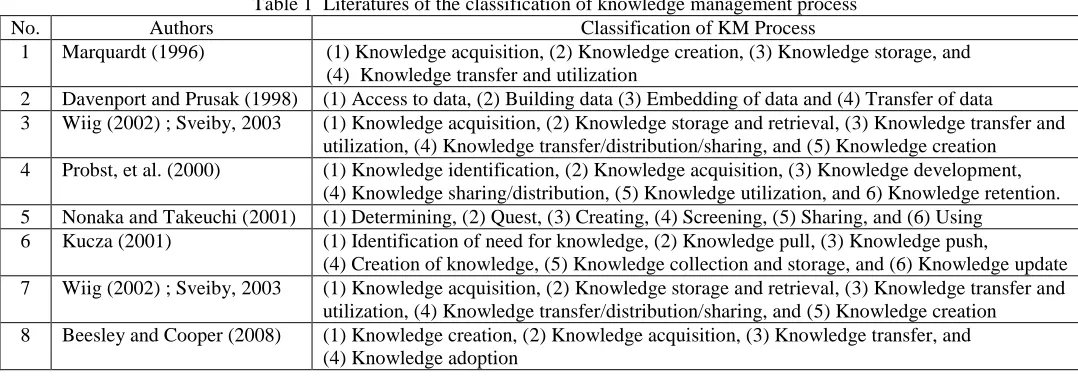
presented model of the process in the practice of KM processes. There are several literatures which divided the elements of KM processes. These examples are shown in Table 1.
Table 1 Literatures of the classification of knowledge management process
No. Authors Classification of KM Process
1 Marquardt (1996) (1) Knowledge acquisition, (2) Knowledge creation, (3) Knowledge storage, and (4) Knowledge transfer and utilization
2 Davenport and Prusak (1998) (1) Access to data, (2) Building data (3) Embedding of data and (4) Transfer of data
3 Wiig (2002) ; Sveiby, 2003 (1) Knowledge acquisition, (2) Knowledge storage and retrieval, (3) Knowledge transfer and utilization, (4) Knowledge transfer/distribution/sharing, and (5) Knowledge creation
4 Probst, et al. (2000) (1) Knowledge identification, (2) Knowledge acquisition, (3) Knowledge development, (4) Knowledge sharing/distribution, (5) Knowledge utilization, and 6) Knowledge retention. 5 Nonaka and Takeuchi (2001) (1) Determining, (2) Quest, (3) Creating, (4) Screening, (5) Sharing, and (6) Using
6 Kucza (2001) (1) Identification of need for knowledge, (2) Knowledge pull, (3) Knowledge push,
(4) Creation of knowledge, (5) Knowledge collection and storage, and (6) Knowledge update 7 Wiig (2002) ; Sveiby, 2003 (1) Knowledge acquisition, (2) Knowledge storage and retrieval, (3) Knowledge transfer and
utilization, (4) Knowledge transfer/distribution/sharing, and (5) Knowledge creation 8 Beesley and Cooper (2008) (1) Knowledge creation, (2) Knowledge acquisition, (3) Knowledge transfer, and
(4) Knowledge adoption
As a result, the researchers conclude that the synthesis elements of knowledge management process. There are many elements together. This study was concerned to use the component which were included:- 1) Knowledge identification - Identify needs and determine what they want to know; 2) Knowledge acquisition - Knowledge is useful both from within and outside the organization. It is the ability to learn by most people in organization; 3) Knowledge creation is to create new knowledge and it is able to use knowledge in different ways. 4) Knowledge sharing - The knowledge of the persons in the organization and shared throughout the organization both formal and informal; 5) Knowledge storage - Knowledge is stored and maintained in different ways and can be searched according to their needs properly and timely recorded in the database; and 6) Knowledge transfer – This process is necessary for the organization to learn to do better. Knowledge is distributed and transmitted quickly and approximately throughout the organization (Davenport and Prusak, 1998; Marquardt. 1996; Probst and Other, 2000; Nonaka and Takeuchi, 2001; Kucza, 2001; Wiig, 2002; Sveiby, 2003; Beesley and Cooper, 2008).
III. RESERCHMETHODOLOGY
This research tries to conduct quantitative survey in order to study KMP in electricity generation process in power plant. However, in this paper The KMP are knowledge identification, knowledge acquisition, knowledge creation, knowledge sharing, knowledge storage, knowledge transfer and utilization.
Population and sample group
This research covered the population and sample as follows: The population of this study consisted of 1,555 supervisors in electricity generation process of EGAT power plant in Thailand in the year of 2012. The sample of this study consisted of 635 supervisors in electricity generation process of power plant. It applied with the Table of Krejcle and Morgan (1970) by using stratified random sampling from 5 Power plant which were Maemoh Power Plant, Bangpakong Power Plant, Sirikit Dam Hydro Power Plant, Phumiphon Dam Hydro Power Plant, and Srinakarin Dam Hydro Power Plant.
Research Instrument
The instrument of this study was a questionnaire consisting of 3 main parts as: Part 1: the checklist of general information personal questions. Part 2: the rating scales of implementation KMP in electricity generation process according to the academics and previous research‟s framework, which are Knowledge Identification, Knowledge acquisition, Knowledge creation, Knowledge sharing, Knowledge storage, Knowledge transfer and utilization. There are 35 questions 5 levels rating scale which had reliability of 0.9707. Part 3: Suggestions and comments about this topic. The questionnaire validity, its content validity, was approved by experts and critics. The Cronbach alpha method that is one of the most important and most common methods was used to measure the reliability of the test. Because it was more than 0.7, the questionnaires were highly reliable
Data Collection and Analysis
[image:2.612.36.575.96.284.2]IV. RESULTS AND DISCUSSIONS
The following are results of statistical analysis of data based on research objectives of this research. The results of the descriptive analysis are presented as follows:
1. General information personal
[image:3.612.51.562.189.298.2]Table 2, it was found that 96.50 percentages of sample group were male while 3.50 percent were female respectively. Regarding educational background, it was discovered that 58.30 percentages of sample group held Lower than bachelor degree, 35.30 percent held Bachelor‟s degree and 6.50 percent had got Higher than bachelor degree respectively. When consider the experiences in job, the 84.60 percentages of sample group had more than 20 years job experience, on the other hand, there was 15.40 percentages of 1-20 years experience in job.
Table 2 Number and percentage of the questionnaire respondents, categorized by basic character of the sample group (n=635)
[image:3.612.31.562.333.444.2]2. Analysis KMP in electricity generation process.
Table 3 The mean () and standard deviation (S.D.) of supervisors‟ opinions concerning the level of KMP.
.
Table 3 showed that overall KMP in electricity generation process was at high level ( =3.71). The Means in each aspect were Knowledge Identification ( =3.82), Knowledge Acquisition ( =3.75), Knowledge Storage ( =3.73), Knowledge Transfer and Utilization ( =3.69), Knowledge Creation and Knowledge Sharing ( =3.64) respectively
3. Confirmatory factor analysis of KMP in electricity generation process.
The researchers used AMOS to analyze and validate the consistency of the KMP model in electricity generation process of power plant. A model is considered to be a good fit if the difference between the sample variances and covariances, and the implied variances and covariances derived from the parameter estimates, is small (Holmes-Smith, 2000). The number of fit statistics have been used by researchers to assess how well the model fits the data (Byrne, 2001; Hair et al., 2006). The fit statistics used in this research can be summary as follows.
Chi-square (For χ2, an acceptable level of fit is p > 0.05; a reasonable level of fit is p > 0.001)
Normed Chi-square (For χ2/df, an acceptable level of fit is 1 < χ2/df < 2; a reasonable level of fit is χ2/df < 3)
Goodness-of-fit index (For GFI, and acceptable level of fit is 0.95 < GFI < 1; a reasonable fit value would be 0.90 < GFI < 0.95) Root-Mean-Square Error of Approximation (For RMSEA, an acceptable fit value is RMSEA < 0.05; a reasonable level of fit would be 0.05 < RMSEA < 0.08). (Byrne, 2001; Holmes-Smith, 2000)
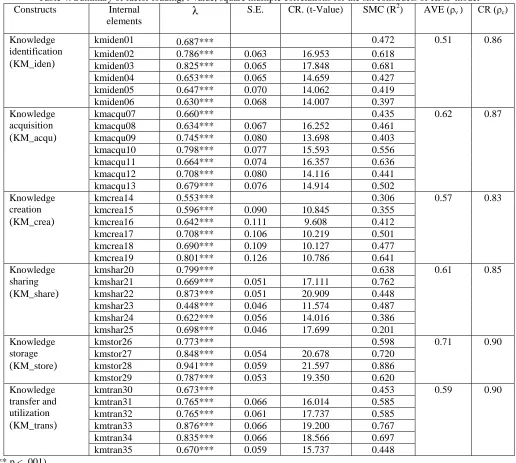
The AMOS version 7 was used to establish the confirmatory factor analysis. Table 3 below provides the summary of factor loading of the observed variable, square multiple correlations (SMC) and composite reliability value (CR) for all the constructs their respective values of the KMP in electricity generation process.
General information Number Percentage
Gender Male 613 96.50
Female 22 3.50
Education Lower than bachelor degree 370 58.30
Bachelor‟s degree 224 35.30
Higher than bachelor degree 41 6.50
Job experiences 1-20 years 98 15.40
More than 20 years 537 84.60
Total 635 100.00
KM process S.D. Level of supervisors‟
opinions
Knowledge Identification 3.82 0.53 High
Knowledge Acquisition 3.75 0.49 High
Knowledge Creation 3.64 0.55 High
Knowledge Sharing 3.64 0.57 High
Knowledge Storage 3.73 0.63 High
Knowledge Transfer & Utilization 3.69 0.56 High
Table 4: Summary of factor loading, t-value, square multiple correlations for the six constructs of KMP model Constructs Internal
elements
λ
S.E. CR. (t-Value) SMC (R2) AVE (ρν ) CR (ρc)
Knowledge identification
(
KM_iden)
kmiden01 0.687*** 0.472 0.51 0.86
kmiden02 0.786*** 0.063 16.953 0.618 kmiden03 0.825*** 0.065 17.848 0.681 kmiden04 0.653*** 0.065 14.659 0.427 kmiden05 0.647*** 0.070 14.062 0.419 kmiden06 0.630*** 0.068 14.007 0.397 Knowledge
acquisition
(
KM_acqu)
kmacqu07 0.660*** 0.435 0.62 0.87
kmacqu08 0.634*** 0.067 16.252 0.461 kmacqu09 0.745*** 0.080 13.698 0.403 kmacqu10 0.798*** 0.077 15.593 0.556 kmacqu11 0.664*** 0.074 16.357 0.636 kmacqu12 0.708*** 0.080 14.116 0.441 kmacqu13 0.679*** 0.076 14.914 0.502 Knowledge
creation
(
KM_crea)
kmcrea14 0.553*** 0.306 0.57 0.83
kmcrea15 0.596*** 0.090 10.845 0.355 kmcrea16 0.642*** 0.111 9.608 0.412 kmcrea17 0.708*** 0.106 10.219 0.501 kmcrea18 0.690*** 0.109 10.127 0.477 kmcrea19 0.801*** 0.126 10.786 0.641 Knowledge
sharing
(
KM_share)
kmshar20 0.799*** 0.638 0.61 0.85
kmshar21 0.669*** 0.051 17.111 0.762 kmshar22 0.873*** 0.051 20.909 0.448 kmshar23 0.448*** 0.046 11.574 0.487 kmshar24 0.622*** 0.056 14.016 0.386 kmshar25 0.698*** 0.046 17.699 0.201 Knowledge
storage
(
KM_store)
kmstor26 0.773*** 0.598 0.71 0.90
kmstor27 0.848*** 0.054 20.678 0.720 kmstor28 0.941*** 0.059 21.597 0.886 kmstor29 0.787*** 0.053 19.350 0.620 Knowledge
transfer and utilization
(
KM_trans)
kmtran30 0.673*** 0.453 0.59 0.90
kmtran31 0.765*** 0.066 16.014 0.585 kmtran32 0.765*** 0.061 17.737 0.585 kmtran33 0.876*** 0.066 19.200 0.767 kmtran34 0.835*** 0.066 18.566 0.697 kmtran35 0.670*** 0.059 15.737 0.448 (*** p < .001)
V. CONCLUSION
All most of the six constructs for the KMP in electricity generation process of power plant represent good measurements for the constructs. The implications of such a finding would be that electricity generation process of power plant view six knowledge management constructs similarly. Future research can concentrate on finding out the reasons behind this and to be able to explain why there were a few differences exist as mentioned above. The limitation, to the researchers„ best knowledge, this study is the first study of this nature and needs further investigation before generalization of the finding of the study.
[image:5.612.42.573.163.580.2]APPENDIX
Table 5 : Summary of view and constructs confirmatory factor analysis for the knowledge management process
Figure 1 : view and constructs
Knowledge Identification Figure 2 : view and constructs Knowledge Acquisition
Figure 3 : view and constructs Knowledge Creation
Figure 4 : view and constructs Knowledge Sharing
Figure 5 : view and constructs Knowledge Storage
Figure 6: view and constructs Knowledge Transfer and Utilization
ACKNOWLEDGMENT
This research was supported by a grant from Electricity Generating Authority of Thailand (EGAT) under the cooperation program between the EGAT (Northern Division) and Faculty of Engineering, Naresuan University.
REFERENCES
[1] Alavi, M. & Leidner, D. E. (2001) Review: knowledge management and knowledge management systems: conceptual foundations and research issues. MIS Quarterly, 25, 107-136.
[2] Anantatmula, V. and Kanungo, S.(2010), „„Modeling enablers for successful KM implementation‟‟, International Journal of Knowledge Management, Vol. 14 No. 1, pp. 100-113.
[5] Constant, D., Kiesier, S. & Sproull, L. (1996) The kindness of strangers. Organization Science, 7, 119-135. [6] Davenport, T. H. & Prusak, L. (1998) Working knowledge, Boston, Harvard Business School Press.
[7] Dvavvy, C. (2006) Recipients: the key to information transfer. Knowledge Management Research and Practice, 4, 17-25. [8] Demarest, M. (1997). “Instanding Knowledge Management”. Journal of Long Range Planning. 30(3), 74-84.
[9] Emelo, R. (2009) The future of knowledge management. Chief Learning Officer.
[10] Ford, D. & Staples, D. (2006) Perceived value of knowledge: the potential informer's perception. Knowledge Management Research and Practice, 4, 3-16. [11] Gan, G. G. G. (2006) Knowledge management practices in multimedia super corridor status companies in Malaysia. Business Faculty. University of Southern
Queensland.
[12] Holmes-Smith, P. (2009) Structural Equation Modeling From the Fundamentas to Advanced Topics: ACSPRI Course Notes. Victoria, Australia, Scsool Research, Evaluation and Measurement Services.
[13] Hair, J. F. Black, W. C., Babin, B. J., Anderson, R. E. and Tatham, R. L. 2006. Multivariate Data Analysis. 6thed. Upper Saddle River, N.J.:
Prentice-Hall.
[14] Holsapple, C. (2005) The inseparability of modern knowledge management and computer-based technology. Journal of Knowledge Management, 9, 45-52. [15] Horwitch, M. and Armacost, J.( 2002). “Helping Knowledge Management be all it can be”. The Journal of Business Strategy. 23(3), 26-31.
[16] Huber, G. P. (2001) Transfer of knowledge in knowledge management systems: unexplored issues and suggested studies. European Journal of Information Systems, 10, 72-79.
[17] Iansiti, M. (1993) Real-world R&D: jumping the product generation gap. Harvard Business Review, 138-147.
[18] Khalifa, M. & Liu, V. (2003) Determinants of sccessful knowledge management programs. Electronic Journal of Knowledge Management, 1, 103-112. [19] KM, W. (1997) Knowledge Management: An Introduction and Perspective. Journal of Knowledge Management, 1, 6-14.
[20] Krejcie, R.V., & Morgan, D.W. (1970).Determining sample size for research activities. Educational and Psychological Measurement, 30(3), 608.
[21] Lee, H. & Choi, B. (2003) Knowledge management enablers, processes and organisational knowledge: an integrative view and empirical investigation. Journal of Management Information Systems, 20, 179-228.
[22] Leonard-Barton, D. (1995) Wellsprings of Knowledge: Building and Sustaining the Sources of Innovation, Boston, Harvard Business School Press. [23] Moffett.S and McAdam.R. Knowledge management: a factor analysis of sector effects. Journal of Knowledge Management . Vol. 13 NO. 3 2009, pp. 44-59. [24] Okunoye, A. & Karsten, H. (2002) ITI as a Enabler of Knowledge Management: Empirical Perspective from Research Organisations in sub-Saharan Africa. 35th
Hawaii International Conference on System Sciences. Hawaii, USA.
[25] Robbins, S., Millet, B. & Cacioppe, R. (2001) Organisational behaviour: leading and managing in Australia and New Zealand, Malaysia, Prentice Hall.
[26] Suwit Saisuthanawit, Athisarn Wayuparb, Panu Buranajarukorn.(2013) "Knowledge Management Process Influencing Core Competencies of Supervisors in the Electricity Generation Process". International Journal of Engineering Research and Development, Vol. 7, Issue 8, 55-63.
[27] Smith, P. (2004) Knowledge management: people are important. Journal of Knowledge Management Practice.
[28] Srinivas, N. (2009) Mimicry and revival: the transfer and transformation of management knowledge to India 1959–1990. International Studies of Management and Organisation, 38, 38-57.
[29] Sveiby, K. (1997) The new organisational wealth: managing and measuring knowledge-based assets, San Francisco, Berret-Koehler Publishers.
[30] Wood, J., Wallace, J., Zeffane, R., Schermerhorn, J., Hunt, J. & Osborn, R. (1998) Organisational Behaviour: An Asia-Pacfic Perspective, Australia, John Wiley. [31] Yu, S.-H., Kim, Y.-G. & Kim, M.-Y. (2004) Linking Organisational Knowledge Management Drivers to Knowledge Management Performance: An exploratory
study. 37th Hawaii International Conference on System Sciences. Hawaii, USA.
AUTHORS
First Author – Suwit Saisuthanawit is Ph.D. candidate in management engineering at faculty of engineering, naresuan university,
mueang phitsanulok province 65000, Thailand. E-mail [email protected].
Second Author – Athisarn Wayuparb (Ph.D.) is lecturer of school of logistics and supply chain at naresuan university, mueang
phitsanulok province 65000, Thailand.
Third Author – Panu Buranajarukorn (Ph.D.) is lecturer of industrial engineering at faculty of engineering, naresuan university,