Comparative Analysis of Data Centric Routing Protocols
for Wireless Sensor Networks
K. Karthikeyan, M.Kavitha
Department of IT, Dr. SNS Rajalakshmi College of Arts and Science Department of CS, Dr. SNS Rajalakshmi College of Arts and Science
Abstract- Wireless sensor networks consists of small nodes with sensing, computation, and wireless communications capabilities. The life time of a sensor node depends on its energy consumption. Saving energy and increase network life time are main challenges of wireless sensor networks. The efficiency of the sensor node depends on the routing protocols used. Routing protocols provides a best data transmission route from sensor nodes to sink node to save energy for nodes in the network. This paper compares the three data centric routing protocols SPIN, SPIN-1,M-SPIN for energy efficiency. Based on this analysis M-SPIN performs better than other two. M-SPIN is a better approach for the application need quick and reliable response. The network simulator version 2 is used for performances analysis.
Index Terms- Energy, routing, SPIN, SPIN-1, M-SPIN, and WSN
I. INTRODUCTION
ireless sensor network are highly distributed networks of small, lightweight wireless nodes deployed in a large numbers to monitor the environment. The main task of a wireless sensor node is to sense and collect data from a certain domain, process them and transmit it to the sink where the application lies.
A. Protocols for Wireless Sensor Network
The routing protocols[2][3] used in the sensor networks are unique from the protocols used in other fixed networks. Sensor networks are infrastructure-less and there is no guarantee for reliable delivery. The nodes in the sensor networks are very prone to failure and there are different categories of routing protocols designed for wireless sensor networks. Wireless sensor network routing protocols are classified as data-centric, node-centric, location aware and quality of service based routing protocols.
B. Data-Centric Protocols
Data-centric[6] protocols differ from traditional address-centric protocols in the manner that the data is sent from source sensors to the sink. In address-centric protocols, each source sensor that has the appropriate data responds by sending its data to the sink independently of all other sensors. However, in data-centric protocols, when the source sensors send their data to the sink, intermediate sensors can perform some form of aggregation on the data originating from multiple source sensors and send the aggregated[11]data toward the sink. This process
can result in energy savings because of less transmission required to send the data from the sources to the sink.
II.SPIN (Sensor Protocol for Information via Negotiation) SPIN is a adaptive communication and data-centric routing protocol [7]. It is suitable to small or medium sized wireless sensor networks and to bridges other distribution environment. Therefore SPIN [4] protocol is more effective and higher energy than some other protocols in a particular environment. The performance of SPIN [7][8] is better than that flooding, gossiping and ideal protocol for energy and bandwidth consumption. Flooding, which broadcast the packet among all of its neighbors; Gossiping, a variant on flooding that sends messages to random sets of neighboring nodes; and ideal, an idealized routing protocol that assumes perfect knowledge and has the best possible performance. The traditional protocols which establish a path before transmit the data are also not suitable for the mobile sink. Because each time sink is changes its position. It needs to flood the data in order to reach at the sink node.
Negotiation [20]
Before transmitting data, nodes negotiate with each other to overcome implosion and overlap problems and only useful information will be transferred, observed data must be described by meta-data
Resource adaptation
Each sensor node has resource manager and applications probe manager before transmitting or processing data. Sensors may reduce certain activities when energy is low. A .Meta data
Completely describe the data, and it must be smaller than the actual data for SPIN[4] to be beneficial and if you need to distinguish pieces of data, their meta-data should differ.
Meta-Data is application specific, and Sensors may use their geographic location or unique node ID and camera sensor may use coordinate and orientation
Application must be able to interpret and synthesize its own meta-data
Meta-data size is very small as compared to the size of the DATA. If a neighbor is interested in the data, it sends an REQ message for the DATA and the DATA is sent back to this neighbor node. The neighbor sensor node then repeats this process to its neighbors till reach at the sink node.
B.SPIN Messages[19]
Sensor nodes use three types of Messages ADV,REQ and DATA to communicate . ADV is used to advertise new data, REQ is also to request for data and DATA is the actual message. The protocol starts when a SPIN node gets new data that it is
willing to share on on-demand basis. It does so by broadcasting an ADV message containing metadata.
Node B sends a REQ listing all of the data it would like to acquire
If node B had its own data, it could aggregate this with the data of node A and advertise
Nodes need not respond to every message
It starts by advertising its data to node B from Node A(a). Node B responds by sending a request to node A (b). After receiving the requested data (c), node B then sends out advertisements to its neighbors (d), who in turn send requests back to B (e, f). The strength of this protocol lies in its simplicity. Each node in the network performs little decision making when it receives new data, and therefore wastes little energy in computation. Furthermore, each node only needs to know about its single hop network neighbors.
SPIN [18] is designed based on two basic ideas; (1) to operate efficiently and to conserve energy by sending metadata (i.e., sending data about sensor data instead of sending the whole data that sensor nodes already have or need to obtain), and (2) nodes in a network must be aware of changes in their own energy resources and adapt to these changes to extend the operating lifetime of the system.
C. Advantages of SPIN
Topological changes are localized
It solves the implosion and overlap problem in the classic flooding protocol.
D .Drawbacks
Scalability: SPIN is not scalable,
If the sink is interested in too many events, this could make the sensor nodes around it deplete their energy, and
SPIN's data advertisement technique can not guarantee the delivery of data if the interested nodes are far away from the source node and the nodes in between are not interested in that data.
E. The Problems of SPIN Protocol
SPIN[3][18] succeeds in avoiding the blind use of resources and solving implosion and overlap problem in the flooding protocol, but the problem of blind forward and data unaccessible still exists and other issues may be appear.
Blind Forward Problem[20]
Source node will send the DATA packet to all the neighbor nodes that respond. Nodes who have received data will broadcast ADV message to all of its neighbors in a similar way, and send DATA packets to its neighbor nodes that respond. This process is repeated until the packets reach the destination. If the network has a new data to be sent, it must repeat the process. So this method could lead to a “blind forward” problem. It is not only a waste of energy, but doesn’t take into account the balance of energy consumption of the network nodes.
Data Unaccessible Issue
In the SPIN protocol, if sensor nodes collect new data that need to be forwarded, it will directly broadcast ADV message to its neighbor nodes. In some cases, due to energy of itself, some nodes are reluctant to forward the new data; furthermore, a node’s neighbor nodes are not interested in the source of the data or they already have the data. In addition, there is an imbalance of energy consumption in the WSN. For the nodes around sink nodes, they locate on the only path of reaching the sink node, so they are bound to take more tasks and it is easy to run out of energy and fail. The problem above will result in data unaccessible in lossless network.
In SPIN[20], the “blind forward” problem will waste energy and shorten the life cycle of the network, and reduce network performance. The “data unaccessible” problem will lead to the network unable to collect information, and make the WSN lose the meaning of application.
III.SPIN-1(Sensor Protocol for Information via Negotiation) SPIN 1[5][20] will overcome the blind forward and data unaccessible problem. SPIN-1 is a data centric, flat routing, source initiated and data aggregation protocol. It establishes a connection based on three-way handshake.SPIN-1 has the same network model with SPIN protocol; the assumptions of network model are as follows:
1) The initial energy of each node is equal; nodes A and B can communicate with each other, the link is symmetrical;
2) Communication between two nodes is far away from the interference of other nodes, and power is without any constraints and nodes remain stationary;
3) Assuming all nodes want to achieve the data, and are located on the path to reach sink nodes;
4) Wireless signals in all directions consume the same energy. A. The Working Mechanism of SPIN-I
Data broadcasting stage
When a sensor node (source node) has new data to send or forward, it first broadcasts ADV message to all its neighbors, and starts the timer. ADV message contains the metadata describing the data properties.
Data requesting stage[20]
After the neighbors have received ADV message, they first determine if they have enough energy to complete the task of the three stages. If its energy value is below the threshold, it will not make any response; otherwise, it checks whether it already has the data. If it already has the broadcast data, then it sets the flag of REQ message to 1, and back its energy value to the source node by REQ message. In SPIN[26][27] protocol, if the node has the data already, it won’t make any response. This point is also the biggest difference between SPIN 1 and SPIN. If the neighbors do not have the data but their energy is enough, in order to request to send data, the flag of REQ message will be set to 0, and back to the source node together with its energy value using the REQ message.
Data transmission phase.
The source node updates its neighbor list according to the flag of REQ message it receives and energy values. In the threshold time, the source node judges nodes’ flag in its neighbor list, if the flag in the neighbor list are both 1 or 0, then filters the nodes whose flags are 0 and forwards data to the node who has the largest energy value; if there are the same energy value, it will randomly select a node to forward; if all the flags of nodes are 0, chooses the node who has the largest energy value to forward the data. If the time is longer than threshold, and all the flags are 1, it is the point that “data unaccessible” problem appears, the source node selects a node who has the largest value from its neighbor list and forwards data mandatory, then removes nodes who do not send REQ message from the neighbor list. B. Energy-Saving Analysis of SPIN-1 Protocol
Compares the total energy, which is consumed by the process in which one node transmits the m bytes of data it receives to the neighbor node through adopting SPIN protocol and SPIN-I protocol. Assuming that both of ADV and REQ messages are L bytes, it needs to consume Em energy to sent a byte and Er energy to receive a byte. The network is distributed, no packet losses or queuing delay, and the average number of node’s neighbor is N. Any node in network will forward the m bytes of data it receives to the next hop node.
1) The steps of node B forwards the M byte of data in the SPIN protocol are:
a. Send ADV messages, energy consumption is (N-1) LEm; b. Receive the REQ message from N-1 nodes around it, the energy consumption is L (N-1) Er;
c. Send Data + L bytes of data, consume (m + L) (N-1) Em energy;
2) The steps of node B receives m bytes of data in the SPIN protocol are:
a. Receive ADV message, consume LEr energy; b. Send REQ message, the energy consumption is LEm; c. Receive m bytes of data, consume (m + L) Er energy;
According to the above description, in SPIN, the minimum energy consumption in process that node B receives the data and forwards the data to the next hop nodes is showed by the formal below:
ESPIN=Em(2NL+mN—m—L)+(NL+m+L)Er (1) In accordance with the above assumptions of SPIN-1 protocol, calculate energy consumption of transmitting the same m bytes data. As the byte of energy’s value and flag carried by REQ is very small, it can negligible.
3) The steps of node B forwards the M byte of data in the SPIN-1 are:
a. Send ADV messages, energy consumption is (N-1) LEm; b. Receive the REQ message from N-1 nodes around it, the energy consumption is L (N-1)Er;
c. Send Data+L bytes of data, consume (m+L) Em energy; The steps and energy consumption values in the process that node B receives m bytes of data in the SPIN-I protocol are exactly the same with SPIN protocol’s. According to the above description, the node B receives the data and forwards the data to the next hop nodes, the minimum energy consumption in SPIN-I routing protocols is:
ESPIN-I=Em(NL+L+m)+(L+NL+m)Er (2)
Compared formula 1 with formula 2 we can see that the coefficient of Er is the same, so we only need to consider and compare the coefficients of Em, and get formula 3 by formula 1 minus formula 2:
SPIN-1-SPIN=2NL+mN-m-L-NL-L-m=(m+L)(N-2) (3) In Formula 3, the value of m + L is greater than zero, so we need only consider the value of N-2. Only when N is equal to 2, the energy value of formula 1 is the same with formula 2. That is B node has two neighbors, a neighbor node sends data to B, B forwards data to the other neighbor node. But this situation is usually almost impossible, especially for newly created network. The average number of nodes in the network must be greater than 2, so the value of formula 3 must be greater than zero. Therefore, the larger N is, the energy consumption is lower significantly in SPIN-1 protocol than that of SPIN protocol. This is because it selects a neighbor node that has the largest energy value to forward message in SPIN-1 protocol, which can balance the energy of sensor nodes in the network. In addition, delete a node that does not respond over threshold time, thus saving the energy of the sensor. However, the time of the same data transfer to the sink node in SPIN-1 protocol is longer than the traditional SPIN protocol, so the SPIN-1 protocol is suitable for real- time low and small or medium scale networks.
IV. M-SPIN (Modified- SPIN)
before any disaster occurs. In this case, it is desirable that data must be disseminated towards the sink node very quickly. M-SPIN routing protocol is better approach for such type of applications than SPIN. Figure 2 shows an example of a WSN. An event that occurs in the WSN divides the entire network into two regions, A and B. Sensor nodes in region A are on the other side in the network in comparison with the sink node and sensor nodes in region B are on the same side and nearer to the sink node. Sensor nodes of region A can receive data from the event node, however, they will unnecessarily waste their energy in receiving or transmitting the data. In order to reach data to the sink node, data will have to travel more hops if they are sent via the nodes in region A. Thus, when an event occurs, it is always desirable that the data is sent through the nodes in region B. This would save the energy spent for transmission of a piece of data from an event node to the sink node. However, such selective transmission is not supported in the existing SPIN protocols.
Figure 2. M-SPIN data transmission A. M-SPIN working mechanism
M-SPIN[42] working mechanism consists of three phases:
Distance discovery phase:
[image:4.612.314.576.460.667.2]During this phase, the hop distance is measured from sink node. Initially, the sink node broadcasts startup packet with the hop value set to 1. It is possible that a node might receive multiple startup packets from its neighbors. The node that receives multiple startup packets uses the minimum hop value received in the messages and stores the same. The node would re-broadcast the startup packet to its neighbor nodes with modified hop value. The process is continued till all the nodes receive the startup packets.
Figure 3.Distance Discovery Phase
Negotiation phase:
Negotiation process is almost the same as the first two phases of the SPIN-1 protocol. The main difference is that the receiver of the ADV message verifies whether it is nearer to the sink node or not in comparison with the node that has sent the ADV message. Only of the hop value of the receiver is lesser than the hop value of the sender of the ADV message then the receiving node sends the REQ message to the sending node for the current data.
Data Transmission phase:
The transmission phase is the same as the SPIN-1. After the reception of the REQ message, the data is sent by the source node to the node which requested the data.
V. COMPARATIVE ANALYSIS OF SPIN, SPIN-1 AND M-SPIN FOR ENERGY CONSUMPTION
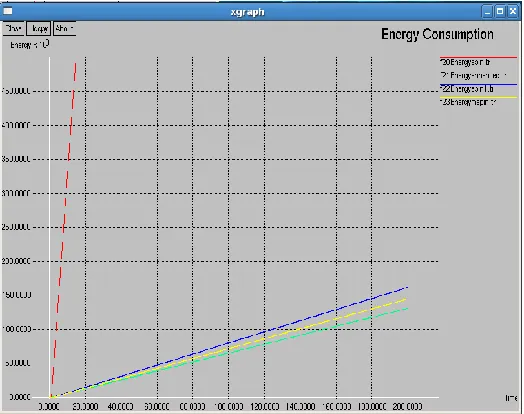
Both the SPIN-1 and the M-SPIN protocols consume lesser energy than SPIN. But the SPIN-1 consumes relatively higher power than M-SPIN. Simulations are performed to understand the energy consumption for the broadcast data transmission. In M-SPIN, only the nodes which are nearer to sink node send REQ packets in response to ADV packet from the source node. This helps the messages reach faster to the sink node using the hop value fixed in the distance discovery phase. In M-SPIN, total number of ADV, REQ and the data messages needed for the transmission of the data come down and this helps in the reduction of energy needed for the transmissions. Hence the energy needed for the transmission is reduced in M-SPIN compared to the SPIN-1. This is possible only because of the introduction of the distance discovery phase introduced in the M-SPIN protocol.
But one problem in M-SPIN is that few sensor nodes may be used several times and those nodes may dissipate energy and may be destroyed earlier than other nodes in the network.
The simulation for the energy consumption by a node for different protocols was performed for 200 seconds and the results are plotted as a graph. From the graphs, it can be concluded that
SPIN needs much higher energy than other protocols SPIN-1 consumes lesser energy than SPIN but the energy consumption is higher than M-SPIN
Simulation Results Graph for different protocols (200sec – zoom view)
VI. CONCLUSION AND FUTURE WORK
In this paper we have compared three data-centric protocols for wireless sensor network .M-SPIN consumes lesser energy than other two protocols. M-SPIN protocol using hop-count values of sensor nodes for WSN. Here also negotiation is done before sending the actual data. M-SPIN only the nodes which are nearer to sink node send REQ packets in response to ADV packet from the source node. Therefore data is disseminated to the sink or neighbor nodes towards the sink node. M-SPIN achieves energy savings by discarding packet transmission to the opposite direction of sink node. But one major problem in M-SPIN is that few sensor nodes may be used several times and those nodes may dissipate energy and may be destroyed earlier than other nodes in the network. In future to overcome this problem faced in the M-SPIN protocol, uses cluster methodology and dynamic cluster head election to overcome the problem of using only few nodes for the forwarding of the data. Clustering algorithm is used for the formation of clusters and the election of cluster heads.
VII. REFERENCES
[1] Akkaya, K., and Younis, M. (2005), “A Survey on Routing Protocols for Wireless Sensor Networks”, Elsevier Journel of Ad Hoc Networks, Vol. 3, pp. 325-349.
[2] Akyildiz, I.F., Vuran, M.C., Akan, O., and Su, W. (2004), “Wireless Sensor Networks:A Survey Revisited”, Elsevier Journel of Computer Networks, Vol. 45, No. 3.
[3] Akyildiz,I.F.,Su, W., Sankarasubramaniam, Y., and Cayirci, E., (2002), “Wireless sensor networks: a survey”, Elsevier Journel of Computer Networks, Vol. 38, No. 4, pp. 393-422. [4] Al-Karaki, J.N., Kamal, A.E., (2004), “Routing Techniques in Wireless Sensor Networks: A Survey”, IEEE transactions on Wireless Communications, Vol.11, No. 6, pp. 6-28.
[5] Akyildiz,I.F.,Su,W., Sankarasubramaniam, Y., and Cayirci, E., (2002), “A survey on sensor networks”, IEEE Communications Magazine, Vol. 40, No. 8, pp.102-114.
[6] Azni, A.H., Madihah Mohd, S., Azreen, A., and Ariff Syah, J., (2009), “Performance Analysis of Routing Protocol for WSN Using Data Centric Approach”, World Academy of Science, Engineering and Technology, Vol. 53.
[7] Basagni, S., (1999), “Distributive and Mobility-Adaptive Clustering for Multimedia Support in Multi-hop Wireless Networks”, Proceedings of Vehicular Technology Conference, VTC, Vol. 2, pp. 889-893.
[8] Chee-Yee Chong, C., and Srikanta, P., (2005), “Sensor Networks: Evolution, Opportunities, and Challenges”, IEEE Tranactions on sensor networks, Vol. 28, pp.117-123.
[9] Deepak, P., and Bibhudatta, S., (2010), “Adaptive Protocol for Critical Data Transmission of Mobile Sink Wireless Sensor Networks”, International Journal of Computer Science, Vol.10. [10] Energy Harvesting Projects, (2005), “Collections of articles on IEEE Pervasive Computing”, pp. 69-71.
[11] Estrin, D., Girod, L., Pottie, G., and Srivastava, M., (2001), “Instrumenting the world with wireless sensor networks”, Proc. Acoustics, Speech, and Signal Processing, Vol. 4, pp. 2033– 2036.
[12] Farhana, Z., (2007), “REEP : a data-centric, reliable and energy-efficient routing protocol for wireless sensor networks”, Digital Commons @ Ryerson.
[13] Garcia-Hernandez, C.F., Ibargüengoytia-González, P.H., Garcia-Hernandez, J., and Pérez-Díaz, J.A., (2007), “Wireless Sensor Networks and Applications: a Survey”, International Journal of Computer Science and Network Security, Vol.7, No.3. [14] Hernzelmen, W., and Kulik, J., (1999), “Adaptive protocols for information dissemination in wireless sensor networks”, ACM/IEEE Mobicom Conference, Seattle, WA, pp. 174-185.
[15]Heinzelman, W., Chandrakasan, A., and Balakrishnan, H., (2000), “Energy-Efficient Communication Protocol for Wireless Sensor Networks”, Proceeding of the Hawaii International Conference System Sciences, Hawaii, USA.
[16] Heinzelman, W.R., Chandrakasan, A., and Balakrishnan, H., (2000), “Energy-efficient Communication Protocol for Wireless Microsensor Networks”, IEEE Computer Society Proceedings of the Thirty Third Hawaii International Conference on System Sciences, Vol. 8, p. 8020.
[17] 21 ideas for the 21st century, (1999), Business Week, pp. 78-167.
[18] Jonna, K., Rabiner, W., and Hari Balakrishanan, (2002), “Negotiation -based protocols for Disseminating information in Wireless Sensor Networks”, ACM Wireless Networks.
[19]Kulik, J., Heinzelman, W.R., and Balakrishnan, (2002), “Negotiation–Based Protocols for Disseminating Information in Wireless Sensor Networks”, Wireless Networks, Vol. 8, pp. 169-185.
[20] Luis, J., Ana Lucila, S., Alicia, T., Cabrera, S., and Barenco Abbas, C.J., (2009), “Routing Protocols in Wireless Sensor Networks”, Sensors 2009.
[21] Luwei, J., Liu, F., and Li, Y., (2011), “Energy Saving Routing Algorithm Based on SPIN Protocol in WSN”, IEEE Tranactions on wireless sensor networks.
[22] Li, L., and Wu, F., (2007), “Research on SPIN of wireless sensor network”, Computer and Modernization, Vol. 3, pp. 93-96.
[23]Munish, B., Kotary, D.K., and Soni, S., (2012), “Comparative analysis of energy efficient routing protocol for wireless sensor network”, International journal of computer application on wireless communication and mobile networks, No. 14, pp.65-69.
[24] Mudholkar, R.R., Sawant, S.R., and Patil, V.C., (2012), “Classification and compersion of routing protocols in wireless sensor networks”, Ubicc journal, Vol. 4, pp.704-711.
[25] Obaisat, Y., and Braun, R., (2003), “On Wireless Sensor Networks: Architectures, Protocols, Applications, and Management”.
[26] Padmanabhan, K., and Kamalakkannan, P., (2011), “A Study on Energy Efficient Routing Protocols in Wireless Sensor Networks”, European Journal of Scientific Research, Vol. 60, No. 4, pp. 499-511.
[28] Romer, K., and Mattern, F., (2004), “The design space of wireless sensor networks”, IEEE transactions on Wireless Communications, Vol. 11, No. 6, pp. 54-61.
[29]Schurgers , C., and Srivastava, M. B., (2001), “Energy Efficient Routing in Wireless Sensor Networks”, MILCOM Proceedings on Communications for Network-Centric Operations: Creating the Information Force, McLean, VA. [30] Shi, Y. B., Ye, X. B., and Liu, P. L., (2005), “Research status on wireless sensor networks”, Foreign Electronic Measurement Technology, Vol. 24, No. 1, pp. 19-23.
[31] Singh, S.K., Singh, M.P., and Singh, D.K., (2010), “A survey of Energy-Efficient Hierarchical Cluster based Routing in Wireless Sensor Networks”, International Journal of Advanced Networking and Application, Vol. 02, No. 02, pp. 570–580. [32] Singh, S.K., Singh, M.P., and Singh, D.K., (2010), “Routing Protocols in Wireless Sensor Networks – Survey”, International Journal of Computer Science and Engineering Survey, Vol. 1, No. 2.
[33] Shanmugam, A., and Chandrasekaran, V., (2012), “A review on hierarchical cluster based routing in wireless sensor networks”, Journal of global research in computer science, Vol. 3, pp.12-16.
[34] Singh, D., Choudhary, N., and Pandey, S., (2012), ‘Performance analysis of energy efficient clustering algorithims for wireless sensor networks”, International journal of computer applications,Vol. 5, No. 12, pp.56-59.
[35] Syah Johari, A., Madihah Mohd Saudi, M.M., and Azreen, A., (2009), “Performance analysis of routing protocols for WSN using data centric approach”, World academy of Science, Engineering and Technology, Vol. 12.
[36] Su, M., and Sankarasubramaniam, Y., (2002), “Wireless sensor network: a survey”, Broadband and Wireless Networking Laboratory, School of Electrical and Computer Engineering, Atlanta, pp. 393-442.
[37] Stankovic, A., (2006), “Wireless Sensor Networks”,University of Virginia Charlottesville.
[38] Vibhav, K.S., Imam, S.A., and Beg, M.T., (2012), “Energy efficient communication methods in wireless sensor
networks-review”, International journal of computer applications, Vol. 39, No. 17.
[39] Wu, F., and L. Li., (2007), “Research on SPIN of wireless sensor network”, Computer and Modernization, Vol. 3, pp. 93-96.
[40] Younis, M., Youssef, M., and Arisha, K., (2002), “Energy-aware Routing in Cluster-Based Sensor Networks”, Proceedings of the 10th IEEE/ACM International Symposium on Modeling, Analysis and Simulation of Computer and Telecommunication Systems.
[41] Ying Miao, (2005), “Applications of sensor networks”, Journal of Computer Networks and Communication Systems, pp. 27-34.
[42] Zabin, F., Misra, S., Woungang, I., Rashvand, H.F., Ma, N.W., and Ali, M. A., (2007), “REEP: data-centric, energy-efficient and reliable routing protocol for wireless sensor networks”. IET Communications on wireless sensor networks. Vol. 2, No. 8, pp. 995-1008.
[43] Zeenat, R., Sarbani, R., and Nandini, M., (2011), “A Modified SPIN for Wireless Sensor Networks”, IEEE transactions on wireless sensor networks Vol. 11, pp 978-982.
AUTHORS
First Author – . K.KARTHIKEYAN, M.Sc., M.Phil, Head, Department of Information Technology,
Dr. SNS Rajalakshmi College of Arts and Science,[email protected]
Second Author –M.KAVITHA, B.E., MSc, M.Phil,
Research Scholar, Dr.SNS Rajalakshmi College of Arts and Science. [email protected]
CorrespondenceAuthor–M.KAVITHA [email protected].