Art and Design Theses Ernest G. Welch School of Art and Design
4-21-2008
Douglas Coupland: Text as Art
Sarah Louise HoustonFollow this and additional works at:https://scholarworks.gsu.edu/art_design_theses Part of theArt and Design Commons
This Thesis is brought to you for free and open access by the Ernest G. Welch School of Art and Design at ScholarWorks @ Georgia State University. It has been accepted for inclusion in Art and Design Theses by an authorized administrator of ScholarWorks @ Georgia State University. For more information, please [email protected].
Recommended Citation
DOUGLAS COUPLAND: TEXT AS ART
by
SARAH L. HOUSTON
Under the Direction of Dr. Susan Richmond
ABSTRACT
This thesis discusses the art of contemporary Canadian artist Douglas Coupland
and his use of textual art. It will explore his combinations of text and art through four
major themes that are recurrent in both his writings and visual art: abundance,
advertising, technology and translation and draw conclusions on the various reasons that
text has become such an important component of his body of work. Overall, the thesis
seeks to show Coupland’s unique use of text to create a modern take on Pop art that is
able to highlight issues in society.
DOUGLAS COUPLAND: TEXT AS ART
by
Sarah L. Houston
A Thesis Submitted in Partial Fulfillment of the Requirements for the Degree of
Master of Arts
In the College of Arts and Sciences
Georgia State University
Copyright by Sarah Louise Houston
DOUGLAS COUPLAND: TEXT AS ART
by
Sarah L. Houston
Committee Chair: Dr. Susan Richmond
Committee: Dr. Maria Gindhart Dr. Glenn Gunhouse
Electronic Version Approved:
ACKNOWLEDGEMENTS
TABLE OF CONTENTS
ACKNOWLEDGEMENTS iv
LIST OF FIGURES vi
CHAPTER
1 INTRODUCTION 1
Figures 11
2 ABUNDANCE 13
Figures 28
3 ADVERTISING 35
Figures 45
3 TECHNOLOGY 52
Figures 63
4 TRANSLATION 70
Figures 81
5 CONCLUSION 88
LIST OF FIGURES
Figure 1.1 James Rosenquist, F-111, 1965 11
Figure 1.2 Douglas Coupland,
Generation X: Tales for an Accelerated Culture 12
Figure 2.1 Douglas Coupland, money, from Microserfs,1995 28
Figure 2.2 Andy Warhol, Dollar Sign,1982 29
Figure 2.3 Douglas Coupland, Prime Numbers, from JPod, 2006 30
Figure 2.4 Douglas Coupland, Scrabble, from JPod, 2006 31
Figure 2.5 Chinese lettering, Play Again Y/N?,
The Rooms Gallery, 2006 32
Figure 2.6 Random numbers, Play Again Y/N?,
The Rooms Gallery, 2006 33
Figure 2.7 Stream of consciousness writing, Play Again Y/N?,
The Rooms Gallery, 2006 34
Figure 3.1 Douglas Coupland, 21, from Microserfs , 1995 45
Figure 3.2 Douglas Coupland, Lawry’s Garlic Salt,
from Microserfs ,1995 46
Figure 3.3 Douglas Coupland, Oriental Noodle Soup
from JPod, 2006 47
Figure 3.4 Douglas Coupland, Doritos, from JPod, 2006 48
Figure 3.5 Douglas Coupland, Corporate Safety Blanket No. 1
Figure 3.6 Douglas Coupland, Corporate Safety Blanket No. 2,
2008 50
Figure 3.7 Douglas Coupland, Absolut Vodka advertisement,
1992 51
Figure 4.1 Douglas Coupland, Binary Code,
from Microserfs, 1995 63
Figure 4.2 Douglas Coupland, Texture diffuse from JPod, 2006 64
Figure 4.3 Douglas Coupland, Programming Code,
from JPod, 2006 65
Figure 4.4 Douglas Coupland, Click here, from JPod, 2006 66
Figure 4.5 Douglas Coupland, …pause, from JPod, 2006 67
Figure 4.6 Douglas Coupland, Play again? Y/N,
from JPod, 2006 68
Figure 4.7 Douglas Coupland, happycamper,
from JPod, 2006 69
Figure 5.1 Douglas Coupland, Patty Hearst Page 1,
from Microserfs, 1995 81
Figure 5.2 Douglas Coupland, Patty Hearst Page 2,
from Microserfs, 1995 82
Figure 5.3 Douglas Coupland, Motherfucker,
from JPod, 2006 83
Figure 5.4 Douglas Coupland, Retranslation,
Monte Clark Gallery, 2005 84
Figure 5.6 Douglas Coupland, Fight Club, 2005 86
INTRODUCTION
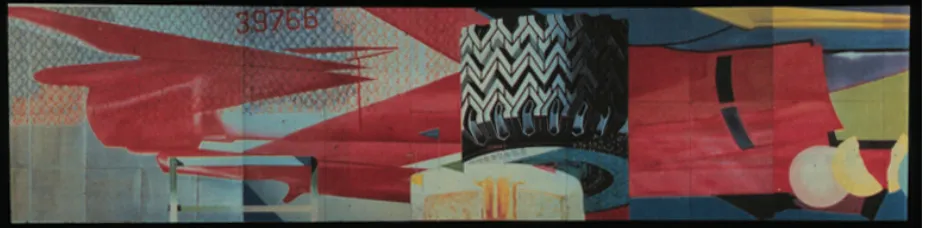
Imagine that you inhabit a world with no history and no ideology. Imagine then attending this elementary school on the edge of the world and opening a copy of the encyclopedia
and finding under Art, a long, thin panel of a certain painting: F-111 (pronounced eff-one-eleven). It contains, among others, images of an angel food cake, tinned spaghetti and the words “U.S. AIR FORCE.” A nuclear explosion, and a Firestone tire, all splashed
across the length of an F-111 fighter plane. All of these images are painted in shocking, bright colors− all of these images that flow daily inside your head− images now all
recontexualized in a seductive, validated World Book-ified context… There is even a young girl, roughly your own age underneath a hair dryer. In all probability, she has her
own ABC Afterschool Special. Epiphany.1
This was the response of a young Douglas Coupland after his eyes had been
opened to the world of Pop art via James Rosenquist’s F-111 (Figure 1.1) in a World
Book encyclopedia. This moment led him to embark upon a life in the world of visual
arts. Shortly after his discovery of Pop, Coupland started one of his favorite childhood
crafts, cutting pictures out of old Life magazines and putting them together to form his
own Rosenquist−style collages.2 Of this he says, “It struck me then, how sexy that is,
viewing mass culture as an aesthetic.”3
Douglas Coupland was born on a Canadian air force base near Baden-Baden,
Germany in 1961. At the age of four, his family returned to Vancouver, Canada, and
Coupland has made Vancouver his permanent home since then, except for brief
relocations for schooling.4 His interest in art remained throughout his childhood, and he
chose to go to art school after high school graduation. He chose to attend The Emily Carr
1
Douglas Coupland, Polaroids from the Dead (New York: Regan Books, 1996), 122.
2
Polaroids from the Dead, 122.
3Deborah Campell, “The World According to Doug,” Canadian Art, Fall, 2006. 4
School of Art and Design in Vancouver and there he made sculpture his focus. He
continued his art studies at the Hokkaido College of Art and Design and Instituto
Europeo di Design.5 His sculpture was well enough received in the mid-eighties that he
was given a show at the Vancouver Art Gallery.
Into his twenties, Coupland considered himself a sculptor, but he became unhappy
with this path, and he began a writing career that would eventually become as important
to his life as visual art.6 Douglas Coupland “the author” occurred mainly by chance. The
editor of Vancouver Magazine saw a postcard that Coupland had sent to a mutual friend
and was impressed by his writing, so he offered him assignments, mainly about scandals
in the art world, like art thefts,7 which Coupland accepted in a bid to further his career as
an artist. His intentions were simply to use the money he received from writing as
funding for art supplies. It turned out that he had skill as a writer, and he ended up
receiving a book deal, and effectively quit producing art in 1989.8 His first novel was
Generation X: Tales for an Accelerated Culture (1991), which he created in response to
his feeling that the new generation of young adults, to whom he gave the title Generation
X, grew up quite differently than the generations before them, that they warranted their
own generation classification, as their “baby boomer” parents were given. He received
this book deal based on a comic strip with the same title that he co-produced.9
5
Robert Birnbaum, “Birnbaum v. Douglas Coupland,” The Morning News, 4 September 2003. 6Conan Tobias, “Fifteen Mumbling Minutes with Douglas Coupland,” University of Toronto Varsity, September 28, 1995.
7Steve Lohr, “No More McJobs for MR. X,” New York Times, May 29, 1994. 8
“Douglas Coupland, West Coast,” Artists for Kids,
http://www.artists4kids.com/artist.php?artist_id=COUPLAND. 9
According to Coupland, the main difference that separated Generation X from
previous generations is what he calls “denarration.” As said in a later novel, Polaroid’s
from the Dead (1996):
Up until recently, no matter where or when one was born on earth, one’s culture
provided one with all components essential for the forging of identity. These
components included: religion, family, ideology, class strata, a geography, politics
and a sense of living within a historic continuum… Suddenly, around ten years
ago, with the deluge of electronic and information media into our lives, these
stencils within which we trace our lives began to vanish, almost overnight,
particularly on the West Coast. It became possible to be alive, yet have no
religion, no family connections, no ideology, no sense of class location, no
politics and no sense of history. Denarrated.10
This sense of denarration permeates the lives of his characters in Generation X. In
addition to its fictional narrative, the book also contains insertions such as cartoons,
slogans and vocabulary words and definitions, all placed in the margins, which gives it
the feeling of a handbook for this new generation. Coupland subsequently became the
voice of the group he named, and he has at times felt held back by his status as “the
generation X guy.” Several years after the publishing of the book, he came to the point
where he would no longer even discuss it in interviews. As early as 1994, he referred to it
as “beyond a cliché by now.”11 He has even wryly referred to it as his “Campbell’s soup
can,” in a nod to one of his heroes, Andy Warhol.12
10
Coupland, Polaroids from the Dead, 180. 11Lohr.
12
Coupland wrote for several years while still considering himself primarily an
artist. He said of this in a 1992 interview with the Ottawa Citizen: “It wasn’t even until
about two (or three) years ago that I even thought of myself as a writer and made the
commitment and decided not to do (visual) art anymore.”13 One reason for this decision
could be his theory that “People don’t respect you if you want to do more than one
thing.”14 Clearly, Coupland has changed his view since saying that. He began to produce
visual art again in 2000, and the myriad tasks and projects in which he is currently
involved in are ever growing and changing.15 Beyond writing and creating art in a wide
variety of media, he has produced his own films, written and acted in plays, been a
furniture designer and worked as a consultant for high−budget Hollywood films, such as
Steven Spielberg’s Minority Report, for which Coupland was consulted on the idea of
what the future would actually look like.16 He has written twelve works of fiction and
several nonfiction books.
The most appealing art works created by Coupland combine his two main
professions, that of an artist, and that of a writer. During the period in which he moved
away from visual art, Coupland began to find new ways to insert art into his novels. This
began as simply as Coupland taking a special interest in the covers of his novels, and then
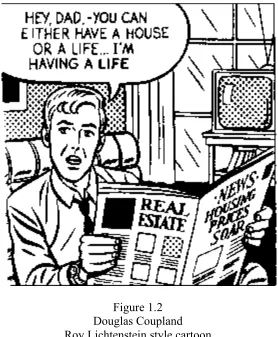
in including artistic elements such as cartoon panels based on the comic strip paintings of
Roy Lichtenstein in Generation X (Figure 1.2). His interest in art continued to manifest
itself in his novels until it moved to a highly abstract level, in which basic usages of
13
Francis Dube, “Grouchy, Lens-Shy, Talented Douglas Coupland,” Ottawa Citizen, September 25, 1992.
14 Tobias. 15
numbers, letters and basic phrases are turned into highly abstract images that have been
inserted in the pages of what is otherwise a conventional fictional novel.
The two books that Coupland places his most interesting examples of text-based
visual art are in the 1995 novel Microserfs and the 2006 novel JPod. In Microserfs,
Coupland explores the lives of a group of computer programmers who work at Microsoft
through the eyes of his main character, Daniel. Daniel and his group of friends decide to
leave Microsoft and create their own software design company where they design a game
called Oop!, which is essentially a computerized version of a box of Legos. Throughout
the novel, the characters express feelings of loneliness and self-consciously reveal
aspects of their self-identities through their computer interactions. Readers are given
samples of some of Daniel’s computer entries; which as supplements to the primary
narrative can be viewed as intriguing pieces of textual art.
The novel JPod has a similar premise to that of Microserfs. In JPod, the story is
told through the computer diary of the main character Ethan. Ethan works at a company
that designs video games and JPod follows his story as well as that of a strange
assortment of family members and workmates. In this novel, Coupland takes the basic
premise of Microserfs, and takes it further into the computer age. When Microserfs was
written, computers were not as abundant as they currently are and the culture of computer
programmers and hackers had never been discussed, but with JPod, Coupland recognizes
that his audience is more educated in computer technology, so he adds a litany of textual
art related to computer programming, search engines and eBay.
None of Coupland’s other novels have the same level of artistic elements as found
characters and settings, from astronauts to normal middle-aged women, to victims of high
school shootings. However, overarching themes are found in virtually all of Coupland’s
fictional novels. Regardless of setting and other plot elements, the characters in
Coupland’s novels always seem to be trying to find their own identities, working their
way through the loneliness that can occur so easily in the modern world. They typically
have to break away from their lives in some way to find themselves. Coupland’s novels
do not always have happy endings, but the author still manages to insert his own form of
truth and beauty into even heartbreaking situations, like the end of a relationship, or a
father searching for his missing son. Though it may just be describing an everyday
situation or scene, Coupland’s writing is characterized by simple but effective
observations and a subtle use of humor. While this thesis will not discuss this topic, it has
often been mentioned that Coupland’s style of describing things has its own visually
artistic quality.17
Despite his success as a novelist, Coupland returned to the art world in 2001. As
a visual artist, Coupland has produced ready-mades, photographs, paintings and videos.
Much of the art that he has created since returning to the art world incorporates text, for
which there is no precedent in his early visual practice. Clearly his work as an author has
influenced his output as an artist. While Coupland’s whole body of work is appealing,
examining his art that incorporates text, both from his novels and his exhibited works,
shows his art at its best and most interesting, in my opinion.
This thesis will discuss Coupland’s use of text as art by focusing on four themes:
abundance, advertising, technology and translation. Each theme will be explored in an
individual chapter. These themes are important because they offer insight not only into
Coupland’s use of image-text combinations, but also his own take on the society in which
we live and through which we communicate. The final section of this thesis will
summarize the various ways in which Coupland has linked text and art in his creations,
and the possible reasons that he has chosen to make text such a prominent component in
his art.
Coupland’s art will be analyzed formally. In addition, connections that can be found
in Coupland’s own writings and the information that he has given in interviews will also
form part of my thesis. Given that his art is still rarely written about (besides by the
galleries that exhibit it), Coupland’s work has never been studied in any real depth. My
analyses will provide the first substantial critical examinations of the art of Douglas
Coupland. Coupland’s visual art is important to explore, because he is creating an artistic
style that is essentially a contemporary take on Pop art, and through combining text with
Pop, he has found the ideal format through which to reflect on new modes of social
communication and interaction in contemporary society.
Before moving into the themes and particular works of art that exemplify them, it is
important to look at the artists who have been the most influential to Coupland’s own
works. The three artists that he speaks the most of, and whose influences can be most
readily seen in his works are James Rosenquist, Andy Warhol and Jenny Holzer. These
artists and their influences will be mentioned briefly here, and will be later discussed in
further depth in relation to a particular theme or work of art.
As the epigraph to this introduction reveals, James Rosenquist was the first artist to
images of popular culture in one painting as a way to comment on government and
society prove to be highly influential to Coupland’s textual art. As we will later see,
Coupland adapts the basic ideals of Rosenquist’s paintings into a format that is comprised
solely of text.
While the first work he mentions being drawn to was Rosenquist’s large work F-111,
the art of Warhol captured Coupland’s attention soon afterwards. The reason for this
seems to be that while Coupland liked Rosenquist’s take on popular culture, Warhol’s
works comment on popular culture in a way that is much simpler than what is found in
Rosenquist’s large, image-filled paintings. Coupland’s style of art and his influences have
always been closely related to Pop art, but Warhol seems most to encapsulate Pop for the
younger artist.
Whenever Coupland discusses influences, Warhol’s name is usually the first
mentioned. According to Coupland, “Warhol (another discovery that I made shortly after
I discovered Rosenquist) said that once you saw the world as Pop, you could never look
at it the same way ever again.”18 Elsewhere he has claimed: “Warhol has influenced my
life more than any other artist. I was reading his books at the age of nine and have never
stopped re-reading them since. He is a genius and a god, and I can’t conceive of the 20th
century without him.”19 Coupland has on many occasions created art with a Warholian
feel to it, and he commonly inserts references to Andy in his works, particularly in his
textual creations.
Coupland’s most contemporary influence is artist Jenny Holzer. While Warhol is a
more prevalent influence in Coupland’s general body of work, in this discussion of
18Coupland,Polaroids from the Dead, 122. 19
Coupland’s textual art, Holzer’s importance is obvious. Holzer’s series of “Truisms”
(1979-1982) which she placed on scrolling LED screens, benches, t-shirts and posters, to
name a few sites, are among the first instances in contemporary art where text can be
found to such a visible degree. Though textual art was central to Conceptual art practices
as early as the 1960s, Holzer’s interest in placing it in the public domain gave her work
broader exposure. Coupland regularly mentions Holzer as an influence, both on his
writing and his art. Coupland says of Holzer,
I began writing because I fell in love with Pop Art at the age of 10. I’ve always
thought that words are sexy. Words are art objects even by themselves, even without
being inserted into a narrative. I discovered Jenny Holzer’s text work in art school in
the early 1980’s. After that, it now seems, a lifetime spent working with words was
unavoidable.20
It appears that Holzer bridges an interesting gap in Coupland’s career. Because she was
an artist who worked solely with text, Coupland found it acceptable to be a writer, but
conversely, because she used text in her art, it would appear that Coupland was inspired
to create text-based art. Holzer’s influence will be discussed more specifically in relation
to particular works created by Coupland, but it is readily apparent that her
groundbreaking uses of text were the impetus to Coupland’s text−based art.
Throughout this thesis, Coupland’s creations will be compared to those of the
artists just mentioned. Through examining his own works, and their influences,
Coupland’s works will be seen to exhibit a contemporary take on Pop art. While
Coupland’s art doesn’t have the vibrant colors traditionally seen in Pop art from the 50’s
and 60’s, he tackles the same goals of exploring what is popular in society in the current
age. Through using text in his creations, he is able to achieve works that capture the feel
of modern times, and also draw the attention of the viewer to the affects of the things that
are encountered daily in a modern society driven by advertising and technology. This
thesis will also be shown how Coupland commonly uses a conceptual approach to
creation, such as extensive translation processes, or producing abundances of text, that
have the end result of works that can be seen as decorative. As will be seen, Coupland’s
extensive experimentation with text produces works that are both visually appealing and
Figure 1.1 James Rosenquist
F-111
(broken into two sections) 1965
Figure 1.2 Douglas Coupland Roy Lichtenstein style cartoon
from Generation X: Tales for an Accelerated Culture
ABUNDANCE
This section explores Coupland’s use of art and text combinations that highlight the
subject of abundance in modern society. Abundance is one of the most common themes
that can be found in both Coupland’s writings and art. When he is discussing abundance,
Coupland is speaking of advertisements, and of the media saturation of the modern
world. When he translates this idea of abundance into art, he exhibits a visual abundance
(by creating works containing a plethora of numbers and words) and uses this to make the
viewer think of the general profusion of ads, shows, books, and products surrounding
him. Coupland, unlike many of the artists of his generation, is not necessarily critiquing
abundance or showing the problems that consumption may cause to the human mind or to
the natural world. Instead, he claims to adore abundance, though his works sometimes
give a different interpretation. The most likely interpretation of this contradiction is that
Coupland both appreciates media bombardment, but is also wary of it.
The first works in which Coupland can be seen playing with the idea of abundance
are his fictional novels. Coupland’s explorations of text-as-art can first be found in his
novels. As mentioned in the introduction, when Coupland was working only as a writer,
he found ways to put artistic additions into his novels. While he began this in his first
novel, Generation X, only two of his novels can truly be found to embrace the idea of text
as art. These fictional works are Microserfs and JPod. Both of these novels are set in
technological environments and it would seem that Coupland developed much of his
textual art in response to computer culture. This idea will be further discussed in the
the best examples of textual art found in any of Coupland’s novels. By textual art or
textual additions (as I will commonly refer to the artistic elements that Coupland places
into his fictional novels) I am referring to things that have been added to the novel that
generally function independently of the story line, and solely as visual elements.
Sometimes these additions are in a small way related to the story line, but the novel does
not require them to function narratively or to provide cohesion. These elements are
composed entirely of words or numbers. In this chapter, all of the textual additions
discussed underscore the idea of abundance.
Coupland first began to conceive of the idea of text as an art in Microserfs. The
visual art elements placed into this story are explained to the viewer as the computer files
of the main character of the novel, Daniel. In one of his first “entries” into his computer,
he decides to create a file composed entirely of the word “money.” This occurs when
Daniel is discussing money with one of his business partners in the software design
company started by the group of friends in the novel. The partner, Ethan, has been
involved with several computer ventures previous to Oop! and has gone through
alternating periods of being either extremely wealthy or extremely broke. Daniel is
asking him how he can so cavalierly make and lose money. Ethan’s only real advice on
the subject is not to think of it as getting and spending money, but to think of money in
terms of it replicating itself and building up. The end result of this suggestion leads
Daniel to create money in his computer file: two facing pages of the novel in which the
lowercase word money is repeated in the same font in even rows as if Daniel has taken
Looking at money, a viewer is supposed to consider abundance, and given the
general tendencies of Coupland, the author does not necessarily want the reader to
consider it in terms of the specific meaning of the word “money.” He is playing instead
with visual abundance and exhibiting the excessiveness that he loves about the modern
world. He likes the shapes that the words make and the patterns that are made within the
repeated words, and he uses the main character’s computer entry to express this idea. In
Microserfs Daniel says of his completed document:
I stared at an entire screen full of these words and they dissolved and lost their
meaning, the way words do when you repeat them over and over− the way
anything loses meaning when the context is removed− the way we can quickly
enter the world of the immaterial using the simplest of devices, like
multiplication.21
Through Daniel’s observation about the effects of multiplication, Coupland is also
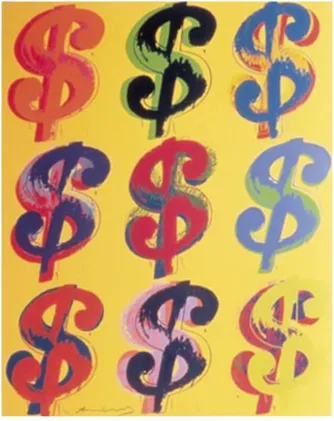
invoking the Pop art tradition, in particular the work of Andy Warhol. Warhol commonly
worked with grids of repeated images, and actually created several works very similar to
the idea that Coupland is working with here. Warhol’s 192 One Dollar Bills (1962) and
Dollar Sign (1982) both exhibit the same idea of repetition of money as found in
Coupland’s money.
Coupland has said that this is his own tribute to Warhol. Warhol created his money
repetition by printing rows of dollar bills onto a canvas (Figure 2.2.) Coupland’s version
has more in common with Warhol’s works than just subject matter. The simple printing
process used by Warhol, in which any number of prints can be made, is in a way very
21
similar to the way in which Coupland would have created his version using a word
processor, by copying and pasting the text. Coupland says of money, and of another page
that repeats the word “machine”:
This embittered reviewer said that they were nothing more than a “craven
autobiography,” and attempts to fill space, but I thought that it was simply a nice
Warhol tribute to have people see the words and think of Andy and of a fresh new
way of seeing and loving the culture we live in.22
Coupland’s response to his reviewer indicates that his text pieces serve as an homage to
Warhol and to contemporary culture, but Coupland could have been thinking even deeper
when making money. As Warhol did with his own references to money, Coupland could
be speaking of art as a commodity, or he could be making a more ironic, autobiographical
reference, though not in the cowardly way in which the critic accuses him. Coupland
began writing as a way to pay for art supplies, essentially writing for the money, and then
he ended up working solely as a writer and pushing his gallery−exhibited visual art to the
back of his mind.
The use of a repeated word filling one or more pages is common in Coupland’s
novels. Another example in Microserfs involves the word machine. The machine page is
identical to money in that it is filled with even rows of the repeated word. In this case the
impetus for the page is Daniel considering the word “machine” and how odd it sounds if
you say it repeatedly until it loses all meaning. He is also considering how outdated the
word machine sounds in a world driven by computer technology. It is obvious that
Coupland is almost obsessed with the appearance and sounds of words. One of the most
22
telling statements of this was when he was discussing the look of words in an interview.
He said, “Egg is a beautiful word, with the G’s capitalized. Zulu is a beautiful word.”23
He is thinking of words and letters outside of their normal context. He is not considering
meaning, but instead he is considering appearance.
The idea of a repeated word filling a page or pages also shows up in JPod,
Coupland’s only other novel containing highly abstract textual additions. JPod deals with
a similar technological backdrop as Microserfs. Into JPod, Coupland inserts more artistic
textual elements that once again highlight the idea of abundance. While in Microserfs
there were many textual additions, Coupland takes the idea much farther in JPod and
ends up adding a massive number of pages to the book that function as art. As with
money in Microserfs, Coupland includes pages like ramen noodles and $ which work
with the same idea of abundance by placing either the repeated words “ramen noodles” or
the symbol for a dollar in even rows. As the basic idea of this has already been discussed
with Microserfs, we will move on to how Coupland takes the idea of exhibiting visual
abundance much farther in JPod.
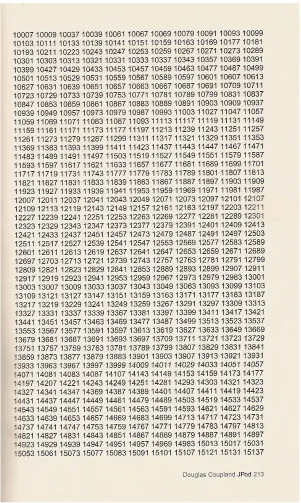
In JPod, Coupland includes large sections of pages containing either number or
letters. One of these numeric sections includes the 8,363 prime numbers between 10,000
and 100,000, which takes up a total of sixteen pages (Figure 2.3.) The second use of
numbering pages is based on the first 10,000 digits of pi and takes up 22 pages. Another
addition similar to the numeric pages are a series of twenty-two pages that list the 972
three-letter words allowed in Scrabble, with one fake word added (Figure 2.4.).
In the storyline of the novel, these pages make up activities that are played by the
members of a section of the software design company. They comprise such activities as
finding the false prime number or finding the mistake in the digits of pi. Some journalists
have suggested that these additions are meant to serve as activities for the reader24, to
make the reader use his or her brain in the same way as this group of highly intellectual
people does in the novel. But it seems unlikely that the average reader would participate
in this. Most people do not know all of the three letter words in Scrabble, or have pi
memorized to the first 10,00 digits. It is illogical that the general reader would put down
JPod in the midst of reading it and start to research these things to “play along” with the
characters. While some of Coupland’s fans probably have done this sort of thing, the
general population would not go through all of this. I would propose that Coupland did
not intend these additions as a fun game. He was using them as a way to incorporate
visual art into his fictional novel, and as a way to highlight visual abundance.
When just reading the novel, a reader encounters these pages and, regardless of
whether he is thinking of them as an artistic statement, he will at least be amazed by the
abundance of pages, and possibly shocked that the author would just include this in the
book. The abundance of pages forces the reader to consider the reasons behind these
pages. What is the average reader supposed to make of these?
Even if the reader does not take the idea far enough to think of these as a statement of
abundance by an artist, at the very least she would have some thought as to why the
author of the book included all of these seemingly senseless pages. The reader would at
least have to recognize the sheer volume, or abundance, of the pages put before her.
Coupland said specifically of his additions to JPod:
I expect them to look at the number and words the way they might look at a Warhol
canvas, just enjoy the multiplicity and the muchness of it all. I love abundance. Words
don’t just have to be words, and images don’t just have to be images. I love
replication, I love mass culture. Enjoy it! The world’s a fucking brilliant place to live
in.25
In his fictional novels, Coupland was able to play with the idea of text as art, and to
explore many different ways of working with text and using it as a reflection of different
themes, like abundance. As Coupland returned to creating visual art that would be
exhibited in a gallery, text once again became a component. While Coupland had always
worked in a wide variety of media and techniques in his artistic practice, the
incorporation of text was new. I propose that Coupland envisioned text as just another
instrument in his artistic toolbox, as something else to use just as one would use paint,
clay or a camera.
From creating textual art in his novels, Coupland began to apply his text as art
approach to gallery work as well. And the similarities between works in the novels and
those exhibited in galleries can sometimes be surprisingly similar. The works that best
exhibit Coupland’s visual use of text as a means to highlight the idea of abundance
formed part of his 2006 exhibition Play Again? at The Rooms Gallery in St. Johns,
Newfoundland. For this show, Coupland took sections of number− and text−based art
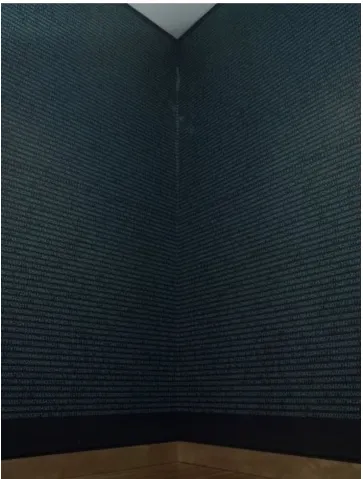
created for JPod and placed them over the walls of three adjoining rooms of the gallery.
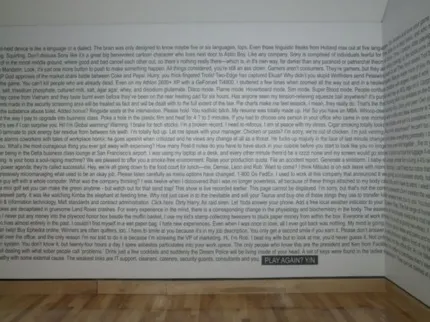
In two of the rooms, plain black letters on white walls form a rambling mass of text.
25
In a stream-of-consciousness fashion, the writing covers such topics such as how to
succeed in business, the outsourcing of work to other countries, and odd advice on how to
act at work such as. This abundance of text seems to come from several different points
of view and switches topics quickly and not quite coherently. Some parts of it have an
almost angry tone, but the general tone of this is frantic. The sentences and phrases make
more sense than any use of text as art that has been seen in Coupland’s novels, but are
extremely hard to read. The stream of consciousness form had by the text, proves,
without careful attention, hard for a viewer to follow or even remain interested in for
longer than a few lines. For example, this brief section from the first pages of the JPod,
which then formed the main body for Play Again? read:
People who use the phrase, “In these changing times, when the only thing certain is
change itself” are idiots. Think about it and read the following sentence: “In these
static days, when the only guarantee is stasis itself…” You see what I mean.
Sometime when you’re all alone in a room, ask yourself if what you do for a living
can be done by someone in India. If there’s even a flicker of doubt, then you have to
admit that you’re doomed. Which is more humiliating: losing your job to a robot, or
losing your job to someone who lives in a country whose standards of living you
consider inferior? You can’t fake creativity, competence or sexual arousal. If you
have none of these three attributes, then pack it in right now. Go sell roadside corn in
India. Your call is important to us.
While Coupland uses punctuation in these pages in JPod, he does not format this text in
the mass of words into any sections. There are no paragraphs to break up the block of
words.
In the exhibit Play Again?, this abundance of text has been taken straight from JPod
and placed directly onto the walls of the gallery in Helvetica font. Coupland leaves the
walls otherwise unadorned. Only one area in the three rooms of the gallery has any
coloration. This is found in a few walls painted in a dark red with Chinese symbols
painted in gold (Figure 2.5.) The final of the three rooms has white numbers placed onto
black walls (Figure 2.6.) In the center of each room is a low, long table filled with either
stacks of blank white paper or symmetrically arranged rolls of toilet paper, almost like
words have been released from paper, where they would usually be found, onto the
gallery walls.
All of the text, with the exception of the Chinese, is unadorned. It is simple black
text on a white background (Figure 2.7.) This use of a foreign text could be perceived as
a way to add a decorative element to the exhibition, or as a comment on the perceived
“exotic-ness” of non-Western cultures. Coupland could also be drawing attention to the
high Asian population in Canada and the way that Chinese and Japanese lettering are
seen more in ads and business signs as the population of non-English or French speaking
citizens move to Canada. Coupland used this same idea in JPod in several pages where
he showed a Chinese character along with its English translation. These pages simply had
a large character with an English translation in parentheses directly under is. In the
gallery setting we do not get a translation. Unless the viewer could read Chinese, these
would just look like interesting symbols exotically colored. From the lack of translation it
abundance of characters on a sign for a Chinese business, or an advertisement, that is
incomprehensible to the viewer. Like many of Coupland’s works, many of the elements
in Play Again? can be read in multiple ways. Coupland leaves much of his text−based
work open to a plethora of interpretations. He rarely draws only one conclusion; his work
is more about presenting facets of the modern world, and letting a viewer draw his or her
own conclusions.
The final room to be discussed is the black room filled with white numbers. This
number−filled room created a curious, and unintended, effect on those who entered it,
that of relaxation. As the artist states:
When you’re looking at nothing but numbers− a numerical field painting of sorts−
an interesting thing happens in your brain. Its numerical center (wherever it is
located) hums into operation, while your verbal and linguistic center shuts down. But
the thing is, because you’re looking at numbers but not doing anything with them,
your brain is essentially in idle mode, and hence the relaxation.27
In Play Again?, Coupland explores several ideas such as freeing words from paper
and the importance that we place on the written word, but the idea that is most prominent
is abundance, which, as Coupland’s statement suggests, is also linked to relaxation.
Curator of Play Again? Shauna McCabe says, “Conceiving a space solely of text,
Coupland offers a fresh new way of seeing the replication of mass culture and the
abundance of the world around us.”28 Walls filled with letters and numbers quickly draw
the mind to the idea of abundance and the role that abundance plays in modern culture, in
27
Douglas Coupland, “I Luv Helvetica,” New York Times, August 27, 2006. 28
“Artist, writer and cultural commentator Douglas Coupland to open new contemporary art exhibition at The Rooms on May 19,” Government of Newfoundland and
particular the abundance of advertisements the average citizen encounters daily. Here
Coupland is highlighting advertising abundance and possibly the way that we deal with
its constant intrusion into our lives. After a while, all of the ads turn into a big blur of
abundance. They just turn into a part of the scenery or the background. Unless an
advertisement is very different, its content becomes fairly easy to ignore. They form a
“field” of words and text that we zoom past in our cars or flip past in a magazine.
Advertisements have just become a part of almost every landscape that one encounters.
Rather than irritate the passer-by, Coupland suggests that they can inspire a sense of
relaxation.
By using textual art as a way to highlight abundance, and the supposed positive
aspects of abundance, Coupland has chosen the perfect visual format. In the Play Again?
exhibition he took the theme of abundance that he was trying to show in his textual art in
his fictional novels and finally put it in a setting where it receives the proper
consideration as “art.” The abundance that could be misunderstood by a reader of one of
his novels (as either being some sort of activity or as a useless filler of pages) can be
considered in an artistic context. Coupland always wanted it to be thought of in this
manner, but it seems unlikely that many readers of his novels fully thought about his
intent. So, while he is working with the same concept of highlighting abundance with
textual elements, the impact is very different in Play Again?.
One of the most important differences to consider when discussing Coupland’s text
that was removed from JPod and placed on gallery walls, is in how the situation into
which the text is placed affects the reader/viewer. In the novel, someone would not
phrases; they would probably just disregard the strange pages and move forward into the
fictional narrative. However, if a person willfully went to see his textual installation, it is
implied that she would spend some quantity of time absorbing the work and thinking
about it. The gallery viewer seems more likely to happen upon the idea that Coupland is
illustrating a visual abundance to make her think about the media abundance of modern
society. Not that readers of one of the fictional novels could not come to the same
conclusion, but Coupland is effectively interrupting the story for them.
Another important difference between encountering Coupland’s textual art in a novel
versus a gallery is the feeling gained by the viewer’s experience of these pieces. While
Coupland’s plethora of pages containing the digits of pi, for example, exhibit abundance,
they are just pages in a book that are easily flipped through. As with seeing an image in
an art textbook versus actually seeing the piece in a gallery, there is definitely more of an
impact seeing something in person. While the textual additions in his novels aren’t
reproductions, they are not the same as viewing a piece in a gallery. Granted, the pieces
in the fictional novels do have advantages: they are portable and can be viewed for as
long as one desires. There is no one blocking a view or any gallery hours that have to be
adhered to, but when seeing viewing Play Again? at the gallery, the viewer is completely
surrounded by the words and numbers. They have no choice but to acknowledge them
and consider them. They are totally inundated. A different affect is caused to the senses
than by just seeing a page in a book.
The words and numbers that are placed on these walls cannot be processed into any
complete statement. They do not offer any real information. While we know that these
make a difference. There is no information that gives references to characters or a story
line. The viewer is simply given walls filled with stream of consciousness statements that
were difficult enough to read when contained in a book, Chinese words that most are
incapable of reading and numbers that require no processing. They all become the same
blur that advertisements, signs and the prices contained in those advertisements and signs
become to the people that are inundated with them everyday. In Pop Art: A Continuing
Tradition, Marco Livingstone makes several statements about Pop artists, in particular
Andy Warhol and abundance that could be directly applied to Coupland and his own
desires for abundance. Given Coupland’s hero worship of Warhol, it is clear that
Coupland has modeled his own artistic intents after Warhol. Livingstone says of Warhol:
Warhol had an uncanny gift for selecting motifs from the glut of visual
information characteristic of a modern industrial society overwhelmed by consumer
products, newspapers, magazines, photography, television and the cinema. He was
particularly astute in realizing that our over-exposure to images in the public domain,
whether of famous faces or horrific events, gradually divests them of any apparent
emotion and at the same time gives them iconic power by engraving them in our
memory through the force of repetition.29
While Coupland is working with text instead of iconic faces, the same principle
seems applicable. Coupland could also be commenting that the abundant advertisements
really contain no important information. Even when we are drawn into reading an ad or
paying attention to a commercial, how often are we truly told anything important or life
changing as these ads would want us to believe.
29
The abundance Coupland gives us could also be related to Internet search engines.
Since in his stream of consciousness he is frequently referencing business and computer
technology, maybe he is emulating in a way the random information that is commonly
received from Internet searches or in spam emails. Most people familiar with computers
have learned simply to glance at those and realize the information is not useful, much as a
reader of JPod or a gallery viewer would quickly realize the abundance of text is not
particularly useful to them for the content it conveys. Coupland has taken all of these
things that we move past everyday and put them back into our face to draw our attention
to this abundance of text that inundates us daily, much as Warhol did when he presented
viewers with the familiar faces and products of popular culture.
But, it would be incorrect to say that Coupland is trying to draw attention to the evils
of this abundance. Given earlier statements by Coupland (“I love abundance. I love mass
culture”) Coupland would have us infer that he is commenting on abundance, but not
totally damning it. He has taken the abundance that he considers to be beautiful, and the
text that he considers beautiful as well, and placed them into a gallery setting to make
more people see things the way that he does. He is elevating text as a visual element and
also highlighting these issues of abundance and the importance we place on the written
word.
Coupland’s statements about the joys of abundance cannot be taken only face value.
While Coupland never says anything that really counters his love of abundance, he has
made statements about advertising that are not entirely positive. This will be further
discussed in the next section, but essentially, he expresses concern about all of the space
how these affect his personality. Given the connections between abundance and
advertising, these concerns put a slight dent into his supposed love of all forms of
abundance. The best way to think of Coupland’s relationship to abundance could be to
consider it a love-hate relationship. By presenting abundance in these mixed terms , he is
also linking himself to the Pop art tradition. Livingstone says of Pop artists:
However pressing their desire to bring the ‘real world’ back into their art as
blatantly and with as little ambiguity as possible, Pop artists remained acutely
conscious of the historical context in which they did so. Their characteristic
detachment enabled them to address themselves to the imagery they saw everywhere
around them without completely submitting themselves to it.30
When applied to Coupland, this statement makes sense. While he in some ways
appreciates the abundance that inspires his art, he is trying to put it out there and see how
viewers respond. By making only positive comments about abundance, he is not
immediately putting a viewer in the place of taking a position on it, as would happen if he
flat out stated its evils. He is removing himself from the situation, as Pop artists did, and
allowing a viewer to consider the myriad of ways that they encounter and perceive the
abundance that they encounter.
30
Figure 2.1 Douglas Coupland
money
(One page of two identical facing pages) from Microserfs,1995
Figure 2.2 Andy Warhol
Dollar Sign
1982
Figure 2.3 Douglas Coupland
Prime Numbers
(One of sixteen pages) From JPod, 2006
Figure 2.4 Douglas Coupland
Scrabble
(One of four pages) From JPod, 2006
Figure 2.5 Chinese lettering
Play Again Y/N?
Figure 2.6 Random numbers
Play Again Y/N?
Figure 2.7
Stream of consciousness writing
Play Again Y/N?
ADVERTISING
The prevalence of advertising is one of the major themes that can be found in both
Coupland’s art and writings. This idea was exhibited in the last section, as Coupland uses
visual abundance as a way to highlight the plethora of advertisements found daily in
modern culture. Mentions of, and textual art that shows products and advertisements are
constants in Coupland’s novels and exhibited art. The use of advertisements and branding
in Coupland’s art also reflects the importance of Pop art to him and his artistic creations.
Everyday products were a common subject in Pop art, particularly in the compositions of
Warhol and Rosenquist. Coupland has found a unique way to use text to mimic
advertisements and comment on the effect of advertising.
Coupland is also highly preoccupied with thoughts of how this constant
bombardment with advertisement affects people. He has repeatedly mentioned his shock
at the thought of how much of his own memory is filled advertisements, and how having
these memories might affect him as a person:
The other day I saw a Shake ‘N Bake TV commercial, one I had not seen in
twenty years, and in a flash, the whole commercial came back to me, as though I
had just seen it five minutes ago. So I guess my head is stuffed with an
almost-endless series of corporation-sponsored consumer tableaux of various lengths.
These “other” commercialized memories are all in my head, somewhere, and this
is indeed something worth considering. What would it be like to have never had
a nonmedia culture? Would I still be “me”? Would my personality be
“different”?31
Clearly, concern over the ramifications of a mind filled with advertisements weigh
heavily on Coupland’s mind. In both Microserfs and JPod are filled with textual art
related to advertising. The first instance of this can be found in Microserfs. As mentioned
in the previous section, the main character of the novel, Daniel, creates files on his
computer that become part of the novel. After he and some friends have a discussion
about the surrealist artists’ interest in the subconscious, Daniel decided to create word
banks of the random words and phrases that pass through his head during the day. From
this topic, Daniel and his friends then wondered whether computers have a subconscious.
If they do, what it would look like? In Daniel’s words: “I’m creating a file of random
words that pop into my head, and am feeding these words into a desktop file labeled
SUBCONSCIOUS.”32 The words placed into this “file” are typically unrelated to one
another and are mainly words straight out of popular culture, such as tabloid topics and
advertisements for food, drinks and other products. Sometimes they are like truisms or
phrases. For example, in the first illustration here, the sample contains a jumble of words,
like “calling card,” “three lemons,” and “stolen watches,” and the truisms “Subjected to
the random, you acknowledge your inability to comprehend logic and linear systems” and
“We generate stories for you because you don’t save the ones that are yours.” These
subconscious files (Figures 3.1and 3.2) seem to hold elements from the frenzy of
thoughts that run through the mind, and further seem to be a direct reflection of
31Coupland,Polaroids from the Dead, 112. 32
Coupland’s worries about the information in his mind, and how much space
advertisements actually occupy inside of his head.
These textual additions are interspersed into the novel and commonly appear at
the beginning and end of chapters. While these are a manifestation of the main
character’s mind, rarely do the things that are mentioned in these subconscious pages
relate to anything in the storyline. Rather, Coupland is using these additions as a way to
insert his new form of textual art into the novel.
When examining these examples from Microserfs, it is clear that while Coupland
uses the same font, he changes the font size and spacing throughout these pages, almost
as if he is trying to make textual illustration out of the words from his own subconscious.
These types of textual additions are related to Coupland’s early fascination with James
Rosenquist.33 A young Coupland liked to create his own Rosenquist−style creations with
images from Life magazine. He connected his creations with Rosenquist’s painting F-111
because it depicted “all these images that flow daily inside your head.”34 Clearly, a
similar idea is at work here, given that these phrases are things that are supposed to be
floating around in the head of the main character of the novel. Coupland seems to be
creating the textual equivalent of a Rosenquist collage. When thinking of Coupland’s
word banks in terms of Rosenquist’s collage−style paintings, the word banks become
easier to conceive of as art, particularly as Pop art. When looking at one of the word
banks from Microserfs (Figure 3.2) you can imagine the elements here as brightly colored
images crashing together: plane flight numbers, a big bowl of oatmeal and a Big Gulp
33See Marsha Tucker, James Rosenquist (New York: Whitney Museum of Art, 1972). 34
drink among other things. Like Rosenquist, he is taking the mundane images from
magazines and televisions advertisements and placing them into the arena of high art.
In JPod, Coupland also uses textual art related to advertising, but in a much more
blatant way. While there are pages in JPod that appear similar to those in Microserfs,
there are also several textual additions that function purely as advertisements; they are
simply product labels.
The first example of these can be found in a page that just contains information
about oriental noodle soup (Figure 3.3). It contains the name of the soup company,
Nissin, the product number, size information and the information that the flavor of this
particular noodle soup is chicken. As in the “subconscious” pagesof Microserfs, here
Coupland has played with the font size and made some of the lettering bold. He also
changed the justification from right at the top of the page and left at the lower portion of
the page. Oriental noodle soup seems to be bridging the gap between the subconscious
pages and more straightforward advertising of the next piece, Doritos.
The most obvious example of product placement, Doritos (Figure 3.4) looks like
the back of a package of Doritos Rollitos. We are given product numbers, calorie and
nutritional information and the ingredient list. There is no evidence that Coupland has
altered this information in any way with the exception of the missing serving size
information. He is not arranging the information or playing with font sizing as was done
in the subconscious pages or in oriental noodle soup. He has reproduced the product in its
most basic form.
While the subconscious files in Microserfs seem more related to the works of
constantly quoting Warhol’s art in one way or another, and these JPod advertisements
seem like just another take on Andy as money was in Microserfs. oriental noodle soup
and Doritos are just the next level of Warhol’s Campbell’s soup cans. This example
shows the core of Coupland’s reconception of the Pop art movement. Instead of showing
a basic can of soup, Coupland is showing basic, textual, product information. He didn’t
create these facts, but rather he copied them from a label. Also, there is no apparent
change in the formatting as he did in the subconscious pages in Microserfs. This is a clear
imitation of Warhol’s original Campbell’s soup can paintings that were left in the original
colors. The fact that Coupland did not alter this label information raises an important
reason as to why Coupland uses only text when drawing the attention of the
viewer/reader to advertisements. When the images are stripped away from
advertisements, they seem much less appealing and much more ridiculous. In Doritos,
viewers are given the information “nacho cheesier” but no image to connect this too.
They are forced to connect those words with the nutritional information and the
ingredient list that contains disodium phosphate and artificial colors. The product that is
being described, when stripped of alluring packaging and a bright image of the chips,
does not sound appealing in any way. If a person had never experienced this product, the
basic facts given here do not inspire one to purchase Doritos, although this page could be
viewed as a cue to run to the fridge and get a snack, as a person would do during a
commercial break. Or, Coupland could be displaying products that relate to the lives of
the programmers in the novel. They all work long hours and have inactive social lives;
Ramen noodles and Doritos are probably some of the foods that are quick and easy to eat
As is evident in everyday life, advertisements pop up in more and more spaces
daily. We do not just see them in magazines or on television. They are virtually
everywhere we look. Branding is even occurring in movies now, with the characters
using or mentioning certain products, like Herbal Essences shampoo or Coca-Cola. Any
sports event has product endorsements placed in every direction. There are few
experiences now that are completely advertising free. It would appear that Coupland is
suggesting that advertisements could work their way into books. Someday we could be
looking at an ad in between chapters of a novel we are trying to read. So here we can see
that Coupland is considering the massive quantity of advertisements that we encounter
daily, but also the future of advertising and how far it could possible spread into every
aspect of daily life.
To further prove this idea, Coupland includes examples of advertising on
computers, for example a penis enlargement spam email and eBay style advertisements
that the characters in the novel crafted to sell themselves. By using these computer
advertisements, he is showing us how quickly computers have become inundated with
ads. Maybe books aren’t far behind. Given Coupland’s concerns over how
advertisements have already affected his mind, it seems unlikely that he wants them to
invade books as well. By creating oriental noodle soup and Doritos, he is leading his
audience to think about how prevalent product placement is, and to draw its own
conclusions about how it can affect their lives, or how it can affect their reading.
Outside of his novels, one of the few examples of Coupland’s artworks that
incorporates text and advertisements is CorporateSafety Blankets, 2007, which is made
No. 2 (Figures 3.5 and 3.6.) These blankets are similar in that they are both off-white and
completed covered in product logos arranged in evenly spaced rows. The logos appear as
either a picture, text or the combination of the two. Coupland has exactly copied the
logos, from their signature illustrations to their signature fonts and colors. The product
logos range from Hello Kitty to Frosted Flakes to Xerox. Coupland is exhibiting both the
abundance of advertisements we encounter daily and also our virtually infantile
connection to certain products. By making these blankets and giving them the title
Corporate Safety Blankets, Coupland is showing our connection to products and the way
that we identify with specific brands. Do we think of ourselves as safe or trendy because
of our connections to these certain products? Do we feel safe using these products
because of the level of advertising that they have as opposed to a new, unknown brand?
What does our use of these things say about us as individuals and as consumers? Further,
do these logos and signature fonts become the design elements of our everyday lives?
Once again, Coupland seems to be tackling the idea of how the abundance of
advertisements, which we cannot avoid, affects us visually as well as psychologically.
Another example related to advertising and text can also be seen in Play Again?.
Comprised of rooms filled with rambling text, Chinese lettering and numbers, this
installation, as discussed in the previous chapter, encourages the viewer to think of the
abundance found in modern society. More specifically, Coupland indicates that one of the
components of that abundance involves advertisements. The use of the rambling text,
indecipherable numbers and foreign lettering lead one to think of the advertisements that
inundate us daily, but that we often ignore by flipping through a magazine page or
constant bombardment of advertisements given that the walls of the rooms are totally
filled with text.
Coupland uses text to illustrate the prevalence of advertising for many reasons: to
show the abundance of advertising, to relate to the Pop art tradition, to strip advertising of
its allure and to attempt to come to terms with the effects that advertising has on the mind
and personality. Coupland, like Warhol, never makes statements that would lead us to
believe that he is harshly against the prevalence of advertisements. He has only
commented on how great he believes abundance to be. But, considering how prevalent
his references to advertisements are, they must be something that weighs heavily on his
mind.
Two final examples reveal the ambivalence Coupland has for advertising. The
first, from 1992, is an actual ad for Absolut vodka (Figure 3.7) that Coupland created.
Presented in a collage format, it features a story about two friends remembering their trip
to the 2003 World’s Fair.35 This ad was part of a series of advertisements created by
writers. The fee they received for creating their ads was donated to charity (in Coupland’s
case a wildlife fund.) Coupland’s second foray into advertising occurred in 2007 when he
was a spokesperson for Blackberry Pearl. He was featured in commercials, the webs site
for the product and in print ads. This time the money he received was donated to an art
gallery in Vancouver. Coupland was involved in these projects as a way to give money to
others, but he received much backlash from his own fans via the Internet for these
decisions. Coupland’s art and writings are always much discussed by his hardcore base of
fans. As the spokesperson of Generation X, some people have come to feel that he has to
35
be a certain way and act a certain way, and apparently these ads made people consider
him a sell-out to the group that he named. Coupland, either in response to these people, or
as a way to validate the advertising of himself, placed explanations in the bibliography
section of his own website entitled “The Vodka Thing,” in which he explained his
motives, saying:
People can forget that as a writer your ways of fundraising for charity are
extremely limited. Painters can donate paintings to auctions, but writers?
Donating books is one option, but it won't raise much. To raise a meaningful sum
I think you really have to put yourself out there.36
Coupland is both supporting advertising by being involved in the process and
simultaneously making being involved with advertising seem shameful. Clearly,
Coupland has a confused relationship with advertising, which could be something else
that he took directly from Warhol.
Warhol brought into his work an outlook and values absorbed through his
successful commercial art practices and through mass media. He and his painting
seemed egoless, deadpan, impersonal, unemotional, inauthentic, contradictory.37
Could it be that Coupland, knowing that we must endure advertising bombardment,
whether we approve of it or not, is sending a message about how to turn what appears to
be a negative into something positive? Through his artistic reworking, he is essentially
subverting products and logos and advertisements by taking things meant to make us
desire and remember products and turning into them into a conceptual rendering of visual
36Douglas Coupland,“The Vodka Thing,” Http://www.coupland.com/coupland_bio.html. 37
decoration, something pleasing to look at, but not something that makes us want to
purchase a product. Coupland, in both his writings and his art, has a way of taking the
Figure 3.1 Douglas Coupland
21
Figure 3.2 Douglas Coupland
Lawry’s Garlic Salt
Figure 3.3 Douglas Coupland
Oriental Noodle Soup
Figure 3.4 Douglas Coupland
Doritos
Figure 3.5 Douglas Coupland