31
Chapter
4
Migration in The Rural Impact : A Case Study of Bulupitu and Sepanjang Village,
Malang Regency, Indonesia
Gunawan Prayitno1,a 1
Urban and Regional Planning, Faculty of Engineering, Brawijaya University, Malang, Indonesia
a
Abstract. Indonesia has long experiences for rural community development that have not only positive impact
on social and economic but also have negative impact. One of the impacts of the failure of rural development is migration from rural area to urban area or to another country as international migration. This paper tries to identify the impacts of migration in the rural area. We use evaluative and qualitative analysis and implement correlation analysis for the analysis of remittance in two villages in Gondanglegi district, Malang Regency Indonesia. Base on the analysis, we found that the impact of remittance in Bulupitu village and Sepanjang village are different. In Bulupitu village remittance influence both of economic and infrastructure aspect. Economic variables are consists of transportation ownership, house ownership, and land ownership; and infrastructure are water access, telecommunication ownership, and religion building/mosque. In the Sepanjang village, the impact of remittance is only has impact on the economic aspects (house ownership, and land ownership).
Keywords: Evaluative, qualitative, correlation, and variables.
I.
Introduction
Indonesia has long experiences for rural community development that have not only positive impact on social and economic but also have a negative impact on social, economic and environment system. The rural sector in Indonesia consist about 135 million people or 57% of the total population. Out of the total rural population, 45 % or 60.75 million are considered to be poor [1]. Government of Indonesia concerned to rural development and poverty alleviation program and provided financial assistance in various forms. The programs are grant, revolving fund, soft and commercial credit already implemented in a rural area through community organization with various levels of formality and activities.
In reality studies found that most programs failed and discontinued [2]. Claim succeed in rural development is from mainstream of development practitioners, but the problem in a rural area still happen where is there being low income, limited access to health and clean water and some threats to the human being. The failure of rural development tends to make the area become static and cannot attract young generation to stay and work in the village. The low income from the agricultural sector activities and uncertainty monthly income push inhabitant tries to find another sector outside from the agricultural sector. Migration is the one way to increase their income because the difference of disparity between the urban and rural economies.
32
Both types of migration have more than one impact on the village. Firstly, the flow of money received directly by the family in the village, and the second is the reduction of the amount of labor that exists in villages, thereby reducing the village productive workforce. Third is the presence of labor migrants who have returned also having an impact on rural areas.
II.
Methods
This research implements quantitative and qualitative methods to measure the impact of remittances in the rural area. Interview was conducting with the respondents in two districts consist of head holder and migrants in each household that has international migrant workers in their family.
2.1. Data collection
Data collection is the foundation of a research process. Data that obtained from the research location have a significant influence on the analysis and the result of the study. Therefore, the method of data collection must be precise in order to obtain valid data and must be in a systematic and standard procedure [3]. Data's collections performed by two methods, namely primary and secondary data collection. The data used in this research is the data that are descriptive and quantitative.
2.2. Evaluative analysis Methods
Evaluative analysis used in this research is the analysis of the correlation. Correlation analysis used to determine the effect of remittances for rural development (social, economic, and infrastructure). The independent variable (X) in this study is the use of remittances, and the dependent variable (Y) in this study was the development of the village consisting of social, economic and infrastructure (Y).
III.
Literature Review
There are many studies about the impact of migration and remittances. Agarwal and Horowitz [4] argue that they have found evidence in favor of the altruism motive for remittances. Their claim is based on the inclusion in their analysis of the number of other migrants abroad from the same household. It is found that remittances are significantly negatively associated with the number of other migrants. Their conclusion that this finding favours the altruism rather than the insurance motive is based on the assumption in the construction of their model that the contract between a migrant and household is not affected by the presence of other migrants from the same household. However, this is only an assumption. We can think of contracts among family members where remittances may depend on the number of migrants. For example, an informal contract based on the“all for one, one for all” principle would lead to the same result as that found by Agarwal and Horowitz if difficulties were experienced by family members at different points in time.
The fact that existing evidence consistently shows that only a small fraction of remittances is used for enterprise financing [5]. The microeconomic literature identifies six different motives, not mutually exclusive, on why migrants transfer income to their families in their countries of origin: altruism, exchange, insurance, investment and inheritance.
33
Finally, the family may directly affect the migrant’s remittance behavior because of the social norms that develop within the family and exercise pressure on its members to help each other in times of need. Also, family members may create or enhance feelings of guilt for those who would not otherwise help those in need [7].
IV.
Results and Discussions
4.1. Indonesian Migrant Workers (IMWs or TKI) Characteristic in Bulupitu and Sepanjang Village
Indonesian migrant workers (TKI) have many contributions on Indonesia economic and rural development. According to the International Organization of Migration (IOM, 2010) and Ministry of Human Power and Settlement (2011), the number of migrant workers from Indonesia has been increasing over the years, from 380,690 in 2004, to 632,172 in 2009. In addition, remittances sent by these workers, which, according to IOM (2010), amounted to USD 6.6 billion in 2009, have been an important factor in the country’s renewed economic growth in the past few years. According to a BI survey report, remittance inflow contributed to Indonesia’s balance of payment in the amount of 27 per cent of all services, income, and current transfer value (IOM, 2010).
Remittance send directly to the family in the rural area, and family member can use it easily like a private income. The family who has international migration in their family could increase their income, or in other word they can securing their income, their health and their education.
[image:3.595.241.388.390.589.2]This is the percentage of male and female Indonesian migrant workers from Bulipitu village and Sepanjang village. We can see that female migrant workers are higher in both villages.
Fig 1. The percentage of Male and Female Indonesian migrant workers (Up Bulupitu village, Below Sepanjang village)
The number of women who become migrant workers is due to the high demand for work as domestic workers (domestic servants). In Bulupitu village, 90% of women employed as domestic workers and 10% of men worked as a chauffeur and private employees in the company. In the Sepanjang village, 25% of women worked as baby sitters, 52% of worked as domestic workers, while 23% of men worked as a driver is migrant worker and factory workers.
34
[image:4.595.203.380.119.335.2]Indonesian migrant workers from both villages sent remittance more than one time a year. In Bulupitu village, on average the workers are sending money 4-5 times a year and the total amount is 7.400.000 Indonesian Rupiah (IDR), and in Sepanjang village, they send remittance 3 until 4 times a year and with the total amount of 2.900.000 IDR. We can see from Fig. 2, there is some people work as migrant workers more than 5 year.
Fig 2. The length of Indonesian migrant workers worked as international migrant (Up Bulupitu village, Below Sepanjang village).
4.2 Correlation Analysis
Based on the test result of the correlation of all the variables, then in the Bulupitu village remittance has any connection or influence on the economy and infrastructure. This is because there are several variables of the economy and infrastructure that have relationships with remittance, but there are variables in two aspects do not have a relationship. As for the social aspect, remittance did not have a significant relationship. This is because none of the variables in the social aspect of having a relationship with remittance. Then it can be concluded if the remittance only affected the economy and infrastructure.
The results obtained in the Bulupitu village are different with the result from Sepanjang village. In the Bulupitu village, the remittance affects on the economic and infrastructure aspects. The sub-variables that have been affected by the remittance are of economic variables (assets ownership, transportation ownership, house ownership) and infrastructure (water access, telecommunication ownership, and religion building/mosque). In Sepanjang village, based on the correlation analysis results, it can be concluded if the remittance effects only on the economic aspects. The sub-variables affected by the remittance are of economic variables (asset ownership and house ownership). Meanwhile, sub-variables of social variables and infrastructure are not affected. This indicates that the effect of remittances in the Sepanjang village is not equal in different variables because only two variables that have the effect of remittance.
35
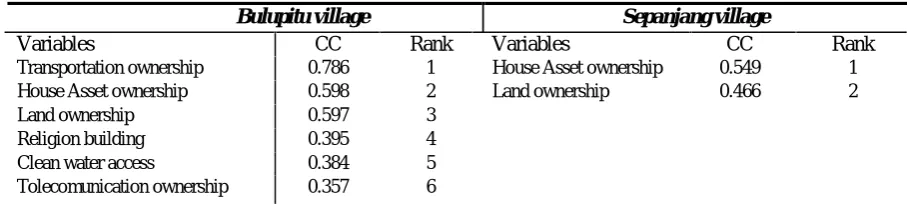
Table 1. The relationship between variables and coefficient correlation in Bulupitu and Sepanjang village
Bulupitu village Sepanjang village
Variables CC Rank Variables CC Rank
Transportation ownership 0.786 1 House Asset ownership 0.549 1 House Asset ownership 0.598 2 Land ownership 0.466 2 Land ownership 0.597 3
Religion building 0.395 4 Clean water access 0.384 5 Tolecomunication ownership 0.357 6
In Bulupitu village remittance influence in 6 (six) variables, and in Sepanjang village only for 2 (two) variables. The highest coefficient correlation in Bulupitu village is the ownership of transportation and in Sepanjang village is house asset ownership.
V.
Conclusion
Remittance has a wide influence in the rural areas. Based on the analysis, remittances have different effects on the two selected villages in this study. In Bulupitu village, remittances have a significant relationship between economic variables and variable infrastructure. However, of these two variables, remittances have a greater influence on the economy or more significant compared infrastructure. Economic variables have a significant relationship with the remittance is transportation ownership (Y7), Asset homes ownership (Y8), and land ownership (Y6), and from infrastructure are religion building (Y15), water use (Y13), and ownership of telecommunications facilities (Y12).
Base on correlation coefficient we can make a rank such as transportation ownership, home ownership, and land ownership, and from infrastructure are religion building, water use, and ownership of telecommunications facilities.
In Bulupitu village remittance influence in 6 (six) variables, and in Sepanjang village only for 2 (two) variables. The highest coefficient correlation in Bulupitu village is the ownership of transportation and in Sepanjang village is house asset ownership. It seems that remittance has more impact in Bulupitu village than in Sepanjang village.
References
[1]. BPS, 2009. Malang Regency in Fig. 2009. Malang: Government of Malang Regency.
[2]. Muktasam: Rethinking Rural Development Approaches to Ensure Human Security in Asia: Lessons Learn From Indonesia, Thailand and Malaysia. A paper presented in a panel on
“Rethinking Rural Development” in the International Development Studies Conference on
“Mainstreaming Human Security: The Asian Contribution”, Chulalongkorn University – Bangkok, October 4–5, 2007.
[3]. Nazir, Moh. 2005. Metode Penelitian. Bogor: Ghalia Indonesia.
[4]. Agarwal, R., and A. Horowitz. 2002. “Are international remittances altruism or insuran ce? Evidence from Guyana using multiple-migrant households”, World Development, 30: 2033–2044 [5]. Lopez Cordova E. and Olmedo (2005). Migrant Remittances, the Transfer Problem and Export
36
[6]. Lianos, TP and Cavounidis, J. 2008. Immigrant Remittances, Stability of Employment and Relative Deprivation. International Migration Vol. 48 (5) 2010. IOM International, Published by Blackwell Publishing Ltd., 9600 Garsington Road, Oxford OX4 2DQ, UK, and 350 Main Street, Malden, MA 02148, USA.