I. INTRODUCTION
A. Background of Problem
In this globalization era, English as the first international language in the world plays an important role in Indonesia. This foreign language has been learned as a compulsory subject from elementary school through university. As cited in English Curriculum Guideline: 1994, mastering what someone has learned is the main goal of learning, if learners have mastered English well, it can be said that they have reached the main goal of learning.
In learning English, there are four skills that should be mastered: listening, speaking, reading and writing. Each skill is related each other. In students’ handbook, there are also good separations of those skills. Every part has specific tasks and exercises that focus on certain skill.
Learning English is also learning many skills and competence, i.e.: structure, vocabulary, listening, speaking, reading, and writing. Reading, as one aspect that should be taught in English comprehension, becomes the most important aspect for the students to be mastered. To gain this, it seems that reading is a primarily aim of teaching English for high school students. After finishing study, the students are expected to be able to read English text book to further their
Through speaking with others and listening to the radio or television, someone gets knowledge or information; however the amount of the information is not as perfect as when they are reading. In reading, the readers will find the reason, example, explanation, comment, note, and summary of the news.
Not everyone is good at reading. In the students’ handbook, reading skill usually appears in kind of text and comprehension exercises. Many students have
difficulty in comprehending the idea in reading text. This condition shows that reading is not a simple task to do for some students. For those students, reading can be a boring activity.
In order to minimize their problems in learning English above, it is assumed that every student should have some suitable strategies in reading comprehension in order to motivate students to read all parts of the text, so they can get information fully. Since learning is a process of gathering knowledge and skill, it needs strategies to make the process run well and easier.
for their learning by enhancing learner autonomy, independence, and self-direction. Here, they can use language learning strategies.
Many various methods were created to increase the students’ ability in learning English and to make the process of gathering knowledge run easier. By
establishing many new schools in the grade junior and senior level, it proved that the development of education is getting better. Almost all of the public and private schools, which were established, conduct international standard class. In the international standard class, of course, the students must increase their ability in communication using English.
Ideally, this educational development must be along with students’ high desire in reaching their goal in learning. This “high desire” can be shown by their
enthusiasm in learning, for example: enjoying the teaching-learning process, following the subject enthusiastically, participating in any English discussion in the class, doing their homework well, visiting the library to find any references related to the material or to read any sources, asking questions when they do not understand of any materials, discussing with their friends, and etc. All these items appeared to focus on positive forms of motivation in the process of learning. The problems raised when there is no synchronization between the ideal condition and the fact that can be seen in the reality. All the positive things above do not run as well as it should be. It can be said that many students have no motivation in learning process.
Some research papers have investigated about certain methods to increase
best method in learning English; it will be useless when the students have no motivation to learn. Based on the facts above, it can be said that although
students have a good treatment and facility in teaching learning activity, even the best one, they have different motivation. In other words, it can be said that one of factors influenced student in learning process is motivation. Motivation becomes an important aspect, since if the students have strong motivation, the learning process will run more effective and well.
Motivation and language learning strategies are two different things. The
similarity is those help the students to comprehend the material in learning. Some studies had been conducted related to motivation or language learning strategies. Research about motivation had been conducted by some researchers. One of which is the study done by Kato et al. who found the different motivation of language learners among different levels. Research about language learning strategies had also been done by Agustina (2002: 32) who found that there were no differences in language learning strategies between successful and
unsuccessful students because all of learning strategies were used by the students.
students and students’ motivation in learning English towards their reading comprehension achievement in learning English, the writer entitled this research paper: “The Correlation of Language Learning Strategies and Students’
Motivation and Their Reading Comprehension Achievement”.
B. Formulation of the Problem
Based on the description in the background above, the writer formulated the problem as follows:
a. Is there any correlation of students’ motivation and their reading
comprehension achievement in learning English?
b. Is there any correlation of students’ language learning strategies and their reading comprehension achievement in learning English?
c. Is there any correlation of students’ motivation and language learning strategies on their reading comprehension achievement in learning English?
C. Objectives
The objectives of the research are to determine whether there is correlation of:
a. students’ motivation and their reading comprehension achievement.
b. language learning strategies employed by the students and their reading comprehension achievement.
D. Significance of the Research
Theoretically, the results of this research may be useful as follows:
to see whether the result of this research support the previous theory on learning strategies and motivation in learning.
Practically, the results of this research are expected to contribute in:
1. considering the English teacher to motivate the students in learning English, especially in reading comprehension.
2. informing the students about the role of language learning strategies in
comprehending their reading skill.
3. encouraging the students to use language learning strategies independently and continuously.
E. Scope of the Research
Meanwhile, the dependent variable here was students’ reading comprehension achievement. This research was conducted in SMA Negeri 1 Bandar Lampung and intended for the second year-students.
F. Definition of Term
1. Reading is one of the most important skills that is needed by the students in order to get information based on what they have already read.
2. Reading comprehension is a process of getting information from written language. It is not only to understand the surface meaning of the text but also understand the purpose of the main idea of the text.
3. Language learning strategies are particular ways of students in processing and comprehending the information that is given by their teacher in their school while they are learning, i.e. to be able to apprehend, internalize, and use the target language.
4. Motivation is students’ “high-desire” that can be shown by students’
II. FRAME OF THEORIES
A. Concept of Language Learning Strategies
The actual implementation of strategy is not necessarily so simple. Models of strategy use are typically predicated on the assumption that individuals engage in goal directed behavior in task environment, such that selection of strategies for a task depends on the performance goal of the individual, and the affordances of the task context, and the individual’s capabilities.
According to Shuell (1986 in Agustina, 2002: 1) learning strategies are special ways of processing information that enhance comprehension, learning, or retention of the information. In the other words, learning strategies are special thoughts or behavior that individual use to help to comprehend, learn, or retain new information.
Learning strategies can be defined as strategies which contribute to the development of the language system which the learner constructs and affect learning directly (Rubin in Wenden and Rubin, 1987: 23). In short the writer concluded that language learning strategies are actions of language learner in attempt to achieve language learning.
responsibility for their learning by enhancing learner autonomy, independence, and self-direction. These are important because learners need to keep on learning even when they are no longer in formal classroom setting. Moreover, cognitive psychology shows that learning strategies help learners to assimilate new information into their own schemata.
Learning strategies are distinguished from teaching strategies, among other reasons because the learner is able to exercise control over the strategy. Oxford (1990a: 70) define language strategies as steps or actions taken by language learners to enhance any aspect of their learning. Oxford’s definition implies that learning strategies are conscious activities because students are learning a language while they are conscious of the process.
Oxford (1990b) has been classified six broad categories of learning strategy systems used by language learners:
1. Cognitive
Learners employ new language by practicing naturally, analyzing contrastively, and summarizing it of this strategy.
2. Memory
This is a strategy of which learners use memory, such as grouping, imagery, structured review, to get information into memory and to recall it when needed.
3. Compensation
4. Meta-cognitive strategies
Learners manage their own learning process by paying attention, self-evaluation, and self monitoring.
5. Affective strategies
This is a strategy of which learners do reduction anxiety and self encouragement, they control their emotional attitude.
6. Social strategies
Learners sometimes learn in group.
B. Classification of Language Learning Strategies
Different researchers have used different categories for classifying learning strategies. Rubin in Wenden and Rubin (1987: 23) has classified learning strategies into three categories, namely: meta-cognitive, cognitive, and social strategies. Therefore, in this research paper, the researcher used learning
strategies classified by Setiyadi in order to make this research paper more specific as the classification to collect the data.
1. Cognitive Strategies
In order to identify what cognitive process is, it is useful to explain two basics issues: namely mental representation or mental processing. In language learning mental representation may refer to how some students memorize what they have learned, or experiences in their life by remembering things in their native
learners employ new language by practicing naturally, analyzing contrastively, and summarizing it of this strategy.
Sherrod (1982) in Agustina (2002) says that cognitive psychologists are concerned with how people attend to information in the environment and how they process that information in their brain. In relation to language learning strategies, the cognitive category may include all activities that take place in the brain in order to acquire a foreign language. It may concludes intelligent guessing, looking for patterns from sentences, inference, association, summarizing, grouping in the mind, deduction, imagery, and other mental.
2. Meta-cognitive Strategies
Oxford (1990a) states that meta-cognitive strategies include: centering, learning, arranging and planning learning, and evaluating learning. In O’Malley & Chamot’s study (1981: 124), meta-cognitive strategies have more processes that are classified under planning, monitoring, and evaluation. It can be said that planning may depend on information provided from the implementation of monitoring and evaluating (Wenden 1991a: 28). The scope monitoring can involve a narrow focusing on a specific item in a reading text to a broad overview of a series of learning activities, such as a semester course in a reading. After becoming aware of a difficulty, learners analyze the difficulty and seek the cause. Evaluating means that the learners consider the outcome of a particular attempt. It may focus on the proficiency of learners or strategies used in learning. Evaluating in the current study is only related to correcting mistakes and focuses on
Oxford’s (1990b) cited in Setiyadi (1999: 143) said that meta-cognitive strategies include strategies for evaluating one’s progress, planning, for language tasks, consciously searching for practice opportunities, paying attention, and monitoring errors. By using meta-cognitive strategies, learners are aware of and control their efforts to use particular skills and strategies. On the other hands (Jones et al., 1987: 15) cited in Setiyadi (1999: 143) said that the learners use their capacity to monitor and direct the success of the task at hand, such as recognizing that comprehension has failed, using fix-up strategies, and checking and obtained answer against an estimation.
3. Social Strategies
Oxford (1990a and 1990b) introduced the category of social strategy and classified it under this category:
Asking questions:
1. Asking for clarification or verification
2. Asking for correction
Co-operating with others:
1. Co-operating with peers
2. Co-operating with proficient users of the new language
Empathizing with others:
2. Becoming aware of others' thoughts and feelings (Oxford, 1990a, p. 21).
The social category includes not only all processes that take place in groups, but also includes individual activities in social setting aimed to acquire another language. An example of this would be reading letters from friends in order to have opportunity to practice English.
In the study of Fillmore (1979) there are three strategies, namely: a) joining a group, b) give the impression – with a few well – that you can speak the language, and c) count on friend. It can be said that learners interact with others outside the classroom.
C. Concept of Motivation
Motivation is the great, unspoken problem of English education in the world. It is “great” because it is probably the most difficult single problem classroom teacher face. Motivation becomes an important aspect since if the students have strong motivation, the learning process will run more effective and well. In line with that explanation, Gardner and Lambert (1984: 54) in Kato (2007) stated that
motivation is one of important aspects in learning language.
organism as behavior. Furthermore, motivation is considered by many to be one of the determining factors in developing a second or foreign language.
It can be assumed that motivation, in this case, is the positive power, which stems from the desire to attain the goal reflected in the orientation for instance; learning English seriously in order to get a better achievement. In relation with the
previous statement, students need motivation in order to attain the goal of
language learning and they can come from themselves or from their environment.
D. Classification of Motivation
In 1959, Gardner and Lambert divided motivation to learn a language into two types, instrumental motivation and integrative motivation. A learner with integrative motivation has a genuine interest in the second language community and instrumental motivation wishes to identify with the ethnic group. These are distinguished as follows:
1. Integrative motivation is characterized by a positive attitude towards the speakers and culture of the target language.
Furthermore, Dorman and Gaudiano (unpublished literature) distinguishes 2 types of factors influencing motivation, they are:
Intrinsic – self generated factors (responsibility, freedom to act, scope to use and develop skills and abilities, interesting and challenging work, opportunities for advancement) – they have a deeper and longer-term effect. Intrinsic motivation refers to being motivated and curious enough to be engaged in an activity for its own sake (Vansteenkiste, et al (2004) in Dorman and Gaudiano). The concept of intrinsic motivation was
originally proposed by Robert White (1959 in Matlin, p.397). He argues that many behaviors –such as play and exploration- do not need to be reinforced in order to be performed. Researchers have discovered that people who believe their work is intrinsically motivating are more satisfied with their lives (Graef et al., 1983 in Matlin, p.397). For example, when pursuing a word in the dictionary and we find ourselves reading about others words – even though we cannot reduce any drive from learning about words such as peplum and hendecagon. This curiosity cannot be explained by drive theory. However, at least for many people, curiosity is intrinsically motivating.
In addition to the indicators of motivation in learning, Abin Samsudin Makmun (1983: 33-34 in Uniroh, 1990: 32-33) identified motivation with some factors as follows:
1) The duration of students’ English learning: how long the ability of students to use time in doing activity in learning is.
2) The frequency of students’ activity in learning English, e.g: how often does the activity take place?
3) The persistence of students in learning English: how strong his tenacity is etc.
4) The toughness of endurance of student in solving the difficulties of learning English and facing its problems or obstacles.
5) The aspiration of the students, for instance: purpose target, etc. 6) The qualification level of students’ achievement in learning English, 7) The devotion of students to get the objective of learning English, for
instance: thought, time, money, effort, etc.
8) The students’ attitude to the purposes of learning English.
(Abin Makmun Samsudin, 1983: 33-34 in Uniroh, 1990: 32-33).
In this research, the writer dealt with these eight factors as the reference in measuring students’ motivation.
E. Concept of Reading Comprehension
language consists of grasping meaning in that language through written representation.
Reading is one of four skills (listening, speaking, reading, and writing) that can be identified as a receptive skill, a skill to understand language element. The other skills (speaking and writing) are classified as productive activity, since in speaking and writing, the learner is required to produce expression orally and in written.
In reading skill a learner needs the ability to recognize symbol system. This is in line with what Nuttal (1982) in Simanjuntak (1988: 14) in Hariyanti (2009: 7) said about reading, reading is defined as the meaningful interpretation of printed or written verbal symbols. Dallman (1982) in Hariyanti (2009: 7) also stated that reading is more that knowing which each letters of alphabet stand for reading involves more than word recognition. It is supported by Simanjuntak (1988: 4) in Hariyanti (2009: 8) who stated that the first point to be made about reading process is comprehension. In line with Simanjuntak, Rubin (1993, 94) states that reading comprehension is a complex intellectual process involving a number of abilities. The two major abilities involve word meaning and verbal reasoning. Without word meaning and verbal reasoning, there could be no reading
comprehension; without reading comprehension, there would be no reading.
Reading with the comprehension one will recognize the purpose and the important point of the text besides understanding the surface meaning of the text. Smith and Dechant (1983) stated that the ability to understand units of increasing size: phrase, clause, sentence, and paragraph is the basic knowledge called as
comprehension skill. There are two ways to check whether students succeed in reading comprehension or not. Firstly, check whether students have known the main idea or not. Secondly, check the students’ mastery on the topic sentence. Moreover, according to Patricia in Simanjuntak (1988: 8) in Hariyanti (2009: 8), understanding a text is an interactive process between the reader’s background knowledge and the text.
Referring to the statement above, it is inferred that reading comprehension means the students must read the text and interact the printed of written symbols with their cognitive skill and their knowledge of the world. In the process of comprehension the students need skills related to the purpose of reading and consider the questions to concentrate on the important points.
According to Milan (1988), there are some essential skills in reading, they are:
1. Comprehension and Retention
determining the main idea of the paragraph and their purpose of reading, comprehending the main idea and distinguishing between the main idea and supporting details.
2. Inferences and Conclusion
In relation to make inferences, Mc Whorter (1989: 254) states that:
An inference is an educational guess or prediction obout something unknow based on available facts and information. It is logical connection that you draw between what you observe or know and what you do not know.
3. Critical Thinking and Analysis
In this term the readers should distinguish the text they are reading, whether it is text of fact or oponion. In relation to fact, Askew (2005) stated that fact is knowledge or information based on real occurrences. From this statement we can conclude that text of fact is a kind of reading text which written based on reality, real occurrence or something really happened. Patrick in Chappell (2005, 2) states that:
F. Theoretical Assumption
One important factor influenced students in learning English is motivation since it is assumed that the students with strong motivation will learn more effective and easier in comprehending their English ability, especially in reading
comprehension. Beside motivation, language learning strategies are also important in learning process. Some students who use language learning strategies can comprehend and process the information in reading skill that is given by their teacher in their school while they are learning English. So, it can be concluded that motivation and language learning strategies have correlations in comprehending students’ reading achievement.
G. Hypothesis
Concerning to the theories and assumption above, the researcher formulated the hypothesis as follows:
H1 There is correlation of students’ motivation and their reading comprehension achievement.
H2 There is correlation of language learning strategies employed by the students and their reading comprehension achievement.
III. RESEARCH METHODOLOGY
A. Research Design
It is clear that this research was a quantitative research. Quantitative research is associated with social survey technique like structured interviewing and self-administered questionnaires, experiments, structured observation, content analysis, and the analysis of official statistics. It implies the application of measurement of predetermined variables, as well as to the gathering and analysis of numerical data.
This research was intended to investigate whether there is correlation of language learning strategies and students’ motivation towards their achievement in reading comprehension. The research was conducted by using descriptive survey method. Winarno Surakhmad (1985: 139 in Uniroh, 1990: 27) states that descriptive
survey method is a method which simply analyze, classify, and reveal an investigation by using some techniques such as interview, questionnaires,
observation or by using test technique, case study, and comparative study. It can happen that descriptive research tries to compare the similarities and the
differences of a certain phenomenon or to measure a dimension like in
In this research, the researcher analyzed the current data that were taken from students’ language learning strategies and students’ motivation in learning English and their reading comprehension achievement. The data, then, were correlated to find out the correlation each other. The design of the research was presented as below:
correlation
X1
Y
X2
Where:
X1 : Students’ Motivation
X2 : Language Learning Strategies
Y : Students’ Reading Comprehension Achievement
B. Variables
In this research, the researcher identified two variables: independent and dependent variables. Independent variable is the major variable which I
1. Motivation and language learning strategies as independent variables because it is assumed that motivation and language learning strategies influence students’ achievement.
2. Students’ reading comprehension achievement as a dependent variable because it is assumed that achievement is affected by students’ motivation and the use of language learning strategies in learning English.
C. Population and Sample
1. Population
The population of this research was the second grade students of SMA Negeri 1 Bandar Lampung in academic year 2010/2011.
2. Sample
In conducting this research, the researcher used simple random probability sampling. From all the classes of second grade students, the researcher chose 3 classes randomly.
D. Data Collecting Technique
In collecting the data, the researcher used two techniques: questionnaires and written test of reading.
2. Test, it is a set of questions and problems in form of objective test used to measure the students’ reading comprehension achievement.
The questionnaires were held in two ways namely: motivation and the use of strategies. There were 70 questions to be answered in these questionnaires. The time to answer these 70 questions was just 60 minutes. It means that every item in the questionnaire had to be answered less than 1 minute. This was done to make the students think fast of the questions and answer it honestly.
1. Questionnaire of Motivation
The questionnaire is often used by the researcher to measure the students’ motivation. By using this technique, the researcher wanted to get more sources of the data from the subjects. The researcher gave a set of questionnaires in order to investigate the students’ motivation in learning English. The questionnaires instrument consists of 40 items. The
questionnaires measure the students’ motivation in learning English. The score are based on the Likert Scale and the range of 1 to 4s.
NO ITEMS
STUDENTS’ SCORE
a b c d
1 1, 3, 7 (a) 4 3 2 1
2
2, 4, 5, 6, 8, 9, 10, 11, 12, 13, 14, 15, 16, 17, 18, 19, 20, 21, 22, 23, 24, 25, 26, 27, 28, 29, 30, 31, 32, 33, 34, 35, 36, 37,
38, 39, 40.
Table 1. Students’ Score of Questionnaire of Motivation
Each alternative was defined as follows:
A = 4; for high motivated students.
B = 3; for high motivated students.
C = 2; for low motivated students.
D = 1; for low motivated students.
In addition to the indicator of motivation in learning, the researcher takes the indicators from Abin Samsudin Makmun (1983: 33-34) in Uniroh (1990: 32) who categorized motivation in eight factors:
NO INDICATOR OF MOTIVATION NO. OF ITEM
1 Duration 1,2
2 Frequency 3,5,6,13
3 Persistence 4,7,17,40
4 The Toughness of Endurance 8,9,12,19,20
5 Students’ Aspiration 10,21,22,23,25,26,30
6
Qualification Level of Students’ Achievement
7 Devotion 11,14,15,16,18
[image:26.595.140.512.87.165.2]8 Attitude 24,27,34,35,36,37
Table 2. Indicators of Motivation
2. Questionnaires of the Use of Strategies
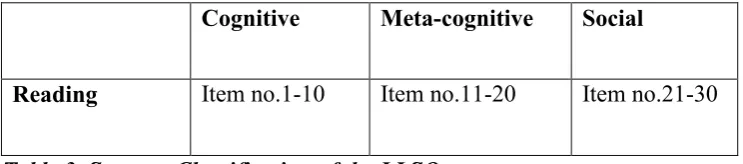
On the use of strategies, the researcher also used questionnaires; it is called Language Learning Strategies Questionnaires (LLSQ) (Setiyadi, 2006: 76) because the researcher wanted to know their learning strategies in learning English. The language learning strategies was classified within one main area only, that is: reading.
Cognitive Meta-cognitive Social
Reading Item no.1-10 Item no.11-20 Item no.21-30
Table 3. Strategy Classification of the LLSQ
The researcher gave a set of questionnaires consist of 30 items based on the indicators: meta-cognitive, cognitive, and social. Each item was designed to measure the three strategies. The students were expected to give their answer based on their feeling and experience.
3. Written Test of Reading
[image:26.595.141.513.385.467.2]correct answer was scored 1 and the wrong answer was scored 0. The time to do the test was 45 minutes.
Since reading skill includes mastering many aspects of language skill and performance such as vocabulary, structure, etc., the researcher in
constructing the reading test divided the test into some parts:
1) Vocabulary test; it contains understanding noun cluster (compound words). This part becomes common problem for most students in reading; understanding words in context, that is asking the meaning of the underlined words in a sentence.
2) Understanding a sentence; it is used to test the students’ ability in understanding central idea of the sentence.
3) Understanding a paragraph; the text consists of one paragraph only. It is used to test the students’ ability in understanding central idea of the paragraph.
4) Understanding a text; the text consists of more than one paragraph. This is the main aim of reading test.
NO READING SPECIFICATION ITEM NUMBER
1 Vocabulary test 1 – 10
2 Understanding a sentence 11 – 20
3 Understanding a paragraph 21 – 30
The number of correct
answer
Table 4. Reading Specification
In scoring system students’ result of the test, the researcher used Arikunto’s formula as follow:
Score = x 100
E. Research Procedure
There were ten steps in this research:
Determining the problem
Observation
Selecting and determining the subject
Determining the research focus
Formulating the questionnaires
Determining the way of collecting and analyzing the data
Preparing the data collecting technique
Collecting the data
Conducting English test
Evaluating and analyzing the data, and
F. Data Analysis
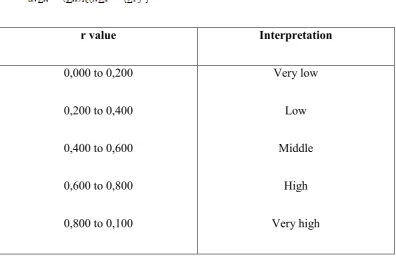
To see the correlation of students’ motivation and language learning strategies and their achievement, the data was analyzed by using Pearson product-moment correlation coefficient. To see the product moment correlation, we have to see “the coefficient” of its relation (r = 1) (see Table 4. r-Value Interpretation Table) and the significant value (p < 0,01) by using this formula:
rXY =
r value Interpretation
0,000 to 0,200
0,200 to 0,400
0,400 to 0,600
0,600 to 0,800
0,800 to 0,100
Very low
Low
Middle
High
[image:29.595.114.511.291.548.2]Very high
Table 5. r-Value Interpretation Table
(Setiyadi, 2006: 167)
In addition to reading comprehension test analysis, the researcher also calculates the degree of discrimination (discriminating power) by using the formula:
Notes: DP = Discrimination Power
U = the proportion of the upper group students
L = the proportion of the lower group students
N = number of students
The criteria are:
1). If the value is positive discrimination, it means that more high level students than low-level students get the correct. If the value is zero, it means that no discrimination.
2). If the value is negative, means that more low level students than the high level students get the item correct.
3). In general, the higher the discrimination, the better. In the classroom situation most items should be higher than 0.20 indexes (Shohamy, 1985: 81).
This is done to find out whether the test (reading comprehension test) can be used as instrument of the research. And by this, the researcher can also improve bad items.
G. Reliability
1. Reliability of the Questionnaires
ranges between 0 to 1. The higher the alpha, the more reliable is the questionnaire (Setiyadi, 2006: 190-191).
2. Reliability of the Test
To find the reliability of the test, the split-half method is used; that is by dividing the number of the test items into two group: odd and even. The formula is:
r1 =
Notes: r1 = coefficientor reliability between first and second half group
X = total numbers of first half group
Y = total numbers of second half group
X2 = square of X
Y2 = square of Y
And after being correlated, the researcher will continue the calculation by using formula of Spearman Brown (Hatch and Farhady, 1982: 268):
rk =
Notes: rk = the reliability of the test.
rl = the reliability of the half test.
The criteria of reliability:
0.50 – 0.89 = moderate
0.00 – 0.49 = low
H. Validity
1. Content Validity
Content validity is the extent to which a test measures a representative sample of the subject matter content. The focus of content validity is on the adequacy of the sample and not simply on the appearance of a test. To assure ourselves f content validity of a test, the content of the test must be carefully defined, and then the test items should correspond to the materials covered in the course.
2 . Construct Validity
IV. FINDINGS AND DISCUSSION
As mentioned in Chapter I, this research is intended to find out the correlation of students’ motivation and language learning strategies towards their reading comprehension achievement. The research was conducted in SMA Negeri 1 Bandar Lampung, 2010; the subjects of this research were the second year
students of Class XI-IPA and the sum of the students was 120 students. There are 3 classes here, which each class consist of 40 students (see Table 6).
In getting the data, the researcher used questionnaires and reading test. The questionnaires were used to get information about the students’ language learning strategies and measure the students’ motivation.
A questionnaire of Language Learning Strategies (LLSQ) (Setiyadi, 2006: 76) was modified for use in this study. 30 question items were employed, with a 4-point Likert-type response scale ranging from always or almost true of me (4 points), usually true of me (3 points), usually not true of me (2 points) to never or almost never true of me (1 point).
Meanwhile, the questionnaire of motivation developed by Abin Samsudin
Makmun (2006: 76) was modified for use in this study. 40 items of question were employed, with a 4-point Likert-type response scale ranging. Point a and b
The last, student's reading test was used as an indicator of students reading comprehension achievement. Reading test was conducted after students had finished fulfilling the questionnaires.
A. Reliability of the Instruments
Reliability can refer to the tendency toward consistency found in repeated measurements of the same phenomenon (Carmines & Zeller, cited in Setiyadi, 1999). It can also refer to stability of measurement over time, an approach which was not suited to the current investigation. In assessing internal consistency, the Cronbach Alpha is the most appropriate reliability index to be used on continuous data. The reliability of questionnaire was computed by using Cronbach Alpha Coefficient in which the higher alpha ranges between 0 and 1. The data shows (see appendix 8) that the reliability coefficient of questionnaire of motivation is 0,586, it means that the questionnaire is high and applicable to be used to measure students’ motivation. Questionnaire of motivation is classified based on eight indicators: duration, the frequency of students’ activity, persistence, the toughness of endurance, aspiration of students, qualification level of students’ achievement, devotion of students and students’ attitude.
questions for each strategy. Therefore, there were 30 questions gave to the students.
To measure the students’ reading comprehension achievement (Y), the writer used objective test by using multiple choice test. Each item provided four alternative answers (options) a, b, c, and d in which most of items were written in Indonesian language. This was done to avoid the students’ confusion in understanding the options, since the option itself was considered not to be the aim of the test. The main aim of the test is to see if the students really understand what they read. But in practice, most students do not understand the options which are written in English; they just then, guess any option. Here, in constructing reading test, the writer divided the test into some parts, they are: vocabulary test, understanding a sentence, understanding a paragraph and understanding a text. Each of those was represented by 10 questions, so that there were 40 questions to be answered (see Table 4). From the data analysis, it is gained that the reliability coefficient of reading test was 0,546. It means that the reading test was very high and can be used to measure students’ reading comprehension achievement (see appendix 12).
B. Validity of the Instruments
be measured by evaluating all items in the test. If all items have measured students’ motivation, this instrument has fulfilled construct validity. To measure construct validity as a language test is often used The Static Correlation Pearson-moment between aspects, instrument of language test, it means that the construct validity has been fulfilled. The criteria were used is if rvalue > rtable, means that the question is valid and vice versa. From the data analysis (see Appendix 7, 9, and 11), it is gained that rvalue > rtable. So that it can be said that the data analysis of this research is valid.
C. The Correlation of Students’ Motivation and Their Reading Comprehension Achievement
Questionnaire of motivation was distributed to measure the students’ motivation in learning English. There were 40 questions in this questionnaire which indicate eight indicators, namely: duration, the frequency of students’ activity, persistence, the toughness of endurance, aspiration of students, qualification level of students’ achievement, devotion of students and students’ attitude.
C.1. Duration
In the duration of students in learning English, the researcher wanted to know the ability of students to use time in doing activity in learning is. There are 2
0 20 40 60 80 100
item no. 1 item no. 2
4 3 2 1
From the chart, it can be seen that students’ answers tend to be positive. For item no.1, 67 students learn English more than 90 minutes beside their learning time at school, 49 students learn English about 61- 90 minutes and the rest learn under 60 minutes. The effective time for them to follow the learning process (item no.2) is 60-89 minutes; it was answered by 89 students. About 23 students answer that they can follow the learning process during more than 90 minutes, 2 students can follow it about 30-59 minutes and the rest (6 students) can follow it effectively only less than 30 minutes. It can be concluded that the effective time for the students to follow learning process is about 90 minutes.
C.2. Frequency
0 10 20 30 40 50 60 70 80
item no. 3 item no. 5 item no. 6 item no. 13
4 3 2 1
For the question no. 3, 53 students answered that they learn English more than 4 times a week, 57 students learn English 3-4 times a week, 9 students answered only twice a week and 1 student just learn English once a week at home. Related to the question no. 3, question no. 5 asked the students of the frequency they follow English activity in the class. For this question, 69 students answered that they follow the activity of learning English about 4 times or more, 1 students answered 3 times, 5 students answered twice, and 33 students answered that they just follow the activity of learning English once a week. Question no. 6 asked the students of their frequency in reading English newspaper/magazine. Here, 71 students answered that read English newspaper/magazine everyday, 41 students answered “often”, 7 students answered “sometimes”, and 1 student answered “never”. The frequency of following English TV program was asked by the question no. 13. 38 students answered that they follow any English TV program, 30 students answered 2-3 times a week, 49 students answered sometimes, and 3 students answered never.
The persistence of students in learning English was represented by the questions no. 4, 7, 17, and 40.
0 20 40 60 80 100
item no. 4 item no. 7 item no. 17 item no. 40
4 3 2 1
rest (2 students) answered often do not pay attention to the material that was taught. From the result of data was taken, we can conclude that many students have strong tenacity in learning English.
C.4. Toughness of Endurance
This indicator illustrates toughness of endurance of students in solving the difficulties of learning English and facing its problems or obstacles. There are 5 questions represented this indicator, those are item no. 8, 9, 12, 19, and 20.
0 20 40 60 80 100
item no. 8 item no. 9 item no. 12 item no. 19 item no. 20
4 3 2 1
of the ways to comprehend their English can be by listening to English song. When the students listen to English song, 88 students often find the meaning of the song, 28 students answered sometimes, 1 student only find the meaning of the song if it is assigned, and 3 students answered that they never find the meaning of an English song.
C.5. Students’ Aspiration
Including in this indicator is how the students to purpose their target. There are 7 questions represented this indicator. Those are item no. 10, 21, 22, 23, 25, 26, and 30. 0 20 40 60 80 100 item no. 10 item no. 21 item no. 22 item no. 23 item no. 25 item no. 26 item no. 30 4 3 2 1
Some targets are presented in this indicator. In the question no. 10, the students are expected to be able to follow English speech contest held by their school, 29 students administer themselves and follow it, 43 students considered to follow it and asked their friends’ suggestion, 12 students just chose to watch and spirited the participants, others ignored the speech contest. In order to reach their target in English, students should have some English sources (item no. 21), such as:
have more than 10 English sources, 52 students have about 6-10, 41 students have only less than 5, and others have nothing. For having these sources, 14 students searched and bought it by themselves, 12 students asked another person to buy it, 92 students got it by borrowing or being presented, the rest (2 students) don’t have any efforts in searching any English sources because they are not interested in. Another effort to reach their target in learning English is done by following English lesson, 28 students still follow English lesson, 87 students have ever followed English lesson and still want to follow, 3 students have ever followed English lesson but do not want to follow it anymore, the rest (2 students) never follow any English lesson. For all the students, to be success in learning English, one of their efforts (item no. 25) is following English course (25 students), re-open the lesson at home (8 students), but there are some students who study just when they face the examination (83 students), and not study at all since they feel that they have already mastered the material very well (4 students). In their spare time (item no. 26), some students (70 students) usually expanding their ability including learning English, 7 students read and write some information in English, 23 students go to vacation, others (20 students) just stay at home and do nothing.
C.6. Qualification Level of Students’ Achievement in Learning English
Many questions of students’ feeling (item no. 28) arise after the process of learning English, some students feel that they really want to learn English (28 students), some others (77 students) feel that learning English make them really want to communicate with native speakers, but there are some students (13 students) who just follow English lesson in order to make their teacher are not angry, the rest (2 students) follow English lesson just because of in shame with other students. The students’ feeling is in line with their wish in learning English (item no. 29), here there are 58 students who wish to add their knowledge, some students (47 students) wish to master English well, but some students wish to get high score in English (1 student), or just to gather with their friends at school (14 students). Learning English activity (item no. 31) can be fun, if it is done with other friends (61 students), but seems that some students only cooperate with other friends sometimes (40 students), some students choose to self-study (13 students), and the rest do not study at all (6 students). Learning English is very useful, but only some students (41 students) feel that English is very useful for their future, some others 53 students feel English is good enough for their future, the rest feel that English is less (19 students) or even useless for their future (7 students).
C.7. Devotion
0 20 40 60 80 100
item no. 11 item no. 14 item no. 15 item no. 16 item no. 18
4 3
2 1
Sometimes, when we learn English there are many barriers we faced in learning English. If it is rain when they are going to go to the lesson, most students still come to lesson thogh no umbrella. Beside there are still some who choose to be absent. In English, sometimes students need to translate the English text into Indonesian. But when they do not have dictionary, 82 students try to find dictionary in the library or try hard to get dictionary. In item number 15, they were asked of how is they effort to face the examination while their material borrowed by their friends. Here, more than 80 students answered that they tried to find the material though it waste their time. From several items were asked in this indicator and the data in the chart above, we can conclude that students have strong efforts to make their learning process run well.
C.8. Students’ Attitude
0 10 20 30 40 50 60 70 80
item no. 24 item no. 27 item no. 34 item no. 35 item no. 36 item no. 37
4 3 2 1
Almost all the students said that English is very important to be learned. At the rate of 51 students said that it is very important especially in science and
technology, 49 students said English is important, the rest said that English is less important to be learned. To follow up this question, on the next question the were asked of their opinion of conducting English conversation club, more than 100 students answered that they are agree (79 students answered agree and 24
answered very agree), the rest answered that they are less agree (14 students) and they are not agree (3 students). When they were asked to write about their curriculum vitae in English, 53 students answered that they are very agree, 48 students answered that they are agree, the rest are less agree (12 students) and not agree (9 students). From the questions were asked above, we can see that their attitude is tend to be positive of English. It can be proved from the chart above, where almost all the students tend to answer with a and b for each questions in this indicator.
From the questionnaire of motivation, it is gained that the mean of questionnaire of students’ motivation was 125,86 with the standard deviation 9,952.
correlation of students’ motivation and their reading comprehension achievement. From the data analysis, we can see that between students’ motivation and their reading comprehension achievement were positively correlated. Students’
motivation and their reading comprehension achievement have a correlation at the rate of 0,406. It means that the higher they motivate themselves, the better their reading comprehension achievement.
The positive correlation between the students’ motivation and their reading comprehension achievement in this study also supports the finding in a study carried out by Uniroh (1990: 78). Her finding suggests a hierarchical relationship between students’ motivation and their reading comprehension achievement.
D. The Correlation of Students’ Language Learning Strategies and Their Reading Achievement
As a basic classification scheme, cognitive, meta-cognitive, and socio-affective were used to identify language learning strategies implemented by the students. The three categories mentioned above were considered initially for collecting data since they were also common terms utilized by language learning taxonomies (Setiyadi, 1999).
D.1. Cognitive Strategy
analyzing, summarizing, and practicing. Sherrod (1982) in Agustina (2002) says that cognitive psychologists are concerned with how people attend to information in the environment and how they process that information in their brain. From the definition above, it is clear that cognitive process include all activities related to mental processing. In relation to language learning strategies, the cognitive category may include all activities that take place in the brain in order to acquire a foreign language. It may concludes intelligent guessing, looking for patterns from sentences, inference, association, summarizing, grouping in the mind, deduction, imagery, and other mental.
0 10 20 30 40 50 60 70 80 90 Item No. 1 Item No. 2 Item No.3 Item No.4 Item No.5 Item No.6 Item No.7 Item No.8 Item No.9 Item No.10 4 3 2 1
D.2. Meta-cognitive Strategy
Meta-cognitive involves self awareness to plan or direct, monitor, evaluate, or correct what has been done in learning English (O’Malley and Chamot, 1990: 44). These strategies are seen to be higher level processes because of their controlling role in cognition. These strategies also referred to as self-management strategies, are utilized by learner to oversee and manage their learning (Wenden, 1991a: 25). By using meta-cognitive strategies, learners are aware of and control their effort to use particular skills and strategies.
0 10 20 30 40 50 60 70 80 90 Item No.11 Item No.12 Item No.13 Item No.14 Item No.15 Item No.16 Item No.17 Item No.18 Item No.19 Item No.20 4 3 2 1
have 50 students answered with scale 4, 16 students answered with scale 2 and only 3 students answered with scale 1. In reading, 58 students use keywords and repeate it for themselves, these 58 students identified scale 3 to answer this question, 34 students answered with scale 4, 23 students answered with scale 2, and the rest (5 students) answered with scale 1. Many weaknesses students have in reading. To cover this, 82 students give their special attention to their
weaknesses while they are reading. 56 students give more attention to read their favourite book or source of reading. Usually the students have certain strategies in understanding reading, there are 65 students who have certain strategies in understanding reading, here 22 students answered with scale 4 and the rest (43 students) answered with scale 3. From these 65 students who have certain strategies in understanding redaing, there are only 49 students who evaluate their strategies. To find meaning of difficult words, 49 students prefer to fiond out the meaning by using dictionary. There are many weaknesses that students have during their reading. They realize it and try to make it better. Almost all the students pay special attention to the weaknesses they have in reading.
D.3. Social Strategy
0 10 20 30 40 50 60 70 Item No.21 Item No.22 Item No.23 Item No.24 Item No.25 Item No.26 Item No.27 Item No.28 Item No.29 Item No.30 4 3 2 1
Social strategy refers to one relation to others. In this strategy, we discuss
students’ relation to others. Students’ relation to others can be important for them to make their process in improving their reading comprehension run well. 60 students discuss any reading source to their friends. When they do not understand the main idea of reading, 44 students always ask their teacher or friends, 52 students do the same thing though not always. Reading letter from pen friends can be a strategy to improve their reading comprehension. There are 68 use this strategy as their way to increase their reading comprehension (33 students answered with scale 4 and 35 students answered with scale 3). In reading, cooperative environment can make students learn well. 34 students answered with scale 4 of this question, 67 answered with scale 3, 17 students answered with scale 2 and only 1 student answered with scale 1. When they make a mistake in reading aloud, 56 students ask their friends or teacher to correcting their mistakes. 54 students prefer learning activity in group to individual learning activity.
one of way for the students to learn well. 69 students answered with scale 3 to this question, 42 students answered with scale 4, 9 students answered with scale 2 and none answered with scale 1. From all the questions that were answered by the students above, it can be said that many students prefer to learn in group to
individual, because learn in group give them chance to share with others.
The findings indicate that the students explored in this study were not
significantly different in using language learning strategies among the students because of all the strategies were used by the students. It was showed by the data that the mean score of cognitive was 29,5833, meta-cognitive was 29,8917 and social was 30,1417 (see appendix 15). It means that the students used social strategies more frequently than cognitive strategies and meta-cognitive strategies.
From Language Learning Strategies Questionnaires, it is gained that the mean of questionnaire of students’ language learning strategies is 89,53 with the standard deviation 10,537. Meanwhile, the mean of students’ reading test is 26,17 with the standard deviation 4,711 (see appendix 14).
The positive correlation between the students’ strategies and their reading comprehension achievement in this study also supports the finding in a study carried out by Agustina (2002: 33). Her finding suggests a hierarchical
relationship between students’ language learning strategies and their success in learning English.
E. The Correlation of Students’ Motivation and Language Learning Strategies and Their Reading Comprehension Achievement
To explore how students’ motivation and language learning strategies relate to their reading comprehension achievement, correlation analysis was undertaken. The result of the analysis shows that the students’ motivation and language learning strategies are significantly correlated toward students’ reading comprehension achievement.
The correlation of language learning strategies used by the students and their motivation have been identified based on mean scores of motivation and the use of language learning strategies (see Appendix 15).
From the descriptive statistics table in Appendix 15, we can see that meanscore of students’ reading test is 26,17 with the standard deviation 4,711, students’
motivation has mean score 125,86 with the standard deviation 9,952 and students’ language learning strategies has mean score 89,53 with standard deviation 10,537.
learning strategies and their reading comprehension achievement. From the data analysis, we can see that students’ language learning strategies has bigger
correlation to the students’ reading comprehension achievement (0,612) than students’ motivation to the students’ achievement in reading comprehension (0,406).
The result of data analysis shows that students’ motivation (x1) and language learning strategies (x2) give high and significant contribution towards students’ reading comprehension achievement. The data (see Appendix 15) shows that r= 0,643, means that each of variables contributed 64,3% towards students’ reading comprehension achievement. But between these two variables, language learning strategy has higher and more significant influence towards students’ reading comprehension achievement.
F. Hypotheses Testing
F.1 Testing of First Hypothesis
H0 There is no correlation of students’ motivation and their reading comprehension achievement.
H1 There is correlation of students’ motivation and their reading comprehension achievement.
achievement have a correlation at the rate of 0,406. It means that H0rejected. In other words, we can say that there is correlation between students’ motivation and their reading comprehension achievement in SMA Negeri Bandar Lampung.
F.2 Testing of Second Hypothesis
H0 There is no correlation of language learning strategies employed by the students and their reading comprehension achievement.
H1 There is correlation of language learning strategies employed by the students and their reading comprehension achievement.
The data in appendix 14 shows the correlation of students’ language learning strategies and their reading comprehension achievement that was positively and highly correlated (0,612). It means that H0 rejected and H1 accepted. From the data analysis, we can conclude that there is correlation of language learning strategies employed be the students and their reading comprehension achievement in SMA Negeri 1 Bandar Lampung.
F.3 Testing of Third Hypothesis
H0 There is no correlation of students’ motivation and language learning strategies employed by the students and their reading comprehension achievement.
The result of variant analysis shows that f = 41,167 with p = 0,000 (p < 0,001). It means that H0 rejected. From the data analysis, it can be concluded that students’ motivation and language learning strategies are significantly correlated to the students’ reading comprehension achievement in SMA Negeri 1 Bandar Lampung.
E. Discussion of Findings
After distributed questionnaire of motivation and also questionnaire of language learning strategies, test of reading was conducted. This test was conducted to measure students’ achievement in reading comprehension. The time to do the test was 60 minutes which during these 60 minutes the students were instructed to answer 40 questions in form of optional questions.
One important factor influenced students in learning English is motivation since it is assumed that the students with strong motivation will learn more effective and easier in comprehending their English ability, especially in reading
comprehension. Beside motivation, language learning strategies are also important in learning process. Some students who use language learning strategies can comprehend and process the information in reading skill that is given by their teacher in their school while they are learning English. So, it can be concluded that motivation and language learning strategies have correlations in comprehending students’ reading achievement.
Based on the result of the research, it can be said language learning strategies and motivation have correlations with students’ reading comprehension achievement. But if it is compared, language learning strategies are more correlated
V. CONCLUSIONS AND SUGGESTIONS
A. Conclusions
Based on the result of data analysis, the researcher drew the conclusion as follows:
1. There is a correlation between students’ motivation and their reading comprehension achievement in SMA Negeri 1 Bandar Lampung. It can be seen from the result of data analysis which shows r = 0,406 and p = 0,000 (p < 0,001). It means that students’ motivation is positively correlated to the students’ reading comprehension achievement, since for r-value between 0,400 and 0,600 is categorized as middle. It can be shown from the result of data analysis which shows that the students have high frequency in learning English (about 4 times a week), strong tenacity in learning, they are very tough in solving the difficulties in learning English, strong efforts to make the process of learning English run well, and their attitude towards English which tend to be positive. The result of data analysis also means that the higher the students motivate themselves in learning English, the higher their reading comprehension achievement.
shows r = 0,612 and p = 0,000 (p < 0,001). It means that language learning strategies is positively and significantly correlated to the students’ reading comprehension achievement, since for r-value between 0,600 and 0,800 is categorized as high correlation. Many students employed any strategies in language learning to improve their reading comprehension achievement, such as: reading any English sources and translating it word by word, to overcome their weaknesses in reading comprehension, they pay special attention to the weaknesses they have in reading, and learn in group to share about their problems in reading comprehension. The result of data analysis means that the higher the use of language learning strategies, the higher their reading comprehension achievement.
3. There is a correlation of students’ motivation and language learning strategies employed by the students on their reading comprehension achievement in SMA Negeri 1 Bandar Lampung. It can be seen from the result of data analysis which shows r = 0,643 and p = 0,000 (p < 0,001). It means that language learning strategies and students’ motivation are positively and significantly correlated to the students’ reading
comprehension achievement, since for r-value between 0,600 and 0,800 is categorized as high correlation. The result of data analysis means that the higher the use of language learning strategies and students’ motivation, the higher their reading comprehension achievement.
B. Suggestions
1. English teachers should motivate their students in learning English more and more. There are many ways to motivate the students in learning English, one of which is by using certain language learning strategies in comprehending students’ ability in learning English, for example: cognitive strategies, meta-cognitive strategies or social strategies. 2. Every student should employ language learning strategies in trying to