Journal of Criminal Law and Criminology
Volume 43 | Issue 6
Article 13
1953
Charred Documents, Their Handling and
Decipherment: A Summary of Available Methods
for Treating Burnt Papers
Donald Doud
Follow this and additional works at:
https://scholarlycommons.law.northwestern.edu/jclc
Part of the
Criminal Law Commons
,
Criminology Commons
, and the
Criminology and Criminal
Justice Commons
This Criminology is brought to you for free and open access by Northwestern University School of Law Scholarly Commons. It has been accepted for inclusion in Journal of Criminal Law and Criminology by an authorized editor of Northwestern University School of Law Scholarly Commons.
Recommended Citation
DECIPHERMENT
A Summary of Available Methods for Treating Burnt Papers
Donald Doud
Donald Doud is an Examiner of Questioned Documents who is associated with John F. Tyrrell in Milwaukee, Wisconsin. He has been a lecturer on various training programs for investigators, prosecutors, and attorneys at universities in the mid west, and his present paper is based upon his lecture given at the 7th Annual Arson Investigators Training Course at Purdue University. Mr. Doud is a member of the American Society of Questioned Document Examiners and has participated in various programs of the American Academy of Forensic Sciences where he has also read a paper on this subject.-EDoOR.
The handling and decipherment of charred documents is one of the perplexing problems in the field of questioned document and arson in-vestigation. The reasons are obvious. A burnt document is exceedingly
fragile and requires infinite care in handling and in processing. Then too, its blackened, carbonized state renders ordinary restorative pro-cesses ineffectual. An entirely new approach to a unique problem is re-quired.
Some of the greatest advances in the field of charred document deci-pherment took place during World War II. At that time it became imperative in England and other war torn countries to develop effective method s of handling and deciphering public documents burned in the air blitz. Among those contributing their scientific skill and knowledge were Walls, Taylor, Jones, and Grant of Great Britain and Black of the United States. Experiments by these men added much to the already accepted techniques of Mitchell, Lucas, Tyrrell, Gross, Davis, and other early pioneers in the field. Today as a result of this scientific work, it is the surprising fact that with most charred documents not completely reduced to fragments their original contents can be deciphered. Truly a contradiction of the old adage "Black is not White."
This paper will summarize the most important decipherment proce-dures developed during the past 50 years. All have produced successful results on certain specific problems, although it does not necessarily hold that any single technique will achieve results with all charred documents. Charred papers vary in physical composition and are burned under many different conditions. It is not to be expected that all will react the same when treated. The document examiner and laboratory technician may find it necessary to attempt several of the methods before finding one that will achieve a successful result.
HANDLING OF CHARRED DOCUMENTS
Field Investigation. The handling of charred remains must be carried
CHARRED DOCUMENTS
plyable and fairly impervious to damage, while others, where a more radical burning has taken place, will fall apart at the slightest touch. The composition of the original paper has much to do with the frag-ility of the charred fragments. To avoid unnecessary breakage, it is advisable to treat all charred documents as though they were of the most fragile type.
Most charred documents are found in safes, strong boxes, or like places of safekeeping, although single documents burned in a fireplace, stove, or other open area may require decipherment. The arson or other field investigator should never attempt removal of the fragments from the original container if it is possible to transport the container undis-turbed to the laboratory. With proper care a strongbox, small safe, or stove 'can be transported without excessive damage to the charred con-tents. A recommended procedure is to pack cotton wool or other cush-ioning material between the charred documents and the side of the container, thus forming a protective layer against damage. In a case handled by David A. Black of Los Angeles' two safe-deposit boxes full of charred documents were transported by personal messenger all the way from the Philippine Republic. Very little breakage was observed,
and the documents were merely packed lightly in cotton wool.
If conditions are such that the original container cannot be taken from the site, it is necessary to transfer the documents to another re-ceptacle which serves as a temporary accommodation for the trip to the laboratory. This transferal operation should be carried out by a trained laboratory technician, or an investigator experienced in charred document care. If much material has been burned, it is usually-best to remove the charred contents as a mass, rather than separately. This is accomplished by slipping a pie tin, or similar piece of thin metal, under the mass of documents and gently withdrawing them from the container. The tin and documents are then placed in a box for transportation to the lab-oratory. Should tightly bound bundles of documents be found, each parcel is removed from the pile with the fingers and placed in a separate box so that the smaller fragments at the bottom are not broken by the
weight of the heavier bundles.
Charred documents found singly should be handled with the greatest of care. Flat bladed tweezers are particularly useful for picking up these fragments. When only parts of whole documents are found, they may be segregated according to the area of the container in which they are found.
1. See "Decipherment of Charred Documents," Jr. of C. Law and Criminol., Vol. 38, No. 5, Jan.-Feb., 1948.
These fragments are then placed in flat boxes labeled correspondingly.' Stationery or candy boxes with tops are the most satisfactory for this purpose.
During all of the removal and segregation operations, it is imperative that air currents be avoided and windows be kept tightly shut. It takes very little movement of air to dislodge these dehydrated pieces of car-bonized material.
Laboratory Treatment. The most difficult part of the operation
be-gins when the charred material reaches the laboratory. Here the separa-tion and segregasepara-tion of the documents takes place. Again it is found that individual conditions govern the best procedures to be used. Documents burned in a closed vessel react differently from those burned in the open air. Depending upon the number of documents and their proximity to one another, as well as the extent of charring, they adhere or are easily separated. If closely bound together they may remain fairly flat whereas singly the fragments tend to curl and twist. Obviously, it is of paramount importance that these papers be separated with the least amount of dam-age to the individual documents; and this is not an easy task, especially when the documents are found in a twisted, shrunken mass of closely packed paper.
Many theories have been advanced for separating charred documents. C. A. Mitchell advocates soaking the bundles of documents in hot water.
2
Others suggest a dilute glycerin-water bath which not only tends to separate the documents, but also renders them more plyable. Still another theory concerns soaking the bundles in alcohol, a procedure de-signed to break the bondage between fragments, thus allowing them to be separated. But before any of these treatments is undertaken, the con-templated decipherment procedure should be considered. The contact process, for example, precludes the use of liquids since its success depends upon gases thrown off by the dry surface of the fragment. Some of the chemical processes also appear to react better when applied to a dry untreated surface.
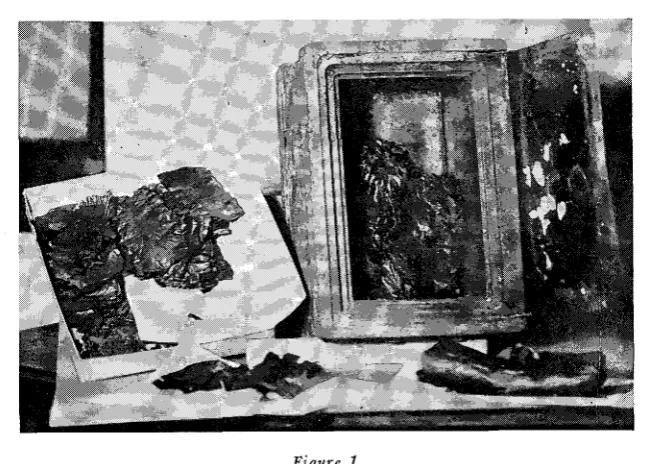
In most cases of documents charred in a mass, it is possible to sep-arate the individual papers without resorting to liquids, solvents, or other chemical means. In a case handled by John F. Tyrrell, associate of the writer, only manual methods were used for separating documents found in a strong box.3 (Figure 1)
The documents treated by Tyrrell consisted mostly of bonds which had been tied together with string, producing deep wrinkles where the string
2. See "Documents and Their Scientific Examination," 1922, Page 83.
CHARRED DOCUMENTS
Figure 1
A Strong Box and its Charred Contents as Recovered from a Fire (Reprinted with permission of John F. Tyrrell, "Decipherment of Charred Documents"
3
.)
had held them together. Removal of the bond pages was thus made dif-ficult, for not only had the bonds been folded several times, but the bind-ing strbind-ing had produced deep wrinkles that interfered with the strippbind-ing of individual sheets from the bundle. It was found necessary to separate each folded side into fragments which were later fitted together with ad-jacent sections for decipherment. In some cases this separation was ac-complished with the blade of a pocket knife, inserting it between the outer layer and the main parcel and prying off the section. In other cases, where there was excessive wrinkling, a long pointed instrument was used, and in still other cases it was found advantageous to use a pair of fine pliers with curved nippers.
As each charred bundle was somewhat flat, it was held upright and por-tions were pried off in a downward direction. Prying is preferable to pulling, which may dislodge pieces of the document. All adjacent sec-tions must be completely separated before decipherment can be carried out. In any event, the process is a tedious one and requires considerable patience.
As the documents, and fragments of documents, are separated, they are reassembled on a flat surface, much like a "jig saw" puzzle. Prompt assembly of the parts eliminates situations whereby a small section of the document (probably bearing the most important information) is lost and
the complete decipherment of the document is made impossible.
In the Philippine problem handled by Black,4 ordinary 18x20 ferro-type plates were used for the support on which to reassemble and store the charred document during the long decipherment process. When work was discontinued each night the plates were placed in a special rack, where the fragments were held undisturbed until further examination. Even small pieces of documents were placed on the plates in the same rel-ative position in which they were found in the safe-deposit boxes. The plates were numbered for ready reference in later tabulating the results of the examination.
Dr. Hans Gross, famous authority on criminal investigation methods, describes5 a method of permanently fastening burnt papers to a support so that they can be examined in a flattened state. Much of Gross' work involved the reconstruction of documents burnt singly, also papers that had been torn into small pieces before incineration. His investigations were often of a criminal nature, and the results on more than one oc-casion led to the apprehension of wrongdoers who had hoped to destroy evidence of their misdeeds. Having been burned singly, the documents were usually found in a completely carbonized and distorted condition. Handling and treatment were most delicate operations.
The treatment suggested by Gross required first a softening of the fragments in water, damp air or steam, the latter being furnished by an ordinary tea kettle. Since most burnt documents are strongly hygro-scopic they readily accept this moisture. Care should be taken when floating the fragments in water that they do not suddenly become saturated and sink to the bottom of the tray where it is most difficult to retrieve them without fragmentation.
The next step is to provide a support which will permit inspection of both sides of the fragment. While Dr. Gross principally used tracing paper, it will be found that glass provides a firmer and more trans-parent surface.
The final requirement for the process is a transparent quick drying adhesive of the gum arabic or celluloid-acetone type. The application ,of this cement is described by Gross as follows:
"The tracing paper or glass is then covered with the gum, about as much surface being gummed as the size of the piece of burnt paper. On this bed of gum we now cautiously place the burnt paper and press it down very gently with the finger so that it becomes gummed to the tracing paper or glass; little
by little this flattening out process is proceeded with more boldly and with more force until it is finished and the burnt paper is entirely gummed down.
4. Supra note 1.
5. "Preserving and Deciphering Burnt Paper," Criminal Investigation (English
CHARRED DOCUMENTS
Care must be exercised never to touch the gum with the fingers before press-ing down the smallest portion of burnt paper or entire pieces will be torn from it and quite lost."
Another variation of this method is described by Gross as follows: "In this connection the author has tried various methods which all have their advantages and their disadvantages. One of these is to soften the differ-ent fragmdiffer-ents while actually resting on the gummed surface. To accomplish this a sheet of tracing paper or glass of the desired size is gummed over and the carbonized paper placed upon it. Small objects such as little pieces of wood, stones, etc., about three finger-breadths high, are then placed all around the apparatus, and upon them is stretched a piece of cloth several folds in thick-ness and well damped. The ends of this cloth should come in contact with the top of the table but should not touch the burnt paper. Both the latter and the gummed surface are therefore in a moist atmosphere. The burnt paper softens and becomes flexible (this unfortunately does not always take place),
the gum does not dry up, and in half an hour or more the flattening out process is accomplished. When in a hurry, if a warm stove is at hand, several gummed sheets covered with burnt paper may be placed in a sieve held above a basin of boiling water, the operation being thus completed more rapidly. But processes in which the burnt paper is softened upon the gummed surface have this great disadvantage-that the edges of the paper, twisted and deformed by the car-bonization, become immediately fixed to the tracing paper or glass, so that it is no longer possible to join them completely together or fix them down properly. This method should only be employed when the burnt paper is only slightly distorted or when it is possible to place its convex surface in contact with the gummed sheet. In this case it will only be resting upon a restraining surface while the raised up edges, when sufficiently softened, come to rest in their appointed place on this surface."
DECIPHERMENT PROCEDURES
For purposes of clarity, the procedures for deciphering charred docu-ments have been placed in two general categories, Photographic, those procedures requiring pure photographic techniques, and Visual, those processes in which the documents are first visually inspected, and the contents tabulated or photographically reproduced. The primary use-fulness of most "visual" processes is to decipher large numbers of charred documents, an effort that would be too expensive and time con-suming by photography alone. However, in specific instances, photog-raphy can be and is used to record the results of "visual" decipherment efforts.
PHOTOGRAPHIC METHODS
Contact Process. Scientists have known for many years that certain
gases and vapors will fog the emulsion of a photographic plate or film without exposure to light. Davis of the Bureau of Standards conducted experiments6 which indicated that recently burnt charred documents
6. See "Scientific Papers of the Bureau of Standards" No. 454, issued October 18, 1922
emitted gases capable of recording a latent image on the photographic emulsion. It was further discovered that ink, printing, pencil, and other materials placed upon the paper before charring inhibited the escape of these gases and the emulsion would remain unfogged in those portions. When developed and fixed in the normal photographic manner, the image appeared very similar to an ordinary photographic negative, and could be printed in the same manner.
Taking advantage of the foregoing phenomena, John F. Tyrrell made numerous contact photographs of charred documents burned in a strong-box.7
As a result of this and other methods, he was able to decipher over 85% of the documents in the container. Tyrrell recommended the following procedure.
When the burnt documents are separated into single sheets, as de-scribed earlier, they are taken into a photographic darkroom. There under red safelights the fragments are carefully placed between two ordinary color blind commercial photographic platess with the emulsion side of the plates in contact with the opposing sides of the charred docu-ment. By this means both front and reverse of a single document are recorded at the same time. The two plates are next cautiously, but firmly, pressed together and bound at the edges with scotch tape. It is obviously impossible to obtain a complete contact between all parts of the fragment and the photographic plate. However, by placing the plate-burnt document combination beneath heavy weights excessive buckling may be prevented during the waiting period.
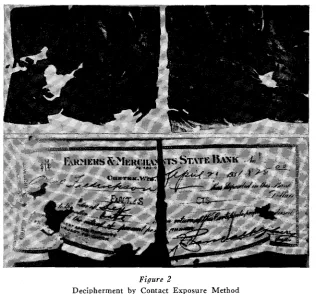
At the end of the two or three week contact period during which the plates are kept in a light-tight box, they are taken out of the box, separated, and processed in the usual photographic manner. Since the image is lacking in contrast, a harsh developer of the Eastman Dl type produces the most satisfactory results. From these plates photo-graphic prints are made (Figure 2) which can later be rephotographed if still more contrast is desired.
As a further experiment, Tyrrell subjected several of the fragments to a lengthy exposure with filtered ultraviolet radiation prior to the contact process. The results with this pre-treatment were superior to those obtained without it, especially when the fragments were older and less photographically active.9
7. Supra note 3
8. Eastman, DuPont, Gaevart, and other companies supply commercial plates under their
-own trade names.
CHARRED DOCUMENTS
Figure 2
Decipherment by Contact Exposure Method
Top: A charred document as it appeared before treatment. Bottom: Photograph made by contact exposure method. (Reprinted with permission of John F. Tyrrell,7)
Filter Photography. This type of photography, when applicable,
overcomes two of the disadvantages of the contact process, the time element, and the diminishing photographic activity of "stale" fragments. The process requires the use of a Wratten #48 deep blue filter in con-junction with commercial film. The filter function is not completely known, but it appears to accentuate the differences in actinic power of the charred document background as compared to those portions of the paper on which printing ink has been deposited.
Infrared Photography. One of the most highly publicized
decipher-ment procedures is infrared photography. However, it is the writer's experience that a large percentage of charred documents fail to yield satisfactory results with this method. In certain specific cases it may produce quite startling results, especially where the original writing mediums are typewriting, pencil, or dense iron-gall ink. Test exposures
left for weeks or months. While ultraviolet treatment appears to increase the activity of older fragments, it should in no sense be considered as a substitute for their immediate processing.
Figure 3
Decipherment by Infrared Photography
Top: Record photograph of document as received. Bottom: Infrared photograph of charred document.
are the only answers to the probability of success in these cases (Figure 3).
One of the recent developments in answer to this problem is an infra-red viewr which enables the examiner to ascertain in advance the proba-ble success of infrared photography. As far as is known this instrument is not yet being sold on a commercial basis for document work.
A widely known method for taking infrared photographs utilizes a Wratten 87, deep red filter in conjunction with Eastman infrared plates, development carried out in Eastman DK
50
developer.'0Lighting for infrared photography may be provided by a number of good incandescent light sources. Two #2 photofloods placed on either side of the document are as efficient as any.
Focusing is done through a Wratten F red filter which is later replaced by the 87 infrared filter. The 87 filter is too dense to focus through, and, since some compensation is necessary for the longer infrared rays,
10. Dr. Bendikson of the Huntington Library in San Marino, California has successfully
CHARRED DOCUMENTS
an F filter provides a comparable substitute.
The infrared exposure is usually of long duration. The exact time is best determined by trial and error, but a good standard for actual size photographs is 1 2 minutes at f. 16 with two #2 photofloods placed three feet from the object board.
VISUAL DECIPHERMENT METHODS
Reflectivity Method. The simplest and yet one of the most versatile
decipherment procedures is that in which burnt documents are examined by a controlled light source directed at various angles relative to the paper surface. As the light is shifted the examiner also views the docu-ment from different angles. The successs of this method depends to a large extent on the density of the original ink or pencil with which the document was written, as well as the degree of charring. When of the proper constituency the written portions sometimes stand out under vari-ous angles of lighting as sheened strokes surrounded by darker areas of the paper. In other cases the strokes appear dark against a sheened back-ground.
There is no set rule for the placement of the light source or the view-ing angle. In some instances an oblique light produces good results. In others, a light placed directly over the document creates the mirror-like reflection which causes the writing to stand out in relief.
The most effective way of carrying out examination by oblique lighting is to place the charred document between two clear glass plates of the proper size and, while carefully pressing the two halves together, bind at the edge with scotch tape. The protected fragments in this form not only present a permanent record that can be marked and filed for refer-ence or demonstration, but they are also flattened to a state where they can be examined more readily. Because of the reflecting properties of the glass, 900 "flare" type lighting cannot be used when the fragments are thus mounted.
Where a photographic record of decipherment by the reflectivity process is desired, the fragment is mounted to a single sheet of glass with small touches of transparent adhesive. Care should be exercised in pressing the fragment as flat as possible without undue breakage. The glass is then fastened to the object board of the camera which is so tilted forward that the illumination from a #2 photoflood placed directly below the camera lens, registers distinctly on the ground glass of the camera. For proper focus the back of the camera is adjusted parallel to the object board. Eastman Commercial Ortho or any other medium-con-trast film will serve for this purpose.
Alcohol-Glycerin Immersion Method. Differences in reflectivity values
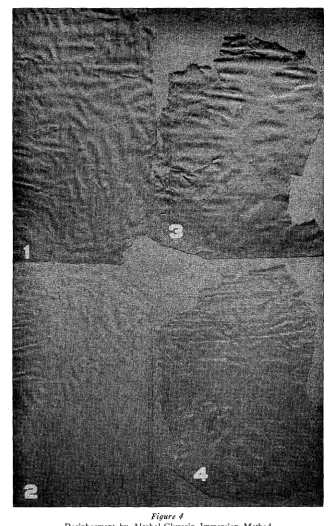
between various parts of a charred fragment may be accentuated by immersion in certain liquids. Taking advantage of this phenomenon, Black devised a glycerin-alcohol-water solution with which he treated and examined hundreds of valuable documents burned when the Ameri-can forces recaptured Manila. By this method he was able to decipher over 90% of the contents of two safe deposit boxes.'1 (Figure 4.)
The components of this solution are 2 parts water, 5 parts alcohol (rubbing), and 3 parts glycerin, in which the documents are immersed for varying periods of time. Photographic developer trays serve as processing containers. They are shallow enough so that any documents sinking to the bottom may be retrieved without excessive damage. The mechanics of his technique are described by Black as follows.
"In using the glycerin-alcohol solution, the charred fragment is immersed and readings of the fragment are made during each stage of the treatment as follows: (1) Before immersion, (2) during immersion,-that is, while the fragment is lying on the surface of the solution soaking it up, and before the fragment is completely soaked; (3) under solution; (4) while dripping wet;
(5) after blotting.
"In this way no chance is missed during the entire process to pick up read-ing matter. What is not readable at one stage may be at another.
"An important point in each stage is to hold the fragment at various posi-tions relative to the source of light (in this case, window light), since differ-ences in reflected light values are what enable decipherment.
"If the fragment is dropped flat on the surface of the solution, reading
mat-ter will sometimes suddenly pop out on the upper surface. The written or printed portion soaks up the solution through the charred paper much faster
than the bare paper does.
"The solutions apparently serve as follows. The water imparts varying reflective values. The alcohol serves as a wetting agent,-the charred frag-ment sometimes looks almost as though it were sucking water in. And the glycerin, a hygroscopic substance, retains part of the water content in the fragment during and after drying-in effect, permits a partial drying.
"Black blotting paper was used for drying, as any lint from the blotter left on the fragment thus corresponded in color to the fragment itself.
"In addition to being simple and rapid. this alcohol-glycering water treat-ment does not permanently change the appearance of the charred fragtreat-ment."
Silver Nitrate Method. According to H. D. Murray of London this
technique was first discovered by Superintendent Cherrill of Scotland Yard, who used it as a final recourse in case where all other methods of decipherment had failed.' To carry out the process, Cherrill places the carbonized paper on a glass plate resting at the bottom of an ordinary photographic processing pan. (A large baking dish would do just as
11. Supra Note 1.
CHAlRRED DOCUMENTS
Figure 4
Decipherment by Alcohol-Glycerin Immersion Method
1 and 3 have been treated; 2 and 4 are the same documents before treatment. (Reprinted with permission of David A. Black, "Decipherment of Charred Documents".1 1)
well.) A solution of 5 % aqueous silver nitrate is poured over the frag-ment and a second glass plate is .then placed on top of the fragfrag-ment. If the calcinated document is especially distorted the top glass may be kept from contacting it by positioning two small objects underneath opposite ends of the plate. The fragments thus treated should be pro-tected from direct sunlight, and within three hours any writing developed is visible as a black image against the grey background of the paper. If the original writing is faint, a weaker solution with longer develop-ment is recommended. A permanent image may be obtained by rinsing the fragment several times in water and drying rapidly. This image may, of course, be photographed.
The writer has tried this process on a number of charred documents. It was found that most ink and typewriting lines were unaffected by the treatment although in some instances printed material was made more visible. The treatment appears to depend upon reduction of the silver nitrate by the iron by-products of the burning process.
Chloral Hydrate Treatment. This method was developed during
World War II by two Englishmen, H.
J.
Walls and W. D. Taylor, who were confronted with the problem of deciphering documents burned in the German Air Blitz.'3 Employing the chemical formula and brief technique outlined by the originators, the following procedure was tried with good results.A solution of 25
%
chloral hydrate in alcohol is carefully applied to both sides of the charred document with a soft camel hair brush, or the fragment may be immersed in the chloral hydrate solution. The specimen is next placed on a small piece of heat resistent glass which is inserted in an oven heated to 600 C. An ordinary hot plate may also be used, but this source of heat is much more difficult to maintain at the proper temperature.When dry, the specimen is again soaked with chloral hydrate and the same drying process carried out. The immersion-drying procedure is repeated several more times, and, on the last immersion, a 10% glycerin solution is added to the chloral hydrate, and the final drying is carried out as before. The gradual accumulation of chloral hydrate crystals creates a "clarifying" action on the burnt figures or letters. Certain types of paper and ink responded better to the chloral hydrate treatment than others. For example, printing ink, typewriting, and certain iron gall inks show improved legibility when treated in this maner, while "washable" analine dye inks do not react well.
CHARRED DOCUMENTS
Grant reports'4 essentially the same results with ink and printing, but further states that heavily loaded papers often respond to the chloral hydrate treatment whereas the results with normal paper are generally poor. He theorizes that chloral hydrate may depend for its reaction on the products of incomplete combustion of cellulose, since the heavily loaded papers reacted more strongly.
Potassiumi, Ferrocyanide Application. A large percentage of the
writ-ing inks in use today contain iron and, even when burned, the iron base ink still retains a residue of iron salts imbedded in the paper fibres.
It has long been known that applications of certain chemical reagents cause a color reaction when combined with iron. Under ideal conditions, the residues of iron base inks on a charred document can be made to react positively. The most useful reagent for this purpose is potassium ferrocyanide acidified with hydrochloric acid which produces a bright blue color when contacting iron. The potassium ferrocyanide is used in a 2% solution of hydrochloric acid and is applied to the document with a camel hair brush or eyedropper. Davis15 reports little success with this method but suggests an interesting alternative. A piece of blotting paper is first soaked in the potassium ferrocyanide solution and placed against the back of the charred specimen. A sheet of white paper is then placed against the face of the burnt document, and the combination is held in close contact. After a short time, if the ink is iron base, a Prussian blue color "bleeds" onto the white paper in a blurred, reversed outline of the writing.
Potassium thiocyanate crystals acidified with hydrochloric acid pro-duces a gas capable of recovering eradicated iron base ink writing and comparable results with charred paper would seem to be indicated. However the application of this gas to three charred documents known to have been written with iron base ink produced disappointing results. The entire surface of the documents turned a deep pink color and the ink writing was rendered in only slightly darker tones than the paper. This lack of differentiation between writing and background may be due to the iron residue remaining in the paper after burning, or to other unknown factors.
Fluorescence in Ultraviolet Light. One of the important wartime
developments was originated by Julius Grant'6 of Great Britain. Grant discovered that by saturating burnt fragments with a solution of "pale
'14. "Decipherment of Charred Documents, Some Recent Work and a New Method," J. Grant, Analyst, Vol. 67; Pp. 42-47, 1941.
15. Supra Note 6.
mineral oil''17 and "petroleum spirits" he could create a fluorescent differentiation between writing and paper when the specimen was viewed under filtered ultraviolet light. Ultraviolet light inspection prior
to such treatment usually reveals nothing. Grant describes his process as follows:
"Place the sample on a blotting paper and if both sides are to be examined on a thin glass plate and thoroughly saturate it with a mixture of equal vol-umes of 'pale mineral oil and petroleum spirits.' This solution is conveniently applied from a dropping bottle. The solvent is allowed to evaporate, and after a variable period depending upon the type of specimen (usually about 1 min-ute), the specimen is flattened out as far as possible with the aid of a glass rod and thoroughly 'blotted' to remove the excess oil. This is particularly im-portant if the back of the specimen is to be examined, since the oil tends to form a thin layer between the char and the glass plate. This pressing process completes the flattening, and the specimen (mounted on the paper or glass)
is in a convenient state for handling and inspection under ultraviolet. With
most writing inks the remains of the writing appear outlined against a faintly fluorescent background, but the reverse results have been found, i. e., the ink absorbed more oil than the paper and fluoresced against a dark background. The nature and age of ink, type of paper, and the extent of charring de-termines the point of difference, but apart from the fact that older writing falls into the former category, no complete explanation of the difference is yet available.
"A number of specimens were examined by this method and all but one fell into one or the other of these categories. In this one instance, the ink and paper absorbed oil equally and the writing was therefore not rendered visible. Positive results with printed and typewritten and duplicated documents, and even with one type of carbon copy, have been obtained. Ordinary pencil writ-ing cannot be distwrit-inguished, but it has been noted that where such writwrit-ing is faintly visible to the unaided eye it is sometimes rendered more distinct to observation in this way by simple treatment with oil as described."
Experiments conducted by the writer indicate that newly burned fragments absorb the oil more readily than older papers. For that reason they tend to produce a better fluorescent differentiation between paper and writing.
Today almost every business transaction of any size is witnessed by a written document. Some of these documents will be burned either accidentally or deliberately; and, of course, modern warfare imposes the ever-present threat of destruction by fire. The large banks and business institutions have adopted the practice of microfilming records to safeguard against such an eventuality. But the ordinary citizen and small business man does not have access to such expensive equipment. He must rely on other protections. One of the most important of these "insurances" is the ability of qualified document and arson investigators to decipher documents burned by fire.