University of Huddersfield Repository
O'Sullivan, Patricia A.
Decision making and ethics : a case study of student nurses
Original Citation
O'Sullivan, Patricia A. (2002) Decision making and ethics : a case study of student nurses. Doctoral
thesis, University of Huddersfield.
This version is available at http://eprints.hud.ac.uk/id/eprint/4671/
The University Repository is a digital collection of the research output of the
University, available on Open Access. Copyright and Moral Rights for the items
on this site are retained by the individual author and/or other copyright owners.
Users may access full items free of charge; copies of full text items generally
can be reproduced, displayed or performed and given to third parties in any
format or medium for personal research or study, educational or notforprofit
purposes without prior permission or charge, provided:
•
The authors, title and full bibliographic details is credited in any copy;
•
A hyperlink and/or URL is included for the original metadata page; and
•
The content is not changed in any way.
For more information, including our policy and submission procedure, please
contact the Repository Team at: [email protected].
DECISION-MAKING AND ETHICS - A CASE STUDY OF
STUDENT NURSES
PATRICIA A O'SULLIVAN
A thesis submitted in partial fulfilment of the requirements for the degree
of Doctor of Education at the University of Huddersfield
ABSTRACT
Previous studies have shown that student nurses find the analysis of ethical dilemmas difficult (McAlpine 1996). This
may well be due to the nature of such situations, which are frequently complex and prone to ambiguity. This leads to
uncertainties as to which course of action is the correct one for those involved.
The purpose of this study was firstly to explore the perceptions of a group of student nurses in relation to ethical
dilemmas, which arose in practice both before and after exposure to the clinical environment, and secondly to
evaluate the usefulness of modules dedicated to ethics, which the students undertook as part of the Project 2000
curriculum. The focus of the evaluative process was the development ot moral responsibility and ethical decision
-making skills.
210 students representing two consecutive cohorts on the Project 2000 pathway took part in the study.
An evaluative case study design was used to examine the responses of students using two instruments, a
questionnaire and an in-depth interview.
The results from the questionnaire data indicated that student views had altered significantly after exposure to
practice and theoretical input regarding the decisions taken in response to the ethical scenarios presented. Statistical
analysis was conducted involving the variables student response and age, and student response and gender, but the
results were not statistically significant.
Data generated from the interviews were divided into four major themes. The complexity of ethical issues for the
health care team; the consequences ethical decision-making could have for society; the development of students'
confidence when faced with ethical dilemmas, and finally how their theoretical input had prepared them for their
forthcoming role as qualified nurses.
The results from the interview data suggest that nurses realised the importance of the decisions that are taken in
practice and how these will influence the direction of health care in the future. The results also demonstrated the
importance nurses placed on a theoretical basis in ethical decision-making as this provided a framework that could
be used throughout a nurse's career allowing him or her to enhance their professional status.
The study results indicate that if nurses are to fulfil their role as professionals then the acknowledgement of moral
responsibility and development of ethical decision-making skills are essential. In today's health service nurses will be
involved with the moral decisions taken by colleagues, patients and their relatives. It is important that nurses cannot
only respond to the moral aspects of individual patient situations but also have an in-depth understanding of the
ethical frameworks which direct decision -making.
CONTENTS
PAGE CHAPTER ONE
INTRODUCTION 01
CHAPTER TWO
A REVIEW OF THE LITERATURE
. Professional Ethics 23
. The Nature of Moral Problems in Clinical Practice 30 The Development of Moral Decision-Making in Nursing 34
. Curricular Approaches to Teaching Ethics in Nursing 43
. Self-Determination and Autonomy in Nursing Practice 51
CHAPTER THREE
METHODOLOGY 54
CHAPTER FOUR
REAL LIFE ETHICS 88
CHAPTER FIVE
ETHICS AND SOCIETY 113
CHAPTER SIX
ETHICS IN PRACTICE 138
CHAPTER SEVEN
PREPARATION FOR PRACTICE 159
CHAPTER EIGHT
CONCLUSION 189
REFERENCES 213
APPENDICES
1). Ethics Modules
a) Introduction to Law and Ethics in Nursing Practice b) Justice and Rights in Nursing Practice
c) Introduction to Management and Duty of Care d) Leadership in Nursing Practice
e) Accountability and Responsibility in Nursing Practice
2). HoIm (1997) Interrelationships in the Clinical Framework Ethical Decision-Making
3). Thompson et al (2000) —The DECIDE Model for Ethical Decision-Making
4). Questionnaire - Ethical Dilemmas in Practice
5). Interview Schedule
6). Statistics
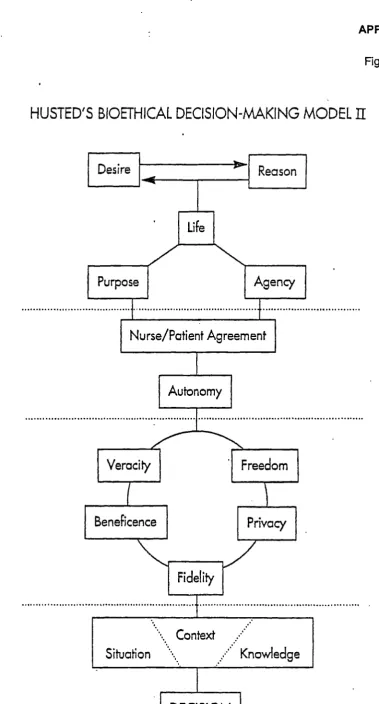
7). Husted et al (2001) - Bioethical Decision - Making Model 2
I would also like to thank:
Dr. Paul Oliver for his unstinting support and guidance during the writing of this thesis.
Mrs. Doreen Wallace for her secretarial skills and the ability to read my mind.
I would also like to extend a special thank- you to my mother who, although she
did not live to see the completion of this thesis did her utmost to provide me with
CHAPTER ONE
INTRODUCTION
The general scope and direction of this study was largely determined by the
increasing importance of ethical decision-making within the health care
services. The last few decades have seen rapidly developing technological
advances. These costly developments within the clinical environment, which
have undoubtedly been of great benefit to patients, have at the same time
created ethical dilemmas that have impacted not only on the client and their
relatives but also on the health care professionals who are responsible for their
care and treatment. One effect of these advances has been to create an
environment in which treatment regimes are available for patients living in
certain health districts but not others. Cases such as these are often
highlighted in the press and on television and the Health Service is asked to
account for these discrepancies in opportunities for patients.
For example, the increasing knowledge and ability of health professionals has
allowed them to be able to sustain the lives of increasingly premature neonates
and prolong the lives of the critically ill (Keenan, 2000). These situations are
accompanied by many ethical decisions in relation to quality of life, the cost of
maintaining life support for a prolonged period of time and the effects that this
will have on the relatives of the patients involved.
Users of the health services are now in a much stronger position to expect a
level of service that is outlined by the Department of Health in their recent
document The NHS Plan (2000) and many wish to take an active part in
decision-making regarding the management of their treatment. Although this is
understanding or the ignoring of advice may lead patients to make a decision
that may not be in their best interests. The health care professional may then
be placed in a difficult situation, torn between their duty of care and upholding
the patients' right to freedom of choice.
The purpose of this chapter is to provide a background to the study describing
its location, rationale, context and finally a statement outlining the aims of the
research. In order to begin to provide the reader with the background to the
research it is necessary to introduce the researcher within the context of her
role while undertaking the study and the way in which this role has developed
since her first involvement in the health and educational field. During the study
the writer will be referred to as the researcher or in the first person where this is
appropriate.
The researcher qualified as a registered nurse in 1981 in a large teaching
hospital in the north west of England and worked as a staff nurse in neurology.
She then moved to a hospital in the south of the country in order to undertake a
specialised clinical course in burns and plastic surgery. On completion of this
course she continued to work in this specialty for two years. In order to
broaden her experience the researcher returned to the north of England and
worked in the Intensive Care Unit/Theatre suite of a large teaching hospital. In
1988, having worked in the health care services as a qualified nurse for
15 years she then moved to the educational field. This move was one that the
researcher had planned to make as she had qualified as a teacher prior to
entering the nursing profession. With a recognised teaching qualification but
without experience of teaching nurses, the researcher worked for a year as an
unqualified tutor involved with the teaching of student nurses. After this time
to post-registration education in a different hospital. In this department the
researcher's responsibility involved the development of a variety of short
courses designed to provide professional updating study days and conferences
in a number of different clinical specialties. The researcher has continued to
teach in this area but now organises specialized clinical courses in
neurosciences and burns/plastic surgery. These courses are designed to
develop the theoretical knowledge base, clinical skills and research expertise of
qualified nurses who have chosen to work in these particular fields of health
care. The students are encouraged to take an active part in the learning
process and to return to their clinical areas to act as agents of change in order
to improve practice, lead new innovations and encourage a research ethic
within the clinical team. The researcher has continued to develop these
courses in response to the changing health environment for the last twelve
years. Over this period the researcher has introduced discussion and reflection
on ethical issues that impinge on the students' practice so that they will be able
to make an effective contribution towards the resolution of ethical dilemmas in
the clinical situation. Alongside this the students' abilities to analyse their own
values and beliefs and consider societal values are also part of the courses.
During this time the researcher found that nurses who had been qualified for
several years were commenting that they were finding it increasingly difficult to
adjust to the growing number of challenges presenting themselves in practice
where the individual had found it difficult to know what was 'the right and good
thing' to do for the patient. These nurses, by their own admission, had very
limited skills in managing ethically difficult care situations. Ethics as a subject
in its own right had never been introduced in their basic training and it was now
proving to be a great disadvantage as these nurses found themselves in
them with feelings of inadequacy, frustration and a realisation that they were
not as effective as they could have been in the particular situation. In 1995 the
researcher completed study at Master's level into the subject of Health Care
Ethics. It was while a student on this course that the researcher began to
realise that the ways of approaching ethical problems are strongly linked with
personal experiences, together with pre-conceived expectations that have not
been challenged. (Benner,1 991) described ethical behaviour as:
An action, which is related to experiences, cognition, emotions and circumstances (p.57).
According to Dimond (1995) historically nurses had not been in a position
where their ideas would be challenged because due to the nature of their role
the expressing of opinions was not encouraged. With this in mind the author
became interested in the concept of what Harré (1983) describes as "agency".
He has described this concept in the following way:
To be an agent is to conceive oneself as a being in possession of an ultimate power of decision and action (p 43).
In order to achieve this, a nurse needs both personal and professional freedom
in order to act on his or her convictions. The character traits necessary for this
to occur must include the following - autonomy, altruism, a conscience, the
ability to think rationally and the courage of convictions held. (Beauchamp et al
1994). The nursing role must also encompass a large degree of commitment
together with a strong will. However, the possession of this personal freedom
means that the decisions that are taken must bear some moral significance and
involve responsibility for those actions. If nurses are going to possess a sense
of "agency" then they need to be able to view themselves as having control and
Within the Health Service environment, Salvage (1985) has described the
sense of helplessness felt by nurses in this particular organisational context.
There appears to be a sense of being reactive instead of proactive; nurses feel
subject to manipulation and therefore not able to resist the unseen forces
operating at management level. Many writers including Kelly (1998) have
described the differences that are apparent between the expectations of
undergraduate nurses and their experiences working in the health organisation.
Many nurses described a hierarchical structure where their organisational
accountability and their moral responsibilities to patients and each other were
detached. If this is the case a sense of "agency" that should exist is replaced
by a sense of inadequacy and feelings of guilt. The nurse may feel that the
fault lies at his or her door or may feel it is the fault of the organisational
environment. In the researcher's experience it is often a combination of both
factors.
If "agenc'y" is in-tpotant to cvtM
of the discipline of ethics is important for several reasons. Wilmott (1993)
outlines the following two reasons. Firstly, the issue related to freedom and
"agency" is most concrete when questions about the right and wrong of
individual actions are discussed. Secondly, an ethical framework allows
exploration of the question in a more focused way.
Ethics has been described as the ability to look both ways (Beauchamp et al
1994). For example, an action can be judged by its consequences, a utilitarian
view, or from a deontological viewpoint where the moral significance of an
action can stand free of its consequences or its causes. In a situation where an
working within the health environment, the nurse can be helped to find a
balance between self-blame and non-acceptance of responsibility.
The Code of Professional Conduct (UKCC, 1992) does imply that nurses have
the freedom to choose between right and wrong actions. This freedom can be
interpreted in several senses. The nurse is accountable for the performance of
his or her professional duty and for some of the consequences of those
actions. This code does not give any ready-made formulae for identifying right
and wrong in given situations but identifies certain actions that are considered
consistently right or not. However, these things are not always easy to identify
and may conflict. It can be argued that the nurse cannot act as a free agent
when he or she is unable to recognise these situations to make use of the
Code of Conduct.
Nursing therefore, may need an ethical theory base, and even if the nurse finds
that this base confJicts with his or her own it wAJ) be part of their professiona)
responsibility to decide whether they are willing to work within it, (Thompson et
al, 2000). Studying ethics allows the nurse to make a considered choice about
his or her own ethical stance with regard to freedom and agency.
Since the completion of the Masters Course undertaken in 1995 the
researcher has been invited to give lectures on ethics to both pre-registration
and post- registration nurses. However this has often been on an ad hoc basis
and it could only serve to briefly introduce the main concepts. As the
researcher was unfamiliar to the students it was difficult to develop any
meaningful group cohesion to allow students to begin to discuss their beliefs
and opinions. This experience has strongly influenced the researcher to
the reader that although this study discusses philosophical theory in relation to
the ethical dilemmas that arise in clinical practice it is primarily concerned with
the student's ability to confront and adequately deal with these situations and
how their ethical decision-making develops in the light of formal teaching in
ethics.
The lack of formal teaching in relation to ethics in pre-registration education
has recently been addressed in the Project 2000 curriculum within the
University of Greenford, which will be outlined later in the chapter. Modules
specifically dedicated to ethical subjects are taught at regular intervals during
the training programme. The study will follow four cohorts of pre-registration
students, two of whom commenced their training in September 1998 and two in
January 1999. The September 1998 cohorts were the first groups to undertake
modules specifically dedicated to ethics. The study aims to investigate the
opinions of student nurses in response to ethical scenarios through the use of a
questionnaire given to the students prior to undertaking clinical practice with
the intention of examining these responses in relation to certain dependent
variables. The study also aims to evaluate the ethics modules through the use
of an interview designed to allow students to comment upon any ethically
challenging situations they encountered in practice. During the interview
process the students will be invited to discuss whether their responses to the
ethical scenarios outlined in the questionnaire have changed in the light of their
exposure to clinical practice. In addition they will be asked if undertaking the
modules on ethics has had any effect on their ability to handle ethical issues
which they have encountered in clinical practice and whether studying ethics
has helped prepare them for their role as qualified nurses. The interview will be
within their respective branch programmes, which will be outlined later in the
thesis.
The students' attitudes to ethical problems that arise in clinical practice and
their ability to deal with these issues will be investigated in the light of
undertaking the specialised modules.
The students who are participating in this study are studying at the University of
Greenford (a fictional name). The University is situated in the centre of
Greenford. With a population of 115,000 it is one of the largest towns in the UK
without city status. The Wentworth campus combines modern and nineteenth
century buildings, several of which are listed due to their architectural or
historical interest. The School of Human and Health Sciences, the department
in which the researcher works, is housed in extensive new premises that
opened in March 1999. There are other university premises and halls of
residence situated around the town, the largest of which, is the student village
situated at Lloyd Hall in extensive parkland on the outskirts of the town.
The University has over 17,000 students and offers a wide range of courses
leading to a variety of qualifications ranging from a BA (Hons) in Accountancy
and Finance to a BSc (Hons) in Virtual Reality Systems. The School of Human
and Health Sciences offers professionally-validated diploma and degree
programmes in health and social work and a wider range of degrees in the
behavioural sciences and health-related subjects. The School has over 4,000
students currently on both academic and vocational programmes. The School
of Human and Health Sciences also has over 2,000 part-time students and the
programmes are devised to support the learning needs of people from a wide
With the completion of the School's new building in March 1999 on the
Wentworth campus the School underwent a mass relocation from 12 outlying
sites throughout the region, which dramatically increased the opportunities for
shared learning. Most courses within the School of Human and Health
Sciences are practice-based and therefore links with external organisations are
strong. In response to a government initiative which outlined new strategies for
nurse education a local College of Health Studies successfully amalgamated
with the existing School of Human and Health Sciences at the University of
Greenford in April 1996.
As far as the existing students were concerned they continued to be taught by
the same people in the same teaching accommodation as previously. Due to
the problems posed by housing a large number of employees from a variety of
satellite sites within the existing University accommodation the process was
staged over a period of 3 years. The researcher was included in the final stage
of the move and transferred to the University in March 1999. Having worked in
a hospital-based environment for many years the transition to a higher
education institution was a difficult process even though the amalgamation had
taken place over a period of time. The major differences that were immediately
noticeable were the numbers of students that were registered on the courses
offered by the University compared to the much smaller numbers that were
taught within the College of Health. This factor was certainly important in the
differing approaches to teaching and the management of courses in general.
The administrative systems within the university were also new for both the
academic staff and the students. Many students had been familiar with a
system where the teaching environment was intimately connected to the
clinical environment, and they had to adapt to a new university system. This
separation of the teaching and clinical environments also caused problems for
geographical distance from some of these areas rather disconcerting. It was
necessary to ensure that these links remained as strong as they had been
previously for several reasons. Firstly, in order to remain credible when leading
specialized courses teachers must keep up to date with changes occurring in
practice. Secondly, the continuation of the involvement of guest speakers from
the clinical areas who support the courses and finally, the obligation teachers
have to work in practice for a certain length of time per year in order to maintain
their professional registration.
Within the School, the Department of Nursing runs the Diploma in Higher
Education (Dip HE) in Nursing Studies. Pathways on this course lead to both
an academic award and to professional registration in the following branch
programmes, which make up the latter 18 months of
training-Adult Nursing
Mental Health Nursing
Learning Disability Nursing
Child Nursing
To ensure that the requirements for both qualifications are met the course has
been developed with reference to The National Committee of Inquiry into
Higher Education (1997) and the English National Board for Nursing, Midwifery
and Health Visiting requirements for educational programmes (ENB 1997). On
completion of the course students are awarded the academic qualification and
will be entered onto the appropriate part of the United Kingdom Central Council
Professional Register for Nurses, Midwives and Health Visitors. The pathway
is delivered over three years. Each academic year consists of three semesters
or trimesters. Each semester is 15 weeks in length and the student is required
to demonstrate a minimum of 2,300 hours of academic study and 2,300 hours
pro-foundation, foundation and advanced levels. Successful completion of
these modules attracts 240 credits plus 90 credits for clinical experience
successfully completed. There are two main parts to the pathway - the 18
month Common Foundation Programme (CFP) and the chosen branch
programme also lasting 18 months. Within the nine trimesters the students
divide their time between theoretical input, directed study and clinical practice.
Nurses work with all client groups in a variety of settings and undertake nursing
activities and acquire skills in a wide range of clinical and multi-agency settings.
The Common Foundation Programme (CFP) makes up half of the course and
is undertaken by all students. During this programme the students are
provided with opportunities for correlation of theory and practice, the
development of observational, assessment and care skills; and the application
of knowledge to the development of problem solving and communication skills.
In trimesters two and three the students spend 360 hours in a variety of
community settings. One hundred and fifty hours are devoted to childcare and
paediatrics, 150 hours to maternity care and the remainder to experience with a
qualified health visitor. The clinical placements are designed to meet the
European Commission Nursing Directive (77/453/EEC). In trimesters four,
seven and nine the students undertake purely clinical placements within the
four specialties outlined previously, which make up the branch programmes.
Trimesters one, two, three, five, six and eight combine both clinical placements
and theoretical input. The Common Foundation Programme is considered to
be the essential building block enabling the development of knowledge and
skills, which will ensure smooth progression to any branch speciality outlined
above. During the above programme twelve modules are accredited at
pro-foundation level, ten modules are accredited at pro-foundation level and twelve
modules at advanced level. Throughout the Common Foundation Programme
designed to illuminate and complement practice through exploration of the
appropriate knowledge base. The practical experience is designed to give the
student an insight into the four areas of nursing which make up the branch
programmes. The exploration of the knowledge base of nursing is organised
around 5 major themes
-Nursing Theory and Practice
Human Development
Research and Information Management
Professional Issues and Management of the Care Environment
Professional Development and Interpersonal Skills.
The arrangement of modules within the above themes provides the students
with the continuity necessary for effective learning. The modules on ethics are
found in the Professional Issues and Management of the Care Environment
theme. The modules taught at pre-foundation and foundation level introduce
the student to the legal framework and general ethical perspectives. The
fundamental ethico-legal issues relevant to the professional contexts in which
nursing occurs and in which care is delivered are also discussed. During the
modules taught at advanced level, ethical, legal and organisational
frameworks, which inform, empower and constrain professional practice, are
examined.
The five modules that will be evaluated within the study are taught within the
Common Foundation Programme and the respective Branch programmes. (see
Appendix 1). The first of these modules introduces the student to the ethical
and legal principles that guide the development of accountable professional
practice in health care. It lays the foundations for student development of the
awareness of ethical and legal issues as components of health care practice.
The syllabus covers ethical duties, moral goodness, beneficence,
response to a series of sentence completion tests. The second module
enables the student to develop an understanding of the ethical principles of
justice and rights. The syllabus covers justice as fairness and equality, rights
theory, truth-telling, consent, confidentiality and offences against the person.
The assessment takes the form of a seminar presentation on a selected clinical
situation. The third module aims to extend the students' understanding of a
moral and legal duty of care and the role that they play in the delivery of care.
The syllabus includes ethical decision-making in relation to paternalism and
liberalism and the meaning of a moral duty of care. This is assessed by an oral
presentation of a negotiated ethical issue. The fourth module aims to help
students understand their contribution as a member of the health care team
and their role in managing change. The syllabus includes leadership roles,
power and authority in professional practice and change management. The
student is required to complete an essay discussing an element of care that
demonstrates how the ward leader enabled change to be managed. The last
module focuses on the legal relationship that exists between nurses, patients,
employers and the UKCC. The syllabus includes the concept and domains of
formal accountability, professional accountability, the impact of the UKCC
document 'The Scope of Practice' and employee responsibility. The students
are required to give a presentation on a chosen topic discussing aspects of
formal accountability and show how legal liability was dealt with. The
theoretical part of the Project 2000 programme is delivered at the Wentworth
campus. Clinical practice takes place in both hospital and community
placements within the surrounding districts.
As early as 1983 Johnson stated:
It is clear from this statement that the need for the teaching of ethics within the
health care professions has been recognised for some time. This has been
underlined by the Pond Report (Boyd, 1987) recommending training in ethics
for the medical profession, by Project 2000 (UKCC, 1986) and the Joint
Institute of Medical Ethics and RCN study (Gallagher et al, 1991), which
focused primarily on the nursing profession. Gallagher and Boyd conducted a
survey, which demonstrated that 98 per cent of those employed in nurse
education in the United Kingdom agreed that ethics should be taught as a
separate module to student nurses. The reasons the respondents gave for this
opinion was professionalism, the need to understand one's own and others'
value systems, reasoning skills and the humanitarian aspect of nursing.
There have been various codes written over the years from the time of
Florence Nightingale by different professional bodies including The
International Council of Nurses, The Royal College of Nursing and The United
Kingdom Central Council. These codes provide a general framework of values
and practices as well as accepted standards of conduct, and are important
according to Jupe (1987) for several reasons. Firstly, nurses represent a range
of professional roles and standards must apply to the profession as a whole.
Secondly, patients represent a diverse group with their own beliefs, which may
be in contrast to the views held by nurses. Thirdly, nurses are confronted with
situations not normally experienced in life; and finally the codes provide the
nurse with the framework to self-examine and realise their own beliefs and
attitudes. However, these codes do not provide the answers to ethical
dilemmas and nurses need guidance in coming to terms with these situations
together with the knowledge to approach the situation and be able to make an
Hussey (1990) noted that although the study of ethics was generally included in
many diplomas, degrees and other post-basic courses it was not common in
pre-registration education. He commented on the fact that by the nature of the
work undertaken by nurses they face far more difficult and demanding
situations than most people face in everyday life. The needs of patients placed
in extremely vulnerable positions, the possible conflicting opinions of
colleagues, technology changing at an ever-increasing pace and a general lack
of resources can be responsible for creating complex moral dilemmas. A recent
government-funded report (Coombes, 2000) has brought to light a 'postcode
lottery' in specialist nursing care for sick babies sent home from hospital to
recover. A postcode lottery is the term used to describe the situation in which
access to specific areas of health care is dependent upon where the individual
lives as some services are provided in certain health districts but not in others.
The report claims that parents of over 6,000 babies cared for in the home have
to learn to master technically complex equipment such as ventilators, which
may be sustaining their child's life. Caroline Glendinning (2000) who is one of
the authors of the report commented:
Some of the nurses felt that parents had been pushed too quickly into agreeing to taking the child home. Because of pressure to discharge, hospitals might sometimes build on parents' natural desire to have children at home (p.65)
These infants, that also included premature babies, often had more than one
health problem, which necessitated interventions such as a tracheostomy or
oxygen therapy. The inevitable stress that this places on parents is increased
by the fact that the day-to-day care of these children by the primary care team
is poorly organised due to resources being stretched too thinly. It is not long
as these and can easily become involved in situations that he or she may not
have the experience, power or influence to deal with.
The struggle to emancipate nursing and establish it as a recognised profession
has been ongoing for many years (Rose et al, 1994). According to Seilman
(1996) nurses have tended in the past to be seen as unthinking individuals who
performed repetitive tasks at the request of doctors, and therefore it is
necessary to educate an individual who can think analytically and argue
rationally and logically. If nurses aspire to be professionals, this means that
they are obliged to meet exacting standards. They are responsible for their
actions, those they consciously take, and those they avoid. Campbell (1984)
pointed out that novice nurses should not be exposed to these situations
without clear guidance. The student nurse must be guided in the reflective
process asking themselves fundamental questions such as: What does it
mean for me to be a nurse? As a nurse what do my patients expect of me?
How should I perform to uphold the nursing role and fulfil the professional
status of nursing? These questions are an important stepping -stone towards a
personal and professional assimilation of moral values. Education in ethics
therefore, is an essential part of developing an autonomous practitioner, who is
capable of constructive critical appraisal of dilemmas arising in practice. The
complex environment in which nurses function sees them not only as providers
of health care but as important players in the political and social arena.
This fact results in many decisions being taken at higher levels of
management, which often involve moral value judgements. If nurses are going
to represent their profession at this level then it is vital that they are able to
argue effectively and understand the nature of the process of decision-making
When a nurse is practising on a day-to-day basis there is constant interaction
with others, be they patients, relatives or other members of the
multi-disciplinary team. This inevitably means, therefore, that there is always a
moral dimension to that practice. There are moral decisions that have
consequences for patients, affecting their rights and the quality of care they
receive. These consequences however are not limited to the patients.
Practitioners are also affected in that they will be asked to call into question
their perceptions of what is right and wrong, just and unjust, beneficial or
non-beneficial for the patient. There are some decisions that are taken in the
health care forum, which can have implications for society in general. The
withdrawal of treatment from patients that have been diagnosed as suffering
from irreversible brain damage and are in a persistent vegetative state was
highlighted in 1993 when Tony Bland, a victim of the Hillsborough disaster, was
allowed to die by the withdrawal of his feeding tube. This decision led to a
reappraisal of other patients who were in a similar state and relatives of these
patients who were asking if a similar decision could be taken for their relative
(Ford, 1993).
There are many reasons put forward to support the inclusion of ethics in the
nursing curriculum. Scott (1995) outlines four such reasons. Firstly, Scott
believes that the quality of the constant interaction of a practitioner with
patients must have some moral relevance to the type of care the patient
receives. Therefore it is necessary to furnish the nurse with the ability to reflect
on the morality of their actions. Secondly, in the clinical situation patients who
are ill and lack the appropriate knowledge about their condition are at the risk
of an ill-prepared nurse failing to take into account the rights of the patient. The
Thirdly, nurses will practise more effectively if they develop a moral
imagination. Finally, if they are involved in decisions that have wider
implications in society they must be aware of the potential of the decisions in
which they are involved.
The necessity for nurses to have a sound understanding of ethical issues is
greater now than at any other time in the history of the Health Service. The
rapidly developing technology, the increased public awareness and
expectations, and the limitations in resources increase the number of potential
ethical dilemmas that can arise in practice. The current Secretary for Health
and Social Services Mr. Milburn in a report entitled 'An Organisation with a
Memory' (DOH, 2000) has called for a national database to be established to
record any incidents that are reported either officially or anonymously. He is
encouraging nurses to 'blow the whistle' if they are concerned about a
colleague's conduct or have doubts about the systems in place to deal with the
day-to-day running of the clinical environment. This move has come about due
to the recent scandals including the GP who killed 15 patients (Bale, 1999)
and the gynaecologist whose operations led to many women suffering severe
side effects that virtually ruined their lives (Boseley, 1998). In the
above-mentioned report The Health Secretary stated:
The terrible thing about them, apart from the harm that was being done to patients, is that all too often the problem was well known. It was often gossiped about in the hospital but nobody did a thing about it. Now that isn't good enough (p. 23)
The new measures outlined in this report have their critics who see them as
another layer of NHS bureaucracy. The ethical problems that can arise from
acting in this way are many and varied. The issue of confidentiality when
initially report colleagues anonymously and then if the correct backup systems
are in place decide that they wish to make an official complaint. The
recommendations made in this report are based on similar systems that have
been established in both the aviation and nuclear industries. However, to
compare the National Health Service to the aviation and nuclear industries is
not, in the researchers' view, a fair analogy as the services that are provided by
these industries are very different from the services provided by the Health
Service. Many recipients of health services are in a vulnerable position and are
not always able to cope with difficult situations or make decisions that in the
course of their daily lives would normally not cause a problem. Payne (2000)
comments that the pressure group 'Public Concern at Work' suggest that the
system could undermine (ocal reporting of incidents and has doubts about the
alternative of anonymous reporting on a national basis.
Articles, which appear in the Nursing Times sometimes, present ethical and
professional dilemmas experienced by readers, and demonstrate the
increasing importance of a nurse's ability to deal competently with ethical
dilemmas arising in practice. A panel of experts often offer advice on the best
way to respond. One such article outlined a case of suspected cruelty towards
elderly patients reported by a staff nurse from information related to her by
health care assistants working on the ward (Hayward et al, 2000). This type of
article appearing in this journal whose main readership is student nurses
perhaps suggests that the teaching of formal ethics within the nursing
curriculum is essential so that nurses will be equipped to deal with situations
such as these in a more competent manner and not have to rely on the advice
provided by a panel of experts writing in the nursing press. It is vital that nurses
feel that they have the theoretical knowledge underpinning moral
beyond, so that they will be able to deal with situations at ward level, which
encompass ethical issues and demand an understanding of the nature of moral
decision-making.
The cultural discipline of nursing has its roots in a 'modern' society which saw
the growth of science, rationality and reason after a period in which religion had
been the dominant perspective. This was known as the period of Reason or
Enlightenment that originated in seventeenth and eighteenth century Europe
(Jones,1999), and it was a time of progression both scientifically and
technologically. During this time it was believed that the methodology of
science could lead the human sciences to an understanding of people and
social issues. In the mid twentieth century a new perspective emerged, that of
Postmodernism, which began due to a loss of faith with the modernistic dream
(Dallas, 2000). It can be described as the belief that society is now based on
the decline of absolute truths and the rise of relativism. Since World War Two
and during the 1950's there has been a growth of relativism within sociology
and other fields. It is based on the argument that there is no such thing as
objective truth, everyone has different values, and ethics is just a matter of
taste (Shawyer, 1999). It supports the view that all ethical judgements are
relative to the individual or to the society in which they live. Moral philosophers
who have developed this idea recognise the importance of the social
environment in determining beliefs (Clark, 1999). The diversity of these
environments has led to the conclusion that there are no universal standards of
good or bad, right and wrong; in other words no agreed, objective absolute
standards. Tarnas (1991) observes that some philosophers of science have
taken up this idea of relativism maintaining that there is no such thing as an
objective, historical knowledge of things and that the person who perceives any
object is influenced by the societal context. An example of relativistic thinking
medicine and mental illness and the language surrounding them. He argued
that the term mental illness arose due to circumstances. Buildings left vacant
by lepers that were cured in Medieval Europe began to house people who
displayed signs of 'possession'. These buildings became known as asylums;
the caretakers became known as psychiatrists and the condition of the inmates
known as mental illness. This being the case individual perceptions are open to
a multitude of interpretations (Jencks, 1996). Advocates of a post-modern
world believe in no certain, single truths. Every question is alleged to have an
infinite number of answers, each one being as equally valid as the other.
MackIm (1999), who argues against this rise of relativist thinking, makes the
point that it is currently fashionable to avoid the language of rights, to reject the
importance of individual autonomy and to focus instead on the importance of
the community. However, it can be argued that health professionals champion
individual autonomy and rights in the face of paternalistic practices (Rosenau,
1995). MackIm believes that ethical universal ideals do exist but they need to
be compatible with numerous cultural interpretations.
Nursing continues to thrive and develop in this changing world and the
researcher believes that the moral judgements made by nurses in the clinical
situation, will be based on what are perceived to be absolute truths, but at the
same time there will be a relative element to that decision based on
consideration of the circumstances that exist at the time. In the light of this
ever-changing lively philosophical debate outlined in the work of MackIm (1999)
the nursing profession must be equipped with the skills to manage ethical
decision—making competently.
This chapter has attempted to set the scene within which the research study
has been conducted. It has also outlined the background and interest of the
researcher in the subject. There is a discussion of the importance of the
changing social and political environment, which has direct repercussions
within the Health Service. The importance of the development of the concept of
"agency" for the recognition of nursing as a profession has been investigated.
It is argued that this concept can be developed fully only if the teaching of
ethics begins when the student nurse commences training. The rise of
post-modernism based on a relativistic theory of knowledge and the influence that
this can have on the ethical decisions that nurses face has also been
addressed.
The following are the aims of the research study:
• To analyse the opinions of student nurses concerning ethical issues that
might arise in clinical practice prior to exposure to the hospital environment
• To examine the opinions of student nurses on ethical issues arising in
practice following clinical placements
• To analyse the opinions of student nurses on the value of the ethics
CHAPTER TWO
REVIEW OF THE LITERATURE
In order to conduct a literature review the topic under research will be divided
into five major subject areas and each area will be reviewed in relation to the
literary material that is relevant to the study. The literature review will also put
the current study into context within the educational and nursing fields.
The five subject areas are as follows:
1. Professional Ethics
2. The nature of moral problems in clinical practice
3. The development of moral decision-making in nursing
4. Curricular approaches to teaching ethics in nursing
5. Self-determination and autonomy in nursing practice
These five subject areas will provide a framework for the analysis of the data
that will be collected through questionnaire and interview.
Professional Ethics
The first subject area to be considered is the role of professional ethics within
the workplace. Any professional role will be a reflection of the particular
institution's expectations and the practices that take place within that
organisation. Beauchamp and Childress (1994) argue that these roles
encompass virtues as well as obligations. They will also bring with them
various conventions, procedures and customs. These authors recognise that
requires the individuals that are part of that body to develop certain virtues.
They suggest that the standards of virtue may incorporate criteria of
professional merit and distinction and if a person is in possession of these he
or she will fulfill the standards required of that profession. Hunt (1997) sees a
growing conflict between the traditional professional ethics of health care, the
economic policies and what he calls 'neo-laissez-faire'. He describes the
increasing development of 'whistle-blowing' due to the fact that professionals
are unable to sustain appropriate standards in the face of dwindling resources
and the commercialism of health care.
The practice of nursing must, by the very nature of its role, encompass social
expectations as well as its own internal standards and ideals. Pellegrino
(1985) categorically claims that the traditional virtues attached to the health
care professional stems from health care relationships. The virtues that are
necessary to fulfill the professional health care role are many and varied. It
would be impossible to name them all but several will be mentioned here such
as trustworthiness, compassion, benevolence, integrity, truthfulness and
justice.
Possession of these traits will, it is hoped dispose individuals to act in
accordance with the goals and expectations of the health care institution
(Pelligrino, 1985). It is important to remember that individuals who exhibit a
moral perspective in life, may well fare better in others' assessment of the
praiseworthiness or blameworthiness of their actions. This is illustrated by
Bosk (1979) who relates a story of medical error where two professionals
commit the same error of judgement but the one who has a record of being
conscientious is not subjected to moral blame in the same way as the other.
Friedson (1986) commented that academics from the 1940's and 1950's
profession. These were complex formal knowledge, skill and an ethical
approach to their work. These particular characteristics tended to set
professionals apart from other occupations and to enhance the reputations of
the institutions in which they practised.
Koehn (1994) states that the concept of the professional is intrinsically
normative and who qualifies for the label will vary according to the norms with
which it is thought they should comply. He believes that it is essentially a
dialectical term. Durkheim in a book republished in 1957 after his death has
written comprehensively on the subject of professional ethics. He places them
between family morals and civic morals. He comments on two aspects of the
subject. Firstly, the general nature of professional ethics compared to other
fields of ethics and secondly the conditions necessary for establishing
professional ethics and their function within the working environment.
Durkheim argues that what differentiates professional ethics from other
branches of ethics is the way in which the public may regard them. If the moral
order is infringed the public look on this with indulgence. Transgressions that
are concerned with the practice of the profession may only mildly be censured.
This feature of professional status is due to the fact that its practice is outside
the common consciousness. Everyone does not perform the functions of the
profession and therefore the majority of the general public is unable to have a
sense of what these functions are or what they ought to be. Neither are they
aware of the special relationship that should exist between the members of the
profession applying these functions. It is only when the transgression is so
grave as to have general repercussions that the public become alarmed.
Durkheim points out that there is a very important condition without which no
only operate if the group protects it with a certain degree of authority. This
system is made up of rules, which govern members of the group and compel
them to act in a particular way, imposing limits on their actions and not allowing
behaviour that will go beyond those limits. The greater the strength of the
group structure the more numerous the moral rules that are appropriate to it
and the greater their authority over the members of the group. If the group
demonstrates a close coherence and the individuals are in frequent contact
with one another with a rich exchange of ideas and emotions the opinions of
the group will be similar in relation to moral behaviour. The better the
organisation and stability of the group the better developed and more advanced
in their operation will be the professional ethic of that group.
No professional activity can exist without its own ethics argues Thompson,
(2000). Historically, within the health care field professional virtues were
closely integrated with obligations and ideals in various codes. The Hippocratic
oath is a prime example of this, commending such virtues as modesty,
sobriety, patience, promptness and piety. Percival (1803) was the first to
attempt to establish a definitive set of virtues in medicine. He stated that the
patient's best medical interest should be the ideal goal of medicine and
therefore the physician's traits of character ought to mirror this.
Beauchamp and Childress (1994) comment that the virtues of nurses similarly
reflect the different models of the profession and its role responsibilities. The
historical model of the nurse as the 'handmaiden' of the doctor was
encouraged to develop the passive virtues of obedience and submission.
Current models work towards the nurse developing active virtues, which will
The role of an advocate, which is important to protect the interests of patients,
will necessitate virtues including justice, persistence and courage.
Winslow et al (1991) pointed out that obedience to certain rules was demanded
in the historical model, but attention to patients' rights and the preservation of
the nurse's integrity are more important in the current models. However it is
relevant here to point out that any virtuous act that is carried out requires the
appropriate judgement. It is necessary to have an understanding of what is
right and what is good.
Koehn (1994) reminds us that many attempts have been made to investigate
exactly what is the moral relationship between professionals and the general
public in whose midst they practise. It can generally be divided into three main
categories. In the first category the professional who is entitled to act as an
exclusive agent of the clients' welfare is governed by norms that are different
from most others', in the second category the professional does not stand in
any special moral relation to their clients but are bound by the same moral
norms as everyone else in society. Finally, in the last category, the professional
has moral obligations to their clients that are special but which have been
established in accordance with the moral norms of a particular community and
which bind each member of that community. Koehn cannot entirely concur with
these categorisations of the professional role and with reference to the nursing
profession the researcher must to some extent agree with her comments. She
points out that the above descriptions are rather naïve in that they ignore a
profession's own understanding of itself as having responsibilities to people
other than their current clientele, people who may well qualify as potential
The second category which includes those professionals that do not stand in
any special moral relation to their clients ignores the special relationship that
develops between the professional and their client. It is both mutually and
morally centred in the promotion of a particular good. The professional
chooses his or her career path and is motivated to do so because they feel
they will derive a degree of satisfaction from the act of doing good. (Friedson,
1986) The philosopher Goldman (1980) stated that:
Professional morality is like ordinary morality, it must consist in honou ring the rights of all rational autonomous persons (p.146)
If everyone, as an autonomous individual, has the right to know in order to plan
their lives then the patient's moral right to know a prognosis must be honoured
as well as the moral right not to hear an unpleasant diagnosis. This category
also forgets that certain goods such as health, justice and beneficence must be
at the moral centre of the professions.
The third category recognises the importance of professional loyalty to the
client and, according to Camenisch (1983), professionals are under a special
obligation to help clients because they have made promises to do so and the
public have accepted those promises. Therefore professional roles are
sanctioned by the morality of that particular community in which the
professionals exist. The public has granted the professional a monopoly of
practice and they have been given an infrastructure in which to practise to earn
a living. Koehn (1994) highlights the fact that all may not accept the promises
that professionals make. All parties affected because someone may be
harmed by the fulfilment of that promise, may well not have accepted a promise
of confidentiality. Neither does it give clear guidance; the answers to difficult
dilemmas seem to depend on the public's current moral consensus. The
must bow to the values and norms of the community. This must then bring into
question the legitimacy of the professional role.
If we can show that there is a professional ethic that affords a ground for sometimes opposing a particular community's moral consensus, while at the same time being an action-guiding extension of genuinely moral public norms or values, the main problems would be avoided. A pledge-based ethic provides such a ground. (Koehn, 1994 p.153)
Encompassed in the notion of the pledge-based ethic is the notion that the
professional will act morally and this will give them authority if they abide by the
conditions of the pledge that has been publicly made. The pledge will outline
the terms necessary for the professional to meet in order to be worthy of the
clients' trust. This trust then becomes a moral trust. Larson (1977) believed
that the promises made as part of a professional pledge committed the
individual to furthering an end that was good and to pursuing this good in
accordance with publicly known limits that were understood and acceptable to
reasonable men and women. If professionals are able to fulfil their pledge then
it may be possible to avoid problems arising when they are put in a position
where the interests of one client are in conflict with those of another.
In the health care environment the professional is dealing with clients, each
one unique, with their own particular histories, who will often act in an
unpredictable fashion. A professional working in this environment will pledge to
adopt a client-centred approach but cannot guarantee a certain outcome. As
early as 1880 Ryan stated:
Duty, not success, is the law of the professions (p.78)
This leads into the second area of analysis of the literature, that of the nature of
The Nature of Moral Problems in Clinical Practice
The study of the ethical health care problems created by rapid technological
advances is known as bioethics, and McAlpine (1997) believes that originally,
health care professionals shared a common objective - the provision of
ethically sensitive health care by morally accountable practitioners. Currently
she feels bioethics can be viewed as a battlefield. In her article 'Critical
reflections about Professional Ethical Stances: Have we lost sight of the Major
Objectives?' she focuses on three professions - nursing, psychology and
philosophy. She feels the dichotomous views within psychology and
philosophy have strongly influenced ethical thought within nursing. HoIm (1997)
points out that medical ethics or bioethics as it has become known is a
relatively new subject which has developed rapidly since the 1960's due to
several scandals that occurred in clinical practice, most notably the
establishment of the 'God Committee' in Seattle which chose candidates for
dialysis based on the notion of social worth. It is agreed that ethical dilemmas
are a recurrent feature in nursing practice and can often be attributed to the
rapid advances in science and technology, which will be addressed later in this
chapter. Holt et al (1999) note that ethical dilemmas in clinical practice are
often complex and require careful consideration and identification of the
underlying issues before any judgement can be made. It is interesting to note
that the following comment formed part of an editorial appearing in the Lancet
in 1997:
This is an interesting view which the researcher feels is justified to a certain
extent albeit, a little harsh. However it does illustrate an important point that
ethical problems must not be divorced from practice and the essence of these
problems is that they arise from situations that can only be found in this unique
environment. In other words the practitioners who are faced with these
problems must have the skills to be able to unravel the complex issues that will
inevitably surround each individual case within the environment in which it is
occurring. It is only in this way that the consequences of any decision can be
evaluated taking into account all the potential effects of that decision on
everyone concerned.
It would be ideal if every encounter between a health care professional and a
client demonstrated the values of trustworthiness, compassion, respect and
honesty together with a commitment to pursue shared goals. If this were the
case communication would be morally unproblematic. However, at times there
may be disagreement about values, or choices may be faced which challenge
beliefs and strongly held values. These situations cause ethical problems in
practice. There will be ethical features in every clinical encounter and
occasionally problems will arise.
Jonsen et al (1998) make the point that clinical situations are often complex
because they involve a wide range of medical judgements, many different
circumstances and numerous values. They feel that it is necessary to provide
clinicians with a simple way to sort out facts and values in each case in a way
that will facilitate discussion and provide a resolution to the problem. In order to
do this the authors suggest that each clinical situation which involves an ethical
problem should be analysed by division into four areas - medical indications,
economic, legal and administrative influences. The above areas serve to
organise the varying facts of the case and the topics call attention to the moral
principles appropriate to the particular case. They also provide a systematic
way to identify, analyse and resolve the ethical problems arising in practice.
It we bear the above ideas in mind we can focus on how they may work in
practice. Looking at the medical indications it is necessary to consider the
history and prognosis of the patient's condition and how acute the problem may
be. What are the goals of treatment, the probability of success and what will
happen if the course of treatment fails? In summary how can the patient be
benefited by medical and nursing care and how can non-maleficence be
guaranteed. The area of patient preferences highlights issues such as patient
information with regard to the benefits and risks together with an understanding
of these in order that the patient can make an informed consent. With reference
to informed consent the competency of the patient must be taken into account
and if this cannot be guaranteed a choice of the most appropriate person to act
as an advocate must be considered. Finally, the expression of prior
preferences in the form of an advance directive, which outlines the patient's
wishes if they are unable to express them personally, should be taken into
account. In summary, the following crucial question must be addressed - is the
patients' right to choose being respected as much as is possible within the
limits of the organisation? Issues important under the heading of quality of life
must include the prospects of a normal life after treatment, prejudice which may
affect the evaluation of the patients' quality of life, deficits that the patient can
experience as an effect of treatment and a life that the patient feels, is no
longer desirable to them. Under the final contextual area it is important to
consider family issues that will influence treatment decisions and religious
undertaken. In addition, situations, which may justify a breach of confidentiality,
problems with the allocation of resources and any conflict that may occur
between the provider of care and the institution, are other important issues.
Moral dilemmas in clinical practice occur in two forms according to Beauchamp
et al (1994). The first contains some evidence that a particular action is morally
right and some evidence that the same action is morally wrong, but the
evidence on both sides is inconclusive. Abortion is an example of this type of
dilemma because the rights of the foetus to life and the right of the mother to
control what happens to her own body are in direct conflict with each other.
The second form of dilemma occurs when a person believes, that on moral
grounds he or she both ought and ought not perform the action. In this type of
situation the person involved is obligated by certain moral norms to act in a
particular way but at the same time due to other moral norms, is also obliged to
act in the opposite way. Therefore in the circumstances the person may be
precluded from doing either. Neither set of reasons is dominant and taking
either course of action may lead to the person doing something that is morally
unacceptable. The cessation of life-saving treatment in the case of the patient
who is in a persistent vegetative state (PVS) is an example of this kind of
dilemma. On the one hand the patient does not appear to have any quality of
life with no awareness of the world around them; but on the other hand taking
life intentionally is not acceptable either, particularly when the patient is
maintaining their vital functions of breathing and circulation.
It is clear that the nature of moral problems in clinical practice is extremely
complex and therefore cannot follow any clearly defined plan to manage the
ethical dilemmas that will inevitably arise. The nurse, as we have already
relationship and therefore it is important to examine the nature and
development of his or her moral reasoning and decision-making in clinical
practice.
The Development of Moral Decision-Making in Nursing
The ethical decision-making of health care professionals cannot conceivably
occur in a vacuum. It is almost inevitably influenced by societal attitudes, by the
social environment in which the individual lives and the organisation of the
health care institution in which the professional works. In 1973 Frankena
argued that moral reasoning is philosophical thinking about morality, moral
problems and moral judgements. This implies that for any judgement the
application of reason, intellect and logic must occur. Several early studies
including Munhall (1980) and Frisch (1987) have shown that student nurses are
unable to reason at what Kohlberg (1976) [who introduced a cognitive theory of
moral development] called the post-conventional level of moral development.
This means that they are not able to differentiate themselves from
expectations, rules and norms and therefore, be able to define moral values
independently. At this point it is necessary to describe the process of moral
reasoning and ethical decision-making. Rest (1979) outlines at least four steps
in the process from the identification of a moral problem to an appropriate
ethical action. There is ability to make an interpretation of the situation in terms
of what actions are possible and who might be affected; the ability to make a
judgement about which course of action is morally right, the ability to give
priority to moral values above personal values and the strength to follow
through an intention to behave morally in the face of opposition. Blum (1994)
identifies seven steps in the process, some of which overlap with those of Rest.