2017 2nd International Conference on Computer, Network Security and Communication Engineering (CNSCE 2017) ISBN: 978-1-60595-439-4
Contribution to the Development of the Simulation Model of Nautical
Tourism Business System
Josko DVORNIK
*, Frane MITROVIC and Eli MARUSIC
University of Split, Faculty of Maritime Studies, Rudera-Boskovica 37, 21000 Split, Croatia
*Corresponding author
Keywords: System dynamics, Simulation modelling, Business system of nautical and tourist ports, Investments in sports objects, Nautical and tourist market.
Abstract. System dynamics simulation modelling of a nautical and tourist port in relation to investments in sports objects will result in an increase of the quality of the total offer and an increase of competitive forces of the observed system. The system of nautical and tourist ports (LNT) has all the characteristics of a complex organization and business system, for which dynamic modelling efficient methods of simulation techniques have to be used. One of the relatively recent, and particularly exposed and practically proved scientific methods is system dynamics simulation modelling which was developed by the distinguished Professor Forrester in the famous world scientific center of the development of management science—The Sloan School of Management (MIT).
In this paper, the business system of LNT will be determined through a global model of integral nautical and tourist service (from berthing service as a basic service to all other additional services). The subsystem of investments in new capacities, like sports and additional capacities will be determined by exogenous variable VINK—value of investments in new capacities.
System Dynamics Quality Simulation Models of a Business System
The subsystem of investment in sports objects of a business system of a nautical and tourist port must have the characteristics of intelligent behavior, which implies the following characteristics of managing behavior: "If the capacity of LNT is full and if in the last several years the income per guest has not increased, it is necessary, in the next mid-term period, to invest in new facilities which will improve the quality of the total services of LNT. In this case it is planned to build at least 4 outdoor and two indoor tennis courts, one beach volleyball court and one swimming pool of 50m2, including facilities like dressing rooms, sauna, showers, massage and medical assistance, etc.). In case there is a decline of interest in the main LNT services, berthing, then it is necessary to stop the construction of new capacities. This implies that the started objects will be finished, while the others will be built after the demand increases again. Also, if the state of the giro account of LNT is not positive or there are not sufficient means to cover the investment, it is necessary to ensure the mid-term and long term loans in order to complete the investment."
In order to determine the global system dynamics simulation model of LNT, it is necessary to determine the following relevant subsystems: subsystem of berthing capacity (the main nautical and tourist service); subsystem of servicing vessels; subsystem of capacities of additional services (trade and catering); information subsystem; subsystem of the state of finances in the giro account; subsystem of credits for performed services; subsystem of debts; subsystem of income; subsystem of marketing and sales; subsystem of long term and short term loans; subsystem of engagement of total capacities; subsystem of the new sport capacities and their facilities.
Investing into new capacities begins on the 380th day (TIME=380) and lasts on average 180 days, which means that it ends on the 560th day of business, and the first positive effects of the investment (variable KPNI), or increase of the total income (UP), total operating costs (UTP), generator of the vessel arrivals (GDP) and average realized revenues per vessel per day (POPPD) stars in time TIME=406 days.
Structural Flowchart in DYNAMO Symbols of the LNT Business System
In accordance to the completed mental and verbal simulation model of investing into sports and other objects in the LNT business system, it is possible to determine the system dynamics simulation flowchart of LNT:
[image:2.612.157.445.212.508.2]V D O P D UBPP B P P D B O P D UVIR V I R D V N P D DOHODAK U O P D UTP VUD V I O P D GDP PVZP PVNP PVIOP PTPD POPPD SUSZR V U S Z R D V I S Z R D KPNI VINK D3 180 PULSE UBV
Figure 1. Structural flowchart of the LNT business system.
Legend:
GDP—Generator of vessel arrival (generator of random numbers of normal distribution) UBPP—Total number of registered vessels
BPPD—Number of vessel registrations a day BOPD—Number of vessel checkouts a day PVZP—Average time of the stay of vessels VIRD—The value of issued invoices a day
POPPD—Average realized revenue per vessel a day UVIR—Total value of issued invoices
VNPD—The value of collected debts a day (Rate of collecting debts) PVNP—Average time of collecting debts (total number of days) UOPD—Average realized revenue of the marina a day (realized debts) UTP—Total operating costs
PTPD—Average costs per vessel a day
VIOPD—The value of paid liabilities a day PVIOP—Average time of paid liabilities
VUSZRD—The value of paid assets to the giro account a day SUSZR—Total assets in the giro account
VISZRD—The value of the paid assets from the giro account a day UBV—Total number of berths
VINK—The value of investments into new capacities KPNI—The coefficient of increase of new investments
The Results of Simulations of 0-Scenario (Zero Scenario) of LNT Relating to Investing into New Sports Objects
[image:3.612.183.436.234.387.2]Graphic results of the simulation are:
Figure 2. Graphic presentation of the simulation of 0 scenario – variables SUSZR, UVIR, UBPP.
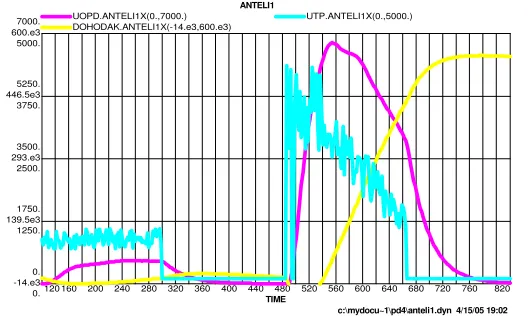
Figure 3. Graphic presentation of the simulation of 0 scenario – variables UOPD, INCOME and UTP.
Analyzing the obtained graphic results of the simulation of 0 scenario it is possible to notice that performance dynamics of variables is in accordance with economic regularity of the LNT business system as a unit within its surroundings.
The total number of registered vessels—UBPP, will in the first tourist season realize a maximum of 100 vessels, while in the following season, due to the gradual finishing of the investments into new capacities, or sport and other objects, the interest of the nautical tourists will increase, which will result in the increase of the total number of vessels, and thus the highest number of registered vessels, in total of 270 a day TIME=493. The characteristic of the number of vessels is stochastic.
The total realized income a day—UOPD, in the first tourist season will reach its maximum of about 641 EUR a day, while in the following tourist season, due to greater offer of sports facilities, the income of 6,749 EUR a day (TIME=555 day) will be realized.
ANTELI1a
SUSZR.ANTELI1X(-200.e3,100.e3) UBPP.ANTELI1X(0.,280.)
UVIR.ANTELI1X(0.,210.e3) 100.e3
25.e3
-50.e3
-125.e3
-200.e3 280.
210.
140.
70.
0. 210.e3
157.5e3
105.e3
52.5e3
0.
TIME
120 160 200 240 280 320 360 400 440 480 520 560 600 640 680 720 760 820
c:\mydocu~1\pd4\anteli1.dyn 4/15/05 19:02
ANTELI1
UOPD.ANTELI1X(0.,7000.) DOHODAK.ANTELI1X(-14.e3,600.e3)
UTP.ANTELI1X(0.,5000.) 7000.
5250.
3500.
1750.
0. 600.e3
446.5e3
293.e3
139.5e3
-14.e3 5000.
3750.
2500.
1250.
0.
TIME
120 160 200 240 280 320 360 400 440 480 520 560 600 640 680 720 760 820
[image:3.612.177.441.410.568.2]In the first tourist season, or the period of TIME=120 day to TIME=304 day, the income of the marina has a negative value (loss) with the greatest loss of 14,000 EUR a day TIME= 173, after which it becomes positive on the day TIME=304 to the new tourist season on the day TIME=486, and reaches its highest amount of 10,650 EUR a day on the day TIME=358. In the period of the following tourist season TIME=486, the income is negative, and it has the highest loss in the amount of -46,560 EUR a day on the day TIME=512. This loss will gradually decrease, and it will become positive again on the day TIME=542, and by the end of the second tourist season will remain positive, reaching its maximum value of 545,900 EUR a day on the day TIME=772.
In the first tourist season the total operating costs UTP are in their highest amount of 1,092 EUR a day on the day TIME=186, and have stochastic character. In the first off-season period UTP from the day TIME=300 to the day TIME=485 they have their constant off-season value of 100 EUR a day, and cover all operating costs of the marina out of the season. In the second tourist season which starts on the day TIME=485, the costs grow to their maximum of 4,279 EUR on the day TIME= 492. In the second off-season period the costs have again the value of 100 EUR a day.
The state of the total assets in the giro SUSZR in the first part of the tourist season to the day TIME=195 have a negative value, with the maximum shortage of cash money of –2,904 EUR on the day TIME=156. Thus, from the day TIME=195 SUSZR becomes positive, realizing the highest amount of assets of 15,960 EUR on the day TIME=334 and retaining that value for several days. Before the beginning of the new, second season on the day TIME=417 SUSSZR again becomes negative, because of new investments, and reaches its maximum of 180,000 EUR on the day TIME=519, after which it becomes positive again on the day TIME=631, realizing the amount of 1,608 EUR, and remains positive until the end of the simulation period, with maximum realized amount of 84,310 EUR on the day TIME=709.
On the basis of the comments of the results of LNT business simulation, and in view of the two observed tourist seasons and the considerable investment with the aim of improving business as a whole, it may be concluded that the observed LNT business system for such a scenario of the observed development period is stable and it gives positive financial results (revenues, income, solvency etc.) and total positive results in the observed period.
Conclusions
On the basis of the system dynamics research of the performance of the complex business system LNT, with the aid of a fast digital computer on which the performance simulation was done, it is possible to bring forward a number of relevant conclusions:
1. A direct application of system dynamics simulation complex models in the field of scientific research of performance of nonlinear management systems has full rationalization, because it ensures to the model constructor an extremely suitable software medium which may be determined as intelligent models of the second generation, if the first generation refers to present expert systems.
2. System dynamics and its efficiency of intelligent modelling of a business system may be considered as a logic order of development of intelligent systems in the field of applying research of dynamics of cybernetic business systems.
3. System dynamics uses special methodology and special software packages, the most outstanding being: DYNAMO; Powersim, Stella, Vensim, and Think.
4. System dynamics is especially convenient for the study of performance dynamics of business systems in which a great number of non-linear retroactive circles operate, or for systems where at operating the system the use of manager’s intuition alone fails.
References
[1] W.J. Forrester, Industrial Dynamics, MIT Press Cambridge, Massachusetts, 1980.
[2] P. Kotler, Marketing Management, Prentice-Hall, 1984.
[3] L.M., James, Corporate Planning and Policy Design: A System Dynamics Approach, MIT Press Cambridge, Massachusetts, 1982.
[4] M. Pidd, Computer Simulation in Management Science, Wiley, New York, 1997.
[5] P. Richardson, L., Alexander, Introduction to System Dynamics Modelling with DYNAMO, MIT Press Cambridge, Massachusetts, 1981.
[6] K. Waren, Competitive Strategy Dynamics, John Wiley & Sons, Chichester, England, 2002.
[7] A. Munitic, F. Mitrovic, J. Dvornik, System dynamics simulation modelling and heuristic optimization of the business production distribution system, SCI 2004, Eighth World Multi-Conference on Systemics, Cybernetics and Informatics, July 18-21, Orlando, Florida, USA, ISBN: 980-6560-13-2, Volume IV, 434-440 pp., (2004).
[8] Munitic A., Mitrovic F., Dvornik J, Simulation modelling of the production distribution system, ATDC 2004, 3rd DAAAM International Conference "Advanced Technologies for Developing Countries", June 23-26, Split, Croatia, ISBN: 953-6114-68-2, 229-235 pp., 2004.
[9] A. Munitic, S. Simundic, J. Dvornik,, Simulation modelling of the business production shipbuilding process, 16th International Conference on Systems Research, Informatics and Cybernetics, InterSymp-2004, July 29–August 5, Baden-Baden, Germany, ISBN: 953-99326-1-0, 57-61 pp, (2004).
[10]A. Munitic, F. Mitrovic, J. Dvornik, System dynamics modelling of the business production of the shipbuilding process, FUBUTEC-2004, Future Business Technology Conference, Integrating Simulation and Knowledge Management for Business Advantage, March 12-13, INSEAD, Fontainebleau, France, ISBN: 90-77381-07-4, 99-102 pp., (2004).