S T U D Y P R O T O C O L
Open Access
A randomized controlled trial comparing Circle of
Security Intervention and treatment as usual as
interventions to increase attachment security in
infants of mentally ill mothers: Study Protocol
Brigitte Ramsauer
1*, Annett Lotzin
1, Christine Mühlhan
1, Georg Romer
2, Tobias Nolte
3, Peter Fonagy
4and Bert Powell
5Abstract
Background:Psychopathology in women after childbirth represents a significant risk factor for parenting and infant mental health. Regarding child development, these infants are at increased risk for developing unfavorable
attachment strategies to their mothers and for subsequent behavioral, emotional and cognitive impairments throughout childhood. To date, the specific efficacy of an early attachment-based parenting group intervention under standard clinical outpatient conditions, and the moderators and mediators that promote attachment security in infants of mentally ill mothers, have been poorly evaluated.
Methods/Design:This randomized controlled clinical trial tests whether promoting attachment security in infancy with the Circle of Security (COS) Intervention will result in a higher rate of securely attached children compared to treatment as usual (TAU). Furthermore, we will determine whether the distributions of securely attached children are moderated or mediated by variations in maternal sensitivity, mentalizing, attachment representations, and psychopathology obtained at baseline and at follow-up. We plan to recruit 80 mother-infant dyads when infants are aged 4-9 months with 40 dyads being randomized to each treatment arm. Infants and mothers will be reassessed when the children are 16-18 months of age. Methodological aspects of the study are systematic recruitment and randomization, explicit inclusion and exclusion criteria, research assessors and coders blinded to treatment allocation, advanced statistical analysis, manualized treatment protocols and assessments of treatment adherence and integrity.
Discussion:The aim of this clinical trial is to determine whether there are specific effects of an attachment-based intervention that promotes attachment security in infants. Additionally, we anticipate being able to utilize data on maternal and child outcome measures to obtain preliminary indications about potential moderators of the intervention and inform hypotheses about which intervention may be most suitable when offered in a clinical psychiatric outpatient context.
Trial registration:Current Controlled Trials ISRCTN88988596
* Correspondence:[email protected]
1Department of Child and Adolescent Psychiatry, Psychotherapy and
Psychosomatics, University Medical Center (UKE) Hamburg-Eppendorf, Martinistrasse 52, 20246 Hamburg, Germany
Full list of author information is available at the end of the article
Background
Previous research has shown that infants whose mothers suffer from mental disorder are at increased risk for developmental delays, cognitive and functional impairments, physical symptoms and injuries, as well as behavioral and emotional problems in pre-school and school age [1-6]. Affective and mood disorders, anxiety disorders, posttraumatic stress disorders, obsessive-compulsive disorders, and psychosis with elevated inci-dences of comorbid diagnoses, varying in onset, course and prognosis, have a higher prevalence in mothers, both postpartum and during early child-age years [7-17]. In clinical populations, co-occurring personality disorders have to be considered as a crucial part of the global risk that mentally ill mothers experience [18-21].
The quality of parenting has been viewed as one key mediator of the relationship between maternal psycho-pathology and the outcome for infants and young chil-dren. Maternal psychological and vegetative symptoms, such as social withdrawal, anxiety, emotional lability, im-pulsivity, and severe exhaustion or weariness, have been found to impinge on the interaction and the develop-ment of the relationship between mother and infant. Often, such mothers are emotionally, cognitively and/or behaviorally inhibited or impaired in their ability to recognize and react with appropriate “sensitivity” and
“responsiveness”[22] to their children’s needs. In regard to the infants of these mothers, higher incidences of be-haviors, such as persistent crying, motoric restlessness, averted gaze or head position, physical neediness and a lack of expression of delight in the presence of their mothers, have been observed [23-25]. These behaviors increase the mother’s experience of stress, which further contributes to the maintenance of maladaptive inter-actional behavioral patterns [26-32]. Without improve-ment in these negative interaction cycles, for example, through early interventions, there is a greater likelihood for infants to develop an avoidant or an insecure-ambivalent or disorganized attachment strategy during the first year of life [33,34]. According to Ainsworth et al. [22], in the Strange Situation, insecure-avoidant (Category A) infants do not actively seek proximity and physical contact to their mothers after separation, instead favoring explor-ation. Insecure-ambivalent (Category C) infants, on the other hand, tend to cling to their caregivers and are char-acterized by frantic appeals to establish and maintain close proximity to them. At the same time, they show anger and sulky or aggressive behavior towards their mothers. These children are difficult to comfort after separation, that is, they maximize their attachment neediness [22]. Secure in-fants (Category B) reach out to their mothers at times of separation distress and calm down easily when comforted so that they can resume play or exploration. If the context of care is additionally characterized by either fear-inducing
or frightening parenting practices (e.g., abuse, neglect, aggressive behaviors) or by fearful behaviors on the part of the mother (e.g., signs of anxiety or avoidance, dis-sociation, etc.), the child is more likely to develop disorga-nized or disoriented behavioral patterns (Category D) [35,36]. These include contradictory behavioral tenden-cies, such as fearful/anxious vacillation between exploring and seeking closeness, temporally uncoordinated or slo-wed movements and occasional physical or mimic par-alysis or “freezing” of the child toward the mother. A maternal mental illness is associated with the develop-ment of insecure organized (avoidant, ambivalent) and disorganized attachment styles in the child [37-41]. Social-emotional maladjustment and related mental health problems in the child are common consequences [42,43]. Furthermore, mothers with mental disorders themselves are frequently characterized as insecure (dis-missing Category Ds or preoccupied Category E), or unre-solved (Category U) rather than autonomous (Category F) when attachment representations of their own childhood experiences with attachment figures are assessed [44-47]. These mothers are troubled by the physical and affective states, needs and behaviors of their infants, which may correspond to “frightening and frightened” [48] and/or
“disrupted”[49] parenting behaviors [50].
According to the model of transgenerational transmis-sion [51], maternal attachment representations influence the child’s attachment more than maternal sensitivity does [52-54]. Further clinical research on this issue pro-vides evidence that the maternal capacity for mentaliza-tion appears to be more crucial than the expressed sensitivity of mothers in the attachment relationship [55]. The mental abilities of the mother to perceive and recognize her own and the child’s wishes, motives, needs, thoughts and feelings within the context of the at-tachment relationship and to communicate, as well as to reciprocate these through active engagement, kinesthetic expressions, words and play, represent key competencies for the development of secure attachment, self-regulation and mental health in the child –even if the mother had experienced unprocessed adverse experiences during her own childhood [56]. Conversely, a diminished capacity to mentalize brought about, for example, by maternal psy-chopathology, increases the likelihood of the child devel-oping an insecure or disorganized attachment style, unless this process can be changed by an attachment-based intervention.
their specific needs in caring and relating to their in-fants. Attachment-based interventions rooted in empir-ical research on developmental psychopathology are, thus, promising approaches to address these multi-faceted treatment targets. However, to date, very few attachment-based interventions have been systematically tested in formal clinical settings using a randomized controlled trial (RCT) framework involving women with complex postpartum psychiatric disorders.
Attachment-based interventions are designed to pro-mote maternal sensitivity, to change maternal mental representations, to promote attachment security in the child, and/or to support the family, examples include STEEP™ [62]; Wait, Watch, and Wonder [63]; Circle of Security [64]; Video Intervention To Promote Positive Parenting [65]. Each of these interventions has been conducted in different settings (home-based, institu-tional, individually, group-based), with various at-risk populations (i.e., low SES, depressed mothers, adolescent mothers, preterm infants), and at a wide range of dos-ages and intensities. Video-analysis is a typical technique implemented as part of these interventions in order to facilitate change. Meta-analytic evidence identifies short-term approaches (< 16 sessions), targeting maternal sensitivity as being the most effective, and sensitivity-focused interventions conducted with clinically referred samples (i.e., DSM-III-R depressed mothers), as being more effective than interventions with other groups [66]. Attachment security, in particular, has been found to be readily influenced by sensitivity-focused interventions [66]. Yet, it remains unknown how brief attachment-focused interventions designed for at-risk populations differentially impact mothers’mentalizing, mental repre-sentations of attachment, beyond sensitivity and mental illness, and children’s level of attachment security.
The Circle of Security intervention is a brief, behavioral and insight-oriented therapeutic group approach for pro-moting attachment and autonomy in the parent–child relationship. It combines psycho-educational, cognitive-behavioral, and psychodynamic understanding and inter-vention techniques. Given that women with various and co-occurring mental illnesses after childbirth differ greatly in their requirements, openness and motivation for, and compliance with mother-infant treatment, the COS inter-vention can allow individualized, flexible and deepened therapeutic access to each mother-infant dyad, which is further supported by its group character. Therefore, within our clinical context, COS seems to be a promising intervention to detect and treat early difficulties in the de-velopment of secure attachment relationships.
The current RCT is designed to evaluate the efficacy of the COS intervention for mentally ill mothers with in-fants, for the first time in Germany and in a clinical con-text. The main research question is whether COS, in
comparison with treatment as usual (TAU), increases at-tachment security and prevents the development of inse-cure and/or disorganized attachment by promoting maternal sensitivity and mentalizing measured after treatment at follow-up when the children are aged 16–18 months. We hypothesize that following treatment there will be a higher proportion of secure child–mother attachment in the COS arm compared to TAU. This paper describes the design of the trial, the implementa-tion of the study protocol in a child and adolescent psy-chiatric outpatient unit, and the data analysis strategies.
Methods and design
Overview
The Circle of Security Study in Hamburg represents a clinically pragmatic form of prevention and interven-tion, performed in a RCT. The study is comparing two mother-infant treatment groups, assigned to COS or TAU as the control condition, in the outpatient unit at the Department of Child and Adolescent Psychiatry, Psychotherapy, and Psychosomatics at the University Medical Center of Hamburg. The recruitment, baseline and follow-up assessment of mother-infant dyads started in January 2010 and will end in April 2014. Par-ticipants were recruited from among those mothers vis-iting the outpatient unit who volunteered to take part, and after having given their informed consent, entered the baseline assessment for this study. Mothers with mental disorder and their infants attending the out-patient unit were referred to the unit from other med-ical/mental health services they had been accessing from different areas of Hamburg, an urban city with a population of approximately 1.8 million inhabitants.
Aims and hypothesis
Participants
All eligible mother-infant-dyads seeking mother-infant treatment were invited to participate in this study, and were entered into the baseline assessment after both par-ents having given their informed consent. The inclusion criterions were again verified, and the mother-infant dyads then randomly assigned to the treatment arms. Demographic information, such as socioeconomic status, as well as age, education, and treatment history of the mothers were assessed at baseline. All mother-infant dyads were German-speaking residents of the greater Hamburg area.
Eligibility criteria
The inclusion criteria are child age 4–9 months and mothers’ being a fluent speaker of German. The exclu-sion criteria are child autism and early retardation or a primary ICD-10/DSM-IV diagnosis of substance abuse, schizophrenia, intellectual impairments (IQ < 80), or sui-cidal ideation and/or recent suicide attempt in mothers. No other exclusions were made in order to ensure that a full and representative spectrum of mentally ill mothers with infants attending our outpatient unit for was included.
Interventions
This trial aims to evaluate the efficacy of the COS group treatment protocol compared to TAU as the control condition. The COS group intervention consisted of 20 90-minute sessions delivered weekly on Tuesday after-noons, plus one additional session of 120 minutes with the fathers or close family members on one Saturday. The TAU condition was delivered at different levels of intensity, as needed by the mothers. Mothers assigned to either of the treatment arms were permitted to receive psychopharmacological medication as part of their adult psychiatric treatment to manage clinical symptoms, as well as individual psychotherapy and/or other psycho-social services.
Circle of Security (COS) intervention
The Circle of Security (COS) intervention [64,67] was designed to alter developmental pathways for at-risk par-ents and their children. In the current study, COS was only used with mothers, except for the single additional session with fathers/family members. It was conceptual-ized as a psychodynamically oriented, psychotherapeutic and community-based parenting program and is consid-ered to be evidence-based in the USA. The COS is a treatment based on groups of six individuals. The group intervention focuses on the caregiver and his/her rela-tional capacities in providing child–parent attachment security. The COS manual (unpublished) draws upon the work practiced in Early Head Start and Head Start
programs in the USA and was developed by the origina-tors [68] at the Marycliff Institute in Spokane, WA. The COS therapists of the current trial underwent an inten-sive 10-day training in COS assessment and treatment organization at the Marycliff Institute in preparation for this study.
Prior to the beginning of the group therapy, a thor-ough diagnostic assessment of the interactions between mother and infant in various situations was performed, during which attachment and explorative behaviors were activated. Additionally, an interview with regard to car-ing for the child (the “Circle of Security” Interview; [69]), as well as an attachment interview (Adult Attach-ment Interview, AAI; [70]) were conducted with the mother. With the “Circle of Security” model as a foun-dation for intervention, an assessment of the relationship between mother and child was prepared with the help of video recordings and both interviews. From this assess-ment, the maternal core difficulty (termed the“linchpin struggle”) and the preferred (unconscious) defense strat-egy against potential threatening or uncomfortable emo-tions (procedural) or cogniemo-tions (termed “shark music”) connected with the attachment and autonomy needs of the child, were deduced. An individual treatment plan was formulated for each mother-infant-dyad,. This treat-ment plan contained a sampling of video sequences, which were used throughout the therapeutic process in order to acquaint the mother with her“linchpin struggle” whilst taking the mother’s “core sensitivity” and “shark music” into account. The “core sensitivity” describes an integral aspect of the personality [71,72], which represents the emotional organization of relationships and the basis for defensive processes in the parent–child interaction. The need for relationships and the fear of the loss of these relationships or separation play central roles in this. Each mother’s idiosyncratic manifestation of this complex inter-play was taken into consideration in the selection of the video sequences.
Every therapeutic group consisted of six women. Six groups were planned and realized for this trial. The in-fants did not participate in group sessions, and childcare was provided for them while the mothers were in sessions.
maternal thoughts and feelings and their defensive nature (“shark music”) with regard to the attachment and auton-omy needs of the children, with the goal of overcoming their impact on child-mother attachment formation and maternal sensitivity. This is intensified by showing video segments of the“linchpin struggle”of each mother-infant dyad.
The 90-minute-COS group sessions took place weekly. Two therapists facilitated each group. Treatment adher-ence and integrity in this study was assured by weekly supervision of the therapists with Bert Powell, one of the originators of the COS intervention.
Treatment as usual (TAU)
As a control condition, TAU was provided to mothers with their infants within the child and adolescent psychi-atric outpatient unit. TAU consisted of standard treat-ment, which may have involved case management or counseling for the mothers. The treatment was offered by two child and adolescent psychiatrists and psycho-therapists with a theoretical blend of psychodynamic and behavioral training in therapeutic work with men-tally disordered mothers and infants. The focus was on the mother, the child, and/or the mother–child relation-ship; fathers were sometimes included. Each treatment session typically lasted 50 minutes. The intensity and length of treatment depended on the specific needs of each mother–infant dyad, and treatment was terminated by the mothers. The exact number of treatment sessions was recorded. Mother–infant dyads with particular needs were referred for additional services (e.g., social support services, family midwives). Most of the mothers attending the outpatient unit had seen an adult psych-iatrist to confirm their diagnosis and further treatment indications at least once, at the beginning of treatment. At the time of follow-up, treatment satisfaction will be assessed for all mothers in the COS and TAU groups.
Assessment and outcomes measures
[image:5.595.58.537.663.734.2]All measures of pre- and post-assessment are listed in Table 1.
Primary outcome
Child attachment The primary outcome of the current study is child attachment security (vs. insecurity). In
attachment research, the Strange Situation Procedure [SSP; 22] is the most widely used and well-validated ex-perimental paradigm for assessing the quality of the child’s attachment to a parent in infancy. The ratings for attachment qualities will be done by two trained and reliable coders blind to treatment allocation. The child’s attachment behaviors will be rated for classifica-tion into secure-B, or into avoidant-A or ambivalent-C as insecure-organized attachment qualities, according to the standard criteria described by Ainsworth [22], and for classification into insecure-disorganized/disor-iented-D attachment qualities, according to the Main and Solomon [35] coding system.
Secondary outcomes
Mini-MBQS - Maternal sensitivity. The revised mini-Maternal Behavior Q-Sort (mini-MBQS) for video cod-ing [73], a 25-item observational codcod-ing instrument, is used for measuring the quality of maternal sensitive be-havior. The q-set items relevant to attachment are mapped onto a prototypically sensitive mother [74]. During the mini-MBQS sorting process, coders system-atically evaluate and sort each of the 25 q-set items into one of the five categories (i.e., “most like mom”, “like mom”, “unlike mom”, “neither like nor unlike mom,
“least like mom”) respectively, based upon behavioral observations of videotaped interactions between mother and child. Correlation scores are calculated, varying from−1.0 (least sensitive or responsive) to 1.0 (prototyp-ically sensitive or responsive) between the observer sorts and a criterion sort for the prototypically sensitive and responsive mother, which is provided by the developers of the instrument. In this trial, mini-MBQS data are de-rived from videotaped 5-minute free play and 5-minute book reading interactions at baseline and follow-up, each coded by two independent raters blind to treatment allocation.
DIP - The Disconnected and extremely Insensitive Parenting rating procedure [75] is used to identify ex-treme insensitivity and/or disconnection in the mother. The DIP captures those maternal behaviors that are most likely related to poor child attachment outcomes [75]. Disconnected behavior and extreme insensitivity are rated on a scale ranging from 1 to 9, indicating an incrementally increasing display and/or prolonged dur-ation of such behaviors. For pre- and post-assessment,
Table 1 Assessments administered at baseline and follow-up throughout the trial
Time point SSP MBQ-S DIP AAI AAI-RF PRFQ-1 SCID-I,-II BDI SCL-90 PSI DERS CBCL FBB-E
Baseline
Child age 4–9 months - √ √ √ √ √ √ √ √ √ √ √
-Follow-up
the DIP is administered for the same 5-minute-interaction episodes (free play, book reading) as the mini-MBQS by two independent raters who each have undergone DIP rating and reliability procedure training.
AAI - The Adult Attachment Interview and its re-spective scoring and classification system [70,76] repre-sent the“gold standard”for classifying maternal state of mind with regard to attachment (as F, Ds, E, U). In the current trial, it is administered at baseline and follow-up. Mothers classified as unresolved (U) with regard to loss or trauma will also be assigned into a secondary best-fitting organized attachment category. The interviews will be transcribed verbatim and coded by two reliable raters who are blind to treatment allocation.
RF -The Reflective Functioning (RF) scale of the AAI [77] is utilized to measure maternal mentalizing, which is defined as the capacity of the mother to reflect upon her own self and close others in terms of intentional mental states. The RF allows for overall ratings of re-flective functioning on a nine-point scale ranging from 1 (lacking RF) to 9 (exceptional RF), with two additional RF scores indexing the absence of mentalizing, that is, -1 (negative RF), 0 (lacking RF). RF-ratings will be per-formed on the AAI obtained at baseline and follow-up by two independent raters blind to treatment allocation.
PRFQ-1 – The Parental Reflective Functioning Questionnaire-1 [78] is used as an alternative instrument for assessing RF via self-report. The PRFQ-1 assesses the levels of parental mentalization up to the child’s age of 3 years. It consists of 39 items comprising three sub-scales prototypically describing high, low, and neither high nor low mentalizing in mothers and fathers. Scor-ing procedures precepts yield a total score on all three subscales. PRFQ-1 is administered at baseline and follow-up.
SCID-I–The German version of the Structured Clinical Interview [79] for DSM-IV [80] axis I disorders is used to verify clinical DSM-IV-Axis-I diagnoses. SCID-I inter-views were conducted by trained researches at baseline.
SCID-II – The German version of the Structured Clinical Interview (SCID-II) for personality disorders is used to identify mothers with probable DSM-IV-Axis II personality disorders. SCID-II interviews were con-ducted by trained researchers at baseline.
BDI – The Beck Depression Inventory [81,82] is ad-ministered to screen for depressive symptoms in the mothers at baseline and follow-up. It consists of 21 items, scaled from zero to three, which are summed to a global score, indicating clinical significance of self-reported depressive symptoms.
SCL-90-R–The revised Symptom Checklist by Derogatis [83] (German version: [84]) is used to assess maternal psychopathological symptoms. The Global Severity Index, as a sum score of the SCL-90-R, is applied to
determine maternal psychopathology at baseline and follow-up.
PSI– The Parenting Stress Index [85] (German: [86]) is a self-report measure consisting of 120 items for par-ents with children aged from 0–12 years, capturing child-related and parent-related stress domains. A total stress score is derived, indicating the severity of the sub-jective burden of parenting. A domain of life events al-lows for the recording of positive and negative life events. The PSI is measured at baseline and follow-up.
DERS –The Difficulties in Emotion Regulation Scale [87] is a 36-item self-report on clinically relevant emo-tion regulaemo-tion difficulties, especially with regard to negative emotions. Items are scored on a 5-point Likert scale ranging from 1 (almost never) to 5 (almost always). The authors have confirmed a six-factor structure of emotion regulation, upon which the DERS is based; and adequate internal consistency (Cronbach’s α> .80) of these subscales has been established [87]. For the pur-pose of this trial, the DERS was translated into German. First, the scale was translated from English to German independently by two translators who then discussed their translations and combined them to form a draft of the questionnaire used in the present study. This draft was back-translated into English by a professional trans-lator. The back-translated version was found to be con-sistent with the original DERS version. The DERS is applied at baseline and follow-up.
CBCL – The Child Behavior Checklist1½-5 [88] (German version) is a questionnaire for parents of chil-dren aged 1.5-5 years, which is used to assess child be-havioral and emotional problems. The items are related to seven problem scales, loading on externalizing, in-ternalizing, and a total score. In the current trial, the CBCL will be administered at follow-up.
FBB-E–Fragebogen zur Beurteilung der Behandlung– Eltern [89] (“A Questionnaire to Evaluate Treatment Satisfaction – Parent Version”) is a well-known German language questionnaire for evaluation and quality assur-ance of the therapeutic treatment of children, adolescents and their families. The FBB-E assesses how positively or negatively parents evaluate the course and outcome, as well as their personal satisfaction regarding the psycho-therapeutic treatment of their children, independent of treatment modality. The FBB-E will be applied at follow-up.
Randomization
Recruitment and baseline procedures
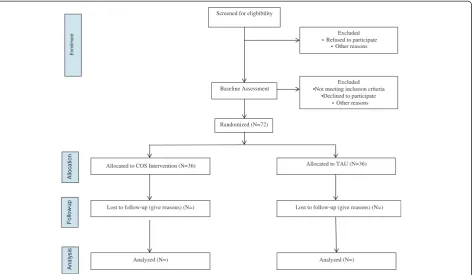
The flow of participants from recruitment through to the end of the study is shown in Figure 1.
unit. Once eligible mother-infant dyads were identified, they were informed about the trial and invited to partici-pate. Both custodial parents had to give their informed consent for the baseline assessment, which was per-formed by trained research staff over several sessions. After completion, the researcher confirmed whether each mother met diagnostic and additional inclusion cri-teria. If they did, they were randomly assigned to one of the two treatment arms (COS or TAU). Once consent to treatment and post-assessment of both parents had been obtained, a trial ID was assigned. Depending on the nat-ural flow of patients a COS group began once six mother-infant cases had been recruited and assigned. TAU started immediately after random allocation. Follow-up assess-ment (child age 16–18 months) is continuing.
Randomization procedures and methods to minimize bias
Eligible patients were randomly assigned to the COS intervention or TAU in a ratio of 1:1. An electronic randomization list was generated using Randlist 1.2 as a random generator. Unique randomization numbers were generated to ensure that the study arm assignment was unbiased. Randomization was stratified for two infant age groups (4–6 months vs. 7–9 months) and separate random lists were created for each age group. Block sizes of six to eight were used for the randomization of the treatment arms. The randomization list was gener-ated by the randomization representative and was stored
in a password-protected electronic document accessible only by the randomization representative. Each random number was stored in a concealed randomization enve-lope. After a patient’s eligibility for the study was deter-mined, the next available randomization number was assigned to the patient, in ascending order. To minimize bias that could have arisen from knowledge of treatment allocation, all outcome assessors were blind to treatment allocation and a random sample of outcome measures was re-rated by independent assessors.
Statistical methods
Sample size and power
The primary outcome for treatment efficacy is the rating of quality of child attachment at follow-up at children’s age 16–18 months (COS vs. TAU) by an objective rater blind to treatment allocation. Differences in distributions of the quality of child attachment (secure vs. insecure-avoidant, -resistant, -disorganized) between both treatment modal-ities are calculated by a chi-square test of significant statis-tical independence. A power analysis for comparing COS and TAU with a power of 80% and the probability of making a Type I (α) error of 5%, with a medium effect (W= 0.3) suggested a recruited sample size of N = 80.
Statistical analysis plan
All available variables will be used without missing out-comes being factored in. The analyses are based upon
Screened for eligbibility
Enrollment
Allocation
Follow
-up
Analysis
Excluded • Refused to participate
• Other reasons
Excluded •Not meeting inclusion criteria
•Declined to participate • Other reasons Baseline Assessment
Randomized (N=72)
Allocated to COS Intervention (N=36)
Lost to follow-up (give reasons) (N=)
Analyzed (N=) Analyzed (N=)
[image:7.595.66.539.89.364.2]Lost to follow-up (give reasons) (N=) Allocated to TAU (N=36)
the assumption of ignorable drop-outs. Characteristics of the treatment groups were assessed at baseline.
Primary outcome
For the primary outcome, that is, child attachment se-curity (vs. insese-curity) as a categorical variable, differ-ences of the proportions of child attachment security between TAU and COS treatment arms will be esti-mated by a chi-square test of statistical significance.
Secondary outcomes
a. To compare differences between COS and TAU on maternal sensitivity (MBQS, DIP) as continuous secondary outcome variables, a 2x2 analysis of covariance (ANCOVA), with repeated measurement (t0-t1) on one first factor, will be used. In these analyses, treatment modality will be treated as the second factor, maternal sensitivity as the dependent variable, and maternal psychopathology (BDI, SCL-90-R) and maternal parenting stress (PSI) as co-variables.
b. To compare differences between COS and TAU on maternal mentalization (RF, PRFQ-1) as continuous secondary outcome variables, a 2×2 analysis of covariance (ANCOVA), with repeated measurement (t0-t1) on one first factor, will be used. In these analyses, treatment modality is to be treated as the second factor, maternal mentalization as dependent variable, and again, maternal psychopathology (BDI, SCL-90-R) and maternal parenting stress (PSI) as co-variables.
c. Furthermore, in a multiple linear regression, the differences in maternal sensitivity and mentalization will be used to predict psychopathology and
maternal stress (with treatment modality, differences in psychopathology, and differences in maternal distress as independent variables).
d. Before analyzing the proportions of mothers whose attachment representations change during the treatment and follow-up period in both treatment arms, we will separate those mothers with a positive shift in attachment representations [i.e., insecure (−dismissing, preoccupied, unresolved) to secure) from the mothers without such a shift or with a negative one ((i.e., secure to any of the others)]. For binary responses, a binary logistic regression will be used to compare proportions of mothers whose attachment representations (positive shift vs. no/negative shift) have been altered as a criterion variable, and treatment group (COS vs. TAU), differences of maternal psychopathology (BDI, SCL-90) as well as parenting stress (PSI) prior and after treatment as predictor variables.
e. To examine associations between changes of psychopathology (BDI, SCL-90) and changes in parenting stress (PSI) between pre- and post-assessment, a Pearson correlation analysis with the difference scores will be conducted.
f. Child behavior and emotional problems (CBCL11/2) at follow-up will be analyzed with respect to mean scores in either arm of the trial, using multiple linear regression analyses. Again, maternal psychopath-ology (BDI, SCL-90) and maternal parenting stress (PSI) will be treated as predictor variables, in addition to treatment modality.
g. Further multiple regression analyses will be conducted, with mean changes in maternal sensitivity (MBQS, DIP), mentalization (RF, PRFQ-1), and maternal attachment representations (positive shift, no/negative shift) before and after treatment, as predictor variables.
h. Binary logistic regression models will be used to compare proportions of child attachment security (vs. insecurity) at follow-up as criterion variables, using treatment modality, maternal sensitivity, maternal self-reflection (RF), maternal psychopathology (BDI, SCL-90), and maternal parenting stress (PSI) as predictor variables.
Ethics
The trial received ethical approval from the local ethics committee of the Medical Board of Hamburg, Hamburg, Germany on 24 August 2009–reference number PV3269.
Discussion
This RCT is notable in that, through a high-quality de-sign, it evaluates an attachment-based parenting pro-gram, namely the COS intervention, in terms of its potential to promote early attachment security in infants of women with mental disorders, who are at increased risk for unfavorable attachment and developmental out-comes. Comparing the attachment outcomes in infants of mothers with psychopathology who received COS or TAU will determine the relative benefit to the child asso-ciated with each of the interventions. Furthermore, by collecting data concerning the mother’s psychopathology, parenting behaviors (i.e., sensitivity), mentalizing and at-tachment representations, both at baseline (at child’s age 4–9 months) and at follow-up (at child’s age 16–18 months), we will be able to test factors that might influence treatment responses on the transmission model.
Limitations
The circumstances of this clinical trial necessitated some scientific compromises. One limitation of this trial is that the person who oversaw the implementation of the COS intervention is also the principle investigator. Thus, personal factors (allegiance effects) may limit the generalizability of our findings. In view of the fact that the study sample comprises clinically referred mothers with mental disorders and their infants, it is ethically un-acceptable to use a no-treatment control group. There-fore, in the best interest of our patients we have used TAU as the control intervention to which patients are randomized. According to the natural flow of patients attending the outpatient unit, eligible women with fants participated voluntarily, and, having given their in-formed consent, were randomly assigned to COS or TAU. Thus, our clinical sample varied in terms of psy-chopathology. There may be a sampling bias, insofar as the mothers with infants attending the outpatient unit might represent a more severely mentally disordered sample choosing to participate in this trial. This may limit the generalizability of the findings, due to sampling bias and a lack of true representativeness. Hence, repli-cation studies or a multi-site trial are necessary. A sam-ple size of N = 80 was determined before any data were collected, based on the assumption of medium effect size and power. For practical reasons, we defined a sample size of N = 72, such that 36 mother-infant dyads were randomly assigned to COS (six COS therapeutic groups) and 36 mother-infant dyads to TAU. Further long-term follow-up measures might be useful to capture positive changes of the intervention that may be attributable to a sleeper-effect [66] and apparent only at later follow-up stages.
Competing interests
The authors declare that they have no competing interests.
Authors’contributions
BR and BP designed the trial. BR wrote the grant application together with GR and AL. BR, PF and TN designed the data analysis strategy, AL and CM contributed to calculating statistical power for the primary outcome variable and writing the statistical and data analytical plan together with BR, PF, and TN. All authors read and approved the final manuscript.
Acknowledgements
This trial has been funded by the Hamburg Foundation for the Advancement for Research and Culture, Germany. The study is being completed within the Department of Child and Adolescent Psychiatry, Psychotherapy and Psychosomatics at the University Medical Center (UKE) of Hamburg. The study would not have been possible without the
engagement of a number of researchers, who have been involved in the acquiring of data, notably, Katrin Griebel, Nicola Onur, and Julia Schiborr. We would like to express special thanks to Jessica Mueller for her careful editorial work on this report.
Author details
1Department of Child and Adolescent Psychiatry, Psychotherapy and
Psychosomatics, University Medical Center (UKE) Hamburg-Eppendorf, Martinistrasse 52, 20246 Hamburg, Germany.2Department of Child and
Adolescent Psychiatry, Psychotherapy and Psychosomatics, University Hospital Münster, Schmeddingstrasse 50, 48149 Münster, Germany.3Anna Freud Centre, 12 Maresfield Gardens, London NW3 5SU, UK.4Educational and Health Psychology Department of Clinical, Educational and Health Psychology, University College London, Chandler House, 1-19 Torrington Place, London WC1E 7HB, UK.5Marycliff Institute, 35 W Main Ave, Spokane, WA, US.
Received: 19 January 2014 Accepted: 27 January 2014 Published: 30 January 2014
References
1. Bagner DM, Pettit JW, Lewinsohn PM, Seeley JR:Effect of maternal depression on child behavior: a sensitive period?J Am Acad Child Psychiatry2010,49:699–707.
2. Bureau JF, Easterbrooks MA, Lyons-Ruth K:Maternal depressive symptoms in infancy: Unique contribution to children's depressive symptoms in childhood and adolescence?Dev Psychopathol2009,21:519–537. 3. Cornish AM, McMahon CA, Ungerer JA, Barnett B, Kowalenko N, Tennant C:
Postnatal depression and infant cognitive and motor development in the second postnatal year: The impact of depression chronicity and infant gender.Infant Behav Dev2005,28:407–417.
4. Grace SL, Evindar A, Stewart DE:The effect of postpartum depression on child cognitive development and behavior: a review and critical analysis of the literature.Arch Womens Ment Health2003,6:263–274.
5. Halligan SL, Murray L, Martins C, Cooper PJ:Maternal depression and psychiatric outcomes in adolescent offspring: A 13-year longitudinal study.J Affect Disord2007,97:145–154.
6. Sohr-Preston SL, Scaramella LV:Implications of timing of maternal depressive symptoms for early cognitive and language development.
Clin Child Fam Psychol Rev2006,9:65–83.
7. Alcorn KL, O'Donovan A, Patrick JC, Creedy D, Devilly GJ:A prospective longitudinal study of the prevalence of post-traumatic stress disorder resulting from childbirth events.Psychol Med2010,40:1849–1859. 8. Austin MPV, Hadzi-Pavlovic D, Priest SR, Reilly N, Wilhelm K, Saint K, Parker
G:Depressive and anxiety disorders in the postpartum period: how prevalent are they and can we improve their detection?Arch Womens Ment Health2010,13:395–401.
9. Bener A, Gerber LM, Sheikh J:Prevalence of psychiatric disorders and associated risk factors in women during their postpartum period: a major public health problem and global comparison.Int J Womens Health 2012,4:191–200.
10. Harlow BL, Vitonis AF, Sparen P, Cnattingius S, Joffe H, Hultman CM:
Incidence of hospitalization for postpartum psychotic and bipolar episodes in women with and without prior prepregnancy or prenatal psychiatric hospitalizations.Arch Gen Psychiatry2007,64:42–48. 11. Le Strat Y, Dubertret C, Le Foll B:Prevalence and correlates of major
depressive episode in pregnant and postpartum women in the United States.J Affect Disord2011,135:128–138.
12. Reck C, Struben K, Backenstrass M, Stefenelli U, Reinig K, Fuchs T, Sohn C, Mundt C:Prevalence, onset and comorbidity of postpartum anxiety and depressive disorders.Acta Psychiatr Scand2008,118:459–468.
13. Russell EJ, Fawcett JM, Mazmanian D:Risk of Obsessive-Compulsive Disorder in Pregnant and Postpartum Women: A Meta-Analysis.J Clin Psychiatr2013,74:377–385.
14. Uguz F, Akman C, Kaya N, Cilli AS:Postpartum-onset obsessive-compulsive disorder: incidence, clinical features, and related factors.J Clin Psychiatr 2007,68:132–138.
15. Vesga-Lopez O, Blanco C, Keyes K, Olfson M, Grant BF, Hasin DS:Psychiatric disorders in pregnant and postpartum women in the United States.
Arch Gen Psychiatry2008,65:805–815.
16. Brockington I:Postpartum psychiatric disorders.Lancet2004,363:303–310. 17. Beck CT, Gable RK, Sakala C, Declercq ER:Postpartum Depressive
Symptomatology: Results from a Two-Stage US National Survey.
J Midwifery Women Health2011,56:427–435.
18. Akman C, Uguz F, Kaya N:Postpartum-onset major depression is associated with personality disorders.Compr Psychiatry2007,48:343–347. 19. Korzekwa MI, Dell PF, Links PS, Thabane L, Webb SP:Estimating the
20. Stevenson J, Datyner A, Boyce P, Brodaty H:The effect of age on prevalence, type and diagnosis of personality disorder in psychiatric inpatients.Int J Geriatr Psychiatry2011,26:981–987.
21. Zimmerman M, Rothschild L, Chelminski I:The prevalence of DSM-IV personality disorders in psychiatric outpatients.Am J Psychiatry2005,
162:1911–1918.
22. Ainsworth MDS, Blehar MC, Waters E, Wall S:Patterns of attachment: A psychological study of the strange situation.Hillsdale, NJ: Erlbaum; 1978. 23. Weinberg MK, Tronick EZ:The impact of maternal psychiatric illness on
infant development.J Clin Psychiatr1998,59(Suppl 2):53–61. 24. Murray L, Cooper P, Creswell C, Schofield E, Sack C:The effects of maternal
social phobia on mother-infant interactions and infant social responsiveness.
J Child Psychol Psyc2007,48:45–52.
25. Tronick EZ:Emotions and Emotional Communication in Infants.
Am Psychol1989,44:112–119.
26. Raikes HA, Thompson RA:Family emotional climate, attachment security and young children's emotion knowledge in a high risk example.
Br J Dev Psychol2006,24:89–104.
27. Murray L, Cooper PJ:Postpartum depression and child development.
Psychol Med1997,27:253–260.
28. Conroy S, Marks MN, Schacht R, Davies HA, Moran P:The impact of maternal depression and personality disorder on early infant care.
Soc Psychiarty Psychiatr Epidemiol2010,45:285–292.
29. Feldman R, Granat A, Pariente C, Kanety H, Kuint J, Gilboa-Schechtman E:
Maternal Depression and Anxiety Across the Postpartum Year and Infant Social Engagement, Fear Regulation, and Stress Reactivity.J Am Acad Child Psychiatry2009,48:919–927.
30. Allhusen V, Belsky J, Booth CL, Bradley R, Brownell CA, Burchinal M, Campbell SB, Clarke-Stewart KA, Cox M, Friedman SL,et al:Affect dysregulation in the mother-child relationship in the toddler years: Antecedents and consequences.Dev Psychopathol2004,16:43–68. 31. Mills-Koonce WR:Adult attachment style and stress as risk factors for
early maternal sensitivity and negativity.Infant Ment Health J2011,
32:277–285.
32. Beck CT:The effects of postpartum depression on maternal-infant interaction: A meta-analysis.Nurs Res1995,44:298–304.
33. Belsky J, Fearon RP:Precursors of Attachment Security. InHandbook of attachment: Theory, research, and clinical applications.2editionth edition. Edited by Cassidy J, Fearon RP. New York, London: The Guilford Press; 2008:295–317.
34. Dickerson Peck S:Measuring sensitivity moment-by-moment: microanalytic look at the transmission of attachment.Attach Hum Dev2003,5:38–63. 35. Main M, Solomon J:Procedures for identifying infants as disorganized/
disoriented during the Ainsworth Strange Situation. InAttachment in the preschool years: Theory, research, and intervention Edited by Greenberg MT, Cicchetti D, Cummings EM.Chicago, IL: University of Chicago Press; 1990:121–160.
36. Lyons-Ruth K, Jacobvitz D:Attachment disorganization: Genetic factors, parenting contexts, and developmental transformation from infancy to adulthood. InHandbook of attachment: Theory, research, and clinical applications.2nd edition. Edited by Cassidy J, Shaver PR. New York, NY, US: Guilford Press; 2008:666–697.
37. Hipwell AE, Goossens FA, Melhuish EC, Kumar R:Severe maternal psychopathology and infant-mother attachment.Dev Psychopathol2000,
12:157–175.
38. Martins C, Gaffan EA:Effects of early maternal depression on patterns of infant-mother attachment: A meta-analytic investigation.J Child Psychol Psychiatry2000,41:737–746.
39. van IJzendoorn MH, Goldberg S, Kroonenberg PM, Frenkel OJ:The relative effects of maternal and child problems on the quality of attachment: a meta-analysis of attachment in clinical samples.Child Dev1992,
63:840–858.
40. van IJzendoorn MH, Sagi A:Cross-cultural patterns of attachment: Universal and contextual determinants. InHandbook of attachment: Theory, research, and clinical applications.Edited by Cassidy J, Shaver PR. New York, NY: Guilford; 1999:713–734.
41. Wan MW, Green J:The impact of maternal psychopathology on child-mother attachment.Arch Women Ment Health2009,12:123–134. 42. van IJzendoorn MH, Schuengel C, Bakermans-Kranenburg MJ:Disorganized
attachment in early childhood: Meta-analysis of precursors, concomitants, and sequelae.Dev Psychopathol1999,11:225–249.
43. Carlson EA:A prospective longitudinal study of attachment disorganization/disorientation.Child Dev1998,69:1107–1128.
44. McMahon CA, Barnett B, Kowalenko NM, Tennant CC:Maternal attachment state of mind moderates the impact of postnatal depression on infant attachment.J Child Psychol Psyc2006,47:660–669.
45. Dozier M, Stovall-McClough KC, Albus KE:Attachment and psychopathology in adulthood. InHandbook of attachment: Theory, research, and clinical applications.2nd edition. Edited by Cassidy J, Shaver PR. New York, NY, US: Guilford Press; 2008:718–744.
46. Fischer-Kern M, Tmej A, Kapusta ND, Naderer A, Leithner-Dziuba K, Loffler-Stastka H, Springer-Kremser M:The capacity for mentalization in depressive patients: A pilot study.Z Psychosom Med Psyc2008,
54:368–380.
47. Fonagy P, Leigh T, Steele M, Steele H, Kennedy R, Mattoon G, Target M, Gerber A:The relation of attachment status, psychiatric classification, and response to psychotherapy.J Consult Clin Psychol1996,64:22–31. 48. Main M, Hesse E:Parents’unresolved traumatic experiences are related
to infant disorganized attachment status: Is frightened and/or frightening parental behavior the linking mechanism?InAttachment in the preschool years: Theory, Research und Intervention.Edited by Greenberg M, Cicchetti D, Cummings EM. Chicago, IL: University of Chicago Press; 1990:161–184.
49. Lyons-Ruth K, Bronfman E, Atwood G:A Relational diathesis of hostile-helpless states of mind: Expressions in mother-infant interaction. In Attachment Disorganization.Edited by Solomon J, George C. New York, NY: Guilford; 1999:33–70.
50. Madigan S, Moran G, Pederson DR:Unresolved states of mind, disorganized attachment relationships, and disrupted interactions of adolescent mothers and their infants.Dev Psychol2006,42:293–304. 51. van IJzendoorn MH, Juffer F, Duyvesteyn MG:Breaking the
intergenerational cycle of insecure attachment: A review of the effects of attachment-based interventions on maternal sensitivity and infant security.J Child Psychol Psychiatry1995,36:225–248.
52. Atkinson L, Goldberg S, Raval V, Pederson D, Benoit D, Moran G, Poulton L, Myhal N, Zwiers M, Gleason K, Leung E:On the Relation Between Maternal State of Mind and Sensitivity in the Prediction of Infant Attachment Security.Dev Psychol2005,41:42–53.
53. Raval V, Goldberg S, Atkinson L, Benoit D, Myhal N, Puoulton L, Zwiers M:
Maternal attachment, maternal responsiveness and infant attachment.
Infant Behav Dev2001,24:281–304.
54. Madigan S, Bakermans-Kranenburg MJ, Van Ijzendoorn MH, Moran G, Pederson DR, Benoit D:Unresolved states of mind, anomalous parental behavior, and disorganized attachment: A review and meta-analysis of a transmission gap.Attach Hum Dev2006,8:89–111.
55. Fonagy P, Steele M, Steele H, Moran GS, Higgit AC:The capacity for understanding mental states: The reflective self in parent und child and its significance for security of attachment.Infant Ment Health J1991,
13:200–217.
56. Fonagy P, Target M:Attachment and reflective function: Their role in self-organization.Dev Psychopathol1997,9:679–700.
57. Boyd RC, Gillham JE:Review of Interventions for Parental Depression from Toddlerhood to Adolescence.Curr Psychiatry Rev2009,5:226–235. 58. Gunlicks ML, Weissman MM:Change in child psychopathology with
improvement in parental depression: A systematic review.J Am Acad Child Psychiatry2008,47:379–389.
59. Nylen K, Moran T, Franklin C, O'Hara MW:Maternal depression: A review of relevant treatment approaches for mothers and infants.Infant Ment Health J2006,27:327–343.
60. Poobalan AS, Aucott LS, Ross L, Smith WC, Helms PJ, Williams JH:Effects of treating postnatal depression on mother-infant interaction and child development: Systematic review.Br J Psych2007,191:378–386. 61. Wan MW, Moulton S, Abel KM:A review of mother-child relational
interventions and their usefulness for mothers with schizophrenia.
Arch Women Men Health2008,11:171–179.
62. Bosquet M, Egeland B:Associations among maternal depressive symptomatology, state of mind and parent and child behaviors: Implications for attachment-based interventions.Attach Hum Dev2001,
3:173–199.
63. Cohen NJ:Watch, wait, and wonder: Testing the effectiveness of a new approach to mother–infant psychotherapy.Infant Ment Health J1999,
64. Hoffman KT, Marvin RS, Cooper G, Powell B:Changing toddlers' and preschoolers' attachment classifications: The circle of security intervention.J Consult Clin Psychol2006,74:1017–1026.
65. Bakermans-Kranenburg MJ, Juffer F, van IJzendoorn MH:Interventions with video feedback and attachment discussions: Does type of maternal insecurity make a difference?Infant Ment Health J1998,19:202–219. 66. Bakermans-Kranenburg MJ, IJzendoorn MH, Juffer F:Less is more:
Meta-analyses of sensitivity and attachment interventions in early childhood.
Psychol Bull2003,129:195–215.
67. Powell B, Cooper G, Hoffman K, Marvin B:The Circle of Security Intervention: Enhancing Attachment in Early Parent–child Relationships.New York, NY: The Guilford Press; 2014.
68. Cooper G, Hoffman K, Marvin R, Powell B:Secure and limited circles of security.Spokane, WA: Centre for Clinical Intervention and University of Virginia; 2000.
69. Cooper G, Hoffman KT, Marvin R, Powell B:Circle of Security Interview. Marycliff Institut: Spokane, WA; 1999.
70. George C, Kaplan N, Main M:Adult Attachment Interview protocol.In Unpublished manuscript.Berkely: University of California; 1984. 71. Masterson JF, Klein R:Disorders of the self: new therapeutic horizons: the
Masterson approach Levittown.PA: Taylor & Francis; 1995.
72. Powell B, Cooper G, Hoffman K, Marvin R:The circle of security project: a case study–"It hurts to give that which you did not receive". In Attachment theory in clinical work with children: Bridging the gap between research und practice.Edited by Oppenheim D, Goldsmith DF. New York, NY: Guilford; 2007:172–202.
73. Pederson D, Moran G, Appendix B. Maternal Behavior Q-set. In E. Waters, B. E. Vaughn, G. Poseda, & K. Kondo-Ikemura:Caregiving, cultural, and cognitive perspectives on secure-base behavior and working models. In New Growing Points of Attachment Theory and Research, Volume 2-3, Serial No. 244. Maternal behavior q-set. Blackwell Publishing on behalf of the Society for Research in Child: Monographs of the Society for Research in Child Development 60; 1995:247–254.
74. Pederson DR, Moran GS, Bento S:Assessing maternal sensitivity and the quality of mother-infant interactions using The Maternal Behaviour Q-Sort (MBQS). (Unpublished doctoral dissertation).London, Ontario Canada: University Western Ontario; 2009.
75. Out D, Bakermans-Kranenburg MJ, Van Ijzendoorn MH:The role of disconnected and extremely insensitive parenting in the development of disorganized attachment: validation of a new measure.Attach Hum Dev2009,11:419–443.
76. Main M, Goldwyn R, Hesse E:Adult Attachment scoring and classification system.3rd edition. University of California at Berkeley; 2003. 77. Fonagy P, Target M, Steele H, Steele M:Reflective-Functioning Manual,
version 5.0, for Application to Adult Attachment Interviews.London: University College London; 1998.
78. Luyten P, Mayes LC, Sadler L, Fonagy P, Nicholls S, Crowley M, Vesper A, Mobley A, Stewart T, Close N, Slade A:The Parental Reflective Functioning Questionnaire-1 (PRFQ-1).Leuven: University of Leuven; 2009.
79. Wittchen HU, Wunderlich U, Gruschwitz S, Zaudig M:Strukturiertes Klinisches Interview für DSM-IV (SKID).Göttingen: Hogrefe; 1997.
80. Association AP:Diagnostic and statistical manual of mental disorders.4th edition. American Psychiatric Association: Washington, DC; 1994. 81. Beck AT, Steer RA:Manual for the Beck Depression Inventory.San Antonio:
The Psychological Corporation; 1987.
82. Beck AT, Steer RA, Garbin MG:Psychometric properties of the Beck Depression Inventory: Twenty-five years of evaluation.Clin Psychol Rev 1988,8:77–100.
83. Derogatis LR:SCL-9OR administration, scoring, and procedures manual. Baltimore, MD: Clinical Psychometric Research; 1977.
84. Franke GH:SCL-90-R. Symptom Checkliste von L. R. Derogatis. Deutsche Version. Zweite, vollständig überarbeitete und neu normierte Auflage. Göttingen: Beltz Test Gmbh; 2002.
85. Abidin RR:Parenting Stress Index, 3rd ed. Professional Manual.Odessa, Fl: Psychological Assessment Resources; 1995.
86. Hofecker Fallahpour M, Benkert TN, Riecher-Rössler A, Stieglitz RD:
Elternschaft und Belastungserleben: Psychometrische Überprüfung des Parenting Stress Index (PSI) an einer deutschsprachigen Stichprobe.
Psychother Psychosom Med Psychol2009,59:224–233.
87. Gratz KL, Roemer L:Multidimensional assessment of emotion regulation and dysregulation: Development, factor structure, and initial validation
of the difficulties in emotion regulation scale.J Psychopathol Behav Assess 2004,26:41–54.
88. Achenbach TM, Rescorla LA:Manual for the ASEBA preschool forms and profiles.Burlington, VT: University of Vermont Department of Psychiatry; 2000.
89. Mattejat F, Remschmidt H:Fragebogen zur Beurteilung der Behandlung (FBB). Handanweisung.Göttingen: Hogrefe; 1998.
doi:10.1186/1471-244X-14-24
Cite this article as:Ramsaueret al.:A randomized controlled trial comparing Circle of Security Intervention and treatment as usual as interventions to increase attachment security in infants of mentally ill mothers: Study Protocol.BMC Psychiatry201414:24.
Submit your next manuscript to BioMed Central and take full advantage of:
• Convenient online submission
• Thorough peer review
• No space constraints or color figure charges
• Immediate publication on acceptance
• Inclusion in PubMed, CAS, Scopus and Google Scholar
• Research which is freely available for redistribution