University of Huddersfield Repository
Viduto, Valentina, Djemame, K, Townend, P, Xu, J, Fores, S, Lau, L, Fletcher, M, Dibsdale,
Charlie, Hobson, S, McAvoy, J and Austin, J
Trust and Risk Relationship Analysis on a Workflow Basis: A Use Case
Original Citation
Viduto, Valentina, Djemame, K, Townend, P, Xu, J, Fores, S, Lau, L, Fletcher, M, Dibsdale,
Charlie, Hobson, S, McAvoy, J and Austin, J (2014) Trust and Risk Relationship Analysis on a
Workflow Basis: A Use Case. In: Proceedings of the Ninth International Conference on Internet
Monitoring and Protection. ICIMP 2014 . IARIA, Paris, France, pp. 712. ISBN 9781634390071
This version is available at http://eprints.hud.ac.uk/id/eprint/22834/
The University Repository is a digital collection of the research output of the
University, available on Open Access. Copyright and Moral Rights for the items
on this site are retained by the individual author and/or other copyright owners.
Users may access full items free of charge; copies of full text items generally
can be reproduced, displayed or performed and given to third parties in any
format or medium for personal research or study, educational or notforprofit
purposes without prior permission or charge, provided:
•
The authors, title and full bibliographic details is credited in any copy;
•
A hyperlink and/or URL is included for the original metadata page; and
•
The content is not changed in any way.
For more information, including our policy and submission procedure, please
contact the Repository Team at: [email protected].
Trust and Risk Relationship Analysis on a Workflow Basis: a Use Case
Valentina Viduto
1, Karim Djemame, Paul
Townend, Jie Xu, Sarah Fores, Lydia Lau,
Vania Dimitrova
1
School of Computing and Engineering University of Huddersfield. School of Computing, University of Leeds
Leeds, UK [email protected]
Martyn Fletcher
2, Stephen
Hobson
2,Jim Austin
1,2, John McAvoy
2,
1
Department of Computer Sciece, University of York,
2 Cybula Ltd. York, UK [email protected]
Charlie Dibsdale,
Rolls Royce PLC Derby, UK
Abstract— Trust and risk are often seen in proportion to each
other; as such high trust may induce low risk and vise versa. However, recent research argues that trust and risk relationship is implicit rather than proportional. Considering that trust and risk are implicit, this paper proposes for the first time a novel approach to view trust and risk on a basis of a provenance data model (W3C PROV) applied in a healthcare domain. We argue that high trust in healthcare domain can be placed in data despite of its high risk, and low trust data can have low risk depending on data quality attributes and its provenance. This is demonstrated by our trust and risk models applied to the Brain Injury Index (BII) case study data. The proposed theoretical approach first calculates risk values at each workflow step considering PROV concepts and second, aggregates the final risk score for the whole provenance chain. Different from risk model, trust of a workflow is derived by applying Dempster–Shafer Analytical Hierarchy Process (DS/AHP) method. The results prove our assumption that trust and risk relationship is implicit.
Keywords- trust; risk model; provenance; decision support; workflow; DS/AHP;
I. INTRODUCTION
In recent years, business critical decisions heavily rely on data collected and manipulated by many distributed sources and services. To make sure that crucial, high value decisions will not put business at risk, it becomes important to put trust in information and system data outputs. Trust is one of the concepts that is used to verify the usefulness and/or criticality of data, systems, personnel and whole workflow. However, it is quite challenging to define the term because it is being used with a variety of meanings and in many different contexts, sociology, psychology, and philosophy. The common notions of trust are associated with hope, faith, belief, confidence reliance on the integrity, dependence or character of a person or thing [10]. The variety of common terms shows that there is no precise definition of trust as it largely depends on author’s viewpoint. Trust is also often situation specific; in one environment trust does not directly transfer to another environment and the notion of context is necessary [10]. Recent research inherently links trust to risk. There is no reason to trust if there is no risk involved. Thus,
The remainder of the paper is organised as follows: Section II gives an overview of the STRAPP project highlighting its aims and applicability to the BII case study. Section III provides the most relevant work in three research areas: trust, risk and provenance and tries to highlight how these fields can facilitate decision making process. Section IV discusses BII case study as well as presents risk and trust models on a workflow basis. Section V summarises the results, work accomplished and provides future research directions.
II. STRAPP OVERVIEW
The STRAPP project has been established, funded by Rolls-Royce, Cybula Ltd, and the UK Technology Strategy Board to facilitate the assessment of provenance-based, personalised trusted digital spaces where timely and critical decisions should be made. The objective of STRAPP is to enable users to place increased trust on data shown by, and decisions made by a system and by allowing them to view the provenance of that data or decision, presented in a personalised manner (for example, based on their role; managers may need to view the provenance and risk of a decision at a different level than software engineers, etc.) Furthermore, the project aims to provide visualization mechanisms to ensure users understand trust and the risks associated with data and decision-making. In the short term, these mechanisms are integrated to both the Equipment Health Management (EHM) system developed by OSyS - a subsidiary company of Rolls-Royce PLC - that provides customers (primarily in the aerospace, marine and energy sectors) with the ability to diagnose and predict equipment faults, and to the Brain Injury Index (BII) system developed by Cybula Ltd that assists researchers and practitioners in the healthcare industry, with a focus on neuroscience. In the longer-term, it is hoped that many other decision-support systems in a wide range of sectors will be able to take advantage of the STRAPP system.
In this paper, we are primarily concerned with the trust and risk assessment components modelled using BII case study data. The purpose is to demonstrate the implicit relationship between trust and risk, as discussed in works [10] [2] and visualise this relationship on a workflow basis.
III. RELATED WORK
Our research encompasses several research directions: trust assessment and modelling, risk analysis and its conceptual relation to trust, provenance modelling and its usability with regard to decision making process. Therefore, in this paper we will focus on trust and risk modelling on a basis of provenance data to make an attempt of demonstrating the implicit relationship between risk and trust as it was observed in papers [2] [10] under specific use case.
Trust is a widely explored topic within a variety of computer science domains. Trust is defined as a relationship between two entities, a trustor and a trustee where a trustor places some level of trust in a trustee under a specific set of
contexts. Thus, trust in literature is used in a variety of meanings. A distinction between context independent trust (reliability trust) and context dependent trust (decision trust) can often be recognized among scientific community, although usually not explicitly expressed [4]. Reliability trust is interpreted as the reliability of something or somebody independent of the context. As such, according to Gambetta [1] trust is a particular level of the subjective probability with which “an agent assesses that another agent or group of agents will perform particular action, both before he can monitor such action and in the context in which it affects his own action.” It is a crucial question then, whether or not to engage in cooperation with an agent. This cooperation depends on the extent to which the agent (trustor) believes that the trustee will behave in a certain way. Hence, the level of trust is determined subjectively based on evidences available to the trustor on trustree’s behaviour and constraints by which this behaviour might be regulated.
Decision trust, when seen within a context, is defined as the extent to which a given party is willing to depend on something or somebody in a given situation with a feeling of relative security, even though negative consequences are possible [4]. This definition implicitly covers contextual elements, such as possible outcomes, environmental factors (existing safety/security mechanisms) and risk attitude (taking, avoiding, and transferring). The authors in [5] draw a model of trust composed of a reliability trust as the probability of a transaction success and a decision trust derived from a decision surface. With such example, authors provide a first attempt to shape the relationship between risk and trust. The model first, calculates expected gain of a possible transaction and second, introduces a fraction of the capital the agent is willing to risk. Risk as part of the model is taken in order to derive a more complete definition of trust, the decision trust. Therefore, the approach of including risk into the model provides more meaningful notion of trust because it combines trust with risk attitudes.
management domain, reputation is used to define trust between two agents. Reputation is what generally said or believed about a person’s or thing’s character or standing [4]. It influences trust in two ways: firstly, it positively affects the trustor’s reliability trust in the trustee and secondly, it disciplines the trustee as it is known that bad behavior will be seen. The good example of difference between trust and reputation can be seen in the following statements: (1) I trust because of its good reputation (2) I trust despite of its bad reputation. Statement 1 states that trust is placed based on reputation, while statement 2 reflects that a relying party has some extra knowledge about a party to trust, e.g., through direct experience or relationship that can overrule any positive or negative reputation. A fuzzy model for calculating trust based on a workflow was proposed in [9]. Authors argue that provenance provides a useful way to capture information and to be used to evaluate trust and fuzzy rules enable greater degree of flexibility in assessing provenance information.
There are many forms and variations of risk and trust analysis, depending on the application domain, such as health care, finance, reliability and safety, IT security. In finance, risk analysis is concerned with balancing potential gain against risk of investment loss. In this setting risk can be both positive and negative. Within reliability, safety and IT security risk analysis is concerned with protecting existing infrastructure and assets. This paper focuses on analysing risk and trust of a health care system under specific use case. We are aiming to demonstrate that risk and trust are not necessarily proportional [2], but have an impersonal relation [3] and fulfill each other. In safety critical and health care systems, it is often stated that trust is better understood in terms of cost/benefit analysis and calculated risks, as well as by knowing provenance information. Therefore, in a situation when users should make critical decisions they users should be aware of possible outcomes and their probabilities, risks to be taken and uncertainties involved in the analysis as well as provenance of information.
As it can be seen the research on trust often highlights importance of provenance. Moreover, the way trust is modelled depends on perspective of the domain and trust definition. We base our research on the assumption that trust can be enhanced knowing the quality of data and its provenance. Also, we make an assumption that knowing data related risks and their scale can improve the knowledge of a system, its processes and most critical data-related activities. In overall, knowing how data was processed, derived, operated, agents involved as well as associated trust and risk values provided at each stage of data processing
IV. BIICASE STUDY
A neuroscience researcher wants to choose a set of data files on which to validate a new analysis technique. They
use the BII portal to select files for appropriate patients, but want to be able to choose a subset of these files which represent the data which is the most trustworthy. For any given file, the researcher wants to see a summary which helps them understand to what extent they can trust the data and what is the level of risk associated with this data. All files on the BII portal have associated metadata. If the metadata is not present, the data should be deemed to be less trustworthy. However, it will not necessarily mean the data is more risky, as the risk is associated with other parameters, such as threats of agent’s failure, wrong data export settings and/or various bugs in software agents.
A. Provenance-Based Risk Model of a Domain Based Workflow
In order to assess risk associated with making critical, high-value health decisions based on evidence presented by a system, it is essential to know how the data was derived, processed and transformed. For this purpose, we build on a workflow generated and associated provenance meta-data which is unique for each system under observation and contains the linking between system personnel, processes and documents along with configuration management information as a connected directed graph. The provenance modeling builds upon the W3C’s de-facto ontological representation of PROV named PROV-O which is defined using the W3C’s Web Ontology Language (OWL2). The provenance data consists of a list of entities from the workflow graph as well as provenance specific meta-data: software version, training data for software systems, personnel associated with system processes. Within STRAPP, we apply a quantitative risk assessment approach to estimate the level of risk possessed by the provenance data recorded within the PROV data model. Therefore, an identification of the elements of risk within the provenance chain becomes important. It should be noted, that the nature of risks may differ thus, the quantitative risk estimation too.
data source (Patient) and finishing by an Entity “Diagnosis” made to the patient.
[image:5.612.311.551.68.329.2]Threats and vulnerabilities shown in Table I are specific to the activities, entities and agents involved in the chain. The list can change depending upon the domain. Risks in BII domain are clearly associated with data completeness, relevance, accuracy (e.g., V2, V3, V4, V5 etc.).
TABLE I. RISK COMBINATIONS
Vulnerability (Vi) Threat (Tj)
Matching Combinations
Poor signal quality (V1)
Electrical Interference (T1)
V1T1, V1T3, V1T4
Incomplete Data (V2) Software Agent Failure (T2)
V2T2, V2T8
Inaccurate values (V3)
Incorrect Calibration (T3)
V3T3
Incorrect data exported (V4)
Poor Electrode Contact (T4)
V4T5, V4T6,
V4T7
Malfunction in a training model (V5)
Software agent Export failure (T5)
V5T5
Incorrect data set (V6)
Incorrectly labelled units (T6)
V6T6
Data set conversion failure (V7)
Wrong Export Settings (T7)
V7T10
Undetected event (V8)
Human agent error (T8)
V8T12, V8T6,
V8T12
Detection routine failure (V9)
Human agent malicious intent (T9)
V9T11
Incorrect parameters chosen (V10)
Bug in conversion software (T10)
V10T6,
Bug in detection software (T11) Unseen event type
(T12)
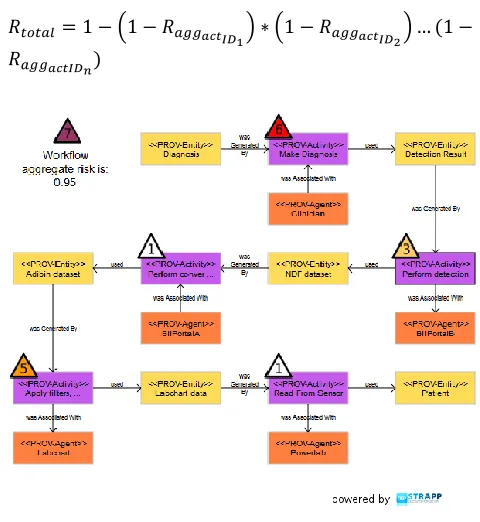
From Fig.1, risk is calculated per block. The block is defined in terms of an entity, activity and associated agent:
;
where is risk of an entity, activity and agent respectively.
STRAPP is querying target system for an activity ID and string of risks with regard to this activity. The system should respond with a string of risks of an entity, activity and agent:
= {R1…Rn };
Risk for an agent is defined in terms of agents’ years of experience and assigned a factor from a scale of 0 to 1, where 1 is very experienced (e.g., more than 10 years experience, and 0 – no experience at all). As such, risk for an agent can be scaled as follows:
ϵ [0.33, 0.66, 0.99]; Risk per block is aggregated as follows:
;
Overall aggregated risk of a chain under analysis is calculated as follows:
( ) ( )
[image:5.612.50.296.162.456.2]
Figure 1 Risk output
Activity “Make Diagnosis” and agent “Clinician” has got high risk level. This is because agent’s risk is defined in terms of its years of experience. Therefore, inexperienced clinician could make an incorrect diagnosis and result in a high aggregated workflow risk. More years of experience would dramatically reduce the overall risk of a final “Diagnosis”.
B. Provenance-Based Trust of a Domain Based Workflow
Our trust model is concerned with the ranking of decision alternatives over a number of attributes. Based on a case study data, some of the attributes can be incomplete. There are numerous methods to aid decision makers solve multi-attribute decision making (MADM) problems with incomplete information, amongst these methods the analytic hierarchy process (AHP) has been widely used, originally proposed by Saaty [13].
Our trust algorithm first identifies all possible focal elements from incomplete decision matrix, then it calculates the basic probability assignment (bpa) of each focal element. Second, belief interval of each decision alternative is evaluated according Dempster-Shafer theory (DS). Third, applying ranking method decision alternatives are determined by comparing their belief intervals. More details on DS/AHP and its application can be found in [14].
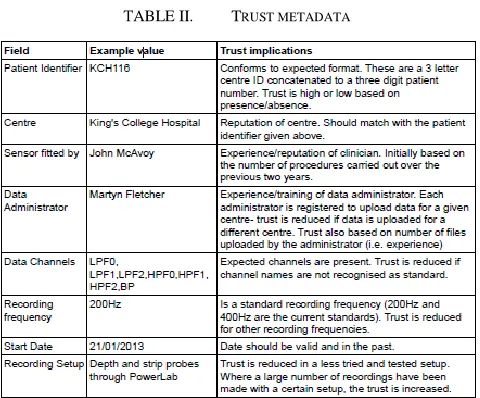
TABLE II. TRUST METADATA
Data on the BII portal contains provenance information about the services which were used to generate it, and the inputs to those services. This information is crucial in the determination of the level of trust which can be placed in the data. The following pieces of information are pertinent to the initial trust model, and will apply to all pieces of data/services in the provenance chain:
TABLE III. DATA PROVENANCE/SERVICE INFORMATION
Some data, after analysis, will have some results associated with it, such as event detections. As part of this analysis, some measures may be available which would help determine the trustworthiness of the data. Initially these are limited, but could be increased in future:
TABLE IV. DATA
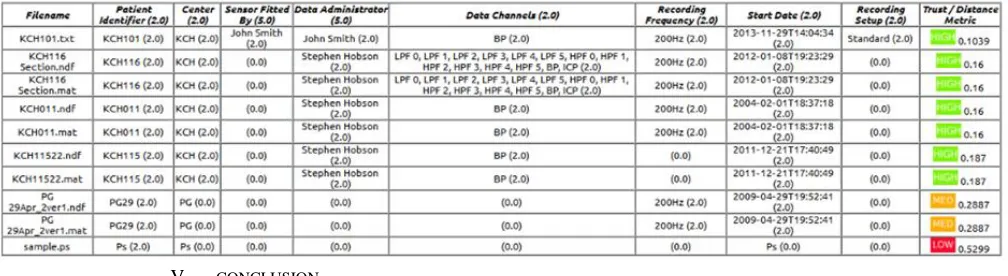
[image:6.612.57.297.68.267.2]Fig.2 shows the trust levels derived by applying DS/AHP to input data shown in Tables II, III, IV. For every PROV element trust level is estimated taking as an input a set of files with relevant data entries and applying DS/AHP algorithm the ranking is performed. As such, we have applied DS/AHP to rank the trust level at the source: Entity “Patient”.
Figure 2 Trust output
The input to DS/AHP consists of 10 files, each with 8 data fields. As it can be seen from Table V some of these fields are missing. Data fields such as patient_ID, center, sensor fitted by, administrator, data channels, recording frequency, and recording setup are treated equally, without emphasizing on importance. After running DS/AHP, it was derived that some of the files have low trust, e.g., “sample.ps”. This is because most of the data fields are empty, missing or incomplete. Medium trust files have several empty fields. In the same manner, the set of data files relevant to activities within a workflow can be analysed and ranked according to DS/AHP. The user of a system can then see at what stage data might get lost, corrupted or tempered with. Therefore, somebody knowing such situation would be interested in knowing possible consequences or risks associated with the decision trust.
TABLE V. TRUST DECISION MATRIX RANKING RESULTS
V. CONCLUSION
Considering that trust and risk are implicit, this paper proposes for the first time a novel approach to view trust and risk on a basis of a W3C PROV provenance data model applied in the healthcare domain. We have made an assumption that high trust in data does not necessarily mean low risk, as these factors fulfill each other rather than can be seen independently. This is demonstrated by our trust and risk models applied to the Brain Injury Index (BII) case study data. We first, present the risk model, which first calculates risk values at each workflow step considering PROV concepts and second, aggregates the final risk score for the whole provenance chain. Different from risk model, trust of a workflow is derived by applying DS/AHP method. In situation when user should make a critical decision, users should be aware of possible outcomes and their probabilities, risks to be taken and uncertainties involved in the analysis as well as provenance of information. The system is trustworthy when these aspects are open to the system user. The evaluation of such system will be performed under the STRAPP context in the medical domain. We make a hypothesis that if user is aware of risks and trust levels involved in the PROV chain the trustworthiness in a system can be improved. Therefore, more analysis needs to be done in the area of risk and trust. Nevertheless, our first attempt of visualizing risk and trust concepts on a workflow basis and making a relational comparison of derived results proved our assumption that risk and trust are implicit, not proportional.
ACKNOWLEDGMENT
The STRAPP project (Trusted Digital Spaces through Timely Reliable and Personalised Provenance) is funded by the UK Technology Strategy Board (grant reference 1926- 19253), Rolls-Royce plc, OSyS Ltd, Cybula Ltd, and the UK Engineering and Physical Sciences Research Council Knowledge Secondment Scheme. Their support is gratefully acknowledged.
REFERENCES
[1] D. Gambetta, “Can We Trust Trust?”, in D. Gambetta (Ed.) Trust: Making and Breaking Cooperative Relations, Electronic
edition, Department of Sociology, University of Oxford, chapter 13, pp. 213-237, 2000
[2] B. Solhaug, D. Elgesem, and K. Stølen. “Why trust is not proportional to risk”, 2nd International Conference on Availability, Reliability and Security (AReS'07), pp. 11-18, IEEE Computer Society, 2007.
[3] O.E Williamson, “Calculativeness, Trust, and Economic Organization”, Journal of Law and Economics, University of Chicago Press, vol. 36(1), pp. 453-86, April 1993
[4] A.Jøsang, C. Keser, and T. Dimitrakos, “Can We Manage Trust? ”, in Trust Management, P. Herrmann, V. Issarny, and S. Shiu (Eds.), Springer, Berlin Heidelberg. p. 93-107, 2005
[5] A. Josang and S. L. Presti, “Analysing the Relationship Between Risk and Trust”, 2nd International Conference on Trust Management (iTrust'2004), Oxford, UK, Springer, pp. 135-145, April 2004. [6] M. Emaldi et al., “To trust, or not to trust: Highlighting the need for
data provenance in mobile apps for smart cities”, Computer Vol. 15, pp. 26-32, 2013
[7] O. Hartig and J. Zhao, “Using web data provenance for quality assessment”, In: Proc. of the Workshop on Semantic Web and Provenance Management at ISWC, 2009
[8] D. Ceolin, P. Groth, W. R. van Hage, A. Nottamkandath, and W. J. Fokkink, “Trust evaluation through user reputation and provenance analysis”, 8th Workshop on Uncertainty Reasoning for the Semantic Web (URSW'2012), Boston, Massachussetts, pp. 15-26, November 2012
[9] S. Rajbhandari, O. F. Rana, and I. Wootten. “A fuzzy model for calculating workflow trust using provenance data”, 15th ACM Mardi Gras conference, New York, NY, USA, pp. 1–8, 2008. ACM. [10] V. Cahill et al. ,“Using trust for secure collaboration in uncertain
environments”, Pervasive Computing, IEEE , vol.2, no.3, pp.52,61, July. 2003
[11] L. Moreau et al., “PROV-dm: The prov data model”. Candidate Recommendation, 2012
[12] D. Ceolin, P. Groth, and W.R.van Hage, “Calculating the Trust of Event Descriptions using Provenance”, Second International Workshop on the role of Semantic Web in Provenance Management (SWPM’10)
[13] T. L. Saaty, “The Analytic Hierarchy Process”, New York:McGraw-Hill, 1980