Optimization of Solid-state Fermentation Process and
Development of Biocontrol Agent Based on Cassava
Residue from
Streptomyces Microflavus
Dong MA
1,2, Kun-lun LI
3, Lin ZHAO
1,2and Xin-li LIU
1,2*1Qilu University of Technology (Shandong Academy of Sciences), Shandong Jinan 250353, China
2Shandong Provincial Key Laboratory of Microbial Engineering, Shandong Jinan 250353, China
3Jinan Hangchen Biological Technology Co., Ltd. Jinan, 250353, China
Keywords: Streptomyces microflavus, Solid-state fermentation, Biopharmaceuticals.
Abstract. In this article, solid-state fermentation of low-cost Streptomyces microflavus is studied by
using cassava residue, rice husk and other agricultural solid waste resources as the substrate to prepare biopharmaceuticals [1]. The experiment results showed that the Streptomyces microflavus’
optimum solid-state fermentation medium and conditions includes the following components: cassava residue 89.85%, rice husk 10%, KH2PO4 0.05%, NaCl 0.05%, MgSO4 0.05%. The fermentation temperature is controlled at about 30 °C, the initial water content is around 50%, initial pH is 6.6-7, the material thickness is 5cm, the inoculation amount is 7.5%, the cultivation time is 4 days, and the spore yield is 4.8*109 cfu/g. The survival rate of Streptomyces microflavus’ spores is 75%, which compared with blank conditions increased by 30% after low temperature vacuum drying. The work of this paper provides some theoretical guidance for the large-scale industrial production of Streptomyces, which has valuable application in agricultural field.
Introduction
With the enhancement of people's awareness of ecology, environment and health, the requirement for agricultural sustainable development is more and more urgent for efficient and safe biological pesticide and biological control of crop diseases[2]. Therefore, the biological control of plant diseases has developed rapidly, and the development, production and application of biocontrol agents and biopesticides have drawn more and more attention. Biocontrol agents are an important tool for the comprehensive treatment of plant diseases, which have the unique advantages of safety, non-toxicity, long lasting effect and environmental protection. Accordingly, they provide feasible solutions for environmental pollution, food safety and drug resistance [3-9]. With the development of green agriculture, biological fertilizers has begun to be used on a large scale [10]. Actinomycetes have always been the focus of research as the main biocontrol microbiology. Streptomyces is the
main source of actinomycetes in agriculture. They can not only inhibit the growth of many pathogenic microbiology, but also stimulate the germination and rooting of crops[10].Various products can be developed and applied, such as antibacterial, insecticidal, weeding, growth regulating, Anti-virus [11-16].
Streptomyces are majority produced by short shelf life liquid fermentation[17], whereas
solid-state fermentation has the advantages of low cost, easy to transport and preservation[18]. In this study, solid-state fermentation of Streptomyces microflavus was carried out based on solid
wastes such as cassava residue and rice husk and the optimum conditions of fermentation and preservation were determined, which laid the foundation for large-scale production of Streptomyces microflavus.
Material and Methods
Material
S14YB130AK097-type incubator shaker (Shanghai Zhicheng Analytical Instrument Manufacturing Co., Ltd.), GNP-9160 water insulated constant temperature incubator (Shanghai Jinghong Experimental Equipment Co., Ltd.), FW-CJ-2FD super Clean Bench (Zhejiang Sujing Purification Equipment Co., Ltd.), BSM320.3 electronic balance (Shanghai Zhuo Jing Electronic Technology Co., Ltd.), GI54DWS high pressure sterilizer (Xiamen Zealway Instrument INC.), NIKON50I optical microscope (Shanghai Precision Instrument Co., Ltd.), XW-80A whirlpool oscillator (Shanghai Jingke Branch Industrial Co., Ltd.)
Slant Culture
Streptomyces microflavus AMYa-008 (provided by Agricultural Culture Collection of China and
preserved in Shandong Provincial Key Laboratory of Microbial Engineering) was used in this
aritical. The glycerol tube culture strain of Streptomyces microflavus AMYa-008 was inoculated into
Gaoshi No. 1 culture, which cultured at 30 °C within 5 d, activated by continuous transfer 2-3 times, placed in 4 °C refrigerator for later use.
Preparation of Seed Liquid
In the ultra-clean platform, picking 1-2 ring bacteria activated by inoculation loop were inoculated into 100 mL SNB medium (sucrose 1.5%, glycerol 1.5%, peptone 4%, potassium dihydrogen phosphate 0.05%, calcium carbonate 0.05%, 0.05% sodium chloride, 0.05% magnesium sulfate, and each component was added in mass fraction) at 500 mL Erlenmeyer flask and, which incubated at 180 r/min on a shaker at 30°C for 4 days. The bacteria activity by plate count reached 3×10⁹ cfu/mL.
Optimization of Material Preparation and Sterilization Process
Cassava residue (50 ~ 80 mesh), rice husk, corn flour, wheat bran were treated with dry and wet heat sterilization respectively.
Wet heat sterilization method: The pH and water content are adjusted after mixing the material, and then sterilized under the condition of 1x10⁵ Pa for last 1 h to prepare for using.
Dry heat sterilization method: The material is dried to make the moisture less than 20%, which drying or stir fry 3-5 h at the temperature of 121°C to prepare for using by adjusting the water and pH.
Optimization of Fermentation Formula
Taking cassava residue as substrate, 5% of rice husk, corn flour, wheat bran and urea were respectively selected as different nutritional adjuvants to carry out optitional experiment of different carbon and nitrogen sources.
Optimization of Solid-State Fermentation Process
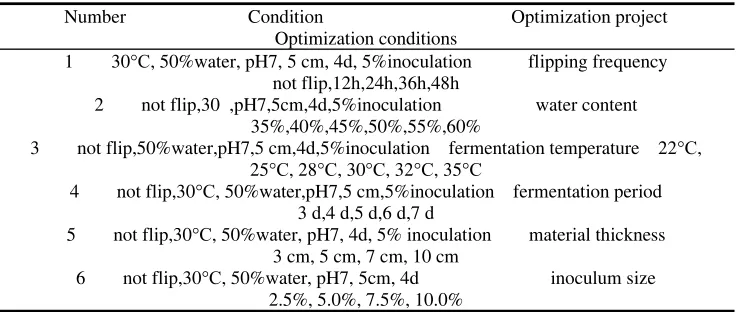
Number Condition Optimization project Optimization conditions
1 30°C, 50%water, pH7, 5 cm, 4d, 5%inoculation flipping frequency not flip,12h,24h,36h,48h
2 not flip,30 ,pH7,5cm,4d,5%inoculation water content 35%,40%,45%,50%,55%,60%
3 not flip,50%water,pH7,5 cm,4d,5%inoculation fermentation temperature 22°C, 25°C, 28°C, 30°C, 32°C, 35°C
4 not flip,30°C, 50%water,pH7,5 cm,5%inoculation fermentation period 3 d,4 d,5 d,6 d,7 d
5 not flip,30°C, 50%water, pH7, 4d, 5% inoculation material thickness 3 cm, 5 cm, 7 cm, 10 cm
6 not flip,30°C, 50%water, pH7, 5cm, 4d inoculum size 2.5%, 5.0%, 7.5%, 10.0%
Orthogonal Experiment of Solid-State Fermentation Conditions
The effects of different content of rice husk, material thickness, initial water content and initial pH on fermentation level and fermentation process were investigated using cassava residue as substrate, rice husk as auxiliary material, inoculum volume 5% and fermentation 4 days at about 30 °C. Trial Enlargement of Solid-State Fermentation and Optimization of Its Conditions
Using the above single factor experiments and orthogonal test conditions optimized for fermentation pilot scale amplification, the optimization of Streptomyces fermentation by three
different ways (shallow plate fermentation, nest reactor fermentation and ventilation and fermentation), select the optimal fermentation mode.
Fermentation Level and Parameter Detection
Growth curve of Streptomyces microflavus AMYa-008: The above optimized fermentation process
was used for solid fermentation, pH and water content of the samples were measured every 12 hours and the number of viable bacteria was determined by the plate count at the rate of 85% or more mature spore.
PH measurement: Sampling in the solid-state fermentation medium by five sampling method, weighed 5g into the flask containing 45 mL tap water, shake well and measured by pH meter[19].
Determination of water content: As above the method, weighed 10g into a clean glass plate, 105 °C baked 2 hours to measure the moisture content[19].
Actinomycete spores production count: Mixing material at the end of the fermentation, taking 10 g samples in 90 mL sterile saline containing glass beads, the gradient dilution was made after shaking 30 min, then coating for plate count and the viable bacteria content in the solid matrix was determined[20].
Low-Temperature and Drying Storage Technology
[image:3.612.123.492.82.238.2]Results and Discussion
Figure 1. Mycelium and spores from Streptomyces microflavus AMYa-008 (×1000).
[image:4.612.119.496.241.353.2]Comparison of Two Sterilization Processes
Table 2. Comparison of dry and wet heat sterilization process.
Sterilization
method the number of bacteria after sterilization (X109 cfu/g) Fermentation yield (X10 9
cfu/g)
Dry heat
sterilization 0.03 3.6
Wet heat
sterilization 0.02 3.6
The above experimental results shown that the average fermentation yield of both sterilization methods can reach 3.6 × 10⁹ cfu/g. Meanwhile, the dry and wet heat sterilization processes have almost no effect on the final fermentation yield. Its advantages include the convenience to develop large-scale production and the relatively low cost. Therefore, the dry heat sterilization process is used to sterilize.
Optimization of Fermentation Formula
Figure 2. Effects of different carbon and nitrogen sources on fermentation yield.
[image:4.612.137.473.449.622.2]nutrition, the risk of bacterial infection is too high. Bacterial infection led to the fermentation yield is lower than the blank, so it is not suitable for fermentation of this strain.
[image:5.612.145.468.139.305.2]Effects of Turning Frequency on the Fermentation Yield of Streptomyces Microflavus Amya-008
Figure 3. Effects of different turnover frequency on fermentation yield.
Based on the above experimental results, it is concluded that the highest fermentation level of the not flip condition can reach 4.2×10⁹ cfu/g. With the increase of turning frequency, the chances of streptomycete mycelium rupture increased, and the possibility of contamination was also increased. Therefore, the turning conditions were finally selected as not to be turned.
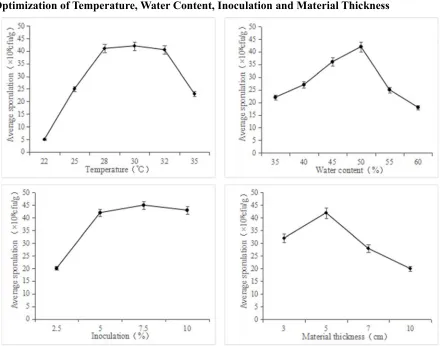
Optimization of Temperature, Water Content, Inoculation and Material Thickness
[image:5.612.86.526.385.731.2]
According to the above experimental results, the optimized conditions were as follows: the fermentation temperature was 28~32°C, the initial water content was 50%, the inoculation was 7.5%, and the material thickness was 5 cm. Based on the cost consideration, 5% inoculation can be selected if industrial enlargement is carried out.
Comparing the fermentation results at different fermentation temperatures, the fermentation production reached the highest level of 4.2*109cfu/g at 30°C, which was respectively increased by 68%, 82.6%than the fermentation level of fermentation temperature at 25°C, 35°C. And under the same conditions, the fermentation level reached 5*108cfu/g at 22°C, 4.1*109cfu/gat 28°C and 4.05*109cfu/g at 32°C.
Comparing the fermentation results of 35% ,40%, 45%, 50%,55% and 60% water content, the highest level of fermentation of Streptomyces microflavus is 4.2*109cfu/g when the water content is
50%. Under the same conditions, the fermentation level increased by 16.7% than 45% water content (3.6*109cfu/g) and 68% than 55% moisture content (2.5*109cfu/g).
Comparing the fermentation results of 2.5%, 5%, 7.5%, 10% inoculation, the highest level of fermentation of Streptomyces microflavus is 4.5*109cfu/g when the inoculation is 7.5%. Under the
same conditions, the fermentation level increased by 125% than 2.5% inoculation (2.0*109cfu/g), 7.14% than 5% inoculation (4.2*109cfu/g) and 4.65% than 10% inoculation (4.3*109cfu/g).
Comparing the fermentation results at different material thickness, the fermentation production reached the highest level of 4.2*109cfu/g at 5cm, which was respectively increased by 31.25% ,50% and 110% than the fermentation level of material thickness at 3cm,7cm and 10cm.
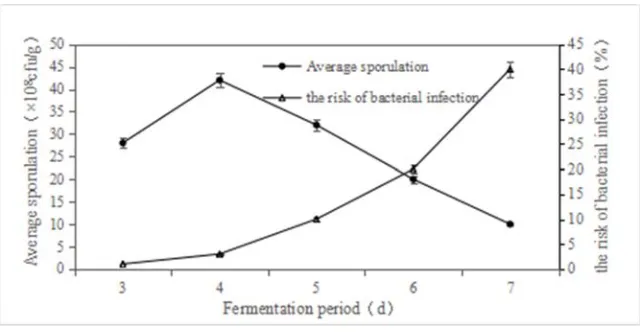
[image:6.612.146.466.362.528.2]Effects of Different Fermentation Period on the Fermentation Yield of the Stretomyces Microfalavus
Figure 5. Effects of different fermentation cycles on fermentation yield.
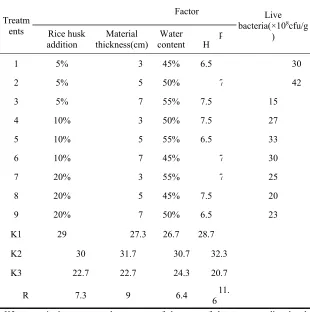
Orthogonal Optimization Test of Solid Fermentation Conditions
Treatm ents
Factor Live
bacteria(×108cfu/g
) Rice husk
addition
Material thickness(cm)
Water content
p H
1 5% 3 45% 6.5 30
2 5% 5 50% 7 42
3 5% 7 55% 7.5 15
4 10% 3 50% 7.5 27
5 10% 5 55% 6.5 33
6 10% 7 45% 7 30
7 20% 3 55% 7 25
8 20% 5 45% 7.5 20
9 20% 7 50% 6.5 23
K1 29 27.3 26.7 28.7
K2 30 31.7 30.7 32.3
K3 22.7 22.7 24.3 20.7
R 7.3 9 6.4 6 11.
Note: K1, K2 and K3 respectively represent the average of the sum of the corresponding levels of each factor, R represents the range of the average of corresponding levels of each factor.
[image:7.612.151.461.86.398.2]Pilot Scale Enlargement and Condition Optimization Results of Solid-State Fermentation
Figure 6. Effects of different fermentation methods on fermentation yield.
[image:7.612.146.468.434.601.2]Water Content, Temperature and Ph Trends
Figure 7. The change of pH value, water content and temperature in the fermentation process.
The whole process of Streptomyces microflavus AMYa-008 solid fermentation which was
designed in this paper period about 4 days, the strain in the first two days propagate fast for the long mycelium in the logarithmic growth phase, which began to form long chain at 1-3 days, and collapse into a single spore at 2-4 days. Meanwhile, the pH value increased from 6.8 to 7.8 and the water content decline from 50% to 48% due to the rapid growth in 1-3 days of Streptomyces microflavus, the growth came into stable period and began to form spores after 2-3 days, the
fermentation ended after 4 days.
Spore Preservation of Streptomyces Microflavus Amya-008
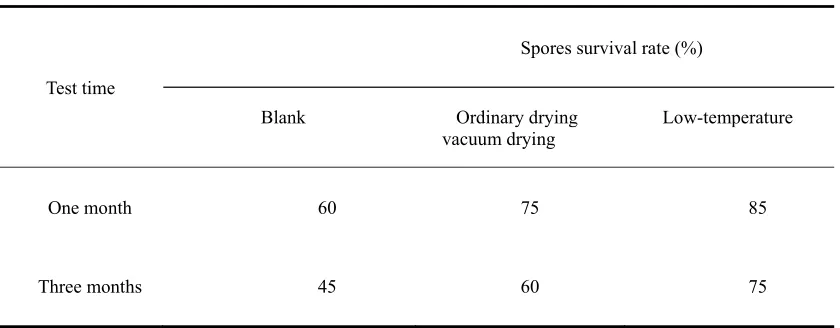
Cryogenic vacuum drying, compared with conventional drying or no drying, the survival rate of spores respectively increased by 10% and 25% at one month, and the survival rate of spores respectively increased by 15% and 30% at three months. Therefore, the low-temperature vacuum drying was chosen as the after treatment preservation process.
Table 4. Spore survival rate in different periods.
Test time
Spores survival rate (%)
Blank Ordinary drying Low-temperature vacuum drying
One month 60 75 85
Three months 45 60 75
Conclusion
[image:8.612.98.518.455.619.2]fermentation of Streptomyces microflavus AMYa-008. This study initially explored the solid
fermentation process and spore preservation method of Streptomyces microflavus AMYa-008, which
made it capable of sporulation and preservation for a longer time. This laid the foundation for the future development of Streptomyces microflavus into agricultural biocontrol agents [21].
Acknowledgements
The work was financially supported by Shandong Provincial Key Research and Development Program (No. 2017CXGC0302, 2017CXGC0204, 2016ZDJS08B01, 2016GGX107003, 2015ZDZX05001, 2015ZDXX0403B01), Shandong Provincial Natural Science Foundation (NO. ZR2012CQ027).
References
[1] Ahmed, S.A. Optimization of production and extraction parameters of bacillusmegaterium levansucrase using solid-state fermentation. Journal of Applied Sciences Research, 2008, 4(10): 1199-1204.
[2] Qian T.Y., Tang C.L., Zong Z.F. Formulation of Bio-Control Actinomyces Strain 153[D]. Northwest A&F University, 2008.
[3] Tang C.L. Bicontril Agent of Actinomyces 153[D]. Northwest A&F University, 2009.
[4] Qian T.Y., Tang C.L., Tian X.L., et al. Formulation of biocontrol Actinomyces strain 153 and its
control effect on verticillium wilt [J]. Journal of Northwest A & F University(Natural Science Edition), 2009, 37(4): 169-172.
[5] Gan L., Lan X.J., Dai P.B., et al. Effect of combined biocontrol Actinomycetes strains on watermelon wilt disease [J]. Chinese Journal of Biological Control, 2015, 31 (4): 516-523.
[6] Ji Y.Y., Zhang Q.L., Zhang W.T., et al. Production of microbial inoculum for biocontrol Actinomycete SCl-1 [J]. Acta Agriculturae Boreali-occidentalis Sinica, 2011, 20(4): 000164-167. [7] Zhu C.X., Bai XS, Zhang M. The status quo of development and perspective of Bio-pestisides [J]. Shanghai Environmental Science, 2002, 21(11): 654-661.
[8] Gong N. Opportunities and challenges in the development of biopesticides[J]. Chinese Journal of Biological Control, 2001, 17(4): 184 - 185.
[9] Yu. Z.N. Microbial pesticides and their industrialization [C]. Beijing: Science Press, 2000, 193-198.
[10] Li X.L., Jin X.D., Wang M.L. Study on Solid Culture of Actonomyces [J]. Journal of Shanxi
Agricultural Sciences, 2006, 34 (1): 53-54.
[11] Mu Y.K., Wang Z.W., Zhang C.M., et al. Optimum of solid fermentation parameters for
Streptomyces sp. S506 [J]. Microbiology China, 2008, 35(10): 1600-1605.
[12] Ding J.J., Wan Z.Y., Fang W, et al. Optimization of fermentation media with Novonestmycin Streptomyces phytohabitans[J]. Hubei Agricultural Sciences, 2015, (16): 3928-3931.
[13] Hardt I.H., Steinmeta H. New natural epothilones from sporangium cellulosum, strains Soce 90/B2 and Scoce 90: isolation, structure, elucidation and SAR studies [J]. Nat prod, 2001, 64(7): 847.
[15] Xu H.H., An Y.X. The development trend and prospect of biopesticides [J]. Pesticide science and administration, 2001, 22(1): 32−34.
[16] Zhang C.M., Mu Y.K., Li H.T., et al. Screening and optimization of the fermentation conditions of biogen streptomyces S506 [J]. Journal of Hebei Normal University, 2008, (05): 660-664.
[17] Tian X.L., Zhao H..J, TANG C.L., et al. Optimization of the fermentation of solid state medium for biocontrol actinomycetes 153 and its heat tolerance ability [J]. Journal of Northwest A & F University (Natural Science Edition), 2010, 38(7): 181-186.
[18] Udo Hölker, & Jürgen Lenz. Solid-state fermentation—are there any biotechnological advantages? Current Opinion in Microbiology, 2005, 8(3): 301-306.
[19] Ogbo, F.C. Conversion of cassava wastes for biofertilizer production using phosphate solubilizing fungi. Bioresource Technology, 2010, 101(11): 4120-4124.
[20] Casillas-Buenrostro R.M., Heredia N.L., Benesh D.A.L., et al. Efficacy of 3m™ petrifilm™ aerobic count plates for enumerating bacillus sporothermodurans, and geobacillus stearothermophilus, in uht milk. International Dairy Journal, 2012, 25(2): 147-149.