University of Huddersfield Repository
Othman, Aisha, Pislaru, Crinela and Impes, Ahmed
Improving Students’ ICT Skills By Using A Novel Framework For A LabBased Learning Module
Original Citation
Othman, Aisha, Pislaru, Crinela and Impes, Ahmed (2013) Improving Students’ ICT Skills By Using A Novel Framework For A LabBased Learning Module. In: Proceedings of The Fourth International Conference on eLearning (ICEL2013). The Society of Digital Information and Wireless Communications (SDIWC), pp. 106113. ISBN 9780985348397
This version is available at http://eprints.hud.ac.uk/id/eprint/18012/
The University Repository is a digital collection of the research output of the University, available on Open Access. Copyright and Moral Rights for the items on this site are retained by the individual author and/or other copyright owners. Users may access full items free of charge; copies of full text items generally can be reproduced, displayed or performed and given to third parties in any format or medium for personal research or study, educational or notforprofit purposes without prior permission or charge, provided:
• The authors, title and full bibliographic details is credited in any copy;
• A hyperlink and/or URL is included for the original metadata page; and • The content is not changed in any way.
For more information, including our policy and submission procedure, please contact the Repository Team at: [email protected].
IMPROVING STUDENTS’ ICT SKILLS BY USING A NOVEL
FRAMEWORK FOR A LAB-BASED LEARNING MODULE
Aisha Othman, Crinela Pislaru, Ahmed Impes
University of Huddersfield, School of Computing & Engineering, Huddersfield HD1 3DH, UK Email [email protected]
ABSTRACT
This paper describes the design of a novel pedagogical framework for a computer programming module. Generally the school-based learning (SBL) and laboratory-based learning (LBL) activities are delivered via a blended learning approach. The novel framework includes an e-learning package which enables the development and improvement of students’ ICT skills, digital age literacy, inventive and higher-order thinking before they attend the practical lab sessions. The proposed pedagogical approach will enable the current generation of students to be better prepared for a workplace where computers, the Internet and related technologies, are becoming more and more ubiquitous.
KEYWORDS
blended learning; ICT skills; laboratory based learning; virtual learning environment; digital literacy.
1. INTRODUCTION
In the early 1990s, the Omar Al-Mukhtar University established their Department of Computer Learning to provide BSc degrees in Software Engineering and Computer Science [1]. The course material has traditionally been delivered through lectures (also known as school-based learning, or SBL) and reinforced in the lab sessions (laboratory-based learning, or LBL). The SBL is based on a lecturer-centered approach in which experienced lecturers provide theoretical knowledge and information via traditional materials (e.g., a blackboard and chalk), and the students receive printed lecture notes and read textbooks. The students later attend lab sessions utilizing a student-centered approach in which they receive hands-on training in the techniques presented in the lectures. Recently, the academic staff within the department has observed that students display a lack of practical experience and understanding of
theoretical subjects that are essential to the success of lab sessions. Internal review reports show issues related to the learning processes and traditional teaching methods, limited access to IT, a lack of development processes, poor curriculum review, and a limited link between the practical tasks and course material.
Due to large class sizes, especially at the undergraduate level, many Libyan universities face significant challenges in adequately assessing student learning and providing feedback to students. Additionally, there are shortages of adequate teaching facilities and science educators. Some universities have opted to increase the number of faculty members, or to alleviate some of the strain by increasing the number of students who use one computer, but the majority of students still display a lack of practical experience and understanding of theoretical subjects during the computer lab sessions. This paper describes the employment of a blended learning approach to improve students’ ICT skills (including their usage of multimedia resources such as simulations, animations, and videos) by incorporating a new e-learning package in a computer science course. There are considered several research questions: (1) What are the best ways to design and develop an interactive e-learning package which supports the SBL and LBL activities?
(2) What should be included in the content of the module to support the increase the use of ICT? 3) What ICT techniques and tools should be used?
2. ABOUT THE BLENDED LEARNING APPROACH
approach [2] employs technological innovations in the merger between course objectives, content, resources and learning activities, and methods of information delivery. Wagner [3] describes it as an integrated system designed to help the learner through each stage of learning, based on the integration of traditional education and e-learning in its various forms within the classroom. This builds on the idea of combining traditional face-to-face methods with e-learning. Moore [4] underlines that blended learning can be defined as a method of education designed to help the learner achieve targeted learning outcomes through the integration of traditional forms of education and e-learning, inside and outside the classroom.
There are many factors that contribute to the success of blended learning:
Communication and guidance - lecturer to
instruct the students when the learning time and explain the steps to be followed in order to learn and programs used by the student for the collection.
Collaborative work on a team - built-in
education must convince everyone because this type of education requires the interaction of all the participants. They must work as a team in order to identify the individual roles.
Encourage dazzling creative work - actively
encourage students to be independent and be part of learning cantered groups. One can learn by reading printed or on-line materials while communicating with other people in various
countries through Internet or video
conferencing. Also the multimedia classroom interactions have the potential to encourage creativity and largesse.
Flexible choices – the students can access
information and answer questions regardless of time and place. So the educational processes should include many choices and flexibility at the same time so all beneficiaries can fulfil their needs.
Opportunities for interaction – the students
should be clear about the available choices. Also a fast method for connection should be offered all the time so the learners and lecturers can exchange information in all circumstances. The students should be
encouraged to network so they can share experiences and ideas about solving problems.
3. ICT IMPACT IN HIGHER EDUCATION
The demand for ICT is increasing daily in all educational systems around the world. In their
1998 report on international education,
UNESCO noted the important and growing role played by educational technology in the development of teaching methods [6], and specified the following guidelines:
I. Lecturers and students must be provided
access digital tools and technology, including the Internet, for use in schools.
II. These tools and technologies must be
high-quality and culturally relevant.
III. Lecturers must provide students with the
necessary knowledge and skills to use the tools and digital resources in order achieve high academic standards.
IV. ICT is one of the key factors in the formation
of the new global economy, and rapid changes in technology have changed our methods of communicating and conducting business. New technologies have brought significant shifts in agriculture, medicine, management, engineering, and other fields, and have the potential to change the nature of education in terms of place, style, and the roles played by students and lecturers.
4. PROPOSED PEDAGOGICAL FRAMEWORK FOR ICT MODULE
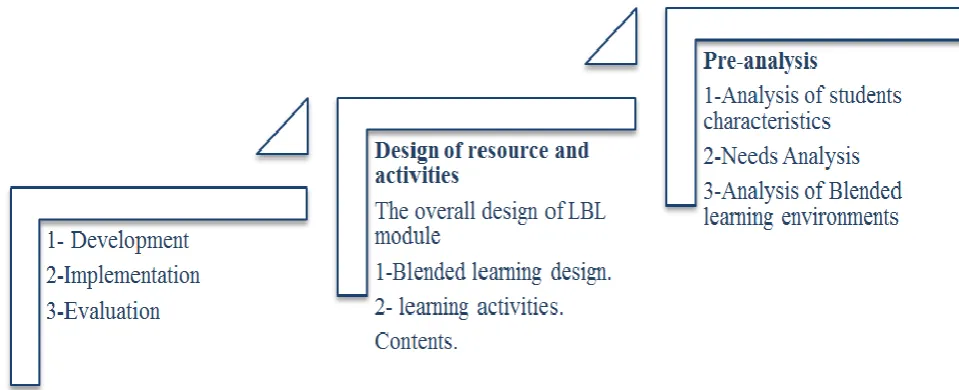
The pedagogical design should link together the course contents, learning environments, teaching and learning styles, assessment methods, learning outcomes, learning processes, and learning activities [7]. The design of the proposed pedagogical framework considers these aspects (see Figure 1).
Step 1 - Pre-analysis
In order to make sure that blended learning can be utilized, a set of analyses and observation must first be carried out. These analyses should contain three elements:
the extent of their readiness to learn the material. A diagnostic test should be conducted to determine students’ range of mastery of the subject matter, and to identify any obstacles to learning. Once a lecturer knows how students approach learning, the
lecturer can offer more support and
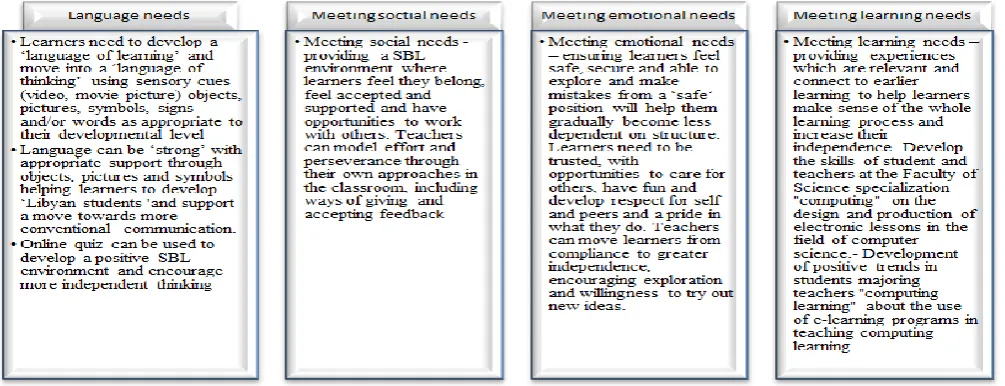
encouragement by building a blended learning environment to meet students’ learning needs [8]. Table 1 shows details about considering a new dimension for affective skills. The proposed pedagogical framework will be
applied for a computer programming course which is generally attended by students who are between 22 and 24 years old. Most
students lack practical experience and
understanding of theoretical subjects that are essential to the success of lab sessions. Students have studied an introductory module during their third year of study. So they should have a clear understanding of the Higher
Education demands, familiar with the
[image:4.595.49.552.249.442.2]classroom technology, and have the basic skills in using those tools and technology.
Table 1. The new dimension for affective skills related to ICT course
(2) Needs analysis. Based on Bloom’s Taxonomy and Kolb’ model for the learning cycle, an analysis must be undertaken to determine and develop appropriate teaching and learning styles for the LBL module [9].
This analysis may consist of tests,
questionnaires, discussions, or the
examination of previous school records and documents. This analysis will provide the lecturer with an initial idea about various learners’ needs. So one can decide how to utilize educational multimedia in order to advance the overall cognitive and emotional growth of the learners by taking into account any shortages in technology.
There are some examples of students’ future skills which should be developed in accordance with Bloom’s Taxonomy:
Remembering- Computer science students will be able to define the C programming theory and practical uses; they should know the process and
activities for exercises; and they should recall basic elements of C programming learned in the SBL (e.g., they should be recall and understand the term “global variable,” and they should be able to list 6 reserved words in C programming).
Understanding - Students should be able to
understand, explain, and describe the
programming process. Students should be able to understand the issues (e.g. they should be able to describe idea of “software crisis,” and they should able to find the value of X after running the C programming).
the average of some numbers).
Analysis - Students should be able to solve problems using the basic commands of C programming, and should know how to use tools to solve command problems.
Synthesis - Students should be able to build a program to solve a specific problem, to implement the activities leading to several
programming languages, including codes,
designs, requirements, and documentation.
Evaluation: They should be capable of evaluating C programming language work for conformity to standards. They should know suitable quantitative and qualitative measures of application, and should be talented enough to practice those measures in the evaluation of software.
(3) Analysis of the blended learning environment. It is necessary to define the features of the environment. The goal of this framework is to determine the level of proficiency of learners and to clarify the learning tasks [10].
Step 2 - Design of Resources and Activities
The blended learning design differs from normal instructional design, which focuses specifically on resources and activities that can be used within the SBL context. The process of identifying the main tasks students must perform in order to successfully function can be implemented as required. For example, the students can use multimedia to facilitate group discussion by using digital tools in an e-learning package. The digital tools can incorporate sound, moving pictures, and animation, which can prompt students to take a more active role in learning by allowing them to view practices in up close in action, and to engage with a keyboard or mouse to navigate interactive materials, simulation, and images. Multimedia allows quick and effective information transfer to all students engaged in SBL.
In our case, we will blend video, audio, text, simulations, images and multimedia into the e-learning package that will be available to students. The lecturer will choose suitable
methods to deliver the necessary information, such as moving pictures or animation. This will help to engage the learners with the subject matter. For example the lecturer may organize the students into groups. One group may draw a flow chart for an exercise of C programming, and will present the idea to the other groups. A second group may take part in a simulation activity of C programming and discuss how to use the program step by step (perhaps using an online tutorial). Other students might work individually, using the Internet and various multimedia to carry out the editing and organization of the elements of code and writing scripts.
As appropriate, the lecturer and students will use a combination of the following materials:
Flip-chart: A group of students may utilize a
flip-chart to present their ideas and explain the
use of basic commands for running
programming.
Computer: Individual students will use online
tutorials and videos for solving problems.
Handouts: The lecturer will give to students
handouts to help them focus more on their research for specific functions and commands. Multimedia: Students will use multimedia tools on the e-learning package to discuss the issues and ideas as a group. The digital tools will allow the incorporation of sound into lessons, moving pictures, and animation, which gives students a more active role in the learning environment. They can watch practices in action, see small things up close, and use the keyboard or mouse to navigate interactive materials, simulations, and images. The use of multimedia helps to transfer information effectively and quickly to all students, and can keep students interested. The lecturer can blend video, audio, text, simulations, images and multimedia into a single online environment via a Moodle application available to students from school or home.It is more important to review and inspect each material before providing it to students; this stage can be used to pilot-test the lesson materials
Review the materials. Learners will be aware
that the lecturer needs to gather the tests, worksheets, and handouts distributed during the SBL.
Prepare the materials. The lecturer will show
commands of the C programming by online tutorial or chart, and students can write notes during the explanation.
Prepare the environment. The lesson will be in
two different places: in the classroom and in a lab.
The classroom setting (SBL) is arranged to encourage student participation. The tables are arranged for easy interaction in small group work. A Smart Board is connected to a computer and projected on a wall where all students can easily see it.
The laboratory based learning (LBL) provides students with access to computers that are connected to the Internet and on which are installed C programming and other required programs. Students can use the computer as a means to design research programs, print reports and activities, and can use the lab during leisure hours to gain additional practice. The computers can also facilitate team training and workshops in computer lab. Students receive practical experience learn teamwork with a set of software programs, they gain experience
designing, implementing and testing
programmable hardware and software which can use to do practical work, research, or homework.
Step 3 – Development of e-learning package
The e-learning package (which will support SBL and LBL activities) will include:
Media unit (MU) will contain multimedia
elements without further sections. The element of the media can be simulation, video, text, animation or audio sequences. This is the process of actually composing an LBL module and preparing and producing educational pieces and outputs (such as texts, audio recordings, video clips, still images, computer software, etc). This phase often begins with a prototype (a preliminary version of the product) in which the developer and programmer presents a storyboard for each screen that includes any links. This prototype allows for checking design specifications and
may be modified once it is presented to a sample audience. Based on the resource and activities, the blended learning approach will be created so the learning activities will meet the requirements of all computer science students, regardless of their limitations on internet access. Consequently, a dual delivery status (ie CD-ROM based and e-Learning package) could be considered. While the e-learning package can be used to interact
simultaneously asynchronous and
synchronous, the CD will include self-learning materials multimedia.
Learning unit (LU) is a composition of objects
(learning elements and media elements) which contain slides for lectures, documents or questions for a test which include the
components graphics, text, and user
interactivity. Multimedia components will be on CD only in order to help the students understand the step-by-step lesson without the risk of a slow Internet connection, and to
provide self-learning materials through
PowerPoint slides and e-tutorials.
The feedback with self-evaluation will be included in the e-learning package and CD. This will consist of self-evaluation and continuous assessment for all lectures in the form of performing practical tasks, multiple-choice questions, quizzes, and questionnaires. Also an interactive learning forum will be provided so the students and lecturers can communicate through emails, blogs, wikis, and discussion board.
Figure 1. The pedagogical framework of the blended learning approach
Step 4 – Implementation of e-learning package
The computing science courses are more than theoretical courses because the lecturer should provide explanations about how to write programmes. Bath and Bourke [10] underline that “it is important to have course aims and learning objectives set before considering blended learning opportunities for your course”. So the students will attend the lecture presented by an experienced lecturer where the theoretical concepts will be introduced.
Then they will have to access the new e-learning package which will contain the lecture notes and supplementary material and exercises which will enable the development of students’ skills which will be relevant to the practical lab sessions. So resources and time will be offered to the learners in order to acquire the knowledge and skills required to use certain technology before they will actually use it.
The students will attend the practical lab session and their answers will be stored in e-wallets that
can be accessed by different lecturers,
demonstrators, and students themselves. These records offer evidence that students achieved their work in a good way or not by providing the best skills and competencies.
Step 5 – Evaluation of e-learning package
Expert evaluation - the e-learning package will
be initially reviewed by the original designer
and other design experts regarding the following aspects: content, interface design, technical functionality, timing, and interaction. The prototype will be improved in accordance with the experts’ comments.
User evaluation – the improved prototype will
be tested on a small number of individual students in the first instance. They have to complete a questionnaire and adjustments may be made before the e-learning package will be field-tested again on a larger group.
5. PROCESS MODEL OF A BLENDED LBL MODULE
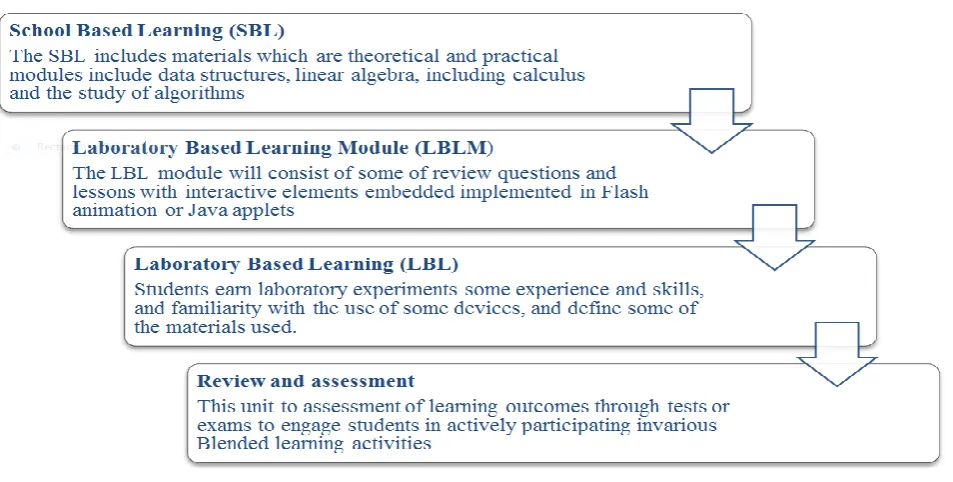
Figure 2 shows the process model which can be divided into four units:
SBL unit – when theoretical and face-to-face
learning occur, tasks are set forth for students to complete either individually or in groups. Students can communicate interactively with the lecturer which can use a Virtual Learning Environment (VLE) to show the educational materials and guidelines with interactive components (such as white board animations, case studies, exercises, or videos).
E-learning package (LBL module) - consisting
the SBL lessons or as part of an entirely separate online learning environment. Also, students can keep a record communication and review via chat or e-mail using the sound system, writing, a whiteboard, and electronic equivalent of the traditional blackboard. Access is granted to the board if the students need to write questions or answers. This is very important particularly to the server-based applications to ensure that each participant can show interactive elements to everyone. The key reason of introducing this e-learning package is to offer personalised e-learning to the learners who will be capable to experience the ambience and ethos of the laboratory before joining the LBL activities in computer labs.
Formal LBL session – when students have to
develop computer programs, go past the review stage for lectures and use new instructional material. Students will be provided with several
options and opportunities for reflection,
discussion, and problem-solving.
Review and assessment of the learning
outcomes - through exams or online test. The authors seek to increase the use of digital tools in computer programming courses, to help students
organize information and visualize and
understand the internal relations between the components of the scientific content. This can be achieved through blended learning approach where in students are divided into small electronic discussion groups to achieve common educational goals. As the digital tools and multimedia promote individualized instruction, these can be employed to give students experience in a subjective manner on their own, with the lecturer designing lessons centered on the student’s individual characteristics using programmed learning (such as modeling, simulation and role-playing games in extra-curricular educational activities).
[image:8.595.49.526.377.618.2]
Figure 2. Process model of the blended LBL module
The students will be able to access training material through e-learning package which can be accessed anywhere and anytime. So the information transfer will occur via the traditional SBL methods, while the e-learning package will give students access to work collection, coursework presentations, e-materials. So the novel pedagogical framework for a computer programming module will help lecturers to teach
delivering an interactive module: remote accessibility, functionality as an aid to bolster traditional learning, and its use in introducing hypermedia as a learning tool. Presenting topics in an interactive way is a perfect technique to make learning attractive.
A blended learning approach provides an environment in which students work together on the activities and learn by watching online tutorials or looking at visual information. This module will cover various computer science topics such as hardware concepts, algorithms, computational thinking, programming, and security.
6. CONCLUSION
The proposed pedagogical framework is
intended to raise the educational competencies and performance of computer science lecturers and students, and to help them achieve their educational goals. It will encourage lecturers and students to employ ICT in the classroom, and this can be achieved by properly utilizing a
blended learning environment. This will
ultimately foster a spirit of cooperation and understanding between lecturers, administrators, and students. This study has shown that the use of computer animations can assist students to better understand complex and difficult concepts in various computer courses. The LBL course training will allow the incorporation of sound, moving pictures, and animation into lessons, which extends lecturers’ capabilities to deliver materials that increase learners’ interaction with the subject matter. Through these media, students can watch practices in action, see micro-views of larger structures, and navigate interactive materials, simulations and images. E-tutorials will offer step-by-step directed tours of the entire e-learning package. Multimedia can transfer information effectively and quickly to all students, and can keep students interested in SBL. The authors intend to blend video, audio, text, simulations, images and multimedia into online applications available to students at school or home. The e-learning package will help learners to improve research and technical
skills, which cannot be accomplished by reading a textbook during SBL or LBL activities. The e-learning package will help students use online resources by offering news archives, databases for online libraries, and a wealth of other
information. Also the development and
implementation of this LBL module can train educators to provide materials to students more clearly anytime and anywhere.
7. REFERENCES
1. Omar Al-Mukhtar University: Computer Science Department homepage. Online available at http://www.omu.edu.ly/. Accessed 25 May 2013. 2. Graham, C.: Blended learning systems: definition,
current trends, and future directions. In Bonk, C. and Graham, C. (eds.), Handbook of Blended Learning: Global Perspectives, Local Designs. San Francisco, CA: Pfeiffer. (2006)
3. Wagner, E. In support of a functional definition of interaction. American Journal of Distance Education, 8(2), 6-29 (1994).
4. Moore, M.: Three types of interaction. American Journal of Distance Education, 3(2), 1-7 (1989). 5. Salim, A. : Educational Technology and E-Learning,
Al-Rushd library, Riyadh. (2004).
6. UNESCO. World Education Report 1998: Lecturers and Teaching in a Changing World. Available at http://www.unesco.org/education/educprog/wer/wer.ht m. Accessed 20 April 2013.
7. Biggs, J.: Teaching for Quality Learning at University. SRHE and Open University Press, Buckingham. (1999).
8. Molden, D.C., Dweck, C.S.: Finding “meaning” in psychology: A lay theories approach to self-regulation, social perception, and social development. American Psychologist, 61, 192-203 (2006).
9. Huang, R. Ma, D., Zhang, H.: Towards a design theory of blended learning curriculum. In Proc. 1st Int. Conf. Hybrid Learning and Education, 66-78 (2004). 10. Bath, D ., Bourke. J.: Getting Started with Blended
Learning. Available at
http://www.griffith.edu.au/__data/assets/pdf_file/0004 /267178/Getting_started_with_blended_learning_guid e.pdf. Accessed 21 May 2013.