Accepted Manuscript
How does drinking water affect attention and memory? The effect of mouth rinsing and mouth drying on children's performance
Caroline J. Edmonds, Naomi Harte, Mark Gardner
PII: S0031-9384(18)30308-1
DOI: doi:10.1016/j.physbeh.2018.06.004
Reference: PHB 12223
To appear in: Physiology & Behavior
Received date: 19 July 2017
Revised date: 16 May 2018
Accepted date: 5 June 2018
Please cite this article as: Caroline J. Edmonds, Naomi Harte, Mark Gardner , How does drinking water affect attention and memory? The effect of mouth rinsing and mouth drying on children's performance. Phb (2017), doi:10.1016/j.physbeh.2018.06.004
ACCEPTED MANUSCRIPT
How does drinking water affect attention and memory? The effect of mouth rinsing and mouth drying on children's performance
Caroline J Edmondsa, Naomi Hartes, Mark Gardnerb
a. School of Psychology, University of East London, Stratford Campus, Water Lane, London, E15 4LZ, UK.
b. Department of Psychology, University of Westminster, 309 Regent Street, London, W1B 2UW, UK.
Corresponding author -
Dr Caroline J. Edmonds, School of Psychology, University of East London, Stratford Campus, Water Lane, London, E15 4LZ, UK
Email. [email protected] Telephone. 020 8223 4336 Fax. 020 8223 4937
ACCEPTED MANUSCRIPT
Abstract
There is general consensus that drinking water facilitates certain cognitive processes. However, it is not yet known what mechanism underlies the effect of drinking on performance and these may be different for different cognitive processes. We sought to elucidate the mechanisms involved by establishing at what stage of the drinking process cognitive performance is influenced. We examined the effect of mouth rinsing and mouth drying on subjective thirst and mood, visual attention and short term memory in children. Data are reported from 24 children aged 9- to 10-years. Children’s performance was assessed in three conditions - mouth drying, mouth rinsing and a control (no intervention). In each condition they were assessed twice - at baseline, before intervention, and 20 minutes later at test. Mouth rinsing improved visual attention performance, but not short term memory, mood or subjective thirst. The effects of mouth drying were more equivocal. The selective nature of the results is consistent with suggestions that different domains of cognition are influenced by different mechanisms.
ACCEPTED MANUSCRIPT
1. Introduction
There is general consensus that drinking water facilitates certain cognitive processes and mood states (1,2). However, it is not yet known what mechanism underlies the effect of drinking on performance, and this may be different for different cognitive processes. For example, psychological explanations suggest that thirst is distracting and as drinking reduces thirst, it also reduces distraction and thus performance improves (3). Alternatively, drinking water may increase general arousal and facilitate performance (4). There are also candidate physiological explanations. For example, there may be a haemodynamic response: drinking water has been shown to result in vasodilation and reduced heart rate in adults (5), which may promote cerebral blood flow and stimulate neural activity (2). Additionally, hormones may play a role: dehydration is associated with elevated cortisol (6), which in turn is linked to impaired cognitive function (7,8), suggesting that drinking to reduce dehydration may affect cognition via reduced cortisol. This paper seeks to elucidate the mechanisms underlying the effect of drinking water on cognitive performance by establishing at what stage of the drinking process cognitive performance is influenced.
Not all areas of cognition are similarly affected by drinking water, and there are differences in the amount of water necessary to improve performance. Many studies have reported that visual attention, measured by letter cancellation, is improved by drinking water, in both adults and children. For example, studies in children have reported that drinking 25 ml (4), 250 ml (9), 300 ml (4) and 500 ml (10) resulted in improved performance on a visual
attention task. Similar studies in adults reported that drinking 25 ml (4), 200 ml (11) and 300 ml water (4) improved visual attention. Many studies have examined the effect of drinking water on memory, but the choice of memory task, and therefore type of memory assessed, has not been consistent across studies, for example, assessing memory for stories (10,12); visual memory (Benton & Burgess, 2009; Edmonds & Burford, 2009); spatial memory (14); multiple types of memory (15). More recently, studies have engaged a similar short term memory task – forwards digit span (hereafter, digit span) - and reported that performance on this task is enhanced by drinking water. For example, children's digit span is improved by drinking additional water over a school day (16), but not by drinking smaller amounts of water – there was no effect on children’s digit span of drinking 25 or 300 ml (4).
Furthermore, there is an association between water drunk, changes in hydration status as assessed by urinary osmolality, and digit span (17). In adults, drinking 300 ml (but not 25 ml) increased digit span (4). Drinking water does not improve all domains of cognition. For example, it has been found not to improve visuomotor tracking (10,12), sustained attention
ACCEPTED MANUSCRIPT
(Benton & Burgess, 2009), or set shifting (15). In summary, while even small amounts of water (25ml) are sufficient to improve visual attention in both children and adults, larger drinks appear to be necessary to improve memory, particularly in adults. These differences might imply that domains of cognition may be affected by different stages of the drinking process.
In addition to different cognitive processes having different dose response effects, whether or not an individual rates themselves as thirsty has been found to affect the influence of drinking water on cognitive performance. For example, performance enhancements on a rapid visual information processing task after drinking water only occurred in thirsty participants (18). Others have reported that visual attention is improved by drinking, but that this is not dependent on thirst reduction, in both children and adults (4). In contrast, performance on a memory task only improved with a drink sufficiently large to also reduce subjective thirst (4). Thus, these findings suggest that memory improvements associated with drinking are
contingent on subjective thirst reduction, but drinking-related improvements in attention appear not to be contingent on reductions in subjective thirst.
This dichotomy in the amount of water necessary to affect performance on attention and short term memory tasks, and the question of whether thirst is concurrently affected, could help to identify the stage in the drinking process during which performance is affected, and thus, the mechanism involved. The finding that a very small drink (25 ml) is sufficient to improve letter cancellation, and that this improvement is not contingent on a reduction in subjective thirst, suggests that this may occur by some process operating within the mouth, for example a hedonic shift in mouth comfort or stimulation of oropharyngeal receptors (4). Mouth rinsing, in which participants rinse a liquid in their mouths and then expel it, stimulates oral receptors without swallowing fluid and has been used extensively to examine the effect of carbohydrate on exercise performance (19–21). Using this methodology, but rinsing water instead of carbohydrate, provides an opportunity to test whether cognitive performance is affected by processes operating in the mouth. If attention is improved by processes within the mouth, then merely rinsing water should result in facilitated performance. Additionally, it may be that drying the mouth would impair attention - inserting dental rolls into the mouth provides an opportunity to test this hypothesis by drying the mouth cavity (22).
ACCEPTED MANUSCRIPT
By contrast, memory is hypothesised to be affected by improved hydration, or an effect on the body that occurs further down the gastro-intestinal tract than the mouth (4), on the basis that a larger amount of water is needed to improve memory, and because, in adults, it is associated with a reduction in thirst. Therefore, the manipulations of mouth rinsing and mouth drying, which do not involve swallowing fluid, would not be expected to affect children's short term memory performance. With regards to subjective thirst, it seems
plausible that drying the mouth would increase the sensation of thirst, and mouth rinsing may decrease it. The effect of drinking water on children’s mood is equivocal (10,12), thus it is not clear how mouth rinsing may affect subjective mood. However, we include mood ratings in our study because it is possible that children may find the effect of drying the mouth unpleasant, and this may be reflected in poor mood ratings.
Therefore, in the present study we examined, in a group of children, the effect of mouth rinsing water and drying the mouth, against a control condition with no intervention.
Children's performance on thirst and mood scales, a visual attention task (letter cancellation) and forward digit span was assessed at two timepoints - baseline, before intervention, and 20 minutes later at test. In order to check that there were no differences in motivation or effort over the three conditions, perceived effort was assessed at the end of the study.
2. Methods 2.1. Design
Twenty-eight children aged 9- to 10-years took part in three conditions on consecutive days: control condition, mouth rinsing, mouth drying. They were assessed at baseline and 20 minutes later on tests of thirst, mood, letter cancellation, forwards digit span and perceived effort. In this specific test order, control preceded rinsing to mitigate against elevation from baseline that was simply due to practice (such effects would be greatest on day 1 when materials were most unfamiliar).
2.2. Participants
Children were recruited from a primary school in the UK. The whole sample consisted of 28 children aged 9-10 years, but four children did not complete each condition and their data were removed from the analysis. The sample that was included in the analyses was comprised of 24 children (14 male, 10 female; age range 9-10 years, M= 9.75, SD= 0.44), none of whom had special educational needs. Children were not offered any incentive for participation in the study.
ACCEPTED MANUSCRIPT
2.3. Materials
2.3.1. Rating Scales
2.3.1.1. Thirst.
To indicate subjective thirst, participants marked a 10cm horizontal line with anchors stating “Not at all thirsty” at 0cm and “Very thirsty” at 10cm. Scores were calculated by measuring where the marker was placed on the line and converting it to a percentage, thus a higher score indicated a higher level of thirst. The same rating scale was used at baseline and test.
2.3.1.2. Mood.
Participants marked a 10cm horizontal line with anchors stating, “Not happy” at 0cm and “Very happy” at 10cm. Scores were calculated by measuring the line from "Not happy", and expressing this as a percentage: higher scores were associated with a more positive mood. 2.3.1.3. Perceived Effort.
In order to assess perceived effort, a series of rating scales was administered at test only. These were an adapted form of the NASA-TLX visual analogue scale (23) appropriate for children. Participants rated their effort, perceived performance, temporal demand and mental demand by marking a 10cm line, and ratings were converted to a percentage. To assess effort, the scale asked, “How did you feel about doing the tests?”, with anchors indicating, “I didn’t care how I did” (left) and, “I really wanted to do well” (right). To assess perceived
performance, the scale asked, “How hard did you work when doing the tests?”, with anchors indicating, “I didn’t work very hard” (left) and, “I worked really hard” (right). To assess temporal demand, the scale asked, “How did you feel when doing the tests?”, with anchors indicating, “I felt as cool as a cucumber” (left) and, “I felt stressed and under pressure” (right). Finally, to assess mental demand, the scale asked, “How hard did you concentrate with doing the tests?”, with anchors indicating, “I didn’t really need to concentrate” (left) and, “I concentrated really hard” (right). A higher score indicated a stronger feeling of perceived effort.
2.3.2. Cognitive Tests
2.3.2.1. Letter cancellation.
This was a pencil and paper test. Participants had to cross through as many of the target letters (U) in a 20x20 grid as possible in 30 seconds. The grid was filled with targets (n=38) and distractor letters (n=362; O, V and C). An upper case Calibri, size 11 point font was used. The score was the number of correctly identified letters (maximum = 38). Parallel forms were used for baseline and treatment test. A higher score indicated better performance.
2.3.2.2. Forwards digit span.
ACCEPTED MANUSCRIPT
A series of digits were read aloud by the researcher at a rate of 1 digit every two seconds. Participants wrote down the sequence in the order it was presented after the researcher read the last number of the sequence. Sequences were initially three digits in length and increased by one digit until a maximum of ten digits were reached. The total score was calculated by adding the totals from each sequence (number of correctly recalled digits before an error was made). Parallel forms were used for baseline and test. The maximum score was 52. A higher score indicated a better performance.
2.4. Procedure
Children were tested in a group setting in their classroom, but completed all tasks at their own desks without help from their peers. Testing took place on three consecutive days in the following order: control, mouth rinsing, dry mouth. Children took part in all three conditions, which all took place between 10 and 11am. In each test session, children were given a printed booklet with the scales and tests inside (for baseline and test). Children completed these in the following order: thirst scale, mood scale, letter cancellation test, forwards digit span test. Before each scale/test was completed the researcher gave a brief explanation of its content and they had the opportunity to ask questions if they were unclear. Data were collected anonymously. The treatment test took place 20 minutes after completion of baseline testing, and comprised thirst and mood scales, parallel forms of letter cancellation and forwards digit span tests, and the perceived effort scales. At the end of the test sessions, children were thanked for their participation.
2.4.1. Control Condition: After completion of baseline scales and tests children were instructed to read in silence for 20 minutes.
2.4.2. Mouth Rinsing Condition:
After baseline testing, children were given a cup containing 25 ml water. They were instructed to begin to swill the entire content of the cup around their mouth and 5 seconds later they were instructed to spit out the water into a plastic cup. The researcher demonstrated the mouth rinsing procedure first. Children then read in silence for 20 minutes.
2.4.3. Dry mouth Condition:
After baseline testing, children were given a clear plastic bag with 4 cotton-wool dental rolls (size: 10mm). They were instructed to place two rolls inside each cheek, between their upper and lower teeth and gums, and then close their mouth. The researcher demonstrated putting the dental rolls into her mouth first. The dental rolls were in situ for 8 minutes, after which children removed them and put them in a bag that was provided. They then read in silence for 20 minutes.
ACCEPTED MANUSCRIPT
We did not assess drinking prior to participation in the study because our aim was to evaluate the effect of our interventions on a group of children, in order to offer guidance on
interventions that might be useful for educators, rather than an individualised approach that would be less useful for group interventions.
2.5. Statistical Analysis
A repeated measures ANOVA (TIME x CONDITION) was conducted for each outcome variable. Planned comparisons comparing baseline and test scores were carried out in each condition in accordance with the hypotheses. The Bonferroni correction for multiple tests was employed and the alpha level was set at 0.017 (0.05 / 3 comparisons). For the motivation scales, which were only included at test, one way ANOVAs (CONDITION) were conducted for each scale.
2.6. Ethics
This study was conducted according to the guidelines laid down in the Declaration of Helsinki and all procedures involving human subjects were approved by the School of Psychology ethics committee, University of East London. Written informed consent was obtained from all parents. Written assent was attained from all of the children who participated in the study.
3. Results
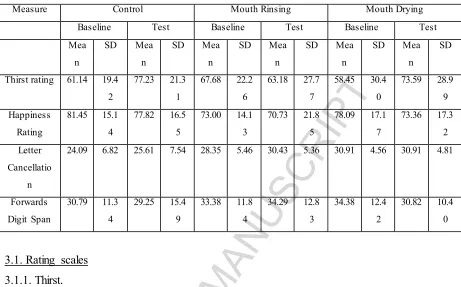
Data presented in Table 1 show mean ratings and standard deviations on the thirst and mood scales, letter cancellation and forwards digit span tests by condition and time of test.
ACCEPTED MANUSCRIPT
Table 1. Means and Standard Deviations for subjective thirst and mood, letter cancellation and forwards digit span, by condition (control, mouth rinsing, mouth drying) and time of test (baseline, test)
Measure Control Mouth Rinsing Mouth Drying
Baseline Test Baseline Test Baseline Test Mea
n
SD Mea n
SD Mea n
SD Mea n
SD Mea n
SD Mea n
SD
Thirst rating 61.14 19.4 2
77.23 21.3 1
67.68 22.2 6
63.18 27.7 7
58.45 30.4 0
73.59 28.9 9 Happiness
Rating
81.45 15.1 4
77.82 16.5 5
73.00 14.1 3
70.73 21.8 5
78.09 17.1 7
73.36 17.3 2 Letter
Cancellatio n
24.09 6.82 25.61 7.54 28.35 5.46 30.43 5.36 30.91 4.56 30.91 4.81
Forwards Digit Span
30.79 11.3 4
29.25 15.4 9
33.38 11.8 4
34.29 12.8 3
34.38 12.4 2
30.82 10.4 0
3.1. Rating scales 3.1.1. Thirst.
There was a significant interaction between CONDITION and TIME of test, F(2,42) = 5.58, p = 0.007, but neither main effect was statistically significant (TIME, F(1,21)= 0.807, p = 0.379; CONDITION, F(2,42) = 2.02, p = 0.146). Follow up tests showed that those in the control group rated themselves significantly thirstier over time, t(21) = 3.53, p = 0.002. Those in the dry mouth group showed a trend towards increased thirst ratings at test compared to baseline, but this was not statistically significant, t(21) = 2.05, p = 0.052, and the mouth rinsing group's ratings decreased, but not significantly so, t(21) = 1.23, p=0.231.
3.1.2. Mood.
In the case of mood, CONDITION and TIME of test had little effect on subjective happiness. Neither of the main effects nor the interaction were statistically significant; TIME,
F(1,21)=1.706, p = 0.206; CONDITION, F(2,42) = 1.835, p = 0.172; TIME x CONDITION, F(2,42) = 2.301, p = 0.113.
3.2. Cognitive Tests 3.2.1. Letter Cancellation.
Letter cancellation scores were affected by TIME of test, F(1,22) = 72.44, p<0.001, and CONDITION, F(2,44) = 4.308, p = 0.020, with the interaction approaching significance, F(2,44) = 2.933, p = 0.064. Planned comparisons revealed that, for the mouth rinsing group,
ACCEPTED MANUSCRIPT
increased letter cancellation success occurred at test compared to baseline, t(23) = 2.936, p = 0.007, but there was no significant difference for those in the control, t(22) = 0.791, p = 0.438, and dry mouth condition, t(23) = 0.057, p = 0.955.
3.2.2. Forwards Digit Span.
Digit span was influenced by an interaction between TIME of test and CONDITION, F(2,46) = 4.978, p = 0.011, with main effects of TIME, F(1,23) = 3.842, p = 0.062, and
CONDITION, F(2,46) = 0.148, p = 0.862, not statistically significant. The pattern observed in the means shows that the largest change in digit span was a decrease from baseline to test in the dry mouth condition. However, none of the comparisons were statistically significant at the corrected alpha level (Control, t(23) = 0.782, p = 0.442; Mouth Rinsing, t(23) = 0.596, p = 0.557; Dry mouth, t(23)= 2.396, p = 0.025).
3.3. Perceived Effort.
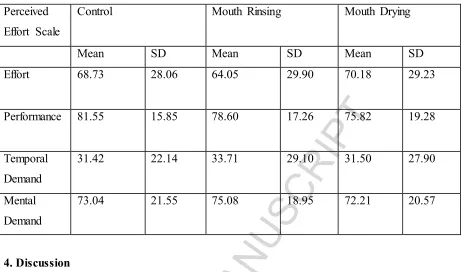
Table 2 shows perceived effort scores by condition. Perceived effort was rated only at test and none of the ratings were affected by CONDITION (Effort F (2,42) = 0.919, p = 0.407; Performance F(2,42) = 0.885, p = 0.420; Temporal Demand F(2,42) = 0.147, p = 0.864; Mental Demand F(2,42) = 0.209, p = 0.813).
ACCEPTED MANUSCRIPT
Table 2. Perceived Effort scores by condition
Perceived Effort Scale
Control Mouth Rinsing Mouth Drying
Mean SD Mean SD Mean SD
Effort 68.73 28.06 64.05 29.90 70.18 29.23
Performance 81.55 15.85 78.60 17.26 75.82 19.28
Temporal Demand
31.42 22.14 33.71 29.10 31.50 27.90
Mental Demand
73.04 21.55 75.08 18.95 72.21 20.57
4. Discussion
Our results show that children's performance on letter cancellation and digit span tasks, and ratings of subjective thirst and mood, were affected by mouth rinsing and mouth drying in the following way. Visual attention, as shown by performance on the letter cancellation task, was improved after mouth rinsing water, but drying the mouth had no effect. Memory
performance, assessed by forwards digit span, shows somewhat equivocal results with a statistically significant interaction between time of test and condition, but non-significant follow up tests. Visual inspection of mean digit span scores suggests that the largest
difference between baseline and test scores was a decrease under mouth drying, but this was not statistically significant. Subjective ratings of thirst showed an effect of condition and time of test on ratings: when receiving no intervention, thirst ratings increased significantly from baseline to test, but there were no statistically significant changes in thirst ratings in the mouth rinsing or mouth drying conditions. Subjective ratings of mood and perceived effort were no different over the three conditions.
These data support our hypothesis that visual attention would be improved by mouth rinsing and would not be contingent on thirst reduction. Our findings are in line with others who have found that performance on an attention task was not related to thirst (24) and with previous research demonstrating that drinking water improved visual attention, but did not affect subjective thirst (4). What mechanism might underlie the effect of mouth rinsing water
ACCEPTED MANUSCRIPT
on attention? Psychological explanations consider how drinking and/or wetting the mouth may affect alertness or reduce distraction associated with a dry mouth. For example, it has been suggested that drinking a small amount of water (25 mls) may improve letter
cancellation because it reduces mouth dryness, which could be distracting (4). In the present study, however, we did not find that drying the mouth with swabs resulted in poorer attention. Thus, our results suggest that wetting and drying the mouth do not have opposing effects, which might indicate that different mechanisms underlie mouth wetting and mouth drying. For example, mouth rinsing may affect attention by stimulating oropharyngeal receptors that elicit neural responses that may occur in advance of changes to hydration status (24–26). In support of this is recent work in mice that has shown directly that thirst neurons respond quickly to inputs in the mouth during eating and drinking (27). Alternatively, or additionally, a haemodynamic response could be involved, with changes in vasodilation and heart rate (5) linked to increased cerebral blood flow (2). These alternatives should be addressed by future work.
The effect of mouth drying and mouth rinsing had somewhat equivocal effects on short term memory. Other studies, using acute interventions similar to that employed here have reported that neither a large (300 ml) nor small (25 ml) drink of water improved children's forwards digit span (4). Only chronic drinking interventions over a whole school day have resulted in improved digit span (16). Taken together, these findings suggest that, in contrast to visual attention, the mechanism that underlies the effect of drinking water on memory could be hydration, and other studies support this interpretation (17,28). It is interesting that there is some indication that drying the mouth may worsen children's digit span, and this should be followed up.
In the present study, all children received treatments in the same order over three days – control, mouth rinsing, mouth drying. This was a compromise brought about as a
consequence of working in a school environment, in which it is important to reduce the impact of study participation on children’s learning. One could argue that the observed improvements in performance may have occurred via practice as a result of repeated exposure to materials. We suggest that this is unlikely because a treatment effect was only found on Day 2 (Rinsing), and not on Day 1 (Control) when performance gains would be expected to be highest if practice improves performance. Importantly, parallel forms were used for baseline and test within each day. Furthermore, if practice were a strong driver of performance changes, a similar pattern of performance improvements might have been
ACCEPTED MANUSCRIPT
expected for the short-term memory task, digit span. By contrast, the treatment effect was specific to letter cancellation performance on the day on which mouth rinsing occurred, in line with theory. However, practice remains one plausible interpretation that should be ruled out by future work, in which order of treatments is fully counterbalanced.
In the present study our method of assessing digit span required children to write down the digits that were spoken to them, rather than have them repeat them back. This approach allowed us to test multiple children simultaneously, thus limiting disruption to the school day. Digit span tests from many test batteries, such as the Wechsler scales of intelligence (29,30) require children to repeat back the digits orally in the presented order. However, not only may the written method have greater ecological validity – for example, it mirrors writing down a telephone number – written recall has been used when assessing digit span for many years (31). Furthermore, no difference has been reported in digit spans recorded under different response methods, including oral, written, or pointing to the numbers (32).
We found that drying the mouth did not increase thirst ratings over and above no
intervention. While the "dry mouth" theory of thirst has been discounted in favour of those that explain drinking via osmoreceptors and neural control of drinking (33,34), there is an empirical association between having a dry mouth and subjective thirst ratings (22). Furthermore in adults, thirst can be temporarily alleviated by rinsing the mouth with water (33), although it may require a period of gargling water substantially longer than that employed in the present study (30 minutes) (26). Our results suggest that a dry mouth may not be how children primarily experience thirst. There may also be differences between adults and children with regards to the effect of mouth rinsing, which did not result in reduced thirst ratings in our study. While studies have reported that drinking water reduces subjective thirst ratings in adults (4,11,35,36), a recent study reported the counter-intuitive finding that
children’s thirst ratings increased after a small drink (4). Relatively little is known about how the thirst mechanism operates in children (37), even though they are at particular risk of dehydration (38). It has been suggested that children need to learn how to perceive and report on the interoceptive sensation of thirst (4) and future work should examine children's phenomenological experience of thirst over childhood and consider how it matures.
Subjective ratings of happiness were not affected by the manipulations adopted in the present study. This is in line with previous work that has found that large drinks affect children’s
ACCEPTED MANUSCRIPT
mood (10,16), but smaller drinks do not (4). It is unlikely that the present study was
underpowered to find effects on mood, because the sample size is similar to others in which drinking water was found to influence mood (10). In any case, it is reassuring that our manipulations did not make the children in our study unhappy.
There was no difference in subjective ratings of perceived effort over the three conditions, for any of the four aspects of effort measured. One role for perceived effort scales is to offer a check that children were equally motivated to perform well in each condition. Our results suggest that this was indeed the case, which means that we can discount differences in effort as a spurious explanation for our findings. Another role of these measures is to offer
explanation for conditions in which one might expect a performance difference, which might not be forthcoming in the results. Thus, if performance differences were not observed, but participants reported significantly increased effort, it would suggest that the lack of difference in outcome between conditions was a result of increased effort (39). This does not appear to be the case in the present study.
It should be noted that the time of the interventions differed in the two conditions, with rinsing lasting 5 seconds and drying lasting 8 minutes. We selected the timing of these activities based on those used in previous studies in which an effect was observed, with mouth rinsing lasting 5-10 seconds (19,21) and mouth drying significantly longer (2 minutes) (22). Crucially, in all three conditions there was the same 20 minute interval between the state induced by the manipulation and test. It would be useful, in future, for a systematic evaluation to be conducted of the amount of time required for rinsing and drying
interventions to affect cognitive performance and thirst ratings.
In conclusion, the results of this study suggest that mouth rinsing without ingesting water improves visual attention in children. This effect of mouth rinsing is selective to attention; its absence for short term memory is consistent with suggestions that different domains of cognition are influenced by different mechanisms. Mouth rinsing is not associated with a change in subjective thirst, nor differences in mood or compensatory effort. This account must be approached with some caution, because it is not possible to completely rule out the effects of practice. Future work should try to eliminate the potential impact of this and also consider whether similar results are found for mouth drying and mouth rinsing in adults; previous research suggests there may be a dichotomy in the effect of drinking water on short
ACCEPTED MANUSCRIPT
term memory in children and adults (4). Finally, this work may have interesting applications for academic performance. If attention to visual material in a speeded task is improved by mouth rinsing, it might potentially improve similar aspects of scholastic behaviour, such as reading speed.
ACCEPTED MANUSCRIPT
Conflict of interest None.
ACCEPTED MANUSCRIPT
Acknowledgements
We thank two anonymous reviewers whose insightful comments helped improve and clarify the manuscript.
ACCEPTED MANUSCRIPT
Financial Support
This research did not receive any specific grant from funding agencies in the public, commercial, or not-for-profit sectors.
ACCEPTED MANUSCRIPT
References
1. Benton D, Braun H, Cobo JC, Edmonds C, Elmadfa I, El-Sharkawy A, et al. Executive summary and conclusions from the European Hydration Institute Expert Conference on human hydration, health, and performance. Nutr Rev. 2015;73:148–50.
2. Masento NA, Golightly M, Field DT, Butler LT, van Reekum CM. Effects of hydration status on cognitive performance and mood. Br J Nutr [Internet]. 2014;111(10):1841–52. Available from:
http://www.journals.cambridge.org/abstract_S0007114513004455
3. Cohen S. After effects of stress on human performance during a heat acclimatization regimen. Aviat Sp Environ Med. 1983;54:709–13.
4. Edmonds CJ, Crosbie L, Fatima F, Hussain M, Jacob N, Gardner M. Dose-response effects of water supplementation on cognitive performance and mood in children and adults. Appetite [Internet]. Elsevier Ltd; 2017;108:464–70. Available from:
http://dx.doi.org/10.1016/j.appet.2016.11.011
5. May M, Jordan J. The osmopressor response to water drinking. Am J Physiol Regul Integr Comp Physiol. 2011;300:R40–6.
6. Francesconi R, Hubbard RW, Szlyk PC, Schnakenberg D, Carlson D, Leva N, et al. Urinary and hematologic indexes of hypohydration. J Appl Physiol. 1987;62(3):1271– 6.
7. Greendale GA, Kritz-Silverstein A, Seeman T, Barrett-Connor E. Higher basal cortisol predicts verbal memory loss in postmenopausal women: Rancho Bernardo Study: Brief Reports. J Am Geriatr Sociey. 2000;48:1655–8.
8. Kirschbaum C, Wolk OT, May M, Wippich W, Hellhammer DH. Stress- and treatment-induced elevations of cortisol levels associated with impaired declarative memory in healthy adults. Life Sci. 1996;58:1475–83.
9. Booth P, Taylor B, Edmonds CJ, Dawkins L, Shahzad FZ, Ahmed SS, et al. Inspection time and cognitive abilities in twins aged 7 to 17 years: Age-related changes,
heritability and genetic covariance. Appetite [Internet]. Elsevier Ltd; 2013;108(3):75– 9. Available from: http://dx.doi.org/10.1016/j.actpsy.2016.05.009
10. Edmonds CJ, Jeffes B. Does having a drink help you think? 6-7-Year-old children show improvements in cognitive performance from baseline to test after having a drink of water. Appetite. 2009;53(3):469–72.
11. Edmonds CJ, Crombie R, Ballieux H, Gardner MR, Dawkins L. Water consumption, not expectancies about water consumption, affects cognitive performance in adults.
ACCEPTED MANUSCRIPT
Appetite [Internet]. Elsevier Ltd; 2013;60(1):148–53. Available from: http://dx.doi.org/10.1016/j.appet.2012.10.016
12. Edmonds CJ, Burford D. Should children drink more water?. The effects of drinking water on cognition in children. Appetite. 2009;52(3):776–9.
13. Benton D, Burgess N. The effect of the consumption of water on the memory and attention of children. Appetite [Internet]. 2009 Aug [cited 2013 Jul 23];53(1):143–6. Available from: http://www.ncbi.nlm.nih.gov/pubmed/19445987
14. Neave N, Scholey AB, Emmett JR, Moss M, Kennedy DO, Wesnes KA. Water
ingestion improves subjective alertness , but has no effect on cognitive performance in dehydrated healthy young volunteers. 2001;255–6.
15. Edmonds CJ, Crombie R, Gardner MR. Subjective thirst moderates changes in speed of responding associated with water consumption. Front Hum Neurosci [Internet]. 2013;7(July):1–8. Available from:
http://journal.frontiersin.org/article/10.3389/fnhum.2013.00363/abstract
16. Fadda R, Rapinett G, Grathwohl D, Parisi M, Fanari R, Maria C, et al. Effects of drinking supplementary water at school on cognitive performance in children. Appetite [Internet]. Elsevier Ltd; 2012;(July). Available from:
http://dx.doi.org/10.1016/j.appet.2012.07.005
17. Perry CS, Rapinett G, Glaser NS, Ghetti S. Hydration status moderates the effects of drinking water on children’s cognitive performance. Appetite [Internet]. Elsevier Ltd; 2015;95:520–7. Available from: http://dx.doi.org/10.1016/j.appet.2015.08.006
18. Rogers PJ, Kainth A, Smit HJ. Rapid Communication A drink of water can improve or impair mental performance depending on small differences in thirst. 2001;57–8. 19. Sinclair J, Bottoms L, Flynn C, Bradley E, Alexander G, McCullagh S, et al. The effect of different durations of carbohydrate mouth rinse on cycling performance. Physiol Nutr. 2013;14(3):259–64.
20. Rollo I, Homewood G, Williams C, Carter J, Goosey-Tolfrey VL. The Influence of Carbohydrate Mouth Rinse on Self-Selected Intermittent Running Performance. Int J Sport Nutr Exerc Metab. 2015;25(6):550–8.
21. Jeukendrup A, Rollo I, Carter J. Carbohydrate mouth rinse: performance effects and mechanisms. Sport Sci [Internet]. 2013;26(118):1–8. Available from:
https://secure.footprint.net/gatorade/prd/gssiweb/pdf/118_CarbohydrateMouthRinse-Jeukendrup_SSE.pdf
ACCEPTED MANUSCRIPT
Judged Pleasantness of Water at Different Temperatures. 1997;61(5):667–9. 23. Hart SG. Development of NASA-TLX (Task Load Index): Results of empirical and
theoretical research. Adv Psychol. 1988;52:139–83.
24. Figaro MK, Mack GW. Regulation of fluid intake in dehydrated humans: role of oropharyngeal stimulation. AJP Regul Integr Comp Physiol. 1997;272(6 Pt 2):R1740– 6.
25. Huang W, Sved AF, Stricker EM. Water ingestion provides an early signal inhibiting osmotically stimulated vasopressin secretion in rats. Am J Physiol Regul Integr Comp Physiol [Internet]. 2000;279(3):R756-60. Available from:
http://ajpregu.physiology.org/content/279/3/R756.abstract
26. Obika LFO, Idu FK, George GO, Ajayi OI, Mowoe RS. Thirst perception and drinking in euhydrate and dehydrate human subjects. Niger J Physiol Sci. 2009;24(1):25–32. 27. Zimmerman CA, Lin Y-C, Leib DE, Huey EL, Daly GE, Chen Y, et al. Thirst neurons
anticipate the homeostatic consequences of eating and drinking. Nature. 2016;537(7622):680–4.
28. Benton D, Jenkins KT, Watkins HT, Young HA. Minor degree of hypohydration adversely influences cognition: A mediator analysis. Am J Clin Nutr.
2016;104(3):603–12.
29. Wechsler D. Wechsler Adult Intelligence Scale. London: The Psychology Corporation.; 2010.
30. Wechsler D. The Wechsler intelligence scale for children - fifth edition. Bloomington, MN.: Pearson; 2014.
31. Martin M. Memory span as a measure of individual differences in memory capacity. Mem Cognit. 1978;6(2):194–8.
32. Ryan JJ, Townsend JM, Kreiner DS. Comparison of Oral, Written, and Pointing Responses to WAIS-IV Digit Span. Appl Neuropsychol Adult [Internet].
2014;21(2):94–7. Available from:
http://www.tandfonline.com/doi/abs/10.1080/09084282.2012.753076?scroll=top&nee dAccess=true&journalCode=hapn21
33. Brunstrom JM. Effects of mouth dryness on drinking behavior and beverage acceptability. Physiol Behav [Internet]. 2002;76(3):423–9. Available from: http://www.ncbi.nlm.nih.gov/pubmed/12117579
34. Rolls BJ, Rolls ET. Thirst. Cambridge: Cambridge University Press; 1982.
ACCEPTED MANUSCRIPT
dryness, thirst and stomach fullness in males and females. Appetite [Internet]. 1997;29(1):31–42. Available from: http://www.ncbi.nlm.nih.gov/pubmed/9268423 36. Edmonds CJ, Pring L. Generating inferences from written and spoken language : A
comparison of children with visual impairment and children with sight. Br J Dev Psychol. 2006;24:337–51.
37. Kenney WL, Chiu P. Influence of age on thirst and fluid intake. Med Sci Sports Exerc. 2000;33(9):1254–532.
38. Benton D, Young HA. Do small differences in hydration status affect mood and mental performance? Nutr Rev. 2015;73:83–96.
39. Scholey A, Savage K, O’Neill BV, Owen L, Stough C, Priestley C, et al. Effects of two doses of glucose and a caffeine–glucose combination on cognitive performance and mood during multi-tasking. Hum Psychopharmacol. 2014;29:434–45.
ACCEPTED MANUSCRIPT
Highlights
We investigate how mouth rinsing & drying affect children’s cognition, mood & thirst.
Mouth drying had equivocal effects.
Mouth rinsing water selectively improved children’s visual attention.