2017 2nd International Conference on Artificial Intelligence: Techniques and Applications (AITA 2017) ISBN: 978-1-60595-491-2
Citation-reason Annotation Using Crowdsourcing
Dongli Han
*, Ayato Inoue, Yousuke Yajima, Zhengliang Sun and Rina Funaki
Department of Information Science, Nihon University, 3-25-40 Sakurajosui,Setagaya-ku, Tokyo, Japan
*Corresponding author
Keywords: Citation-reason, Annotation, Crowdsourcing.
Abstract. We have proposed an idea to predict citation-reasons between scientific papers with machine-learning techniques, and try to narrow down the search range for relevant papers based on the citation-reasons. However, the machine-learning method seems not accurate enough according to a subject experiment. In this paper, as a substitution of the machine-learning method, we have proposed a strategy to annotate citation-reasons between papers in a crowdsourcing manner. An analysis on the result has shown the effectiveness of our strategy and some future tasks.
Introduction
When conducting scientific research, the first step is to acquire relevant papers. Grabbing vast numbers of papers by inputting keywords into a digital library or an online search engine could be one of the easiest way, while reading all of them to find the most relevant ones is agonizingly time-consuming.
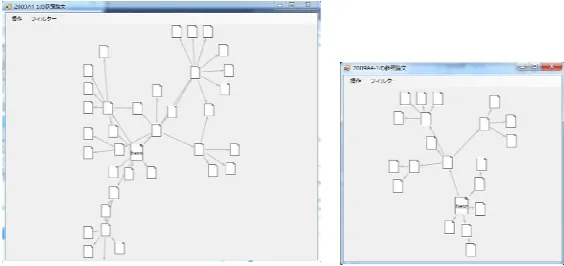
To address this issue, we have built a prototype to predict citation-reasons between scientific papers with machine-learning techniques first, and then try to narrow down the search range for relevant papers based on the citation-reasons [1]. Figure 1 shows our idea to extract the most relevant papers based on citation-reasons. Each node here represents a scientific paper, and each directed edge stands for a citation from one paper to another. The largest node in the center indicates the paper from which a search process starts at the very beginning. As shown by Figure 1, only papers with particular citation-reasons have remained as the most relevant papers finally after the refinery process.
[image:1.612.165.447.571.704.2]However, the machine-learning method seems not accurate enough according to a subject experiment [2]. In this paper, as a substitution of the machine-learning method, we have proposed a strategy to annotate citation-reasons between papers in a crowdsourcing manner. The next section first describes some previous strategies employed for crowdsourcing, then shows our own ideas, and finally elaborates how we realize them in detail. The third section describes the process of task execution and analyzes its results. Finally, we make a conclusion about the effectiveness of our strategy for crowdsourcing and some future tasks in the last section.
Strategies for Crowdsourcing
A form of employment that requests work from an unspecified number of workers on the Internet is referred to as crowdsourcing. There are many simple crowdsourcing tasks such as questionnaires. Anyone with a stable Internet environment could pick up a job on the Internet and accomplish it well if the job is simple enough. For the entrusting side, there is an advantage that the result of a particular task can be obtained at low cost in a short period of time.
As stated above, crowdsourcing allows any person to work for any task. This is an ideal form for the people willing to work. On the other side, a crowdsourcing platform or a private crowdsourcing system must have some special mechanisms to guarantee the work qualities. Many researchers have worked on this either by establishing more efficient working flows, or by creating more strict entry policies to filter bad-performance workers out [3, 4, 5, 6]. Sometimes, a Results-oriented policy is also adopted to encourage the good workers to undertake as more work as possible [7].
Our purpose here is the same as those of previous efforts, i.e., we need the citation-reason annotation task to be undertaken with good or at least acceptable accuracy. Therefore, we have optimized the working flow, entry policy, and payment rules, so that they could be applied to our citation-reason annotation task. In the rest part of this section, we will describe the ideas and how we have realized them specifically.
Reduction of Task-difficulty
Unlike the simple tasks that are conducted in the existing crowdsourcing systems, assigning a citation-reason to a paper pair is not easy. The worker has to read the citing context in the citing paper (sometimes even other parts of the citing paper), and the cited paper if necessary. Also, she must have clear understandings on the citation-reason hierarchy as shown in Figure 2.
Figure 2. Citation-reason hierarchy.
As shown by Figure 2, there are 10 different kinds of citation-reasons, which makes it not only difficult but also time-consuming to determine the most appropriate one. On the other hand, Internet workers tend to choose tasks which do not require much time or prior knowledge.
Based on this observation, we have divided the citation-reason annotation task into three sub-tasks according to the citation-reason hierarchy. For each sub-task, the worker only needs to pick one from up to three choices for any one of the three hierarchies. For example, if the worker has been asked to annotate a top-layer citation-reason, she only needs to choose one from Comparison, Use, and
Maintaining Motivation of Workers
When a worker carries out a task, her performance and work accuracy are greatly affected by her motivation for the task at that time. As the task we are talking about in this paper is much more difficult than others, we need to be more careful to maintain the workers’ motivations in order to obtain more trustable answers. Along this idea, we have added a function to show each worker her working status in real time. We believe motivation of workers can be maintained to some extent in this way. Here are the working statuses stored, updated, and shown in our system.
- Work quality level of a particular worker
- Number of tasks that a particular worker is allowed to execute on that day
- Number of tasks that a particular worker has executed and has been judged to be correct by system so far
- Total number of tasks that a particular worker has executed so far
- Number of tasks that a particular worker has executed but are still waiting for judgment by system
Efforts to Improve Annotation Accuracy
Since our annotation task is relatively difficult, the work quality tends to decrease. Also, because each annotation task has been divided into three sub-phases, in order to prevent the problem that all answers will be wrong when proceeding to Phase 2 or Phase 3 with the wrong answer in Phase 1, several efforts have been made here.
- Limit on number of executable tasks. This is to add a limit to the number of executable tasks within one day. One reason for this is that at the initial stage, there is no obvious difference between good workers and bad workers. Therefore, if we want to minimize the low-quality workers’ impact, we need to set up a relatively low limit number. As to be stated later in the section of Level up, a worker needs to increase the limit of number with her own efforts. Another reason for this is when workers execute tasks without limitation, their concentration tend to become lower, which could lead low accuracy gradually.
- Elimination of low-quality workers. In order to maintain the annotation accuracy, we take a two-step strategy to eliminate low-quality workers. First, as a preliminary exclusion, we have prepared a number of test tasks, and only workers taking the test and reaching the passing line could proceed to the real crowdsourcing. Then as the real time exclusion, our system keeps estimating the worker’s annotation accuracy and stops issuing tasks to the worker if her accuracy becomes lower than a threshold value. The estimated annotation accuracy is calculated with the following formula.
Estimated annotation accuracy = number of correctly executed tasks / (total number of executed tasks – number of executed but unjudged tasks). (1)
Here, the criteria which is used to determine the correctness of a task by the system is quite simple: a majority vote. And if the system considers the votes not enough to make a judgement, the task will stay in the waiting-for-judgement list.
- Linking with remuneration amount. We believe that it is necessary to build a mechanism allowing high-quality workers to execute as more tasks as possible to raise the annotation accuracy. In conjunction with the level-up function to be described later, high-quality workers could execute more tasks and earn more rewards compared with low-quality workers. As a result, the increase of answers of high-quality workers will undoubtedly lead to an improvement in the total annotation accuracy of our system.
- Confidence declaration. Before a task is finished, the worker is asked to declare her confidence in the result of the annotation by selecting one choice from confident and not confident. We hope the Confidence declaration function could help us grasp the reliability of each worker, and hence raise the final annotation accuracy. We will talk about this later in the next section.
Annotation by Crowdsourcing
We have built a private crowdsourcing system for citation-reason annotation with the above strategies incorporated. On the other hand, we have randomly invited 100 college students to undertake the tasks. After explaining how to execute the annotation task and how the remuneration is calculated, 35 students show their interest and execute the test task, which further reduces 6 students as the result of the preliminary exclusion.
The real crowdsourcing has been conducted twice by the 29 students, each time continuing for one week. Totally, 100 paper pairs have been selected randomly from the annual conference proceedings of ANLPJ (The Association for Natural Language Processing in Japan) and used as the target data of annotation. As described previously, each paper pair has been divided into two or three sub-tasks automatically by the system according to the real-time annotation results. For each randomly presented sub-task, the citing place will be shown to the worker together with some other information such as the chapter headline and the paper title of both the citing paper and the cited paper. Also, if the worker feels necessary, she could even click a button in the system interface to open and read the PDF-format citing paper although it will cost extra time.
First Round of Annotation
In a preliminary experiment, we have noticed that precision could be maintained by eliminating low-quality workers with a correct answer rate less than 50%. Also, if the number of tasks that have already been judged is two small when eliminating workers, there is a possibility that high-quality workers may also be eliminated together. Therefore, a threshold value is also set for the number of judged tasks. As a result, in the first round of annotation, conditions for eliminating low-quality workers are set as follows.
(number of judged tasks > 5) and (estimated annotation accuracy < 50%). (2)
In addition, the maximum number of executable tasks per day and the level-up conditions are set as shown in Table 1.
[image:4.612.127.486.616.667.2]We have carefully determined the citation-reason for the same 100 paper pairs as the correct answer by repeated deliberate discussions. With this correct answer, the accuracy of the annotation by the crowdsourcing system has been calculated. Out of 100 paper pairs, the crowdsourcing system has got final answers for 61 paper pairs, which means, the rest 39 paper pairs could not collect sufficient number of workers to finish the annotation until the final phrase. The annotation accuracy by the crowdsourcing system is 60.7% (37/61), slightly lower than we have expected.
Table 1. Maximum number of executable tasks per day and the level-up conditions Level1 Level2 Level3 Level4
Executable tasks 3 4 5 6
Necessary number of successful tasks for Level-up None 5 10 20
Necessary accuracy for Level-up None 60% 70% 80%
Second Round of Annotation
In the second round of annotation, we try to make improvement to some parameters of the system. This mainly includes those related to the problem of low completion rate (61/100) and the inability of recognizing low-quality workers in the first round.
(number of judged tasks > 5) and (estimated annotation accuracy < 60%). (3)
The conditions for eliminating low-quality workers is set as Formula (3) and the maximum number of executable tasks per day is set as Table 2.
Table 2. Maximum number of executable tasks per day. Level1 Level2 Level3 Level4
Executable tasks 3 5 7 9
The crowdsourcing system has got final answers for 91 paper pairs, and the annotation accuracy by the crowdsourcing system is 72.5% (66/91) which is better than that from the machine-learning method [2] and shows the effectiveness of the change on parameters. In addition, an investigation shows that the system succeeded in recognizing 2 out of 3 low-quality workers with a correct answer rate of less than 40%. Could this be another reason for the improvement in annotation accuracy? To make this point clear, we have carried out anther investigation. We have compared the annotation accuracy of the paper pairs in which low-quality (LQ) workers were involved and the accuracy of the paper pairs in which LQ workers were not involved. The result is shown in Table 3.
Table 3. Comparison between annotation accuracy from LQ workers and other workers.
Correct Wrong Accuracy
Number of paper pairs LQ workers are involved 20 10 67% Number of paper pairs LQ workers are not involved 46 15 75%
There is an 8% difference in the annotation accuracy depending on whether the low-quality workers were involved or not. This indicates the effectiveness of our proposal for eliminating low-quality workers in the second round.
Besides the elimination of low-quality workers, the fact that workers are becoming accustomed to the annotating process also seems to be related to the improvement in accuracy in the second round. Therefore, preparing a set of practice tasks with correct answers for the workers to warm up before starting the real annotation task might lead to further improvement in the final annotation accuracy.
In addition, we have noticed another fact through the comparison of the results from the two rounds of annotation. Annotation accuracy of paper pairs that have been annotated with the same citation-reasons in both the first and second round reached 82.6%, which is much better than the overall average (72.5%). The reason seems to be obvious. Each paper pair is annotated a couple of times and determined by unspecified majority, and doing it for multiple times simply led to increasing the number of workers. Therefore, it could be an effective strategy to increase the number of the tasks from the same paper pair when we expect to obtain more accurate results in the absence of manpower.
Relationship between Confidence and Accuracy
Using the function of confidence declaration and the correct answers, we have calculated the confidence declaration certainty as defined by Formula (4) for each worker.
The confidence declaration certainty is set to become low when the number of incorrectly executed tasks with a confident declaration is large. We consider that the worker is not able to grasp her own ability and the difficulty of the task correctly if she often incorrectly executes tasks while with confident declarations.
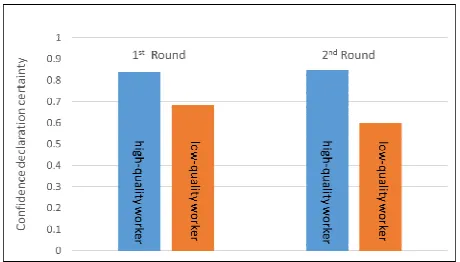
[image:6.612.191.421.240.371.2]The average confidence declaration certainty of five workers with the highest rate of correct answers and five workers with the lowest rate of correct answers have been shown in Figure 3. The average Confidence declaration certainty of high-quality workers is higher than that of low-quality workers, exceeding 0.8 in both the first and the second rounds. As some future works, we could think about defining a similar formula where the real number of incorrectly executed tasks in Formula (4) is replaced by the automatically determined number of incorrectly executed tasks, and using it in real-time annotation process to assign weights to more confident workers and gain more accurate annotation results.
Figure. 3. Relationship between confidence declaration certainty and annotation accuracy.
Conclusions
In this paper, we have built a citation-reason annotation system by crowdsourcing. The annotation results are acceptable according to the analysis on the annotation results. Especially the second round of annotation reaches 72.5% which is better than what we have obtained using the machine-learning method. A questionnaire for the various ideas in lowering the difficulty level, maintaining motivation, and improving annotation accuracy has also shown the effectiveness of our proposal. On the other hand, through the analysis on the annotation results, we have gained some Foreseeable findings which will undoubtedly help us improve our crowdsourcing system and get better annotation results in the future.
References
[1] D. Han, H. Koide, and A. Inoue, Acquisition of Scientific Literatures Based on Citation-Reason Visualization, The 11th Joint Conference on Computer Vision, Imaging and Computer Graphics Theory and Applications (VISIGRAPP 2016) - Volume 2: IVAPP, pp. 125–132, Rome (2016).
[2] H. Koide, S. Takahashi, J. Matsumoto, K. Yokobori, and D. Han, Citation Classification Using Information around the Citing Spot, IPSJ SIG Technical Report, vol. 2012-NL-209, No. 2 (2012).
[3] M.Ashikawa, T. Ikeda, Annotation Using Crowdsourcing, Journal of the Japanese Society for Artificial Intelligence, vol. 29, No. 1, pp. 54–59 (2014).
[4] H. Kashima, H. Kajino, Crowdsourcing and Machine Learning, Journal of the Japanese Society for Artificial Intelligence, vol. 27, No. 4, pp. 381–388 (2012).
[6] M. Ashikawa, T. Kawamura, and A. Ohsuga, Construction and Management of High-quality Private Crowdsourcing Platform, The 28th Annual Conference of the Japanese Society for Artificial Intelligence, 1J5-OS-18b-4 (2014).