2017 2nd International Conference on Computer Engineering, Information Science and Internet Technology (CII 2017) ISBN: 978-1-60595-504-9
An Adaptive LMMSE Interpolation Algorithm for
Channel Estimation in LTE-Advanced Systems
HUIMIN LI, ZHIZHONG ZHANG and FANG CHENG
ABSTRACT
The traditional LMMSE interpolation algorithm assumes that the terminal knows the channel power delay profile (PDP), which is not consistent with the actual situation. This paper proposes an improved LMMSE interpolation algorithm based on RMS estimation. The time-delay parameters of channel first are estimated by pilots, then LMMSE interpolation process in frequency domain is completed by LUT (looking up table) for selection of corresponding frequency domain interpolation matrix. This solves the difficulty in acquiring the second-order channel statistics in the traditional LMMSE interpolation algorithm, and avoiding the real-time inversion process of matrices. Simulation results demonstrate that this method can reduce the complexity and show a good performance of BER and MSE, thus it is more suitable for practical application.
KEYWORDS
Minimum mean square error, Channel estimation, Adaptive parameters
INTRODUCTION
In the LTE-A system, the system communication performance depends largely on the accuracy of the channel estimation. In the engineering project, the wireless channel has a very complex propagation path, which will lead to a large change in multi-path delay. If a fixed multipath delay is used, the mismatch of the correlation function can cause some loss to the channel estimation performance. The optimal LMMSE channel estimation performance can be obtained if the real-time multipath delay spread estimate is obtained according to the change of channel condition in communication and the LMMSE channel estimation parameter is adjusted accordingly. Based on this, the paper presents an adaptive LMMSE interpolation algorithm.
TRADITIONAL LMMSE ALGORITHM
The transmitted data is X , the channel frequency response is H , the received signal is Y, and the Gauss white noise is W, then the signal model is as follows:
Y XH W (1)
The expression of the LS channel estimation algorithm is as follows: ____________________________________
1 ˆ
LS
H X Y (2)
LMMSE channel estimation algorithm is as follow:
-1
ˆ ˆ
( )
p p p
LMMSE LS
HH H H
SNR H WH
W R R I (3)
In this formula, W is filtering matrix in frequency domain; RHHp is channel
autocorrelation matrix of all pilot position subcarrier in frequency domain; RH Hp p is
correlation matrix of data subcarrier and pilot sub carrier position in frequency domain; constellation factor depends on the modulation mode: for QPSK, 1; for 16QAM, 17 / 9; for 64QAM, 2.6854.
The autocorrelation matrix of the channel is related to the statistical properties of the channel, it expressed:
,H
HH m n
R E HH r (4)
1/ 2 )
, /
1
(1 )(1/ 2 (m n) )
rms
rms
L j m n N
m n L
rms rms
e r
e j N
(5)
We can see from (3), HˆLMMSE is related to RHHand SNR, and RHH is determined
by rms. The traditional approach is usually take rms a constant, but this may lead to the selected parameter values do not match the current channel, and affect algorithm performance.
ADAPTIVE LMMSE INTERPOLATION ALGORITHM
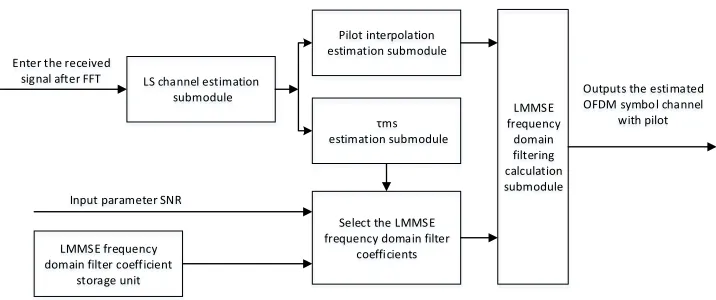
It can be seen that rms and SNR determine the MMSE filter matrix from the above LMMSE channel estimation algorithm. Based on this, the adaptive LMMSE channel interpolation algorithm is proposed in this paper is as follows:
(1)The Root Mean Square (RMS) delay spread is calculated by RMS estimation module;
(2)Get the most matching MMSE coefficients according to the LMMSE library; (3)The channel estimation of the data location is obtained by performing LMMSE interpolation on the LS channel estimate.
LS channel estimation submodule
Pilot interpolation estimation submodule
LMMSE frequency domain filter coefficient
storage unit
LMMSE frequency
domain filtering calculation submodule
Select the LMMSE frequency domain filter
coefficients τms estimation submodule Enter the received
signal after FFT
Input parameter SNR
Outputs the estimated OFDM symbol channel
[image:3.612.119.477.51.201.2]with pilot
Figure 1. Overall block diagram.
Real-Time RMS Estimation Algorithm
The LMMSE interpolation algorithm based on PDP estimation is mainly to estimate the channel power delay distribution (PDP), The PDP estimation idea is that the channel estimation value of the pilot position is obtained by the least squares method, and the time domain channel response value is obtained by IDFT transform. Then the estimated PDP can obtained by the effective path extraction of the response value of the time domain channel. And then use the estimated PDP to calculate the channel delay parameters. Finally, the channel delay parameters are substituted into the traditional LMMSE interpolation algorithm. The specific steps are:
(1) Take out the LS channel estimation value of pilots LS to do the corresponding points for the IDFT point operation.
ˆ ˆ ˆ
ˆ ( ˆ ) [ (1), (2),..., ( )]
LS IDFT LS h h h Np
h H (6)
(2) Calculate the energy P according to the channel impulse response in the time domain.
ˆ [ (1), (2),P P , (P Np)] abs( LS). ^ 2
P h (7)
(3) Find the maximum value of the energy Pmax , and set the useful signal
threshold according to the maximum value TpPmax para1. Among them, 64 is the
empirical value obtained after several simulations, which can be adjusted according to the actual situation.
(4) Find the noise energy and the noise power threshold, that is, select the value of P less than the threshold value Tp to get P1, and the average value of P1 can be considered as the energy of the noise. According to the noise energy to set the noise threshold TN, in which the value of para2 is 6 according to the simulation experience, and the parameters can be adjusted according to the actual situation.
max/ para1
N
(5) Sort the value of P . If the number of multi-path is 6, select the first six maximum values of P to get P2, and record its location information.
[ ,P Pos]sort( , 'P descend') (9)
2 [ (1), (2), P P ,P L( )]
P (10)
[Pos(1),Pos(2), Pos L( )]
,
Pos (11)
(6) Choose the values which are greater than or equal to the noise threshold
𝑇
𝑁 from P2 to get 3P and retain its position. The every value of 3P are divided by the maximum value to get Pk. And then according to the location information of 3P to obtain multipath delay.( ) / (12 )
k Pos k Ts Nfft NRB
(12)
(7) Calculate the Root Mean Square (RMS) of the delay spread.
2 2
rms
(13)
2 2
k k k
k k
P
P
(14)k k k
k k
P
P
(15)Storage and Selection of LMMSE Parameters
In order to reduce the complexity, LMMSE parameters can be calculated and stored according to different RMS and SNR. When you need to use the parameters, and then look up the table call (LUT, Look Up Table). In this paper, the LMMSE interpolation is completed by estimating the delay parameter of the channel, selecting the closest channel PDP, and obtaining LMMSE parameters through the LUT.
SIMULATION RESULTS
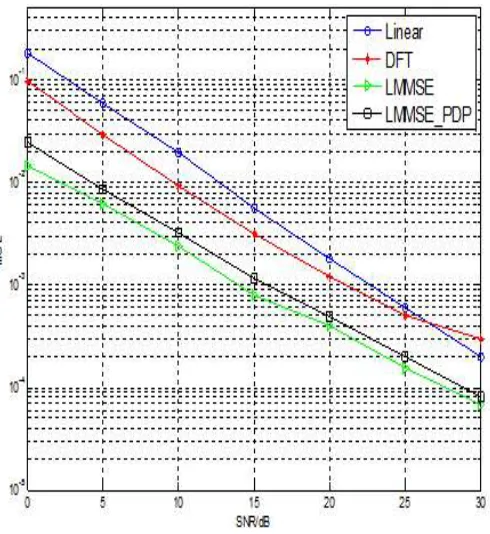
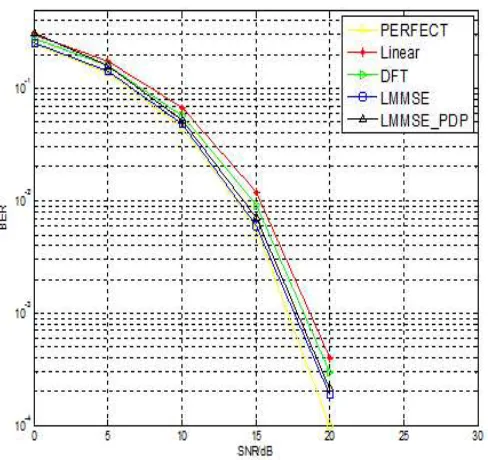
modulation mode, the transceiver antenna is configured to be 4 x 4, and the channel model is EPA. The simulation results are shown in figure 2 and figure 3.
A comparison of system error rates under different interpolation algorithms is shown in Figure 2. Among them, the "Linear" represents the linear interpolation algorithm, "Linear" represents the linear interpolation, "DFT" said interpolation algorithm based on DFT, "LMMSE" represents the ideal LMMSE interpolation algorithm, the "LMMSE_PDP" curve representing the performance of the improved LMMSE interpolation algorithm, and the curve of BER performance as a reference under ideal channel frequency response.
[image:5.612.180.425.360.627.2]We can see from Figure 2, the improved LMMSE interpolation algorithm performance slightly worse than LMMSE algorithm under ideal conditions (the algorithm requires the channel characteristics in advance) performance, but better than the linear interpolation algorithm and DFT interpolation algorithm. When the SNR is greater than 15dB, the improved LMMSE interpolation algorithm is approximated to the ideal LMMSE algorithm in MSE performance. And we can see from Figure 3, the BER performance of the ideal LMMSE algorithm is closest to the PERFECT performance of BER, and the performance of LMMSE_PDP interpolation algorithm is less than that of the traditional LMMSE algorithm. Since the improved algorithm can estimate the channel delay parameters in real time, the bit error rate is still very low under the condition of small SNR, and it is very close to the LMMSE interpolation algorithm in the ideal state.
Figure 3. BER performance curve.
SUMMARY
The implementation of LMMSE interpolation algorithm requires channel prior information, but it is often difficult to obtain in the actual environment. In view of this problem, this paper estimates the channel delay parameters effectively in the view of channel energy, and then gets more accurate autocorrelation matrix. Simulation results show that the proposed algorithm has better performance of MSE and BER. Compared with LMMSE algorithm, the proposed algorithm avoids to calculation of channel statistics directly. The complexity of the algorithm is reduced, and the efficiency of the system is improved. The algorithm is simple and feasible, so it is suitable for engineering application.
ACKNOWLEDGEMENTS
Huimin Li Email: [email protected]; the work is partially supported by Innovation Team Building Program at Institutions of Higher Education in Chongqing (KJTD201312).
REFERENCES
1. Zhiwei Chang, Zhiyong Piao, Zhenhai Jing. 2015. “An Adaptive MMSE Channel Estimation Algorithm for LTE,” J. Application of Electronic Technology. 41(12):87-89.
2. Chaopeng Li, Zhiyong Piao. 2017. “LMMSE channel estimation algorithm based on real-time computing delay spread,” J. Electronic Design Engineering. 25(1):82-85.
3. Qing Bian, He Huang, Meiling Ding. 2013. “A Simplified LMMSE Algorithm for Downlink Channel Estimation in LTE System,” J. Journal of Circuits and Systems. 18(1):322-326.