2016 International Conference on Artificial Intelligence: Techniques and Applications (AITA 2016) ISBN: 978-1-60595-389-2
Distribution Network Reconfiguration Based
on Relevance Vector Machine
Sheng ZHOU
1,*, Min-fang PENG
1, Liang ZHU
2, Hong-wei CHE
2, Zheng-yi LIU
2,
Xian-bing DING
1, Guang-ming LI
1and Da LIU
31
College of Electrical and Information Engineering, Hunan University, Changsha, 410082, China
2
State Grid Hunan Electric Power Company, Changsha 410007, China
3State Grid Jiaxing Power Supply Company, Jiaxing 314033, China
*Corresponding author
Keywords: Distribution network reconfiguration, Pattern recognition, Relevance vector machine, Load pattern, model, Minimum active power loss.
Abstract. The distribution network reconfiguration can be described as a pattern recognition problem, a method to solve this problem, which is based on the strategy of building relevance vector machine pattern recognition model of distribution network is proposed. Having better generalization ability and faster training speed, the model takes the load pattern as its input and outputs the state of the branch group after the distribution network is simplified. Finding the exact location of the branch group with connective switches by using the proposed model, then according to the improved optimal flow method to find the position of the connective switches, so as to find the optimal structure of distribution network with minimum active power loss. Results show that the proposed method can obtain a more accurate recognition result in small and medium scale distribution network.
Introduction
Distribution network is to undertake the task of distribution of electric energy in the power grid, it takes the power transmission to power users as its main responsibility. In order to improve the power quality of power users, reduce the loss of distribution network, improve the reliability of power supply, eliminate the circuit overload, etc. We can optimize the structure of distribution network. Traditional distribution network reconfiguration change its structure mainly by changing the state of the connective switches and sectional switches.
Study of the traditional distribution network reconfiguration has made obvious progress, it can be roughly divided into the following categories: (1) Mathematical optimization algorithm[1,2], by using existing mathematical optimization in distribution network reconfiguration, but the amount of calculation is too large, it’s so difficult to apply in practical engineering. (2) Heuristic algorithm,it mainly concludes the Optimal flow method[3,4] and the Branch exchange method[5,6], such algorithm calculation speed has improved, but lack of global optimization of distribution network reconfiguration. (3) Artificial intelligence algorithm[7,8,9], there are genetic algorithm, particle swarm optimization algorithm, support vector machine algorithm, simulated annealing, etc.This kind of algorithm can guarantee to get the optimal solution, but the reconfiguration time is relatively long and the solution accuracy is not enough. However, in recent years, the computational efficiency and accuracy has made a breakthrough, so we can get more applications in this field.
support vector machine (SVM) is compared with. The proposed method is proved to be better than the distribution network reconfiguration based on SVM.
RVM Pattern Recognition Model
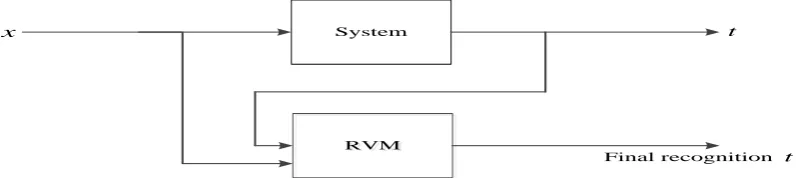
RVM pattern recognition model includes mainly two phases: (1) Training phase, for the known input
x, output t, select some data to form a set of training samples to train RVM. (2) Recognition phase, for the samples who have the unknown output, the trained RVM can get the recognition output t
according to its input x.RVM pattern recognition model is shown in Figure 1.
System
System
RVM
RVM
Final recognition t
t
[image:2.595.95.496.209.298.2]x
Figure 1. RVM model for common pattern recognition.
Simplify of Distribution Network
The distribution network has a relatively large scale, number of load nodes and branches. It also contains so many connective switches and sectional switches. Take the 69-node distribution system as an example; it can be simplified as shown in Figure 2.
0 1 2 3 4 5 6 7 8 9 10 11 12 13 14 15 16 17 18 19 20 21 22 23 24 25 26 27
28 29 30 31 32 33 34 35 36 37 38 39 55 56
42 43 44 45 46 47 48 49 50 51 52 53 54 40 41 57 58
59 60 61 62 63 64 65 66 67 68 69
20
48
3 11
13 15 66
9 0
9
11
12 13
2 3 4 5 6
7
8 10
NOTE: The dashed line represents the connective switch
1 2
3 4 5
4
[image:2.595.151.456.420.519.2]1
Figure 2. The simplification of distribution network.
In figure 2 below is a diagram of the above. Before reconfiguration, the original network is simplified according to a certain rule:
(1) Closing the connective switches and remove all the branches that are not in the loop.
(2) Except power node 0, remove all nodes whose degrees are less than 3 to the formation of branch groups and each branch group should be numbered.
3 and 4, which contains one branch, but for the second branch group, the two ends of the node is 4 and 9, which contains five branches. After simplification, the distribution network consists of five loop network, in order to keep its radial operation, each loop must open any one branch of a branch group, while some have a common branch group between loop and loop, the two loops cannot open shared branch groups at the same time. For example, the first loop network including the branch group 1, 2, 3, 8, 9; the second loop network including branch 4, 5, 9, 10. When the first loop network is selected to open on the branch 9, the second loop network can only open on the branch 4, 5 or 10. The key of distribution network reconfiguration is to find the branch group which is to be opened in each loop network, and then find the exact location of the connective switches in the branch groups, change network structure, to achieve the minimum active power loss.
Reconfiguration Based on Relevance Vector Machine
The Formation of the Input and Output
[image:3.595.182.414.470.583.2]RVM reflects the nonlinear relationship between the load pattern and the optimal structure of distribution network, it takes the load pattern as its input and outputs the state of the branch group after the distribution network is simplified. As for a distribution network, when the load value of load bus is a determined load level, we call it load pattern. After simplifying the distribution network, if the distribution network has m branch groups, load level is divided into p levels, so there is pm load pattern[11]. The output component of RVM is corresponding to a branch group in the simplified distribution network, using a set of binary data to represent the state of branch group, 0 means remaining the same, 1 represents the branch group off. If the output component value is 1, the corresponding branch group should be disconnected. As shown in Figure 2, the simplified distribution network has 13 branch groups. If you get a set of output vectors 0010010101010, the branch group number 3,6,8,10,12 should be disconnected. Load level can be divided into seven categories according to Table 1, where the load value is the percentage of the load peak value.
Table 1. Load levels of distribution network.
Load level Load value (%)
1 40
2 40-50
3 50-60
4 60-70
5 70-80
6 80-90
7 90-100
RVM model of distribution network reconfiguration
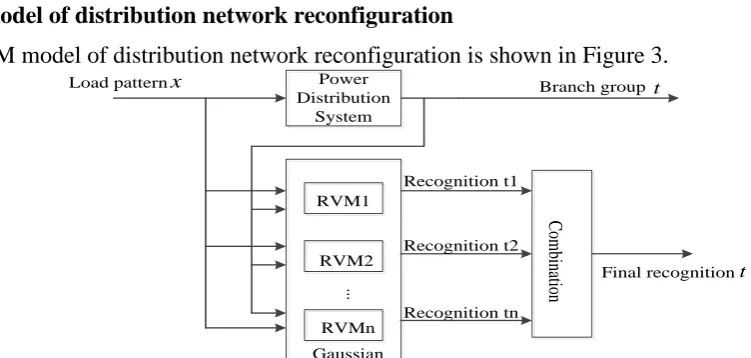
The RVM model of distribution network reconfiguration is shown in Figure 3.
...
RVM1
RVM2
RVMn
Gaussian x
Load pattern Power t
Distribution System
Recognition t1
Recognition t2
Recognition tn
Final recognition t
C
om
bin
ati
on
Branch group
[image:3.595.98.474.589.768.2]The basic RVM can only identify two kinds of pattern recognition problems, but the distribution network reconfiguration is a multi-classification pattern recognition problem[12]. In order to solve this kind of problem, it is necessary to use a combination of a number of trained RVM classifier. RVM can choose different kernel functions, such as Gaussian, Polynomial, Spline kernel function and so on. In this paper, we choose Gaussian function K x x( , )i =exp( || xxi|| / 22( 2)) as the kernel function.
For a distribution network reconfiguration, the following steps can be carried out:
(1) Simplify the distribution network according to the proposed method , find all load pattern of the distribution network. Select a certain number of training sets (x,t) and test sets (x,x’), x and x’ represents the load pattern,t and t’ represents the state of branch group.
(2) Select Gaussian function as the kernel function and train RVM.
(3) Save the trained RVM, in the case of without changing the distribution network structure, according to the existing load pattern, we can quickly output the state of the branch group.
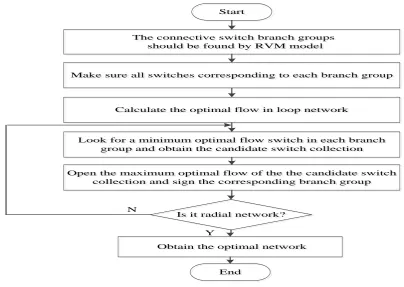
The ultimate goal of distribution network reconfiguration is to find a switch combination which minimizes the loss of distribution network. The connective switch branch groups have been found by RVM model, then we should confirm the exact location of the connective switches in the branch groups. An improved optimal flow method is proposed to find theconnective switch which should be disconnected. Finding the minimum optimal flow in a set of the branch groups in loop network, then we obtain the candidate switch collection, Next, the maximum optimal flow of the the candidate switch collection is opened, and the process is repeated until the distribution network is radial operation. Flow chart of algorithm is shown in Figure 4.
Start
Start
The connective switch branch groups should be found by RVM model
The connective switch branch groups should be found by RVM model
Make sure all switches corresponding to each branch group
Make sure all switches corresponding to each branch group
Calculate the optimal flow in loop network
Calculate the optimal flow in loop network
Look for a minimum optimal flow switch in each branch group and obtain the candidate switch collection
Look for a minimum optimal flow switch in each branch group and obtain the candidate switch collection
Open the maximum optimal flow of the the candidate switch collection and sign the corresponding branch group
Open the maximum optimal flow of the the candidate switch collection and sign the corresponding branch group
Is it radial network?
Is it radial network?
Obtain the optimal network
Obtain the optimal network
End
End N
[image:4.595.97.502.385.672.2]Y
Figure 4. Flow chart of algorithm.
Analysis of Example
pattern learning samples by using the branch exchange method. They are divided into four groups of training samples and one group of 1000 test samples. At the same time, we use SVM to do the same training and recognition. Recognition result shown in Table 2.
Table 2. Recognition result of 69-node distribution system.
Number of training samples Recognition accuracy of RVM(%)
Recognition accuracy of SVM(%)
500 92.0 92.1
1000 92.8 92.6
1500 94.0 93.4
2000 95.6 94.2
Summary
This paper describes the distribution network reconfiguration as a pattern recognition problem. Using RVM in the good performance to solve the problem of finite samples and pattern recognition, and build the RVM pattern recognition model of distribution network reconfiguration. The goal of distribution network reconfiguration is to find a network structure which minimizes the active power loss with load pattern, and the recognition result of RVM and SVM is compared with.RVM has better generalization ability and faster learning speed than the traditional machine learning method. With the increase of training samples, the recognition accuracy of RVM is higher, the recognition result is better, and it can obtain a more accurate recognition result in small and medium scale distribution network.
Acknowledgement
This work is supported by National Natural Science Foundation of China under Grant No.61472128 and 61173108, and Hunan Provincial Natural Science Foundation of China No.4JJ2150.
References
[1] Sarma N D R, Prakasa R K S.A new 0-1 integer programming method of feeder reconfiguration for loss minimization in distribution systems[J]. Electric Power System Research, 1995,33(2):125-131.
[2] Liu Bosi, Xie Kaigui, Zhou Jiaqi.Electrical distribution networks reconfiguration using dynamic programming[J]. Proceedings of the CSEE, 2005, 25(9):29-34.
[3] Shirmohammadi D, Hong H W. Reconfiguration of electric distribution networks for resistive line losses reduction[J]. IEEE Transactions on Power Delivery, 1989,4(2):1492-1498.
[4] Deng Youman, Zhang Boming, Xiang Niande. An improved optimal flow pattern algorithm for distribution network reconfiguration [J]. Power System Technology,1995,19(7):47-50.
[5] Civanlar S, Grainger J J, Yin H ,et al .Distribution feeder reconfiguration for loss reduction[J]. IEEE Transactions on Power Delivery, 1988, 3(3):1127-1223.
[6] Bi Pengxiang, Liu Jian, Zhang Wenyuan. A refined branch exchange algorithm for distribution networks reconfiguration[J]. Proceedings of the CSEE,2001,21(8):98-103.
[7] Yin Hong, Liu Tianqi, Li Fan, et al. Distribution network reconfiguration with different distributed generation based on immune genetic algorithm[J]. Proceedings of the CSU-EPSA, 2014,26(4):15-19.
[9] Hu Minxian, Chen Yuan. Simulated annealing algorithm of optimal reconstruction in distribution system[J]. Automation of Electric Power Systems,1994,l8(2):24-28.
[10] Liu Wei, Han Zhenxiang. Distribution system reconfiguration based support vector machine[J]. Automation of Electric Power System, 2005, 29(7):48-52.
[11] Wu Dengguo, Li Xiaoming. Distribution grid reconfiguration based on extreme learning machine[J]. Electric Power Automation Equipment, 2013, 33(2):47-51.