2017 2nd International Conference on Software, Multimedia and Communication Engineering (SMCE 2017) ISBN: 978-1-60595-458-5
State of Charge Estimation for Electric Vehicle Batteries Based on a
Particle Filter Algorithm
Jun BI
1,2, Yong-xing WANG
1,*and Xiao-mei ZHAO
11MOE Key Laboratory for Urban Transportation Complex Systems Theory and Technology, Beijing
Jiaotong University, Beijing 100044, China
2Beijing Jiaotong University, Weihai, Weihai 264401, China
*Corresponding author
Keywords: Electric vehicles, Battery data, State of Charge estimation, Particle filter algorithm.
Abstract. Accurate State of Charge (SOC) estimation is critical for improving the battery performance. In order to realize the accurate estimation of SOC for electric vehicle (EV) batteries, considering the complex operating mode and nonlinear characteristics of EV batteries, this paper proposes a particle filter algorithm for estimating SOC based on the battery data from EVs operating in Beijing. To determine the state-space model for EV batteries, the data are used to estimate the parameters of the model. Moreover, based on the actual collected data, the experiments are designed to demonstrate the particle filter algorithm. The results indicate that the estimation values of particle filter algorithm are close to the true values and the error is comparatively small. Therefore, the particle filter algorithm has high accuracy in the SOC estimation for EV batteries.
Introduction
State of charge (SOC) is an important parameter for electric vehicle (EV) batteries, which refers to the ratio of remaining energy to the nominal one of a battery. Accurately estimating SOC is critical to improve the energy efficiency and alleviate the battery aging. Considering the nonlinear characteristics of EV batteries, several studies attempted to use artificial intelligence methods to estimate SOC, such as artificial neural network [1], support vector machine [2] and Kalman filter [3]. Kalman filter is an optimal estimation method under the error following Gaussian white noise, which may not satisfy the actual demands. Particle filter has better performance to solve the parameter estimation problems with nonlinear or non-Gaussian systems, which is suitable to be used to dynamically estimate SOC of EV batteries [4]. For the particle filter, besides its structure, the accuracy of its estimation results is significantly affected by experimental data, because the state-space model would be determined by the data [5]. Thus, different data can result in different estimation results and accuracy. In this study, based on the battery data from EVs operating in Beijing, a particle filter algorithm is designed to estimate SOC. The data include the information of the battery status of EVs operating in roads as regular vehicles, which have representativeness for the EVs in Beijing and other similar areas. The state-space model for EV batteries is obtained by using the actual collected data. Moreover, the particle filter algorithm is applied in the data and the experimental results confirm the accuracy of the algorithm.
Data Collection and Processing
Table 1. Record sample in the data.
ID Time stamp SOC Total voltage Electric current Cell voltage 1 0510102105 74% 392[V] 36[A] 3.26[V]
However, in the raw data, the incorrect data and missing data would occur occasionally due to interference and abnormal conditions during data collection. The deletion processing is introduced to search and delete incorrect data. For the data missing problem, the interpolation processing can be used to solve it. A piecewise linear interpolation is adopted to implement the interpolation experiments. Moreover, the collected data include both the charging and discharging processes. However, this study focuses on the SOC estimation in the discharging processes during EV operating. Therefore, after obtaining the complete data, the records regarding to discharging processes need to be selected, which are stored as the experimental data.
Particle Filter Algorithm for SOC Estimation
State-space Model for EV Batteries.
In order to estimate SOC by using the particle filter algorithm, it is critical to establish a state-space model for EV batteries. The state of battery is commonly determined by the ampere–hour integral method that is used to obtain the SOC of EV batteries, as shown in Eq. (1).
0 0
( ) ( )
t i
n
n i
SOC t SOC d
C , (1)
where SOC t( ) is the SOC value at time t. SOC0 is the initial value of SOC. ni presents the
coulombic efficiency of the battery pack. ( )i is the instantaneous current of the battery pack. Cn is the rated capacity of the battery pack.
To establish the state equation of the state-space model, Eq. (1) needs to be discretized. After discretization processing, the state equation of the state-space model is:
1 ( ) 1
i
k k k
n
n t
x x i
C , (2)
where xk is the SOC value at time k.ik 1 is the current value at time k 1. t is the time interval.
Considering the characteristics of collected data, an electrochemical model is applied to establish the observation equation of the state-space model, as shown in Eq. (3).
0 1 2 3ln( ) 4ln(1 )
k k k k k k
y k Ri k x k x k x k x , (3)
where yk is the terminal voltage. R is the internal resistance. R k k k k, 0, ,1 2, 3 and k4 are the undetermined parameters.
[image:2.595.51.535.710.741.2]Eq. (2) and Eq. (3) consist of the state-space model with undetermined parameters for EV batteries. To determine the undetermined parameters in the model, a recursive least-squares algorithm was adopted to estimate the parameters based on the experimental data. Table 2 lists the results of the parameter estimation.
Table 2. Values of the undetermined parameters in the state-space model.
Parameters k0 R k1 k2 k3 k4
Values 453.771 0.127 -37.284 97.003 133.428 -1.139
particles and corresponding weight values through random sampling. The details of particle filter algorithm can be observed in Ref. [6]. The steps of the particle filter algorithm for SOC estimation are as follows.
Step1: Set initial parameters for the algorithm.
Step2: Generate the set of particles 0
1
N i
i
x through initial probability density function p x( 0),
and set the initial weight value of each particle as 1/N.
Step3: At time k, estimate xik i 1, 2, ,N by using Eq. (2).
Step4: Update the weight values of particles. Calculate the weight value of each particle at time
k. The weight value of ith particle at time k is:
2 2 ( ) 2 1 2 i k k y y i k
w e . (4)
The normalization processing needs to be implemented for the weight values, as shown in Eq. (5).
1
N
i i i
k k k
i
w w w . (5)
Step5: Evaluate the number of effective particles. If the number is less than the threshold value,
the set of particles 0
1
N i
i
x needs to be regenerated. The weight value of each particle is set as
1/N.
Step6: Implement the state estimation and obtain the estimation value
1
N
i i
k k k
i
x w x .
Step7: End the algorithm. If the iteration ends, the algorithm is terminated. Otherwise, set
1
k k and return to Step3.
Experimental Results
In order to verify the accuracy of the particle filter algorithm, the experiments are designed to estimate SOC based on the actual data of battery status. The experimental data include three complete discharging processes. The collection time of the data of the three discharging processes is on May 28th, 2015 (9:29 am-11:11am), May 31st, 2015 (18:21pm-20:08pm) and June 1st, 2015 (9:20 pm-11; 35 pm), respectively.
For the parameters of the particle filter algorithm, the number of particles N is equal to 300. Moreover, the process noise follows the normal distribution with variance equaling to 0.05. The measurement noise follows the normal distribution with variance equaling to 5. Figure 1 presents the experimental results for SOC estimation of the three discharging processes. Besides the estimation values, the true values are also be depicted in the figures.
(1) Estimation results on May 28th, 2015 (9:29 am-11:11am)
(2) Estimation results on May 31st, 2015 (18:21pm-20:08pm)
(3) Estimation results on June 1st, 2015 (9:20 pm-11:35 pm) Figure 1. Estimation results of the particle filter algorithm.
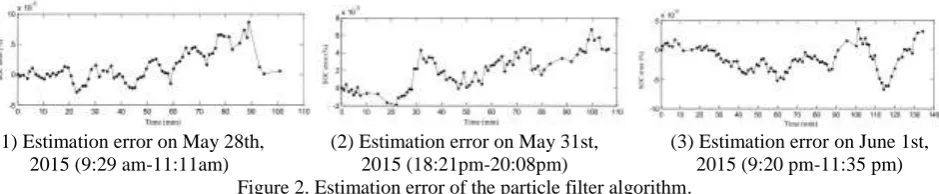
(1) Estimation error on May 28th, 2015 (9:29 am-11:11am)
(2) Estimation error on May 31st, 2015 (18:21pm-20:08pm)
(3) Estimation error on June 1st, 2015 (9:20 pm-11:35 pm) Figure 2. Estimation error of the particle filter algorithm.
[image:4.595.65.535.73.170.2]As shown in Figure 2, it is observed that the absolute values of the error for SOC estimation are less than 0.001. The results show that the error is comparatively small. To further verify the accuracy of the particle filter algorithm, root-mean-square error (RMSE) and root-mean-square relative error (RMSRE) are used as performance indexes to analyze the accuracy of the algorithm [7]. Table 3 lists the values of RMSE and RMSRE of the estimation results for the three discharging processes.
Table 3. RMSE and RMSRE of the estimation results.
Dates of the discharging processes RMSE RMSRE
May 28th, 2015 0.0028 0.0040
May 31st, 2015 0.0028 0.0037
June 1st, 2015 0.0026 0.0035
It can be observed that the values of RMSE for the three discharging processes are less than 0.003. The values of RMSRE for the three discharging processes are not larger than 0.004. The results of RMSE and RMSRE indicate that the accuracy of the particle filter algorithm is high. For SOC estimation of EV batteries, the particle filter algorithm has an acceptable estimation effect.
Conclusions
This study investigates the problems of SOC estimation for EV batteries. Considering the complex operating mode of EV batteries, a particle filter algorithm is designed to estimate SOC. The actual data of battery status from EVs operating in Beijing are applied to establish the state-space model for EV batteries. After determining the state-space model, the particle filter algorithm can realize SOC estimation through the model. Based on the experimental data, including three actual discharging processes, the experiments are designed to verify the particle filter algorithm. The results indicate that the estimation values of SOC are close to the true values. The error analysis is presented and its results show that the estimation error is comparatively small. The particle filter algorithm has high accuracy for SOC estimation. Notably, the state-space model for EV batteries considers the battery voltage, electric current and SOC. The future study will consider the effects of other parameters on SOC estimation through corresponding actual data and further improve algorithm performance.
Acknowledgement
This research is supported by Key research and development project of Shandong Province (2016GGX105004).
References
[1] C.H. Piao, W.L. Fu, J. Wang, Z.Y. Huang, Estimation of the state of charge of Ni-MH battery pack based on artificial neural network, The 31st International Telecommunications Energy Conference, INTELEC, 2009, pp. 1-4.
[3] H.W. He, R. Xiong, X.W. Zhang, F.C. Sun, J.X. Fan, State-of-Charge Estimation of the Lithium-Ion Battery Using an Adaptive Extended Kalman Filter Based on an Improved Thevenin Model, IEEE Transactions on vehicular technology, 60 (2011) 1461-1469.
[4] X. Liu, Z. Chen, C. Zhang, J. Wu, A novel temperature-compensated model for power Li-ion batteries with dual-particle-filter state of charge estimation, Applied Energy. 123 (2014) 263-272.
[5] S. Shao, J. Bi, F. Yang, W. Guan, On-line estimation of state-of-charge of Li-ion batteries in electric vehicle using the resampling particle filter, Transportation Research Part D Transport & Environment. 32 (2014) 207-217.
[6] S. Hu, Z. Jing, Overview of particle filter algorithm, Control and Decision. 20 (2005) 361–365.