2016 International Conference on Artificial Intelligence: Techniques and Applications (AITA 2016) ISBN: 978-1-60595-389-2
A Real-time Visual Tracking System with Delivery Robot
Chao LI
1,*, Chu-qing CAO
1and Yun-feng GAO
21HIT Wuhu Robot Technology Research Institute Laboratory, Wuhu, Anhui Province, China
2School of Mechatronics Engineering, Harbin Institute of Technology, Harbin, Heilongjiang Province, China
*Corresponding author
Keywords: Tracking, Luggage delivery, Real-time, Fast fourier transform.
Abstract. In this paper, we proposed a real-time visual tracking system for delivery robot. The RGB-D data are collected for environmental perception. The critical step is the tracking algorithm we utilized, this tracking algorithm must be robust, which can easily detect and locate the target, and adapt many complicated environment without loss the target. And moreover, this tracking algorithm must meet the high demand of real-time capability to fulfil the task. In the system designing, a FFT based tracking algorithm is used and the experimental results showed that this algorithm is both robust and efficient, thus is very appropriate for the luggage delivery robotic system.
Introduction
With the increasing demand of carrying luggage in the hotel industry, luggage delivery robot system becomes more and more necessary [1-3]. This kind of delivery robot automatically carries luggage and belongings for the hotel guest and follow their steps into the room, which can greatly easing the labor force, and improves work efficiency.
There are several requirements should be considered in designing this system. First, this tracking algorithm must be robust, which can easily detect and locate the target, and adapt many complicated environment without loss the target; second, this high demand of real-time capability to fulfil the task. Third, the payload of the luggage delivery robot is much higher compared to home-service robots. Finally, the interface of system is friendly and users can operate easily and expediently. In this study, we mainly focus on the selection and modification of tracking algorithm which can satisfy the practical application needs.
The luggage delivery robot need to adapt to various environmental change. Traditional tracking algorithm is easily influenced by illumination change and the problem that tracing window does not adaptively change as target scale. Recently, novel low-cost RGB-D sensors such as the Kinect became available which is capable of delivering color and depth information in real-time [4-5]. The increasing popularity of depth sensors has made it possible to obtain reliable depth easily. This may be a game changer for tracking, since depth can be used to prevent model drift and handle occlusion.
This paper presents a real-time visual tracking system with delivery robot. In section 2, a brief introduction of the related works is presented. The proposed tracking robotic delivery system is detailed in section 3. Section 4 presents the experiments and some initial results for the real-time tracking of the target. Finally, brief conclusions and future work are summarized in section 5.
Related Works
Visual object tracking is one of the core problems of computer vision, with wide-ranging applications including human-computer, surveillance, auto-driving, motion classification and medical imaging.
improving CAMSHIFT tracking method [7]. The classical multiple instance learning (MIL) [8] tracker has demonstrated good performance to handle drift. However, the MIL tracker may detect the positive sample that is less important because it does not discriminately consider the sample importance in its learning procedure.
Zhang et al. [9] proposed a simple yet fast and robust visual tracking algorithm via utilizing the spatio-temporal context. This approach formulates the spatio-temporal relationships between the target and its surrounding regions in a Bayesian framework.
Apart from algorithms, various efforts have been made on constructing RGBD datasets for computer vision tasks. Song et al. [10] constructed a unified benchmark dataset of 100 RGBD videos with high diversity, proposed different kinds of RGBD tracking algorithms using 2D or 3D model, and present a quantitative comparison of various algorithms with RGB or RGBD input.
Proposed Real-time Tracking Robotic Delivery System
[image:2.595.105.489.389.739.2]The Proposed Framework
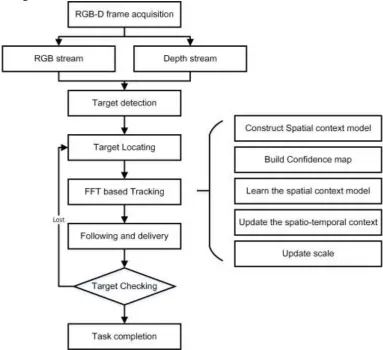
Figure 1 illustrates the whole technical of the proposed robotic delivery system. Both the RGD video stream and depth video stream are obtained from the Kinect Sensor. With combination of the two streams, we first detect the target and confirm the result with user. Once the target is confirmed, the robot will follow the target within certain distance (we set 50cm as default in this study). Then FFT based tracking algorithm is utilized to follow and deliver the luggage and articles. During the tacking, the target is continuously checking to make sure the target is not lost, or else the robot needs to relocate the target.
The Constructed Experimental Platform
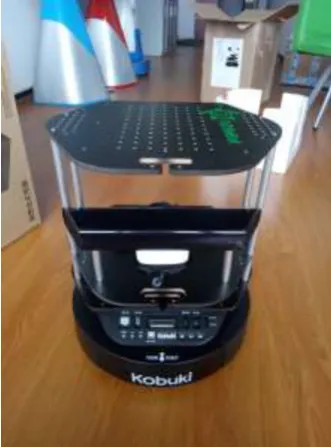
The experimental platform mainly including TurtleBot 2.0, which is a low-cost, personal robot kit with open-source software and Netbook (ROS Compatible), Kinect for windows (as shown in figure 2).
[image:3.595.214.380.134.358.2]
Figure 2. The experimental platform of TurtleBot.
The Tracking Algorithm
After detecting and locateing the target person with tracdition human detection algorithm, the FFT based tracking algorithm is used for target tracking. This algorithm proposed by Zhang et al. is chosen in our study due to several reason list as follows:
A. The Fast Fourier Transform algorithm can deal with appearance variations introduced by occlusion, illumination changes, and pose variations.
B. This algorithm is scale adaptive.
C. This algorithm can be used in both online learning and detection. The brief steps of FFT-based tracking algorithm:
First, a spatial context model is learned between the target object and its local surrounding region based on their spatial correlations. Next, the learned spatial context model is used to update a spatio-temporal context model for the next frame. A confidence map is constructed in the next frame which integrates the dense spatio-temporal context information, and the best object location can be estimated by maximizing the confidence map. Finally, the scale adaptation is added in the procedure given the estimated confidence map, thus obtained an fast and accurate result.
The Fast Fourier Transform (FFT) is adopted for learning and detection, which assured the fastness of the processing, which models the statistical correlation between the simple low-level features from the target and its surrounding regions. The author [9] further propose a novel explicit scale adaptation scheme, which is able to deal with target scale variations efficiently and effectively.
Experiments and Results
Experiment is implemented under Robot Operating System (ROS) with a mobile robot named “Turtlebot” attaching Kinect at a height of 0.6m from the ground. This experimental platform is simply designed without considering the payload. Experiments were designed and performed to validate the robustness and efficiency of the proposed delivery system.
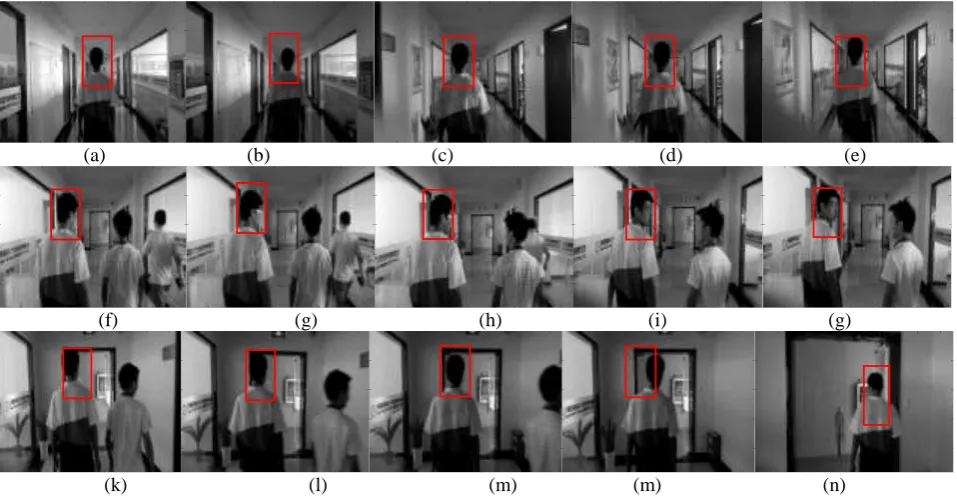
conclusion can be drawn that the FFT-based tracking algorithm is very robust and nearly influenced by the surrounding environmental changes. Moreover, the target person is walking with the normal pace, thus the detection and tracking result can totally satisfy the real-time requirement.
(a) (b) (c) (d) (e)
(f) (g) (h) (i) (g)
[image:4.595.60.539.127.375.2](k) (l) (m) (m) (n)
Figure 3. Illustration of results of the tracking algorithm how to handle the environmental changes and distractor.
Robustness. The proposed algorithm handles heavy occlusion well as most of context regions are not occluded which have similar relative spatial relations to the target center. In addition, this algorithm detect the target by combining the target appearance and its surrounding contexts, thus the method is robust to distractor.
Efficiency. The FFT-based tacking algorithm has low computational complexity. In learning the spatial context model, the confidence map and the scale updating can be pre-computed only once before tracking and the computational complexity for computing each FFT is very low.
Summary
In this paper, we presented a real-time and robust luggage delivery system tracking target people, which designed to be used on autonomous service robots. The experimental results indicated that the robot tracking algorithm is robust and fast. In the future work, we will add more test such as duration test, payload test. In addition, the navigation and interaction function will be improved for practical use.
References
[1] S. Muramatsu, K. Takahashi, S. Kudoh, Development of the robust delivery robot system with the unknown object in indoor environment, 39th Annual Conference of the IEEE Industrial Electronics Society, IECON 2013, pp 8271-8276.
[2] D. A. Rodrigues, Artificial intelligence software for the autonomous interoffice delivery robot, California State University Channel Islands, PHD thesis.
[4] O. H. Jafari, D. Mitzel, B. Leibe, Real-Time RGB-D based People Detection and Tracking for Mobile Robots and Head-Worn Cameras, International Conference on Robotics and Automation, ICRA 2013.
[5] C. Kerl, J. Sturm, and D. Cremers, Dense Visual SLAM for RGB-D Cameras, 2013 IEEE/RSJ International Conference on Intelligent Robots and Systems, 2013, pp 2100-2106.
[6] G. R. Bradski, Computer vision face tracking as a component of a perceptual user interface, in In Proc. of the IEEE Workshop on Applications of Computer Vision, 1998, pp. 214-219.
[7] J. G. Allen, R. Y. D. Xu, and J. S. Jin, Object tracking using camshift algorithm and multiple quantized feature spaces, in Proceedings of the Pan-Sydney area workshop on Visual information processing. Darlinghurst, Australia: Australian Computer Society, Inc., 2004, pp. 3-7.
[8] X. Zeng, Y. Gao, S. Hou, S. Peng, Real-Time Multi-scale Tracking via Online RGB-D Multiple Instance Learning, Journal of Software, 2015.
[9] K. Zhang, L. Zhang, Q. Liu, D. Zhang, M. H. Yang, Fast visual tracking via dense spatio- temporal context learning, the 12th European Conference on Computer Vision (ECCV), 2014.