2016 International Conference on Computational Modeling, Simulation and Applied Mathematics (CMSAM 2016) ISBN: 978-1-60595-385-4
Rapid Solidification Processing of Ag-5%Bi Alloy under Microgravity
Condition inside Drop Tube
Wei-li WANG, Ao WANG, Xiao-yu LU, Sheng-bao LUO and Bing-bo WEI*
Department of Applied Physics, Northwestern Polytechnical University, Xi’an 710072, China*Corresponding author
Keywords: Rapid solidification, Microgravity, Undercooling, Dendritic growth.
Abstract. Liquid Ag-5%Bi alloy has been rapidly solidified in the form of 84-1140 µm droplets under free fall condition. The results show that there are dendritic (Ag)1 phase, interdendritic (Ag)2 phase
and (Bi) solid solution phase in this alloy respectively. The microstructure of (Ag)1 phase displays a
conspicuous “dendritic-equiaxed” morphology transition with the decrease of droplet diameter, which is attributed to the fragmentation of dendrites induced by the recalescence of highly undercooled liquid alloy. The theoretical analysis with the LKT/BCT dendritic growth model predicts that the growth velocity of (Ag) dendrite increases with undercooling, and the kinetics transition from solute diffusion-controlled growth to thermal diffusion-controlled growth occurs at 98 K during solidification. Meanwhile, the remarkable solute trapping effect takes place according to theoretical calculated calculation.
Introduction
The rapid solidification of metallic alloys under high undercooling has the advantage of extended solubility, the refined microstructures and the formation of metastable phases[1-5]. Microgravity is expected to enhance the priority of high undercooling since the thermal convection and the gravity induced segregation can be neglected during containerless solidification[6-8]. Drop tube technique is an effective approach to combine the favourable physical conditions such as rapid cooling, high undercooling, microgravity environment and containerless state[9-11]. Dendrites are a common morphology in various alloys, their growth velocity and structure have a profound effect on the properties of metallic materials[12-14]. The containerless rapid solidification of highly undercooled liquid alloys is provided an advanced way to investigate the dendritic growth kinetics, microstructural transformation, and solute distribution characteristics. For binary alloy systems, the rapid growth kinetics of a single solid-solution phase can be well characterized by the Lipton-Kurz-Trivedi model for free dendrite growth inside undercooled liquid alloys[3,11-15].
The traditional research of Ag-Bi alloy mainly focus on the application features of eutectic or near-eutectic point owing to the narrow solidification temperature range, such as magnetic, Vickers microhardness, or Microstructures at different annealing temperatures[16-19]. But for hypoeutectic Ag-Bi alloy, especially for the single-phase alloy, the study on the crystal growth mechanisms is less reported because it has the broad solidification temperature range, complicated solidification and dynamic process. The phase diagram of binary Ag-Bi alloys exhibits a retrograde solidus line, which will induce the remelting phenomenon of some alloys. The main objective of this work is to rapidly solidify Ag-5%Bi alloy by drop tube technique and to explore its microstructural evolution within the broad freezing temperature range. Based on the LKT/BCT model, the dendritic growth kinetics of the solidification process is analyzed.
Experimental Procedure
diameter at the bottom and is installed on the top of a 3m drop tube. The drop tube is then evacuated to 2.0×10⁻⁴ Pa and backfilled with a mixture gas of He (99.995%) and Ar (99.999%) to 1×10⁵ Pa. Superheating to 200~300 K above the liquids temperature is accomplished by induction heating. After that, the bulk sample is dispersed into small droplets by high pressure Ar jetting gas which fall down freely. Their solidification structures and solute distribution profiles were investigated with FEI Sirion electron microscope (SEM) and INCA Energy 300 energy dispersive spectrometer (EDS).
Results and Discussion
[image:2.612.98.513.181.500.2]
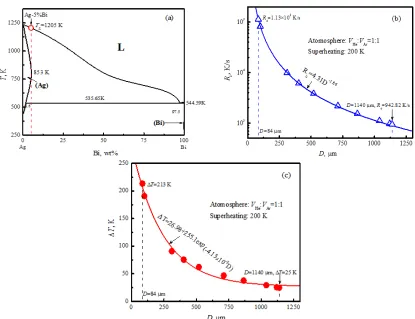
Figure 1. Processing parameters of Ag-5%Bi alloy: (a) selection of alloy composition in phase diagram, (b) calculated cooling rate of alloy droplets, and (c) predicted undercooling for alloy droplets.
Figure.1 (a) shows the location of binary Ag-5%Bi alloy in the equilibrium diagram, which is tangent to the solidus line and the corresponding liquidus and solidus temperatures are 1205 K and 535.65 K respectively, the solidification temperature range is 669 K(0.56 TL). From the diagram, the (Ag) solid
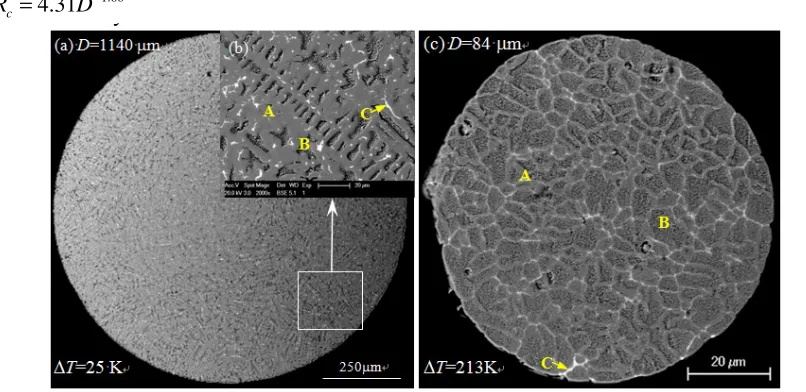
solution forms at the temperature of 1205 K, then the remelting phenomenon takes place at the temperature of 853 K. During the experiment, a bulk sample of alloy melts is dispersed into a great number of small droplets and these droplets then fall freely in the drop tube, binary Ag-5%Bi alloy was rapidly solidified in the form of droplets with 1140-84 µm diameters inside a drop tube. Figure.2 shows the typical microstructural patterns under free fall condition. In the larger droplets, such as
D=1140 µm in Figure. 2 (a) and (b), the microstructure is characterized by coarse dendrites. Once
droplet diameter is less than 403 µm, the microstructure consists of the major equiaxed grains and minor fragments of dendrites. Instead, the branched dendrites are replaced entirely by the unique equiaxed grains when the droplet size reduces to D=84 µm as shown in Figure. 2 (c). Consequently, a
cooling rate display in Figure.1 (b), which increases with the decrease of droplet diameter. For example, the droplet with the diameter D=1140 µm, the cooling rate Rc is 942.82 K/s. For the droplet
with D=403 µm, Rc=6.16×10³ K/s. The maximum cooling rate Rc=1.13×10⁵ K/s is predicted for the
smallest droplet with D=84 µm. Clearly, the smaller droplet has the larger cooling rate, which is
expressed by:
1.86
4.31
c
[image:3.612.98.501.153.349.2]R = D− (1)
Figure 2. The solidification microstructures of binary Ag-5%Bi alloy with different droplet diameters: (a) D=1140 µm,
(b) the enlargement for frame (a), and (c) D=84 µm.
Meanwhile, the undercooling shows the same characteristics with the cooling rate, as seen in Figure.1 (c). When the droplet diameter D=1140 µm, the undercooling ∆T=25 K. The droplet
diameter reduces to 403 µm, the undercooling attains 76 K. The maximum undercooling of 213 K acquires at the smallest droplet diameter of 84 µm. The relationship between the undercooling and droplet diameter is written as:
3
26.98 255.1exp( 4.13 10 )
T − D
∆ = + − × (2)
Apparently, this structural transition is attributed to the cooling rate and undercooling, which leads to the fragmentation of dendrites induced by the recalescence of the rapidly solidified of high undercooling and liquid alloy.
Furthermore, three kinds of morphologies present at different droplet diameters, which are labelled by A, B, and C zones respectively. In order to identify the phase characteristics, the chemical compositions are detected by the energy dispersive spectroscopy (EDS) analysis. The solute content of the dendrite feature which is labelled by A zone acquires 2.2 at.% Bi at the droplet of 1140 µm, it increases with the decline of the droplet diameter, the maximum content of 4.04 at.% obtains in the 84
µm droplet. Similarly, the solute content of interdendritic structure labelled by B zone is 0.82 at.% Bi at the droplet of 1140 µm, which slightly grows with the decrease of droplet diameter, the 1.85 at.% Bi acquires in 84 µm droplet. Therefore, the microstructure of A zone is represented by (Ag)1 solid
solution phase, and the interdendrite structure of B zone is identified by (Ag)2 solid solution phase.
Otherwise, the white phase is also analyzed by EDS method, which shows 19.88 at.% Ag solute content. It is clear that this phase is (Bi) solid solution phase. Combined with the phase diagram showed in Fig.1 (a), the (Ag)1 phase begins to crystallized at 1205 K in the cooling process. Then the
remelting phenomenon takes place when the temperature reduces to 853 K, and (Ag)2 solid solution
The kinetics process of dendritic growth for liquid Ag-5%Bi alloy is analysed according to LKT/BCT dendritic growth model[11-15], which determines the interrelation between dendrite growth velocity V, dendrite tip radius R and liquid alloy undercooling ∆T by the following two
coupled equations:
c t r k
T T T T T
∆ = ∆ + ∆ + ∆ + ∆ (3) * ' L 0 h t /
2 (1 ) T
-1 (-1 ) ( )
v c
t c
v v c
R
m C k P
P
k I P
σ ξ ξ Γ = − ∆
[image:4.612.90.535.135.546.2]− − (4)
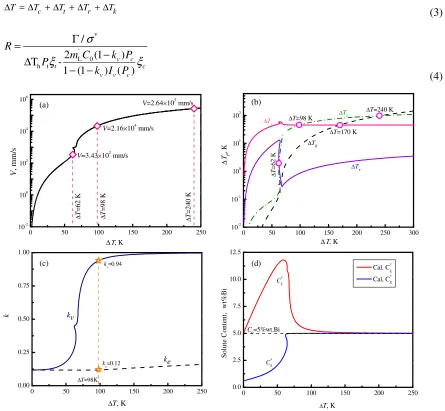
Figure 2. The kinetic mechanism features of dendritic growth inAg-5%Bi alloy at different undercoolings: (a) dendritic growth velocity, (b) partial undercoolings, (c) solute partition coefficient,
and (d) solute concentrations at liquid/solid interface.
where ∆Tt represents the thermal undercooling, ∆Tc the solutal undercooling, ∆Tr the curvature
undercooling, and ∆Tk the kinetic undercooling. C0 is the alloy composition, Γ the Gibbs-Thomson
coefficient, σ* the stability constant, ∆Th the hypercooling limit, Pt and Pc the thermal and solutal
Peclet numbers, ξt and ξc the thermal and solutal stability functions, Iv(Pc) the solutal Ivantsov
function, kv the effective solute partition coefficient, and mL' the effective liquids slope. Because the
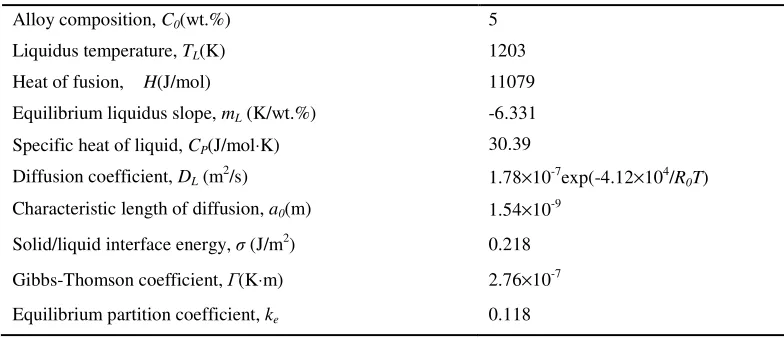
initial form of LKT/BCT dendrite growth model requires linear liquidus and solidus lines, some modifications have to be made for the case of Ag-Bi alloys which show a nonlinear liquids line. The physical parameters are listed in Table.1.
The growth velocity of (Ag) dendrite is plotted in Figure. 3 (a). It increases with the increase of the undercooling. It is divided into three parts with the increase of undercooling: sluggish, medium and rapid growth respectively. As the undercooling is less than 62 K, the dendritic growth velocity of (Ag)
0 50 100 150 200 250
0.0 2.5 5.0 7.5 10.0 12.5
Cal. C*L Cal, C* S
C* L
∆T, K
S o lu te C o n te n t, w t% B i C* S C 0=5%wt.Bi (d)
0 50 100 150 200 250 300
10-2 10-1 100 101 102 (b)
∆T=240 K
∆T=170 K
∆ T = 6 2 K
∆T=98 K
∆T r ∆T k ∆T t ∆T c ∆ ΤP , Κ
∆Τ, Κ
0 50 100 150 200 250
0.00 0.25 0.50 0.75 1.00 k v=0.94 k e=0.12 (c) ke k
∆T, K
kv
∆T=98K
0 50 100 150 200 250
10-2 100 102 104 106
V=2.64×105 mm/s
∆ T = 2 4 0 K
V=2.16×104 mm/s
V=3.43×102 mm/s
∆ T = 9 8 K (a)
∆Τ, Κ
phase increases sluggishly with the undercooling. Subsequently, the dendritic growth velocity accelerates between the undercooling 62 K and 98 K. Once the undercooling exceeds 98 K, it presents the rapid dendritic growth velocity. The reason is described by the relationship between the four partial undercoolings and the total bulk undercooling. Apparently, the solutal undercooling ∆Tc
dominates the dendrite growth when ∆T<98 K, which is corresponding the sluggish dendritic growth velocity and coarse dendrites. With the increase of the total bulk undercooling, the thermal undercooling ∆Tt rapidly increases and even exceeds the solutal undercooling ∆Tc at 98 K so as to
become dominant factor for dendrite growth, which presents the rapid dendritic growth velocity and refined structure. The kinetic undercooling ∆Tk shows a continuous growth in the whole undercooling
range, which exceeds the thermal undercooling ∆Tt at 240 K and becomes the principal influencing
factor on the dendritic growth. The curvature undercooling ∆Tr also rises as the bulk undercooling
increases till abruptly decreases at 62 K. These results indicate that the kinetics transition from solute diffusion-controlled growth to thermal diffusion-controlled growth occurs at ∆T=98 K for (Ag)
[image:5.612.109.501.278.447.2]dendrites during the solidification of Ag-5%Bi alloy.
Table 1. Physical parameters of Ag-5%Bi alloy used for calculations.
Alloy composition, C0(wt.%) 5
Liquidus temperature, TL(K) 1203
Heat of fusion, H(J/mol) 11079
Equilibrium liquidus slope, mL (K/wt.%) -6.331
Specific heat of liquid, CP(J/mol⋅K) 30.39
Diffusion coefficient, DL (m
2
/s) 1.78×10⁻⁷exp(-4.12×10⁴/R0T)
Characteristic length of diffusion, a0(m) 1.54×10⁻⁹
Solid/liquid interface energy, σ (J/m2) 0.218
Gibbs-Thomson coefficient, Γ(K⋅m) 2.76×10⁻⁷
Equilibrium partition coefficient, ke 0.118
Figure.3 (c) demonstrates the equilibrium and effective solute partition coefficients. Obviously, the calculated equilibrium solute partition coefficients ke increases slightly with undercooling whereas
the effective solute partition coefficients kv increases rapidly when the undercooling is larger than 25
K. If the undercooling increases to 98 K, the effective solute partition coefficients kv value is 0.94,
which is more about 8 times larger than the ke value. Then it increases slowly with the undercooling.
Clearly, the transitional undercooling from solutal to thermal has the significant influence on the effective solute partition coefficient, corresponding the remarkable solute trapping effect. The variations of the liquid concentration CL* and the solid concentration
*
S
C at the liquid/solid interface
with undercooling are calculated by using the LKT/BCT model. The solid concentration at the liquid/solid interface increases rapidly with undercooling when the undercooling is below 62 K, then it attains actual concentration of Ag-5%Bi alloy. It is clear that the solute trapping effect takes place according to the calculated results.
Conclusions
The liquid Ag-5%Bi alloy, which has a broad solidification temperature range of 669 K(0.56 TL), has
been rapidly solidified in form of droplets with 84-1140 µm diameter under free fall condition. The theoretical calculation demonstrates that the smaller droplet has the higher cooling rate and the larger undercooling. Microstructures show that there are three kinds of phases in this alloy, which is analyzed by EDS method and displayed dendritic (Ag)1 phase, interdendritic (Ag)2 phase and (Bi)
induced by the recalescence of highly undercooled liquid alloy. The analysis with the LKT/BCT theory of rapid dendritic growth predicts that the growth velocity of (Ag) dendrite increases with undercooling, and the kinetics transition from solute diffusion-controlled growth to thermal diffusion-controlled growth occurs at 98 K undercooling during the solidification of Ag-5%Bi alloy. On the other hand, the remarkable solute trapping effect takes place according to the theoretical results.
Acknowledgement
The authors are grateful to Z.C. Xia, Y. H. Wu and L.H.Li for their help with experiment and calculation. The financial supports by National Natural Science Foundation of China (51571163, 51371150, 51271150, and 51327901) are acknowledged with gratitude.
References
[1] A.L. Ramirez-Ledesma, E. Lopez-Molina, H.F. Lopez, J.A. Juarez-Islas, Athermal ε-martensite
transformation in a Coe20Cr alloy: Effect of rapid solidification on plate nucleation, Acta Mater., 111 (2016) 138-147.
[2] J. E. Spinelli, B. L. Silva and A. Garcia, Microstructure, phases morphologies and hardness of a Bi–Ag eutectic alloy for high temperature soldering applications, Mater. Design, 58 (2014) 482-490.
[3] H. P. Wang, W. J. Yao, and B. Wei, Remarkable solute trapping within rapidly growing dendrites, Appl. Phys. Lett., 89 (2006) 201905.
[4] C. Kenel and C. Leinenbach, Influence of cooling rate on microstructure formation during rapidsolidification of binary TiAl alloys, J. Alloys Compd., 637 (2015) 242-247.
[5] J. Kundin, L. Mushongera, H. Emmerich, Phase-field modeling of microstructure formation during rapid solidification in Inconel 718 superalloy, Acta Mater., 95 (2015) 343-356.
[6] C. Steliana and T. Duffar, Numerical modeling of CdTe crystallization from Te solution under terrestrial and microgravity conditions, J. Cryst. Growth, 400 (2014) 67-75.
[7] T. Okutani, Y. Kabeya and H. Nagai, Thermoelectric n-type silicon germanium synthesized by unidirectional solidification in microgravity, J. Alloys Compd., 551 (2013) 607-615.
[8] T. Konishia, H. Nagai, Y. Nakata and Takeshi Okutani, Microstructure and magnetic properties of Sm2Fe17 alloy prepared by unidirectional solidification in microgravity, J. Magn. Magn. Mater., 269 (2004) 48-53
[9] O. Oloyede, T. D. Bigg, R. F. Cochrane and A. M. Mullis, Microstructure evolution and mechanical properties of drop-tube processed, rapidly solidified grey cast iron, Mater. Sci. Engin. A, 654 (2016) 143-150.
[10] L.L. Ge, R.P. Liu, G. Li, M.Z. Ma and W.K. Wang, Solidification of Al–50 at.%Si alloy in a drop tube, Mater. Sci. Engin. A, 385 (2004) 128-132.
[11] W.L. Wang, Y.J. Lü, H.Y. Qin and B. Wei, Dendrite growth characteristics within liquid Fe-Sb alloy, Sci. China Ser. G-Phys. Mech. Astron., 52 (2009) 720-728.
[12] S. Onel and T. Ando, Application of a simple subregular solution model to the computation of phase boundaries and free dendritic growth in the Ag-Cu system, Acta Mater., 113 (2016) 109-115.
[14] Z.J. Wang, J.J. Li, J.C. Wang and Y.H. Zhou, Phase field modeling the selection mechanism of primary dendritic spacing in directional solidification, Acta Mater., 60 (2012) 1957-1964.
[15] J. Lipton, W. Kurz and R. Trivdi. Rapid dendrite growth in undercooled alloys. Acta Metall., 35 (1997) 957-964.
[16] N.T. Cherpak, A.A. Lavrinovich, T.A. Smirnova, P. Haldar and D. Hazelton. HTS Bi-2223/Ag tape-based Troxel magnetic system. Cryogenics, 39 (1999) 791-793.
[17] A.Y. Ilyushechkin, T. Yamashita and I.D.R. Mackinnon. Re-melting of Bi-2212/Ag laminated tapes by partial melting process. Physica C, 377 (2002) 362-371.
[18] W. Guo, G. S. Zou, A. P Wu, Y. Y. Wang, H. L. Bai and J. L. Ren. Study of air heat treatment on Bi-2223/Ag superconducting tapes. Physica C, 469 (2009) 778-781.
[19]J. E. Spinelli, B. Luiz Silva and A Garcia. Microstructure, phases morphologies and hardness of a Bi-Ag eutectic alloy for high temperature soldering applications. Materials and Design, 58 (2014) 482-490.
[20] Lee E. and Ahn S. Solidification Progress and Heat Transfer Analysis of Gas-Atomized Alloy Droplets during Spray Forming. Acta Metall. Mater., 42:9 (1994) 3231-3243.