2017 International Conference on Mathematics, Modelling and Simulation Technologies and Applications (MMSTA 2017) ISBN: 978-1-60595-530-8
SQL Codes to Implement the Bayesian Classification
Na LI
*, Lin-tong ZHANG and Zhi-gang ZHANG
University of Science and Technology Beijing, Beijing, China *Corresponding author
Keywords: Bayesian classification, Recursive algorithm, SQL.
Abstract. Bayesian classification is a hotspot of machine learning, the purpose of this paper is to train an efficient Bayesian classification based on SQL. It expounded the Bayes' theorem and the concept of Bayes classifier as the foundation, and then, used the recursive algorithm to create a Bayesian data set; the SQL query codes to count classification properties, decision attribute values and class-condition in the training sample, and to calculate the corresponding probability; and the SQL query - update codes to mark the most optimal decision value, thus, the high accuracy of Bayesian classifier model had been trained. Further, we applied the above classification system to predict and determinate the students' grades. It is preliminarily shown that Bayesian classification method has
better application prospect in predicting students’ grades.
Introduction
Bayesian decision theory is the basic method of decision-making in probability framework. Its classification task is based on the given probability and misjudgment loss to select the most optimal classification marks. This paper will introduce a Bayesian classifier system—apply the students' given grades to train out a Bayesian classifier with a higher performance, thus, by doing this, the students’ grades can be well predicted, and such Bayesian classifier has a higher rate of anticipation.
Bayesian Classifier Bayesian Decision Theory
The principle of the Bayesian decision theory [1, 3, and 4] is to decide the credibility of discriminating as a certain decision value by calculating the conditional probability of an event, this ultimate result is the probability distribution of random variables. Bayesian decision theory, based on the Bayesian theory, will apply the prior probability to calculate the posterior probability. Finally, it will make a reasonable decision by calculating the probability.
Bayes' theorem is used to describe the relationship between two conditional probabilities:
1 1 2 2
1 1 2 2
1 1 2 2
1 1 2 2
1 1 2 2
( , , , , )
( | , , , )
( , , , )
( ) ( , , , | )
( , , , )
n n
n n
n n
n n
n n
P X x X x X x Y y
P Y y X x X x X x
P X x X x X x
P Y y P X x X x X x Y y
P X x X x X x
(1)
Y
: the decision classes;y
: the decision values;x
i: the attribute values in the ith attributeXiofthe sampleX . (i1, 2,, )n
There into, (P Y y)is the class “prior” probability: P X( 1x X1, 2x2, , Xn x Yn| y)is the
class-conditional probability of sample X relative to class notation Y ;
1 1 2 2
( , , , n n)
P X x X x X x is the "evidence" factor for normalization, that is, the same property
values for the same attribute of the sampleX can be grouped together. Therefore, the question of
( )
P Y y and class-conditional probability P X( 1x X1, 2x2, , Xn x Yn| y) based on training
samplesX .
Naive Bayesian Classifier
According to formula (Eq. 1), the difficulty of obtaining the posterior probability
1 1 2 2
( | , , , n n)
P Y y X x X x X x is that: the class-conditional probability
1 1 2 2
( , , , n n| )
P X x X x X x Y y is the joint probability of all attributes. Therefore, we make
an "attribute conditional independence assumption"[2], that is, each property is independent of each other, and the classifier under this assumption is called the naive Bayesian classifier.
1 1 2 2
1 1 2 2
1 1 2 2
1
1 1 2 2
( ) ( , , , | ) ( | , , , ) ( , , , ) ( ) ( | ) ( , , , ) n n n n n n n i i i n n
P Y y P X x X x X x Y y
P Y y X x X x X x
P X x X x X x
P Y y
P X x Y y
P X x X x X x
(2)Y: the decision classes; y: the decision values;
x
i: the attribute values in the ith attributeXiofthe sampleX . (i1, 2,, )n
Therefore, the expression of the naive Bayesian classifier [5] is:
1 1 2 2
1
(
,
, ,
) argmax (
)
n(
|
)
nb n n i i
y Y i
h
X
x X
x
X
x
P Y
y
P X
x Y
y
. (3)Bayesian Classifier Instance
The following table is an existing data examples (Table 1), the method is to create a Bayesian data set by using the Cartesian product operation, and to train a naive Bayesian classifier by the relationship between the classification attributes and decision attributes, thus, the data are optimally discriminated:
Table 1. An existing data examples.
First step: estimate the class “prior” probabilityP Y( y) , which represents the classification
attribute of "default loans":
3
( " ") 0.3,
10 7
( " ") 0.7,
10
default loans
default
P Yes
P loans No
Second step: by using the formula (Eq. 1), determine the conditional probability of each attribute
( i i| )
P X x Y y ,i 1, 2 . Here X1 is the attribute of "house", and X2 is the attribute of "marriage”:
" "|" "
3
( " " " ") 0.429, 7
own house No defa
P P house Yes ult loans No
ID House Marriage Default Loans ID House Marriage Default Loans
1 Yes Single No 6 No Married No
2 No Married No 7 Yes Divorced No
3 No Single No 8 No Single Yes
4 Yes Married No 9 No Married No
" "|" "
2
( " " " ") 0.667, 3
Single Yes
P P Marriage Single default lo na s Yes
" "|" "
2
( " " " ") 0.286, 7
Single No
P P Marriage Single default loans No
Third step: by using the formula (Eq. 2), make decisions on the sample data set:
" "|" " " "|" "
(
efault l
"
")
own house Yes Single Yes0,
P
d
oans
Yes
P
P
" "|" " " "|" "
(
efault lo
" "
)
own house No Single No0.086,
P d
a s
n
No
P
P
“own-house” and “single” people have a larger probability of not-defaulting on the loans, therefore, the naive Bayesian classifier discriminates the “own-house” and “single” people as "not-default loans".
SQL Implements Bayes Classifier Algorithm Principle
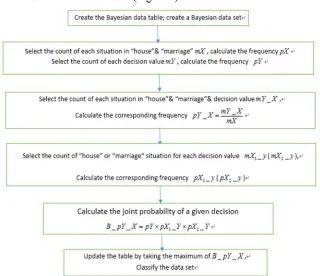
In order to better present the thorough consideration of Bayes classification, the first step, use recursive algorithm to compute the Cartesian product of multiple attribute values corresponding to each attribute in the sample, and then, create a data set of Bayesian classification, this step is the foundation of the success within the whole algorithm; the second step, for each case in the data set, use the SQL codes to query the records of the classification attribute, decision values and the class-condition in the sample table, and then, count and calculate the corresponding probability, this step is the core of the success within the whole algorithm; the third step, the assumptions is the "naive Bayes classifier", therefore, calculate the joint probability of a given decision value, (which is the continuous multiplication of the class-conditional probability) take the most probable decision value, and finally, the optimization of Bayesian classifier is realized.
Algorithm Implementation
[image:3.612.133.453.454.730.2]The algorithm flow chart is as follows (Figure 1):
Some SQL codes are as follows: 1. Delete the Bayesian data table
drop table FL_Bayes_Demo
2. Create the Bayesian data table
create table FL_Bayes_Demo ( ID integer, X1 varchar(10), X2 varchar(10), Y varchar(10), mX integer, pX float, mY integer, pY float,mY_x integer, pY_x float, mX1_y integer, mX2_y integer, pX1_y float, pX2_y float, B_pY_X float, cY_X varchar(1) )
The meaning of each field is:
1
X : availability of housing;X2:marital status ;
Y
:the situation of delinquent loans;1
x : attribute values of housing “Yes/No”;
2
x : attribute values of marital status "single/married/divorced”;
mX
: count of X1 x X1, 2 x2;p X :frequency of X1x X1, 2 x2;y
: the decision value of the default loans “Yes/No”;mY
: count of Y y;p Y :frequency of Y y;_
mY X : under the condition of X1x X1, 2 x2,calculate the count of Y y;
_
pY X : under the condition of X1x X1, 2x2, calculate the frequency of Y y;
1_
mX y: under the condition of Y y,calculate the count of X1 x1;(mX2_yin the same way
)
1_
pX y: under the condition of Y y,calculate the count of X1 x1;(pX2_yin the same way
)
_ _
B pY X : apply formula (Eq. 3), to Continuous multiplication pY pX1_Y pX2_Y;
_
cY X : apply formula (Eq. 3), Take the same property valueX1x X1, 2x2, the maximum value
under different decision values y is used to the classification.
3. Create a Bayesian classification data set ----recursive algorithm
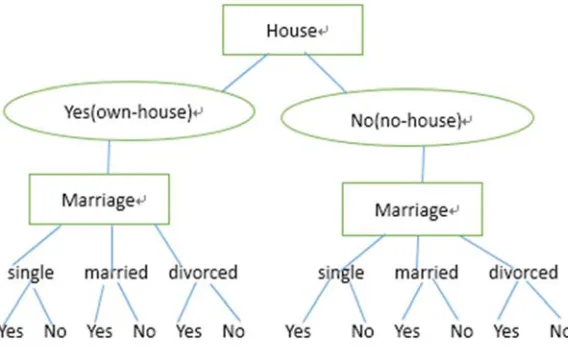
The principle of this algorithm is to create a custom recursive function that iterates through each attribute value of each attribute from X1, , Xn in turn. In the loop, whenk 1, ,n 1, the next
attribute k1 is retrieved by calling the recursive function. Whenkn, recursive algorithm has
been finished, and then, output the previous n traversal values, and create the Bayesian
[image:4.612.147.431.520.694.2]classification data set at this time (Table 2). The example flow chart is as follows:
Table 2. Create a Bayesian classification data set.
4. Select the count and value of the decision attributes mY
select distinct default_loans,count(*) as con from Bayes_Demo order by default_loans
5. Select the count of each combination of the classification attributes mY_X
select house,marriage,count(*) as con from Bayes_Demo group by house,marriage order by house,marriage
6. Select the count of each value of the decision attributes mX1_y mX2_y
select default_loans,count(*) as con from Bayes_Demo group by default_loans order by default_loans
7. Calculate the total number of sample tables
select count(*) as con from Bayes_Demo
8. Update the count of each combination of the classification attributes in the Bayesian data table mX
update FL_Bayes_Demo set mX=1, pX=0.1 where Y=Y and X1='Yes' and X2='Marriage'
9. Update the frequency of each combination of the classification attributes and decision attributes
in the Bayesian data table pY_X
update FL_Bayes_Demo set pY_x=mY_x/mX where mX>0
10. Update the probability of each combination of the classification attributes and decision
attributes in the Bayesian data table _B pY_X
(According to formula (Eq. 3), the probability:
1
( ) n ( i i| )
i
P Y y P X x Y y
)update FL_Bayes_Demo set B_pY_X=pY*pX1_y*pX2_y
11. According to the maximum value of the classification probability of each combination, update the final form
(According to formula (Eq. 3), that is to select:
1
max (
)
(
|
)
n
i i
y Y
i
P Y
y
P X
x Y
y
)The first step: select the maximum of joint probability B_ pY_X in the Bayesian data table,
SQL codes are:
select max(B_pY_X) from FL_Bayes_Demo where X1=A.X1 and X2=A.X2
The second step: select the record of the maximum of joint probability _B pY_X , SQL codes are:
select X1,X2 ,Y from FL_Bayes_Demo A where B_pY_X=
(select max(B_pY_X) from FL_Bayes_Demo where X1=A.X1 and X2=A.X2 ) order by X1,X2 ,Y
The third step: updatecY_X , and markcY_X at the maximum of _B pY_X, SQL codes are:
update FL_Bayes_Demo A set cY_X='*' where B_pY_X=
(select max(B_pY_X) from FL_Bayes_Demo where X1=A.X1 and X2=A.X2 )
Algorithm Analysis
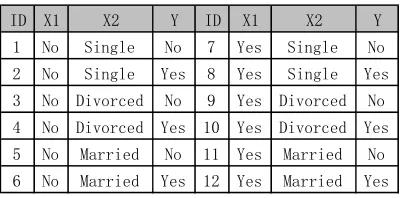
The results of Bayesian data set are as follows:
ID X1 X2 Y ID X1 X2 Y
1 No Single No 7 Yes Single No
2 No Single Yes 8 Yes Single Yes
3 No Divorced No 9 Yes Divorced No
4 No Divorced Yes 10 Yes Divorced Yes
5 No Married No 11 Yes Married No
Table 3. The results of Bayesian data set about defaulting loans.
From the analysis of the results, it can be seen that “no-house ”&”single”, and “no-house ”&”divorced”, which can be discriminated as "default loans" by the naive Bayes classifier; the “married” can be discriminated as "not-default loans" by the classifier; The above data shows that, “own-house” is a sufficient but unnecessary condition for "not-default loans"; At the same time, by comparing the data set with the original data, the classifier has a high accuracy rate of 90%, so it has high practical value.
Algorithm Application
[image:6.612.108.504.287.471.2]The above classification system can be applied to students' grades, which can implement the prejudgment of the “Probability Theory” courses, and the results are as follows:
Table 4. The results of Bayesian data set about student grades.
1
X : a passing situation of "Advanced Mathematics I";( classification attribute)
2
X : a passing situation of "Advanced Mathematics II";( classification attribute)
3
X : a passing situation of "Linear Algebra";( classification attribute)
Y: a passing situation of “Probability Theory”.(decision attribute)
With the same classification system, X1,X2,X3are as classification attributes, Yis as a decision
attribute, a Bayesian classifier was trained by the grades of the previous three courses, in order to
prejudge the passing situation of Y ” probability theory “course.
From the analysis of Table 4, there are 2252 students, the number of “Probability Theory” result discriminant right is 2030, so the Bayesian classifier in this set of data has a discriminant accuracy rate of 90.14%,it is a high accuracy; At the same time, While from the intuitive, under the condition of “Advanced Mathematics I" fail, "Advanced Mathematics II" passed, "Linear Algebra" fail, the number of students who pass the “Probability Theory” is more, but by discriminant classifier, it will predict “Probability Theory” as "fail". By careful analysis, the reason is that the number of people who don’t pass it is relatively small, therefore, the probability of the joint probability is larger, and so, "probability theory" exam will be judged as “fail”.
Summary and Conclusion
This paper uses a training data set, program the recursive algorithm, and SQL query codes to select the related records about the count and the frequency. Finally, by using SQL query – update codes,
ID X1 X2 Y mX pX mY_x pY_x mY pY mX1_y mX2_y pX1_y pX2_y B_pY_X cY_X ID X1 X2 Y mX pX mY_x pY_x mY pY mX1_y mX2_y pX1_y pX2_y B_pY_X cY_X 1 No Single No 3 0.3 1 0.333 7 0.7 4 2 0.571 0.286 0.1143 7 Yes Single No 1 0.1 1 1 7 0.7 3 2 0.429 0.286 0.0857 * 2 No Single Yes 3 0.3 2 0.667 3 0.3 3 2 1 0.667 0.2 * 8 Yes Single Yes 1 0.1 0 0 3 0.3 0 2 0 0.667 0 3 No Divorced No 1 0.1 0 0 7 0.7 4 1 0.571 0.143 0.0571 9 Yes Divorced No 1 0.1 1 1 7 0.7 3 1 0.429 0.143 0.0429 * 4 No Divorced Yes 1 0.1 1 1 3 0.3 3 1 1 0.333 0.1 * 10 Yes Divorced Yes 1 0.1 0 0 3 0.3 0 1 0 0.333 0 5 No Married No 3 0.3 3 1 7 0.7 4 4 0.571 0.571 0.2286 * 11 Yes Married No 1 0.1 1 1 7 0.7 3 4 0.429 0.571 0.1714 * 6 No Married Yes 3 0.3 0 0 3 0.3 3 0 1 0 0 12 Yes Married Yes 1 0.1 0 0 3 0.3 0 0 0 0 0
the maximum value of combinatorial classification probability is found, and a Bayesian classifier with 90% accuracy can be trained. Further, under the condition of classification attributes ("Advanced Mathematics I", "Advanced Mathematics II", "Linear Algebra"), by applying such classification system, an efficient Bayesian classifier can be trained. It can prejudge the situation of "probability theory" grades, by compared with the actual result, the forecasting results’ accuracy is as high as 90.14%.
Therefore, the Bayesian classifier model mainly has the following obvious advantages: 1) the attributes of the sample are easy to extract, the complexity is low, and the processing speed is fast .2) using naive Bayes classification algorithm, the model is simple and easy to implement. There are some defects in this algorithm: 1) low classification attribute, not very general; (2) the Bayesian classifier, although simple, is not necessarily the optimal classification algorithm. It should be compared with other algorithms.
Generally, a relatively new classification system has been introduced in this paper, under the condition of given classification attributes and decision attributes, can train a kind of high precision Bayesian classifier to predict student grades, it has the high availability and ease of use.
Acknowledgements
This article is funded by the Beijing University of Science and Technology Education Research Project (JG2017Z10).
References
[1] Ye Yuan. Thunderstorm prediction based on Bayesian classification method [A]. Committee on Meteorology, China Meteorological Society, Committee on Hydrometeorology, China Meteorological Society, National Meteorological Center, Ministry of Water Resources: 2009, 9. [2] Xin Zhang. Trojan horse program flow recognition method based on Bayesian classification algorithm [A]. Computer Security Professional Committee, China Computer Society, 2012:3. [3] Zhiqing Lin, Jun Guo. Application of Bayesian classifier in handwritten Chinese character recognition [J]. Electronic Journals, 2002, (12): 1804-1807.
[4] Yongbin Zou, Xingshu Chen, Wenxian Wang. Research on the theme of crawlers of the Bayesian classifier [J]. Computer Application Research, 2009, 26(09): 3418-3420+3439.