Essays on Relational Contracts
Akifumi Ishihara
A thesis submitted to the Department of Economics of the
London School of Economics for the degree of Doctor of
Declaration
I certify that the thesis I have presented for examination for the PhD degree of the London School of Economics and Political Science is solely my own work other than where I have clearly indicated that it is the work of others (in which case the extent of any work carried out jointly by me and any other person is clearly identified in it).
The copyright of this thesis rests with the author. Quotation from it is permitted, provided that full acknowledgement is made. This thesis may not be reproduced without the prior written consent of the author.
Abstract
This dissertation contains three essays on self-enforcing implicit contracts in economic transactions and politics.
Chapter 2 studies a repeated agency model with two tasks where the agent has private information on the first task and there is no verifiable performance signal for the second task. The equilibrium level of the first task is determined so as to guarantee the credibility of the relational contracts to provide incentives for the second task. It implies interest-ing economic results includinterest-ing non-monotonic relation between the discount factor and the total surplus, social desirability of unverifiability, and implications for organization design.
Chapter 3 studies a model of political contribution of dynamic common agency where state-contingent agreements must be self-enforced. First, we investigate the punishment strategy for supporting the self-enforcing mechanism. The most severe punishment strat-egy on the principals takes the form of a two-phase scheme in general. Second, we characterize the payoffset of the equilibria on which the same decision is chosen by the agent through implicit agreements and examine whether it can achieve the same payoffas in the standard static menu auction model. It implies that there could be an equilibrium outcome in a static menu auction that cannot be supported in our model for any discount factor.
Contents
Acknowledgement . . . 9
1 Introduction 11 2 The Interaction of Formal and Implicit Contracts with Adverse Selection 15 2.1 Introduction . . . 15
2.2 Related Literature . . . 21
2.3 The Model . . . 24
2.3.1 Environment . . . 24
2.3.2 Economic Interpretation of the Setting . . . 27
2.3.3 Strategy and Equilibrium . . . 28
2.4 Analysis . . . 32
2.5 Social Desirability of Unverifiability . . . 39
2.6 Task Assignment Problem . . . 43
2.6.1 Centralization . . . 44
2.6.2 Task Separation . . . 45
2.6.3 Implications . . . 46
2.7 Extension and Robustness . . . 50
2.7.1 Extension to a General Setting . . . 50
2.7.2 Assumptions on the Behaviour . . . 52
2.8 Conclusion . . . 58
2.9 Appendix: Proofs . . . 60
2.9.1 Proof of Proposition 2.1 . . . 60
2.9.2 Proof of Lemma 2.1and 2.2 . . . 72
2.9.3 Proof of Corollary 2.1 . . . 78
2.9.4 Proof of Proposition 2.3 . . . 78
2.9.5 Proof of Lemma 2.3 . . . 78
2.9.6 Proof of Lemma 2.4 . . . 79
2.9.7 Proof of Proposition 2.5 . . . 80
2.10 Appendix: The Optimal Contract without Assumption of Limited Com-mitment Ability . . . 80
3 Relational Political Contribution under Common Agency 87 3.1 Introduction . . . 87
3.2 The Model . . . 93
3.2.1 Environment . . . 93
3.2.2 Simple Strategy Representation . . . 94
3.3 Decision-Stationary Equilibria . . . 98
3.4 The Optimal Penal Code . . . 101
3.4.2 The Optimal Penal Code on the Principals . . . 102
3.5 Validity of Menu Auction for Political Contribution . . . 112
3.5.1 BW’s Model . . . 112
3.5.2 Comparison between SMA and RPC . . . 113
3.5.3 Example . . . 118
3.6 Discussion . . . 119
3.6.1 Approximation . . . 119
3.6.2 Conflict Makes the SMA Vulnerable . . . 120
3.6.3 Other SMA Equilibria . . . 121
3.6.4 SMA with Caps on Transfer . . . 121
3.7 Conclusion . . . 123
3.8 Appendix: Proofs . . . 124
3.8.1 Proof of Proposition 3.1 . . . 124
3.8.2 Proof of Proposition 3.2 . . . 126
3.8.3 Proof of Proposition 3.3 . . . 130
3.8.4 Proof of Lemma 3.4 . . . 132
3.8.5 Proof of Proposition 3.5 . . . 133
3.8.6 Proof of Corollary 3.1 . . . 135
3.8.7 Proof of Proposition 3.6 . . . 135
3.8.8 Proof of Lemma 3.5 . . . 136
3.8.9 Proof of Proposition 3.7 . . . 136
3.8.10 Proof of Proposition 3.8 . . . 136
3.8.11 Proof of Lemma 3.6 . . . 137
3.8.12 Proof of Proposition 3.10 . . . 138
4 Strategic CandidacyviaEndogenous Commitment 139 4.1 Introduction . . . 139
4.2 One-Shot Political Competition . . . 145
4.2.1 Environment . . . 145
4.2.2 Political Equilibria . . . 146
4.2.3 Impossibility of Strategic Candidacy with Two Candidates . . . 148
4.3 Repeated Competition . . . 149
4.4 Strategic Candidacy in Two-Candidate Competition . . . 151
4.4.1 Definition . . . 151
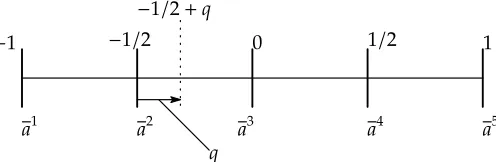
4.4.2 Example: A Spatial Model with Five Citizens . . . 151
4.4.3 The Necessary and Sufficient Condition . . . 155
4.5 Is Candidacy Necessary for Political Compromises? . . . 158
4.5.1 Example Revisited . . . 159
4.5.2 Deterrence of the Median’s Candidacy . . . 161
4.6 Concluding Remarks . . . 165
4.7 Appendix: Proofs . . . 167
4.7.1 Proof of Proposition 4.2 . . . 167
4.7.2 Proof of Proposition 4.3, 4.4, and 4.5and Corollary 4.1 . . . 167
4.7.3 Proof of Proposition 4.6and 4.7 . . . 174
List of Figures
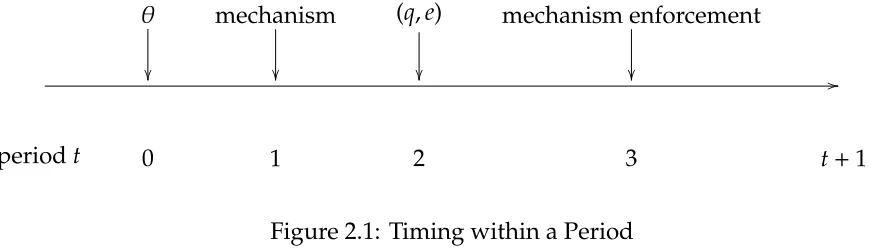
2.1 Timing within a Period . . . 24
2.2 Equilibrium Constraints . . . 33
2.3 Total Surplus andP’s payoffin the OPPE . . . 38
2.4 Comparison between the Verifiable and Unverifiable Cases . . . 40
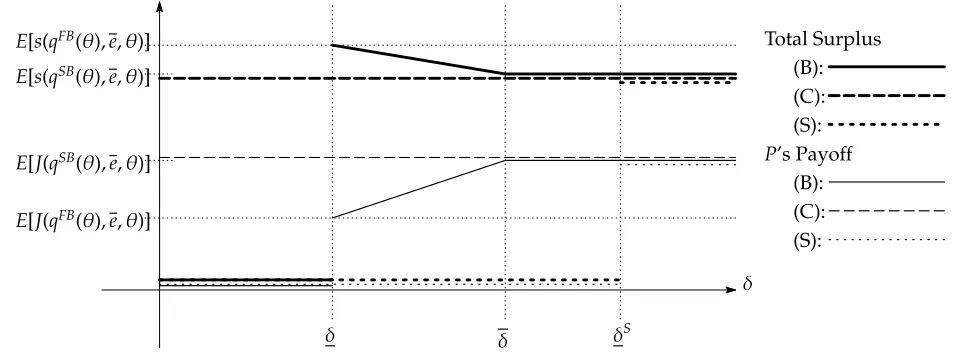
2.5 Comparison among (B), (C), and (S) . . . 47
3.1 In Case of Exclusion-type . . . 108
3.2 In Case of Sanction-type . . . 109
4.1 Consequent Policy . . . 153
4.2 Policies by citizen 2 and 3 . . . 161
4.3 Whenk0 <M . . . 163
List of Tables
Acknowledgement
.
There are so many people to support my academic life throughout the graduate pro-gramme so far and it would be impossible to achieve the completion of this dissertation without them. Nevertheless expressing my gratitude to all of them would make a too big book. So I want to apologize to acknowledge very limited persons.
I am greatly indebted to my advisors Andrea Prat and Leonardo Felli. Andrea contin-uously gave me insightful suggestions which often made a breakthrough in my research. He also often told me the importance of economic insights from the model. It is an invalu-able lesson for me who sometimes falls to do just a mathematical exercise in my research. Leonardo gave many specific and careful comments those were definitely helpful for im-proving the dissertation. His suggestion on my writing and presentation has also been useful for expressing my research in an effective way.
to all of these people.
Chapter 1
Introduction
Contracts and agreements have played a major role in a broad range of economic, political, and social activities. One of the important aspects of contracts and agreements is that these are typically concludedex antefor stipulating theex postbehaviour. It means that contracts and agreements have little influence if theex postenforcement is not guaranteed.
Whereas recent development of the theory of contract and mechanism design has pro-vided a huge amount of insights on information and incentives, it has less emphasized its importance of the role of enforcement of contracts and agreements. The standard agency model and mechanism design problems typically assume that a contract or mechanism offered by a principal or mechanism designer is enforced by exogenous third party such as courts (or able to be committed by them). However this is often too ideal for the following reasons at least.
Illegal Contract: the law may stipulate to prohibit (illegal) agreements being enforced.
Imperfect Law System: the law system may not be matured enough to guarantee the
enforcement.
Nevertheless we have observed that contracts and agreements have positive impacts in many cases even if there are some enforcement problems due to the above reasons. It indicates a next important direction of incentive theory to consider the enforcement problem explicitly to obtain additional insights on information and incentive problems.
Motivated by the above discussion, this dissertation theoretically investigates incentive problems in economics and politics and discusses the impact of agreements when the enforcement is not perfectly guaranteed. Especially, we focus on situations in which self-enforcement agreements are supported by ongoing relationships between the involved parties. If an agreement in each period is not guaranteed to be enforced exogenously, then each of the involved parties has an option to deviate from the agreement. In the ongoing relationships, however, such a deviation might be deterred since the deviation could induce the loss from punishment for the future relationship.
In the following three chapters, we consider incentive problems of multitasking agency, lobbying activityviapolitical contribution, and political competition in elections respec-tively. Each of them has a common question; how to deal with the self-enforcing agree-ments in the ongoing relationship.
total surplus is not monotonically increasing in the discount factor. In particular, the total surplus for intermediate values of the discount factor is greater than for high values since the principal must care about sustaining relational contracts rather than distorting the first task to reduce the information rent to the agent. Second, for intermediate values of the discount factor, the equilibrium is more socially efficient than when both the first and sec-ond tasks are verifiable. Interestingly it implies that to assure enforcement of agreements sometimes induces socially worse outcomes. Furthermore, in order to obtain insights for organizational design, we consider a job design problem of whom the principal allocates the second task to. If the second task can be allocated to the principal herself, then the total surplus could be lower than in allocating the second task to the agent. Since the information rent can be an incentive device for the unverifiable task, the principal never exercises her option to allocate the second task to a different agent. From a perspective of organizational design, these results imply the benefit of delegation and bundling of tasks due to the effect of information rent on the other task through the self-enforcement mechanism.
additional amount of the payment, it is cancelled. Second, we characterize the payoff set of the equilibria on which the same decision is chosen by the agent through implicit agreements and examine whether it can achieve the same payoffas in the standard static menu auction model. It implies that there could be an equilibrium outcome in a static menu auction that cannot be supported in our model for any discount factor. This result has an important meaning since a political outcome predicted by a static menu auction model might not be justified by ongoing relationships even when the political players are assumed to be patient.
Chapter 2
The Interaction of Formal and Implicit
Contracts with Adverse Selection
2.1 Introduction
Problems of incentive provision are often observed in economic relationships such as procurement transaction, organization, and regulation of industry. The incentive problem often becomes more serious when there are multiple dimensions of tasks, all of which the right incentives must be provided for. As Holmstr ¨om and Milgrom (1991) demonstrate in the principal-agent relationship, if the agent is faced with multi-dimensional tasks, then the principal must be concerned with balancing incentives among the tasks as well as the incentive provision. In the extreme case where some tasks do not generate any objective performance measure, legal contracts can never compensate him for the effort devoted to these tasks and then the agent would devote his effort only to a subset of the tasks. Thus the multitask property has suggested additional insights for contract design. It has also stimulated some issues in the theory of the firm. In particular, the task assignment problem to decide who has the responsibility of the task is definitely motivated by the multitasking incentive problem.
We argue that the interaction of information rent and reneging temptation of relational contracts causes several interesting results. Specifically, raising the discount factor and/or making the signal on the performance verifiable do not necessarily improve economic efficiency. This interaction provides new incentive perspective for the job design problem. The deriving force of these results are the information rent caused byex anteasymmetric information, which affects the incentive provision in the task without verifiable signals.
In what follows, we analyse a repeated principal-agent relationship with two tasks. Each task can lead to a potential inefficiency. On the first task, the agent hasex anteprivate information on his cost in each period. On the second task, the cost is technologically independent of his private information. However the performance measure is unverifiable so that it cannot be assessed by a third party and formal contracts contingent on it are not enforced by the court. We assume that both tasks are essential for the parties’ payoff so that the principal must deal with these two incentive problems simultaneously.
One way to create incentives related to the second task is the use of relational contracts based on the unverifiable measurement. More specifically, the principal uses both formal contracts contingent only on verifiable signals and informal agreements contingent on unverifiable signals as well as verifiable ones. This is consistent with evidence showing that both formal and informal contracts are used as incentive devices.1 In our model,
the principal optimizes hew own payoffevery period subject to two kinds of constraint. First, the principal must deal with the information rent caused by the agent’s private information. Second, since informal agreements cannot be enforced by the court exoge-nously, both parties must be concerned with ensuring to honour the informal agreements
1Gibbons (1998, 2005b) describes a number of cases in which bonus plans based on subjective assessments
voluntarily.
It is well known that there are many equilibria in repeated games even if they are restricted to the public perfect equilibria those are tractable in repeated games with public monitoring.2 In order to obtain the prediction from our model, we make the additional
assumption (Assumption 2.4) which requires that in each period the principal maximizes her own payoff as long as the players are on the equilibrium path. This restriction is analogous to the standard principal-agent models which presume the principal to make a take-or-leave-it offer. It also means the principal’s imperfect ability at commitment. It implies that she cannot commit to the strategy which is not maximizing her own payoff in some period even if it can induce a preferable outcomeex ante.
The above assumption implies that the equilibrium is stationary; in equilibrium, the principal offers the same contract and the agent decision depends only on the current type.3
Together with an additional assumption4 on the equilibrium behaviour, this stationarity
further implies that the equilibrium is characterized by the principal’s static optimization problem as in the standard adverse selection model with an additional constraint requir-ing the players to honour the informal agreements. This additional constraint determines the scope of relational contracts and it is satisfied if the sum of the discounted future total surplus between the principal and the agent exceeds the agent’s current deviation benefit on the second task. Thus, if this additional constraint is relevant, then the principal’s concern of incentive provision in unverifiable tasks can alter the design of formal con-tracts from the optimal contract without the additional constraint. This effect causes the following results.
2The definition of the public perfect equilibrium is provided by Fudenberg et al. (1994).
3Without Assumption 2.4, under the strategy which maximizes the principal’s payoff, she can exploit
the agent in the first period and compensate for it in the future by maximizing the future aggregate benefit. See Section 2.7 for details.
It is the comparative static analysis of our equilibrium characterization with respect to the discount factor that gives us our first main result. Clearly, the discount factor determines the scope of relational contracts since it affects the future discounted total surplus. It is important to distinguish three cases: high, intermediate, or low discount factor. If the discount factor is low, then relational contracts do not work at all and there is no value of the relationship between the principal and the agent since there is no way to provide the agent incentives for the second task. Conversely, if the discount factor is high, then relational contracts work well enough to provide the right incentive with respect to the second task. Nevertheless the principal is still faced with hidden information with respect to the first task and hence she attempts to decrease the information rent to the agent. As in the standard adverse selection problem, this concern leads to the inefficient outcome with respect to the first task.5
When the discount factor is intermediate, the same equilibrium outcome as in the case of high discount factor cannot be supported since it does not create a sum of the discounted future total surplus that is large enough to sustain the relational contracts. Nevertheless the principal can increase the total surplus by mitigating the inefficiency caused by the information rent problem in the first task. In order to ensure the success of the relational contracts, she improves the efficiency relative to the case of a high discount factor. In other words, by decreasing the discount factor from a high level to an intermediate level, the principal’s objective is altered from purely reducing the information rent to ensuring the functioning of the relational contract, which leads to a more efficient outcome.
The second main result shows that unverifiability could be socially desirable. Specif-ically, we compare our equilibrium characterization described above with one in which the performance measure on the second task is also verifiable under Assumption 2.4. In
the latter, the principal’s concern for ensuring the efficacy of relational contracts vanishes and then, regardless of the discount factor, the outcome is the same as the former for high discount factors.6 It implies that, for intermediate discount factors, the aggregate benefit
between the two parties is greater when the second task is unverifiable than when it is verifiable.7 When the second task is also verifiable, the inefficiency caused by her concern
about the information rent still remains even if the discount factor is not high.
In order to obtain insights for organizational design, we next consider the following task assignment problem. Before the game starts, the principal is allowed to allocate the second task to the agent or another party. We investigate three possibilities as follows: centralization where the principal performs the second task, task bundling where both tasks are assigned to a single agent, and task separation where the second task is allocated to a different agent . Clearly, task bundling is the same as the setting explained above.
The equilibrium under centralization is exactly the same as the one where the second task is verifiable. Under centralization, there is no agency problem in the second task and the principal’s only concern is to reduce the information rent. Then as in the discussion of verifiability, when the discount factor is intermediate, centralization generates lower social surplus than task bundling. Note that in contrast with centralization, task bundling is interpreted as delegation of the decision right to the agent. Thus it advocates the delegation of authority to the informed party; if the decision right can be sold to the agent, then the principal might prefer delegation since it can work as a commitment device to produce a more efficient outcome.
When only task bundling and task separation are available, the former is preferred to
6Under Assumption 2.4, when the performance measure on the second task is also verifiable, the
equi-librium results in the repetition of the equiequi-librium in the one shot game. The same outcome is implemented when the performance measure on the second task is unverifiable and the discount factor is high.
the latter from the social perspective. Intuitively, by bundling the tasks, the information rent obtained from the first task in the future can be an incentive device for the second task. By contrast, in task separation, the agent working on the second task no longer has opportunity to obtain the future information rent. Furthermore, the principal no longer has an incentive to improve the aggregate benefit among all the parties since doing so just increases the information rent for agent 1 and does not help to relax the self-enforcement constraint at all. These effects imply that task separation is undesirable not only from the social perspective but also the principal’s perspective.
The next section reviews the related literature and clarifies the contribution of this chapter. Section 2.3 describes the main model and defines the strategy and equilibrium used in the analysis. Section 2.4 characterizes the equilibrium conditions and provides comparative statistic analyses. Section 2.5 points out the possibility that unverifiability is socially desirable. Section 2.6 considers the task assignment problem. Section 2.7 discusses the robustness of the results. The final section concludes. The appendix contains proofs for some propositions and lemmas.
2.2 Related Literature
This chapter is related to several strands of the literature on contract theory and the theory of the firm. In order to clarify the relation to the literature, we classify the related papers into the following three categories, relational contracts and screening, verifiability of performance measures, and multitasking incentive agency and job design.8
Relational Contracts and Screening Several papers study the design of relational con-tracts for screening. However none of them include multitasking problems. Levin (2003) develops the design of relational contracts with asymmetric information.9 Athey and
Miller (2007) study repeated bilateral trading with a budget balancing constraint and two-sided private information. Alonso and Matouschek (2007) study a repeated coordination problem where monetary transfer is prohibited.
The following papers also study repeated principal-agent relationships with screening and are related to our results. Calzolari and Spagnolo (2010) study competitive bidding
8MacLeod (2007) and Malcomson (2010) survey the various topics of self-enforcing relational contracts.
Dewatripont et al. (2000) briefly summarize the topics of multitasking incentive and job design problems.
9In his model the agent obtains private information after contracting while in our model he obtains
in procurement and suggest the importance of limiting the competition since it maintains information rent to the agent which is necessary for implementing unverifiable quality.10
We partly share this logic and argue for a similar role of information rent in a bilateral relationship. Wolitzky (2010) considers a dynamic monopolist problem with price dis-crimination and unverifiable delivery decisions. Setting a price corresponds to our first task in the sense that it is related to private information about consumer value and the delivery decision corresponds to our second task in the sense that it is unverifiable. In our terminology, delivery is implemented by the principal and then his model is similar to centralization in our task assignment problem. He investigates both non-durable and durable goods monopolists and demonstrates that the so-called Coase conjecture, due to the ratchet effect in durable goods markets, is not observed when an unverifiable delivery cost is introduced. While his analysis of durable goods includes the dynamics of market rationing, our model essentially rules out such a dynamic path by excluding persistent state variables and then there is no issue of learning over the periods.11 Dynamic flow of
information in repeated principal-agent relationships will be left for future research.12
Verifiable and Unverifiable Performance Measure As long as unverifiable performance
is more informative on the task than verifiable performance, an interaction of formal and informal contracts could emerge. Baker et al. (1994), Pearce and Stacchetti (1998) and Itoh and Morita (2010) study this topic in an environment with biased measurement, risk-sharing, and relation-specific investments, respectively. However these abstract from multitasking issues. The interaction of formal and informal contracts in multitasking 10Board (2010) demonstrates the similar outcome in repeated competitive procurement. However in his
model, the agents have no private information and then the principal does not need to attempt to screen the agents’ types.
11We briefly discuss the case of serially correlated type in Section 2.7.
12Halac (2009) studies repeated principal-agent relationships where each party holds private information
environment is studied by Schmidt and Schnitzer (1995), Daido (2006), Sch ¨ottner (2008), and Iossa and Spagnolo (2009).13 Neither of them includes hidden information.
Several papers have already found the possibility of welfare improvement by making a task unverifiable (Baker et al., 1994; Schmidt and Schnitzer, 1995; Bernheim and Whinston, 1998; Kovrijnykh, 2010). Their idea is basically that unverifiability can make a stronger punishment for deviation and then provide a larger incentive via relational contracts, which improves efficiency. As argued in Section 2.1, our idea is different from theirs.14
Kvaløy and Olsen (2009) introduce the principal’s endogenous verification investment – interpreted as a cost of writing effective formal contracts – which stochastically deter-mines the verifiability. They show that the discount factor and verifiability could have a negative impact on the quality of the transaction.15 This chapter derives this phenomenon
caused by hidden information instead of an endogenous verification decision.
Multitasking Incentive Agency and Job Design Multitasking incentive problems and
job design have been mainly discussed in environments without relational contracts. One of the main strands in the literature studies the environment with hidden action and identifies conditions on the verifiable measurement under which task bundling is preferable to task separation between multiple agents. (Holmstr ¨om and Milgrom, 1991; Itoh, 1994; Meyer et al., 1996).16 In the environment with hidden information, Jackson
and Sonnenschein (2007) and Matsushima et al. (2010) investigate the linking mechanism in which many identical tasks are allocated to a single agent and the agent’s messages
13Dewatripont et al. (1999) study a multitasking problem with implicit contracts. They focus on an agent
with career concerns and the contract design problem is different from our model.
14We discuss the detail of the difference in Section 2.5.
15Their interest is in how a change of such factors affects the quality level implemented in the transaction
and they do not mention the overall economic efficiency including the cost of the investment for verification. Actually, in their model, the overall economic efficiency is weakly increasing in the discount factor.
16A number of papers study the vertical job design problem, i.e. centralization or delegation. See
θ
²
²
mechanism
²
²
(q,e)
²
²
mechanism enforcement
²
² //
[image:24.595.80.520.53.177.2]periodt 0 1 2 3 t+1
Figure 2.1: Timing within a Period
on his preference are rationed so as to approximate theex ante belief on the preference. Both of their papers demonstrate that when the number of the tasks are sufficiently large, the linking mechanism can almost beat the incentive problem without any transfer. The research interest in this chapter is different from them in the sense that we consider the effect of a small number of the tasks with hidden information on the multitasking incentive problem.
Sch ¨ottner (2008) is one of the most related papers to this chapter. She studies the effect of job design on relational contracts and points out that task bundling is often preferred to task separation. In her paper, however, hidden information is excluded. The implication for the job design problem with hidden information is one of our contributions to this literature.
2.3 The Model
2.3.1 Environment
drawn from [θ, θ] according to the cumulative distribution functionF(θ) with the density function f(θ). Assume thatθtis independently drawn in each period. At stage 1,Poffers
Aa mechanism, which is to be defined formally later. Assume thatPcan choose to abstain from offering mechanisms. If Pdoes not offer a mechanism or Arejects the mechanism, then the period ends and both players obtain zero payoff. If A accepts the mechanism, then Aworks on two tasks at stage 2. In the first task, he chooses qt ∈ [0,q] ≡ Q where
q>0 and in the second one he faces a binary choiceet∈ {0,e}wheree>0. These decisions
yieldPthe benefit y(qt,et) andAthe costc(qt, θt)+et. Finally, at stage 3 the parties make a
decision on the enforcement of the mechanism. Later we will explain this stage precisely. In period t, given θt, qt, et, and a monetary transfer wt from P to A, Pand A obtain
the (ex post) payoff y(qt,et)−wt andwt−c(qt, θt)−et respectively. Denote the aggregated
surplus by s(q,e, θ) ≡ y(q,e)−c(q, θ)−e and the first best decision by (qFB(θ),eFB(θ)) ∈
arg maxq,es(q,e, θ). We make the following assumptions.
Assumption 2.1 For all q∈Q, e∈ {0,e}, andθ∈[θ, θ], the following conditions are satisfied;
1. c(q, θ)is three-times differentiable and bounded in each component, cq(q, θ)>0, cθ(q, θ)>0,
cqθ(q, θ)>0and c(0, θ)>0.
2. s(q,e, θ)is twice differentiable in q, bounded in each component, s(q,0, θ)<0, s(0,e, θ)<0, sqq(q,e, θ)<0and there exists q0 ∈ (0,q)such that sq(q0,e, θ)=0.
3. Let J(q,e, θ) ≡ s(q,e, θ)−cθ(q, θ)F(θ)/f(θ). Then Jqq(q,e, θ) < 0, Jqθ(q,e, θ) < 0, and
J(qFB(θ),e, θ)>0.
If the second taskeis absent, implying that it is a single task model, then these assumptions would be fairly standard in the adverse selection literature.17 Nevertheless some remarks
17The assumption thatc
θ(0, θ)>0 rules out a case wherec(q, θ)≡ θq+Kfor someK> 0 since it is not
are useful here. Part 2 of Assumption 2.1 implies that both tasks are strict complements in the sense that to implemente=eandq>0 is essential for the value of the relationship. If it is impossible to induce positive amounts of (q,e), then the business is less valued than the outside option.
J(q,e, θ) is known as the virtual-surplus, which becomes the consequent objective
function for P in a typical adverse selection model. Part 3 guarantees that for each θ, arg maxq,eJ(q,e, θ) is unique. Hereafter denote the maximand ofJ(q,e, θ) by (eSB(θ),qSB(θ)).
It can be seen that eSB(θ) = e and J
q(qSB(θ),e, θ) = 018 for each θ ∈ [θ, θ] and qSB(θ) is
decreasing inθ. Part 2 and Part 3 further guarantee thateFB(θ)=e19ands
q(qFB(θ),e, θ)=0
for each θ ∈ [θ, θ], qFB(θ) is decreasing in θ,20 and qFB(θ) ≥ qSB(θ) for all θ ∈ [θ, θ] with
equality holding only ifθ=θ.
The assumption on the observability and verifiability is as follows. All variables except forθare observable by both parties. Pcannot observeθand she believes that it is distributed according toF(θ) and f(θ). Bothqtandetare describable at stage 1 in periodt
whereas unless otherwise stated, only the first taskqtis verifiable.
A mechanism is defined as a pair of a formal contract and an informal agreement. A formal contract is a transfer schedulept(qt) fromPtoAcontingent onqt and enforced by
the court.21 We assume thatp
t(qt) is continuous inqt.22 An informal agreementbt(qt,et) is
a transfer schedule from P toA which can be contingent on both qt and et and must be
enforced by themselves.23 Bothp
t(qt) andbt(qt,et) can be positive or negative. Enforcement
18Note that max
qJ(q,0, θ)<0 for anyqandθby Part 2 of Assumption 2.1.
19It is because max
qs(q,e, θ)>maxqJ(q,e, θ)≥J(qFB(θ),e, θ)>0>maxqs(q,0, θ) for anyqandθ.
20Note thats
qθ(q,e, θ)<0 for allqandθ.
21Here we implicitly assume that monetary transfer is also verifiable. 22The assumption of continuity ofp
t(qt) is required only for the proof of Lemma 2.6, which shows the
existence of an equilibrium strategy used for the punishment. It means that this technical assumption is only for the construction of the off-path outcome and innocuous in the other parts of the analysis. Thus except for Lemma 2.6, we will not explicitly mention this assumption. See the proof of Lemma 2.6 and footnote 44 there for the detail.
23The assumption on the describability ofq
of informal agreements is defined as follows. At stage 3, each party choosesIi
t ∈I≡ {H,R}
for i = P,A where H denotes honouring the informal agreement, and R reneging. The informal agreementbt(qt,et) is enforced if and only if both parties chose to honour it, i.e.,
It ≡(ItP,ItA) = (H,H). If it is not enforced, i.e.,It ,(H,H), then no transfer is made by the
informal agreements.
We later discuss the effect of verifiability of the second task e. We define that the second taskeis verifiable if an informal agreementbt(q,e) is also enforced by the court for
eacht. It implies that when the second task is verifiable,bt(q,e) is successfully transferred
regardless ofIt.
2.3.2 Economic Interpretation of the Setting
Throughout this chapter, we treat this environment as a manufacturer-supplier relation-ship. The manufacturer offers a menu contractp(q) contingent on units of the productsq from the supplier. However this product is valueless without the supplier’s effort which can be interpreted as improvement of quality, careful delivery, or regular maintenance. For simplicity, in what follows, we use the term “quantity” for the first task and “effort” for the second task.
This framework can be applied to the analysis of other situations. On management of a production line of automobiles or or electric machineries, the product consists of hard parts q assembled in the expertized line and softwaree for controlling the system the performance of which is hard to be evaluated from the outside. In an relationship between a firm owner and a CEO,qmight be interpreted as the size of a project and eas the effort to find and tailor the project for successful implementation. In the context of
regulation, the regulation authority asks the regulated firm to meet several environmental standards and some of the standards might be hard to measure objectively. The analysis below would be applicable to these cases.
2.3.3 Strategy and Equilibrium
A pure strategy in the repeated game is defined as a mapping from a privately observable history to a decision variable. Formally, let D ≡ Q× {0,e} be the set of the task levels and W ≡ ({(p(·),b(·,·)) | p : Q → R,b : D → R}) be the set of feasible mechanisms. Denote W ≡ W ∪ {φ} where φ denotes no mechanism being offered. Denote also the decision of A’s rejection of the mechanism byω. Then the public history, a sequence of publicly observable variables24, up to periodt≥1 is defined asht ≡(h
τ)tτ−=10where for each
τ= 0, . . . ,t−1,hτ ∈ {φ} ∪(W×({ω} ∪(D×I2))).25 Leth0be the null history andH be the
set of the public histories. A’s private history, the sequence ofA’s observable variables, up to periodtis defined ashA0 =h0and fort≥1,hAt≡(θ
τ,hτ)tτ−=10. LetHAbe the set ofA’s
private histories.
P’s pure strategy is a pair of mappings σP ≡ (Γ, ιP) where Γ : H → W and ιP :
H ×W×D → I. These define the mechanism offered byP and whetherPenforces the informal agreement given that the mechanism is accepted, respectively. A’s pure strategy is a pair of mappingsσA≡(χ, ιA) whereχ:HA×[θ, θ]×W→D,ιA :HA×[θ, θ]×W×D→I,
and D ≡ D∪ {ω}. χ stipulates A’s response to an offered mechanism and ιA whether to
enforce the informal agreement. Denote the set of strategies by Σi for i = P,A. A pure
strategy profile (σP, σA) is a perfect Bayesian equilibrium if after every history, there is no
24We mean by “publicly observable” and “public history” that it is observable for bothPandAbut not
necessarily observable for others. Then note that it does not necessarily coincide with “verifiable”.
25It is implicitly presumed that ifh
τcontains an element inD, then it means thatAaccepts the mechanism
incentive to deviate to improve her/his own average payoffat any stage of the period and P’s belief aboutθis computed by Bayes’ rule whenever it is possible and consistent with the strategy profile.26
Since the game has a recursive structure, we can decompose strategy (σP, σA) in the
following way. For any public history up to stage 0 of periodt,ht ∈ H, let
σP
+(ht)
Γ(ht)∈W
ιP(· |ht) :W×D→I
σP
+(ht,·) :{φ} ∪(W×(D∪ {ω}))→ ΣP whereσP
+(h0)≡σP, and for anyA’s private history up to stage 0 of periodt,hAt∈ HA,
σA+(hAt)
χ(· |hAt) : [θ, θ]×W →D
ιA(· |hAt) : [θ, θ]×W×D→I
σA
+(hAt,·) : [θ, θ]×({φ} ∪(W×(D∪ {ω})))→ΣA whereσA
+(h0)≡σA. This formulation is interpreted as that the strategy stipulates players’ actions in the current period and a strategy itself played in the repeated game starting from next period, that is the continuation strategy.
The repeated game typically has multiple equilibria. Thus we make some additional restrictions on the equilibrium strategy. First, we focus on the public strategy in the equilibrium.
Assumption 2.2 σA satisfies that for all t ≥ 0 and hAt ∈ HA, σA
+(hAt) is independent from (θ0. . . , θt−1)andιA(θt,Wt,dt |hAt)is independent from(θ0. . . , θt−1, θt).
It simply states thatA’s equilibrium strategy is independent fromθs which are irrelevant 26Since the equilibrium mechanism seen later does not have bunching for the first task, the restriction to
to his current payoff. An equilibrium of a public strategy is known as the public perfect equilibrium (PPE) and every pure strategy equilibrium payoffcan be achieved by PPE.27
Instead ofσA
+(hAt), hereafter denoteA’s public strategy byσA+(ht) wherehtis a public history. The next assumptions stipulate the bargaining power and the commitment ability.
Assumption 2.3 A public strategyσsatisfiesσ+(ht,W, ω)=σ+(ht, φ)=σ+(ht)for all ht ∈ H.
Assumption 2.4 LetHˆ (σ) ⊂ H be the set of public histories achieved with positive probability by public strategy σ. For any ht ∈ Hˆ (σ), σ
+(ht) ≡ (σP+(ht), σA+(ht)) must attain the maximum average payofffor P in the PPE.
Assumption 2.3 means that the event of no contracting at the beginning of the period is not interpreted as serious misbehaviour and then the same strategy is taken in the continuation game. These could prevent the punishment for deviating party which can reinforce efficiency. Assumption 2.4 means that as long as the players are on the equilib-rium path,Phas absolute bargaining power at the stage of contracting in the sense that the equilibrium strategy will optimizeP’s utility subject to the equilibrium constraints. This is for consistency with the standard principal-agent models which presume the principal to make a take-or-leave-it offer. It also implies thatP’s commitment ability to the future play is not so strong thatPmay not voluntarily choose the worse outcome, which could lead to more efficient outcomeex ante.
Assumption 2.3 and 2.4 cause some loss of generality. In particular, Assumption 2.4 is crucial if the type is independently drawn each period as in our model. In Section 2.7, we discuss how much loss of generality is caused by these assumptions.
Hereafter call the equilibrium satisfying Assumption 2.2, 2.3, and 2.4 the Optimal Public Perfect Equilibrium (OPPE). The following proposition shows that it is without
loss of generality to focus on the following simple trigger strategy for finding the OPPE. To state the proposition, let HR ≡ {ht ∈ H | ∃τ < t,∃i,∃(d
τ,Iτ) ∈ D×I2,Iτi = R}, that is
the set of public histories in which there exists a party having reneged on an informal agreement andHH ≡ H \ HR, the set of public histories in which informal agreements
have been honoured on.
Proposition 2.1 Letσbe an OPPE and (π,u)be the OPPE payoff. Then there exists an OPPE σ∗such that
• for all ht∈ HH,
– Γ∗(ht)=W∗∈ W,
– if W∗ ∈ W, then χ∗(W∗ | ht, θ
t) = d∗(θt) ∈ D∪ {ω}, andιP∗(W∗,d | ht) = ιA∗(W∗,d |
ht, θ
t)=H,
• for ht ∈ HR,Γ∗(ht)=φ, and
• the associated payoff(π∗,u∗)satisfies thatπ∗=πand u∗≥u.
Proposition 2.1 drastically simplifies our analysis. Specifically, we obtain several notable features of σ∗ that (i) on the equilibrium path, if W∗ ∈ W and d∗(θ
t) ∈ D, i.e., P
Hereafter we focus on the OPPE which satisfies Proposition 2.1.
2.4 Analysis
Thanks to Proposition 2.1, the OPPE can be derived by a stationary problem with some constraints. Furthermore, the following proposition shows that the OPPE is more simpli-fied in that all types accept the equilibrium mechanism.
Lemma 2.1 Let W∗ ∈ W be the OPPE mechanism and d∗(θ) be A’s OPPE decision given that mechanism W∗is offered. Then d∗(θ)∈D for allθ∈[θ, θ].
Let W∗ = (p∗(q),b∗(e,q))
q∈Q,e∈{0,e} and d∗(θ) = (q∗(θ),e∗(θ)) be the equilibrium task level chosen byAgiven the mechanismW∗. Due to the stationarity ofW∗andd∗(θ),P’s average payoffis given by
π∗ = (1−δ) ∞
X
τ=0
δτE θ
y(q∗(θ),e∗(θ))−w∗(q∗(θ),e∗(θ)) = Eθ
y(q∗(θ),e∗(θ))−w∗(q∗(θ),e∗(θ))
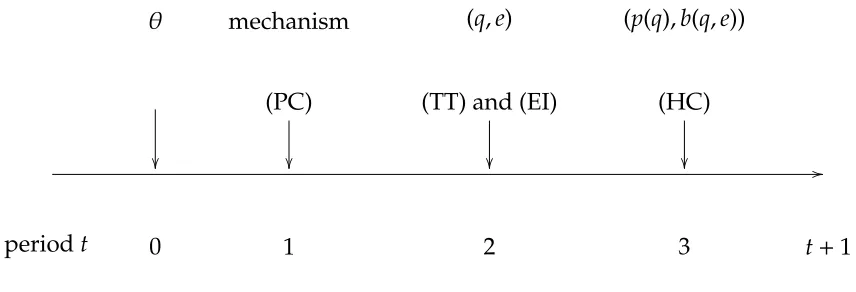
wherew∗(q,e)=p∗(q)+b∗(q,e). This is the objective to be maximized subject to the equilib-rium conditions. In each period, the players are faced with four equilibequilib-rium conditions which are common among periods on the equilibrium path. Figure 2.2 describes them in order. At stage 1, the participation constraint (PC) is satisfied if and only if Awith type θ ∈ [θ, θ] accepts W∗ offered by P. At stage 2,A choosesd∗(θ) = (q∗(θ),e∗(θ)). There are two concerns on this incentive compatibility constraint. First, the truth-telling constraint (TT) is satisfied if and only if typeθdoes not pretend to be any other typeθ0. Second, the effort incentive constraint (EI) is satisfied if and only if typeθdoes not choosee,e∗(θ).28
28Strictly, we must also check the incentive constraint not to chooseq < Q∗ ≡ {q0 ∈ Q |∃θ ∈ [θ, θ],q0 =
θ mechanism (q,e) (p(q),b(q,e))
²
²
(PC)
²
²
(TT) and (EI)
²
²
(HC)
²
² //
[image:33.595.82.510.50.196.2]periodt 0 1 2 3 t+1
Figure 2.2: Equilibrium Constraints
Finally, at stage 3, the honouring constraint (HC) is satisfied if and only if both parties choose to honour the informal agreement.
Let
U∗(θ) ≡ w∗(q∗(θ),e∗(θ))−c(q∗(θ), θ)−e∗(θ), u∗ ≡ Eθ[U∗(θ)],
s∗ ≡ u∗+π∗
beA’sex postandex antepayoffand theex antetotal surplus within a period. In general, the players are concerned about their future continuation payoffas well as the payoffin the current period. Nevertheless by construction of the strategy, the continuation payoffis not altered by any deviation on (TT), (EI), and (PC). It means that it is enough to consider these constraints without the future continuation payoff. On (HC), choosing ιi∗ = H induces the continuation payoff, π∗and u∗forPand Arespectively. Conversely, choosingιi∗ = R induces no mechanism in the future and then the continuation payoffis 0 for both parties. Thus, while the continuation payoffmust be taken into account in (HC), the value of the
possibility to chooseq<Q∗can be excluded by constructingp∗(q) such that forq>supQ∗,p∗(q)=sup
q∈Q∗p∗(q)
continuation payoff is still history-independent. Therefore the optimization problem of characterizing the OPPE can be transformed to a static mechanism design problem.
First, look at (TT). For eachθ, θ ∈[θ, θ],θdoes not pretendθ0 ∈[θ, θ] if and only if
U∗(θ) ≥ w∗(q∗(θ0),e∗(θ0))−c(q∗(θ0), θ)−e∗(θ0) = U∗(θ0)+c(q∗(θ0), θ0)−c(q∗(θ0), θ).
The envelope theorem by Milgrom and Segal (2002) implies that this is equivalent to that q∗(θ) is non-increasing inθand
U∗(θ) = U∗(θ)+
Z θ
θ
cθ(q∗(z),z)dz. (2.1)
Second, consider (EI). (EI) is satisfied if for eachθ,θ0 ande0 ,e∗(θ0),θdoes not choose (q(θ0),e0). It is expressed as
U∗(θ) ≥ w∗(q∗(θ0),e0)−c(q∗(θ0), θ)−e0
= U∗(θ0)−b∗(q∗(θ0),e∗(θ0))+b∗(q∗(θ0),e0)+c(q∗(θ0), θ0)−c(q∗(θ0), θ)+e∗(θ0)−e0.
Substituting (2.1) implies that
Z θ0
θ
cθ(q∗(x),x)dx−c(q∗(θ0), θ0)+c(q∗(θ0), θ)≥ −b∗(q∗(θ0),e∗(θ0))+b∗(q∗(θ0),e0)+e∗(θ0)−e0.(2.2)
Third, (PC) means that every type accepts the mechanism. Since to reject generate zero payoffforA, the condition is described as
for allθ∈[θ, θ]. SinceU∗(θ) is non-increasing due to (2.1), it is satisfied if and only if
U∗(θ) ≥ 0. (2.3)
Finally, consider (HC). Given that qand e were observed andA choosesIA = H, if P
choosesIP = H, then b∗(q,e) is transferred fromPtoA and the continuation payoff from the next period isπ∗. Conversely ifPchoosesIP = R, thenb∗(q,e) is not to be transferred and the continuation payoff from the next period is 0 because she does not offer any mechanism from the next period. ThusPchoosesIP =Hif and only if
−b∗(q,e)+ δ 1−δπ
∗ ≥0.
Similarly,AchoosesIA =Hif and only if
b∗(q,e)+ δ 1−δu
∗≥0.
Combining them implies that
δ 1−δπ
∗ ≥b∗(q,e)≥ − δ 1−δu
∗. (2.4)
Plugging (2.1) intoπ∗and integrating by parts yield that
π∗ = E
θ
y(q∗(θ),e∗(θ))−c(q∗(θ), θ)−e∗(θ)−U∗(θ) =
Z θ
θ
whereJ(q,e, θ) is defined as in Assumption 2.1. In equilibrium, it is maximized by control variables (q∗(θ),e∗(θ),U∗(θ),b∗(q∗(θ),e)) subject to (2.2), (2.3), (2.4), and monotonicity of q∗(θ) inθ. This problem is simplified as follows.
Lemma 2.2 The optimization problem described above is equivalent to the following;
max
q∗(θ)
Z θ
θ
J(q∗(θ),e, θ)f(θ)dθ
subject to δ 1−δ
Z θ
θ
s(q∗(z),e,z)f(z)dz≥e (2.6)
and q∗(θ)is non-increasing inθ.
If constraint (2.6) is absent, then the Euler equation implies thatq∗(θ)=qSB(θ) for allθ.
SinceqSB(θ) is non-increasing inθ, it is the solution ifqSB(θ) satisfies (2.6), that is
δ 1−δ
Z θ
θ
s(qSB(z),e,z)f(z)dz≥e ⇐⇒ δ≥δ≡ e
e+Rθθs(qSB(z),e,z)f(z)dz
. (2.7)
Suppose that (2.7) is not satisfied. Now consider the following Lagrangian with multiplier λ∗≥0:
L ≡
Z θ
θ
J(q∗(θ),e, θ)f(θ)dθ+λ∗
1−δδ
Z θ
θ
s(q∗(θ),e, θ)f(θ)dθ−e
.
The Euler equation implies that the solution satisfies that
sq(q∗(θ),e, θ)=
1 1+ δ
1−δλ
F(θ) f(θ)cqθ(q
∗(θ), θ). (2.8)
Recall that by definition ofqSB(θ),q∗(θ)=qSB(θ) ifλ=0. However, since it does not satisfy
Under what conditions is it feasible? It is easy to see that q∗(θ) characterized by (2.8) is decreasing inθ by Assumption 2.1. The right hand side of (2.8) is greater then 0 and qSB(θ) satisfies that J
q(q∗(θ),e, θ)=0 or equivalently
sq(qSB(θ),e, θ)=
F(θ) f(θ)cqθ(q
SB(θ), θ),
the right hand side of which is greater that of (2.8). Thus we see that for δ < δ, sq(qFB(θ),e, θ)<sq(q∗(θ),e, θ)<sq(qSB(θ),e, θ), which implies that by concavity ofs(q,e, θ)
qFB(θ)>q∗(θ)>qSB(θ)
for all θ ∈ (θ, θ). Furthermore, (2.8) shows that q∗(θ) is increasing in λ∗ (provided that δ >0) and approachesqFB(θ) asλ∗goes to infinity. Then by concavity ofs(q,e, θ) inq,s∗is increasing asλ∗goes up and the supremum of it isR s(qFB(z),e,z)f(z)dz. Thus the solution
obtained by (2.8) is feasible if and only if
δ 1−δ
Z θ
θ
s(qFB(z),e,z)f(z)dz>e ⇐⇒ δ > δ≡ e
e+Rθθs(qFB(z),e,z)f(z)dθ
(2.9)
where strictly inequality must be satisfied because of Slater constraint qualification for constrained optimization problems. Whenδ=δ, it is obvious thatqFB(θ) for eachθis the
unique feasibleqand then it is the solution.
Finally, ifδ < δ, then there is noq∗(θ) which satisfies (2.6). This implies thate∗(θ)= 0 for allθ∈[θ, θ] and thenπ∗<0. In this case,Pstrictly prefers to offer no mechanism. The summary of the above analysis is as follows.
E[s(qFB(θ),e, θ)]
E[s(qSB(θ),e, θ)]
E[J(qSB(θ),e, θ)]
E[J(qFB(θ),e, θ)]
δ δ
Total Surplus:
P’s Payoff:
[image:38.595.73.452.49.225.2]δ
Figure 2.3: Total Surplus andP’s payoffin the OPPE
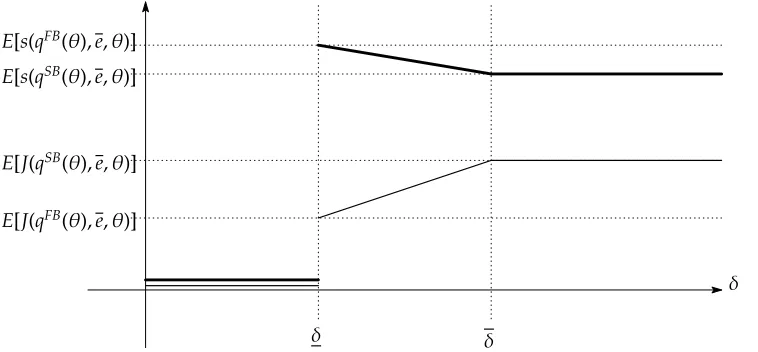
1. Forδ≥δ, d∗(θ)=(qSB(θ),e).
2. Forδ∈ (δ, δ), d∗(θ) = (q∗(θ),e)where q∗(θ)satisfies (2.6) and (2.8) with equality for some λ∗>0.
3. Forδ=δ, d∗(θ)=(qFB(θ),e).
4. Forδ < δ, W∗=φ.
Proposition 2.2 implies the following corollary.
Corollary 2.1 On the OPPE, the total surplus forδ∈(δ, δ)is decreasing inδand strictly greater thanδ≥δ. P’s payoffforδ∈(δ, δ)is increasing inδand strictly less thanδ≥δ.
Figure 2.3 illustrates the result in Proposition 2.2 and Corollary 2.1.
the discount factor is lower such thatδ∈[δ, δ), the optimal level of the first task does not ensure the future surplus enough to sustain the self-enforcing contracts. Nevertheless, as (2.6) shows, it is possible to induceeby raising the total surplus for an intermediate value of the discount factor. Thus the total surplus is rather improved by mitigating inefficiency with respect to the first task caused by asymmetric information. In other words, P’s objective is altered from optimizing her own payoff to caring about the total surplus to sustain the relational contracts.
2.5 Social Desirability of Unverifiability
Contrary to the previous assumption, assume now thateis also verifiable within a period. We show that verifiability could lead to a lower social surplus.
Even when e is verifiable, the basic procedure for deriving the equilibrium is sim-ilar to the previous section.29 The difference is that informal contracts b∗(q∗(θ),e) do not have to satisfy (HC) which is corresponding to (2.4). Thus, when e is verifiable, the optimization problem to derive the OPPE is to maximize (2.5) by control variables (q∗(θ),e∗(θ),U∗(θ),b∗(q∗(θ),e)) subject to (2.2), (2.3), and monotonicity ofq∗(θ) inθ.
Proposition 2.3 When e is verifiable, the OPPE satisfies that W∗ ∈ W, q∗(θ) = qSB(θ), and
e∗(θ)=e for anyδ∈ [0,1).
Comparing it with the result in Proposition 2.2 immediately implies the following corollary.
Corollary 2.2 For δ ≥ δ, unverifiability of e is weakly socially desirable. In particular, for
δ∈[δ, δ), unverifiability of e is strictly socially desirable.
29The optimality of stationary contracts with all the types participating can be proven by a similar proof
E[s(qFB(θ),e, θ)]
E[s(qSB(θ),e, θ)]
E[J(qSB(θ),e, θ)]
E[J(qFB(θ),e, θ)]
δ δ
Total Surplus Unverifiable: Verifiable:
P’s Payoff
Unverifiable: Verifiable:
[image:40.595.73.457.49.225.2]δ
Figure 2.4: Comparison between the Verifiable and Unverifiable Cases
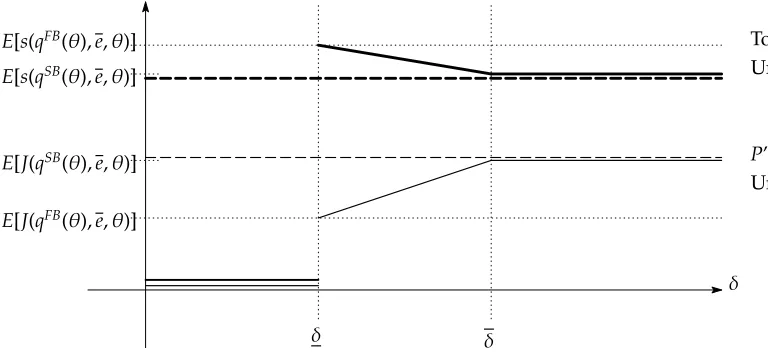
Figure 2.4 illustrates the comparison between the unverifiable case and the verifiable one. Actually the problem of the verifiable case is the same as that of the unverifiable case without (2.6). Thus the equilibrium achieved in the verifiable case is the same as in the unverifiable case withδ≥δ. However it is less socially efficient than the unverifiable case withδ∈[δ, δ).
The intuition is similar to the comparison between the cases of high and intermediate discount factor in the previous section. Even for intermediate δ, if e is verifiable, then P has no problem about implementing e. Unverifiability of e urges P to consider the implementation of e more seriously, which induces more social efficiency as discussed before.
Note that unverifiability is not desirable fromP’s view. Actually, regardless of verifia-bility ofe, P’s objective is the expected value of J(q∗(θ),e, θ) and the unverifiability could change the quantity level fromqSB(θ) to a more socially efficient level. SinceqSB(θ) is the
optimum ofJ(q∗(θ),e, θ), the unverifiability is obviously less preferred byP. ThusPdoes not strategically leave the contract incomplete even if she can.30
30Nevertheless we can demonstrate the strategic contractual incompleteness. by extending the model.
We can also obtain an economic implication for the role of courts and contract law. The standard contract theory typically tells us that if the court could void a contract, a party anticipating that action would lose the incentive to implement better economic performance due to the lack of the commitment to theex post compensation. This view makes it difficult to explain why courts sometimes intervene to void contractual terms in reality. One of the explanations from our model is that when the long-term relationship is working and the party with bargaining power are faced with the party with private information, the court should sometimes void the terms of the contract. Intuitively, contract design by the party without information causes inefficiency due to the concern of the information rent. If verifiability is not assured by the court, then the contracting party cannot control the information rent and then the inefficiency caused by it can be mitigated.
Several papers in the literature point out the desirability of unverifiability. Neverthe-less it should be emphasized that the logic here is quite different from that of the literature. To understand the difference, consider a strategy which implements the same decision every period in equilibrium. Then it can be a public perfect equilibrium if and only if the following inequality is satisfied:
δ 1−δ
h
s∗−si ≥ g∗ (2.10)
wheres∗denotes the equilibrium total surplus,sdoes the total surplus without relational contracts andg∗the agent’s deviation benefit from unverifiable tasks. It expresses that the self-enforcing contract can work if and only if the future total surplus from relational
tracts exceeds the one-shot benefit from deviation in the unverifiable tasks. By substituting s=0 andg∗=e, it is the same as (2.6) in our model.
The typical argument is that unverifiability can make for a stronger punishment on deviation, which improves efficiency. For instance, Schmidt and Schnitzer (1995) study a relational contracting model where, as in our model, the agent’s tasks are two dimen-sional. They show that the above inequality is necessary and sufficient for the equilibrium condition and compare the cases where both tasks are unverifiable and one of the tasks is verifiable. Then in the latter, since the verifiable task can be implemented by formal contracts, the deviation incentive g∗ is smaller. At the same time, however, the total surplus without relational contracts s could be larger since formal contracts can always give incentives for the verifiable task. Overall, whether the constraint is relaxed or not is ambiguous. In particular, if the effect onsdominates that of g, then verifiability is not necessarily desirable. Here the payoff s is the total surplus after informal contracts are reneged on. Thussexpresses the degree of effectiveness of the punishment. Making one task verifiable can weaken the punishment necessary for sustaining relational contracts, which can worsen efficiency.31
By contrast, our argument starts with the case where both tasks are verifiable. Then the formal contract can completely eliminate the deviation incentive meaning thatg∗ =0. Furthermore, since there is no unverifiable task, the principal will implement the decision as she likes. Now suppose that one of the tasks becomes unverifiable. Since the same strategy as in the verifiable case is most preferred to the principal, it would be implemented as long as it satisfies (2.10). If not, then the principal would attempt to improve the total surplus to satisfy (2.10). In other words, by increasing g, the principal’s objective is
31A similar argument is developed by Baker et al. (1994), Bernheim and Whinston (1998), and Kovrijnykh
changed from maximizing her own payoffdistorted from the total surplus to improving the total surplus to sustain the relational contracts. In this sense, a more important effect of unverifiability on the efficiency in our argument is increasing grather than decreasing s.
2.6 Task Assignment Problem
In the main analysis, we assume that a single agent dedicates to the two tasks. The liter-ature on the multitask