2017 3rd International Conference on Electronic Information Technology and Intellectualization (ICEITI 2017) ISBN: 978-1-60595-512-4
Comparison Study on Methods of Rowing
Bricks Automatically
Tianping Bi, Hao Lu and Yanxiang Peng
ABSTRACT
In order to solve some problems such as the low qualified rate of the masonry wall construction and serious material loss, three methods are adopted to row bricks, including using CAD, REVIT and BIM5D software. By comparing the time, cost, schedule and other factors, we can find out the best way of rowing bricks. BIM5D can row bricks more conveniently. It not only can directly export the amount and picture of rowing bricks but also can improve whole quality of bricks. The study can provide reference in choosing the methods of rowing bricks, so as to guide the actual construction more accurately, optimize the plan better, reduce the construction and decrease the cost.
INTRODUCTION
In this study, bricks are taken as the breakthrough point, combined with the actual engineering case to analyze the advantages and disadvantages of the traditional CAD row bricks, REVIT row bricks and BIM5D row bricks. These data of the comparison, analysis and summary can further understand the practical application value of BIM technology [1]. Dig out other applications except construction simulation, collision check [2]. The purpose is to improve work efficiency, reduce construction period and reduce cost. Therefore, this project will take Phoenix Island Middle School Teaching Building as an example to study the cost, time, efficiency and other indicators under different brick building technologies. ________________________
Find the best method to improve project efficiency and bring greater benefits.
PROJECT OVERVIEW
Phoenix Island Middle School is located in Qingdao, Shandong Province. The project is a frame structure with a total construction area of 36227.54 square meters. The foundation of Pile Foundation, Raft Foundation and Independent Foundation are adopted three kinds of basic methods. Most of the walls are made of air-reinforced concrete blocks.
ROWING BRICKS BY CAD
(1) Selecting bricks
Firstly, bricks should be selected firstly and they will be classified by size, particularly the horizontal size.
(2) Vertical row bricks
Generally, bricks are arranged by the height between floors. Bricks should be in integral rows within the height. The floor height is 3600mm, the width of the brick is 240mm and the thickness of mortar joint is 15mm.
n=L/(β+δ) (1)
n: The number of bricks required per floor. L: Floor height. β: Brick width. δ: Ash seam width.
(3) Horizontal row bricks
Before rowing bricks, the size of window opening from the drawing should be measured firstly. Noticing the setting of mortar joint width [3,4].
ROWING BRICKS BY REVIT
(1) Creating brick tribes
Firstly, create a brick tribe of metric conventional model and three kinds of bricks through the stretching command, namely the whole brick (600*240*200), half brick (300*240*200) and rear brick (500*240*200).
(2) Creating the masonry wall tribes
Secondly, create the line-based metric conventional model. Then, the completed whole-block, half-block, tail-block were imported into the new family library [5].
(3) Setting bricks
a: Number of array Q: Long wall α: The length of the block
Rear bricks should be placed on the right and the right alignment, locking the reference plane. Add the associated parameters and edit the formula. In the second row, the half bricks shall be placed to be aligned and locked with the left reference plane. Then whole bricks should place for right array.
b=roundup(Q-γ)/α-1 (3)
b: Number of array Q: Long wall α: The length of the block γ: Half block length
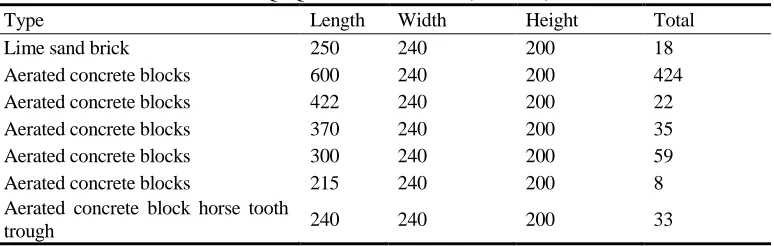
[image:3.612.106.493.269.392.2]Rowed bricks can be used to guide the construction. Take QTQ-3-external <SA, S4><SA, S3> as an example, as is shown in Table I.
TABLE I. QTQ-3-EXTERNAL<SA,S4><SA,S3>.
Type Length Width Height Total
Lime sand brick 250 240 200 18
Aerated concrete blocks 600 240 200 424 Aerated concrete blocks 422 240 200 22 Aerated concrete blocks 370 240 200 35 Aerated concrete blocks 300 240 200 59 Aerated concrete blocks 215 240 200 8 Aerated concrete block horse tooth
trough 240 240 200 33
ROWING BRICKS BY BIM5D
(1) Integrating model
The civil engineering model, the field layout model, the template and the scaffold model are imported into the solid model and the field model respectively to realize the integration of several professional models [6].
(2) Adjusting general parameters
Read the corresponding parameter values for the different types of walls from of the building general description. In the BIM5D software, we set the brick masonry bricks, the height of the plug seam, the thickness of the mortar joint and the lap length between the blocks. The setting should accord with the specification for masonry brickwork [7-9].
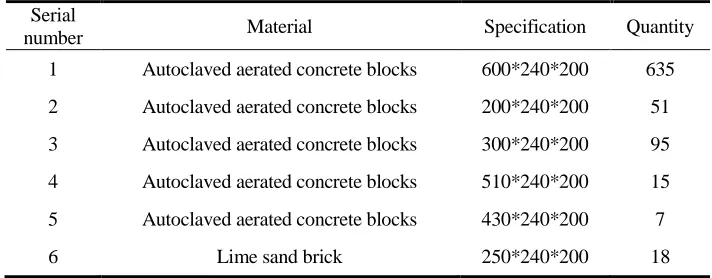
(3) Edit, modify and export arrangement graph
TABLE II. QTQ-3-EXTERNAL MASONRY DEMAND. Serial
number Material Specification Quantity 1 Autoclaved aerated concrete blocks 600*240*200 635 2 Autoclaved aerated concrete blocks 200*240*200 51 3 Autoclaved aerated concrete blocks 300*240*200 95 4 Autoclaved aerated concrete blocks 510*240*200 15 5 Autoclaved aerated concrete blocks 430*240*200 7
6 Lime sand brick 250*240*200 18
COMPARATIVE ANALYSIS
Through the Phoenix Island Middle School teaching building project comparative analysis of the pros and cons of three types of rowing bricks. As is shown in Table III.
TABLE III. COMPARISON OF THE THREE TYPES OF ROWING BRICKS.
Method Advantage Disadvantage
CAD
Drawings easy to identify plans, design results repeated use, low hardware configuration requirements;
Two-dimensional drawings, cannot accurately statistics the amount of engineering data, cumbersome statistics, a row of tiles for a long time;
Revit
The building family is simple, and it can be directly operated on the original architectural model, and it is three-dimensional and intuitive;
Each wall of the block need to be placed separately, create changes are more difficult;
BIM5D
Simple operation, engineering standards, three-dimensional visualization, brick row speed [11-12];
High hardware requirements, high requirements for work environment;
CAD brick-rowing has great limitations, especially for a complex project similar to Phoenix Island middle school teaching building [13].The CAD drawings is two-dimensional drawings, the actual layout of each location brick cannot be displayed visually, and 3D brick can imagine space, also only need to draw each elevation and plane map. Not only wasted time, but also it can be arranged in a comprehensive and intuitive manner.
Next, REVIT brick-rowing and BIM5D brick-rowing should be compared for rowing speed and rowing quality.
Rowing speed
the time for creating tribes. When modeling with REVIT, it should be redraw the layout when changing parameters. BIM5D can directly adjust the thickness of mortar joint and other parameters, which is more convenient.
Rowing quality
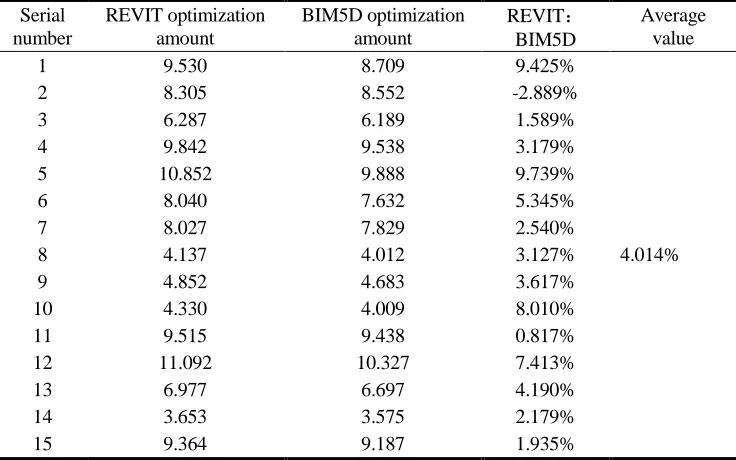
[image:5.612.113.481.231.461.2]Comparing the brick-rowing amount of REVIT and BIM5D, the application amount of bricks in BIM5D is 4.014% less than that in REVIT. It means that BIM5D could greatly save the brick amount, and save the costs, as is shown in Table IV.
TABLE IV. COMPARISON TABLE OF BRICK VOLUME OF REVIT AND BIM5D. Serial
number
REVIT optimization amount
BIM5D optimization amount
REVIT: BIM5D
Average value
1 9.530 8.709 9.425%
4.014%
2 8.305 8.552 -2.889%
3 6.287 6.189 1.589%
4 9.842 9.538 3.179%
5 10.852 9.888 9.739%
6 8.040 7.632 5.345%
7 8.027 7.829 2.540%
8 4.137 4.012 3.127%
9 4.852 4.683 3.617%
10 4.330 4.009 8.010%
11 9.515 9.438 0.817%
12 11.092 10.327 7.413%
13 6.977 6.697 4.190%
14 3.653 3.575 2.179%
15 9.364 9.187 1.935%
CONCLUSIONS
The traditional method of rowing bricks by CAD cannot visually demonstrate the specific effect of three-dimensional model. Rev it and BIM5D can be better than CAD to complete the row of bricks to complete the row of bricks. By comparing the three rows of bricks, BIM5D brick-rowing is best convenient, simple and easy to operate.
actual construction need to be further improved. We still combine specific project examples, sum up experience and improve the development of BIM5D technology, so that it can better guide the construction.
ACKNOWLEDGEMENTS
This work was financially supported by the National Science Fund subsidized project (51678375), Thirteen five national key research and development programs (2016YFC0702002-06), Liaoning Provincial Natural Science Foundation (20170540759; 201602604), Liaoning Provincial Department of Education general project (LJZ2016005) and Shenyang Jianzhu University general project (2017101).
REFERENCES
1. Yang Li. Technical Research on Improving Acceptance Rate of Masonry Partition at one Time[J/OL]. Architectural Knowledge, 2017,(13):(2017-10-18).
2. Pingjiang Jiang, Kai Yang, Shaowu Zeng, Mingqiang Wang. Application of BIM technology in construction of Jinsha River Double Track Extra Large Bridge [J/OL]. Railway Standard Design, 2018,(08):(2017-11-07).
3. Yanjun Liu. Application of AutoCAD software tile [J]. Shanxi Building, 2010, 36 (31): 364-365. 4. Yan Xue, Haiyang Gu. Application of CAD simulation of brick laying and feeding process in
engineering [J]. Tianjin Construction Science and Technology, 2014, 24 (05): 38-40.
5. Langni Deng, Xiaoxia Huang, Liang Guo, Jinchao Ma, Risheng Luo.Research on BIM-Based Application of Simulated Brick [J]. Journal of Engineering Management, 2016, 30 (06): 124-128. 6. Zhiqiang Wei. Application of BIM5D Based on Cloud Technology in Steel Truss Girder
Construction [J]. Railway Technical Innovation, 2017, (04): 86-91.
7. Chisi Su. Brick masonry construction technology analysis [J]. China Hi-tech Enterprise, 2009, (24): 98-99.
8. Yonmin Sun, Changxu Zhang. Study on Compilation of National Standard "Construction Code for Masonry Structures" [J]. Journal of Wuhan University (Engineering and Technology Edition), 2015, 48 (03): 387-390 + 396.
9. Hongko Zhao. Improvement of masonry building method of constructing horse teeth [J]. Browser, 2009, (05): 44.
10. Yang Xiao. Construction technology of embedded prestressed bars in masonry walls [J]. Jiangxi Building Materials, 2016, (12): 98.
11. Lanlan Zhang. BIM5D in the construction project cost management [A]. "Smart City" magazine, the United States Journal Academic Exchange Association .2016 Smart City and Information Technology International Symposium on Symposium III [C]. Smart City magazine, the United Periodical Academic Exchange Association: 2016, 1.
12. Jiang Xu. Research on Application of BIM 5D Technology in Central Grand Project[J]. Procedia Engineering, 2017,174.
13. Zhilong Wang, Fei Peng, Xiaoli Mei, Feng Gao. Secondary Structure Deepening Design with BIM Technology [J]. Construction Technology, 2016, 45 (06): 49-52.
14. Ping Leng, Zhankuan Shi, Wentao Qiao, Po Zhang, Ning Liu. Application of QR Code Technology Based on BIM in Steel Structure Construction [J]. Construction Technology, 2017, 46 (18): 93-95.