2019 International Conference on Computational Modeling, Simulation and Optimization (CMSO 2019) ISBN: 978-1-60595-659-6
Modeling of Grain Storage Ventilation Based on BP Neural Network
Hong-yu LI, Zi-zhao JIAO and Jing-yun LIU
*Logistics Department, College of Urban Rail Transit and Logistics, Beijing Union University, 97 Beisihuan East Road, Chaoyang District, Beijing 100101, China
*Corresponding author
Keywords: Grain storage, Stored grain aeration, BP neural network, MATLAB, Simulation.
Abstract. In the process of grain storage, low temperature and drying are two indispensable
conditions. Among them, drying is to keep safe water content of grain so as to avoid mildew and prolong its storage period. As far as drying is concerned, ventilation is the key. According to the characteristics of grain storage ventilation, combined with the heat and mass transfer theoretical model of grain storage aeration, simulation was carried out in MATLAB to obtain the corresponding ventilation duration, and neural network training and test data were obtained. Then the BP neural network model of real-time grain temperature and moisture, air temperature and humidity changes in the granary is established. MATLAB is used for simulation. The results show that the model can accurately simulate the temperature and humidity of the air and the temperature and moisture of grain after ventilation, providing a solution to grain storage ventilation modeling.
Introduction
In the process of grain storage, aeration can regulate the temperature and humidity and other conditions of grain storage [1]. At the same time, the grain temperature can be uniformed, the evaporation of water in grain can be reduced, and the seasonal rotation, grain dew, mold and other phenomena can be avoided.[2] Using the model to quickly simulate and predict the grain storage ventilation process is of great significance for adopting a reasonable ventilation strategy. The traditional theoretical model based on heat and mass transfer during stored grain aeration usually had a good accuracy for simulation. However, its calculation was time consuming and would occupy lots of computation resources. Therefore, BP neural network was studied in this paper to model the aeration process in order to provide a solution to the stored grain simulation problem.
In one aeration system, the initial grain moisture content, the inlet air temperature and relative humidity, and the aeration duration would all influence the stored grain ventilation process. The first three parameters were usually known, but the ventilation duration needed to be calculated. Therefore, the heat transfer and mass transfer theoretical model was used to calculate the ventilation duration first under different inlet air conditions [3]. Then the model was used to simulate the grain temperature, humidity and grain under different initial moisture, under different initial grain moisture content, inlet air temperature, relative humidity of the inlet air and ventilation duration.
BP Neural Network Design for Stored Grain Aeration Modeling
The significance of stored grain ventilation control was to ensure the quality and quantity of grain storage, so the problem of grain storage ventilation control was also the optimization problem of grain storage ventilation control. The control target was temperature and moisture reach the target value, while the system consumes the lowest energy. There are two control variables, the air relative
humidity Ha-in and the temperature Ta-in at the air inlet. The controlled variables are grain temperature
BP Neural Network
The BP neural network is a multi-layer feedforward neural network trained by error reverse-propagation algorithms, and is the most widely used neural network [4]. BP neural network was a multi-layer network, and its core method was gradient descent method. The weight and threshold of the network was repeatedly adjusted by the back propagation algorithm, so that the square sum of errors in the output layer of the network would be less than the specified error [5]. This paper mainly used the characteristic of BP neural network's accurate nonlinear mapping fitting ability to simulate the acquired data, and finally achieves reasonable prediction of intergranular air temperature and humidity and grain temperature and moisture content after ventilation.
BP Neural Network Topology Design
The BP neural network with three layers was used in this paper. The design of BP neural network was mainly to determine the specific variables of input layer and output layer and their node number, and also to determine the number of hidden layer nodes.
The real-time changes of grain temperature and moisture, and intergranular air temperature and humidity in the storage bin were studied in this paper, which were affected by the initial grain moisture content, the inlet air relative to humidity and temperature, and the ventilation duration. Therefore, the node number of the input layer was four, and that of the output layer was four.
Hidden nodes in the neural network hidden layer can extract and store the rules of the network model from the sample, enhancing the mapping ability of the neural network. As the key to connect the input layer and the output layer, the number of hidden nodes should not be too large or too small. If there were too many hidden layer nodes, over-fitting might happen; If the number of hidden layer nodes was too small, the trained data could not be fully utilized and the function of neural network would be greatly reduced.
In this paper, the 'trial and error method' was used to determine the number of hidden layer nodes:
=
M n l a. (1)
The structure of BP neural network for stored grain aeration modeling was shown in Figure 1.
Input Layer (4) Implied Layer (10) Output Layer (4)
Figure 1. BP neural network structure for grain storage ventilation modeling.
BP Neural Network Data Sample
Theoretical Model of Grain Storage Ventilation
The stored grain bulk was divided into several control volumes, and for each volume, four partial differential equations based on heat and mass transfer during ventilation were used as the simulation model [3]. Finite difference method was used to calculate the model in order to get the temperature and moisture content changes of the grain bulk.
w g R t M
. (2) The thermal balance equation for grain was:
a in a g w
ca a
a W M M W R
t M
W
. (3) The thermal balance equation of air was:
)] (
[( )
( a g w g vap pv a g a
g g pg
g h T T R L c T T
t T
c
. (4) The heat conservation equation for control volume of intergranular air was:
g w a pv g a a g a in a pa a a pa
a f c T T h T T c T R
t T
c
) ( ) (
. (5) In this paper, the data used to train and test the neural network was obtained with the above model.
Model for Ventilation Duration
Ventilation duration is the main factor affecting the ventilation process. During ventilation, when the moisture content of the grain finally reached the equilibrium moisture content, ventilation would be finished. The time duration of this process is the maximum.
By setting the initial grain moisture content at13, 16 and 20%, inlet air temperature at 10, 20, 30 and 40°C, inlet air relative humidity at 50 and 60%, groups of data were obtained with matlab using the theoretical model. testing data was selected to the test network. Before training or testing the neural network, all the data was normalized to avoid excessive saturation of neurons. The normalized formula is. min max min n n x x X x x
. (6)
Where xn was each original input data; xmin was the minimum value of the original input data; and
xmax was the maximum value of the original input data.
Finally, ventilation duration model based on BP neural network was developed and simulated for the data required by the modeling of ventilation process.
Data of the Neural Network Model for Ventilation Process
The initial moisture content of the grain was set at 13, 16 and 20%, the inlet air temperature at10, 20, 30 and 40°C, the relative humidity at 50% and 60% respectively, and the ventilation duration at 1, 2, 3, 4, 5, ... 31 hours. Finally, 744 groups of data were obtained. Before application, the data was also normalized.
BP Neural Network Simulation and Result Analysis
Neural Network Simulation Results
BP neural network was conducted using the BP neural network topology and simulated data in Matlab. the learning rate for the neural network is 0.03, the maximum number of cycles are 3000, and the
minimum expected error is 0.00001. The weights from the input layer to the hidden layer were W1,
and the weights from the hidden layer to the output layer were W2. Combined with experimental data,
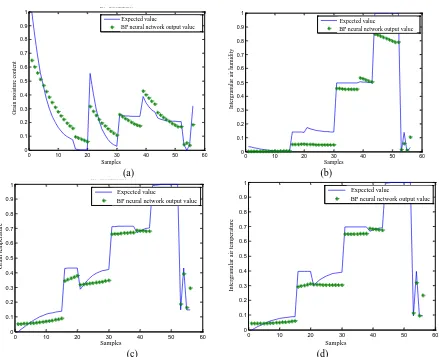
BP neural network was used to simulate the temperature and moisture content of grain and the temperature and humidity in the air.
for grain moisture content, intergranular air humidity, grain temperature and intergranular air temperature reapectively.
0 500 1000 1500 2000 2500 3000 0 0.05 0.1 0.15 0.2 0.25
训 练 步 长
训练误差
Training step
[image:4.595.187.393.112.274.2]Training error
Figure 2. Mean Square Error Caused by Training.
0 10 20 30 40 50 60
0 0.1 0.2 0.3 0.4 0.5 0.6 0.7 0.8 0.9 1
输 入 样 本
粮食水分
测试数据
BP simulation
期 望输 出 值
BP网络 粮 食 水 分 实 际 输 出 值
Expected value
BP neural network output value
Samples
Grain moi
sture cont
ent
0 10 20 30 40 50 60
0 0.1 0.2 0.3 0.4 0.5 0.6 0.7 0.8 0.9 1
输 入 样 本
空气湿度
测试数据
BP simulation
期 望输 出 值
BP网络 空 气 湿 度 实 际 输 出 值
Samples Inte rgranular a ir humi dity Expected value
BP neural network output value
(a) (b)
0 10 20 30 40 50 60
0 0.1 0.2 0.3 0.4 0.5 0.6 0.7 0.8 0.9 1
输 入 样 本
粮食温度
测试数据
BP simulation
期 望输 出 值
BP网络 粮 食 温 度 实 际 输 出 值
Samples
Grain t
empera
ture
Expected value
BP neural network output value
0 10 20 30 40 50 60
0 0.1 0.2 0.3 0.4 0.5 0.6 0.7 0.8 0.9 1
输 入 样 本
空气温度
测试数据
BP simulation
期 望输 出 值
BP网络 空 气 温 度 实 际 输 出 值
Samples Inte rgranular a ir te mperat ure Expected value
BP neural network output value
(c) (d)
Figure 3. Simulation results of the BP neural network.
Analysis of Neural Network Simulation Results
[image:4.595.70.509.292.649.2]maps are 0.12, 0.15, 0.21 and 0.35 respectively, with high precision and good fitting degree. Therefore, grain moisture content, intergranular air humidity, grain temperature and intergranular air temperature simulated by BP neural network in this paper have results, and the obtained model weight matrix could be used as the weight value of the model. The model could be universally applied.
Summary
To sum up, the BP neural network and the heat and mass transfer red model of grain ventilation were used to establish a stored grain ventilation model. This model could track and acquire the real-time grain temperature and moisture, intergranular air temperature and humidity changes in the bin. During simulation in Matlab, the error was greatly controlled and would not affect the overall simulation results. Compared with the prediction of traditional models, this model has the characteristics of good non-linear mapping ability, high calculation speed and easy to apply.
Acknowledgement
This research was financially supported by Scientific Research Project of Beijing Education Commission (KM201811417007).
References
[1] G. R. Thorpe. Modelling ecosystems in ventilated conical bottomed farm grain silos. Ecological Modelling 94 (1997) 255-286.
[2] Gu Wei, Wang Benlong, Hu Tianqun, Zhang Minping. Numerical Evaluation of Cooling Effect of Mechanical Ventilation [J]. Grain Storage 5 (2007):29-34.
[3] A. Iguaz, C. Arroqui, A. Esnoz, P. Vírseda. Modeling and simulation of heat transfer in stored rough rice with aeration. Biosystems Engineering 89 (2004) 69-77.
[4] Wen Xin, Zhang Xingwang, Zhu Yaping, Li Xin. Intelligent Fault Diagnosis Technology: MATLAB Application [M] Beijing University of Aeronautics and Astronautics Press, 2015.09.