2016 International Conference on Manufacturing Science and Information Engineering (ICMSIE 2016) ISBN: 978-1-60595-325-0
Study on Temperature Field of
Multi-temperature and Multi-compartments
Refrigerated Car
GUANGHAI LIU, LI YOU and RUHE XIE and YIFENG ZOU
ABSTRACT
For simulate temperature field of multi-temperature and multi-compartments car, a serial of experiments have done. The experimental conditions were set with 20K temperature differences. The temperature of the freezing compartment and cooling compartment were experimented as -5℃ and 15℃. After the experiments, paper analyzed the distribution and change of temperature in each compartments. Then, the reason of temperature fluctuation were discussed. Finally, it puts forward the some operational recommendations for temperature and multi-compartments car. It provide reference for how to strengthen the quality of perishable goods in cold chain. It can reduce the perishable goods loss, cut down cost and save energy.
INTRODUCTION
refrigerated transport system is more complex than single compartment refrigerated transportation system [3-4]. In view of the above problems, this paper take multi-temperature and multi-compartments refrigerated car as the research object, the experiment was made mainly by setting different temperature zones to explore the inside temperature field distribution of the vehicle and analysis of the temperature changes and interaction effects in the refrigerated transport process. At the end of the paper, by analyzing the experimental results, some references were provided for how to strengthen the quality of perishable goods in the cold-chain.
EXPERIMENTAL PREPARATION
Experimental Equipment and General Arrangement
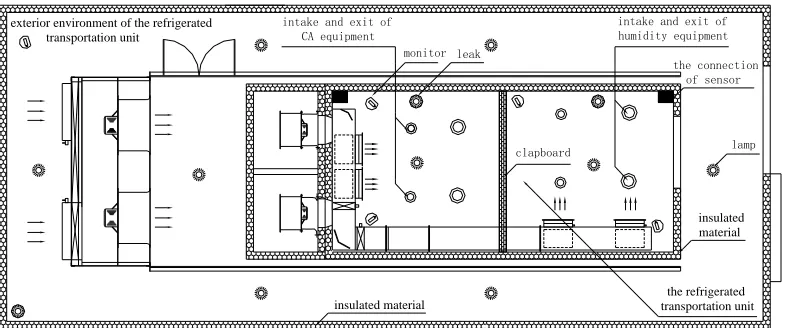
The experiments were carried out in multi-temperature refrigerated transport simulation experimental platform designed by Research Center for Logistics & Transportation of Guangzhou University. The experimental multi-temperature vehicle model was double evaporator double temperature refrigerated car [5-6]. The temperature can be changed from -20 ℃ to 20 ℃. In the experiment, the two separate temperature control space is marked as compartment 1 (freeze compartment) and compartment 2 (cooling compartment). The external environment control unit was maintained 25℃, the wind speed of the wind turbine is adjusted to 4m/s (uniform wind speed). The internal refrigeration unit is closed, the temperature in compartment 1 is -5℃, compartment 2 is 15℃.
insulated material
insulated material
leak monitor
lamp the connection of sensor intake and exit of humidity equipment intake and exit of
CA equipment
clapboard
exterior environment of the refrigerated transportation unit
[image:2.612.122.515.445.609.2]the refrigerated transportation unit
Temperature Sensor Placement
In order to distinguish and analyze the data, 15 temperature measurement points were set in each compartment. The temperature sensor arranged basically in every vertex to each compartment inside the refrigeration unit walls, edges and faces of the central and in the middle of the compartment. Each measured point inside and outside the area were left walls about 10cm and got data per minute, as shown in Figure 2.
Figure 2. Temperature sensor distribution of Figure 3. Average temperature of refrigerated car distribution. curve of two temperature compartment.
EXPERIMENTAL PROCEDURES AND RECORDS
Experimental Procedures
According to the requirements of the experiment, the external environment control in about 25℃, wind speed control in 4m/s. Open the air supply outlet and the air return inlet of the experimental platform to ensure the normal circulation of air. The cooling tower water filled up, ensure the refrigeration effect has remained unchanged.
Experimental Records
This experiment studied the temperature field distribution between different temperature compartments by simulating 20K temperature differences between compartment 1 and compartment 2 for multi-temperature transportation. Two compartment began to cool down from 25 ℃.
significantly. It can be seen that the impact of the temperature field on the inside of the car is particularly large. On the other hand, compartment 2 cooled down to about 5℃ in 10min, then the temperature has been in constant fluctuations.
EXPERIMENT ANALYSIS
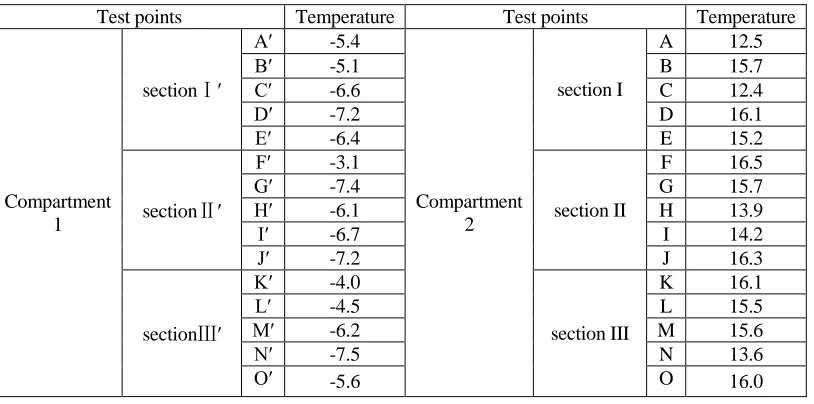
[image:4.612.97.504.327.529.2]The temperature in different points were shown in table I. According to the chart, we can find that the average temperature of the test points in compartment 1 and compartment 2 has a certain difference with the set temperature. This is related to the uniqueness of refrigerated transport. Refrigerated vehicles in the transportation process, an external high speed leads to significantly enhance the outer surface of the wind pressure, internal forced heat convection leads to air flow, coupled with air flow organization and compartment between the heat and mass transfer, making temperature at different locations will be different.
TABLE I. The average temperature of each test point under different temperature conditions. Test points Temperature Test points Temperature
Compartment 1
sectionⅠ′
A′ -5.4
Compartment 2
section I
A 12.5 B′ -5.1 B 15.7 C′ -6.6 C 12.4 D′ -7.2 D 16.1 E′ -6.4 E 15.2
sectionⅡ′
F′ -3.1
section II
F 16.5 G′ -7.4 G 15.7 H′ -6.1 H 13.9
I′ -6.7 I 14.2 J′ -7.2 J 16.3
sectionⅢ′
K′ -4.0
section III
K 16.1 L′ -4.5 L 15.5 M′ -6.2 M 15.6 N′ -7.5 N 13.6 O′ -5.6 O 16.0
CONCLUSION
In terms of refrigerated equipment, the air-tightness need to strengthen between different temperature compartments. It should be ensure that the heat leakage reduced, the goods under different temperature compartments without interaction effect, the quality of the goods safety. When design temperature and multi-compartments refrigerated car, the insulation materials should choose strong air tightness, low heat leakage rate of materials, to make the external pressure, or other aspects of the influence of the internal temperature field is reduced to less. In addition, when placing the goods should pay attention to air flow organization, to avoid a significant rise in temperature caused by improper placement. It’s also needed to strengthen the packaging of goods.
ACKNOWLEDGMENT
Thanks for the support by Science and Technology Planning Project of Guangzhou (No. 08JA630019) and Outstanding Young Teacher Training Program of Guangdong (No. Yq2013129).
REFERENCES
1. Xu Qian, Xie Jin. Optimization design and numerical simulation on the field of fluid and temperature in the multi-temperature refrigerated trucks [J]. Food & Machinery, 2008(6):88-92. 2. Liu Hao Rong, The performance test and optimization about multi-temperature vehicle [D].
Guangzhou: Guangzhou University. 2012.
3. Zhang Dongxia, Lü Enli, Lu Huazhong, et al. Experimental study on temperature field distribution characteristics in fresh-keeping transportation[J]. Transactions of the Chinese Society of Agricultural Engineering (Transactions of the CSAE), 2012, 28(11): 254-260.
4. Xie ruhe li haorong liu guanghai, et al. The Study of Temperature Variation During the Process of Unloading about Multi-temperature Refrigerated Vehicle[J]. Refrigeration, 2012(1):1-7. 5. Liu Guanghai, Xie Ruhe, Zong Yan. Energy consumption management and energy saving
strategy analysis of refrigerated transportation [J]. Railway Transport and Economy. 2011, 33(7):28-31.