doi:10.4236/ojapps.2013.32B007 Published Online June 2013 (http://www.scirp.org/journal/ojapps)
Directly Driven RO System by PV Solar Panel Arrays
Moustafa Elshafei
1, Anwar Khalil Sheikh
2, Naseer Ahmad
2 1Systems Engineering Department, KFUPM, Dhahran, Saudi Arabia 2Department of Mechanical Engineering, KFUPM, Dhahran, Saudi Arabia Email: [email protected], [email protected], [email protected]Received 2013
ABSTRACT
In this work the performance evaluation of directly driven Reverse Osmosis (RO) water desalination system by Photo-voltaic (PV) arrays is investigated by a novice method. Reverse Osmosis water desalination system needs continuous supply of energy and on the other hand energy from the PV is intermittent in nature. The energy consumption of RO plant is strong function of clean water (permeate) flow rate and system pressure and they needs to be tuned to match the maximum power provided by the PV arrays. In this work a novice method to tune the RO system parameters by ma-nipulating the position of the valve at the brine side of the RO system is proposed. A simple perturb and observe algo-rithm is used for automatic control of the valve position. The performance of the proposed battery less system is com-pared with a conventional system using PV, charge controller and battery. The proposed directly driven battery-less system provides more water per day than battery operated system.
Keywords: PVRO System; Maximum Power Point Tracking; Reverse Osmosis; Desalination, Renewable Energy
1. Introduction
Safe drinking water shortage in the world has necessi-tated research and development in the sea and brackish water desalination based on renewable energies [1]. In the recent years, the interest in the use of reverse osmosis membrane desalination has increased due to the energy efficiency and versatility of this process relative to other water desalination technologies [2]. When operating the reverse osmosis desalination unit it is imperative that system conditions are monitored and maintained at ap-propriate set points in order to produce the required amount of clean, portable water while preventing system damage [3]. It is also desirable to find the operating methods to reduce the energy consumption of the reverse osmosis desalination plant in the presence of variability of feed water salinity and input power.
PV-powered reverse osmosis is considered one of the most promising forms of renewable energy powered de-salination, especially when it is used in remote areas. PV-RO initially is most cost-competitive for small-scale systems where other technologies are less competitive [4]. In RO filtration process salty water is pressurized to flow through a membrane, causing a separation of the saline solution from the solute. The energy required to pressur-ize the feed water is the major energy needed for the RO process [5]. Reverse Osmosis is a scalable process, but the energy efficiency decreases on small-scale systems. Different control algorithms can be utilized to improve the efficiency and feasibility of PV-RO systems [6].
pressure by manipulating the valve position at the brine side.
The paper is organized as follows: Section 2 provides the system description of the PV RO system, section 3 is regarding the modeling of the whole system, and section 4 is about simulation results followed by conclusions.
2. System Description
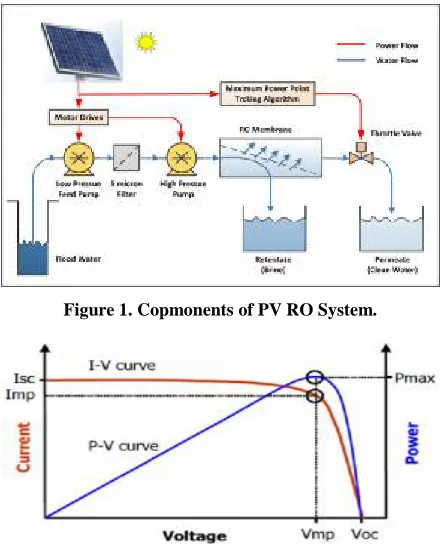
[image:2.595.62.283.449.722.2]PV RO system consists of power generation unit and desalination unit. PV power unit consists of PV panels and DC power is produced when the solar radiations are incident upon it. RO desalination process consists of high pressure pump, membrane unit and pressure control valve at the brine side. The solution is pressed by pump against the membrane, water molecules passes through the membrane reducing the concentration of the solute known as permeate and the rest of the water with high salt concentration is rejected as a waste known as brine. The valve at the brine side is used to control the amount of discharged brine and to control the system pressure. Figure 1 depicts out the illustration of PV RO system.
Electric energy produced by the PV panel is strong function of insolation and temperature of the module. The current-voltage characteristics of PV arrays are il-lustrated in Figure 2, where the maximum power point is at Imp and Vmp. The closer we get to this point, the more energy is generated to run the RO process in PV-RO systems. Our goal is to maximize the power provided by the PV array by targeting this point.
Figure 1. Copmonents of PV RO System.
Figure 2. I-V and P-V curves of a typical PV array [5].
Typical illustrations of I-V and P-V curves for PV ar-rays are available in [11], mathematical modeling of PV cells is discussed in [13,14], and the RO process model is explained in [12]. Various techniques for maximum power point tracking of PV arrays are summarized in [15]. Models for the PV-RO systems were presented in [6], and an experimental system was developed to track the maximum power point using two PIC24 master/slave microcontrollers. In [13], feedback and feed forward control algorithms were developed to find the best fixed voltage which operates the plant at a close value to the maximum power point, but it has efficiency limitations. In our approach, we are introducing a new way of track-ing the maximum power point in PV-RO systems by changing the position of the valve on the brine side, which can be done easily without adding extra expensive components.
3. Modeling
For PV RO system, it is assumed that the system is run-ning directly by the output of PV panel, and the brine flow rate is controlled by a valve. In this section, the mathematical representation of the PV array, motor, pump, and RO process will be discussed. The mathe-matical equations which represent the RO desalination process are explained in [6], and used in this work. The RO system is illustrated in Figure 3, where Pf,Qf and Xf are the input high pressure, flow rate and salt concentra-tion respectively. The high pressure forces the water to pass through the membrane to the permeate side, while leaving the retentate. The pressure at the brine side is denoted by Pb. Similarly, the brine flow rate and concen-tration are denoted by Qb, and Xb respectively. The per-meate water flow rate is Qp, and its concentration ix Xp. The Osmotic pressure is the function of temperature and salt concentration in the feed water [5]. To have positive permeate flow, the operating pressure needs to be greater than the osmotic pressure.
Valve equation:
[image:2.595.313.539.593.718.2]The pressure equation for the high pressure vessel containing the membrane is as follows.
b f Pm
P =P −D (1)
where DPm is pressure drop along the membrane. The brine discharge rate through the valve is given by
( )
b v b atm
Q =K u P −P (2)
where u is the valve opening on a scale from 0 to 1, Kv is the valve flow coefficient, and Patm is the atmospheric pressure.
Membrane Modeling:
The membrane mass balance equation is given by
fQf bQb pQp
ρ =ρ +ρ (3)
Neglecting the change in density, equation (3) be-comes simple
f b p
Q =Q +Q (4)
Salt balance equation
f f b b p p
Q X =Q X +Q X (5)
From (4) and (5)
b f p b f p X X Q Q X X − =
− (6)
Membrane water permeability
( )
p w m
Q = ∆ − ∆P π K A (7)
where;
0.5( )
0.5( )
0.5( )
and 75.85 * ( / 300)Pa / ppm
f b p
f b p
f b p
P P P P
X X X
T
π π π π
α α α
α
∆ = + −
∆ = + −
= + −
=
Substituting (6) in (7), we get
( ) ( 2 )
2
( )
2
f p w m f p b f
b
b f p w m
X X K A P X X Q X
X
Q X X K A
α α − ∆ − − + = + − (8)
The membrane salt permeability is given by
( )
p p p S m
Q X = X−X K A (9)
where Am is the area of the membrane, and
f f p p
p f
Q X Q X
X
Q Q
+ =
+ (10)
Then from (5), we can write (10) as
2
2
b b p p
p b
Q X Q X
X
Q Q
+ =
+ (11)
Equation (9) can now be written as
( p) p p p S m 0
f X =Q X −X −X K A = (12)
Equation (12) may be solved for Xp using bisection method in the interval [0, 0.95Xf], Where Qp is substi-tuted by Equation (6), and Xb by Equation (8). Next, Xb can be found from (8), Qp from (5), and Qf from (3).
Motor:
The following relation represents the torque of the motor when its resistance is constant:
0 m t I I T K −
= (13)
where T is the torque in newton-meter, I and Im0 are the motor current and the current related to the friction, re-spectively, and Kt is the torque constant in A/Nm. The motor angular velocity is represented as follows:
(V Rmo)Km
ω= − (14)
where ω is the angular velocity, V is the motor voltage, Rmo is the resistance of the motor in ohms, and Km is the motor speed constant in rev/Vs.
Pump:
The feed water volumetric flow in the following rela-tion is the output of the pump, which is related to the angular velocity of the motor.
2 f
D
Q ω
π
= (15)
D
is the pump displacement per revolution. The hy-draulic pressure of the feed in Pascal can be found using the following relation:2 f in T P P D η π
= + (16)
where η is the efficiency of the pump. PV array model
The five parameters model for PV array can be used to represent the relation between the cell current and volt-age [13,14]:
0( 1)
s t V IR aV s L sh V IR I I I e
R +
+
= − − − (17)
where IL is the light generated current, I and V are the cell current and voltage, respectively, Io is the dark satu-ration current, Rs and Rsh are the cell series and shunt resistances, respectively, a is the quality factor for the diode, and Vt is the thermal voltage, which is defined as follows:
/
t s
V =N kT q (18)
Figure 4. Illustration of the PV-RO system.
track the maximum power given by the PV array by ma-nipulating the valve position. As in eq. (12), manipulat-ing the valve openmanipulat-ing is related to the volumetric flow of the brine water. Additionally, since the volumes and the masses must be balanced, this has a direct impact on the flow of feed water, which is related to the output of the pump (eq. 17). Furthermore, the output of the pump is driven by the angular velocity of the motor (eq. 17), which is related to the input voltage and current coming from the PV array (eq. 16). Finally, since the valve opening is related to the voltage and current of the PV array, manipulating it can also change the input power going to the motor.
4. Simulation Results and Discussion
All of the above equations were programmed in the MATLAB environment to simulate the system. Feed water temperature of 300 K, a salinity of 5000 ppm was taken and other parameters for PV array, motor, and pump are from [3] and are below.
6 5
6 3
8
8 3 2
1.5
2.5 10
1.911 10
1296
6.252( / )
5.5( / )
0.65
0.1546
2.6 10 /
2.0 10
101
1.9481 10 ( / sec) t
o
s
sh
t
m
mo
mo
v
atm
s
aV V
I A
R
R
K A Nm
K rev Vs
I Amp
R
D m rev
K
P kPa
K m m
−
−
−
−
−
=
= ×
= × Ω
= Ω
= = =
= Ω
= ×
= ×
=
= ×
The solar insolation for a typical day in May in Dhah-ran, Saudi Arabia is given in Figure 5. Figures 6 show the simulation results when only the valve position is changed from 10% to 80%. Manipulating the brine valve position changes the load line of the motor pump. This I-V relation represents the load curve to be matched by the PV. Figure 6 shows the I-V curve of the PV array and the load curves for two different valve positions (U = 0.1(10% open) and U = 0.8 (80% open)). It is evident that as we close the valve position, system pressure
in-creases and load line becomes steeper showing that more power is consumed from the PV array. If the load line is passing through maximum power point in the IV curve then maximum power is harvested from the PV array and this point can be tracked by changing the valve opening.
A simple hill-climbing (Perturb & Observer) algorithm was developed to manipulate the position of the valve in order to track the maximum power point. The system operation is simulated from 6:00 am to 6:00 pm and the current and voltage are measured every 15 minutes and the change of power is monitored.
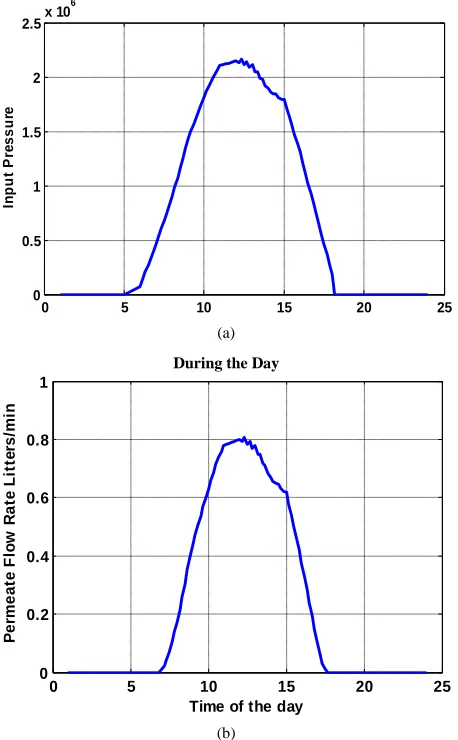
Figure 7 shows the power delivered by the PV com-pared with the consumed power. At low power the valve will not operate until the pressure in the membrane ex-ceeds the osmotic pressure. Figures 8(a) and (b) illus-trates the feed pressure and the permeate water flow rate. The total water flow rate came to about 324 liters/day.
Conventional Battery-Operated System
0 5 10 15 20
0 200 400 600 800 1000
Time in hours
S
o
la
r
E
n
e
rg
y
W
a
tt
s
/m2
Figure 5. Typical 24 hours solar insolation in May at KFUPM.
0 5 10 15 20 25
0 5 10 15 20 25 30
Current in Amp
V
o
lt
a
ge U =0.1
PV
U =0.8
RO Load curve
[image:4.595.310.537.317.500.2] [image:4.595.311.536.547.708.2]0 5 10 15 20 25 0
50 100 150 200
Time of the day
P
V
p
o
w
[image:5.595.62.287.86.247.2]er
Figure 7. Dotted: available power; solid: used power.
0 5 10 15 20 25
0 0.5 1 1.5 2 2.5x 10
6
I
n
p
u
t
P
re
s
su
re
(a)
During the Day
0 5 10 15 20 25
0 0.2 0.4 0.6 0.8 1
P
e
rm
e
a
te
F
lo
w
R
a
te
L
itt
e
rs
/m
in
Time of the day
(b)
Figure 8. (a) Variation of Feed pressure (Pa); (b) Permeate water flow rate in L/min.
The performance of the proposed system is compared with a commercial system delivered with an electronic MPPT system and a battery. The MPPT utilizes the solar energy during the day to charge the battery. The RO
sys-tem then operates directly from the battery at almost constant battery voltage of 24 volts (+- 2 volts). In this case the brine valve is kept at a fixed position (0.5). The efficiency of the electronic MPPT is 97%, and the battery efficiency is assumed to be 85%. The total energy deliv-ered by the MPPT to the battery is calculated as follows.
Es=Total Radiation energy = 6.76 kWh/m2
Energy available from the PV panel = Es*(panel area)*(panel efficiency) = (6.76)*(1.25)*(0.16)
=1.352 kWh
Assuming MPPT efficiency 97% is used to capture the entire solar energy to a 24 volt battery. During RO op-eration at a constant voltage of 24 volts, the battery cur-rent is about 17 Ampere, and the permeate flow rate is 1.727 litters/min. The total desalinated water depends now in the battery efficiency. For example at battery ef-ficiency is 0.85, the total operating time will be about 169 minutes, and the total produced permeate water Qtotal = 292 litters/day, that is less than the water volume pro-duced by the proposed battery less system. In fact, to produce the same amount of water per day, the battery efficiency should be at least 94%.
5. Conclusions
In this work detailed mathematical model of a battery- less PV RO system is explained and a simple design ap-proach to track the maximum power point of the PV module is introduced. The perturb and observe (P&O) algorithm is used to find and track and maximum power point by manipulating the position of the brine valve in the RO system. The whole system was simulated by making use of typical values of the process parameters. Power consumed in the RO process is closely tracking the available power from the panel. The proposed scheme is a simple low-cost approach since changing the position of the valve can be done by a cheap microcon-troller. Further improvements needs to be done to reduce the repetitive fluctuations in the valve position. It is shown that the proposed battery-less system provides more water per day than battery operated system.
6. Acknowledgements
The authors would like to acknowledge the support of King Fahd University of Petroleum and Minerals through the Center for Clean Water and Clean Energy at KFUPM (DSR project # R6-DMN-08) and MIT.
REFERENCES
[image:5.595.59.288.279.649.2]pp.1537-1556. doi:10.1016/j.rser.2011.11.002
[2] A. Rahardianto, J. Gao, C. J. Gabelich, M. D. Williams and Y. Cohen, “High Recovery Membrane Desalting of Low-salinity Brackish Water: Integration of Accelerated Precipitation Softening with Membrane RO,”Journal of Membrane Science, Vol. 289, 2007, pp. 123-137. doi:10.1016/j.memsci.2006.11.043
[3] A. R. Bartmana, A. Zhua, P. D. Christofidesa and Y. Cohena, “Minimizing Energy Consumption in Reverse Osmosis Membrane Desalination Using Optimiza-tion-based Control,” Journal of Process Control,2010. [4] A. Al-Karaghouli, D. Renne and L. L. Kazmerski, “
Re-newable Energy Technical and Economic Assessment of Photovoltaic-driven Desalination Systems,”Vol. 35, 2010. [5] O. K. Buros, “The ABCs of Desalting,” Published by the International Desalination Association, Topsfield, Mas-sachusetts, USA, 2000.
[6] A. M. Bilton, L. Kelley and S. Dubowsky, “Photovoltaic Reverse Osmosis — Feasibility and A Pathway to De-velop Technology,” Desalination and Water Treatment, Vol. 31, 2011, pp. 24-34. doi:10.5004/dwt.2011.2398 [7] A. M. Thomson, “Reverse-osmosis Desalination of
Sea-water Powered by Photovoltaics without Batteries,” A Doctoral Thesis, Loughborough University, 2003. [8] S. Abdallaha, M. Abu-Hilala and M. S. Mohsen, “
Per-formance of A Photovoltaic Powered Reverse Osmosis System under Local Climatic Conditions,” Desalination
Vol.183, 2005, pp. 95-104. doi:10.1016/j.desal.2005.03.030
[9] A. R. Bartman, P. D. Christofides and Y. Cohen, “Non-linear Model-based Control of An Experimental Reverse-osmosis Water Desalination System,” Industrial & Engineering Chemistry Research, Vol. 48, 2009, pp. 6126-6136. doi:10.1021/ie900322x
[10] P. C. M de Capvalho, R. S. T. Pontes, D. S. Oliveira Jr, D. B. Riffel, R. G. V. de Oliveria and S. B. Mesquita, “Control Method of A Photovoltaic Powered Reverse Osmosis Plant without Batteries Based on Maximum Power Point Tracking,” IEEE/PES Transmission & Dis-tribution Conference & Exposition: Latin America, 2004. [11] Solmetric Corporation, “Guide To Interpreting I-V Curve
Measurements of PV Arrays,” Solmetric Corporation, March 2011.
[12] H. T. El-Dessouky and H. M. Ettouney, “Fundamentals of Salt Water Desalination,”Elsevier Science B.V., 2002, p. 429.
[13] J. A. Gow and C. D. Manning, “Development of A Photo-voltaic Array Model for Use in Power-electronics Simu-lation Studies,” Proceedings of the 14th IEE Electric Power Applications Conference, APEC, UK, Vol. 146, No. 2, 1999, pp. 193-200.
[14] A. El Tayyan, “PV System Behavior Based on Data-sheet,” Journal of Electron Devices, Vol. 9, 2011, pp. 335-341.