http://dx.doi.org/10.4236/act.2013.24023
Numerical Studies of the Generalized
l
1
Greedy Algorithm
for Sparse Signals
Fangjun Arroyo1*, Edward Arroyo2, Xiezhang Li3, Jiehua Zhu3
1Department of Mathematics, Francis Marion University, Florence, USA 2School of Science Technology, American Public University System, Manassas, USA 3Department of Mathematical Sciences, Georgia Southern University, Statesboro, USA
Email: *[email protected]
Received October 26, 2013; revised November 26, 2013; accepted December 2, 2013
Copyright © 2013 Fangjun Arroyo et al. This is an open access article distributed under the Creative Commons Attribution License, which permits unrestricted use, distribution, and reproduction in any medium, provided the original work is properly cited.
ABSTRACT
The generalized l1 greedy algorithm was recently introduced and used to reconstruct medical images in computerized
tomography in the compressed sensing framework via total variation minimization. Experimental results showed that this algorithm is superior to the reweighted l1-minimization and l1 greedy algorithms in reconstructing these medical
images. In this paper the effectiveness of the generalized l1 greedy algorithm in finding random sparse signals from
un-derdetermined linear systems is investigated. A series of numerical experiments demonstrate that the generalized l1
greedy algorithm is superior to the reweighted l1-minimization and l1 greedy algorithms in the successful recovery of
randomly generated Gaussian sparse signals from data generated by Gaussian random matrices. In particular, the gener-alized l1 greedy algorithm performs extraordinarily well in recovering random sparse signals with nonzero small entries.
The stability of the generalized l1 greedy algorithm with respect to its parameters and the impact of noise on the
recov-ery of Gaussian sparse signals are also studied.
Keywords: Compressed Sensing; Gaussian Sparse Signals; l1-Minimization; Reweighted l1-Minimization; l1; Greedy
Algorithm Generalized l1 Greedy Algorithm
1. Introduction
In signal processing one wants to reconstruct a signal from highly incomplete sets of linear measurements of the signal, that is, the number of measurements is much smaller than the dimension of the signal. More precisely, assuming Am n with , one wants to recon-struct an unknown signal 0 from a set of m
measurements b = Ax0. This requires one to solve the
system of linear equations
mn
x n
Ax = b (1) to determine the solution that is exactly equal to x0. Since
system (1) is consistent and underdetermined, it has infi-nitely many solutions making it difficult to find the cor-rect solution x0. In many actual applications, such as
im-age reconstruction and decoding, however, the signal one wants to reconstruct is known to be sparse (or nearly sparse) in the sense that its coefficients in some or-thonormal basis are mostly zero (or approximately zero). The theory of compressed sensing [1-5] reveals that
sig-nals that have sparse representations can be reconstructed with high precision from far fewer measurements than the dimension of the signal itself. In fact, if the columns of A are chosen from a suitable distribution and the sig-nal is sufficiently sparse, then the sigsig-nal can be exactly recovered by solving the following standard l1-norm
minimization problem:
1
min subject to
n
x x Ax b (2)
where 1 1
n
i i
x
x . This optimization problem of aconvex objection function can be solved effectively and it has broad applications [6-10]. But the iterative l1-minimization method has a shortcoming in finding the
sparsest solution. Since the larger entries of x in each iteration skew the l1-norm, they are more heavily
penal-ized in the l1-minimization process. To address this
im-balance, weighted algorithms were introduced to reduce the influence of the larger entries. Two major algorithms designed for this purpose are the reweighted l1-minimi-
zation and l1 greedy algorithms [11,12].
Suppose that
xk is the sequence of vectorsated by l1-minimization. In the k-th iteration of the
re-weighted l1-minimization method [11], one minimizes
1
k
W x instead of x1 in (2), where
1
1
diag , ,
1
, 0, 1, ,
k k k
n k
i k
i
W w w
w x
i n (3)
Observe that the weights in (3) are roughly inversely proportional to the sizes of the entries of the previous iterate xk−1. So the larger entries are weighted down to
rectify their undue influence in the next iteration of the l1-minimization process. Numerical experiments [11]
have indicated that the reweighted l1-minimization
re-covers random sparse signals with a much higher prob-ability than the standard l1-minimization in (2). The
re-weighted l1-minimization algorithm has been extensively
studied in recent years. The lq-minimization problem, 0 <
q ≤ 1, was discussed and implemented using the re-weighted l1-minimization scheme [13,14]. A two-step
reweighted l1-minimization was introduced to improve
the recovery of sparse signals [15], and a reweighted l1-
minimization for a nonuniform sparsity model was pro-posed [16]. The performance of the reweighted l1-mini-
mization with noisy data was also rigorously analyzed [17], and some convergence conditions of reweighted l1-minimization for a special family of measurement
ma-trices were studied [18].
In the l1 greedy algorithm [12], instead of using
vari-able weights as in (3) the weights are set to a fixed small constant for entries whose magnitude is above a cer-tain threshold and to 1 for the other entries. This thresh-old is lowered after each iteration so that more and more large entries are weighted down by in each subse-quent iteration step. More precisely, the weights in the k-th iteration of the l1 greedy algorithm are defined by
k i
w
1
, for
, 1, , 1, otherwise k k i k i x M
w
i n
where 0 max
0i
1i n
M x x
, x
0 is generated by the
standard l1-minimization,
0,1 and
0,0.001
.Numerical experiments showed that the l1 greedy
algo-rithm outperforms both the unweighted and reweighted l1-minimization algorithms in recovering random sparse
signals [12,19].
A generalized l1 greedy algorithm in the compressed
sensing framework was recently introduced by the au-thors of [20]. The new algorithm not only incorporates the threshold feature of the l1 greedy algorithm to
coun-teract the influence of large entries but also assigns sig-nificantly large weights to the smallest nonzero entries to speed up the identification of nonzero entries. Moreover, in contrast to the l1 greedy algorithm where the
remain-ing entries are assigned a neutral weight, the remainremain-ing
entries in the generalized l1 greedy algorithm receive
weight roughly inversely proportional to their magni-tudes as in the reweighted l1-minimization algorithm.
Thus the generalized l1 greedy algorithm not only
incor-porates features of both the l1 greedy and reweighted
l1-minimization algorithms but also enhances the impact
of the small entries in the l1-minimization process.
Generalized l1greedy algorithm
1) Generate x0 by the reweighted l
1-minimization;
2) For k = 1 to kmax;
a) Update the weight matrix Wk; where
1 1 1 1 1 0 , for , for 1 , otherwise , 1,0,0.001 , 0,1 , 0
k k i k k i i k i 1, k x Ms w x x
M x O
s Ms
b) Solve weighted l1-minimization problem:
1
arg minn subject to
k k
x
x W x Ax b
c) Return if a stopping criterion is met.
In [20] the generalized l1 greedy algorithm was applied
to the problem of reconstructing essentially piecewise constant medical images in computerized tomography (CT) in the compressed sensing framework via total variation minimization. Tested with the Shepp-Logan phantom and a real cardiac CT image, the generalized l1
greedy algorithm was shown to perform better than the reweighted l1-minimization and l1 greedy algorithms. In
particular, it was observed that in the context of recon-structing these two images the generalized l1 greedy
al-gorithm was superior to the others at distinguishing small gradients. However, to show that the generalized l1
greedy algorithm is truly superior to the other two algo-rithms at detecting small entries in general we should compare the performance of the three algorithms in re-covering random sparse signals. So in this paper, follow-ing [11,12], we present a series of rigorous numerical studies of the performance of the generalized l1 greedy
algorithm in the general setting of Gaussian random ma-trices A and random sparse signals x. The rest of this pa-per is organized as follows. In Section 2, the relative frequencies of successful recovery of random Gaussian sparse signals for the reweighted l1-minimization, l1
greedy, and generalized l1 greedy algorithms are
com-pared. Section 3 presents the stability of the generalized l1 greedy algorithm with respect to its parameters.
Sec-tion 4 studies the performance of the generalized l1
generalized l1 greedy algorithm is better at detecting
smaller entries in the general setting than the other two algorithms. Section 6 concludes with a brief summary of the generalized l1 greedy algorithm and the results.
0 0.001
x x ,
where x is the reconstruction of x0 by the algorithm. The
parameters chosen for the three algorithms are listed as follows:
1) In the reweighted l1-minimization: 0.1.
2. Relative Frequency of Success in
Recovering Gaussian Sparse Signals
2) In the l1 greedy algorithm: 0.8; 0.001;others are the same as in 1).
3) In the generalized l1 greedy algorithm: 0.25; s
= 0.8; 40; others are the same as in 2). In our first experiment we want to determine how well
each of the three algorithms can recover random Gaus-sian sparse signals from random GausGaus-sian measurements b = Ax.Following the same approach taken in [11], we implement each of the three algorithms in MATLAB and invoke the l1eq-pd solver from the l1-MAGIC software
package developed by E. Candes and J. Romberg (avail-able at www.l1-magic.org). We set m = 128 and n = 256. For each trial, a random matrix Am n
n
with i.i.d. Gaussian entries is selected and its columns are normal-ized. A random k-sparse signal 0 is also selected in such a way that the k nonzero positions are randomly distributed and the nonzero components satisfy the stan-dard Gaussian distribution
x
0,1N . We run 150 trials for each sparsity level k between 50 and 90. The total number of iterations (excluding the initial l1-minimiza-
tion step) for each of the three algorithms is set to 16. For the generalized l1 greedy algorithm we start with 4
itera-tions of the reweighted l1-minimization. The criterion for
successful recovery for all three algorithms is set to
The settings in this section will be used throughout the paper unless changes are explicitly stated otherwise.
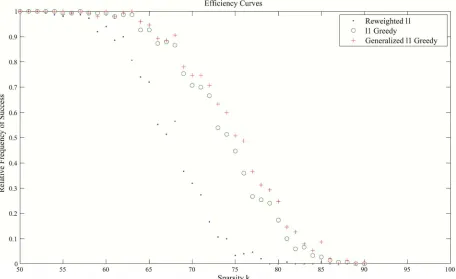
The output of this experiment is presented in Figure 1. As one can see from the graph, for a fixed sparsity level k the probability of successful recovery of a k-sparse signal by the generalized l1 greedy algorithm is higher than in
the both cases of the reweighted l1-minimization and l1
greedy algorithms. On average, the l1 greedy algorithm
and the generalized l1 greedy algorithm recover about
14% and 18% more entries than the reweighted l1-mini-
mization method, respectively, for 50 ≤ k ≤ 90. Further-more, on average, the generalized l1 greedy algorithm
recovers about 6% more entries than the l1 greedy
algo-rithm.
3. Influence of the Parameters on
Reconstruction Success
[image:3.595.71.527.428.707.2]An empirical analysis of the reweighted l1-minimization
Figure 1. Improvements in recovering sparse solutions from the generalized l1 greedy algorithm when compared to the
algorithm determined that the algorithm is robust with respect to (chosen from a suitable range) and that much of the improvement in recovery comes from the first few reweighting iterations [11]. We performed a similar analysis of the generalized l1 greedy algorithm,
and our results indicate that the algorithm is stable with respect to each of its parameters (within a certain range of values). We illustrate this behavior with the parameter
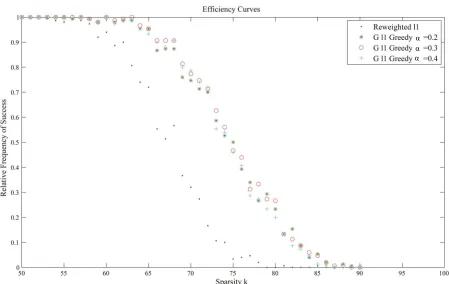
using the same settings as in Section 2 for the re-maining parameters. From Figure 2 one can see that the algorithm is fairly stable for the following values of : 0.2; 0.3; 0.4.Our experimental results also show that the algorithm is very robust with respect to for 10
and fairly robust with respect to s and for values between 0.7 and 0.9. It is also evident from Figure 3 that the number of iterations kmax of the generalized l1 greedy
algorithm has minimal affect on the performance of the algorithm when kmax≥10. So in practice only a few
itera-tions are needed to achieve the best performance of the generalized l1 greedy algorithm.
4. Influence of Noise on
Reconstruction Success
In real life applications measured data are often cor-rupted by a small amount of noise. Thus one needs to recover the original signal x0 from noisy data
* 0
b Ax
where is an unknown noise term. The signal-to- noise ratio (SNR) in dB is defined by
m
e
2 10 *
2
SNR 20 log b
b b
,
where b = Ax0 is noise-free data. In this section we show
how white Gaussian noise at SNR levels 40 dB and 60 dB, respectively, affect the performance of the general-ized l1 greedy algorithm. We also compare the
perform-ance of the reweighted l1-minimization, l1 greedy, and
generalized l1 greedy algorithms on noisy data with an
SNR of 60 dB. As in [12] the precision of recovery is set according to the noise level. More precisely, the criterion for successful recovery are taken to be x x0 0.001 and
0 0.002
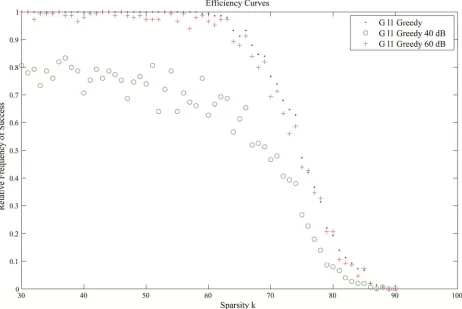
x x for noisy data with an SNR of 40 dB and with an SNR of 60 dB, respectively. All the other settings are the same as in Section 2. Figure 4 shows that the performance of the generalized l1 greedy algorithm is
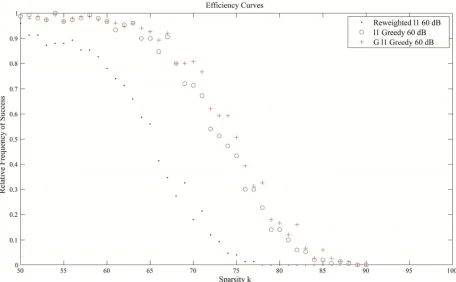
very robust with respect to noise at an SNR level 60 dB and fairly robust with respect to noise at an SNR level 40 dB for 30 ≤k≤ 90. Figure 5 compares the performance of the three algorithms on noisy data with an SNR of 60 dB. Clearly, the generalized l1 greedy algorithms
outper-form the other two algorithms. Moreover, for noisy data with an SNR of 60 dB, on average, the generalized l1
greedy algorithm recovers about 17% more entries than the reweighted l1-minimization algorithm and about 5%
more entries than the l1 greedy algorithm for 50 ≤ k ≤90.
e;
[image:4.595.74.523.432.716.2]α α α
Figure 3. Effect of the number of iterations on the performance of the generalized l1 greedy algorithm.
[image:5.595.68.530.410.719.2]Figure 5. Improvements in recovering sparse solutions with noisy data with an SNR of 60 dB from the generalized l1 greedy
algorithm when compared to the reweighted l1-minimization and l1 greedy algorithms.
5. Reconstruction of Sparse Signals
Containing Nonzero Small Entries
It is known that the l1 greedy algorithm outperforms the
reweighted l1 minimization algorithm in finding spare
signals [12,19]. However, the reweighted l1-minimization
algorithm was designed to help speed up the detection of small entries [11]. The generalized l1 greedy algorithm of
[20], which incorporates features of both algorithms, should have the performance advantage of the l1 greedy
algorithm while enhancing the power of the reweighted l1-minimization algorithm in detecting small entries. In
fact, the generalized l1 greedy algorithm appears to be
superior to the other two algorithms in distinguishing small gradients in the task of reconstructing images via total variation minimization [20]. In this section we want to see how well the generalized l1 greedy algorithm
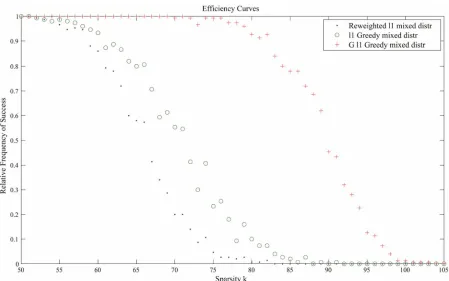
would perform in recuperating random sparse signals with a guaranteed percentage of small entries. More pre-cisely, in our last experiment we want to determine the extent to which the ratio of very small entries in the sparse signals affects the probability of successful recov-ery by each of the algorithms under consideration. The entries of the sparse signal in each trial are obtained from a mixed Gaussian distribution as follows: a random 30% of the entries are generated using a Gaussian distribution with mean 0 and standard deviation 0.01 while the re-maining 70% of the entries are generated using the
stan-dard Gaussian distribution . We need to fine tune the generalized l1 greedy algorithm to make it most
efficient at detecting the small entries in the range we set. Experimental trials show that setting
0,1 N0.01
results in the best performance. The values of the other parame-ters are left unchanged. We then run 150 trials for each sparsity level k, 50 ≤ k ≤ 105, and set the criterion for successful recovery to x x 0 0.001. As one can see from Figure 6, the generalized l1 greedy algorithm vastly
outperforms both the reweighted l1-minimization and the
l1 greedy algorithms in recovering sparse solutions
con-taining a few nonzero small entries. Moreover, on aver-age, the generalized l1 greedy algorithm recovers 32%
more entries than the reweighted l1-minimization
algo-rithm and 11% more entries than the l1 greedy algorithm
for 50 ≤ k ≤105.
6. Conclusion
Our statistical experiments indicate that the generalized l1
greedy algorithm outperforms the reweighted l1-mini-
mization and l1 greedy algorithms in recovering random
sparse signals from random Gaussian measurements. In fact, the generalized l1 greedy algorithm recovers more
Figure 6. Improvements in recovering sparse solutions with a mixed Gaussian distribution from the generalized l1 greedy
algorithm when compared to the reweighted l1-minimization and l1 greedy algorithms.
extremely well in detecting small entries of unknown sparse signals thereby dramatically speeding up their recovery via l1-minimization. It is expected that more
details of signals could be recovered by using the gener-alized l1 greedy algorithm without extra cost.
7. Acknowledgements
F. Arroyo was supported by a faculty research grant from Francis Marion University. X. Li and J. Zhu were par-tially supported by a Faculty Research Award and a COSM Interdisciplinary Pilot Fund from Georgia South-ern University.
REFERENCES
[1] E. Candes, J. Romberg and T. Tao, “Stable Signal Reco- very from Incomplete and Inaccurate Information,” Com- munications on Pure and Applied Mathematics, Vol. 59, No. 8, 2005, pp. 1207-1233.
http://dx.doi.org/10.1002/cpa.20124
[2] E. Candes, J. Romberg and T. Tao, “Robust Uncertainty Principles: Exact Signal Reconstruction from Highly In- complete Frequency Information,” IEEE Transactions on Information Theory, Vol. 52, No. 2, 2006, pp. 489-509. http://dx.doi.org/10.1109/TIT.2005.862083
[3] E. Candes and T. Tao, “Near Optimal Signal Recovery from Random Projections: Universal Encoding Strate- gies?” IEEE Transactions on Information Theory, Vol. 52,
No. 12, 2006, pp. 5406-5425.
http://dx.doi.org/10.1109/TIT.2006.885507
[4] E. Candes and M. Wakin, “An Introduction to Compres- sive Sampling,” IEEE Signal Processing Magazine, Vol. 25, No. 2, 2008, pp. 21-30.
http://dx.doi.org/10.1109/MSP.2007.914731
[5] D. Donoho, “Compressed Sensing,” IEEE Transactions on Information Theory, Vol. 52, No. 4, 2006, pp. 1289- 1306. http://dx.doi.org/10.1109/TIT.2006.871582 [6] S. Chen, D. Donoho and M. Saunders, “Atomic Decom-
position by Basis Pursuit,” SIAM Journal on Scientific Computing, Vol. 20, No. 1, 1998, pp. 33-61.
http://dx.doi.org/10.1137/S1064827596304010
[7] D. Donoho and B. F. Logan, “Signal Recovery and the Large Sieve,” SIAM Journal on Applied Mathematics, Vol. 52, No. 2, 1992, pp. 577-591.
http://dx.doi.org/10.1137/0152031
[8] D. Donoho and P. B. Stark, “Uncertainty Principles and Signal Recovery,” SIAM Journal on Applied Mathematics, Vol. 49, No. 3, 1989, pp. 906-931.
http://dx.doi.org/10.1137/0149053
[9] F. Santosa and W. Symes, “Linear Inversion of Band- Limited Reflection Seismograms,” SIAM Journal on Sci- entific and Statistical Computing, Vol. 7, No. 4, 1986, pp. 1307-1330. http://dx.doi.org/10.1137/0907087
[10] R. Tibshirani, “Regression Shrinkage and Selection via the Lasso,” Journal of the Royal Statistical Society: Series B, Vol. 58, 1996, pp. 267-288.
Sparsity by Reweighted l1 Minimization,” Journal of
Fourier Analysis Applications, Vol. 14, No. 5-6, 2008, pp. 877-905. http://dx.doi.org/10.1007/s00041-008-9045-x [12] I. Kozlov and A. Petukhov, “Sparse Solutions of Under-
determined Linear Systems,” Handbook of Geomathe- matics, Springer, New York, 2010, pp. 1243-1260. http://dx.doi.org/10.1007/978-3-642-01546-5_42
[13] S. Foucarts and M. J. Lai, “Sparsest Solutions of Under- determined Linear Systems via lq-Minimization for 0 < q ≤ 1,” Applied and Computational Harmonic Analysis, Vol. 26, No. 3, 2009, pp. 395-407.
http://dx.doi.org/10.1016/j.acha.2008.09.001
[14] M. J. Lai, “On Sparse Solutions of Underdetermined Lin- ear Systems,” Journal of Concrete and Applicable Ma- thematics, Vol. 8, 2010, pp. 296-327.
[15] A. Khajehnejad, W. Xu, S. Avestimher and B. Hassibi, “Improved Sparse Recovery Thresholds with Two-Step Reweighted l1-Minimization,” IEEE International Sym-
posium on Information Theory Proceedings, 2010. [16] A. Khajehnejad, W. Xu, S. Avestimher and B. Hassibi,
“Analyzing Weight l1-Minimization for Sparse Recovery
with Nonuniform Sparse Models,” IEEE Transaction on Signal Processing, Vol. 59, No. 5, 2011, pp. 1985-2001. http://dx.doi.org/10.1109/TSP.2011.2107904
[17] D. Needell, ”Noisy Signal Recovery via Iterative Re- weighted l1-Minimization,” Proceedings of 43rd Annual
Asilomar Conference on Signals, Systems, and Computers, 2009, pp. 113-117.
[18] Y. B. Zhao and D. Li, “Reweighted l1-Minimization for
Sparse Solutions to Underdetermined Linear Systems,” SIAM Journal on Optimization, Vol. 22, No. 3, 2012, pp. 1065-1088. http://dx.doi.org/10.1137/110847445
[19] A. Petukhov and I. Kozlov, ”Fast Implementation of l1
Greedy Algorithm,” Recent Advances in Harmonic Analysis Applications, Springer Proceedings in Mathe-matics & Statistics, Vol. 25, 2013, pp. 317-326. http://dx.doi.org/10.1007/978-1-4614-4565-4_25