Munich Personal RePEc Archive
A panel data analysis of the growth
effects of remittances
Rao, B.Bhaskara and Hassan, Gazi
University of Western Sydney
21 October 2009
A Panel Data Analysis of the Growth Effects of Remittances
B. Bhaskara Rao
Phone: +61 2 94523412; Fax: +61 2 9685 9105
School of Economics and Finance, University of Western Sydney,
Locked Bag 1797, Penrith South DC, NSW 1797, Australia
Gazi Mainul Hassan
Phone: +61 2 96859261; Fax: +61 2 9685 9105
School of Economics and Finance, University of Western Sydney,
Locked Bag 1797, Penrith South DC, NSW 1797, Australia
Abstract
Many development economists believe that remittances by the migrant workers are an
important source of long rum growth. Therefore, recent studies have investigated the
indirect and direct effects remittances on the growth rates of the recipient countries. This
paper analyses the strength of these effects with a common data set and with alternative
methods of estimation. It is found that while the evidence supports the indirect effects of
remittances, the direct growth effects of remittances seem to be insignificant.
Keywords: Remittances, Growth, Panel Data, System GMM
1. Introduction
Remittances by migrant workers are now an important source of funds for many
developing countries. The inflow of these funds has been also rapidly growing. Barajas
et. al., (2009) and Chami et. al., (2008) have discussed in some detail the significance of
remittances as a source of funds for the developing countries. According to their
estimates remittances through official channels during 2007 were $300 billion in addition
to unknown amounts transferred through unofficial channels. The ratio of remittances to
GDP exceeds 1% in 60 countries. While a significant proportion of these inflows are for
altruistic reasons to support the living standards of family members, some are also
motivated by pecuniary gains and take advantage of the incentives offered by the
recipient countries. For example deposits by nonresidents attract higher interest rates and
are exempt from income tax in counters like India.
Remittances have both welfare and growth effects. They directly alleviate poverty
levels by increasing recipient family’s income and living standards; see Adams and Page
(2005), Insights (2006) IDS, Siddiqui and Kemal (2006) and Gupta, Pattillo, and Wagh
(2007). At the same time remittances have significant indirect and direct macroeconomic
effects. Given that there is a robust and negative relationship between growth of output
and its volatility (see Ramey and Ramey, 1995, Kroft and Lloyd-Ellis, 2002 and
Hnatkovska and Loayza, 2003), IMF (2005), World Bank (2006) and Chami et al (2008)
have investigated the relationship between volatility and remittances. Their findings
imply that remittances by reducing volatility indirectly increase the growth rate.
Similarly, there is evidence that development of the financial sector increases the growth
rate and therefore remittances indirectly increase growth rate by improving the progress
of the financial sector.1 A third indirect growth effect of remittances is through its effect on the real exchange rate. Amuedo-Dorantes and Pozo (2004), Lopez, Molina and
Bussolo (2007) and Lartey, Mandelman and Acosta (2008) have found that the exchange
rate appreciates in countries with large remittances, which in turn has a negative effect on
the growth rate; also see Acosta, Lartey and Mandelman (2007). Two other indirect
effects of remittances that receive scant attention are firstly its effects on human capital
1
formation, through its effects on education, and secondly its effects on the investment
ratio. Both human capital formation and investment ratio are generally seen to have
growth effects on output. In contrast to these growth effects of remittances through the
aforesaid indirect channels, some have tried to estimate their direct growth effects by
regressing the growth rate on remittances and a set of control variables. Barajas et. al.,
(2009) recently found that these direct growth effects are generally small and
insignificant. However, this is contrary to what is generally expected by some
development economists who view remittances are akin to foreign direct investment and
other private capital inflows in their effects on growth.2 Therefore, additional studies based on different data sets and estimation methods would be useful to lend support or
contradict the findings by Barajas et. al.3 However, a single paper is inadequate to
examine both the indirect and direct growth effects of remittances. Furthermore, it is also
necessary to analyze how strong and significant are the relationships between growth and
the intermediate variables, e.g., progress of the financial sector, through which
remittances may effect growth. Therefore, this paper examines only the direct effects of
remittances and it differs from the earlier papers in that it examines some methodological
issues and uses alternative approaches.
The outline of this paper is as follows. Section 2 examines some methodological
issues concerning the specification and estimation of the growth effects of remittances.
Our empirical results are presented and discussed in Section 3 and Section 4 concludes.
2
Barajas et. al., observe that “Policy-oriented economists have also made similar claims about remittances. Ratha (2003), for example, calls remittances “an important and stable source of external development finance” but mainly suggests that remittances could and should enhance economic growth
rather than show that remittances have actually done so.
3
2.Specification and Estimation Issues
The specifications used for estimating the growth effects of one or another growth
enhancing variable, in both the cross country and country specific studies, need
examination. Although most of these studies claim that they are estimating the permanent
long run growth effects, there is no distinction between the permanent long run and the
transitory short run growth effects of variables. The dependent variable is usually the
annual growth rate of output in the country specific time series studies and either this or
its five year average in the cross country studies. Neither of these growth rates can said to
be a good proxy for the unobservable long run growth rate in the steady state i.e., the
steady state growth rate (SSGR). The short run growth rates are also important for the
policy makers especially of the developing countries because they persist for more than
five years and will have permanent level effects; see Rao and Cooray (2009).
Likewise, many studies claim that their specifications are based on one or another
endogenous growth model, but it is hard to understand how their specifications are
derived from the claimed endogenous growth model. Commenting on the unsatisfactory
nature of specifications in many such empirical works, Easterly, Levine and Roodman
(2004) have noted that “This literature has the usual limitations of choosing a
specification without clear guidance from theory, which often means there are more
plausible specifications than there are data points in the sample.” Rogers (2003) also took
a similar view about the ad hoc nature of specifications in many cross-country studies but
justified the ad hoc specifications because though this is less than ideal, the complexity of
economic growth and the lack of an encompassing model make it a necessity.
Consequently, as found by Durlauf, Johnson, and Temple (2005), the number of potential
growth improving variables used in various empirical works is as many as 145. Given
these reservations it is hard to select a few uncontroversial control variables to estimate
3. Methodological and Specification Issues
It is worth recalling the observation made by Easterly et al. (2004). Many panel data
studies have often used 5 year average growth rates of per capita or per worker output to
measure the unobservable steady state growth rate (SSGR). However, when perturbed a
time span of 5 years is too short for an economy to attain the steady state. This is so
because simulations with the closed form solutions show that an economy takes a few
decades to converge anywhere close to its steady state. This transition period may be
more than 50 years even for small perturbations; see Sato (1963) and Rao (2006). For
example when Easterly et al. (2004) have used 8 year average growth rates of output,
instead of the popular 5 year growth rates, to check the robustness of the results the
Burnside and Dollar (2000) effects of aid on the long run growth. The coefficient of aid
and the conditionality variables became insignificant in the Easterly et. al., regressions.
They have also experimented with various lengths for panels—ranging from annual
growth rates to the average growth rate for the entire sample period of 1970 to 1993 used
by Burnside and Dollar—and found that this did not alter their finding that the growth
effects of aid are insignificant. This is an indication that even average growth rate of over
two decades is not a good proxy for the SSGR. This limitation is also recognized by
Demirgüç-Kunt and Levine (2008) with the observation “To the extent that five years
does not adequately proxy for long-run growth, the panel methods may be less precise in
assessing the finance growth relationship than methods based on lower frequency data.”
This limitation of measuring the unobservable SSGRs did not so far receive much
attention of the growth economists and econometricians.4
In light of such limitations, what can be estimated at best, with annual data or even
with short panels, seems to be the production function but not the direct and permanent
growth effects of growth enhancing variables like remittances, reforms and globalization
etc., by regressing the growth rate on these variables. The production function can be
modified to capture the permanent growth effects of variables like remittances through
their effects on the total factor productivity (TFP). Edwards (1998) and Dollar and Kraay
(2004) suggest a similar procedure, but our method is different because this approach
4
Winters (2004) also recognized that 5 year average growth rates are inadequate to measure the
depends on the selected growth model. We select the Solow (1956) growth model for a
few reasons. Firstly, the Solow exogenous growth model, with constant returns, is easy to
extend and estimate compared to a variety of endogenous growth models which need
more complicated non-linear dynamic specifications. Greiner et al. (2004) have estimated
such endogenous growth models with country specific time series data to determine the
permanent growth effects of R&D expenditure. Secondly, there is no convincing evidence
that endogenous growth models, with increasing returns, empirically perform better than
the Solow model; see Jones (1995), Korcherlkota and Ke-Mu Yi (1996), Parente (2001)
and Solow (2000). Solow (2000) observed that “The second wave of runaway interest in
growth theory—the endogenous-growth literature sparked by Romer and Lucas in the
1980s, following the neoclassical wave of the 1950s and 1960s—appears to be dwindling
to a modest flow of normal science. This is not a bad thing. Nevertheless, a wider variety
of growth models is now available for trying out; and some of the main empirical
uncertainties have been specified, and perhaps narrowed down even if not settled.”
Our extended Solow model may be called the Solow model with an endogenous
framework. The well known extension to the Solow model by Mankiw, Romer and Weil
(1991, MRW hereafter) is based on a similar approach. However, our extension differs
somewhat but its underlying spirit is similar. While our model directly estimates the
effects of variables on the SSGR, the MRW method is more suitable for estimating the
level effects of human capital or improved measures of inputs.
Let the Cobb-Douglas production function with the constant returns and
Hicks-neutral technical progress be
0< <1 (1)
t t t
y = A kα α
where y = per worker output, A = stock of technology and k = capital per worker. It is
well known that the SSGR in the Solow model equals the rate of growth of A which is the
same as total factor productivity (TFP). It is common in the Solow model to assume that
the evolution of technology is given by
0 (2)
gT t
where A0 is the initial stock of knowledge and T is time. Therefore, the steady state
growth of output per worker equals g. The modified production function for estimation
will be:
0
lnyit =lnA +gT+αlnkit (3)
It is also plausible to assume for our purpose that
At = f T Z( , t) and fT fZ ≤0 or ≥0 (4)
where Z is a vector of growth improving variables like remittances and control variables
like the investment ratio, financial developments etc. This is consistent with the views of
Edwards (1998) and Dollar and Kraay (2004) who take the view that a more convincing
and robust evidence between, for example, openness and growth should be derived from
its effects on productivity.5 The effect of remittances or some other variable on TFP can be captured with a few alternative empirical specifications for (4) but we shall use only a
simple linear specification and express the extended production function as follows.
1 2
( )
0 (5)
t
g g Z T
t t
y =A e + kα
It is also possible to introduce conditionality variables into the above specifications, but
we shall ignore this extension. Our alternative specification implied that SSGR is:
∆lny* =SSGR= +g1 g2 Z (6)
where g1captures the growth effects trended and ignored variables and g2captures the
growth effects of the variables in the Z vector. Our extended specification is well suited to
5
test, for example, the claims by some economists that countries with higher receipts of
remittances grow faster because the SSGR depends on remittances.
3. Empirical Results
Our sample consists of 40 countries with a remittances to GDP ratio of 1% or more.
The annual data for these countries starts in 1960 and ends in 2007. However, data on
some key variables are not available for all the countries and hence our panel data is
unbalanced. Further details of the data are in the appendix.
Before we estimate our modified production function we present estimates of the
conventional and standard specification of the growth equation used in many empirical
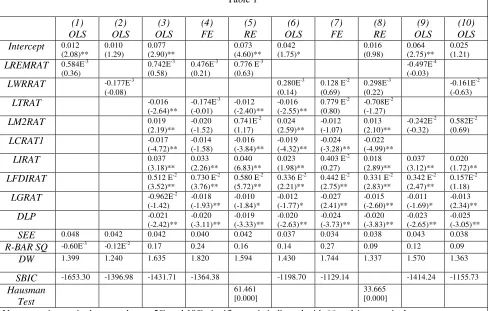
works. These estimates are given in Table 1. The dependent variable is the rate of growth
of per worker output (∆LYL). In columns (1) and (2) of Table 1 OLS estimates of with 2
definitions of remittances with pooled sample (OLS hereafter) are given. Since the sample
means are used in the estimation, pooled estimates can be treated as more satisfactory
proxies for the long run values of the variables. In column (1) growth rate is assumed to
depend only the ratio of remittances to GDP. One would expect that if remittances have
any significant long run growth effects the coefficient of remittances will be significant
and positive although it will be biased because other growth enhancing variables are
excluded and remittances may also depend on growth thus causing an endogenous
variable bias.6
Two definitions of remittances have been tried. The first is REMRAT which includes
remittances by all nonresidents and the second is WRRAT which includes remittances
only by nonresidents who are classified as residents in a foreign country and taxed there.
It is hard to say which of these two is better although Barajas et. al., assert that WRRAT is
better. Estimates of with these 2 measures of remittances are disappointing. While the
coefficients of REMRAT is positive it is insignificant. The coefficient of WRRAT is
6
Table 1 (1) OLS (2) OLS (3) OLS (4) FE (5) RE (6) OLS (7) FE (8) RE (9) OLS (10) OLS Intercept 0.012
(2.08)** 0.010 (1.29) 0.077 (2.90)** 0.073 (4.60)** 0.042 (1.75)* 0.016 (0.98) 0.064 (2.75)** 0.025 (1.21)
LREMRAT 0.584E-3
(0.36)
0.742E-3
(0.58)
0.476E-3
(0.21)
0.776 E-3
(0.63)
-0.497E-4
(-0.03)
LWRRAT -0.177E-3
(-0.08)
0.280E-3
(0.14)
0.128 E-2
(0.69)
0.298E-3
(0.22)
-0.161E-2
(-0.63)
LTRAT -0.016
(-2.64)** -0.174E-3 (-0.01) -0.012 (-2.40)** -0.016 (-2.55)**
0.779 E-2
(0.80)
-0.708E-2
(-1.27)
LM2RAT 0.019
(2.19)** -0.020 (-1.52) 0.741E-2 (1.17) 0.024 (2.59)** -0.012 (-1.07) 0.013 (2.10)** -0.242E-2 (-0.32) 0.582E-2 (0.69)
LCRAT1 -0.017
(-4.72)** -0.014 (-1.58) -0.016 (-3.84)** -0.019 (-4.32)** -0.024 (-3.28)** -0.022 (-4.99)**
LIRAT 0.037
(3.18)** 0.033 (2.26)** 0.040 (6.83)** 0.023 (1.98)**
0.403 E-2
(0.27) 0.018 (2.89)** 0.037 (3.12)** 0.020 (1.72)**
LFDIRAT 0.512 E-2
(3.52)**
0.730 E-2
(3.76)**
0.580 E-2
(5.72)**
0.336 E-2
(2.21)**
0.442 E-2
(2.75)**
0.331 E-2
(2.83)**
0.342 E-2
(2.47)**
0.157E-2
(1.18)
LGRAT -0.962E-2
(-1.42) -0.018 (-1.93)** -0.010 (-1.84)* -0.012 (-1.77)* -0.027 (2.41)** -0.015 (-2.60)** -0.011 (-1.69)* -0.013 (2.34)**
DLP -0.021 (-2.42)** -0.020 (-3.11)** -0.019 (-3.33)** -0.020 (-2.63)** -0.024 (-3.73)** -0.020 (-3.83)** -0.023 (-2.65)** -0.025 (-3.05)**
SEE 0.048 0.042 0.042 0.040 0.042 0.037 0.034 0.038 0.043 0.038
R-BAR SQ -0.60E-3 -0.12E-2 0.17 0.24 0.16 0.14 0.27 0.09 0.12 0.09
DW 1.399 1.240 1.635 1.820 1.594 1.430 1.744 1.337 1.570 1.363
SBIC -1653.30 -1396.98 -1431.71 -1364.38 -1198.70 -1129.14 -1414.24 -1155.73
Hausman Test 61.461 [0.000] 33.665 [0.000]
Notes: t-ratios are in the parentheses. 5% and 10% significance is indicated with ** and * respectively.
significant at the 10% level but it is negative. Addition of the lagged dependent variable
to these specifications did not yield better estimates. Similarly addition of squared
remittances, time trend and a multiplicative variable of remittances and M2RAT did not
yield a significant positive coefficient for remittances and these are not reported to
conserve space.7
We have added then some standard control variables to the above specifications.
These control variables, in their logs, are: trade openness (LTRAT), measured as the ratio
of exports plus imports to GDP, ratio of M2 definition of money to GDP (LM2RAT), ratio
of bank credit to private sector to GDP (LCRAT1), ratio of investment to GDP (LIRAT),
ratio of foreign direct investment to GDP (LFDIRAT), ratio of current government
expenditure to GDP (LGRAT) and the rate of inflation (∆LP).8 The specifications, with the expected signs for the coefficients, are as follows.
7
We followed here the alternative specifications tried by Barajas et. al.
8
0 1 2 3 4
5 6 7 8
0 1 2 3 4
2 1
(xx=7)
2 1
ti it it it it
it it it it
ti it it it it
LYL LREMRAT LTRAT LM RAT LCRAT
LIRAT LFDIRAT LGRAT LP
LYL LWRRAT LTRAT LM RAT LCRAT
α β β β β
β β β β
α β β β β
∆ = + + + +
+ + + + ∆
∆ = + + + +
5 6 7 8
1 6 7 8
(yy=8)
0 and and 0.
it it it it
LIRAT LFDIRAT LGRAT LP
β β β β
β β β β
+ + + + ∆
≥ ≤
These 2 equations are estimated with OLS and as fixed effects (different intercepts
but same slopes, FE hereafter) and random effects (RE hereafter) models.9 These 3 estimates for equation (7) are in columns (3), (4) and (5) and for equation (8) in columns
(6) to (8). For equation (7) the null in the Hausman test that the RE model is preferable
to the FE model is rejected. The test statistic, with the p-value in the square brackets, is
2
(6) 33.665 [0.00]
χ = and significant at the 5% level. However, the absolute value of SBI
of OLS estimate for this equation is higher at -1169.6 than the SBI for the FE model
which is -1129.1, thus favouring the OLS estimate in column (3). These results are also
valid for the estimates of (8) and its OLS estimate in column (6) is preferable to those in
columns (7) and (8).
In the preferred OLS estimate in column (3) out of the 8 slope coefficients 6 are
significant. It should be noted that the coefficient of remittances is insignificant although
its sign is positive. The signs of the coefficients trade openness and the credit ratio are
negative but significant at the 5% level and contrary to prior expectation. The signs of the
coefficients of the ratios of M2, investment, foreign direct investment to GDP and
inflation are as expected and significant. The sign of the ratio of government expenditure
has the correct negative sign but significant only at the 16% level. These observations
also hold for the OLS estimate of equation (8) in column (8) except that the ratio of
government expenditure to GDP now became significant at the 10% level. Although OLS
100 and if anyone finds the right set of control variables that would be a miracle. Therefore, our selection of these control variables should be treated with the usual caution.
9
estimates are preferred, the FE and RE estimates of these two equations are qualitatively
similar. OLS re-estimates of equations (7) and (8) after deleting the variables with the
wrong signs, viz., LTRAT and LCRAT1 are in columns (9) and (10). In neither equation
the coefficient of remittances is significant.10 Thus our estimates imply that the growth effects of remittance seem to be small and insignificant and support the findings in some
earlier works like Barajas et. al.
A weakness in the conventional specifications and estimates is that there is no
distinction between the short and long run effects of remittances or any other growth
enhancing variable. Since several empirical studies claim that they are analyzing the long
run growth effects of remittances and/or other growth improving variables, we shall use,
as discussed in Section 2, our extended specification in equations (3) and (5) based on
the Solow model. Besides the ratio of remittances we have included 7 other variables that
may have long run growth effects. These are shown in equations (7) and (8). Therefore,
the Z vector consists of 8 variables and an intercept to capture the growth effects of
trended but ignored variables. Our modified production function is:
( 1 )
0 (9)
i it
g g Z T
t t
y = A e +∑ kα
the vector Zitconsists of the 8 variables from equation (7) or (6).
10
We have also tried estimates by instrumenting remittances with time trend and 2 and 3 period legged values of remittances. The correlation coefficient between remittances and the instruments was high at 0.88. Although the coefficients of REMRAT and WRRAT were positive in some estimates, they were
The specification in (9) cannot be easily estimated with the standard panel data
methods of OLS or FE or RE because of the nonlinearity of the variables. Generalized
Method of Moment (GMM) proposed by Arellano and Bond (1991) is the commonly
employed estimation procedure to estimate the parameters in a dynamic panel data model
with nonlinearities in the variables. In this method first differenced transformed series are
used to adjust for the unobserved individual specific heterogeneity in the series. But
Blundell and Bond (1998) found that this has poor finite sample properties in terms of
bias and precision, when the series are persistent and the instruments are weak predictors
of the endogenous changes. Arellano and Bover (1995) and Blundell and Bond (1998)
proposed a systems based approach to overcome these limitations in the dynamic panel
data models. This method uses extra moment conditions that rely on certain stationarity
conditions of the initial observation. The systems GMM estimator (SGMM) combines the
standard set of equations in first differences with suitably lagged levels as instruments,
with an additional set of equations in the levels with lagged first differences as
instruments; see for further details on the advantages of SGMM Arellano, Bond and
Temple (2002), Rao, Tamazian and Singh (2009) and Rao, Tamazian and Kumar (2009).
We shall use this estimation method to estimate our modified production function (8).
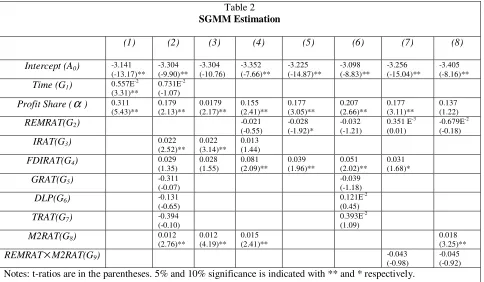
Our empirical results with SGMM are in Table 2. Due to the non-balanced nature of
our data we have ignored the first 5 years 1960 to 1964 and also the last 3 years 2005,
2006 and 2007. Therefore our sample covers the period 1965 to 2004. Furthermore, we
have encountered convergence problems due to high first order serial correlation in the
residuals of the levels equation. The estimated first order serial correlation is close to
unity. To achieve convergence the levels equations is estimated in a transformed form
where the first order serial correlation is fixed at 0.998.
We estimated first a simple version of equation (8) where TFP is assumed to be a
function of time only to get an understanding of the strength of TFP effects on growth
and also to check if this specification yields a plausible estimate for the share of profits
.
α The levels version of the estimated specification is:
where T is time. The estimates are in column (1) of Table 2. It can be seen that all the
parameters are significant at the 5% level. The estimate of profit share at 0.311 is highly
plausible and close to its stylized value of one third in the growth accounting exercises.
The coefficient of time implies that the long run growth rate of per worker income is low
[image:14.595.67.551.195.477.2]in these countries at about 0.56%.
Table 2
SGMM Estimation
(1) (2) (3) (4) (5) (6) (7) (8)
Intercept (A0) -3.141
(-13.17)** -3.304 (-9.90)** -3.304 (-10.76) -3.352 (-7.66)** -3.225 (-14.87)** -3.098 (-8.83)** -3.256 (-15.04)** -3.405 (-8.16)**
Time (G1) 0.557E -2
(3.31)**
0.731E-2
(-1.07)
Profit Share (α) 0.311 (5.43)** 0.179 (2.13)** 0.0179 (2.17)** 0.155 (2.41)** 0.177 (3.05)** 0.207 (2.66)** 0.177 (3.11)** 0.137 (1.22)
REMRAT(G2) -0.021
(-0.55)
-0.028 (-1.92)*
-0.032 (-1.21)
0.351 E-3
(0.01)
-0.679E-2
(-0.18)
IRAT(G3) 0.022
(2.52)** 0.022 (3.14)**
0.013 (1.44)
FDIRAT(G4) 0.029
(1.35) 0.028 (1.55) 0.081 (2.09)** 0.039 (1.96)** 0.051 (2.02)** 0.031 (1.68)*
GRAT(G5) -0.311
(-0.07)
-0.039 (-1.18)
DLP(G6) -0.131
(-0.65)
0.121E-2
(0.45)
TRAT(G7) -0.394
(-0.10)
0.393E-2 (1.09)
M2RAT(G8) 0.012
(2.76)** 0.012 (4.19)** 0.015 (2.41)** 0.018 (3.25)**
REMRAT×M2RAT(G9) -0.043
(-0.98)
-0.045 (-0.92)
Notes: t-ratios are in the parentheses. 5% and 10% significance is indicated with ** and * respectively.
To understand on what factors TFP may depend it is necessary to estimate our
extended specification. We have estimated (8) with the 7 growth inducing variables in
the Z vector and the specification of this equation analogous to (9) is as follows.
1 2 3 4
6 7 8
1 6 7 8
5
ln ( 2 1
(10)
g 0 and g and g 0.
) T+ lnk
ti it it it
it it it
it it
y g g TRAT g M RAT g CRAT
g FDIRAT g GRAT g LP
g g IRAT π α = + + + + + + + ∆ ≥ ≤ + ×
In the first instance REMRAT is excluded from the specification for two reasons.
Firstly, variables like M2RAT, CRAT1 and IRAT are important channels through which
REMRAT is generally considered to have its growth effects. Therefore, adding REMRAT
may not produce good and reliable results because of multi-colinearity. Secondly, it is
affecting adequately TFP. If they do have significant growth effects, then it is likely that
1
g will be small or insignificant and remittances may indirectly improve growth through
these channels. We have excluded CRAT1 because its presence made its coefficient and
that of M2RAT insignificant. Estimates of (10) with the other 6 variables are in column
(2) of Table 2. Of these the coefficients only those of IRAT and M2RAT are significant at
the 5% level and they seem to explain adequately the trend in TFP because, as expected
above, the coefficient of trend g1 is insignificant. However, the share of profits has
decreased to about 0.18 from its earlier estimate of 0.311 but this lower estimate plus 2 of
its standard deviations is not far below the stylized value of one third. Removal of trend
and 3 other insignificant variables with lower t-ratios viz., GRAT, DLP and TRAT has
improved the significance of the coefficient of FDIRAT and it is now significant at
slightly more than the 10% level. The reestimated equation is in column (3) of Table 2.
There are no significant changes in the estimates of the other parameters. These estimates
imply that the permanent positive growth effects IRAT, M2RAT and FDIRAT are small.
At the sample mean values of these variables of 0.21, 0.41 and 0.02, respectively, their
permanent growth effects are 0.44, 0.51 and 0.05 percentage points respectively. If IRAT,
M2RAT and FDIRAT can be increased by 50 percent, this will add about a 1.5 percentage
points to the long run growth rate of per worker output. Although this is a difficult target
it is not impossible to achieve. It is an attractive policy option because the average growth
rate of these countries is low at about one percent and this can be increased to 2.5 percent.
To examine if remittances has any growth effects the above equation is reestimated
by adding REMRAT and these are in column (4) of Table 2. It can be seen that the
coefficient of REMRAT has the wrong sign and is insignificant. When WRRAT is used in
place of REMRAT the results are similar and these are not reported to conserve space.
The insignificance of REMRAT may be because the growth effects of remittances
are indirect through its effects on variables like IRAT and M2RAT. Since these two are
already included in these estimates, REMRAT may not have any additional growth
effects. To test this we estimated this equation by removing both the channels viz., IRAT
and M2RAT and the results are in column (5) of Table 2.The coefficient of REMRAT is
negative and significant at slightly higher than the 5% level. The coefficient of FDIRAT
Addition of other non-channel variables GRAT, DLP and TRAT did not change the
results but the coefficients of these 3 variables are insignificant. These estimates are in
column (6) of Table 2. In this equation only the coefficients of FDIRAT and profit share
are significant besides the intercept. The coefficient of REMRAT is negative and
insignificant. When WRRAT is used in place of REMRAT it made no difference and these
are not shown to conserve space.
Recently Giuliano and Ruiz-Arranz (2009) have added a conditional multiplicative
term to show that remittances have positive growth effects and this effect is higher in
countries with less developed financial sector. This is plausible if remittances are a good
substitute for bank finance for funds to investment. In their SGMM estimate the
coefficient of REMRAT was positive (0.406) and the coefficient of the product of
REMRAT and the ratio of deposits to GDP was negative (-0.008) and both are significant
at the 5% level. To test if this result holds in our sample with an improved specification to
capture the long term growth effects, a multiplicative term REMRAT×M2RAT, which is
similar to the Giuliano and Ruiz-Arranz variable, has been added to the equation in
column (5). In this equation FDIRAT is the only control variable because the coefficients
of 3 additional non-channel variables, viz., GRAT, FDIRAT and DLP are found to be
insignificant; see estimates in column (6). Estimates with the multiplicative term are in
column (7) of Table 2. The coefficients of REMRAT and REMRAT×M2RAT have the
expected positive and negative signs but are highly insignificant. There is no other
significant change in the estimates of other parameters. When WRRAT is used in place of
REMRAT results were worse and the share of profits became insignificant. We have
added to this equation M2RAT as an additional variable although it is hard to justify
because it is a channel for REMRAT to affect growth and adding this or similar channels
is redundant and biases estimates. Nevertheless, since Giuliano and Ruiz-Arranz’s
specification includes a similar term and additional channels we estimated in column (8) a
specification with both REMRAT and M2RAT. Although the coefficient of M2RAT is
positive and significant the coefficients of REMRAT and the multiplicative term have
remained insignificant. Furthermore, the coefficient of REMRAT became negative and the
significance of other coefficients has worsened. In our view the standard specification
used by Giuliano and Ruiz-Arranz in which the unobservable long term growth rate is
proxied with 5 year average growth rate of GDP is unsatisfactory. Easterly et. al., (2004)
5 year average growth rate may be capturing some transient growth effects, whereas our
specification is more appropriate to estimate the effects on the long run steady state
growth rate. Therefore, it is difficult to accept that Giuliano and Ruiz-Arranz have
actually estimated the permanent long run growth effects of REMRAT in spite of their
elaborate but ad hoc specifications with a large number of multiplicative terms.
Nevertheless, their contribution is significant in many other respects because their data
refinements and use of SGMM and threshold effects techniques will encourage others to
follow their example, hopefully with improved specifications.
On the basis of these results it is hard to say that remittances have any long run
growth effects. However, as Giuliano and Ruiz-Arranz’s work reveals remittances may
have transient growth effects in the short run. Such effects are better suited for estimation
with country specific time series data and time series methods. These transient effects
may be significant and persist for a few years. If so, they will have significant permanent
level effects on per worker output. Furthermore, remittances may also have indirect and
permanent growth effects through its effects on IRAT and M2RAT etc However, these
growth effects are likely to be small because they will be the product of 2 fractions. For
example if the coefficient of REMRAT in the investment equation is 0.15 and significant
in a properly specified investment equation, since the coefficient of IRAT in our estimates
is 0.022, the indirect growth effect of remittances will be only 0.003. A 20% increase in
remittances will add an additional growth rate of only 0.07 percent. If these indirect
growth effects exist for REMRAT, they may be complex to untangle because as noted by
Barajas et. al., some are positive and some are negative. In our reduced form estimates the
coefficient of remittances when significant was negative; see column (5) of Table 2.
4. Conclusions
In this paper we have analyzed the direct growth effects of remittances and the
growth effects of the channels through which remittances may affect growth by treating
as conditioning variables. We have used conventional panel data estimation methods and
also the system GMM in which the limitations due to weak instruments and persistence in
the variables are minimized if not totally eliminated; see Buny and Windmeijer (2009) for
the weak instruments problem in SGMM. Our results showed that remittances, measured
However, we found 2 channels through which remittances may have indirect growth
effects. These are IRAT and M2RAT and both have direct growth effects. To estimate the
indirect growth effects of REMRAT through these channels, it is necessary to use proper
specifications for IRAT and M2RAT instead of arbitrarily regressing them on a single
variable such as REMRAT. This task is beyond the scope of this paper. We think that
such effects will be small in properly specified investment and money supply equations.
Therefore the ultimate growth effects of remittances through these channels will be also
small. Barajas et. al., offer a reason for this.11 According to them remittances, however small, may have both positive and negative effects on growth. The negative effects are
due to the Dutch Disease and deterioration of the quality of governance and neither of
them have been investigated in our paper. Therefore, these two effects may offset each
other if reduced form growth equations with remittances as the only explanatory variable
are estimated. While adding additional conditional variables it is appropriate to exclude
the channels through which remittance have indirect growth effects.
We agree with Easterly et. al., (2004), Rogers (2003) and Demirgüç-Kunt and Levine
(2008) on their criticisms of the specifications used in empirical growth models.
Therefore, We have suggested and estimated an extended production function, instead of
a growth equation, to derive the SSGR using the framework of the Solow growth model.
In many empirical works there is no awareness that the SSGR is an unobservable
variable—like the natural rate of unemployment. Both should be derived by estimating a
theoretically sound model by imposing the steady state conditions.
Although we found that remittances have no long run growth effects, they may have
short to medium term transitory growth effects. These growth effects do not raise the
permanent growth rates but they will have permanent level effects. We take the view that
cross country and panel data methods are less likely to be useful for estimating the
transitory growth effects compared to their estimates with country specific data and time
series methods. We hope that some investigators will pay attention to the significance
11
such level effects of remittances instead of concentrating solely on its long run growth
effects because these transitory effects persist for a few years and can permanently
Data Appendix: Data definitions and sources
Variables Definition Source
CRAT1 Domestic credit provided
by banking sector (% of GDP)
World Development Indicators (WDI) 2008
FDIRAT Foreign direct investment
to GDP ratio.
World Development Indicators (WDI) 2008
GRAT General government final
consumption expenditure to GDP ratio.
World Development Indicators (WDI) 2008
H Human capital; An average
of the Barro-Lee and Cohen-Soto data set and it incorporates a 7 percent rate of Return to each year of education.
Barro-Lee and Cohen-Soto data set.
IRAT Gross domestic fixed
investment to GDP ratio.
World Development Indicators (WDI) 2008
K Capital Stock; Derived
using perpetual inventory method
Kt = .95 * Kt-1 + It.
It is real gross domestic
fixed investment
International Financial Statistics, IMF
L Labour Force World Development
Indicators (WDI) 2008
M2RAT Money and quasi money
(M2) to GDP ratio.
World Development Indicators (WDI) 2008
DLP Inflation, (GDP deflator)
annual percentage
World Development Indicators (WDI) 2008
REMRAT Workers’ remittances and
compensation of
employees to GDP ratio. Workers' remittances and compensation of
employees comprise current transfers by
migrant workers and wages and salaries earned by nonresident workers. Workers’ remittances are classified as current private transfers from migrant workers who are residents of the host country to recipients in their country of origin. They include only transfers made by workers who have been
living in the host country for more than a year, irrespective of their immigration status. Compensation of
employees is the income of migrants who have lived in the host country for less than a year.
TRAT Sum of export plus import
of goods and services to GDP ratio.
World Development Indicators (WDI) 2008
WRRAT Workers’ remittances to
GDP ratio. Workers' remittances are current transfers by migrants who are employed or intend to remain employed for more than a year in another economy in which they are considered residents.
World Development Indicators (WDI) 2008
Y Real Gross Domestic
Product
References
Acosta, P., Lartey, E., and F. Mandelman (2007) Remittances and the Dutch Disease,
Federal Reserve Bank of Atlanta WP 2007-8.
Adams, R., and J. Page (2005) Do International Migration and Remittances Reduce
Poverty in Developing Countries?, World Development, 33(10): 1645-69.
Aggarwal, R., Demirguc-Kunt, A. and M. Peria (2006) Do Workers’ Remittances
Promote Financial Development?, World Bank Policy Research Working Paper 3957,
Washington, D.C.
Amuedo-Dorantes, C., and S. Pozo (2004) Workers’ Remittances and the Real Exchange
Rate: A Paradox of Gifts, World Development, Vol. 32(8): 1407-1417
Ang, J., (2008) A Survey of Recent Developments in the Literature of Finance and
Growth, Journal of Economic Surveys, vol. 22(3), 536-576,
Arellano M., and O. Bover (1995): Another Look at the Instrumental Variables
Estimation of Error-Component Models, Journal of Econometrics, 68, 29-51.
Arellano, M., and S. Bond (1991): Some Test of Specification for Panel Data: Monte
Carlo Evidence and an Application to Employment equations, Review of Economic
Studies 58, 277-297.
Barajas, A., Chami, R., Fullenkamp, C., Gapen, M., and P., Montiel (2009) Do Workers’
Remittances Promote Economic Growth?, International Monetary Fund Working Paper
No. WP/09/153
Blundell, R., and S. Bond (1998): Initial Conditions and Moment Restrictions in Dynamic
Burnside, C., and D. Dollar (2000) Aid, Policies, and Growth, American Economic
Review, 90 (4): pp. 847–868.
Buny, M., and F. Weindmeijer (2009) Problem of the System GMM Estimator in
Dynamic Panel Data Models, Econometrics Journal (Forthcoming) volume 12, pp.1-32
Chami, R., Barajas, A., Cosimano, T., Fullenkamp, C., Gapen, M.,and P. Montiel (2008)
Macroeconomic Consequences of Remittances, Occasional Paper No. 259, International
Monetary Fund
Dollar, D., and Kraay, A. (2004) Trade, growth and poverty, Economic Journal,
114(493), F22–F49.
Durlauf, S., Johnson, P., and J. Temple (2005) Growth econometrics. In Aghion, P., and
Durlauf, S. (Eds.), Handbook of Economic Growth, vol. 1, pp. 555–677. Chapter 8, pp.
555-677.
Demirgüç-Kunt, A., and R. Levine (2008) Finance and Economic Opportunity, World
Bank Policy Research Working Paper No. 4468
Easterly, W., Levine, R., and D. Roodman, (2004) New data, New doubts: A Comment
on Burnside and Dollar's “Aid, Policies, and Growth”, American Economic Review, 94
(3), 774–780.
Edwards, S., (1998): Openness, Productivity and Growth: What Do We Really Know?,
Economic Journal,108(447), 383-98.
Greiner, A., Semler, W. and G. Gong (2004) The Forces of Economic Growth: A Time
Series Perspective, Princeton, NJ: Princeton University Press.
Giuliano, P., and M. Ruiz-Arranz (2009) Remittances, Financial Development,
and Growth, Journal of Development Economics, 90, 144-152.
Gupta, S., Pattillo, C., and S. Wagh (2009) Effect of Remittances on Poverty and
Financial Development in Sub-Saharan Africa, World Development, Vol. 37(1), pp.
104-115
Hnatkovska, V., and N. Loayza (2003) Volatility and Growth, World Bank Working
Paper No. WPS3184.
Insights (2006) Sending money home: Can remittances reduce poverty?, Institute of
Development Studies, University of Sussex
International Monetary Fund (2005) Two Current Issues Facing Developing Countries, in
World Economic Outlook, April 2005: Globalization and External Imbalances, World
Economic and Financial Surveys (Washington).
Jones, C., (1995) R&D Based Models for Economic Growth, Journal of
Political Economy, 103: 759-784
Kroft, K., and H. Lloyd-Ellis (2002) Further Cross-Country Evidence on the Link
Between Growth, Volatility and Business Cycles, Queens University Working Paper.
Kohcerlakota, N., and Kei-Mu, Yi (1996) A Simple Time Series Test of Endogenous vs.
Exogenous Growth Models: An Application to the United States, Review of Economics
and Statistics, 78 (1), 126–134.
Lartey, E., Mandelman, F. and P. Acosta (2008) Remittances, Exchange Rate Regimes,
and the Dutch Disease: A Panel Data Analysis, Federal Reserve Bank of AtlantaWorking
Paper 2008-12
Lopez, H., Molina, L. and Bussolo, M. (2007) Remittances and Real Exchange Rate,
World Bank Policy Research Working Paper 4213, Washington: D.C.
Mankiw, N. G., D. Romer and D. N. Weil (1992) A Contribution to the Empirics of
Parente (2001) The Failure of Endogenous Growth, Knowledge, Technology and
Policy, 13: 49-58
Ramey, G., and V. A. Ramey (1995) Cross-Country Evidence on the Link Between
Volatility and Growth, American Economic Review, December 85(5), pp. 1138 – 1151
Ratha, D., (2003) “Workers’ Remittances: An Important and Stable Source of External
Development Finance,” in Global Development Finance 2003 (Washington: World
Bank).
Rogers, M., (2003) A Survey of Economic Growth, Economic Record 79 (244), 112–135.
Rao, B. B. (2006) Investment Ratio and Growth, ICFAI Journal of Applied Economics 3:
68-72.
Rao, B., and A. Cooray (2008) Growth literature and policies for the developing
countries, MPRA Paper 10951, University Library of Munich, Germany
Rao, B. B., Tamazian, A. and R. Singh (2009) What is the Long Run Growth Rate of the
Asian Tigers?, MPRA Paper 12668, University Library of Munich, Germany,
forthcoming, Applied Economics Letters.
Sato R (1963). Fiscal Policy in a Neo-Classical Growth Model: An Analysis of
Time Required for Equilibrium Adjustment, Review of Economic Studies 30: 16-23
Siddiqui, R., and A. R. Kemal, (2006): Remittances, Trade Liberalisation, and Poverty in
Pakistan: The Role of Excluded Variables in Poverty Change Analysis, The Pakistan
Development Review, vol. 45(3), pages 383-415.
Solow, R. (1956): A Contribution to the theory of economic growth, Quarterly Journal of
Economics, 70(1), 65-94.
Solow, R. (2000). Toward a Macroeconomics of the Medium Run, Journal of
World Bank (2006) The Development Impact of Workers’ Remittances in Latin America,