http://dx.doi.org/10.4236/ce.2016.710148
How to cite this paper: de Lima Ferreira, J., & Bertotti, G. R. (2016). Continuing Education for Professional Development in Higher Education Teaching. Creative Education, 7, 1425-1435. http://dx.doi.org/10.4236/ce.2016.710148
Continuing Education for Professional
Development in Higher Education Teaching
Jacques de Lima Ferreira
1, Gisele Rietow Bertotti
21Graduate Strict Sense Program of Education and New Technologies, Centro Universitário
Internacional—UNINTER, Curitiba, Brazil
2Pontifical Catholic University of Paraná, Curitiba, Brazil
Received 30 May 2016; accepted 9 July 2016; published 12 July 2016
Copyright © 2016 by authors and Scientific Research Publishing Inc.
This work is licensed under the Creative Commons Attribution International License (CC BY).
http://creativecommons.org/licenses/by/4.0/
Abstract
This paper presents a qualitative research of the case study type that was held with professionals from various fields of knowledge (law, nursing, administration, education, accounting, medicine, physical therapy, journalism, economics, engineering, etc.), undergraduates who participated in a continuing education course, specifically, a specialization in continuing education to work in higher education in a community institution. The research problem that guided the research was: What are the contributions, implications and impacts of continuing education for teaching in higher education from the perceptions of professionals from various fields of knowledge? The research aimed to analyze the professionals’ repercussions of the process of continuing education for the practice of teaching in higher education. The research involved three classes of specialization of the following years: 2013, with 25 students; 2014 with 22 students and 2015 with 23 students, to-taling 70 subjects investigated. Data were collected from a questionnaire with open and closed questions which has enabled content analysis from the perspective of Bardin (2011) with the help of Atlas Ti software. The results showed that the participation in the continuing education course contributed to teaching in higher education through the possibility of obtaining pedagogical know-ledge and practical application of these, which culminated in a reflection on pedagogical practice, impacting directly on the professional work of these teachers, who only felt the lack of a more de-tailed work with the education of the distance mode.
Keywords
Continuing Education, Teaching, Higher Education, Teacher’s Professional Development
1. Introduction
de-1426
mands seeking for improvements and advances in democratization of this level of education, coupled with the impact of information and communication technologies on the various areas of knowledge. Higher education has become complex because the university receives a wide variety of students from different social and economic levels that mostly use technologies to communicate and learn, and consequently, it is important that the teacher in higher education knows how to use educational technologies as a resource in favor of the process of teaching and learning, that he/she recognizes that it is not the only source of information to students that learning in high-er education involves aspects related to professional practice, skills and abilities that need to be developed and worked in harmony with the values and attitudes of contemporary society.
In the circumstances described above, changes in the university context, teachers face challenges and dilem-mas constantly, which make them seek qualification, knowledge and methodologies for teaching which make them able to meet the new demands of higher education. The hiring of teachers1 in universities requires qualifi-cation and experience which in turn often becomes insufficient to teach in higher eduqualifi-cation. It is necessary to be in constant search for knowledge, for continuing education and professional development since the university teacher urgently needs to relearn how to be a teacher due to a number of issues that are latent in this universe as pedagogical knowledge, diversity and inclusion of students, the use of technology, teaching with research, active methodologies, peer learning in college, collaborative learning, among others.
The number of students who entered colleges increased considerably and consequently the confrontations and challenges that teachers face in teaching and learning are many. Given this perspective, the university seeks to hire teachers that work in this context with professionalism and scientific and pedagogical knowledge. Therefore, for this to happen, it is necessary specific continuing education to work in higher education, since many teachers, except educators and licentiates, who have not been trained to be teachers and often have no knowledge on teaching in higher education. The vast majority of teachers in universities became teachers on the practice they perform without pedagogical knowledge without specific training to do so.
Given the necessity of continuing education for teaching in higher education, the research of this paper presents the perceptions of undergraduates of a specialization that aims to provide continuing formation for un-dergraduates who have completed their college course and aim to teach in their respective professional areas. The specialization is called “Teacher’s continuing education to work in higher education” aims to prepare pro-fessionals to practice teaching in the university context on the development and deepening of theoretical know-ledge and practical relevant to the teaching activities in the classroom and distance contexts. Therefore, it seeks the understanding of educational concepts, the condition of pedagogical acting and didactic activities in the reality of higher education. This specialization course is offered annually by a large community college in the city of Curitiba and was designed before the new demands of university education, the expansion of places, the need for curricular restructuring and teaching methodologies for teaching, research and dissemination of this action in the social context, without forgetting the need for the use of technology in teaching practice as a re-source in favor of education.
The specialization occurred in classroom mode, the classes took place weekly; 3 times a week in the evening for a year, from March to December and the workload was 360 hours. The continuing education course offered the following subjects: teaching action in higher education, educational concepts; teaching, curriculum, educa-tional policies, planning, evaluation, technological resources, distance education and teaching practice. The stu-dents performed teaching practice at the same university.
The investigation of this paper presents a qualitative approach of a case study type that was performed in three groups of undergraduates of the specialization from the years 2013, 2014 and 2015 and had as research problem the following question: What are the contributions, implications and impacts of continuing education for teaching in higher education from the perceptions of professionals from various fields of knowledge? In the search for answers to the problem that guides this research, we aim: to analyze the professionals’ repercussions to the process of continuing education for the practice of teaching in higher education. Therefore, it is initially made a reflection on the continuing education for teacher’s professional development. In the second phase, the methodological procedures used in this study are explained. Finally, a content analysis from the perspective of
Bardin (2011) with the help of Atlas Ti software is performed and the search results are displayed.
1
1427
2. Continuing Education for Teacher’s Professional Development
Continuing education is in a relatively new area of study, since studies in this area began to be developed from the Law of Directives and Bases of Education in the 1990s (Brazil, 1996), referred to as “continuing profe- ssional development” Article 67. This insertion occurs in a context of perpetuation of the neoliberal ideal figure from finding the mismatch between the education offered and the needs of the labor market (Shiroma, Moraes, & Evangelista, 2007).
In addition to the strong influence suffered by the adopted socio-economic model, education also was funded by multinational organizations and the transfer of educational policies based on foreign models that prioritized adoption of rates and evaluative rankings, which instilled to education a competitive nature and based on results. This focus on the product resulted in changes in educational practice which, with a view to reducing costs, un-derwent a process of speed and cheapness, resulting in increasing the supply of spaces in the distance mode, in-tensification of teaching and inin-tensification of educational products sales (Silva, 2001).
The actions related to continuing education in this period, from a study of the type state of the art, were clas-sified according to the adopted concepts and resulted in the following categorization: acquisition of information /skills, reflective practice within the school and reflective practice with broader sociopolitical dimensions (Car-valho & Simões, 1999).
In the following decade, the focus on practices which aim to stimulate the teaching reflection on practice now features more strongly (Ferreira, 2003) and they progress gradually to include the ethical and political dimen-sions beyond the emotional aspect, which provides a new categorization now between practices centered on the teacher and school groups (Davis et al., 2009).
The emphasis on the teacher is highlighted by Vaillant and Marcelo (2012: p. 31) who emphasize the need to think continuing formation as an adult education process, which aims to encourage the development of self- training, because they consider that “motivation to change is the element that determines that anyone take a chance to look at the other side of the mirror.” In this sense, these authors advocate the need to consider teach-er’s education as part of a teachteach-er’s professional development project, introducing not only a new nomenclature for such training, but a design that considers education as a continuum, a process by which the teacher will go throughout life and where he/she is considered as the main agent.
3. The Methodological Path
The investigation of this paper aims to analyze the impact of professionals from different areas of knowledge which participated in the process of continuing education for the practice of teaching in higher education in the form of a specialization. To accomplish the objectives of this research was chosen the qualitative approach of a case study, interpretative nature. Qualitative research allows the researcher to interpret the educational pheno-menon before its reality and its surroundings. In this perspective, the researcher can establish a real interpreta-tion of events and educainterpreta-tional events in the quest to understand the complexity of educainterpreta-tion and educainterpreta-tional processes. According to Chizzotti:
Qualitative research covers, today, a cross-disciplinary field involving the humanities and social sciences,
assuming traditions or multiparadigms of analysis derived from positivism, phenomenology, hermeneutics,
Marxism, critical theory and constructivism, and adopting multimethod research for the study of a pheno-menon located in the place where it occurs, and finally, seeking not only to make sense of this phenomenon but also interpret the meanings that people give to them(Chizzotti, 2006: p. 28).
The research is enriched by engaging an investigation of the case study type, by allowing detailed investiga-tion of a specific case, in this paper, the observainvestiga-tion of the continuing educainvestiga-tion course, specializainvestiga-tion, designed to train teachers for higher education. The case study allows the researcher to develop his/her vision in detail in specific situations. According to Bogdan and Biklen (1994: p. 89) “[...] the case study is the detailed observation of a context or individual from a single source document or a specific event.”
1428
are female and 06 are male.
The 2014 class consisted of 22 students also showed more women in specialization, 15 female and 07 male. The 2015 class had 23 students, 12 female and 11 male. In Brazil the teaching career has many women, espe-cially in higher education in the area of human and health sciences. The total number of investigated subjects was 70 graduating students of specialization, 46 are female and 24 male. Of the 46 women, the initial formation extends to several areas of training such as Education, Nursing, Nutrition, Journalism, Physiotherapy, Law, among others. Of the 24 men who carried out the expertise, initial training was carried out in areas such as Medicine, Engineering, Accounting, Economics, Management, among others.
All the subjects have completed specialization and after three months answered a questionnaire with 09 open questions and 05 closed questions which inquired contributions, implications and impacts of continuing educa-tion for higher educaeduca-tion teaching. The data colleceduca-tion instrument was developed in Google Docs and sent by email to the graduates. The anonymity of the subjects occurred during all stages of data collection and for data analysis. The Free Consent Agreement was made available to the research subjects along with the questionnaire, all graduates involved are over eighteen years and accepted freely to participate in the investigation.
Questionnaires were received by e-mail and coded in such a way as to enable the realization of the content analysis and ethical research. Questionnaires were coded as follows:
-The acronym QF stands for training questionnaire.
-The numerical expression 01 corresponds to the subject who participated in the research, identification. -The numerical expression in 2013 is the year that the egress finished specialization.
All these information together formed a QF012013 code that has the following meaning: training question-naire of the subject 01, from 2013 year of specialization. For each completed questionquestion-naire was created a code with this information. After the questionnaires were identified by a code, they were added to qualitative data analysis software Atlas Ti in its version for the Mac to start the process of content analysis from the perspective of Bardin (2011), as shown inFigure 1.
This entire process of identification and coding was done in the 70 questionnaires answered by the research subjects from the mentioned years.
4. The Analysis Process of Collected Data
The data analysis is a very important part that helps the researcher in the organization and interpretation of data collected. At this stage of the research, the researcher seeks to organize and structure the data to identify a meaning, a meaning that can represent data showing evidence of research. According to Creswell (2014), data analysis:
[...] qualitative research consists in the preparation and organization of data (i.e., text data such as tran-scripts, or data images as photographs) for analysis after reducing data in areas through a process of creating and condensation codes and finally, the representation of data in figures, tables or discussion (Creswell, 2014: p. 147).
[image:4.595.92.539.588.706.2]Data analysis in qualitative approach is dynamic and varied; the researcher may choose to perform different types of analysis of data to help answer his/her research problem. The researcher, when performing data analysis, needs to be careful in data collection and, especially, have theoretical knowledge about the analysis technique to
1429
be held. Currently, there are different techniques for organizing and analyzing qualitative data in this paper, we opted for the content analysis from the perspective of Bardin (2011) held in the questionnaires that were sent to graduates of specialization. Content analysis is a possibility as a research technique that can be used in a qualita-tive approach. It can be performed in various materials in text form from any source. According to Oliveira et al., (2003), the content analysis is an:
[...] interpretative analysis tool, is one of the oldest research techniques—the beginnings of its use dating back to 1787 in the United States, and its emergence as a study method happened in the 20’s and 30’s of last century with the development of Social Sciences, when classical science went into crisis. As it is known, the interpretive attitude is part of the human being who wants to attain knowledge. Since hermeneutics, art of interpreting sacred texts or mysterious, man practiced interpretation as a way to put his point about a given phenomenon(Oliveira et al., 2003: p. 2).
Bardin (2011: p. 37) clarifies that the content analysis “[...] is a set of communication analysis techniques. It is not only a tool, but a range of implements; or, more accurately, it will be a single instrument, but marked by a large disparity of forms and adaptable to a very wide field of application [...].” Content analysis can also be per-formed on images and sounds and conduct content analysis can be done in different ways, there is no rule to be fulfilled to reach the end of the analysis process, the researcher has different possibilities to perform analysis to answer his/her search object. Given the various possibilities to perform content analysis, it was decided to take as base the technique of the steps proposed by Bardin (2011) to perform content analysis of questionnaires ans-wered by graduating students. The steps of content analysis from the perspective of Bardin (2011) present the following phases: pre-analysis, material exploration and processing of results. The first step, the pre-analysis, corresponds to the organization of the material collected.
The pre-analysis is aimed at organizing the data, the choice of documents that will be part of the data analysis, the development of indicators, codes that facilitate the analysis. At this stage of content analysis, formative questionnaires were organized and we created a code to identify each completed questionnaire. We had as cor-pus (set of documents used) of content analysis all questionnaires (70 formative questionnaires).
In the exploration phase of the material is the time in which the researcher performs content analysis, the sys-tematic application of technical analysis. At this stage we proceeded the encoding, which is the creation of codes from reading the responses of the data collection instrument. It is the organization of data to later perform the categorization. According to Bardin categorization “[...] corresponds to a transformation-made according to pre-cise rules-the raw text data, processing this that, by clipping, aggregation and enumeration, achieves a represen-tation of the content or its expression; likely to clarify the analyst about the features of the text” (Bardin, 2011: p. 133).
Encoding is the systematic organization that is done to further classify and categorize. After encoding the next step is the categorization, which according to Bardin (2011) is:
[...] a classification operation of the components of a set of differentiation and then by regrouping accord-ing to gender (analogy), with pre-defined criteria. The categories are rubrics or classes, which bring to-gether a group of elements (recording units, in the case of content analysis) under a generic title, this group made because of the common characteristics of these elements (Bardin, 2011: p. 147).
Still in the exploration phase of the material, after the data encoding was performed categorization which is presented with a process that allows the codes to be grouped, segregated or grouped with the aim of consolidat-ing a meanconsolidat-ing.
In the results treatment phase, according to Bardin (2011: p. 131) “[...] the raw results are treated in order to be meaningful and valid” [...] and the researcher “[...] with at his/her disposal significant results and faithful, can then propose inferences and interpretations and advance the purpose of the planned objectives—or which con-cern other unexpected discoveries.”
The content analysis in the formative questionnaires which graduates of specialization responded used the Atlas Ti software, which allows the researcher to perform the analysis on a large amount of data. According to
1430
[...] manage encoding and access to texts combined with sophisticated searches. The encoding and access not only facilitate the selection of text snippets (or parts of images) and the application of codes, but also make it easier to access all encoded texts in the same way without descontextualization, ie, without losing any information about the origin of this text. These programs can help in the analytical process; they offer a number of instruments to examine features and relationships (Gibbs, 2009: p. 137).
The Atlas Ti is a qualitative data analysis software widely used in the area of education research, it allows the management, organization, grouping and regrouping of the data. Queiroz and Cavalcanti (2011)emphasize the potential of the software and point out that it can perform:
[...] longitudinal analysis and manage different types of documents or data collection tools, such as an-swers to open questionnaires questions, observation reports, letters, even all texts expressed in written form,
as well as audio (interview transcript unstructured, songs, meetings, lectures and other images (photos,
drawings, paintings, etc.) and videos (from television reports recordings, classes, films) (Queiroz & Ca-valcanti, 2011: p. 3).
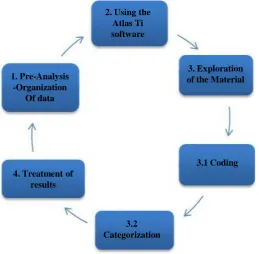
To illustrate the steps of content analysis in the training questionnaire with the help of Atlas Ti software, is presented inFigure 2 the steps of the data analysis process carried out and its explanation.
Step 1. Pre-Analysis—Organization of data: The data placed in the software come from the formative ques-tionnaire sent by email to graduates of specialization in teacher’s continuing education to work in higher educa-tion, courses of the years 2013, 2014 and 2015. The questionnaire was developed in Google Docs and sent by email to the graduates. In all questionnaires encoding was performed.
Step 2. Using the software Atlas Ti: We used the content analysis in all formative questionnaires, 70 ques-tionnaires received by email. Quesques-tionnaires were identified by a code that followed the following name: QF (Formative Questionnaire), 01 which corresponds to the identification of graduates who attended the specializa-tion and year. Example: QF212015 this code means-training quesspecializa-tionnaire egress 21 of the year 2015. The coded questionnaires were saved in PDF format and inserted Atlas Ti software to start the analysis process.
[image:6.595.185.445.451.705.2]Step 3. Exploration of the material: In the exploration of the material, the formative questionnaires that are in the Software Atlas Ti passed through two stages: the coding and categorization, these steps correspond to the analysis of open and closed questions of the questionnaire. For each question and answer of the questionnaire a code was created.
Figure 2. Stages of content analysis with the help of Atlas Ti software. 2. Using the
Atlas Ti software
1. Pre-Analysis -Organization
Of data
3. Exploration of the Material
4. Treatment of results
3.1 Coding
1431
Step 3.1. Coding: The step of coding was performed with the creation of codes to perform the categorization. The codes represent a system of symbols which allows the representation of information. The codes were created from the moment you start reading the questionnaire responses. For each response was created a code and the same or similar answers received a code previously created.
Step 3.2. Categorization: Categorization is the union or the set of codes for incidence or similarity which al-lows researchers to group the data to reinforce meaning. The codes were grouped by similarity and incidence led the analysis categories.
After finishing coding, it was visualized Atlas Ti the code which had the highest incidence and similar res-ponses. All codes with the highest incidence and similar responses were analyzed by the researchers. The code analysis was performed as follows: 1—careful reading of the responses of graduates; 2—Reflection of research-ers on each response; 3—Identification and creating of groups with points of convergence between the answresearch-ers to consolidate a meaning; 4—Creation of categories from the responses of graduates.
Step 4. Treatment of results: Knowing the answers of the participants, they began to establish themselves as indicators for the creation of categories. For this, the researchers sought the meaning and direction of the res-ponses of graduates and to the extent that they were also interested in knowing the intensity of the appearance of logical semantic meanings for that, they decided to quantify the absolute and relative frequencies of responses. For the analysis of the content held in the questionnaires, it was prepared a table showing the categories created and some of its indicators (replies). The table presented below, has three answers that were used as examples for the creation of categories and the total number of responses in each category. The questions were chosen 12, 13 and 14 with responses that help to answer the research problem.
In the formative questionnaire we asked to graduates: What are the contributions of the specialization to your training in higher education teaching? The answer with the highest incidence to this question was that the exper-tise provided knowledge about teaching in higher education, with 54 incidents. The question was intended to identify the contributions of specialization for the graduates’ education. According toTable 1, we present the categories that were created from the participants’ responses:
InTable 1, we found that 38 graduates mentioned that pedagogical knowledge is related to teaching activities,
[image:7.595.88.540.503.716.2]teaching is a science that is dedicated to the education process, it is essential for the formation of a teacher. On the responses of graduates, we, researchers, also agree that pedagogical knowledge is essential to perform the action of teaching, concerning issues related to teaching and learning that allow the teacher to build knowledge with his/her students. Scientific knowledge of professional training area linked to the pedagogical knowledge enables teachers through their teaching to be able to overcome the challenges in the process of teaching and learning. In the twenty-first century, education is still based on the reproduction of knowledge, the teacher
Table 1. Some reasons set out by the students of the research to justify the contributions of the specialization for training in higher education teaching.
Responsesxplicitados Graduates
(CATEGORY)-Pedagogical Knowledge to act in Higher Education
Total of responses: 38
“The pedagogical knowledge that I had contributed so I can relate knowledge of my training with the pedagogical to
work as a teacher knowing what to do about the organization, preparation and execution of a class”. QF122014
“The pedagogical knowledge that I got made me realize that without the theoretical and practical foundation the
teacher cannot transmit and build knowledge with their students”. QF072015
“Without pedagogical knowledge the teacher often performs his/her action within the classroom without knowing in
fact what he/she is doing, this knowledge is essential to teach [...]”. QF202015
(CATEGORY)-Practical knowledge to teach Total of
responses: 16
“During my training the specialization provided me with the practical knowledge of how to teach a class, from its
planning to the completion of the class”. QF092013
“The specialization has contributed a lot in my training; being able to put into practice the knowledge acquired was
very good”. QF112014
“No doubt, learning about educational concepts, reading and understanding the educational process in higher education helps a lot, but the fact of studying and putting into practice the knowledge acquired left me safer to act as a teacher in higher education, the relation between theory and practice is essential”.
QF232015
1432
who presents pedagogical knowledge in his/her training tends to build knowledge with his/her student, is con-cerned with learning and places himself/herself as mediator of this process.
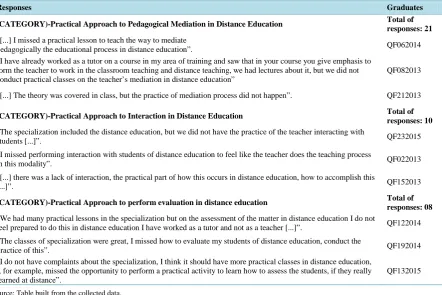
In the formative questionnaire, the question 13 inquired to graduates: What are the implications of specializa-tion for your training in higher educaspecializa-tion teaching? The answer with the highest incidence to that quesspecializa-tion men-tioned the lack of practical classes in the subject distance education, with 39 incidents. The question was in-tended to assess the implications of specialization for the training of graduates. According toTable 2, we pre- sent the categories that were created from the responses of the participants:
In the process of continuing education, the teaching activities in higher education have been incorporated into classroom and distance modes, with specific subject for distance education, students had the opportunity to dis-cuss and reflect on the role of the teacher in this type of education. According to the responses, 21 graduates said that during the process of continuing education, have not worked satisfactorily the practical classes for the med-iation in distance education. In the distance the medmed-iation is an extremely important teaching activity, since it allows the teacher to build with his/her student knowledge, is the relationship between teacher and student that happens to the process of teaching and learning, is when the teacher puts himself/herself as a facilitator, motiva-tor, motivating learning, which contributes to the student to learn. The lack of pedagogical practice of mediation in the formation of a teacher can compromise the process of student learning, as in distance education the teach-er has an important role and his/hteach-er acting is totally diffteach-erent from what happens in the classroom teaching. It is necessary and important to work with the mediation in practice so the students can realize the difference.
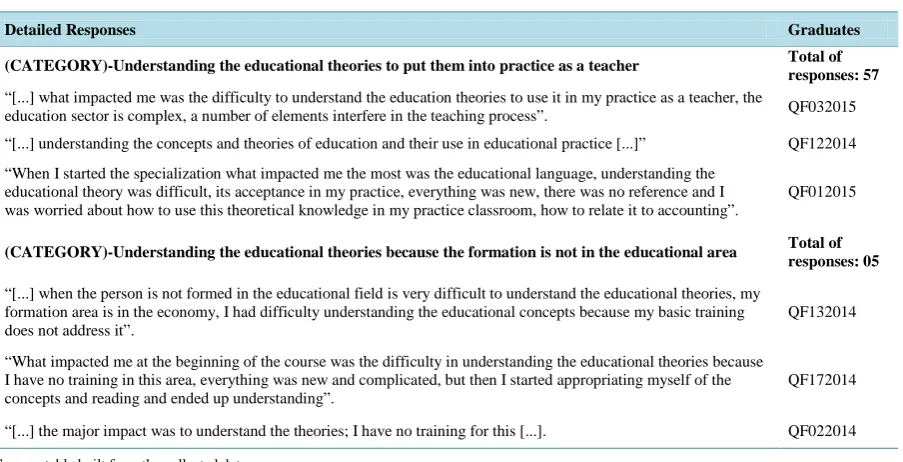
In the formative questionnaire, question 14, wondered the following: What are the impacts of specialization for your training in higher education teaching? The answer with the highest incidence to this question is related to the difficulty students have in understanding the educational theories, with 62 incidents. The question was in-tended to assess the implications of specialization for the training of graduates. According to Table 3, we present the categories that were created from the participants’ responses:
In the students’ formation process, either initial or continuing, it is important that the teacher contextualizes the linked theory to practice, that theory has practical reflection on the reality of the student. To make them
Table 2. Some reasons set out by the graduates of the research to justify the implications of specialization for training in higher education teaching.
Responses Graduates
(CATEGORY)-Practical Approach to Pedagogical Mediation in Distance Education Total of responses: 21
“[...] I missed a practical lesson to teach the way to mediate
pedagogically the educational process in distance education”. QF062014 “I have already worked as a tutor on a course in my area of training and saw that in your course you give emphasis to
form the teacher to work in the classroom teaching and distance teaching, we had lectures about it, but we did not conduct practical classes on the teacher’s mediation in distance education”
QF082013
“[...] The theory was covered in class, but the practice of mediation process did not happen”. QF212013
(CATEGORY)-Practical Approach to Interaction in Distance Education Total of responses: 10
“The specialization included the distance education, but we did not have the practice of the teacher interacting with
students [...]”. QF232015
“I missed performing interaction with students of distance education to feel like the teacher does the teaching process
in this modality”. QF022013
“[...] there was a lack of interaction, the practical part of how this occurs in distance education, how to accomplish this
[...]”. QF152013
(CATEGORY)-Practical Approach to perform evaluation in distance education Total of responses: 08
“We had many practical lessons in the specialization but on the assessment of the matter in distance education I do not
feel prepared to do this in distance education I have worked as a tutor and not as a teacher [...]”. QF122014
“The classes of specialization were great, I missed how to evaluate my students of distance education, conduct the
practice of this”. QF192014
“I do not have complaints about the specialization, I think it should have more practical classes in distance education, I, for example, missed the opportunity to perform a practical activity to learn how to assess the students, if they really learned at distance”.
QF132015
[image:8.595.95.538.424.719.2]1433
understand the theory and relate it to the practice makes meaningful learning, especially when the student has no experience or knowledge about the subject matter. It is complex the process of relation between theory and prac-tice, the teachers need to relate the study subject to a practical context, knowledge, so that the student may es-tablish relations. For graduates of the specialization course, which are from different areas of knowledge, know-ledge of educational theories, it is essential for the teacher to put into practice the pedagogical knowknow-ledge. The understanding of the issues addressed in education may initially seem strange to the professional who has train-ing in other areas of knowledge, but with proper appropriation and understandtrain-ing of the theory and its relation-ship with practice, the connections of the teaching and learning process will be materialized, acquiring sense and meaning to the teacher.
5. Final Considerations
Considering the data collected in this study, it is concluded that participation in the specialization course inves-tigated contributed to teaching in higher education since it enabled the obtainment of pedagogical knowledge, which, in the participants’ opinion, helped to develop the ability of transposition of the theory into practice with greater confidence in the pedagogical action, showing a direct impact on professional performance. This finding relates to the studies on teachers continuing education which demonstrate its use as a way to remedy deficient aspects of undergraduate courses (Davis et al., 2009) in which the emphasis on theoretical aspects implies a de-valuation of the pedagogical part (Gatti, Barreto, & André, 2011) and denotes the need of pedagogical deepen-ing which is also pointed out by teachers from bachelor’s degree programs who have chosen to follow a teach-ing career.
Another factor that confirms an aspect mentioned as important in the theoretical framework of the continuing education area ratified by this research concerns the importance of linking the theoretical reflections to the prac-tical nature of activities since a quarter of the participants highlighted as positive the opportunity to put into practice what was studied in the classroom.
[image:9.595.89.541.484.715.2]The acquisition and application of theoretical and practical knowledge conduced a reflection about the peda-gogical practice of those who have already worked in higher education and provided confidence gained in their work. However, some aspects highlighted by the study participants, draw attention to some implications that in-volve the difficulty in dealing with distance education, and the realization of the need for inclusion of practical activities, interaction and on working with the assessment with that type of education. It would therefore be ad-visable to take into account the teachers’ observation and seek to implement it in the next groups.
Table 3. Some reasons set out by the graduates of the research to justify the impacts of specialization for training in higher education teaching.
Detailed Responses Graduates
(CATEGORY)-Understanding the educational theories to put them into practice as a teacher Total of responses: 57
“[...] what impacted me was the difficulty to understand the education theories to use it in my practice as a teacher, the
education sector is complex, a number of elements interfere in the teaching process”. QF032015
“[...] understanding the concepts and theories of education and their use in educational practice [...]” QF122014
“When I started the specialization what impacted me the most was the educational language, understanding the educational theory was difficult, its acceptance in my practice, everything was new, there was no reference and I was worried about how to use this theoretical knowledge in my practice classroom, how to relate it to accounting”.
QF012015
(CATEGORY)-Understanding the educational theories because the formation is not in the educational area Total of responses: 05
“[...] when the person is not formed in the educational field is very difficult to understand the educational theories, my formation area is in the economy, I had difficulty understanding the educational concepts because my basic training does not address it”.
QF132014
“What impacted me at the beginning of the course was the difficulty in understanding the educational theories because I have no training in this area, everything was new and complicated, but then I started appropriating myself of the concepts and reading and ended up understanding”.
QF172014
“[...] the major impact was to understand the theories; I have no training for this [...]. QF022014
1434
Regarding the impacts of the training, there was an emphasis on the mention of the difficulties encountered in working with educational theories and transpose them to practice, corroborating the conclusion that this specia-lization course impacted teachers in the sense of realizing the need to seek theoretical studies about educational theories and stimulated reflection on the need for integration between theory and practice.
Finally, it is concluded that such studies only will cause greater gains if changes in practice can be shared among peers, as ratified by Vaillant & Marcelo (2012: p. 29), “it is the interrelationship between people pro-moting learning environments that facilitate the complex development of individuals that form and are formed.” Hence the importance of conducting such studies and their dissemination in the scientific community so more people can benefit from this knowledge sharing, thereby contributing to the professional development process.
References
Bardin, L. (2011). Content Analysis. São Paulo: Edições, 70.
Bogdan, R. C., & Biklen, S. K. (1994). Qualitative Investigation on Education. Porto: Editora Porto.
Carvalho, J. M., & Simões, R. H. S. (1999). What Do the Brazilian Journals Say about Teacher’s Education and Practice:
1990-1997. Vitória: Universidade Federal do Espírito Santo.
Chizzotti, A. (2006). Qualitative Research in Human and Social Sciences. Petrópolis, RJ: Vozes.
Creswell, J. W. (2014). Qualitative Investigation and Research Project: Choosing among Five Approaches.. Porto Alegre: Penso.
Davis, C. L. F. et al. (2009). Teacher’s Continuing Formation:An Analysis of Modalities in Brazialian States and Cities. São Paulo: FCC/DPE.
Gibbs, G. (2009). Qualitative Data Analysis. Porto Alegre: Artmed.
Oliveira, E., Ens, R. T., Andrade, D. B. S. F., & Mussis, C. R. (2003). Content Analysis and Research in the Education Field.
Educational Dialogue Journal, Curitiba, 4, 11-27.
Queiroz, T. L. A., & Cavalcante, P. S. (2011). The Contributions of Atlas Ti Software to the Analysis of Written Experience
Reports. In Congresso Nacional de Educação-Educere (pp. 11775-11787). Curitiba: Pucpr.
Shiroma, E. O., Moraes, M. C. M., & Evangelista, O. (2007). Educational Policy (4th ed.). Rio de Janeiro: Lamparina. Silva, M. A. (2001). Teacher Issue on Educational Policy. In C. Cunha, J. V. Sousa, & M. A. Silva (Eds.), Educational
Pub-lic PoPub-licies in Latin America: Lessons Learned and Challenges (pp. 325-346). Campinas, SP: Autores Associados.
1435
Appendix
FORMATIVE QUESTIONNAIRE
This questionnaire is aimed exclusively to a research on teacher’s continuing education to work on higher edu-cation.
1. Sex:
( ) Female ( ) Male 2. Age:
( ) 18 to 24 years ( ) 25 to 35 years ( ) 36 to 45 years ( ) 46 to 55 years ( ) More than 55 years 3. Status:
( ) Single ( ) Married
( ) Widower/widow ( ) Divorced 4. Formation ( ) Under graduation ( ) Specialization ( ) Master ( ) Doctorate
5. Have you had any experience as a teacher in any other level? ( ) Yes
( ) No
6. What is your initial formation?
7. After you finish the specialization are you going to continue to take courses related to teaching? 8. If you become a teacher now, what subject would you like to teach?
9. During the development of your under graduation, specialization or master have you had information about being a teacher on your area?
10. Why did you choose to take a specialization which aims the formation to teach on higher education?
11. Do you intend to work on your area of formation and be a part-time teacher or be only a higher education teacher?
12. What are the contributions of the specialization to your training in higher education teaching? 13. What are the implications of specialization for your training in higher education teaching? 14. What are the impacts of specialization for your training in higher education teaching?