http://dx.doi.org/10.4236/eng.2013.512118
Experimental and Numerical Evaluation and Optimization
of a Non Standard Pitot/Sampling Probe
Andrea Shmueli1, Tor Erling Unander2, Ole Jørgen Nydal1
1Norwegian University of Science and Technology, Department of Energy and Process Engineering, Trondheim, Norway 2Department of Petroleum Research, SINTEF, Trondheim, Norway
Email: [email protected]
Received September 4, 2013; revised October 4, 2013; accepted October 11,2013
Copyright © 2013 Andrea Shmueli et al. This is an open access article distributed under the Creative Commons Attribution License, which permits unrestricted use, distribution, and reproduction in any medium, provided the original work is properly cited.
ABSTRACT
An isokinetic sampling probe is designed and constructed to measure entrained liquid droplet fluxes in separated gas- liquid pipe flows. This probe also has the capability of working as a non-standard Pitot tube when the sampling is stopped. CFD simulations using the commercial software Ansys CFX were carried out for single phase gas flow to analyze the non-standard design. Pitot tube velocity calculations and isokinetic sampling conditions were studied. The predicted results were compared against theoretical velocity profiles from the literature and with gas single phase ex- perimental data acquired in a horizontal 49 m long steel pipeline with an internal diameter of 69 mm. The experiments were done by using a dense gas (SF6) at 7 bara. An asymmetry of the experimental velocity profiles reproduced with the numerical simulations. The CFD simulations made it possible to verify the design and predict and correct an instal-lation problem.
Keywords: Isokinetic Probe; Pitot Tube; CFD; Flow; Installation Effects
1. Introduction
Pitot probes are devices which are commonly used in the industry to measure the local velocity in gases flowing in pipes or ducts. The dynamic pressure
Pd P Pt s
ofthe fluid stream is measured by the Pitot probe and the velocity can be calculated from it. When the gas com- pressibility effect can be neglected, the local velocity can be calculated from:
2 d
g
g
P
U C
(1)
where C is a calibration constant.
The Pitot tubes have been used for measuring the gas dynamic pressure in gas-liquid flows [1-4]. However, the calculation of the velocity from the pressure values is not straightforward and will depend upon the flow regime [5]. In gas flow with liquid droplet entrainment, it is a common practice to use isokinetic sampling probes to extract flow from the main stream in order to get the lo- cal dispersed droplet flux. These probes are designed to have a Pitot-like geometry and pressure tapings and can be designed to measure the local velocity when the sam- pling is stopped. The probes are generally not standard so
their design must be tested and validated. Two aspects that should be taken into account when designing a new Pitot probe are the velocity measured by the Pitot probe in an ideal flow and the effect of the probe presence on the upstream flow [6]. Due to the complexity of multi- phase flows, the probe design and installation are evalu- ated by using single phase gas conditions.
In this paper, a design and installation assessment of the non standard Pitot/sampling probe is done by the analysis of single phase gas experimental data and simu- lation of the probe current design using CFD tools.
2. Probe Design
The correlati on is a function of the fluid properties and of the local energy dissipated by the turbulence.
1 15 4 15 4
4 15 3 5
max 2.609 Re
Re
g g g
w m h l d C We d
l l
(2)
4 50.028 for 1 15
0.25 for 1 15
N N Cw N (3)
The viscosity number is defined by, f l N g (4)
Kubie and Gardner (1997) [10] developed a correla- tion for maximum droplet size in liquid/liquid systems.
2
2 3
max c max 0.369
d U f d
D
(5)
0.250.076 Re
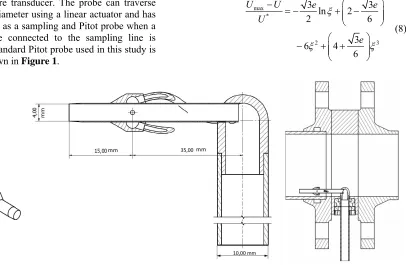
f (6) The probe diameter should allow for measurements in oil-water-gas flow systems. The probe has a 4 mm inner diameter, a 0.2 mm wall thickness. It is possible to measure within 4.2 mm of the pipe wall. To avoid dis-turbing the flow, the opening of the sampling probe ex-tends 50 mm upstream (≈11.4dp). The dynamic pressure is read at 3.75dp and the static pressure sensed at the pipe wall on the probe stem plane. Two hoses were connected to transmit the dynamic pressure from the holes to the differential pressure transducer. The probe can traverse the vertical pipe diameter using a linear actuator and has the ability to work as a sampling and Pitot probe when a manual ball valve connected to the sampling line is closed. The non standard Pitot probe used in this study is schematically shown in Figure 1.
3. Experiments
3.1. Experimental Setup
The experiments were carried out in the medium-scale flow loop at SINTEF Multiphase Flow laboratory in Trondheim, Norway. The facility consists of a horizontal 69 mm inner diameter, 50 m long pipeline. The probe test section is located about 580D downstream the mix-ing point.
3.2. Experimental Measurements
Pitot measurements on the vertical diameter were carried out using single gas phase SF6 (Sulphur hexafluoride) at 7 bara and 20˚C. Three experimental gas velocities were tested 4, 6 and 8 m/s. The measured gas density and dy- namic viscosity from the experiments are ρg = 41.91 Kg/m3 and
g= 1.5e ‒ 05 Pas respectively.
The measurements are compared against two theoreti- cal velocity profiles. Following [11] the velocity distri- bution in the main body of flow can be written as shown in Equation (2), where α is a power law constant that in this case is 0.111 as is proposed by [12].
max g U y U (7)
where = y/R is the normalized distance from the wall to the pipe center. The second profile is obtained by fol- lowing the modified log-wake model [13] for turbulent pipe flow: max * 2 3 3 3 ln 2 2 6 3 6 4 6
U U e e
[image:2.595.132.538.456.721.2]U e (8)
The local gas velocity measurements and the theoreti- cal profiles are normalized by their maximum value and shown in Figure 2. The experimental velocity profiles for all the tests are not symmetric and a systematic error is shown for all of them on the upper half section of the pipe. However, there is a good fitting between the ex- perimental velocity profile and the theoretical one on the bottom part on the pipe.
4. CFD Model Details
3D CFD simulations of the flow around a non standard Pitot probe were developed using the commercial soft- ware ANSYS-CFX© (V-13) which employs the finite
volume method for solving the conservation equations.
4.1. Cases under Study
The simulations were carried out using single gas phase SF6 (Sulphur hexafluoride) at 7 bara, 20˚C and 4 m/s. The calculated Mach number for the tested conditions is lower than 0.3 and thereby the fluid is considered as in- compressible on the simulations [14]. The goal of the model is to simulate the flow around the designed non standard Pitot probe in order to find the origin of the ex- perimental velocity profile asymmetry, predicting a pos- sible installation effect on the gas velocity calculation and afterwards improving the current design. Two loca- tions of the Pitot probe above the pipe center were nu- merically studied (See Table 1).
4.2. CFD Model General Settings
[image:3.595.66.279.493.637.2]The turbulence model was a homogeneous K-ε model. All the simulations were considered as steady state con-
Figure 2. Experimental and theoretical normalized gas ve- locity profiles for 4, 6 and 8 m/s.
Table 1. Simulated cases.
Case Location of the probe opening from the bottom of the pipe [mm] 1 51
2 59
ditions. For all the simulations, the convergence was reached when the maximum and RMS residual error for any parameter was reduced to less than 4e−04 and 4.2e−05 respectively.
4.3. Boundary Conditions and Simulation Domain
The simulated domain consists of the probe and a section of the pipe (3.8 m upstream of the probe and 314 mm downstream of it). The hoses used for the total pressure sensing were not included on the model. The imposed boundary conditions were total pressure at the inlet (Up- stream Boundary) and uniform mass flow at the outlet boundary condition (Downstream Boundary). All the walls were treated as no-slip walls.
4.4. Mesh
The fluid domain was meshed using the commercial Workbench CFX© Mesh Module. The created meshes
were non-structured formed by tetrahedral, wedge and py- ramid elements. A grid dependence procedure was car- ried out in order to select the right mesh (see Table 2).
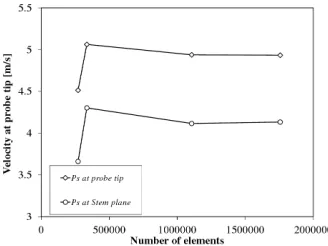
[image:3.595.340.504.585.708.2]Four parameters were compared in order to select the right mesh for the simulations: The pressure loss on the pipe segment, maximum Y+ value, the gas velocity on the probe opening calculated from Equation (1) using the static pressure value at the current location Ps-1 (See Figure 3 and 4).
Figure 3. Location of the specific calculated parameters in the domain.
The velocity profile on a line is located on the probe opening Ps-2, (See Figure 5). A percent error lower than 3% between each mesh and the finest one of every physical variable compared was used as selection criteria. There are some qualitative differences between all the meshes especially close to the probe tip. The biggest dif- ference between Mesh 1 and Mesh 4 is 7%. The selected mesh for the simulations was Mesh 3.
5. Results
5.1. Pitot Geometry Effect
One possible cause of the asymmetry in velocity profiles around the pipe centerline is a blockage effect of the stem in the flow upstream the probe tip. For this reason, the vertical velocity profiles in different locations down- stream and upstream the probe tip are plotted in Figures 6 and 7. The profiles from the pipeline inlet to the probe location are compared (Figure 6) showing symmetry with respect to the pipe axis. The flow in the pipe is de- veloped before 20D. There are no upstream distur- bances on the profiles due to the presence of the Pitot. However, the probe stem has a blockage effect on the profiles downstream the tip of the probe, mainly due to the reduction of the flow area (Figure 7). This behavior
Figure 5. Mesh dependency study variable: velocity profile on a line located at the probe opening.
Table 2. Generated meshes for case 1.
Mesh 1 2 3 4
Max Y+ 13.27 13.52 13.56 13.55 Connectivity
number 3 - 46 3 - 46 2 - 44 2 - 50 Element vol ratio 1 - 52 1 - 48 1 - 93 1 - 82 Min face angle 18 - 84 17 - 86 16 - 86 12 - 87
Max face angle 65 - 130 66 - 136 66 - 131 64 - 134 Edge length ratio 1 - 43 1 - 43 1 - 16 1 - 16
Elements 270,328 334,852 1,105,596 1,756,149 Nodes 92,570 111,118 383,564 600,838
Figure 6. Velocity profiles from the pipe inlet. Case 1.
Figure 7. Velocity profiles downstream the probe tip. Case 1.
was expected as the ratio of the Pitot tube diameter to the pipe diameter does exceed 0.02 [14].
5.2. Pitot Vertical Location
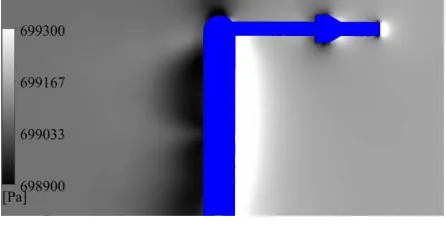
Two cases were studied as presented in Table 1. The vertical location of the probe has a qualitative and quan- titative effect on the static pressure distribution around the Pitot. The closer the Pitot is to the upper side of the pipe the lower is the pressure on the probe plane (See Figure 8). Near the top of the pipe the probe disturbs the flow and accelerates it creating a low pressure area on the top of the probe caused by the area reduction between the stem of the probe and the pipe.
The velocity at the probe opening (Table 3) is calcu- lated using Equation (1) with the total pressure value at the probe tip and the static pressure values at Ps-1, Ps.2 and Ps-3 (See Figure 3). The percentage errors in the velocity calculation using Ps-1 or Ps-2 are 10% and 17 for Cases 1 and 2 respectively. The percentage errors when sensing the static pressure in front the Pitot tip (Ps-3) are 0.5% and 0.7% for Cases 1 and 2 respectively.
Figure 8. Static pressure contour case 2.
Table 3. Velocity at the probe opening calculated with total pressure and static pressure at point 1 and 2.
Case Location Static Pressure [Pa] Total Pressure [Pa]
Velocity at the probe opening
[m/s]
Ps-1 699,344 - 4.92
Ps-2 699,428 - 4.49
Ps-3 699,434 4.46
1
Pt 699,851
Ps-1 699,003 - 4.89
Ps-2 699,151 - 4.10
Ps-3 699,156 4.08
2
Pt - 699,504 -
experimental one is made in Figure 9. Using the static pressure at the probe tip plane to calculate the local ve- locity shows a better fit with the theoretical profiles.
5.3. Pitot Probe Sampling under an Isokinetic Condition
The main goal of this simulation was to obtain the pres- sure loss inside the probe working under isokinetic con- dition. It is important to establish the pressure loss be- tween the probe tip and the dynamic pressure ports inside it. For this simulation just Case 2 was analyzed.
The simulation and mesh selection was done following the steps explained on section 4. The flow conditions and fluid are the same as in the previous simulations. The imposed boundary conditions were total pressure at the inlet (Upstream Boundary), uniform mass flow at the outlet of the probe (calculated from the isokinetic condi- tion) and uniform mass flow at the outlet boundary con- dition (Downstream Boundary). All the walls were treat- ed as no-slip walls. The k-ε turbulence model was used on the simulations.
The streamlines approaching the probe opening and inside it are plotted in Figure 10. All the streamlines are undisturbed as the probe is not present and the velocity
of the flow entering the probe is the same as in the main body of the flow so the conditions for isokinetic sam- pling are accomplished.
[image:5.595.58.287.247.426.2]The total pressure is averaged on planes perpendicular to the flow inside the probe (See Figure 11). The total pressure holes are currently located on the position marked by the dotted line. The pressure loss between the probe opening and the total pressure holes is 33 Pa.
[image:5.595.309.537.409.514.2]Figure 9. Comparison between experimental, theoretical and CFD normalized gas velocity profile at 4 m/s.
Figure 10. Streamlines entering the probe.
[image:5.595.314.531.549.703.2]6. Experiments on the Upgraded Installation
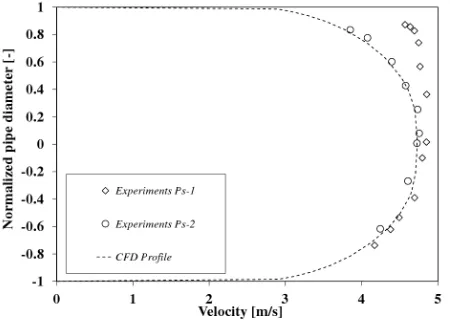
New experiments at 4 m/s were developed using an up- graded setup in which the static pressure tap was located on the same plane of the probe tip. The velocity profiles are symmetric in accordance to the pipe axial direction. The experiments are compared against the CFD profile showing an agreement and improvement in comparison with the previous setup (See Figure 12).
7. Conclusions and Remarks
A non-standard Pitot/sampling probe was experimentally tested and simulated using Ansys CFX (V13) to validate its accuracy and to determine any design or installation problem. The current experimental setup caused asym- metries on the measured gas velocity profiles.
The experiments were conducted for 3 velocities while the numerical simulations were carried out for one veloc- ity. The obtained experimental asymmetries show a sys- tematic behavior so the numerical results are extrapolated to other flow conditions.
The CFD simulations were concentrated on two probe vertical locations where the velocity profiles present the asymmetry. The effect of the probe location on the verti-cal pipe diameter, static pressure port location on the pipe wall, probe stem location and dynamic pressure ports location was studied. The location of the static pressure tap at either the probe tip plane or upstream of it will give more real and accurate velocity values.
As a result from the simulations, the static pressure tap at the top of the pipe was relocated in order to have a real and accurate reading of the static pressure. The probe itself generates disturbances of the flow downstream of it but not upstream of it.
[image:6.595.61.286.536.696.2]A simulation of the isokinetic sampling probe was car- ried out to obtain the pressure drop inside the probe. It
Figure 12. Comparison of the experiments carried out the upgraded facility at 4 m/s with previous experiments and CFD profile.
was recommended for further probe designs to place the dynamic pressure holes on the probe closer to the probe tip in order to avoid the pressure losses and have a better reading of the pressure.
Experiments with a new configuration with the static pressure tap on the same plane as the probe tip were car- ried out at 4 m/s showing an improvement on the meas- urements with symmetric velocity profiles which agreed with the theoretical predictions.
8. Acknowledgements
The financial and research support from Total E&P and Sintef Petroleum Research are greatly appreciated.
REFERENCES
[1] L. A. Dykhno, “Maps of Mean Gas Velocity for Stratified Flows with and without Atomization,” International Journal of Multiphase Flow, Vol. 20, No. 4, 1994, pp 691-702.
http://dx.doi.org/10.1016/0301-9322(94)90039-6
[2] F. M. White, “Fluid Mechanics,” 4th Edition, McGraw- Hill, New York, 1999.
[3] D. Tayebi, S. Nuland and P. Fuchs, “Droplet Transport in Oil/Gas and Water/Gas at High Densities,” International Journal of Multiphase Flow, Vol. 26. 2000, pp. 741-761. http://dx.doi.org/10.1016/0301-9322(94)90039-6
[4] R. Skartlien, S. Nuland and J. Amundsen, “Simultaneous Entrainment of Oil and Water Droplets in High Reynolds Number Gas Turbulence in Horizontal Pipe Flow,” Inter- national Journal of Multiphase Flow, Vol. 37 2011, pp. 1282-1293.
http://dx.doi.org/10.1016/j.ijmultiphaseflow.2011.07.006 [5] G. Falcone, F. Hewitt and C. Alimonti, “Multiphase Flow
Metering: Principles and Applications,” Elsevier, Amster- dam, 2009.
[6] R. C. Baker, “Flow Measurement Handbook: Industrial Designs, Operating Principles, Performance and Applica- tions,” Cambridge University Press, New York, 2000. http://dx.doi.org/10.1017/CBO9780511471100
[7] M. Wicks and A. E. Dukler, “Entrainment and Pressure Drop in Concurrent Gas-Liquid Flow: Air-Water in Hori- zontal Flow,” American Institute of Chemical Engineers, Vol. 6, No. 10, 1960, pp. 463-468.
http://dx.doi.org/10.1002/aic.690060324
[8] L. Williams, “Effect of Pipe Diameter on Horizontal An- nular Two-Phase Flow,” PhD Thesis, University of Illi- nois at Urbana-Champaign, 1990.
[9] G. Kocamustafaogullari, S. R. Smits and J. Razi, “Maxi- mum and Mean Droplet Sizes in Annular Two-Phase Flow,” International Journal of Heat and Mass Transfer, Vol. 37, No. 6, 1994, pp. 955-965.
http://dx.doi.org/10.1016/0017-9310(94)90220-8
[10] J. Kubie and G. C. Gardner, “Drop Sizes and Drop Dis- persion in Straight Horizontal Tubes and Helical Coils,”
http://dx.doi.org/10.1016/0009-2509(77)80105-X
[11] N. Afzal, A. Seena and A. Bushra, “Power Law Velocity Profile in Fully Developed Turbulent Pipe and Channel Flows,” Journal of Hydraulic Engineering, Vol. 133, No. 9, 2007, pp. 1080-1086.
http://dx.doi.org/10.1061/(ASCE)0733-9429(2007)133:9( 1080)
[12] W. J. Duncan, A. B. Thorn and A. D. Young, “Mechanics of Fluids,” ELBS Edward Arnold, 1967.
[13] J. Guo and P. Juliem, “Modified Log-Wake Law for Tur- bulent Flow in Smooth Pipes,” Journal of Hydraulic Re- search, Vol. 41, No. 4, 2003, pp. 493-501.
http://dx.doi.org/10.1080/00221680309499994
Appendix
Nomenclature
ρ Density
P Pressure
d Diameter
D Pipe diameter
C Pitot calibration constant ≈ 1
U Velocity
R Pipe radius
Umax Velocity at the pipe center
dmax Maximum droplet size
dh Hydraulic diameter
dp Pitot diameter
Cw Coefficient in Kocamustafaogullari correlation
y Distance from the wall
Normalized distance from the wall to the pipe center
Dynamic viscosity
Power law constant
Re Reynolds number
f Friction factor
Wem Modified Weber number
N Viscosity number
Surface tension
g Gravity
Subscripts
c Core
d Dynamic
s Static
t Total
g Gas
l Liquid