Improving the Dependability of
Destination Recommendations using
Information on Social Aspects
Daramola, Olawande J. and Adigun, Mathew O. and Ayo,
Charles K. and Olugbara, Oludayo O.
Covenant University, University of Zululand, Covenant University,
University of Zululand
22 January 2009
Online at
https://mpra.ub.uni-muenchen.de/25160/
13
IMPROVING THE DEPENDABILITY OF
DESTINATION RECOMMENDATIONS USING
INFORMATION ON SOCIAL ASPECTS
Olawande J. Daramola1
Covenant University
Mathew O. Adigun
University of Zululand
Charles K. Ayo
Covenant University
Oludayo O. Olugbara
University of Zululand
Prior knowledge of the social aspects of prospective destinations can be very influential in making travel destination decisions, especially in instances where social concerns do exist about specific destinations. In this paper, we describe the implementation of an ontology-enabled Hybrid Destination Recommender System (HDRS) that leverages an ontological description of five specific social attributes of major Nigerian cities, and hybrid architecture of content-based and case-based filtering techniques to generate personalised top-n destination recommendations. An empirical usability test was conducted on the system, which revealed that the dependability of recommendations from Destination Recommender Systems (DRS) could be improved if the semantic representation of social attributes information of destinations is made a factor in the destination recommendation process.
Keywords: Content-based filtering; Recommender Systems; Ontology; Social Attributes, Destination recommendation.
INTRODUCTION
Having access to concrete information about the social attributes of a prospective place of visit can prove very beneficial in making more informed decision about the choice of travel destination. This can be very crucial in instances where social concerns do exist about specific
destinations, which in reality can be sufficient reasons to alter the preferred destination of a tourist if known ahead of time.
Recommender Systems (RS) are a class of intelligent applications that offer recommendations to information seeking users as a response to user queries or knowledge gained during interaction with the user. They mostly leverage in-built logical reasoning capability or algorithmic computational schemes to deliver their recommendation functionality. Over the years, RS have enjoyed great application in the e-commerce domain because of their ability to provide assistance to information seeking users.
The two most dominant strategies engaged for recommendation are content-based filtering and collaborative filtering, although other variants of these methods like knowledge-filtering, constraint-based and case-based approaches also exist (Kazienko & Kolodziejski, 2006; Ricci & Missier, 2003; Burke, 2000; Zanker et al., 2008). Content-based filtering attempts to correlate the content description of items that are to be recommended with the preferences selected by the user in generating recommendation. In the case of collaborative filtering, the ratings of an item by several other users are used to generate recommendation for a new user after sufficient similarity had been established. The limitations of the content-based and collaborative filtering methods (see Ricci & Missier, 2003) have facilitated the emergence of a number of variants and hybrid recommendation approaches in recent years (Vozalis & Margaritis, 2003; Kazienko & Kolodziejski, 2006), which combine two or more recommendation methods.
The task of improving the dependability of recommendations in RS is still a very interesting subject in e-tourism research. We will define dependability in this context as the measure of the trustworthiness of a system’s recommendation relative to the reality of a user’s situation or experience. Since this is a metric that is best assessed by the user, there is the need to introduce more real life factors such as social attributes information of a destination into the recommendation systems’ design in a way that more adequately emulate reality. It is interesting to observe that many of the existing DRS seem to have placed more emphasis on user’s travel activity preferences, the facilities and services, and the type of accommodation available at specific destinations (for instance
TripMatcher (http://www.tripmatcher.net), Expedia (http://www.expedia.com)). Not much consideration has been given to
15 have very serious impact on a person’s touristy experience. Our persuasion is that the important social attributes of a destination should be incorporated as part of the parameters for destination recommendations in order to boost the dependability of such recommendations. This is particularly desirable in the contexts of many developing nations where many social challenges exist as a result of underdevelopment.
In this paper, we introduce a novel approach that uses available social attributes information about destinations as an important factor in destination recommendations in order to boost the dependability of such recommendations. As a case study we have developed an ontology of major Nigerian destinations as a semantic representation of five specific social attributes of such destinations. Our approach engages ontological filtering to bias the recommendations from a Hybrid Destination Recommender System (HDRS) architecture that uses content-based and case-based techniques in generating top-n destination recommendations. We performed an empirical evaluation of the system to assess the quality and potential dependability of its recommendations strictly from the user’s perspective.
The rest of this paper is organized as follows. In section 2, we present a review of related work. Section 3 gives a detailed description of our HDRS and some information on our implementation approach. In section 4 we give a report of the empirical evaluation of the system, while in section 5, we give the conclusion.
RELATED WORK
results to user queries. Hybrid recommendation technology was used for trip@advice (http://www.nutking.ectrldev.com/nutking/) and applied to visiteurope.com tourism promotion platform (Venturini & Ricci, 2006).
In the area of ontology-enabled systems, a novel ontological approach to user profiling was used in the development of Quickstep and Foxtrot recommender systems (Middleton et al., 2002), which were used for recommending online academic research papers. In OntoSeek (Guarino et al. 1999), ontology was used to improve content-based search, whereby users engage the OntoSeek ontology for query formulation. Ontology was also used to automatically construct knowledge bases from web pages in Web-KB (Craven et al. 1998). Talea (Levi et al., 2006) is an ontology-based framework aimed at supporting the development of web-based e-business applications.
In the e-tourism domain, the Harmonise project is a prominent ontology-based solution for the interoperability problems in the European travel and tourism market (Dell’Erba et al., 2002). The Harmonise project is aimed at providing a knowledge sharing and ontology mediation platform for the diverse e-commerce application within the European e-tourism market sphere. Entree (Burke, 2000) is an ontology-enabled case-based reasoning system for recommending restaurants. TripMatcher and Me-Print (Berka & Plobnig, 2004) are examples of knowledge-based DRS that are known to leverage knowledge at some level in generating recommendations. In (Ganzha et al., 20006)ontology and software agents were used in providing travel support services. The etPlanner (Hopken et al., 2006) is an ontology-based travel planning recommender platform. In this work, we innovated destination recommendation by introducing the use of social attributes information of destinations as a factor in the recommendation process in contrast to what exist in many destination recommender platforms with the aim of enhancing the potential dependability of recommendations.
OVERVIEW OF THE HDRS
Definition of the Problem
17 Generally, the task of destination recommendation can be abstracted as an event-matching problem such that:
Given the conjunction predicate Userj that denotes the activity
preferences profile of a user and the rating (importance) of each activity i.e.
Userj = a1r1Λ a2r2Λ a3r3… Λ akrk
Where each ai is a specific travel activity feature and ri the rating of ai
.We define a predicate function
1 (if ai has been selected)
pred(ai) = 0 (if ai has not been selected)
Such that Pj becomes a pattern vector for the activity preferences of
Userj:
Pj = <x1.r1,x2 r2,…xk rk> where each xi = {0,1} and ri ( is integer)
If V= {a1, a2,…an} is the set of possible travel activities and U = {c1,
c2…cm} is the set of possible destinations then we look to define a
recommendation function: F (V) → X where X ⊂ U.
With respect to our approach, we have incorporated the description of the social attributes of a destination as modelled by an ontology: If the matrix Smj represents the description of j (where j is the maximum
cardinality for social attributes) social attributes of m cities, then the augmented recommendation function becomes:
F(V, Smj) → X *
where X*⊂ U.
Given that X Θ Smj→X* where Θ is an ontology filtering operator,
and X*⊂ U is a re-ordering of X.
The HDRS Architecture
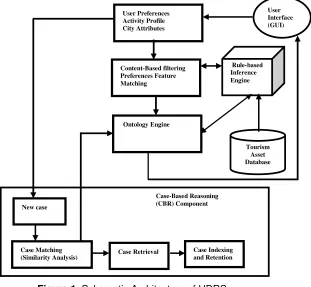
The system architecture of the HDRS (see Figure 1) consists of the following core components:
Sport Games. Choice inputs on five important expected social attributes of a desirable destination are also fed into the system. These are:
− Weather Temperature = {“Cold”, “Mild”, “Warm”, “Hot”, “Very Hot”}
− Scenery = {“Very Quiet”, “Quiet”, “Medium”, “Noisy”, “Very Noisy”}
− Volume of Traffic = {“Very Low”, “Low”, “Medium”, “High”, “Very High”}
− Crime Rate = {“Very Low”, “Low”, “Medium”, “High”, “Very High”}
− Status = {“City”, “Urban”, “Town”, “Settlement”, “Village”}
ii) Content-based Filter: The content-based filtering component is responsible for generating the initial top-n recommendations after performing nearest-neighbour vector space matching between the user’s selected travel activities and activity features of prospective destinations. A personalized frequency-based metric Tij is computed for each possible
destination after using a set of knowledge-based rules to associate specific tourist assets stored in a tourism asset database with particular travel activities i.e.
Tij = ∑(kjfi)Pi Where
kj = number of times activity ai has been selected by userj / number of times userj has traveled, hence kj is a personalization factor for userj based
on the travel history.
fi = frequency count of assets for activity ai in a destination / total frequency count of assets for activity ai. in the database.
Pi = the priority score rating of activity ai, if ai has been selected or 0
if not selected
19 doing the system avoids content-based filtering to produce result more quickly.
[image:8.420.55.366.236.523.2]iv) Ontology Engine: The use of ontology is one of the most efficient ways of realizing a knowledge filtering approach. An ontology is a formal explicit specification of a conceptualisation of a domain in ways that provides a basis for knowledge sharing and reuse (Gruber, 1993; Noy & Hafner, 1997; Chandrasekaran et al., 1999). It provides a platform for the representation of facts in a format that is meaningful and readable for both man and machine. The ontology engine in the HDRS architecture consumes the initial recommendations of the content-based / case-based filters and revises it after description logic reasoning has taken place with respect to the social attributes of the suggested destinations in the initial recommendations, before a top nearest neighbourhood recommendation list is sent via the web-based GUI to the user.
Figure 1. Schematic Architecture of HDRS Case-Based Reasoning (CBR) Component
Case Matching
(Similarity Analysis) Case Retrieval
Case Indexing and Retention New case
User Interface (GUI) User Preferences
Activity Profile City Attributes
Content-Based filtering Preferences Feature Matching
Ontology Engine
HDRS DEVELOPMENT METHODOLOGY
Ontology Design
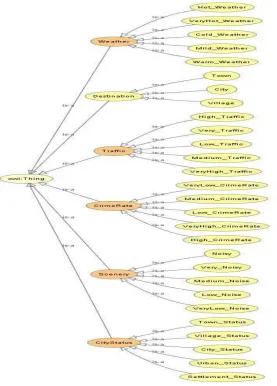
In the execution of our approach, an ontology of Nigerian destinations was developed, which was a semantic representation of facts about five social attributes of major Nigeria destinations. Our conceptualisation of a Nigerian destination is illustrated with the semantic graph shown in Figure 2. A conceptual taxonomy of Nigerian destinations was developed consisting of three class abstractions: City, Town and Village, with ‘ISA’ relationships. The five social attributes have been modelled as properties of a destination using ‘FeatureOf’ association. The relationship between the different destination subclasses has been represented using ‘PartOf” association, whereby Villages and Towns are conceived as extensions of specific City destinations. In order to promote ontological reasoning, semantic relationships that exist between different instances of specific social attribute classes have been modelled with the ‘CloserTo’ association. For example ‘Hot Weather’ is specified as symmetrically closer to ‘Very Hot Weather’, in order to provide adequate basis for reasoning about entities represented in the ontology. The Nigerian City ontology was implemented as an Owl ontology using the Protégé Ontology editor. The ontology consists of five disjointed classes namely: Destination, CrimeRate, Weather, Traffic, Status and Scenery. Three other classes: Town, City, Village were modelled as subclasses of Destination. The Ontology consists of facts about instances (represented as individuals in Protégé) of 37 Nigerian cities and 100 towns and villages.
Implementation Details
The HDRS prototype was implemented in Java and exploits the Java Servlet technology, running on Sun Application Web Server 9.0. The tourism asset database was implemented in MySQL, which exploits the JDBC Connector. Data on tourism assets were collected from the
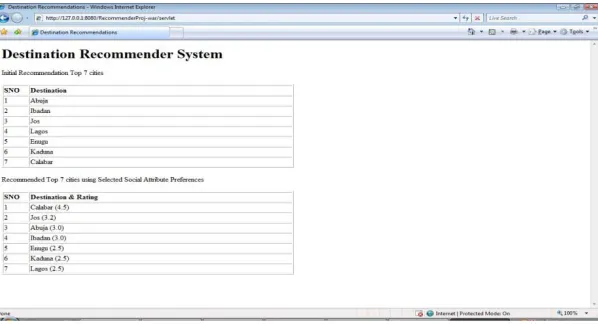
21 reasoner for the ontology. The Protégé Java AP1 was used with the NetBeans 5.5.1 Java development environment to trigger desirable ontology querying and reasoning functionalities. Figures 3,4 and 5 are snapshots from our implementation.
Figure 2. A Graph of the Nigerian City Ontology
ISA FeatureOf PartOf CloserTo
VHW-Very High Weather, HW – High Weather, WAM – Warm, MLD – Mild, CLD – Cold
VH – Very High, HG – High, MED – Medium, LW- Low, VL – Very Low VN – Very Noisy, NOS – Noisy, QU – Quiet, VQU – Very Quiet CTY – City, UR – Urban, TWN – Town, SET – Settlement, VIL - Village
City Nigerian Destinati on Statu CT Y U R
TW SE
T VI L Town Villag e Scener y V N NO S ME D Q
U VQU Crim e V H H G ME D L W VL W Weath er VH W H W WA M ML D CL
D Traff
V H H
G ME D
L W
EMPIRICAL USABILITY EVALUATION OF HDRS
Usability evaluation is an attempt to measure the user’s perception of a recommender system after an interaction experience. The essence of usability testing is to assess the quality of human-computer interaction properties of a system. According to ISO 924-11 (1998), usability is the extent to which specified users can use a system to achieve specified goals with effectiveness, efficiency and satisfaction. It is also, a perception of a system’s ease of learning and use from both the experienced and un-experienced users’ viewpoint (Lindgaard, 1994).
Our adoption of prototype usability testing was not only to evaluate the HDRS but to also obtain timely feedbacks from potential users prior to committing further investments of resources to its development. Since we fully consent to the fact that the use of empirical testing with potential users is still the best way to find problems related to user’s task and experiences (Riihiaho, 2000; Zins et al., 2004).
Herlocker et al. (2004) suggested the use of explicit (ask) and implicit (observe) feedbacks as the most appropriate for user evaluation of RS, and emphasised the need to clearly define the task that a recommender system is intended to support before its evaluation. Therefore, standard usability testing concepts (Nielsen, 1993) was used for evaluating our HDRS.
23 Figure 3. A Visualization of Class Entities of the Nigerian
Figure 4. A Snapshot of the HDRS Prototype
[image:13.420.65.364.322.484.2]25 Experiment Design
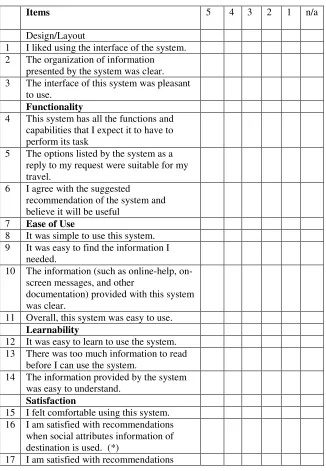
A trial experiment was undertaken with 20 users, including 5 non-Africans who have been resident in Nigeria for an upward of three years, 5 Africans on short visit to Nigeria for the purpose of religious tourism. The rest of the sample user population were drawn from the business-traveller group that consist of contractors, business men and professional executives. All the participants gave their informed consent to participate in the experiment, and were taken through a 15 minutes tutorial session at the commencement of the experiment. Participants were requested to respond to a pre-experiment questionnaire which was specifically designed to evaluate the background of the participants particularly in terms of their IT skills, knowledge of the Internet, familiarity with recommender systems, e-commerce portals, and general tourism and travel experience. They were asked to rate themselves on a scale of 100, which was graduated into 5 class categories. The specified task for the HDRS is to provide intelligent recommendation to the user on the most probable Nigerian locations to spend the next vacation after it has been supplied with a list of travel activity preferences and social attributes description of a desirable destination. The system was configured to operate in two modes and participants were allowed to engage the system in as many sessions as they chose in each mode. In the first mode, the social attributes aspect of the system was disabled such that the system offered recommendation without allowing users to specify social attribute preferences, while in the second mode the opportunity to specify social attribute preferences was provided.
Items 5 4 3 2 1 n/a
Design/Layout
1 I liked using the interface of the system. 2 The organization of information
presented by the system was clear. 3 The interface of this system was pleasant
to use.
Functionality
4 This system has all the functions and capabilities that I expect it to have to perform its task
5 The options listed by the system as a reply to my request were suitable for my travel.
6 I agree with the suggested
recommendation of the system and believe it will be useful
7 Ease of Use
8 It was simple to use this system. 9 It was easy to find the information I
needed.
10 The information (such as online-help, on-screen messages, and other
documentation) provided with this system was clear.
11 Overall, this system was easy to use.
Learnability
12 It was easy to learn to use the system. 13 There was too much information to read
before I can use the system.
14 The information provided by the system was easy to understand.
Satisfaction
15 I felt comfortable using this system. 16 I am satisfied with recommendations when social attributes information of destination is used. (*)
[image:15.420.50.376.76.547.2]17 I am satisfied with recommendations
27 when social attributes information of
destination is not used. (*)
18 Overall, I am satisfied with this system.
Outcome / Future Use
19 I was able to complete the task quickly using this system.
20 I could not complete the task in the preset time frame.
21 I believe I could become productive quickly using this system.
22 The system was able to convince me that the recommendations are of value. 23 From my current experience with using
the system, I think I would use it regularly.
Errors / System Reliability
24 Whenever I made a mistake using the system, I could recover easily and quickly.
25 The system gave error messages that clearly told me how to fix problems. 26 In my opinion the system is somewhat
fault tolerant
Results and Analysis
Post –Experiment Results
The feedbacks obtained from users through the post-experiment questionnaire was analysed statistically to determine the mean scores of user ratings of the system based on the seven usability metric parameters used to evaluate the system. Table 2 shows the mean scores of the parameters used. These are: design/layout, functionality, ease of use, learnability, satisfaction (which was split into two, i.e. when social attributes information is used and when social attributes information is not used), future use (confidence), and reliability. From the result, our HDRS had a mean score of above 4 in seven out of the 8 parameters used which suggest an acceptable level of performance. From our experiment, it was discovered that most users expressed satisfaction; and showed preference for recommendations that were based on the use of social attributes information over when social attributes information was not used.
0 10 20 30 40 50 60 70 80 90
Knowledge of Internet
Familiarity with RS Familiarity with e-Comm Applications
Travel and Tourism Experience
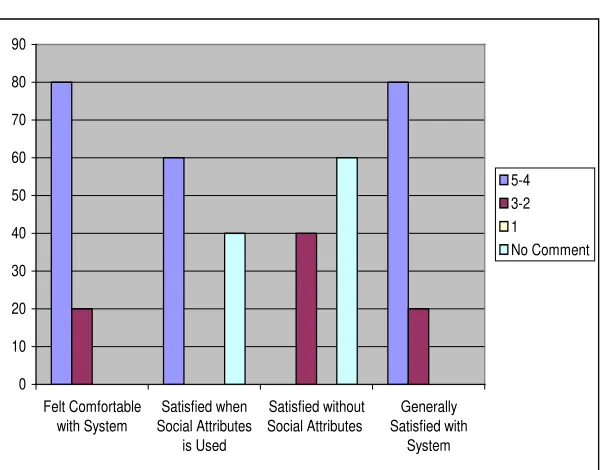
[image:17.420.66.357.69.305.2]29 Also, from our experiment, 80% of the sample population responded that they felt comfortable with the system by giving it a rating of 5(excellent) or 4(good). 20% of the participants gave the system a rating of 3(satisfactory) or 2(unsatisfactory). 60% of the sample population rated the recommendations of the system as excellent or good when social attributes information was used, 20% of participants rated the recommendations as satisfactory or unsatisfactory, while 40% chose not to comment. Also, 20% of participants rated recommendations of the system as 3(satisfactory) or 2(unsatisfactory) when social attributes information was not used, 0% rated it as excellent or good, while 40% chose not to comment. 80% of participants felt generally satisfied with the system. Figure 7 is a visualization of user’s satisfaction with the recommendation of the HDRS prototype.
The results of the evaluation experiment clearly supports the notion that making use of social attributes information as a factor in destination recommendation can indeed boost the dependability of destination recommendations.
Usability Metrics Mean Scores Std. Deviation
1 Design/Layout 4.13 0.57
2 Functionality 4.19 0.63
3 Ease of Use 4.15 0.25
4 Learnability 4.00 0.76
5 Satisfaction/Social attributes 4.15 0.78 6 Satisfaction/without Social attributes 3.58 1.05
7 Outcome/Future Use 4.20 0.34
[image:18.420.73.353.88.223.2]8 Reliability 4.02 0.68
CONCLUSION
In this work, we have implemented an ontology-based Hybrid Destination Recommender System (HDRS). We have also introduced the ontological filtering of the social attributes information as a factor in the destination recommendation in contrast to what currently exist in most destination recommendation portals. Our empirical evaluation of users’ perception of recommendations from the HDRS was considered satisfactory. It was also revealed that the use of social attributes information for destination recommendations has the potential to improve the dependability of such recommendations, and thus giving credence to the novelty of our approach.
0 10 20 30 40 50 60 70 80 90
Felt Comfortable with System
Satisfied when Social Attributes
is Used
Satisfied without Social Attributes
Generally Satisfied with
System
5-4 3-2 1
[image:19.420.57.357.92.327.2]No Comment Figure 7. Summary of User’s Satisfaction with the
31
REFERENCES
Balabanovic, M. & Shoham, Y. (1997). Fab: Content Based, Collaborative Recommendation. Communications of the ACM, Vol. 40, No.3, pp.66-72. Berka, T. & Plobnig, B. (2004). Designing Recommender Systems for Tourism.
In A.J. Frew (Eds.), Information and Communication Technologies in Tourism (pp.228-238), Vienna-New York: Springer.
Burke, R. (2000). Knowledge-based recommender systems. In A. Kent (Eds.),
Encyclopedia of Library and Information Systems, Vol. 69, Supplement 32, New York: Marcel Dekker.
Burke, R. (2002). Hybrid Recommender Systems. Survey and Experiments. User Modelling and User-Adapted Interaction, Vol. 12, No.4, pp.331-370. Chandrasekaran, B., Josephson, J. & Benjamins, V. (1999). What are ontologies,
and why do we need them? IEEE Intelligent Systems. Vol. 14, No.1, pp.20-26.
Craven, M., Dipasquo, D., Freitag, D., Mccallum, A., Mitchell, T., Nigam K. & Slattery, S. (2000). Learning to Construct Knowledge Bases from the World Wide Web. Artificial Intelligence, Vol. 118, No.1-2, pp.69-113. Delgado, J. & Davidson, R. (2002). Knowledge Bases and User Profiling in
Travel and Hospitality Recommender Systems. In K.W. Wober, A. Frew and M. Hitz (Eds), Information and Communication Technologies in Tourism (pp.1-16), Wien-New York: Springer.
Dell’Erba, M., Fodor, O., Ricci, F. & Werthner, H. (2002). Harmonise: a Solution for Data Interoperability. In J.L. Monteiro, P.M.C. Swatman and L.V. Tavares (Eds.), Proceedings of Second IFIP Conference on E-Commerce, E-Business,E-Government (pp.433-445), Boston: Kluwer.
Fesenmaier, D.R., Ricci, F., Schaumlechner, E., Wöber, K. & Zanella, C. (2003). DIETORECS: Travel advisory for multiple decision styles. In A.J. Frew, M. Hitz, & P. O'Connors (Eds), Information and Communication Technologies in Tourism (pp.232-241), Springer.
Ganzha, M., Gawinecki, M., Paprzycki, M., Gąsiorowski, R., Pisarek, S. & Hyska, W. (2006). Utilizing Semantic Web and Software Agents in a Travel Support System. In A.F. Salam and J. Stevens (Eds.) Semantic Web Technologies and eBusiness: Virtual Organization and Business Process Automation (pp.325-359), Hershey, USA: Ideal Publishing Group. Gretzel, U., Mitsche, N., Hwang, Y. & Fesenmaier, D. (2004). Tell me who you
are and I will tell you where to go: Use of Travel Personalities in Destination Recommendation Systems. Information Technology & Tourism, Vol. 7, No.1, pp.3-12.
Gruber, T. (1993). A translation approach to portable ontology specifications.
Knowledge Acquisition, Vol. 5, No.2, pp.199-220.
Guarino, N., Masolo, C. & Vetere, G. (1999). OntoSeek: Content-based access to the web. IEEE Intelligent Systems, Vol. 14, No.3, pp.70-80.
Höpken, W., Fuchs, M., Zanker, M., Beer, T., Eybl, Flores, S., Gordea, S., Jessenitschnig, M., Kerner, T., Linke, D., Rasinger, J. & Schnabl, M. (2006). etPlanner – An IT Framework for Comprehensive and Integrative Travel Guidance. In M. Hitz, M. Sigala and J. Murphy (Eds.), Information and Communication Technologies in Tourism (pp.125-134), Wien-New York: Springer.
Expedia Inc. Http://www.expedia.com. Accessed the 14 th of April 2008. Nigerian Tourism Development Board. Http://www.nigeriatourism.net. Accessed
the 13 th of July 2008.
ISO 9241-11 (1998). Ergonomic requirements for office work with visual display terminals (VDT) – Part 11 Guidance on usability.
Jung, K., Jung, J. & Lee, J. (2003). Discovery of User Preferences in Personalized Design Recommender System through Combining Collaborative Filtering and Content Based Filtering. In LNCS 2843 (pp.320-327), Verlag, New York: Springer
Kazienko, P. & Kiewra (2004). Personalized Recommendation of Web Pages. In Nguyen (ed.) Intelligent Technologies for Inconsistent Knowledge Processing. Advanced Knowledge International, Adelaide, South Australia, pp.163-183.
Kazienko, P. & Kolodziejski. (2005). Windowls – Adaptive System for Integration of Recommendation Methods in E-commerce. LNAI 3528, Springer Verlag, pp. 218-224.
Kazienko, P. & Kolodziejski, P. (2006). Personalized Integration Recommendation Methods for E-commerce. International Journal of Computer & Applications, Vol. 3, No.3, pp.12-26.
Konstan, J., Miller, B., Maltz, D., Herlocker, J., Gordon, L. & Riedl, J. (1997). GroupLens: Applying collaborative filtering to usenet news.
Communication of the ACM, Vol. 40, No.3, pp.77–87.
Lewis, J.R. (1995). IBM computer usability satisfaction questionnaires: psychometric evaluation and instructions for use. International Journal of Human Computer Interaction Vol. 7, No.1, pp.57-78.
Lindgaard, G. (1994). Usability testing and system evaluation. A guide for designing useful computer systems. London, Chapman and Hall.
Middleton, E., Shadbolt, N. & De Roure, D. (2004). Ontological User Profiling in Recommender System. ACM Transactions on Information Systems, Vol. 22, No.1, pp.54–88.
Nielsen, J. (1993). Usability engineering. Boston, MA, Academic Press, Harcourt Brace & Company.
Noy, N. & Hafner, C. (1997). The state of the art in ontology design. AI Magazine, Vol. 18, No.3, pp.53-74.
Porter, B. (1987). An exemplar-based learning apprentice. In Proceedings of the Fourth International Workshop on Machine Learning, Irvine, Ca; Morgan Kaufmann, pp.12-23.
33
Pühretmair, F., Rumetshofer, H. & Schaumlechner, E. (2002). Extended Decision Making in Tourism Information Systems. Lecture Notes In Computer Science, Proceedings of the Third International Conference on E-Commerce and Web Technologies, Vol. 2455,pp.57-66.
Ricci, F. & Del Missier, F. (2004). Supporting Travel Decision Making through Personalized Recommendation. In C.M. Karat, J. Blom and J. Karat (Eds.), Designing Personalized User Experiences for eCommerce (pp.221-251), Kluwer Academic Publisher.
Ricci, F., Cavada, D., Mirzadeh, N. & Venturini, A. (2006). Case-based travel recommendations. In D.R. Fesenmaier, K.R. Wober and H. Werthner, (Eds.) Destination Recommendation Systems: Behavioural Foundations and Applications (pp.67-93), Oxford: CAB Publishing.
Riihiaho, S. (2000). Experiences with Usability Evaluation Methods. Thesis at the Helsinki University of Technology, Laboratory of Information Processing Science.
TripMatcher. Http://www.tripmatcher.net/. Accessed the 14 th of April 2008. Venturini, A. & Ricci, F. (2006). Applying trip@dvice recommendation to
visisteurope.com. In G. Brewka, S. Coradeschi, A. Perini and P. Traverso (Eds.), Proceedings of the 17th European Conference on Artificial Intelligence (pp.607-611), Amsterdam: IOS Press.
Vozalis, E. & Margaritis, K. (2003). Analysis of Recommender Systems’ Algorithms, Proceedings of the 6th Hellenic-European Conference on Computer Mathematics and its Applications (HERCMA) (pp.732-745), Athens: Greece.
Zanker, M., Fuchs, M., Hopken, W., Tuta, M. & Muller, N. (2008). Evaluating Recommender systems in Tourism- A Case Study from Austria. In P. O’ Connor, W. Hopken and U. Gretzel (Eds.), Information and Communication Technologies in Tourism (pp.24-34), Innsbruck-Wien-New York: Springer.
Zins, A., Bauernfeind, U., Missier, F., Mitsche, N., Ricci, F., Rumetshofer, H. & Schaumlechner, E. (2004). Prototype testing for a destination recommender system: steps, procedures and implications. In A.J Frew (Eds.), Information and Communication Technologies in Tourism (pp.249-258), Proceedings of the International Conference in Cairo, Egypt, , Vienna-New York: Springer.
Zins, A., Bauernfeind, U., Missier, F., Venturini, A. & Rumetshofer, H. (2004). An Experimental Usability Test for Different Recommender Systems. In A.J. Frew (Eds.), Information and Communication Technologies in Tourism (pp.228-238), Vienna-New York: Springer.
SUBMITTED: JANUARY 2009 REVISION SUBMITTED: APRIL 2009 ACCEPTED: MAY 2009
Olawande Daramola ([email protected]) is a Lecturer at Covenant University, Department of Computer and Information Sciences, Ota, Ogun State, Nigeria.
Mathew Adigun ([email protected]) is a professor at University of Zululand, Department of Computer Science, South Africa.
Charles Ayo ([email protected]) is an Associate Professor at Covenant University, Department of Computer and Information Sciences, Ota, Ogun State, Nigeria.
Olu Olugbara ([email protected]) is a Senior Lecturer at Covenant University, Department of Computer and Information Sciences, Ota, Ogun State, Nigeria.
ACKNOWLEDGEMENTS